Litter Box in a Small Apartment, Where It Actually Fits
Litter box in a small apartment + the 1.5x rule: a 16-inch cat needs 24 inches of box. Three zones to rule out before you look for space.

Alfredo RamsesFounder · August 25, 2026 · 24 min read

On this page8 sections
- 1Why Hiding the Box Makes a Small Apartment Smell Worse
- 2Ruling Spots In and Out When There Is No Spare Room
- 3Sizing the Box to the Apartment Without Sizing It Wrong for the Cat
- 4What Changes When You Rent
- 5One Cat, Two Cats, and the Same Square Footage
- 6Moving the Box Without the Cat Rejecting It
- 7What to Do Next
- 8Frequently Asked Questions
The apartment has one good corner and you have already given it to the couch. So the box went in the only gap left, and now there is a cat who stands in it with his front paws in and his back end hanging over the rim.
He is not being fussy about a box that fits the gap. The gap is the problem, and standing in it wrong is the only sentence he has available to say so. This site measures things before it recommends them, and in a litter box small apartment setup the measurement has to come first, because square footage is exactly the pressure that makes people guess. Here is how to rule spots out before you rule any in, how to size a box against the cat instead of the gap, what falls off the list the moment you are renting, and what changes when there are two cats and still one one-bedroom apartment.
Quick Answer
Small apartments do not need a smaller box. They need a better-chosen spot, decided in this order:
- Measure the cat nose to tail base, then multiply by 1.5. That is your box length.
- Rule out three zones first: beside food and water, beside anything that starts loud, behind any door that swings shut.
- Pick the surviving spot with the most air, not the most privacy.
- With two cats, run two boxes in two places that share no wall.
Why Hiding the Box Makes a Small Apartment Smell Worse
Every result you found for this search opens the same way. Hide it, conceal it, tuck it into a bench that also seats guests. The advice is genuinely appealing, it photographs beautifully, and in a small apartment it is the single most reliable way to make the smell worse than it was before you spent the money.
Odor does not get destroyed by a lid or a cabinet door. It gets diluted by air, and the amount of air you have is the volume of your apartment. That is the whole mechanism, and it explains something people take personally: identical cats, identical litter, identical scooping, and a studio smells before a house does. There is simply less air in the room doing the diluting.
Nobody in a small apartment is dirtier. They are just working with a smaller denominator. Which is why placement gets decided by criteria rather than by whichever gap happens to be free, and the criteria that rule a spot in or out anywhere in the home are the same ones running underneath everything below.
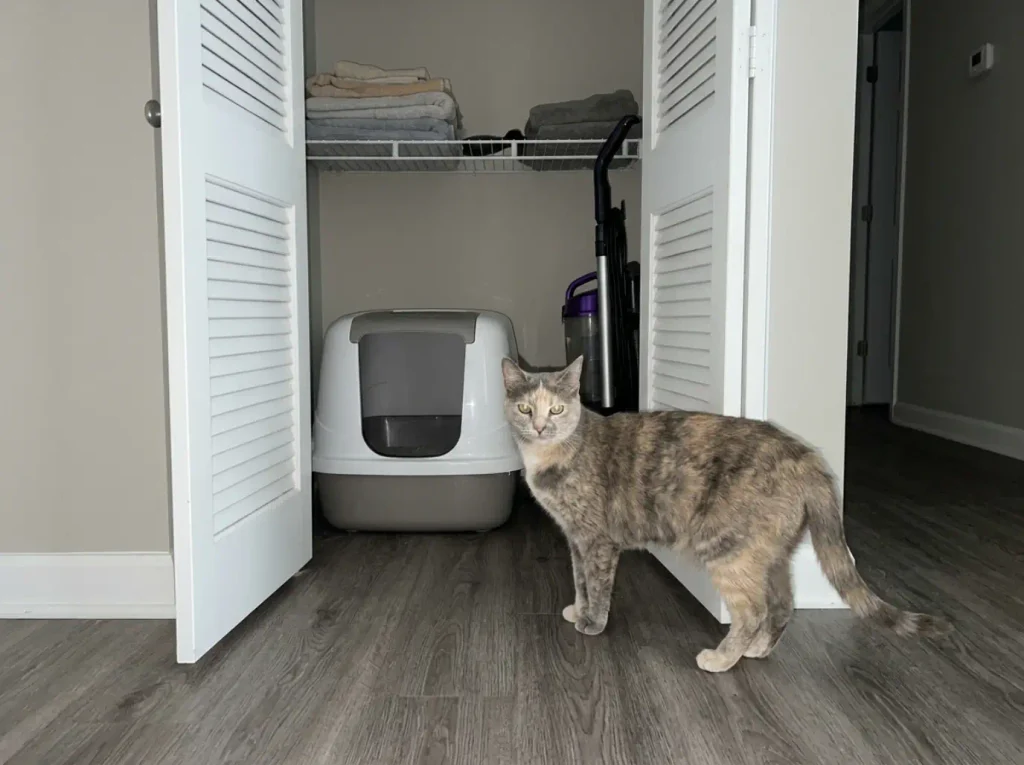
Now put a cabinet around that box. The enclosure does not ventilate, it contains, and containment moves the ammonia rather than removing it. It concentrates it in a small volume at floor level, which is precisely where the cat’s face goes when he steps in. That is what a covered box does to the air the cat is breathing, and it is the reason a cat who used a hooded box happily for a month can quietly start going next to it in week five.
Say the conflict out loud, because it is the honest center of this article. The hidden litter box cabinet solves a real human problem, which is looking at a litter box in the room where you eat dinner. It creates a real cat problem, which is breathing in it.
Both are legitimate. Only one of them is a constraint. You can negotiate with your own preference about what the living room looks like. He cannot negotiate with the air.
The pattern that plays out in apartment threads has a fixed order, and the order is the painful part. The litter box furniture gets bought first, assembled in the living room, admired. The smell shows up in week two or three, well after the return window has become an argument. Nobody warns about it beforehand because the person selling concealment is selling to the human’s eyes, not the cat’s nose.
Air is a location requirement, not an accessory you add later. Stand in the gap you are considering and ask where the air in it comes from and where it goes. If there is no honest answer, that is not a spot with a box in it. That is a closet with a box in it, and it will smell like one by the end of the month.
None of which makes a litter box enclosure automatically wrong.
It would be dishonest to leave it there when a lot of people reading this already own one. Enclosures are not automatically wrong, size decides is the fuller version of that argument, and the short form is that a generous cabinet in a ventilated spot, scooped daily, in a one-cat home, is fine. The failures cluster where the cabinet is tight, the room is closed, the scooping slips, or a second cat joins. If the furniture is non-negotiable for you, keep it. Just promote airflow from a nice-to-have to the first thing you check, and take the flap door off the front.
Ruling Spots In and Out When There Is No Spare Room
What you do not need is another list of twenty clever ideas. You need a filter that deletes ninety of a hundred options and leaves you looking at three, because the real question in a small apartment was never where it looks best. It is which of these three gaps is not going to fail on me.
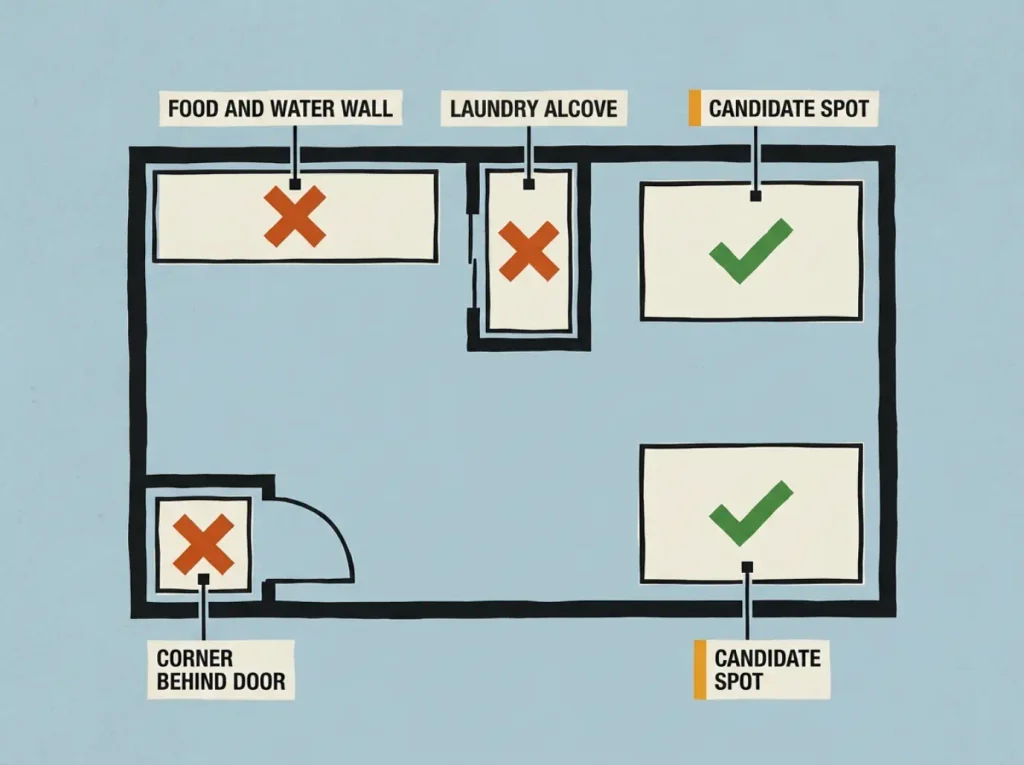
The filter runs in a fixed order, and the first pass is three automatic disqualifications. No exceptions, no case-by-case.
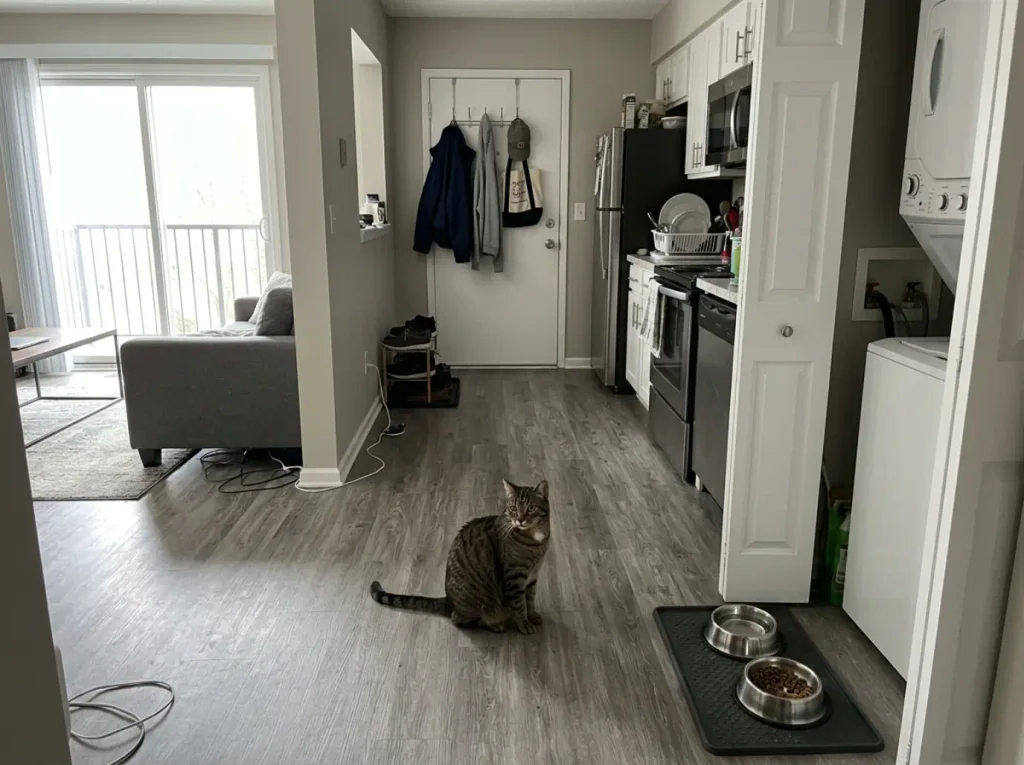
- Next to the food and water.Cats do not eat where they eliminate, and they will resolve the conflict in whichever direction you did not want. A wall that holds both the food and water bowls and a box is one wall doing two incompatible jobs.
- Next to anything that starts on its own and makes noise. Washer, dryer, dishwasher, boiler. The machine does not need to be running while he is in there. It only needs to have startled him once, and thereafter that corner is a place where loud things happen without warning.
- Behind a door that can swing shut. A closed door turns the box into a room he cannot reach, and the failure is silent. You find out later, on the rug, and blame the cat for a door you closed.
The Three Spots That Get Ruled Out Before You Look at Anything
Run those three and watch what happens to a small apartment. In a house, they cost you almost nothing; there is always another room. In a studio they can eliminate most of your usable wall in one pass, and that is not the filter being too strict. That is the apartment telling you the truth about how much genuinely viable space it has, which is information worth having before you buy furniture rather than after.
There is a useful reframe here that most advice misses. “Don’t put it in the living room” is useless guidance in a home that is entirely living room. The rule is not about rooms.
It is about the specific square yard. Do not put it in the yard of floor where the bowls are; the rest of that same room may be completely fine. Zones, not rooms. That one shift makes the whole framework work in a studio.
The Two-Exit Rule, and Why Small Apartments Fail It
Here is the criterion almost nobody publishes, and it is the one that separates a spot that works from a spot that only fits. A cat wants more than one way out of the place he is most vulnerable. A gap with a single opening is a dead end, and a cat who is at all uncertain about his housemates, the doorbell, or the neighbor’s dog will hesitate at a dead end.
In a small apartment, dead ends are the norm rather than the exception, which is exactly why this rule bites here and barely registers in a house. The alcove between the fridge and the wall has one way out. The bottom of the closet has one way out. The gap behind the bathroom door has one way out. All three look like brilliant space-saving finds and all three are, from where he is standing, a corridor with a wall at the end.
Two exits does not require a grand open plan. It requires that the box is not jammed into a pocket. Pull it eight inches off the wall so there is passage behind it, or set it at the open end of an alcove instead of the closed end, or turn it ninety degrees so approach and departure are not the same single line. Small moves. No purchase required.
And the third pass is air, which the previous section already made the case for. Now it becomes operational: of the gaps that survived the three disqualifications and the two-exit test, the one with real air movement wins. Not the quietest, not the most hidden. The one with air.
The Spots That Look Good and Are Not
Some candidates are so appealing that they get chosen over and over, and they fail for reasons that only show up weeks later.
The balcony is the classic. It is outside the living space, it seems to solve the smell entirely, and it fails on two counts at once: the door gets closed, usually at night or when it rains, and the temperature swings hard in both directions. A box he cannot reach at 3am is not a box.
The unused shower is the second one, and it works right up until somebody uses the shower. Then the box moves, and moving the box is the thing this article’s last section is about, which is not a step you want to run on the schedule of your own showering.
The gap under the entryway console is the third, and it is the most seductive because it genuinely is dead space, the spot a console table is supposed to redeem. It is also a high-traffic area on the single busiest line in the apartment, the one every arrival, delivery, and departure crosses. A cat mid-squat does not want the front door opening four feet away.
Which leaves the bathroom as the spot most small apartments land on, correctly. It usually has a fan, a hard floor, and a genuine low-traffic area to work with. It has its own set of rules though, and the bathroom is the spot most small apartments land on, and it has its own rules covers them properly rather than in a paragraph.
Everything in this section is free. Nothing here needs buying, and you should exhaust all of it before any of what follows.
Sizing the Box to the Apartment Without Sizing It Wrong for the Cat
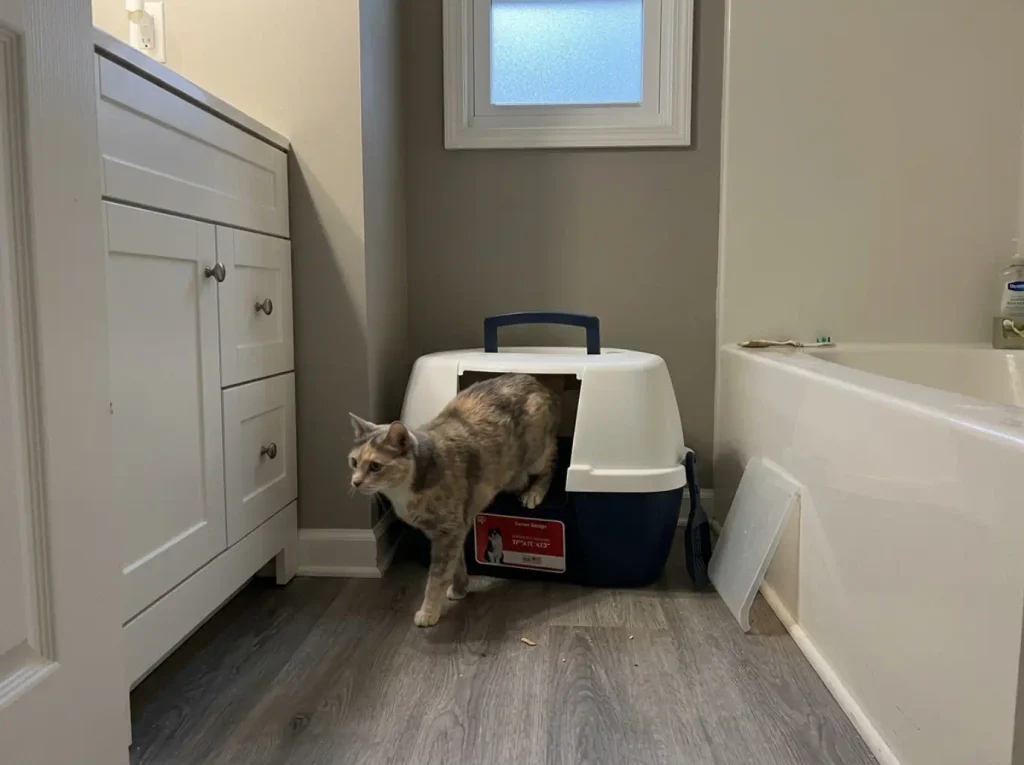
This is where the temptation to cheat peaks, and where the answer has to be no. The compact box that slots perfectly into your remaining gap is very often the box that produces urine on the rug in six weeks, and the arithmetic proving it takes one line.
Measure the Cat, Not the Gap
Stretch him out and measure from the tip of his nose to the base of his tail, tail excluded. That figure is his nose-to-tail-base length, and it is the only input that decides box size. Multiply by 1.5. That is the minimum interior length of his box. A 16-inch cat needs 24 inches of box, and veterinary sizing guidelines put the minimum at one and a half times the cat’s nose-to-tail-base length regardless of the floor plan it has to live on. The full sizing rule, in inches works through how the number shifts for a kitten or an older cat.
Length is only half of it. He also has to turn a full circle and dig, which needs roughly 15 to 18 inches of interior width. A long narrow tray can pass the length test and still fail him, because a cat who cannot turn around ends up backing out or standing with his rear over the edge, and the puddle lands outside a box that technically measured fine.
Now the part that matters most, because it is the exact reverse of what everyone does. Measure the cat, get a number, and let that number decide which gaps stay on the list. Do not measure the gap and then shop for a box that fits it.
The first order treats the cat as the fixed constraint and the apartment as negotiable. The second treats the apartment as fixed and shrinks the cat’s box until the failure is his fault, which it never was.
That reordering is uncomfortable in a small apartment, and it should be. Sometimes the honest output is that the gap you had in mind was never a candidate. Better to learn that with a tape measure than in month two.
The Dead Corner Is the Square Foot You Have Left
Once the number is fixed, the question becomes where to find floor without stealing useful wall. The answer in most apartments is a corner litter box, because corners are already dead. Furniture does not use them well, traffic routes around them, and a rectangular box parked in one wastes the two triangles on either side.
A triangular corner unit fills that shape instead of fighting it. You are reclaiming space that was already lost rather than surrendering wall you were using, which in a studio is the difference between a setup that works and one you resent by the third week.
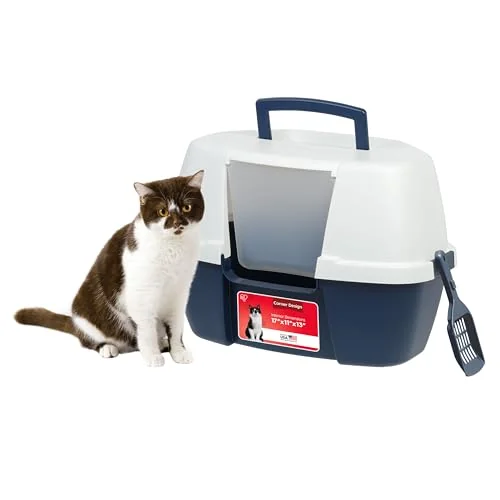
The flap door comes off in about two seconds and does not have to go back on. One reviewer took hers off before her cat had used the box even once, on the theory the cat would object, and reported it just as easy to clean afterward. You lose some litter containment and you gain air, and in a small apartment that trade is the profitable direction. Take it off first, and put it back only if the tracking turns out to bother you more than the smell.
When the Corner Box Comes Up Short
Which brings us to the pega that most affiliate roundups quietly skip. A corner unit’s geometry caps its length. The two IRIS numbers tell the story on their own: the corner box runs 21 inches, and the high-sided rectangular box in the same brand’s lineup runs 19 by 15 by 11.75 inches outside with roughly 15.3 inches of interior length. Neither one is close to what a genuinely large cat needs.
Run the rule and it is unambiguous. An 18-inch cat needs 27 inches of interior floor. A large Maine Coon at full stretch blows past everything sold as a corner solution, and the honest answer for that household is that the corner is not where his box goes. He gets a full-size open pan on a wall, and the corner gets a plant.
I used to treat corner boxes as the obvious default recommendation for anyone short on floor space, because the shape argument is so clean. What changed my mind is how consistently the complaint in small-apartment threads is the same one: it fit the room beautifully and the cat outgrew it, or was already too big on the day it arrived. The shape solves the human’s problem first. It only solves the cat’s if he happens to be small enough, and that is a fact about the cat, not about the box.
What Changes When You Rent
Half the internet solves this problem with a build. Cut a cat door into a cabinet, mount a floating shelf, anchor a bench to the wall. Excellent solutions if you own the wall. If you rent, all three are advice for a different reader, and the constraints that actually apply to you deserve to be named rather than assumed away.
No Drilling, and What That Alone Removes
Say the rule plainly: anything that stands, rests, or holds itself up by its own weight is available to you. Anything that anchors to a wall or braces against a ceiling is not, however elegant it looks in the photograph.
That single condition is a hard filter. Wall-mounted enclosures, cut-in cabinet doors, built-in nooks, anything that needs a bracket — gone, in one pass. What survives is freestanding, and this is where the small-apartment answer and the renter answer happen to converge: an open pan, a corner tray, or a top-entry box are all things you set down. No anchors, no holes, nothing to patch.
Repurposing furniture you already own beats building anything, and the reason is not budget. It is that the built thing stays. A sideboard you already had is a sideboard you take with you. A cabinet cut and fitted to that specific alcove is a gift to your landlord.
What You Take With You, and What Stays
Portability is a real specification, and nobody lists it. The setup has to survive a move, and a piece of furniture built to that exact corner does not move. It just becomes something you dismantle on a day you have no time to dismantle anything.
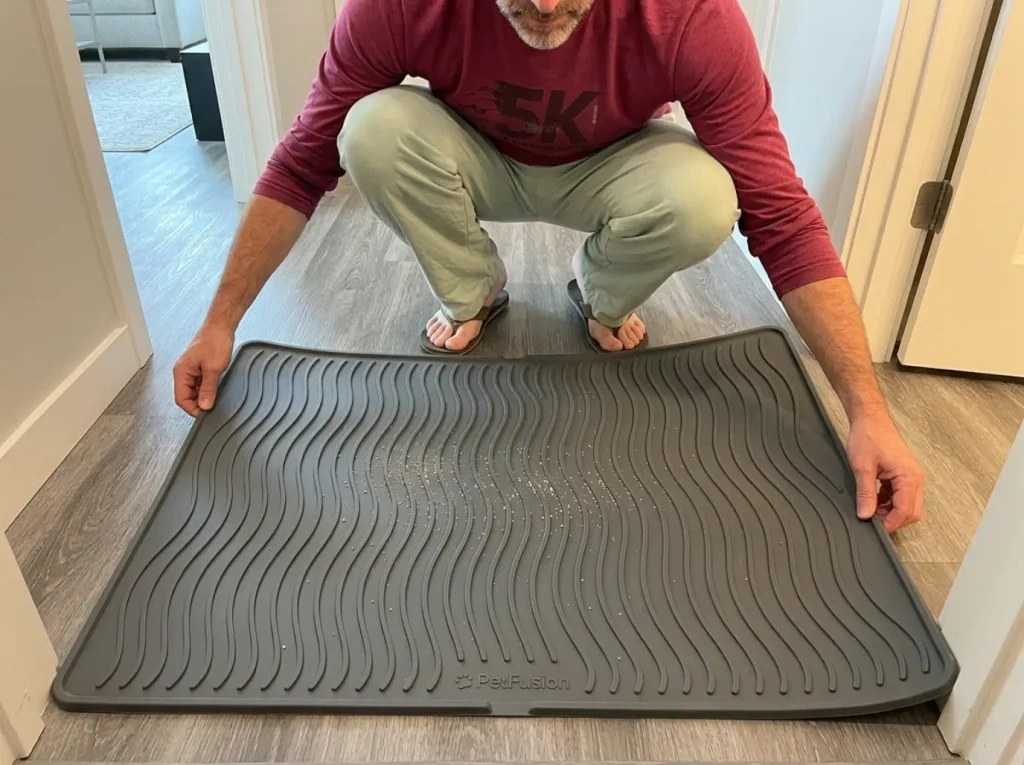
Then there is the floor, which is the part of renting that costs actual money. Tracked litter is abrasive grit walked across vinyl or laminate several times a day, every day, for the length of your lease. That is not a mess, it is wear, and wear on a rented floor comes out of a deposit. A mat is the cheapest component in the whole system and the only one that protects money rather than spending it.
The PetFusion ToughGrip Waterproof Cat Litter Mat covers 23 by 30 inches in the Large size, sits flat under its own weight with no adhesive and no fixings, which makes it no-drill and renter-friendly by construction, and it rolls up on moving day. The silicone is heavier and more expensive than a foam mat, and if your floor is carpeted the case for it weakens considerably, because carpet is the landlord’s problem in a different way, and a cheap washable mat handles it. On a hard rented floor, this is the one purchase in the article that pays for itself. Where you put it matters as much as which one you buy, and where the mat actually goes, which is not where most people put it is worth reading before you position it.
The last renter constraint is the one nobody writes down. At some point somebody is coming to look at your apartment: a landlord inspection, a pre-viewing for the next tenant, the landlord about the radiator. The whole setup has to be able to come apart and go somewhere for two hours, and the corner has to look like a corner again afterward. No adhesive residue, no discoloration, no dent.
Build for that from day one and the day itself is fifteen minutes. Build a permanent installation and it is a small crisis.
One Cat, Two Cats, and the Same Square Footage
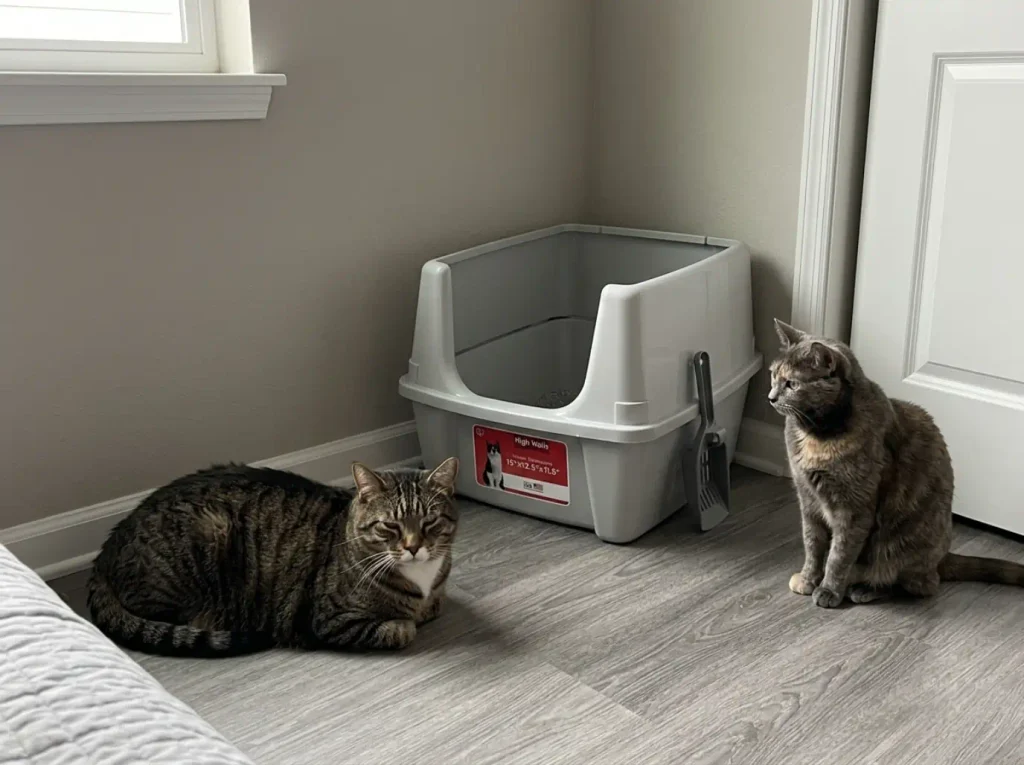
If you have two cats, most of what you have read about this online was written for somebody else. The answer changes completely, and almost nobody separates the two cases.
The n+1 Math, and the Minimum That Actually Works
The standard is the n+1 rule — one box per cat plus one spare — attributed to Dr. Justine Lee and repeated everywhere, including as Whisker’s own placement guidance for small apartments sets out. Two cats, three boxes, which is the multi-cat answer every source gives and no studio can honor. How the count works out for two cats walks through the full arithmetic.
Three boxes do not fit in a studio.
Pretending otherwise helps nobody, so the useful question is the one nobody asks: what is the working minimum. It is two, in two genuinely separate locations. Two is where the guarding problem stops. One is where it starts.
For that second box, a high-sided litter box with no lid is the combination to want, because it controls the scatter of a vigorous digger without reintroducing the air problem from the first section. The IRIS USA Large High Sided Cat Litter Box is that shape, at 19 by 15 by 11.75 inches outside and about 15.3 inches of interior length. Read that interior number against the 1.5x rule before you buy: it works for a cat measuring up to roughly 10 inches nose to tail base, which is a smaller animal than most adult cats. For anything bigger it is a supplementary second box in a two-box system rather than a primary, and that is exactly the job being described here. One caveat that belongs with any high-walled box: accessibility is a real constraint for a senior cat, and an arthritic cat will simply stop using a box it has to climb into. If either resident is older or stiff, one of the two boxes needs a low cut-down entry, and that box is the one that goes closest to where the cat sleeps.
Two Boxes Are Not Two Places If They Share a Wall
The most common way people satisfy the count and still fail is putting both boxes side by side. It looks like compliance. To the cat living it, two boxes against the same wall are one wide box, and one wide box is one location with one approach, which is the precise thing the second box was supposed to fix.
Separation is the active ingredient, not quantity. Different wall, different sightline, ideally different room, and above all a different escape route. In a studio, “different room” might mean the bathroom and the far corner of the main room, and that is enough. What matters is that one cat standing at one box cannot see or block the other.
Because the failure mode here is quiet, and it is worth naming so you can spot it. A cat who wants to control the resource does not need to fight for it. He sits at a diagonal, ten feet away, doing nothing that looks like anything, and the other cat reads the room and does not go. Nothing you would ever notice. You find out through what turns up on the floor, and by then it reads as a box problem when it was always a geometry problem.
If the litter habits of a cat who used his box reliably change suddenly, that is a vet visit before it is a furniture question, and it should not wait on rearranging anything. Everything in this article assumes the vet has already cleared him. Back to the furniture.
Why an Automatic Box Does Not Solve This
The recommendation you will hit next, in every thread on this subject, is the automatic box: let one self-cleaning unit absorb the load of more cats and skip the space math entirely. It sounds like it was designed for this exact problem.
Check the volume. A Litter-Robot 4 with Step & Fence occupies 27 by 22 by 29.5 inches, and it is that last figure that ends the conversation. Nearly two and a half feet tall is a piece of appliance-scale furniture, not a space-saving move, and putting one into a studio to save floor space runs precisely backward. Then there is the noise: a cycling unit in an apartment where the bedroom is also the living room is audible from the bed, which is a different article’s problem but very much your problem at 3am.
That is not an argument against automatic boxes. It is an argument against this one being the answer to a square-footage question, which is what it keeps getting offered as. If the appeal for you is the scooping rather than the space, the tradeoff is real and worth weighing properly — who actually needs a self-cleaning box makes that case honestly, including the cases where it is genuinely the right call.
Moving the Box Without the Cat Rejecting It
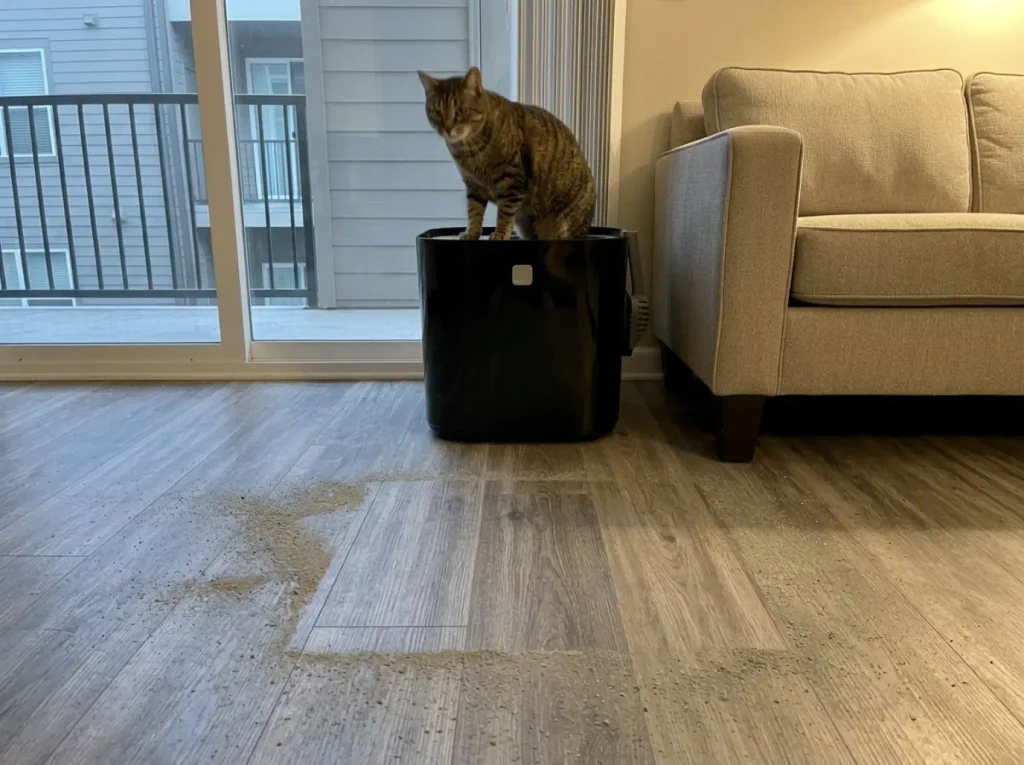
You have now decided on a better spot. Your instinct is to pick the box up and put it there this afternoon. That instinct is the single most reliable way to lose everything the last four sections just bought you.
A Few Inches a Day, or Both Boxes at Once
Gradual has a specific meaning here. Move the box a few inches to a foot per day toward its destination, or run the old box and the new box in parallel and remove the old one once he has adopted the new one on his own. Either works. Abrupt does not, and the failure is not subtle: the cat returns to where the box used to be and uses that spot, box or no box.
The good news is that gradual relocation is where a small apartment makes this easier rather than harder, which is a rare sentence in this article. Total distances are short. A foot a day crosses most studios inside a week, and even the awkward diagonal from one corner to a bathroom is maybe ten or twelve days. In a house the same method can take a month. Yours is a one-week project.
One Change at a Time
Do not change the litter in the same week you change the location. Do not switch to a new style of box in the same week either. Each of those is an experiment, and running two at once means that if he rejects the result you have no idea which one he rejected — so you undo both, and you have learned nothing from a week of everyone’s time.
Location first, on its own, until it is settled. Then, if you still want to change the litter, change the litter.
One side effect of the new spot shows up immediately, and in a small apartment it shows up everywhere: tracking. The path from box to the rest of the apartment is different now, and it is short, so litter distributes across your whole floor within a day or two. That is where a top-entry litter box earns its place, since the cat exits upward through the lid and leaves most of the grit behind. Which wall height actually keeps litter inside has the full comparison of entry styles against scatter.
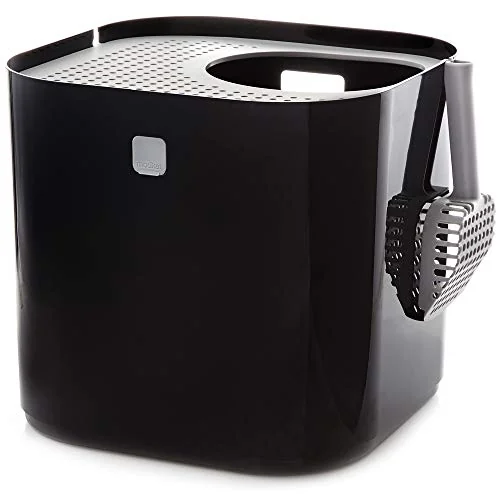
The maintenance question is not about the cat. He decides within days. It is about you, and a new routine slips at around week three, which is when the scooping frequency you started with quietly becomes something else.
Move the box and change the litter in the same week and you have run two experiments at once. If it fails you cannot tell which one failed, so you reverse both and learn nothing. One change, three weeks, then the next one. It feels slow right up until the first time it saves you from undoing something that was working.
What to Do Next
Measure the cat before you measure the gap. The number that comes out of that is what decides which gaps were ever candidates, and it does not get smaller because your apartment did.
Air beats privacy in a small apartment, and it is not close. The spot with the most air moving through it wins, even when it is the spot you least wanted to give up, because a small room dilutes nothing on its own and a cabinet dilutes less than that.
Two cats need two boxes in two places, not one bigger box in one place. If the footprint genuinely cannot hold two separate locations, then the footprint is the constraint you are actually solving, and it is better to know that than to keep rearranging a single box.
Check back in three weeks. Three things tell you whether it took: whether he still walks in without hesitating at the entrance, whether the tracking has settled to a steady level rather than climbing, and whether you are still scooping as often as you did in week one. The third one is the one that slips, and it is the one that brings the smell back.
Move the box to the spot with the most air and take the door off the one you already own. If the smell drops, you just solved this for nothing.
Amazon’s Audible — free for 30 days
Your cat won’t let you read. Let someone read to you.
Audible is Amazon’s audiobook library — thousands of titles, read out loud, on your phone. Free for a month, plus one audiobook to keep forever.
Frequently Asked Questions
01What do you do with a litter box in a small apartment?
You rule spots out before you rule any in: away from food and water, away from anything that starts loud on its own, and out of any corner with one way in. Then pick whichever survivor has the most air moving through it, because a small room dilutes nothing on its own.
02What is the best litter box for a small apartment?
The one whose interior length is at least one and a half times your cat measured nose to tail base. That number does not shrink because the apartment did. Corner and high-sided open boxes recover floor space without trapping air; covered furniture buys tidiness and pays for it in smell.
03Where is the best place to keep a litter box in an apartment?
A low-traffic spot with two ways out, real airflow, and a door that cannot swing shut on it. In practice that is usually a bathroom corner or an alcove rather than a closet, because a closet fails the air test even when it passes the quiet one.
04How do you keep a litter box from smelling in an apartment?
Scoop more often than you would in a house, keep the box open rather than enclosed, and put it where air actually moves. The same litter habits smell stronger in a small apartment because there is less air to dilute them, so frequency and airflow do the work a lid only pretends to do.
05Can two cats share one litter box in a studio?
They can, and it is where a lot of out-of-box problems start, because a single box lets one cat control access to the only option the other has. Two boxes in two separate spots is the working minimum, even when the square footage argues otherwise.

Leave a comment