Best Cat Brush by Coat Type, Judged by How Deep It Reaches
Find the best cat brush by coat type in a minute: part the fur, test the brush you own, and pick the one that reaches the layer where mats start.

Alfredo RamsesFounder · October 13, 2026 · 21 min read
On this page8 sections
- 1The Best Cat Brush by Coat Type Starts With the Layer Mats Form In
- 2The One-Minute Reach Test for Any Brush
- 3Long and Dense Coats: Comb First, Slicker Second
- 4Brush Heads Against the Cat, and the Coats That Break the Table
- 5Short Coats, and the Cat That Won't Take Metal
- 6If You Can Only Buy One Brush, and Where the Skin Says Stop
- 7Part the Coat Before You Choose a Brush, and Look Again in Three Weeks
- 8Frequently Asked Questions
Two weeks of brushing and the sofa is still furry, while the hair behind his ears has knotted anyway. The brush isn’t broken and your cat isn’t difficult: its pins stop in the top layer of the coat, and the tangles start in the layer under it. A brush only does what its pins can touch, so the best cat brush by coat type is the one whose reach matches your cat’s coat, not the one with the nicest handle. Below: how the layers work, a one-minute test with the brush already in your drawer, long coats, head size, short coats and the cat that objects, and the single brush to buy if you can only buy one.
Find your cat’s coat in the first column; the rest of the row is the brush that suits it, how far it reaches and what to leave in the drawer.
| Coat | Everyday brush | How far it reaches | Skip |
|---|---|---|---|
| Short and smooth | Bristle brush, or a glove for a cat that objects | The loose hair on top | A slicker pressed hard against close-lying hair |
| Medium or double | Slicker, then a steel comb | Past the topcoat, into the layer where tangles start | A bristle brush on its own |
| Long and dense | Steel comb first, slicker second | The root, where mats begin | A bristle brush or a slicker on its own |
| Curly or Rex | A soft tool and a light hand | The surface, gently | Hard wire pins on fine hair |
| Hairless | No brush; skin questions go to the vet | Nothing to reach | Every brush |
The Best Cat Brush by Coat Type Starts With the Layer Mats Form In
A brush label tells you the size of the head and the material of the pins. It never tells you how many layers the coat has, and that is what decides which pins do any work.
What a cat’s coat is made of, in plain terms
Everything in the full grooming guide for the cat hair room rests on one fact about the coat that a brush label never mentions: a coat has layers. On top are the guard hairs, the longer, coarser outer hair that gives the coat its color and sheds water. Under them is the undercoat, the soft, fine layer that keeps the cat warm.
On a short, smooth coat the two layers lie close together and there is very little underneath to tangle. On a medium, double or long coat the lower layer is deep, and that is where mats begin: at the root, not at the tip.
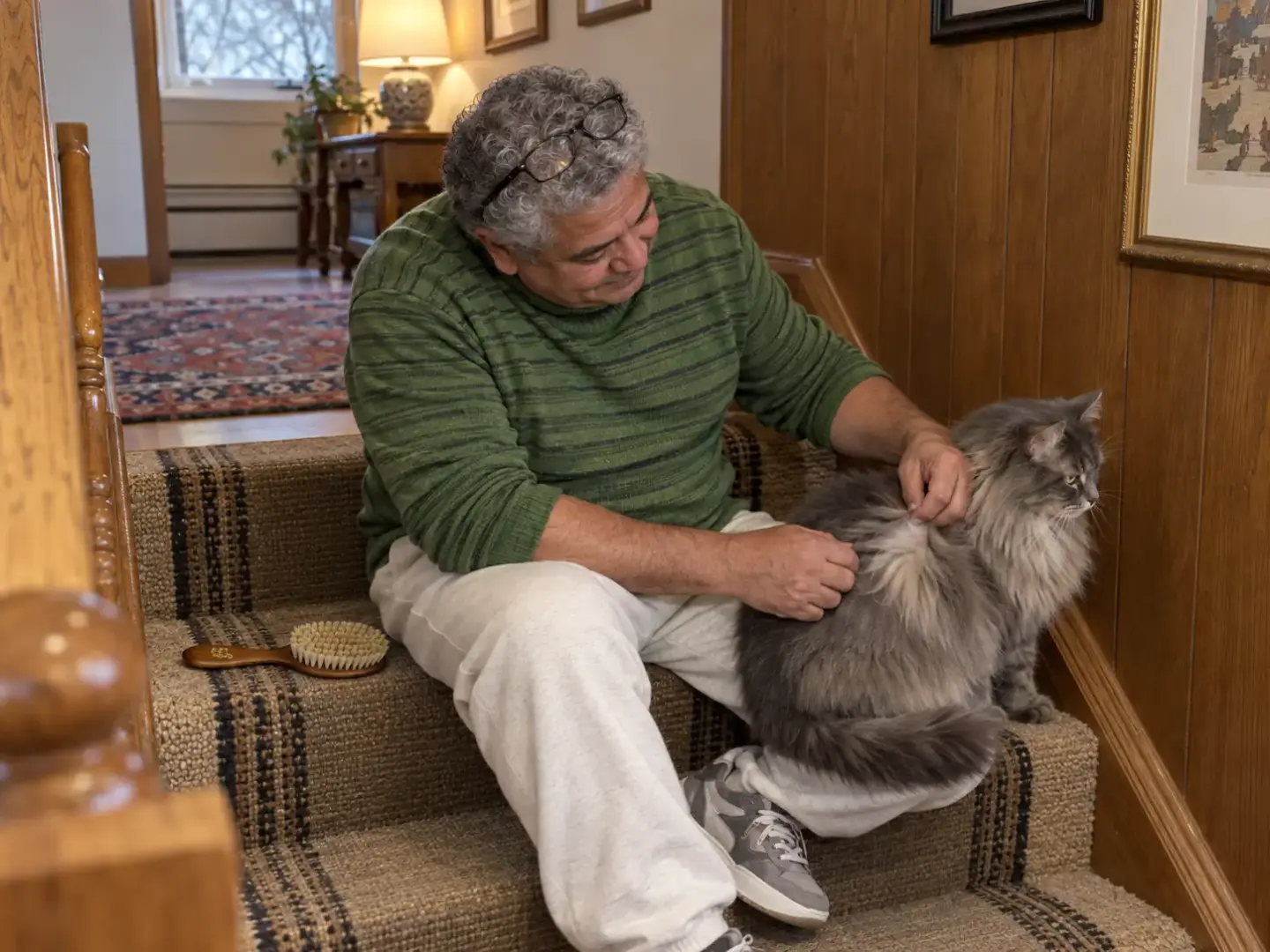
You can sort your cat into one of three families with your fingertips in about a minute. Press them into the fur on his back and note whether you meet skin almost at once, a soft cushion, or a deep dense pile that swallows your fingers (the third is the one that surprises people, because it looks no different from the second until you touch it). Short and smooth, medium or double, long and dense: the table above uses the same three, plus two coats that get their own section later.
The consequence is simple and a little unfair to the brush. Working only the top of a coat does not prevent mats, because the knot is underneath, and a pin that never goes down there can pass over it every day for a year.
Why a brush that “does nothing” is usually stopping one layer short
Say you have brushed daily for two weeks and the result is a cat who tolerated every pass and a coat that looks exactly the same. The cat did his part. The pin did not do its part: it moved the hair it could reach, and that was never the hair causing the problem.
In a pet-grooming forum, commenters split on exactly this. One writes that slickers “just skim the surface.” Another says a slicker “mostly just brushes the top layer” and that a metal comb is what gets down to the skin. A professional groomer in the same thread puts the slicker first and the comb after.
Three answers that sound like they contradict each other, and they are describing different coats. How far a pin goes decides whether it is the right tool, and no pin is deep enough for every cat.
The next section turns that disagreement into a test you can run on your own cat.
Two cats, two coats, one house
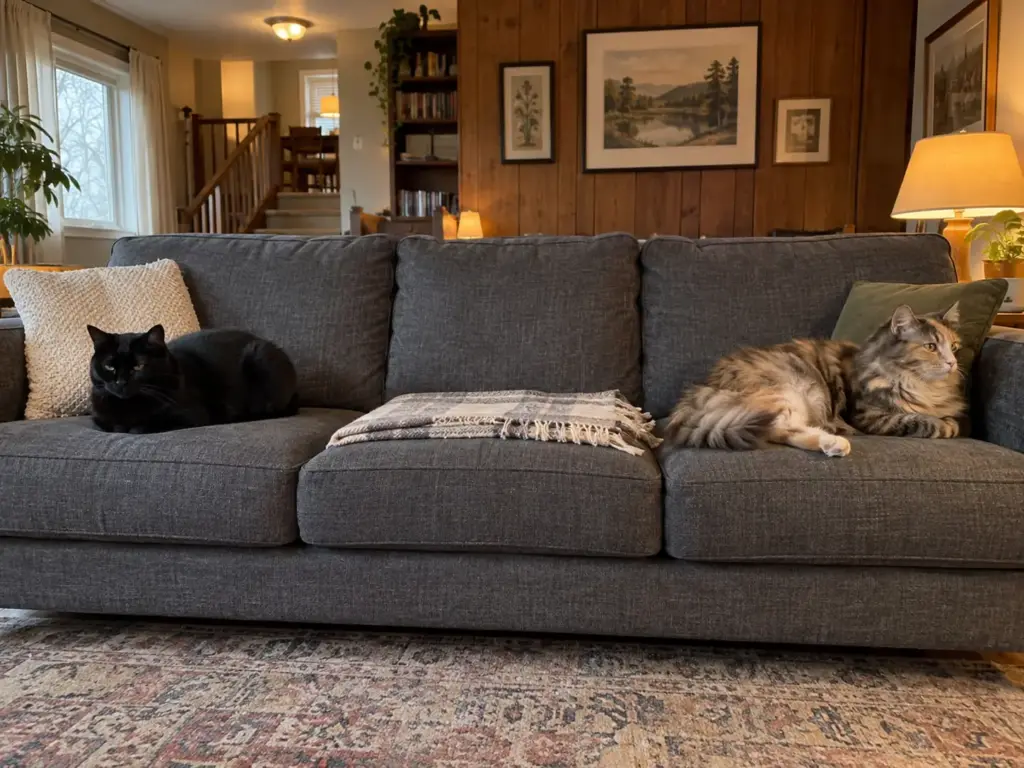
The two cats behind this site split the same way: one wears a long, dense coat and the other a short, dense one, and a single brush does not serve both. What clears the short coat’s loose hair never touches the long coat’s undercoat, and what reaches the long coat’s root is more tool than the short coat needs. In a multi-cat house with two coats in it, you are buying two tools, and neither one is a failure of the other cat.
How often each coat needs this is another question, and how often the coat needs this answers it by coat. Here the question is only which tool.
The One-Minute Reach Test for Any Brush
Opinions about bristle against slicker run both ways, and your cat’s coat is the only vote that counts. What follows is a check you can run, not a result anyone measured: two steps, your fingers and the brush you already own.
Part the coat with your fingers first
Settle the cat somewhere he is comfortable, ideally half asleep or right after he has eaten, when he will let you take your time.
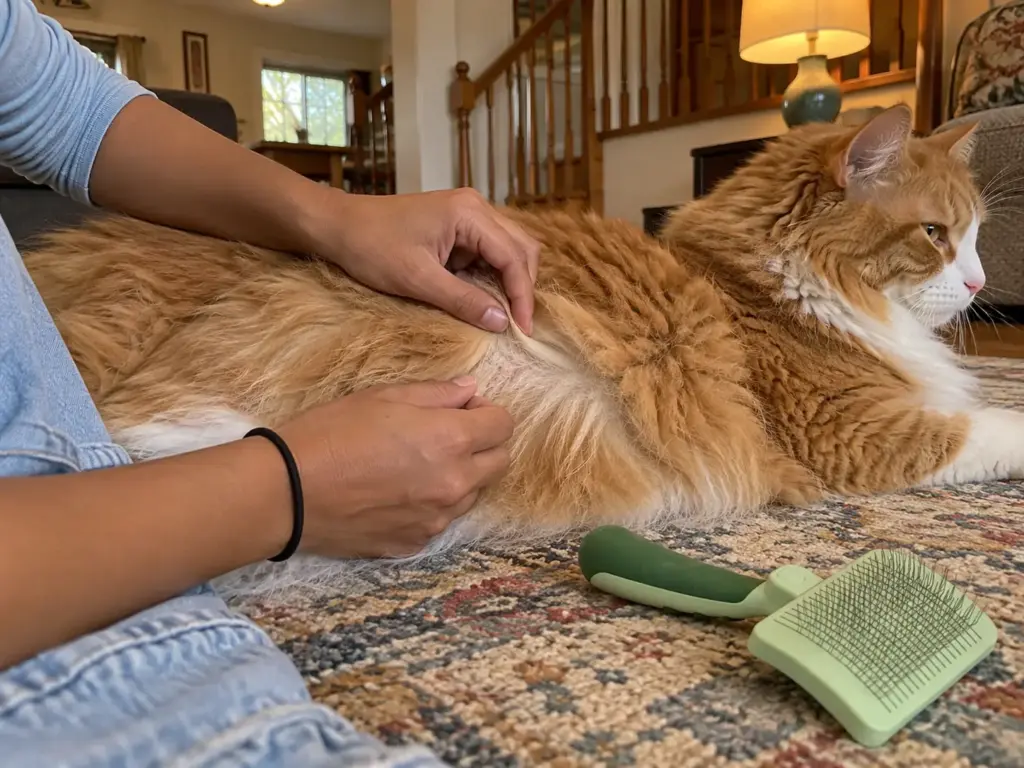
Press your fingertips into the coat on his back and spread them, the way you would part a curtain, until you can see where the hairs meet the skin. Look at what is down there rather than at what the surface shows: how thick the hairs are near the skin, and whether they lie loose or packed into a dense, felt-like layer. Do it once and remember it. That is the layer a brush has to reach, and this step costs you nothing.
If the skin you uncover looks red, scabbed or sore, stop the test there. That is a question for the vet, and the brush can wait.
Run the brush once, then part the coat again
Take the brush you already own and make one slow pass over that spot, in the direction the hair grows. Against the lay is out: it pulls at the skin, and a cat who objects to brushing against the grain has a fair point.
Then part the coat again in the same place and compare. Two outcomes are possible. If the hairs underneath have loosened and shifted, so the layer looks lighter than it did, the pins reached it. If the layer below looks as dense and settled as before, the brush rode over the top and stopped one layer short.
The second result is the common one on a long or double coat, and it tells you something no star rating can: whether this brush touches the part of your cat that tangles.
After the first pass, spread the fur with the tips of your fingers rather than the flat of your hand. Fingertips feel a dense layer the brush left alone, which your eyes will miss under a glossy topcoat, and a flat palm just smooths the top back over it.
What the test says about a bristle brush and a slicker
A bristle brush earns its place on a short, smooth coat, where the loose hair sits on top and one sweep clears it. The Mars Coat King Bristle Cat Hair Brush has 3/4-inch bristles on a 2-inch head, and that measurement says what the test will say: on a medium or long coat, 3/4 inch is where it stops. Buyers who report that it “does not remove any shed” are most likely describing that mismatch, though one reviewer also found the bristles coming out and tangling in the cat’s fur, which is a separate flaw.
So is it a bad brush? No, it is the wrong brush for a deep coat, and the fingertip test tells you which kind of coat you have before you buy a second one.
A slicker is the usual next step. The Coastal Pet Safari Cat Self Cleaning Slicker Brush is a compact paddle of fine wire pins, and wire usually reaches further than bristle on a medium or long coat because it slips between the hairs instead of riding over them. As a self-cleaning brush it spares you pulling hair off the pins by hand, though one reviewer says the wires do not retract all the way when you clean it.
The same wire is the bigger flaw: another reviewer wrote that the wires scratched their cats’ skin and the cats didn’t like it. Keep the hand light enough that the pins never press on skin.
A pin brush, with rounded pins set in a rubber cushion, sits between the two. It is gentler than wire and reaches a little further than bristle, so it suits a medium coat when the slicker feels like too much for the cat. It is a middle step and not a rescue: on a long, dense coat its pins stop short for the same reason the bristles do.
Neither tool touches the layer below the slicker’s reach. A deshedding tool, the blade or rake that goes deeper still, is a separate decision, and the blade and rake that go deeper still is where it gets made.
Long and Dense Coats: Comb First, Slicker Second
Long, dense coats are where the order of tools matters most, because the layer that mats is the one furthest from the surface. The sections below say which tool goes first, where it goes and what to check before you buy a comb.
Why the comb goes first on a long, dense coat
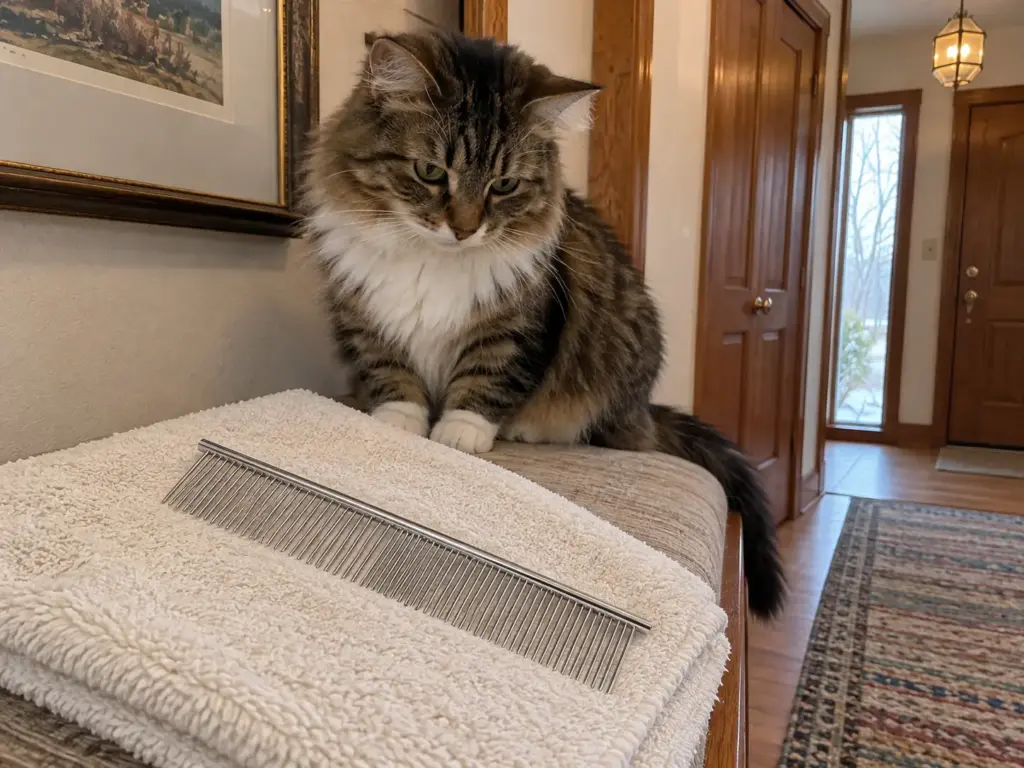
If you are shopping for a cat brush for long hair, the slicker is the obvious first grab, and on a long, dense coat it goes second. A slicker lifts the top layer, so the coat looks smoother afterward while the layer underneath stays exactly as tight. A steel comb does the opposite job: its teeth are long enough to go through to the root, so it shows you what is down there before anything else pulls on it.
On a medium coat the order can flip, slicker and then comb, the way the professional groomer in that forum thread does it. The deeper the coat, the earlier the comb goes in.
VCA Animal Hospitals’ guide to grooming a long-haired cat says to comb or brush a long-haired cat every day and to pay attention to the areas that develop mats. How often your own cat’s coat needs it is another article’s job; which tool reaches the mat-prone layer is this one’s.
Which part of the coat gets combed
Mats tend to start away from the back, which is the part of himself a cat can reach best. They start where the hair is soft and often rubbed: behind the ears, in the armpits, along the belly and at the base of the tail. Those four spots are where the comb goes first and most often. The skin there is thin and the hair moves with every step he takes, so the hand stays light (and if he defends the armpits and belly, he has a reason).
Begin on whichever zone he lets you touch without flinching, with almost no pressure, and leave the touchy ones for the end of the session. When he moves away, the session is over, however much coat is left.
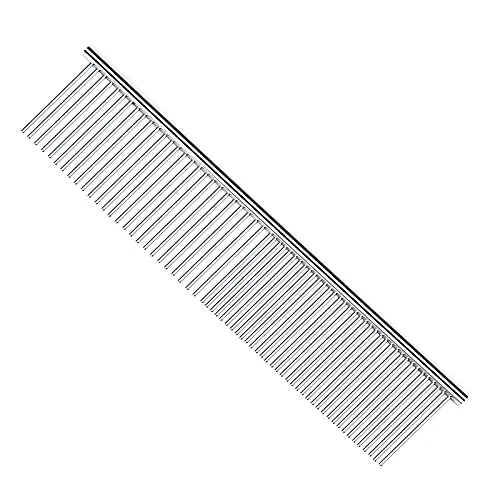
A groomer of cats in the same forum says a large metal comb from any pet store, the greyhound style, works over the whole coat, and there is no listing to link for that one. The steel comb I can link is the PETTOM, and it comes with a warning.
What to look for in a steel comb before you buy
Three checks, none of which depends on a brand. The tips should be rounded and smooth, because a sharp or burred tip drags on thin skin in exactly the places you are combing. The teeth should stand straight and fixed, with no wobble when you flex the comb, since a tooth that moves will end up in the coat. And the tooth length has to beat the depth of the coat, or the comb cannot reach the root it was bought for.
That last one is why a short-toothed comb meant for a different animal can feel fine in your hand and still do nothing on a dense long coat, and it is also why you read the photos of a listing and not just its title.
Two other combs sit on the same shelf and do different jobs. A wide tooth comb is a fair first pass through a long coat, because the teeth have room to go through without dragging. A flea comb has its teeth set too close together to get through a dense coat, so it is a tool for something else. A dematting comb, with its blades, is another job again, and a mat sitting tight against the skin is a matter for a groomer, not for a stronger comb.
Brush Heads Against the Cat, and the Coats That Break the Table
Everything above treats a brush as a set of pins. This section sets the head against the cat, then looks at the three coats the table cannot sort by length.
Set the head against the cat, not the listing
A listing gives you the width of a brush head in inches. Your cat has no inches, only places: the broad back, the narrow gap under a front leg, the small curve behind an ear. A head that suits the back cannot get into the other two, and a small head gets everywhere and takes forever on the back.
The widths on record here are short. The Mars bristle brush has a 2-inch head, the PETTOM comb is 7.5 inches long, and the Safari slicker’s listing gives no measurement at all, so it is described only as a compact paddle.
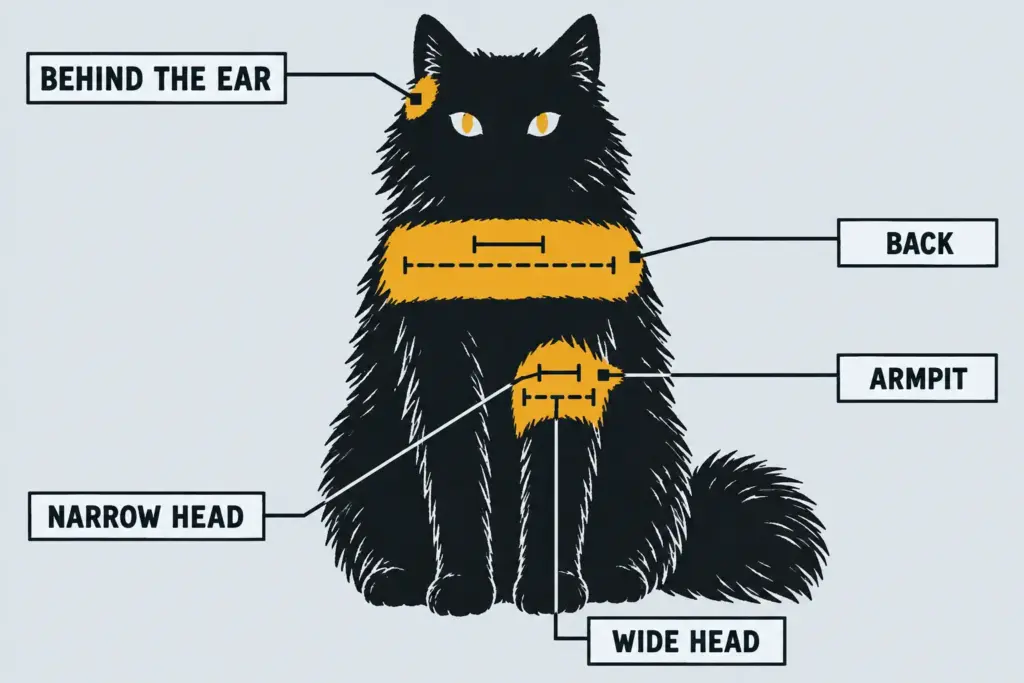
Measure against your own hand instead. Lay a hand flat in the gap between his front legs where it meets the chest: a head wider than that gap will not pass under the arm. Then hold it behind his ear: a head wider than the curve there will not sit flat and tips off before it reaches the base of the hair.
A wider head means fewer passes, and that holds only on the broad back. Under the arm and behind the ear the reverse is true, because the head cannot get in. For a big long-haired cat that usually means two heads: a wide one for the back and a small one, or the end of a comb, for the places that actually tangle.
Over the spine, hips and ribs, where there is little between the pins and the bone, the hand gets lighter again. A cat who flinches at the spine and relaxes at the shoulder is describing where the pressure lands, not objecting to the brush as such.
Size of cat matters here more than size of brush. A big long-haired cat has a back wide enough that a 2-inch head needs many strokes to cover it. A compact short-haired cat, a British Shorthair type for instance, has the opposite problem: a back a 2-inch head covers in a few passes, and an armpit so narrow that only the corner of a comb gets in. Two cats, two sets of measurements, and the only listing that holds both is the one you draw with your own hand.
Hold the brush head against your own hand before you buy it. If the head is wider than the gap between his front legs, it will not go under the arm, and that is the spot where it is needed.
Curly and Rex coats
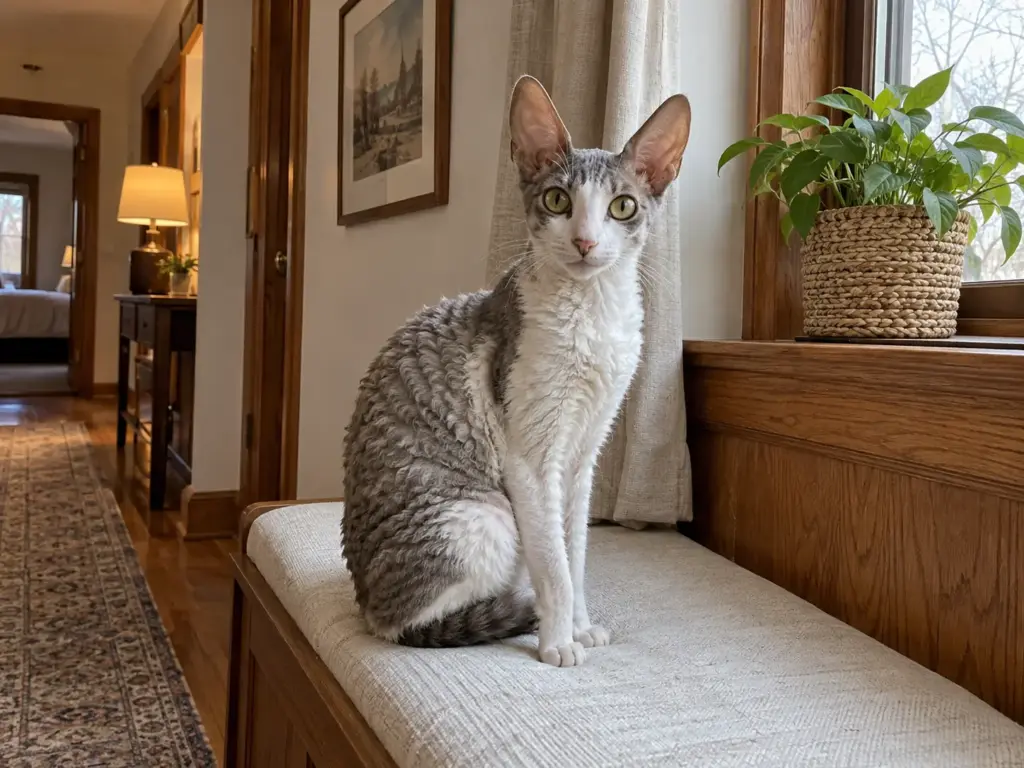
No source I trust measures brushing on these coats, so what follows is reasoning, not data. A curly coat or a Rex coat is short and fine, and fine hair breaks more readily than it pulls, which makes a hard wire pin the likely wrong choice here. A soft tool and a light hand are the safer start. Watch the cat: if he stiffens or turns to look at the brush, the pressure is too much, whatever the coat.
The reach test still applies, with the answer turned around. On a coat this short and fine there is no deep layer to get under, so a brush that only touches the surface is doing the right amount, and a tool that digs is doing too much. Part the fur with your fingertips the same way, and judge by what you see: if the hairs lie in loose waves with skin close beneath them, a soft brush or a gloved hand is all the coat will ever need, and the tools that make sense on a Maine Coon-sized back belong in somebody else’s drawer.
If you are still choosing a cat and the coat is part of why, breeds that shed less on a rented sofa covers curly and Rex coats from the other side.
Hairless cats
A hairless cat, a Sphynx for example, does not get a brush row, because a brush has nothing to grab. Nothing in this article tells you how to care for that skin either, since that is a question for the vet.
Short Coats, and the Cat That Won’t Take Metal
A short coat asks for the least tool, and a cat that objects to metal asks for even less. This is where the glove comes in, and where the cat’s say about the tool comes before the person’s.
What a short, dense coat actually needs
A cat brush for short hair needs to do the least. The loose hair sits on top and a bristle brush sweeps it off. A cushioned boar-bristle brush from a discount store was one forum commenter’s pick, and on a short coat that is the tier where I would save.
Before you buy even that, run one damp hand along the coat in the direction the hair lies, then look at your palm. That is reasoning rather than a measurement, but it costs you a wet hand and shows you how much loose hair there is to deal with.
Wet your hand, shake off the drips, and stroke the coat the way the hair lies. Whatever your palm picks up is the loose hair on the surface, which is the part of the job a bristle brush or a glove can do.
The glove for the cat that objects
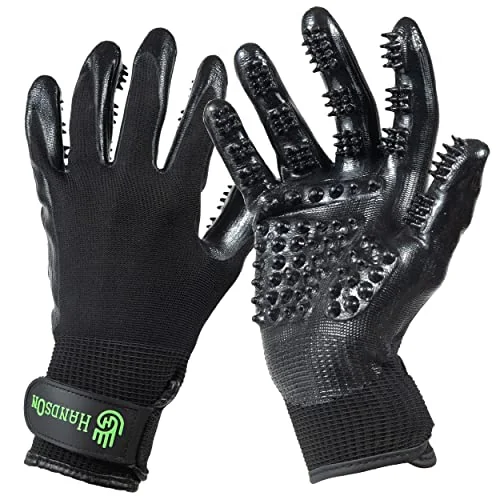
A short coat does not make a cat easy to brush. Forum commenters describe one cat who hates slickers and brushes and gets by with a comb, and another who seemed bothered or hurt even by gentle brushing. Neither cat is at fault. Each is reporting that something about the tool, usually the pins, doesn’t feel right on the skin, and the cat’s report is the one that has to be solved first, because the person wants the hair off and the cat wants not to be tugged.
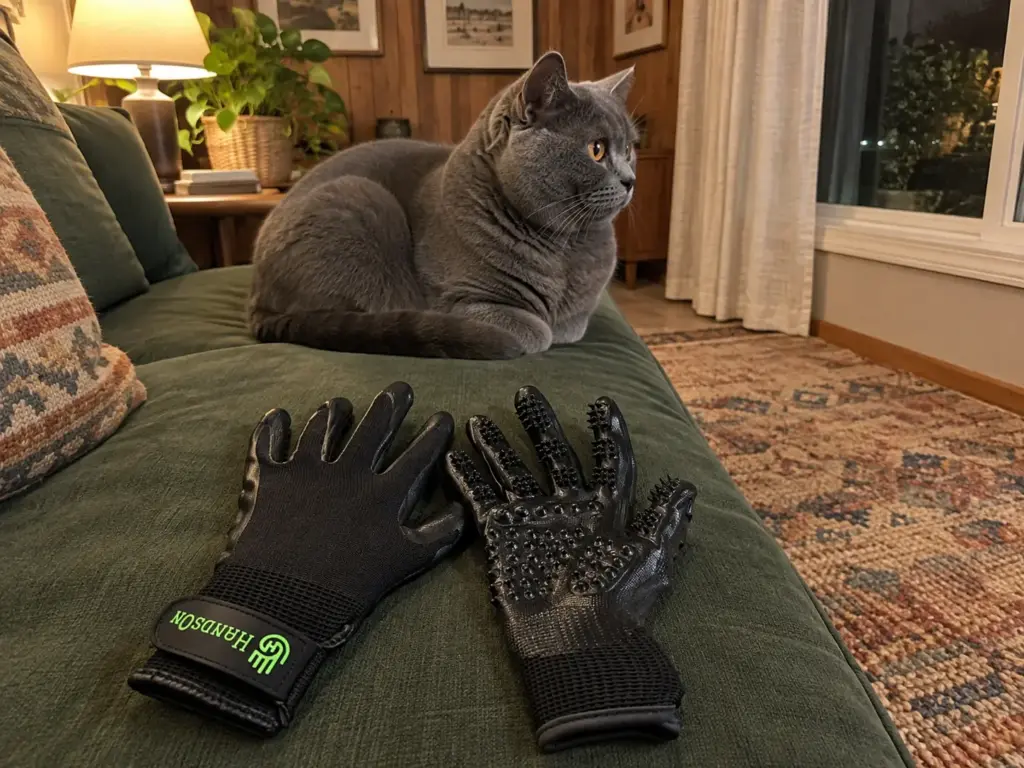
That is the case for a glove. It removes the least hair of any tool here, and it feels like a petting hand, so it is the tool a cat accepts when he refuses the rest. A glove he lets you use every day does more than a brush he leaves the room for.
If he turns his head away from the glove as well, you have reached the part of the problem this article cannot fix, and why a cat won’t let you brush it, and what it objects to works through it step by step.
A rubber or silicone brush, and why there is no link
A rubber curry brush, or a silicone one with soft nubs, belongs in this section: it lifts loose hair off a short coat with no wire or edge anywhere near the skin. It has no link here for a plain reason. The model I would have pointed to is not for sale on Amazon right now, and I won’t send you to a dead listing.
Any rubber curry brush from a pet aisle will do the job, and the check before you buy is the nubs: they should bend under your thumb.
If You Can Only Buy One Brush, and Where the Skin Says Stop
By now you know what each brush reaches. This section turns that into one purchase, puts the brushing where the hair can land, and says where the brush stops and somebody else takes over.
One brush, one coat: the rule
If you can only buy one, buy by coat. Short and smooth gets a bristle brush, medium or double gets a slicker, and long and dense gets a steel comb, with a slicker later if the drawer has room. A cat who won’t take metal or pins gets the glove.
Notice what that does to the pick everyone reaches for first: the slicker is the right single choice for only one of the four, whatever its star rating says.
If your house has two coats in it, that rule gives you two tools, and the second one is part of the budget from the start. And if the question is really whether to buy a whole set, which pieces of a grooming kit are worth keeping in the drawer goes through the full drawer piece by piece.
Brush where the hair can land
A bristle brush on a short coat can release a cloud. One forum commenter said so much hair comes off at once that it floats everywhere, and advised brushing in a bathroom or out on a patio. In a small apartment the bathroom or a balcony does the same job, since tile wipes clean and nothing in there is upholstered. For what happens to the hair after it leaves the cat, where the hair lands once it comes off the cat picks up from here.
Keep the brush in the room where you use it, not in the drawer with the other tools. A brush you have to go and fetch is the one that stays put on the day the cat is finally in the mood.
When the skin says stop
The brush stops at the skin. If you part the coat and find red, scabbed, bald or sore skin, or a mat sitting tight against the skin, the next call is to a groomer or the vet, not to another tool. According to VCA Animal Hospitals’ guide to removing mats from long-haired cats, “Never use scissors to cut a mat off.”
The same guide notes that a veterinarian can sedate a cat for pain-free removal if it comes to that. A commenter in the grooming forum let a cat’s mats get away once, and the cat ended up with a skin infection and a vet visit.
The other stop sign has nothing to do with the coat. A cat who used to sit for brushing and has stopped goes to the vet before you change anything about the tool or the house. For the wider question of when shedding stops being normal, that article takes it from here.
Part the Coat Before You Choose a Brush, and Look Again in Three Weeks
Three things to take with you. The pin decides, not the name on the box: a brush does exactly what its pins can touch. A one-minute check with your fingers and the brush you already own tells you whether it reaches the layer where tangles form. And two cats with different coats need two tools, however neat one drawer looks.
Three weeks from now, part the fur in the same spot you tested. The layer underneath should still lift easily under your fingertip, and the cat should still walk over when the brush comes out. If either has slipped, the tool or the routine needs a second look.
Today, before you order anything, take the brush you already own, make one pass down his back and part the fur where it went through. What you find under the topcoat is the answer to which brush to buy.
Frequently Asked Questions
01What type of brush is best for a cat with long fur?
A steel comb first, then a slicker: the comb’s long teeth reach the root, where tangles begin, and the slicker lifts the top layer of the coat. Run the one-minute reach test to confirm your cat’s coat opens under each.
02What is the best undercoat brush for cats?
For everyday use, a steel comb is the best undercoat tool, because its teeth are long enough to reach the layer where tangles begin. Undercoat rakes and blades go deeper and are covered in the deshedding article.
03What do professional cat groomers use?
Groomers answering owners in a pet-grooming forum name the same two tools, a slicker brush and a metal comb, in whichever order the coat needs. On a long, dense coat the comb goes first; the reach test shows which order suits your cat.
04What type of brush should I get for my cat?
Get the one that matches your cat’s coat: a bristle brush or glove for short and smooth, a slicker for medium or double, a steel comb for long and dense. If you can only buy one, buy by coat.


Leave a comment