Why a Cat Won’t Let You Brush It, and What It Objects To
Cat won't let you brush it? Test four objections, start with 5 seconds of hand on the head, and add zones one by one [rubber tips + glove + lick mat].

Alfredo RamsesFounder · October 6, 2026 · 21 min read


On this page8 sections
- 1A Cat That Won't Be Brushed Is Almost Always Objecting to Something Specific
- 2The Tool and the Grip, Free Things First and Soft Ones After
- 3The Ladder, With Seconds per Rung, Zones in Order and a Session That Ends Early
- 4The Cat That Goes for the Brush or Your Hand
- 5In a Small Apartment, With One Cat or Two
- 6When Brushing Isn't the Answer, a Groomer, a Lion Cut or the Vet
- 7Count the Strokes, Let the Cat End It, Hand Off the Rest
- 8Frequently Asked Questions
You lift the brush off the shelf and the cat who was asleep on the rug a second ago is already halfway down the hall. Or he stays, but the skin along his back starts to twitch on the second stroke and his head swings round toward your hand. When a cat won’t let you brush it, that exit is an answer to something you can measure: the tool, the spot you reached for, the way your other hand was holding him, the room, the hour.
A refusal almost always points at one piece of the session rather than at brushing in general, and each piece has a test you can run on your own floor this week. Below: how to tell which objection you are looking at, which tool goes first, how many seconds each step of the build-up gets, what to do with a cat who goes for the brush, and when the job belongs to a groomer or a vet.
Quick Answer
A cat that refuses the brush is objecting to one part of the session. Work around that part:
- Stop before the tail tip twitches, and try again another day.
- Start with your hand only, five seconds on the head and chin.
- Swap wire pins for rubber tips or a grooming glove.
- Brush cheeks and head first; leave belly and tail base for last.
- Give a treat during and after, one kept only for brushing.
- Hand mats at the skin, bites or sudden refusals to a groomer or vet.
A Cat That Won’t Be Brushed Is Almost Always Objecting to Something Specific
A weekly grooming routine assumes a cat who sits through it. This is the cat who doesn’t, and “he hates being brushed” is too wide a verdict to act on. Split the refusal into the four things he could be answering, run one small test for each, and write down what happens. Three strokes in three places, on two different days, will tell you more than a month of trying harder.
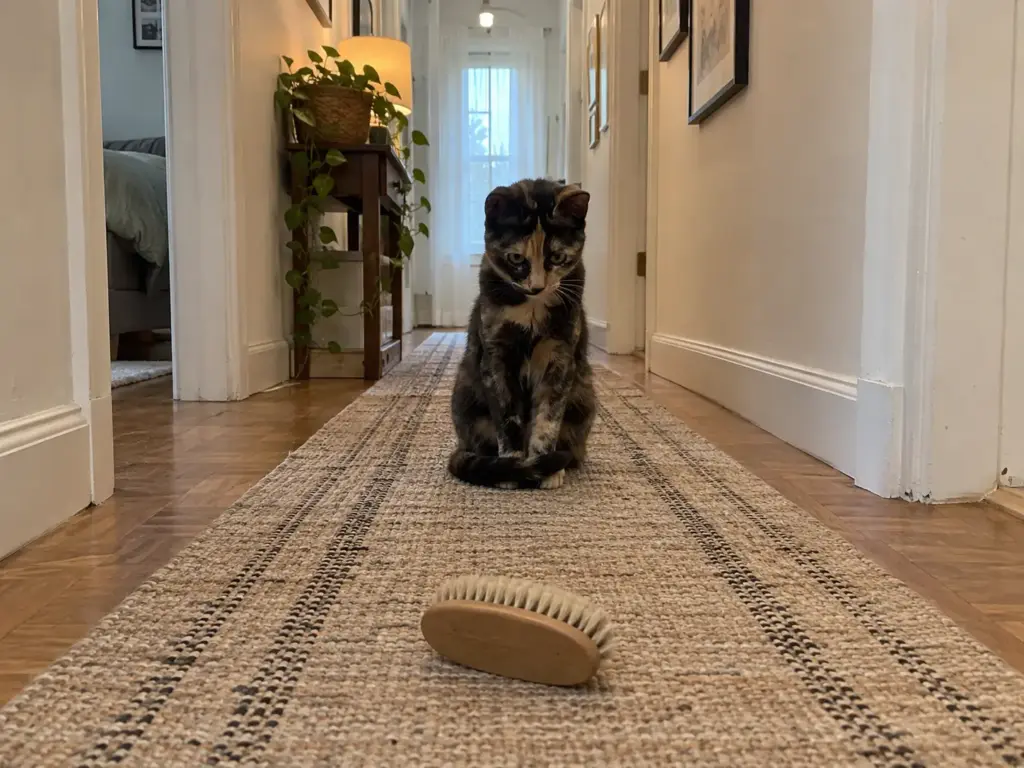
Every test below has one condition: the cat has to be able to leave at any second. When everything else has failed, owner threads tend to land on the towel. Wrap him, hold him, finish the job.
One r/CatAdvice owner, whose cat headbutts her for a daily brush and then scratches the moment the brush reaches her hindquarters, said that was the last idea she had left. It is also the one move that wrecks every test on this list.
A cat who is being held reacts to the restraint, so whatever you think you learned about the brush or the spot is noise. If he can walk away and chooses to stay, the result counts; if you are holding him, it doesn’t, and the next session opens with a cat who remembers the towel.
The tool pulls, scratches or sounds different
Wire pins drag on a tangle and scrape when you press. A comb that snags a knot pulls on skin you can’t see. Some brushes click, and some build up static that crackles on a dry winter day. Any of those is enough for a cat to decide the object in your hand is the problem, and he would be right.
The test: for two sessions, switch to rubber tips, on a rubber curry brush or a silicone brush, or to a gloved hand, and count how many strokes he takes compared with the old tool. If the number goes up, you have your answer, and the old brush can go back in the drawer.
The tool can also carry a memory. In one r/CatAdvice thread, an adopted senior cat went into hiding the moment her owner took the previous owner’s grooming glove out of its box. More patience with that glove would have gone nowhere. A different tool was the only way forward.
The spot you touch, or the grip
Most cats will rub a cheek against a brush you hold out and still refuse a long stroke from neck to tail. The San Francisco SPCA, writing for Maddie’s Fund, describes exactly that split, and its advice for a cat who objects at the back or the base of the tail is to stay around the head. Both reactions come from the same cat on the same afternoon. They are not a contradiction.
So map it. One stroke on the cheek, one on the shoulder, one on the flank, with a pause between each. Note where his head turns toward your hand, because that turn is the earliest clear “no” you will get.
On a long coat, the places he guards hardest are usually the ones that knot first: armpits, belly, chest and the base of the tail. The refusal and the tangles show up in the same zones, which is why the knots keep growing exactly where you can’t reach.
The grip is the quieter half of this. A hand under the chest lifting him to reach the belly, a hand on the scruff, fingers around a front leg to get at the armpit: he is answering the hand, not the brush. Run the test with your free hand resting on the floor, touching nothing.
The room or the hour
Run the same three strokes in two places and at two times of day. One owner in r/CatAdvice can brush her cat only during the mid-morning nap she takes in a patch of sun. Outside that window, nothing. Inside it, the cat lies there and lets it happen.
That is timing carrying a session on its own, and plenty of cats have a window like it. After play and after a meal is the one that comes up most, when he is a calm cat, tired and fed, with nothing left to want from you. The opposite is a room with traffic: a doorway people walk through, the sofa where the other cat sits, the kitchen at dinnertime. Pick the dullest room you have.
When it stops being about the brush
Three situations take this off your floor. A cat who used to accept brushing and now refuses it, a bite that comes every time you touch one particular area, and a knot sitting tight against the skin all belong to a vet visit, or for the knot a groomer, before you run another session. That goes at any age, an older cat included.
VCA Animal Hospitals’ guidance on petting aggression names a bite tied to one area of the coat, and a reaction that comes out of nowhere, among the reasons to book an exam. Leave the reading of it to them.
Everything else in this article is for the cat who has opinions about the session and nothing more.
The Tool and the Grip, Free Things First and Soft Ones After
A brush is furniture before it is a tool. The cat needs to smell it, rub on it and walk past it a dozen times while it does nothing. A tool that appears only when it is about to be used announces the session before you have sat down.
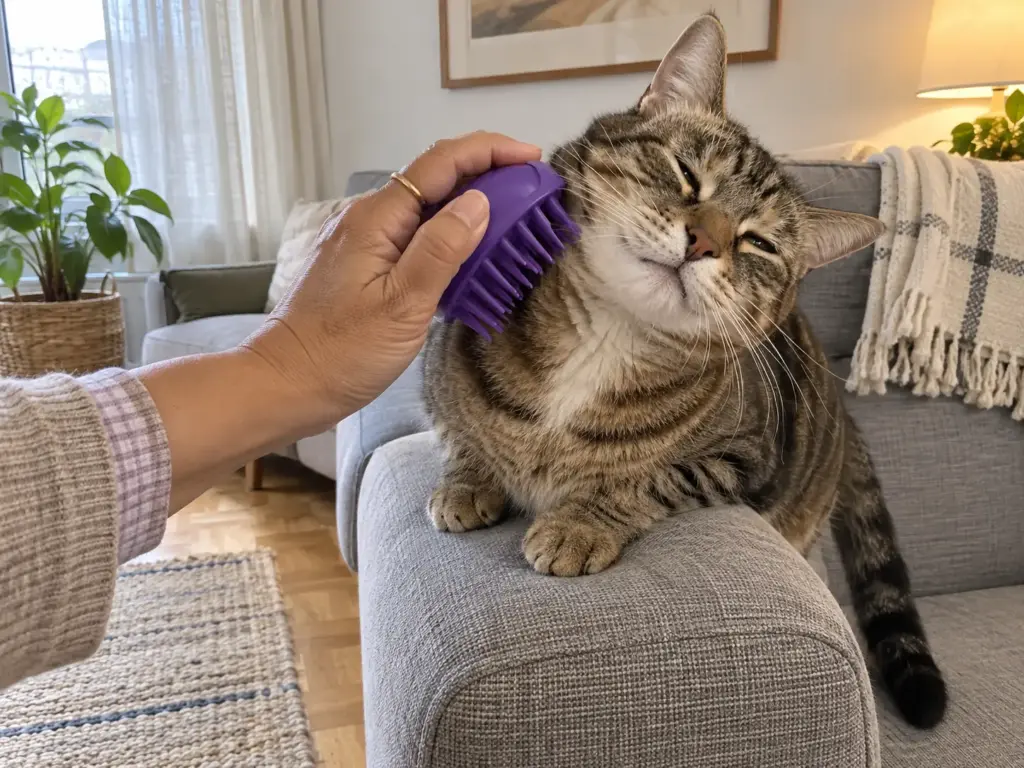
What you already own, an old brush on the counter and a damp hand
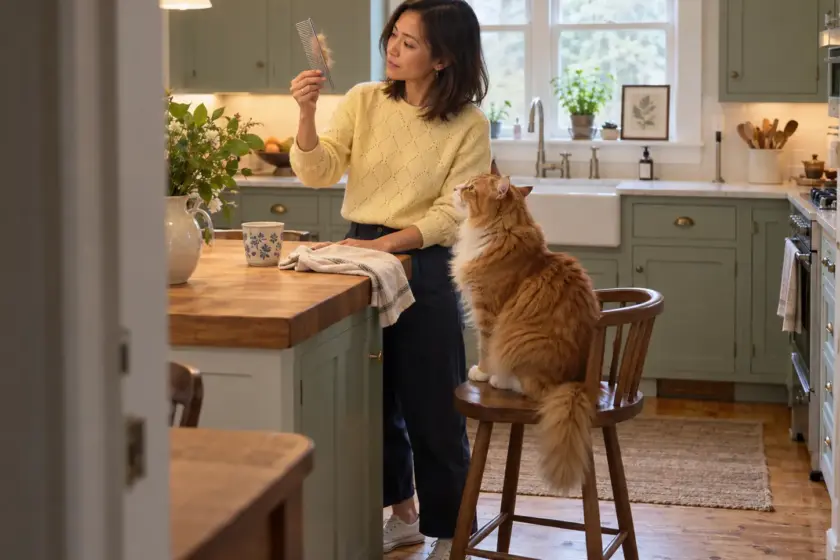
One r/CatAdvice owner left her old brush lying on the kitchen counter so her cat could rub against it. It smells like her, it sits still, and the cat investigates it on his own schedule.
Do the same with whatever cat brush you own: leave it out, at his height, for several days, and let him sniff the brush before it touches him. Don’t wave it at him or drag it along the floor. A brush that moves like a toy gets hunted like one.
The other free tool is your hand, slightly damp. International Cat Care names a damp cotton or rubber glove as one of the gentle options for grooming, and a clean rubber dish glove does the same job for a cat who flinches at bristles. A damp palm lifts loose hair off a short coat and feels exactly like being petted, because it is.
Getting from the head to the full coat this way can take several weeks. That is normal pacing, and nothing is going wrong.
The first brush has rubber tips, not wire
Once he takes five seconds of your hand on his head without moving away, a brush can come in. The first one should be soft enough that he barely notices the switch. The Cat Brush with Soft Rubber Pins is a silicone brush that measures 8 x 4.5 x 2.5 inches and weighs 0.8 ounces, small enough to sit inside a cupped palm so that what reaches the cat is the pressure of your hand with a row of rubber tips in it.
No wire anywhere on it. Its weak point is the cat who would rather bite it than be stroked with it; one r/CatAdvice owner has a cat who does precisely that (more on that cat in a moment).
A slicker brush with wire pins is the wrong first brush for a cat who already refuses. The pins are often the very thing he is objecting to, so buying a better slicker just gives him a sharper version of the same complaint. If rubber tips don’t suit him either, a soft bristle brush is the next thing to try, still with the pins out of the picture.
Hold the brush with the tips facing your palm while you pet him for the first few strokes, then turn your wrist so the tips touch the coat. He feels your hand the whole time and never watches a tool come toward him.
The glove, for the cat that doesn’t want to see a tool
Some cats are fine with the touch and object to the sight: the brush in your hand is the signal, and they leave before it lands. For that cat, a glove takes the tool out of the picture. HandsOn Pet Grooming Gloves have small nitrile nodules on the fingers, so a stroke reads to the cat as petting. They are sized to your hand, not to the cat; the pair linked here is Large, 1 pair, and the smaller or larger size is the one to pick if your hands run small or big.
They don’t win every cat over. The senior adopted cat in that r/CatAdvice thread hid as soon as her owner took a glove out of its box, and the owner read it as a bad history with that exact object. If your cat has already met a glove he didn’t like, go back to the bare damp hand instead of insisting.
The Ladder, With Seconds per Rung, Zones in Order and a Session That Ends Early
“Go slowly” is the instruction every cat owner has already been given, and it doesn’t say how slow. A fight with the brush is information: the goal for that session was too big. The steps below desensitize him to the brush by shrinking the goal to a size the cat can win, with numbers attached.
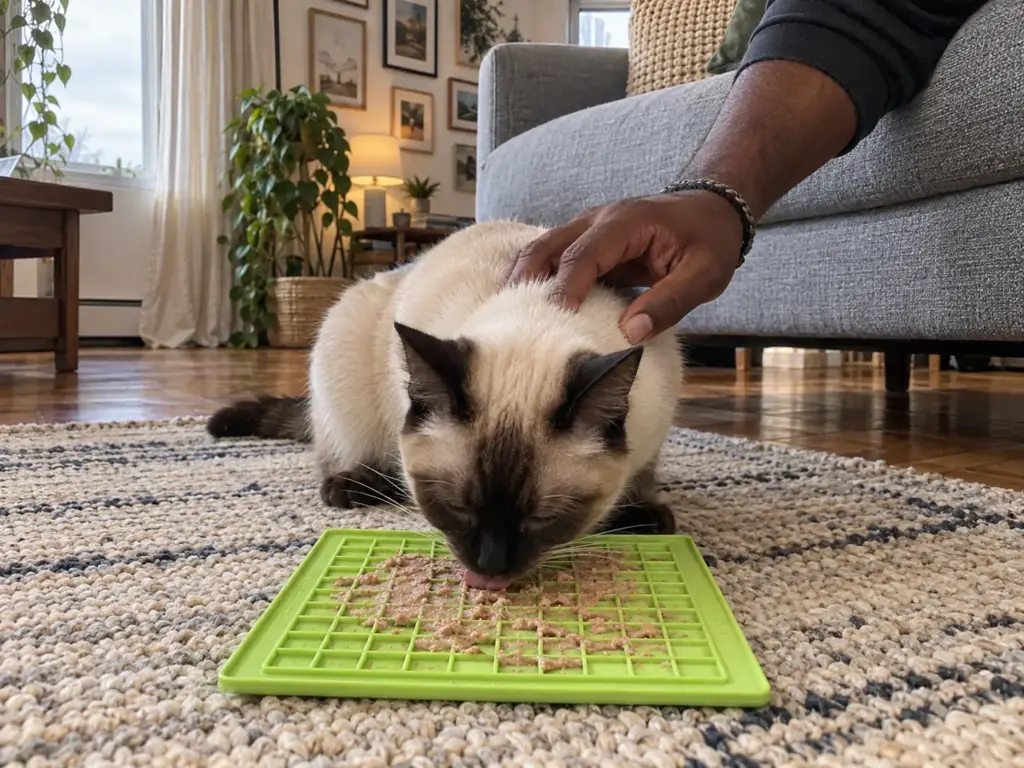
Hand only, five seconds on the head and chin
Saba Sayyed, a certified cat behavior consultant quoted by PetsRadar, starts with no tool at all: scratch the head and chin by hand, then bring the comb in for five seconds on the same spots while the cat is tired or resting, with strokes of about five seconds and a treat straight after. VCA Animal Hospitals frames the same idea as a threshold. Count how many pets he takes before he tenses, stay below that number, say “all done” and hand over a small treat, starting with just one or two strokes. Pairing every step with a treat is positive reinforcement, and pairing the brush itself with a treat he already loves is counter-conditioning.
Put those together and you get a ladder. The pace in the table below is the one this blog recommends; no study set these numbers, and your cat can send you down a rung on any day he likes.
| Rung | What touches the cat | How long | Days before the next rung |
|---|---|---|---|
| 1. Hand | Your hand on head and chin | About 5 seconds | 3 to 4 |
| 2. Brush offered | Brush held still for him to rub a cheek on | As long as he rubs | 2 to 3 |
| 3. First strokes | Brush on head and cheeks | 2 or 3 strokes of about 5 seconds | 3 to 5 |
| 4. Shoulders and back | Brush from the neck along the back | Up to 30 seconds in total | About 7 |
| 5. Flanks | Brush down the sides | Up to 1 minute in total | About 7 |
| 6. Guarded zones | Belly, legs, tail base, armpits | 1 or 2 strokes per zone, added one at a time | Open-ended, and some cats stop here |
The brush enters, in strokes and not minutes
Count strokes, never minutes. A minute is something you watch on a clock while the cat’s patience runs out; a stroke is a unit he can see you stop at. If he took three yesterday, today is three, and the session ends there even if he looks relaxed.
A second pair of hands helps from rung 3 onward. Start free, with a spoonful of his usual wet food spread thin on a flat saucer, and brush while he licks. If that works and you want it to last longer, the LickiMat Classic Playdate is a flat, textured mat you press food into, so he works at it lick by lick and stays put through a short session; it is the same mat that turns up in the lick mat in a two-cat apartment.
The maker’s own listing says in capital letters that it is not a chew toy and asks you to supervise. And food packed into the grooves is a washing-up job you will be doing after every session.
Those day counts assume a cat with a clean slate. A cat who has been held down for a brush before, or the adopted cat who hides from a glove, is starting from below rung 1. For that cat, double the days on the first two rungs before you judge anything.
The ladder isn’t failing when he needs two weeks at the hand stage. He is just counting from a different starting point.
Which zones, in what order
Head and cheeks first: they are his safe areas, the places where he already accepts touch from other cats and from you. Then the shoulders and the line of the back. Then the flanks. The belly, the legs, the tail base and the armpits come last, one zone at a time, and some cats will never sign off on all four.
A short-haired cat can live happily with a belly nobody brushes.
A long coat is the harder case, because the last zones on the ladder are the first ones to knot, and a tangle can build underneath before it shows on top. Before any tool goes near an armpit, run your fingers through it: that is the free check, and it tells you whether a tangle is forming without pulling on anything. A coat that is already matted is a groomer’s job, not a rung on this ladder.
Only in the final rungs, with a cat who already takes the brush on his back and flanks, does a comb make sense. The PETTOM Steel Grooming Comb is a 7.5-inch steel comb with two tooth spacings, and the wide-tooth end is the one for checking an armpit. Reviewers on the listing mention a vet and a groomer recommending it for upkeep between appointments. Durability is mixed, with buyers reporting teeth that bend after a few uses, and steel drags hard on a knot, which is exactly why it doesn’t belong on the early rungs.
Where the session ends
The session ends at the first sign, and ideally one stroke before it. Watch for a tail flick (the tip twitching or thumping), flattened ears, dilated pupils, a sudden burst of him grooming himself, or the skin along his back rippling. That ripple is the earliest of the three and the one people miss most; Cat Care Society’s overstimulation guide describes the first sign as often subtle and quick, a small ripple or twitch in the skin.
Once you see it, put the brush down. Try again tomorrow, not in ten minutes, because a cat who was “overstimulated” a moment ago has a lower threshold, not a reset one.
According to International Cat Care’s grooming guidance, “If grooming is a struggle, it should be stopped.” Stopping early is not giving up on the coat. It is the step that makes the next session possible. How many sessions a week his coat needs is a separate question, and how often to brush by coat type answers it.
Pick one treat he loves and give it only for brushing, never at dinner or for coming when called. Within a couple of weeks the brush coming off the shelf starts to mean that treat, and you can see it in how fast he walks over.
The Cat That Goes for the Brush or Your Hand
A cat who grabs the brush with his teeth or swipes at your wrist has run out of tolerance, and he says so with the tools he has. Reading it as bad manners leads straight to the response that makes it worse. Read it as a limit he reached, and you can plan around it.
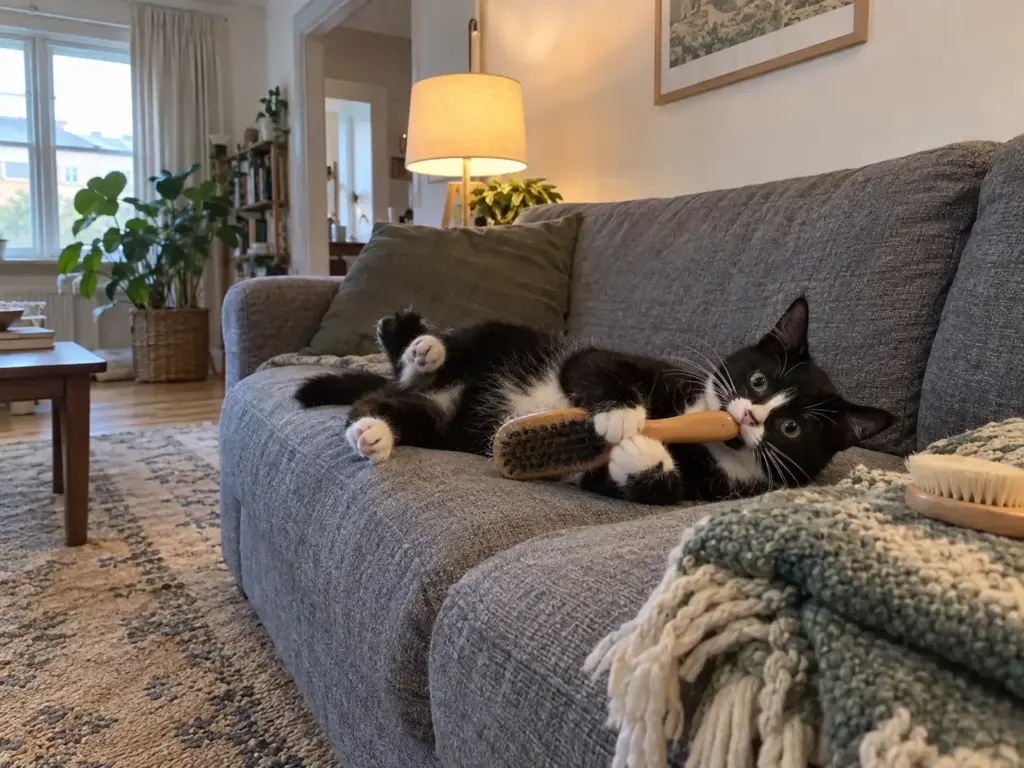
Two brushes, one for chewing and one for combing
One r/CatAdvice owner settled on what she calls her “combative comb.” Her cat wants to chew the brush she is using, so she gives him a different one to bite and grooms with the first. He gets something to fight, the coat gets brushed, and nobody’s hand is in the middle.
The old brush from the bathroom drawer does the chewing job for free. The rubber-pin brush from earlier is one that some cats prefer to bite, so in a two-brush house it can just as easily end up as the chew one.
One stroke and out, at the first fixed stare
A fixed stare at your hand, the skin rippling, the tail starting to lash: any one of those ends the session on the spot. On this point, the SF SPCA and Maddie’s Fund guide to aggression when brushed is plain: stop at the first warning sign, and never punish. For a cat who goes for the brush, that can mean a single stroke and then leaving the room, which feels like nothing and still counts as a session he finished calmly.
But a bite that breaks the skin, or a reaction that is new and nothing like him, goes to the vet before another session, and this article won’t guess at what it means.
Why scolding makes the next session harder
A raised voice, a tap on the nose, a squirt of water: each one teaches him that the brush arrives with something unpleasant attached. His threshold drops, the warning signs get shorter, and the next swipe comes a stroke earlier than the last. Scolding doesn’t change the limit he has. It just removes the warning you would have had before he hits it.
Put the chew brush on the floor next to him before the grooming brush leaves the shelf. Bring the real one in only once he has had his go at the decoy and let it drop, so he is already busy when the first stroke lands.
In a Small Apartment, With One Cat or Two
In a small apartment every room already belongs to someone, and the spot where the cat refuses is often the spot where he has lost an argument before. Moving the session is the cheapest change on this list, and in a rental it is often the only one available.
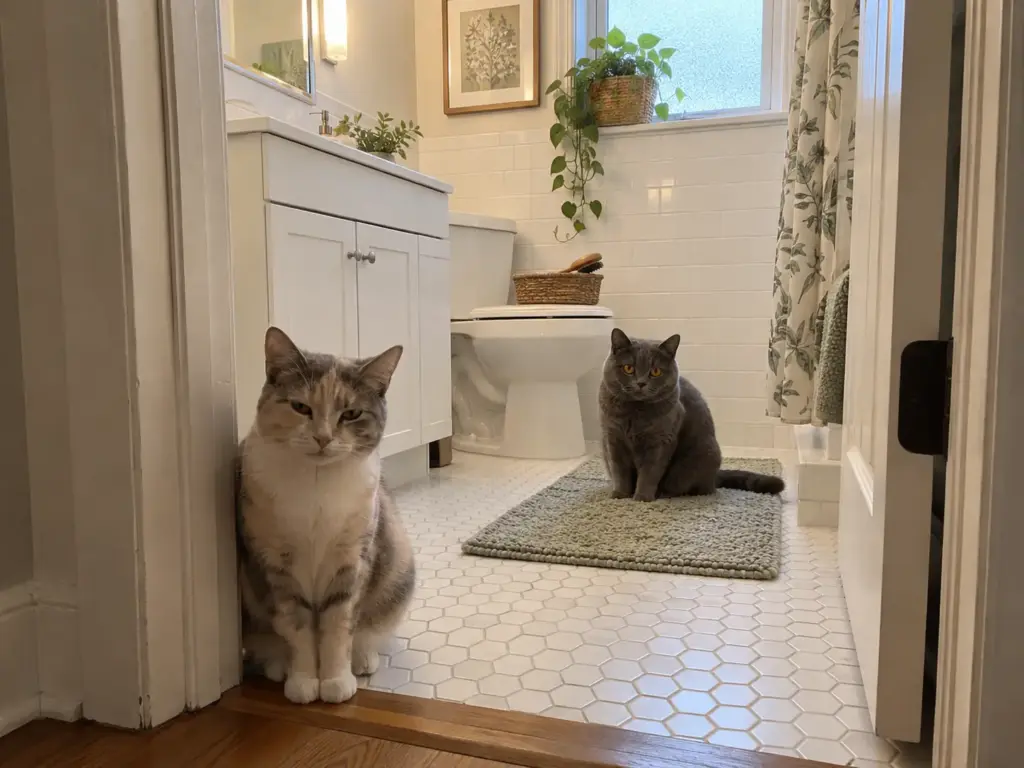
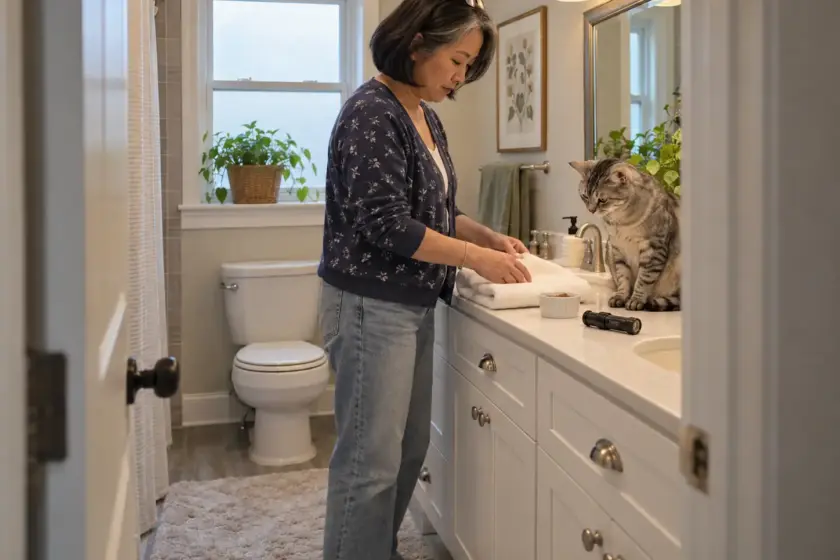
Where to try, a closed bathroom or a hallway and not the sofa arm
The usual suggestion is to brush him where he relaxes, which in most apartments means the arm of the sofa. That breaks down in a small place. The sofa arm is narrow, it has a wall or a window behind it, and it is where he has been scooped up, held for a claw trim or caught for the carrier. The better call is a dull, low room: the bathroom with the door pushed nearly shut but not latched, or the hallway floor with both ends open.
Sit on the floor at his level. He keeps an exit, the rest of the household stays out, and nothing in the room has a history.
Run the same three strokes in the new spot that you ran on the sofa. If the count goes up, the room was part of the objection.
Leaving the kit in sight without drilling, and where the hair lands
The “leave the brush out” step needs a place for the brush to live. The top of a low bookcase, a corner of a windowsill he already uses, or the edge of a shelf he can reach all work, and none of them needs a hole in the wall. Keep the brush, the chew brush and the treats together in that spot, so the whole setup is just part of the apartment.
Spread an old pillowcase on the floor where you sit, and the hair falls on it instead of working into the bath mat or the hallway runner. Fold it in on itself afterward and shake it outdoors or over the trash, without moving the session to a spot that is easier to vacuum. If loose hair is the bigger fight in your rental, where the hair lands in a rental goes through it room by room.
One cat versus two
This part is our own read of how a shared apartment works, not something a behavior source has measured. With two cats, the second one is an audience. A cat who would take five strokes alone may take none with the other cat watching from the doorway, and a cat who has to share a small space has reasons not to look handled in front of the other.
So brush one cat at a time, with the other in a different room and the door closed. The brushing treat goes only to the cat being brushed, never to the one waiting outside. If both refuse, run the room test above for each of them separately, because two cats under one roof can easily be objecting to two different things.
When Brushing Isn’t the Answer, a Groomer, a Lion Cut or the Vet
Some cats will give you two to five strokes and not one more, however patiently you work the ladder. That is a real cat with a real limit, and the coat still needs looking after. There are other ways to get there.
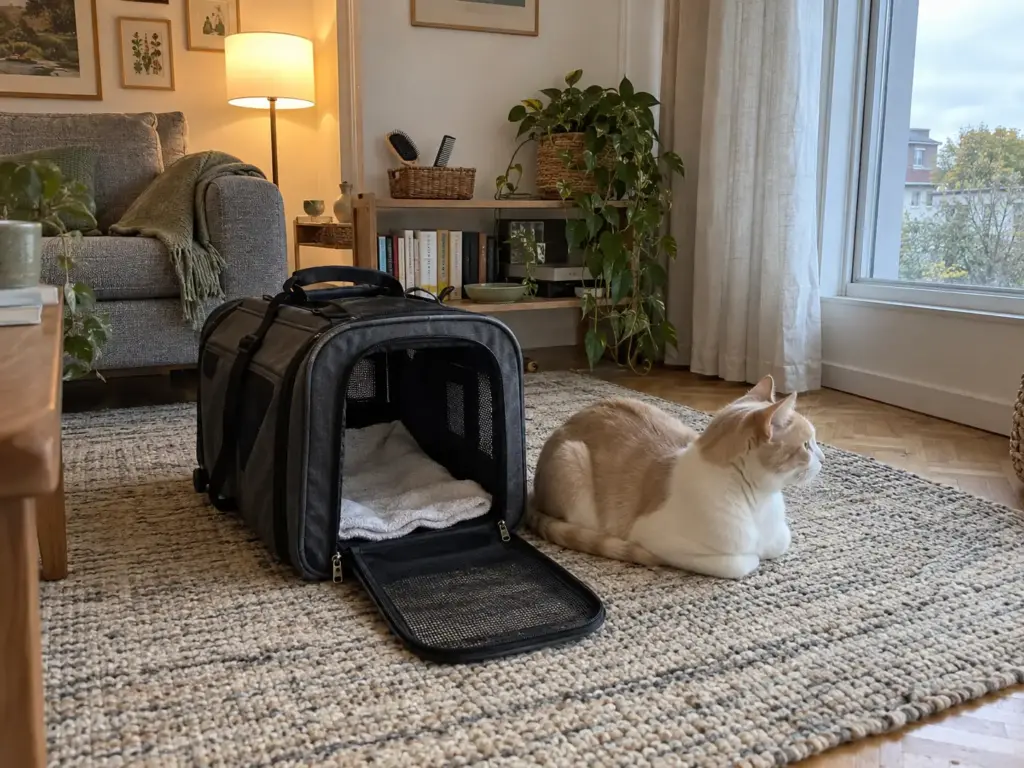
The cat that gives five strokes and not one more
On Mumsnet, owners of long-haired cats who refuse brushing describe a simpler arrangement: a groomer clips the coat short every few months, and nobody fights over a brush in between. The lion cut, the coat clipped close all over with a mane and a tuft at the tail tip left, is the best known version. A sanitary trim around the rear, twice a year, is the lighter one. A short coat is far easier to keep clear than a long one you are losing ground on, and choosing it is not a failure.
The same threads carry a second message for owners who feel guilty about a knotted coat. The replies keep repeating that vets see matted cats all the time and don’t judge anyone for it.
What to ask a groomer or a mobile groomer
Tell them the cat is nervous with tools before you book, not on the day. Mention anything specific you have noticed, such as a cat who tenses at the sound of scissors or clippers, since that kind of reaction is usually learned from a past session and the groomer can work around it. Ask whether they take cats on their own, away from barking dogs, and whether a session can end early if he has had enough. In a small apartment, a mobile groomer who comes to your door is worth asking about too, since it takes the carrier and the car out of the visit.
The vet, in one sentence
A knot tight against the skin, any bite that breaks the skin, or a cat who used to accept brushing and has stopped all go to the vet before the next session; International Cat Care notes that severe mats often have to be shaved off by the veterinary team, and when a change in the coat is a vet question covers the rest of that line.
Count the Strokes, Let the Cat End It, Hand Off the Rest
A cat who won’t be brushed is answering one part of the session, and three strokes in three places on two days will show you which part. The number of seconds and the moment the session ends are his to set; your job is to count and stop one stroke early. Knots at the skin, bites that break skin and a cat who has suddenly changed his mind about brushing belong to a groomer or a vet, not to a longer session.
Three weeks from now, run the same three strokes in the same spot as your first test and compare the count with what he gave you on day one. If the number has gone up, the ladder is working; if it hasn’t moved, change the room or the tool before you change anything else.
Today, take the old brush out of the drawer, put it on the counter or a low shelf, and don’t use it. Just watch whether he walks over to sniff it, rubs a cheek on it, or ignores it.
Frequently Asked Questions
01What to do if your cat won’t let you brush them?
Stop the session before the tail tip starts twitching, then start again on another day with your hand alone on the head and chin for about five seconds. Test the tool, the spot and the room one at a time to find what the cat is objecting to.
02How to brush an unwilling cat?
Use the softest tool you have, such as rubber tips or a damp hand, and give two or three strokes on the cheeks before anything else. Never hold the cat in place, add one zone at a time, and finish every session with a treat kept only for brushing.
03How do I brush my cat without getting scratched?
Stop at the first warning sign, such as a fixed stare, rippling skin or a lashing tail, and give the cat an old brush to bite while you groom with another. A bite that breaks the skin, or a reaction that is new, goes to the vet first.
04Is it normal for a cat to dislike being brushed?
Yes, it is common, and the refusal usually points at one specific thing such as the tool, a guarded zone, being held or the room. A cat who used to accept brushing and suddenly stopped is different: have the vet see him before you try again.
Leave a comment