Cat Fountain Water Has Three Clocks, Not One
Don't confuse topping off with changing it (they're different jobs). Full swap every 2-3 days, and film on the wall beats any calendar.

Alfredo RamsesFounder · August 26, 2026 · 20 min read

On this page8 sections
The water looked fine yesterday. This morning there is a faint ring where the water meets the wall of the reservoir, and your cat put his face down, paused for half a second, and drank anyway. He is not being fussy. He noticed something a day before you did, which is exactly what should happen, because the film that produces that ring starts forming within about a day and stays invisible until day two or three.
Working out how often to change cat fountain water is really about untangling three separate jobs that everyone calls one job, and the two people mix up most are the water and the filter.
Quick Answer
Empty and refill the whole reservoir every 2 to 3 days with one cat, every 1 to 2 days with two or more. Topping off to the fill line does not count as changing it. And if you see film, cloudiness or foam, that day wins over the calendar.
Topping Off Is Not Changing the Water
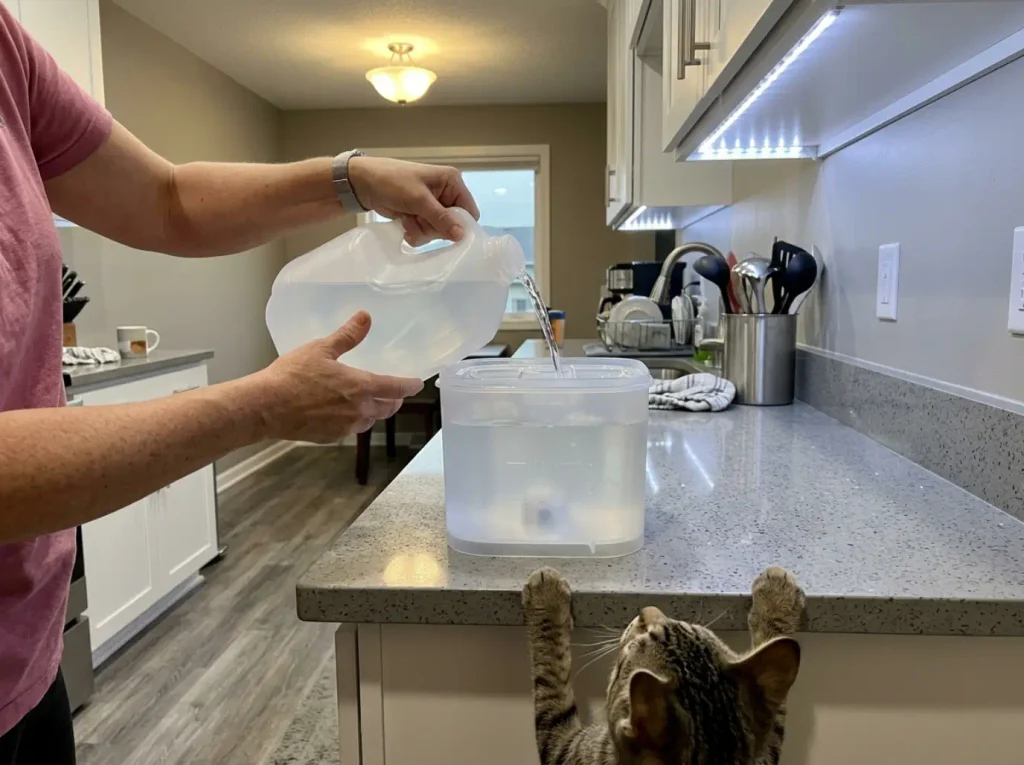
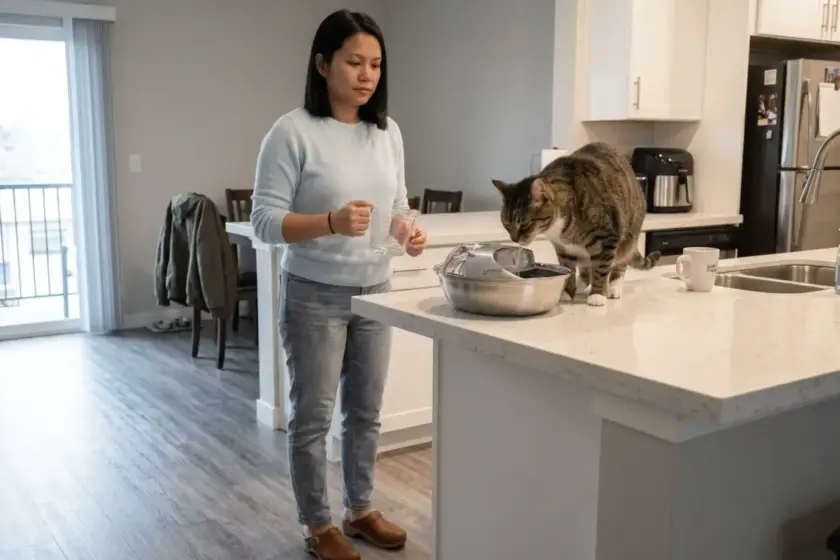
You have been pouring fresh water in every couple of mornings for months, and you would say without hesitation that you change your cat’s water regularly. What you have been doing is diluting the previous batch. It is the single most common way a fountain routine quietly fails, and it fails invisibly, because the water level is right and the water is moving and nothing looks wrong. If you are still deciding whether a fountain earns its place at all, this is the maintenance reality the box does not mention.
What a Top-Off Actually Replaces
A top-off replaces volume. That is the whole of it. Some of the water evaporated off the top, some of it went into the cat, and you put back the difference. Nothing leaves the reservoir during that operation, and the part of the water you would most want to remove is the part that stays.
Think of what goes in at the other end. Every drink puts saliva into the reservoir. A cat that eats and then drinks carries food particles in on his face. Add shed skin cells, dust off the counter, and the mineral load of your tap water, and you have a slow accumulation of organic material that a fresh pour on top does not touch.
Petlibro’s own troubleshooting notes name that list exactly, which is a fair thing for a fountain manufacturer to admit.
What Stays Behind Every Single Time
The film is what stays. It is not floating in the water where a top-off could dilute it. It is stuck to the reservoir walls, growing on the surface below the waterline, and pouring clean water over it does about as much as pouring clean water over a dirty plate.
Then there is the evaporation problem, which runs in the wrong direction. Water leaves; the minerals dissolved in it do not. Every top-off adds a fresh dose of minerals to a reservoir that never gets emptied, so the concentration climbs week over week. On hard water that is how you end up with a chalky line that no amount of rinsing removes, in a fountain you have been “changing” all along.
The Mark on the Reservoir Is a Volume Line, Not a Schedule
Most fountains have a fill line molded into the reservoir, and it does one job: it tells you when the pump is at risk of running dry. It says nothing about freshness. The fountain has no way to know how old the water in it is, and neither does the line.
That is the whole design gap. A fountain reservoir is a container of standing water with a pump circulating it, and circulation is not turnover. The volume that went in on Sunday is still in there on Thursday, moving in a loop.
Track the full swap, not the top-off. The top-off happens on its own because the water level nags at you every time you walk past. The swap has no visual cue at all, which is precisely why it is the one that slips. Put it on the same day every week and let the second one fall wherever it falls.
Why Running Water Still Goes Bad
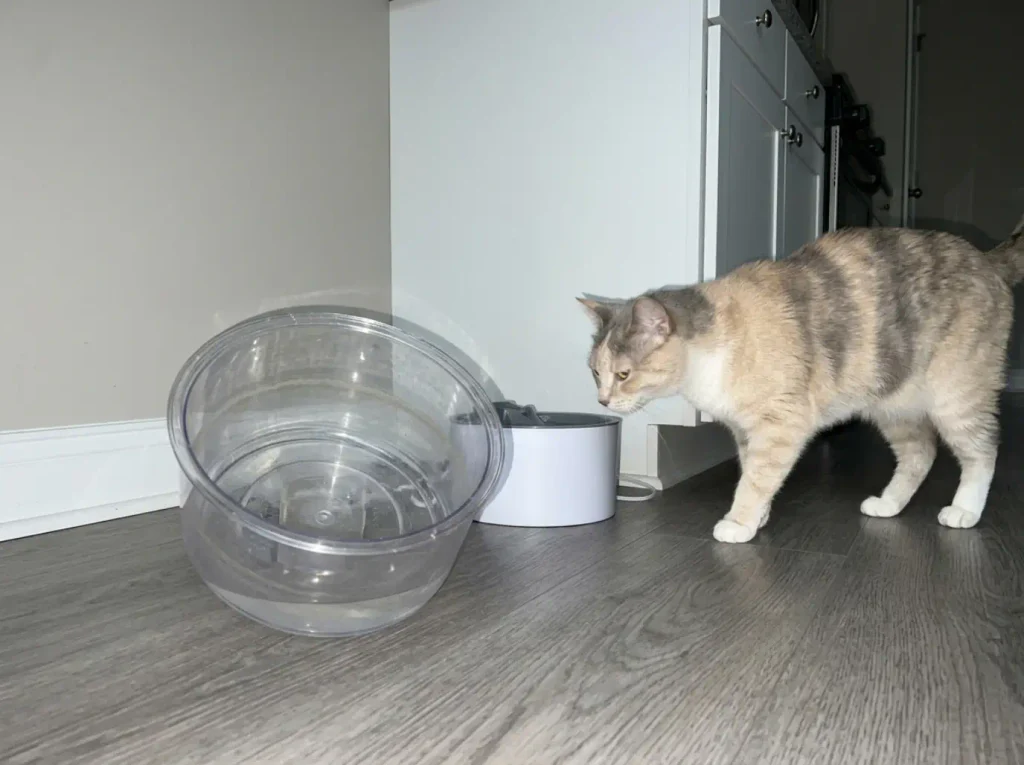
You bought the fountain because the water moves, and the water does move. That was never the misunderstanding. The misunderstanding is assuming that what grows in a fountain needs still water to grow, and it does not. It needs a wet surface, something organic to eat, and time.
A fountain supplies all three, and the pump keeps the third one company.
The Film Starts Before You Can See It
Biofilm begins forming within roughly 24 hours on any wet surface carrying saliva or food residue. That is the number that reframes the whole schedule. It is not that the water is fine for five days and then turns; it is that the film starts on day one and only becomes visible on day two or three, once enough layers have stacked up to catch the light.
Scrubbing does not buy you as long as it feels like it should either. On plastic reservoirs the film re-establishes within about 48 hours of a full clean, because a cat’s tongue leaves microscopic scratches in the surface and those scratches are perfect anchor points. Stainless and ceramic hold up better for exactly that reason: there is less for it to grip.
Most people call it slime long before they call it biofilm, and slime is the better word for what you are actually looking for. It is stringy, it is slightly pink or gray, and it lives around the spout and along the waterline. The CDC’s own work on the subject notes that biofilm forms on any wet surface that combines moisture, nutrients, and time, which is a fair description of a cat fountain in a warm kitchen.
Hard Water and Slime Are the Same Layer
Here is the part that surprised me and changed how I write about fountain cleaning. Hard-water crust and slime are not two separate problems sharing a container. Biofilm matrices incorporate mineral crystals directly into their structure, so on hard water the white chalky deposit and the slick coating are one layer with two textures.
That has a practical consequence. If your tap water leaves spots on your glasses, your fountain is not just accumulating limescale on a slower clock. It is building a mineral-reinforced film that is physically tougher to remove than the soft slime a soft-water household deals with. Same fountain, same cat, harder job.
And it means the swap interval and the descaling interval are not independent of each other, whatever the manual implies. Changing the water more often on hard water genuinely slows the crust, because you are removing the mineral load before it has time to get built into anything.
What the Pump Does, and What It Does Not Do
The pump circulates. That is its entire function, and it does it well. What it does not do is remove anything, and what it definitely does not do is sterilize. A pump running through a reservoir with an established film is distributing that film’s output around the water rather than cleaning it out.
The filter does not close that gap either. Activated carbon adsorbs dissolved compounds and traps particles. It does not neutralize bacteria, and once saturated it becomes another wet surface with plenty of organic material on it. A colonization site, rather than a defense.
The same stagnant water risk the CDC flags in building plumbing systems is the mechanism at work here, scaled down to a countertop. A reservoir with a pump in it is still a volume of stagnant water; the pump moves the top of it past a spout, not through anything that removes what is growing.
None of which means the fountain is a bad purchase. It means it is a container that needs emptying, and if you are weighing up whether the fountain is doing anything for his water intake in the first place, that question is a separate argument with its own evidence.
The Signs That Override the Schedule
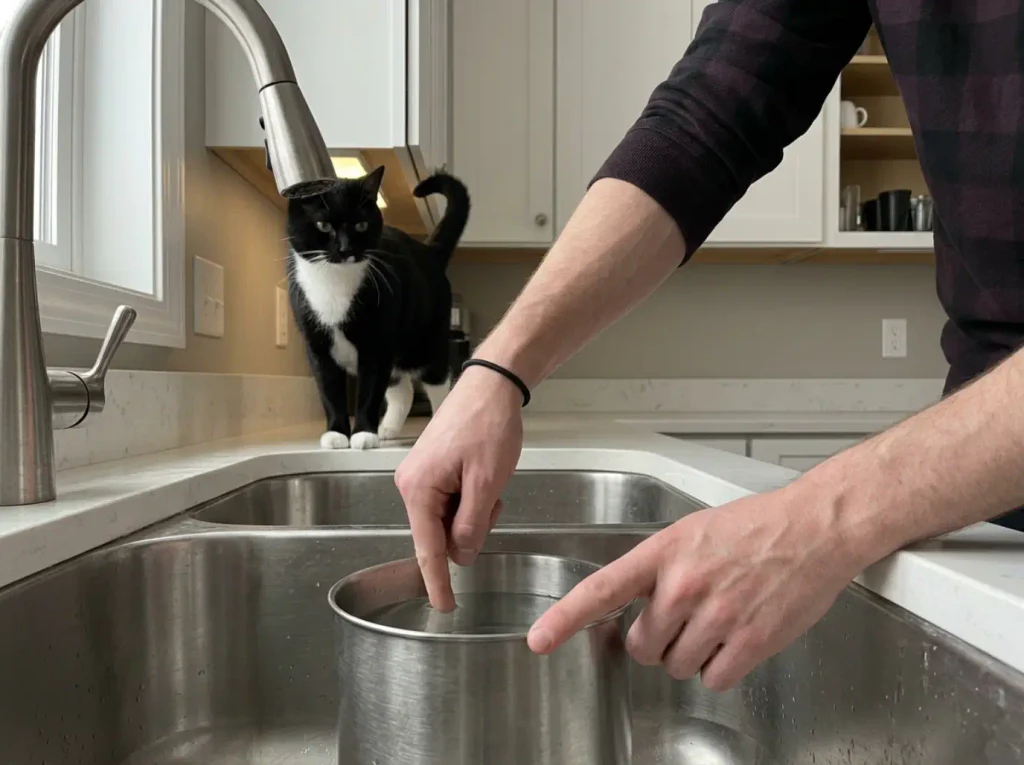
The calendar says Thursday. The water says today. The water wins, and there is a reliable order in which it tells you, running from the earliest signal to the one that arrives far too late to be useful.
Run a Finger Below the Waterline First
Reach into the reservoir and run a fingertip along the inside wall, below the waterline, where the water has been sitting longest. Smooth means clean. Slightly slick, slightly resistant, the way a wet plate feels before it is properly washed, means the film is already established.
This is the only signal that arrives early enough to act on, and almost nobody uses it, because everybody is looking at the water instead of touching the container. The water in a fouling fountain stays clear for days after the walls stop being clean.
Do it at the waterline specifically, not at the bottom. The waterline is where the film builds first and thickest, and it also happens to be exactly where a cat’s whiskers make contact in a deep or narrow reservoir. The same whisker contact PetMD describes under whisker fatigue puts his face in the least fresh part of the container on every drink. Nobody connects those two facts, and they sit an inch apart.
Do the finger test while you are topping off. Your hand is already in there, it takes two seconds, and it replaces the calendar entirely. Slick wall means swap it now regardless of what day it is.
Cloudy Water Is the Middle Signal
Between the slick wall and the foam there is a stage most people skip past, because cloudy water in a fountain does not look like cloudy water in a glass. It is subtler. Hold the reservoir up against a window and the water loses its edge, going very slightly milky, the way a water bowl looks on the second day in a warm room.
Two different things produce it, and they arrive together. One is the bacterial population itself, now dense enough to scatter light. The other is mineral buildup coming out of solution as the water evaporates and concentrates, which is also what leaves the chalky white ring on the reservoir wall.
That matters because those two are usually treated as separate problems, a hygiene one and a hard-water one. They are the same layer. The film’s matrix incorporates the mineral crystals as they form, which is why scrubbing off scale and scrubbing off slime turn out to be one job rather than two.
Foam Means You Are Already Late
Foam or white bubbles that sit on the surface and refuse to break up under the flow is the signal most people treat as their first warning. It is not a warning. ThirstyCat, who sell the things, put it plainly: by the time foam appears you are a day or two past the ideal change point.
What the foam is telling you is that the water’s surface tension has changed, because there is enough dissolved organic material in there to hold a bubble together. It is a measurement of accumulation, and accumulation is the thing you were trying to prevent.
Useful, then, but only as a check on your own schedule. If you are regularly seeing foam, your interval is too long by about two days. Move it in and stop reacting to the bubbles.
Waiting for the Smell Is Waiting Too Long
Odor is dead last. Water that smells has been holding a substantial bacterial population for days, and by the time it reaches your nose from a reservoir on the floor, it has been unpleasant at cat-nose distance for considerably longer. Cats sit much closer to it than you do and have a far better nose.
The reason people default to the smell test is that it is the only signal that finds you. Film has to be looked for, cloudiness has to be checked against the light, foam has to be noticed. Smell arrives on its own while you are making coffee, which makes it feel like a system when it is really just the last alarm in a row of alarms you missed.
So the order runs: film, then cloudiness, then foam, then odor. The first one is the one worth using. If your cat starts drinking noticeably less, or stops using the fountain he has used happily for a year, that is not a water-freshness problem to solve with a scrub. A sudden change in drinking is a call to your vet before it is a maintenance question.
Three Clocks, and the Two People Confuse
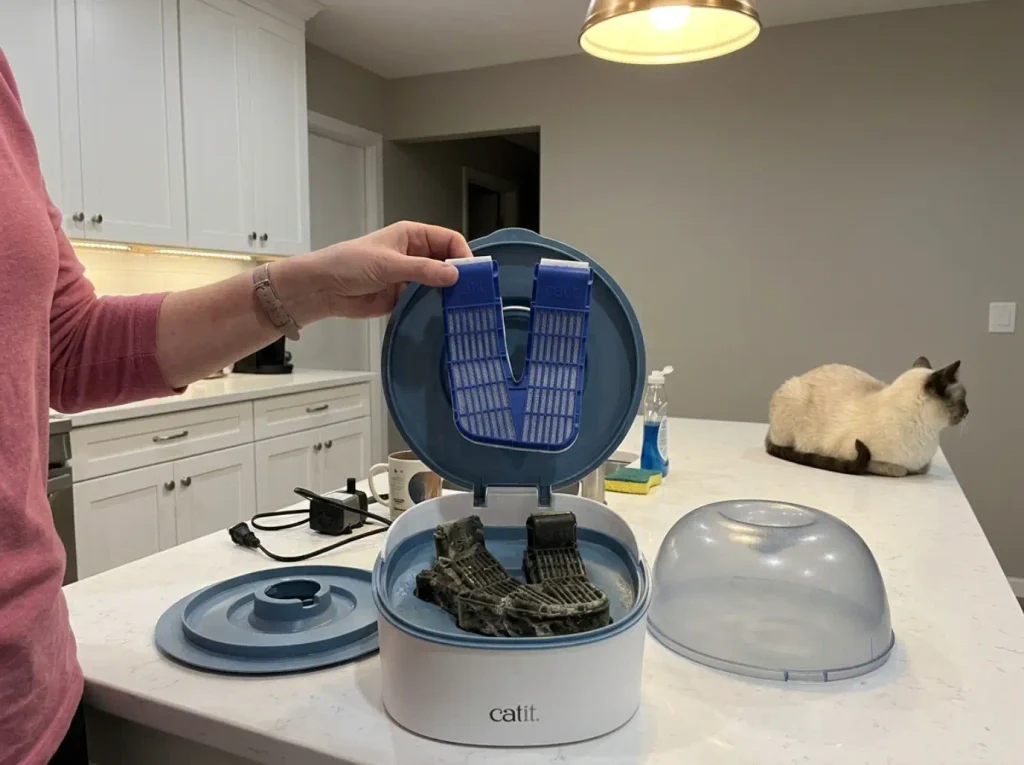
You changed the filter on Sunday, so the water is fresh. That is the sentence this whole article exists to interrupt. Those are two different jobs, measured in two different units, and doing one does nothing whatsoever for the other. Once you see them separately the schedule stops feeling arbitrary.
The Daily Clock — Topping Off
Daily, or every other day, depending on how fast your reservoir evaporates and how much your cats drink. In a dry apartment with the heating on, a small fountain can drop noticeably in 24 hours.
The trigger is the pump, not the fill line. Keep the water above the pump inlet with a bit of margin — keeping the inlet comfortably submerged rather than just barely covered is the practical floor. A pump that runs dry burns out, and that is the most common way a fountain dies before its time.
This clock resets nothing. Say it once more because it is the expensive mistake: the daily top-off is not a full water change.
The Two-to-Three-Day Clock — The Water Itself
This is the clock this article owns. Empty the reservoir completely, rinse it out with your hand or a cloth, wipe the waterline, refill. Every 2 to 3 days for one cat, every 1 to 2 days for two or more.
No soap on this clock. A plain rinse is what a water swap asks for, and soap residue is something a cat can taste for days afterward. Soap belongs to the teardown.
The industry baseline sits looser than this, at five or six days for a single cat, and that number gets copied between brand blogs without anyone checking it against the 24-hour biofilm clock. It is a “you will probably get away with it” figure rather than a target. Two to three days is what it costs to keep the reservoir walls genuinely clean, and it takes two minutes.
The Two-to-Four-Week Clock — The Filter
The carbon filter runs on weeks because it measures saturation, not freshness. Two to four weeks for one cat, closer to two to three weeks with two or more. When it saturates, it stops adsorbing and starts releasing, and the part you installed to clean the water joins the other side.
A filter replacement clock only gets honored if the replacements are in the drawer, which is the real reason people run four-week filters for three months. The Catit Drinking Fountain Replacement Carbon Filter Cartridge 3-pack covers a Catit fountain for roughly a quarter at the two-to-four-week interval and is the exact-fit option for that brand, with the usual exact-fit trade-off of costing more per cartridge. For a non-brand fountain, or for two cats burning through them faster, the BalimoPet 8-Pack ships eight carbon filters with eight foam sponges and works out cheaper per unit. The catch is in the words “compatible with most”, so measure your existing cartridge before ordering, because a filter that sits loose in the housing lets water route around it.
Changing the filter does not reset the water clock, and changing the water does not extend the filter’s life. And there is a fourth job under all of this, the deep clean with the pump opened up, which most manufacturers put on a weekly cleaning schedule and most owners quietly do monthly: the filter and the full teardown have a clock of their own, covered properly in its own article rather than crammed in here.
One Cat, Three Cats, and the Interval That Changes
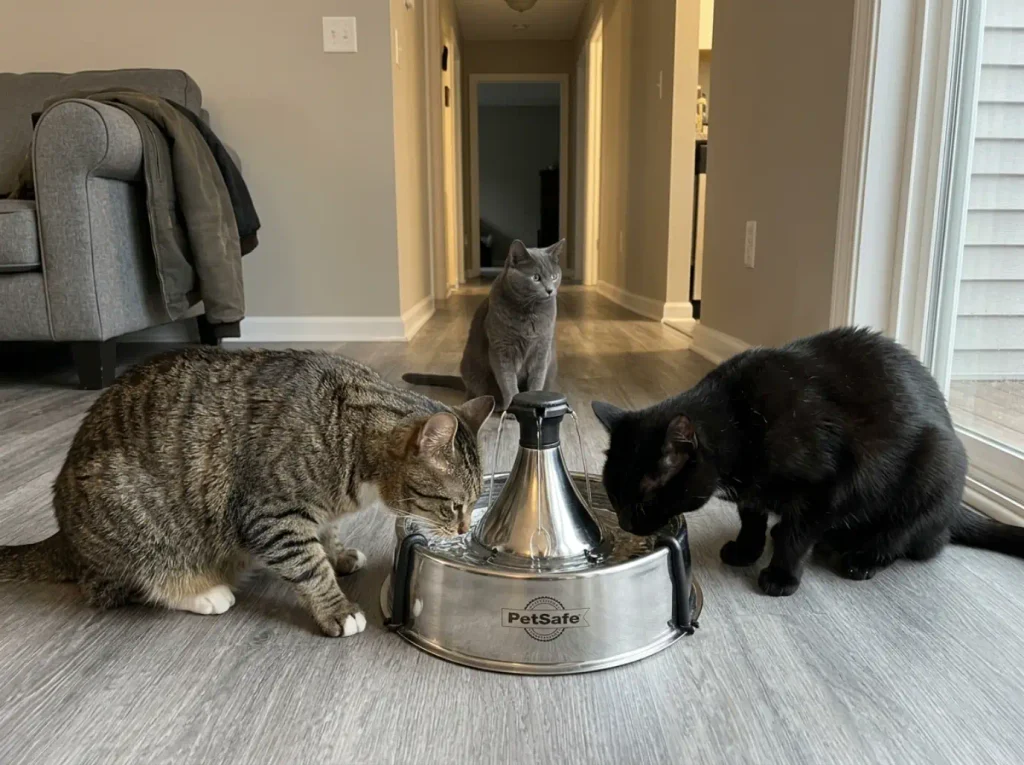
The number you read somewhere was almost certainly written for a one-cat household, because that is the default nobody states. In a multi-cat household sharing one reservoir, that number belongs to a different house.
The Ladder, Cat by Cat
The interval shortens with each additional cat, and not by a little:
- One cat: full swap every 2 to 3 days. The industry line of 5 to 6 days is the outer edge of getting away with it, not the target.
- Two cats: every 1 to 2 days. Most brand guidance lands on 3 to 4 here, which is again the ceiling rather than the plan.
- Three cats: every 1 to 2 days, no flexibility in it.
- Four or more: daily, or every other day at the absolute outside.
The reason the ladder is steeper than you would expect is that it is not driven by how much water they drink. It is driven by what they put in. Each cat adds saliva and food particles on every visit, and that organic input is what the film feeds on. Two cats do not drink twice as much water as one, but they do roughly double the substrate load, and the film responds to the second number.
Hard Water Moves You Down a Step
If your tap water leaves white spots on glasses out of the dishwasher, take one step down the ladder. A single-cat household on hard water lands at 2 days rather than 3; two cats land at daily.
That is not a hedge. Mineral crystals get built into the film structure, so hard water is not adding a second slow problem alongside the first one — it is making the first one physically tougher. Swapping the water sooner removes the mineral load before it has time to get incorporated, which is a cheaper fix than descaling later.
A Bigger Reservoir Buys Fewer Refills, Not Fresher Water
This is the expensive misunderstanding in multi-cat homes, and it is easy to fall into. A larger reservoir does not slow biofilm. The film grows on the surfaces, not in the volume, and a bigger container has more surface, not less. What capacity buys you is fewer top-offs and no risk of the pump running dry while you are at work.
So before spending anything: with more than one cat, two small fountains in two different rooms beat one big one, and it is not close. You get a second drinking station so a pushy cat cannot monopolize the first, and you halve the substrate load in each reservoir, which extends both intervals at once. If you already own a fountain and a spare bowl, put the bowl in the second room today and see whether the quieter cat starts using it. Costs nothing.
Where a large reservoir genuinely earns its place is the problem it actually solves: running dry between swaps. In a three-cat house the PetSafe Drinkwell Stainless 360 Multi-Pet Fountain holds 128 ounces and is drinkable from all the way around, which suits several cats approaching at once far better than a single spout does. The stainless shell also gives film less to grip than scratched plastic. It still needs emptying every day or two, and it is a genuinely heavy thing to carry full, which matters more than it sounds, as the next section gets into.
Making the Swap Fast Enough That You Actually Do It
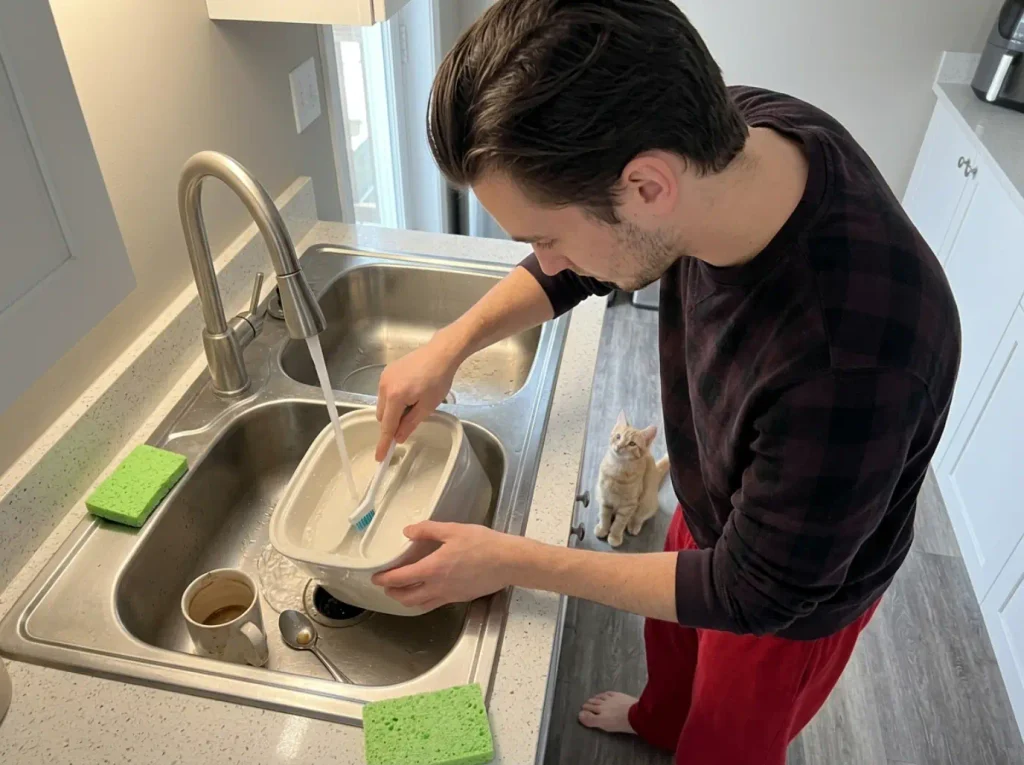
Everyone can keep a new routine for three weeks. Week four is decided entirely by how many steps the job has. A two-to-three-day interval is not a discipline problem; it is a friction problem, and friction is fixable.
The Four-Move Version
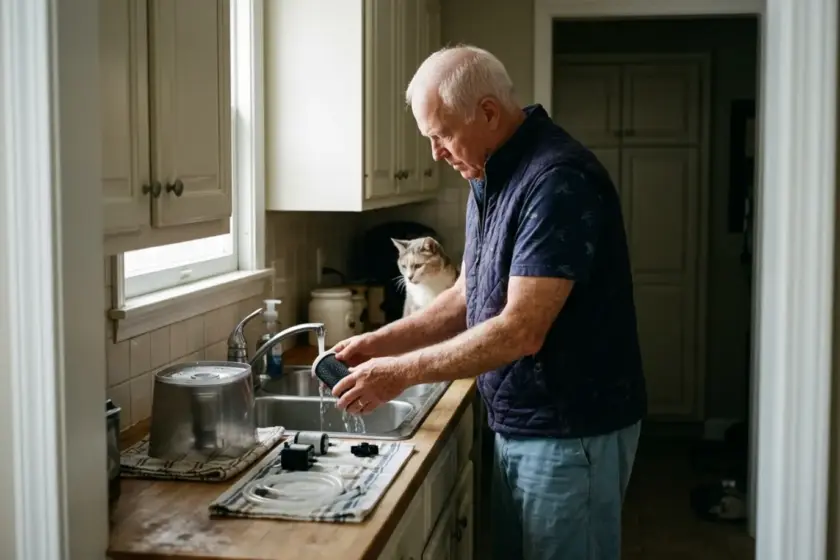
Empty it. Rinse the reservoir with your hand under running water. Wipe the waterline. Refill and put it back.
That is the whole job, and on a plastic reservoir it is over in well under two minutes.
Note what is not in that list: no disassembly, no soap, no pump, no filter. Those all belong to the teardown clock. The most common reason people abandon the two-day interval is that they have mentally attached the full teardown to it, and nobody does a teardown every other day.
The waterline wipe is the move that does the real work, because that is where the film builds first. Miss it and you have replaced the water while leaving the thing producing the problem exactly where it was.
When the Sink Is Not Two Steps Away
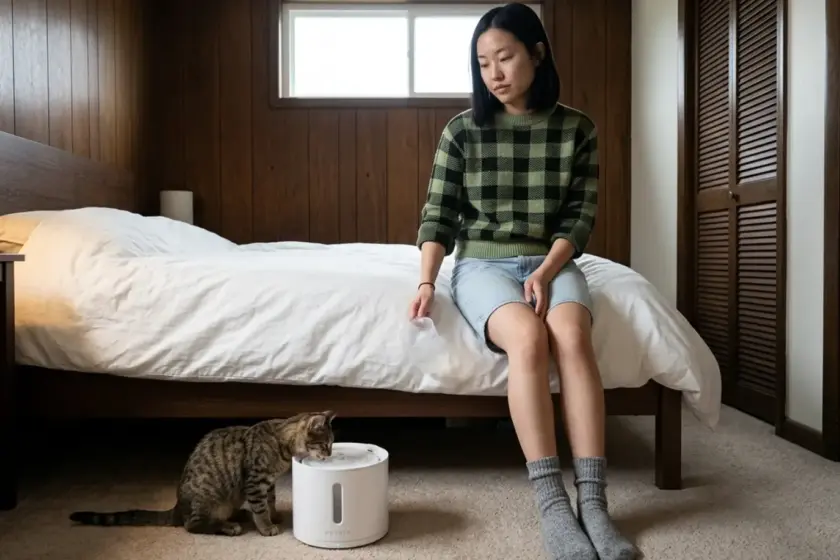
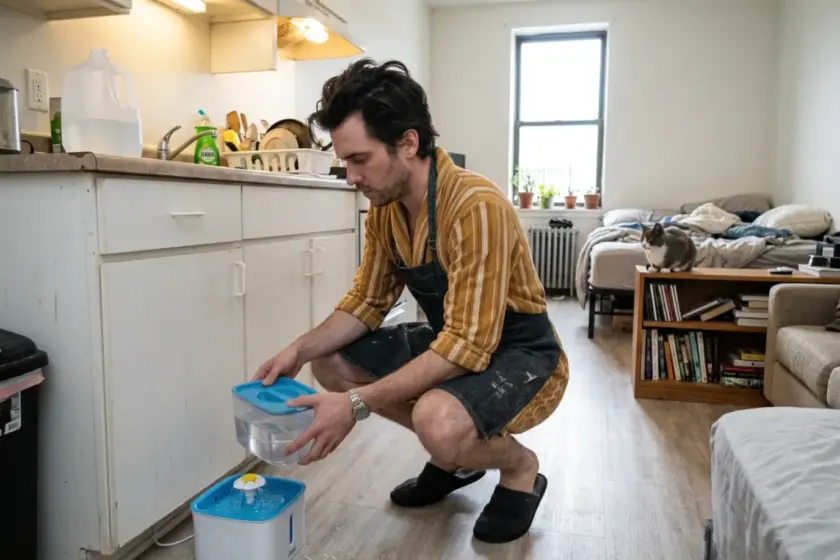
Every guide to this assumes a kitchen with a sink in it. Plenty of people do not have that arrangement. If the fountain lives in a hallway, a bedroom or a studio corner and the only kitchen sink is a shared bathroom down the hall, a full reservoir is a heavy, sloshing, awkward thing to carry, and that carry is what ends the habit by week three. The renter-friendly version is to decouple the two movements: empty the reservoir into a jug where it stands, then carry the empty shell to the tap.
This is reasoning from the physical facts rather than anything I found written down, because no manufacturer and no forum thread addresses it at all.
The fix is to stop carrying it full. Empty the reservoir into a jug or a watering can where it stands, tip that down the drain, and carry the empty reservoir to the sink for its rinse. Same job, a fraction of the weight, and nothing sloshes onto the floor on the way.
If even that is too many trips, keep a filled jug of water next to the fountain and do the whole swap in place: empty into one jug, wipe, refill from the other. You make one trip to the sink instead of two, and you make it holding an empty container. In a small apartment that is the difference between a routine that survives a busy week and one that quietly becomes a top-off habit again.
The One Brush That Saves the Teardown
Before buying anything: an old cloth kept specifically for the fountain does most of this. The reservoir walls and the waterline are flat, open surfaces, and a cloth reaches all of them. Keep it separate from the dish sponge, because a sponge that has been through greasy pans leaves residue a cat can taste.
Where a cloth genuinely cannot reach is the narrow channels and the spout housing, and that is where film survives a swap and reseeds the fresh water within hours. The XANGNIER Pet Water Fountain Cleaning Kit covers those with ten pieces including a long handle brush, a crevice brush, swabs and a sponge, of which honestly the crevice brush is the only one that matters for a water swap. The rest is teardown equipment.
Which is the argument for the smaller option. The PetSafe Drinkwell Pet Fountain Cleaning Kit is three brushes sized for fountain channels and nothing else, and three brushes is roughly what anyone ends up using. Buy the ten-piece if you also want the swabs for the pump cavity on teardown day. Otherwise the three does the same work.
Hang the swap off something you already do. Trash night, or the evening you fill the kettle for the last time. A new routine holds far better attached to an old one than standing on its own, and this one is short enough to slot into an existing trip to the kitchen.
What to Do Tonight
Topping off and changing are two different jobs. The first happens on its own because the water level reminds you; the second has no reminder at all, which is why it needs a day on the calendar.
With one cat, swap the whole reservoir every 2 to 3 days. With two or more, every 1 to 2. On hard water, move one step faster than that.
And when the calendar and the reservoir disagree, the reservoir wins. Run a finger along the inside wall below the waterline. If it slides, it does not matter what day it is.
At three months, check the reservoir itself rather than the schedule. Hold it up to the light and look for dullness or fine scratching on the inside, and listen to whether the pump has changed pitch. A scratched plastic reservoir holds film no matter how punctually you swap the water, and at that point you have stopped having a cadence problem and started having an equipment one.
Empty it, rinse it, refill it. Two minutes, every other day, and you have solved this without buying anything.
Amazon’s Audible — free for 30 days
Your cat won’t let you read. Let someone read to you.
Audible is Amazon’s audiobook library — thousands of titles, read out loud, on your phone. Free for a month, plus one audiobook to keep forever.
Frequently Asked Questions
01How long does a cat water fountain last?
Most plastic fountains last a couple of years before the reservoir gets scratched enough to hold film no matter how often you change the water. Stainless lasts longer because there is less for the film to grip. The pump usually gives out first, and on most models it is replaceable on its own.
02Do I keep my cat’s water fountain on all the time?
Yes. A fountain switched off is a bowl with a motor in it, and the water sits in a closed reservoir rather than an open dish. Leaving it running also keeps the pump from seizing, which is what happens when it dries out between uses.
03What happens if I don’t change my cat’s water filter?
A saturated filter stops trapping and starts releasing, so the particles it caught go back into the water and the carbon stops working. That clock runs on weeks, not days, and it is a separate job from the water swap. Changing one does nothing for the other.
04How do I sanitize my cat water fountain?
That is the full teardown clean, not the water change: dish soap, hot water, every part separated and the pump opened. It runs on a different schedule from swapping the water. Between teardowns, a plain rinse with no soap is all the water swap asks for.
05How often should I change cat fountain water with two cats?
Every one to two days. Two cats roughly halve the interval a single cat needs, because each one adds saliva and food particles on every drink and that is what the film feeds on, not the volume of water they take out.
Leave a comment