Why a Cat Stops Drinking From a Bowl That Looks Fine
Don't start with the illness list. A cat that stops drinking is usually answering the bowl, the spot, or a change you made (check those first).

Alfredo RamsesFounder · September 21, 2026 · 21 min read

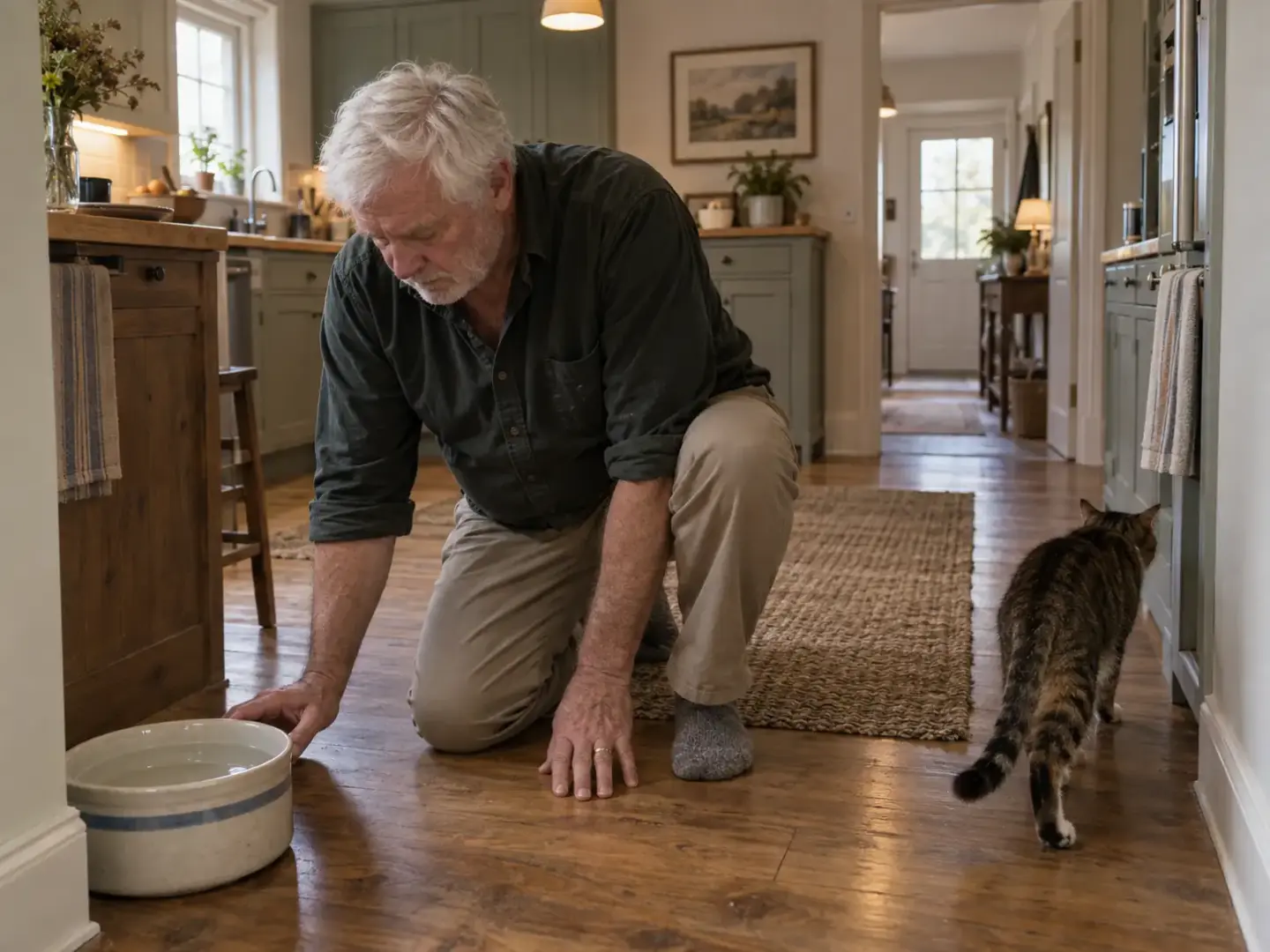
On this page8 sections
- 1Start With What Changed in the Last Two Weeks
- 2The Point Where This Stops Being a Bowl Problem
- 3What Is Actually Wrong With the Bowl You Already Own
- 4Where the Bowl Is Standing, and Why the Cat Disagrees
- 5In a House With More Than One Cat, Nobody Is Watching the Right Thing
- 6Count the Water That Is Already in the Food
- 7Closing the Loop
- 8Frequently Asked Questions
The bowl is full. It is standing exactly where it has stood for two years, in the same spot you have refilled a thousand times, and your cat walks past it like it isn’t there. Search what causes a cat to not drink water and almost every result opens with a list of illnesses, which is the one part of this you cannot check yourself at eleven at night.
He isn’t being difficult. A cat that stops drinking from a particular bowl is usually telling you that something changed about that bowl, that spot, or that week, and the fix is almost never the thing you were about to buy. Here is what to check tonight, in the order a real apartment makes possible, and the point where this stops being ours to answer.
Quick Answer
Work down this ladder in order. The first four are free and take one evening.
- Something changed recently: new food, new bowl, a move, a new housemate
- The bowl itself: plastic, too narrow, or filled only partway
- Where it stands: next to the litter box, the food, or a noisy appliance
- Water already in the food: wet food is mostly water, dry food is not
- In a multi-cat home, the bowl empties even if one cat has stopped
- Call the vet today if there is no water at all, no urine, or dry gums
Start With What Changed in the Last Two Weeks
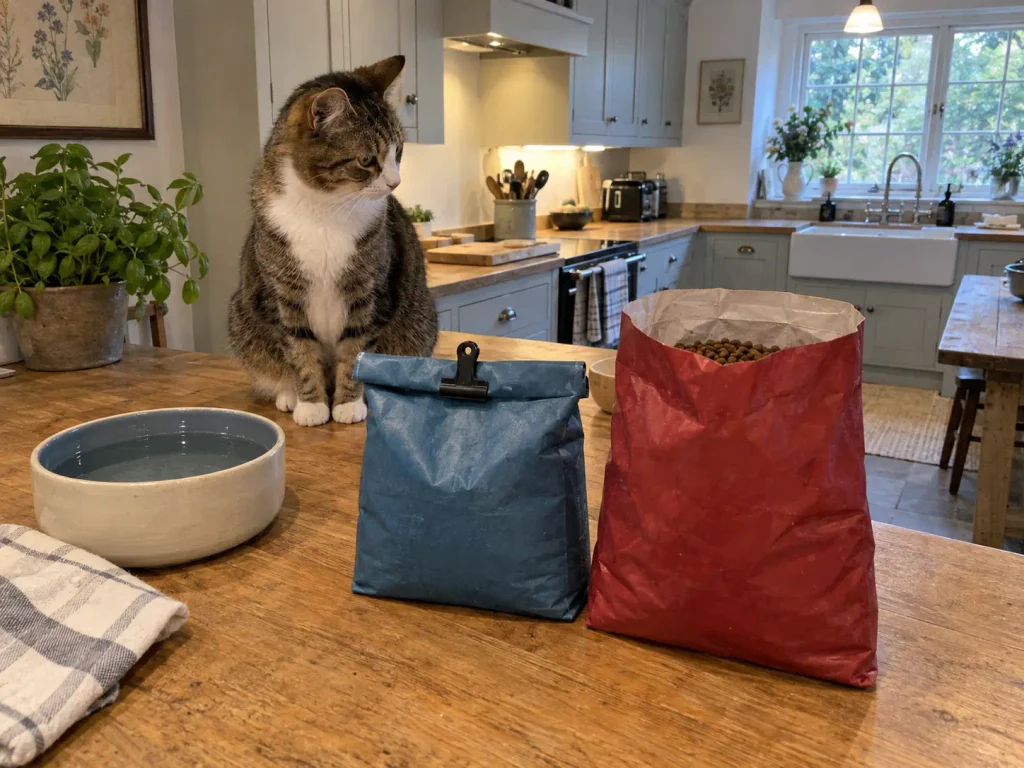
Everyone’s first instinct is to search for a disease, and it is the wrong first move for a purely practical reason: you cannot test it from your kitchen. A cat that drank normally in August and stopped in September usually had something happen in September. Start there, because whatever you find is something you can undo tonight for nothing.
Before you go further, separate two situations that almost every article treats as one.
A cat drinking less than you expected and a cat that has stopped entirely are different problems on different clocks. Drinking less is often not a problem at all, especially once you know what the daily baseline actually is and how much of it arrives in the food rather than the bowl, which is the whole subject of how much water a cat actually needs in a day. Stopped entirely is a much shorter clock, and it skips most of this article. Know which one you have before you start rearranging furniture.
The testable-change list is shorter than you’d think. A new bag of food, including a switch between two dry brands that look identical in the bowl. A new water bowl, or the old bowl run through the dishwasher with a detergent you just started using. A bowl that got moved six feet during a cleaning.
A move to a new apartment. A new person, a new baby, a new cat, a new dog. A radiator that came on for the season, or an air conditioner that changed the temperature of the room the bowl sits in. Any of those lands in the same two-week window as the behavior you noticed.
Then run the reversal, because it is the cheapest diagnostic available to you. Put the old thing back for two or three days and watch.
If the old bowl comes back out of the cabinet and he drinks from it on day one, you are done, and you didn’t spend anything. If nothing changes, you have eliminated an entire branch of causes rather than guessing at it. Either outcome is worth three days.
One thing worth checking before you conclude that nothing changed: the bowl that is “full” because nobody has emptied it. Stale water is the phrase owners actually use in these threads, and it is accurate. Topping up a bowl is not the same as refilling it, and a bowl that has been sitting in a warm room since Tuesday has picked up dust, litter grit, and the smell of whatever it is made of.
You are looking at the water line. He is smelling the water. Those are not the same measurement.
Dump and rinse rather than top up, and do it at a fixed point in your own day so you don’t have to remember when you last did it. Morning coffee works because you are already standing at the faucet. A bowl topped up for four days and a bowl emptied daily look identical from above, which is exactly why this one gets missed.
For an older cat, add one more item to the change list: anything that altered how far he has to bend. A bowl that moved from a raised stand to the floor is a change even though the water is the same, and stiff joints turn a low bowl into a small negotiation every time. That is its own question, worth reading about in whether elevated bowls are actually good for cats, because the answer is not a flat yes.
And if you genuinely go through all of it and nothing changed, that finding matters. A cat that stopped drinking for no reason you can find has moved past the part of this that belongs to an apartment.
The Point Where This Stops Being a Bowl Problem
Here is the sentence the other sites bury under four sections of symptom lists. We can help you with the apartment. We cannot tell you what is wrong with your cat, and neither can anyone else typing on the internet.
A change in drinking can come from a kidney, urinary, dental, or digestive problem. That is the honest version, stated as a category, and this article is not going to sort it for you. Separating those requires a vet, an exam, and usually a blood draw. Ranking them by likelihood in a paragraph would be guessing dressed up as help, and you would make a decision based on it.
The one worth naming for the reader who came here about a bowl is mouth pain, because it disguises itself as a bowl problem. A cat that walks up to the water, sniffs it, and turns away is behaving differently from a cat that avoids that corner of the kitchen entirely.
The first one wants the water. Something about the act of drinking is the obstacle, and no bowl swap fixes that. If you are also seeing food dropped mid-meal or a paw going to the face, that pattern belongs in front of a vet rather than in a shopping cart.
There is one observation you can make at home, and it is an observation, not a diagnosis. Lift the loose skin over the shoulders and let go: on a well-hydrated cat it drops back flat almost instantly.
If it stays tented, that is information to bring to a vet. The honest caveat comes from Cornell’s own guidance, which notes that geriatric cats can show reduced skin turgor even when they are normally hydrated. On a senior cat, this check alone can raise a false alarm. Use it as one input, never as the answer.
If you live with two or more cats and your honest answer to “has he been drinking?” is “I think so,” stop and notice that you just found something. Not knowing is itself the finding, and it changes what you can safely conclude from a bowl that keeps emptying. The fix for that blind spot is further down, and it costs nothing.
There is also a trap in the phrase “well, he drinks a bit.” According to Ridgefield Veterinary Center’s guidance on when dehydration becomes an emergency, “Even if your cat is still drinking water, dehydration can continue to worsen when fluid loss exceeds the amount they take in.” Some intake is not automatically a green light. The question is whether what goes in is keeping up with what goes out, and that is not a question a water line answers.
Some things do not wait for the weekend. No water at all for a day. No urine in the litter box. Gums that feel dry or tacky rather than slick. A cat that has taken himself somewhere quiet and will not get up.
Any of those is a call to your vet today, not a thing to watch overnight, and everything below this section assumes your vet has already been part of the conversation.
What Is Actually Wrong With the Bowl You Already Own
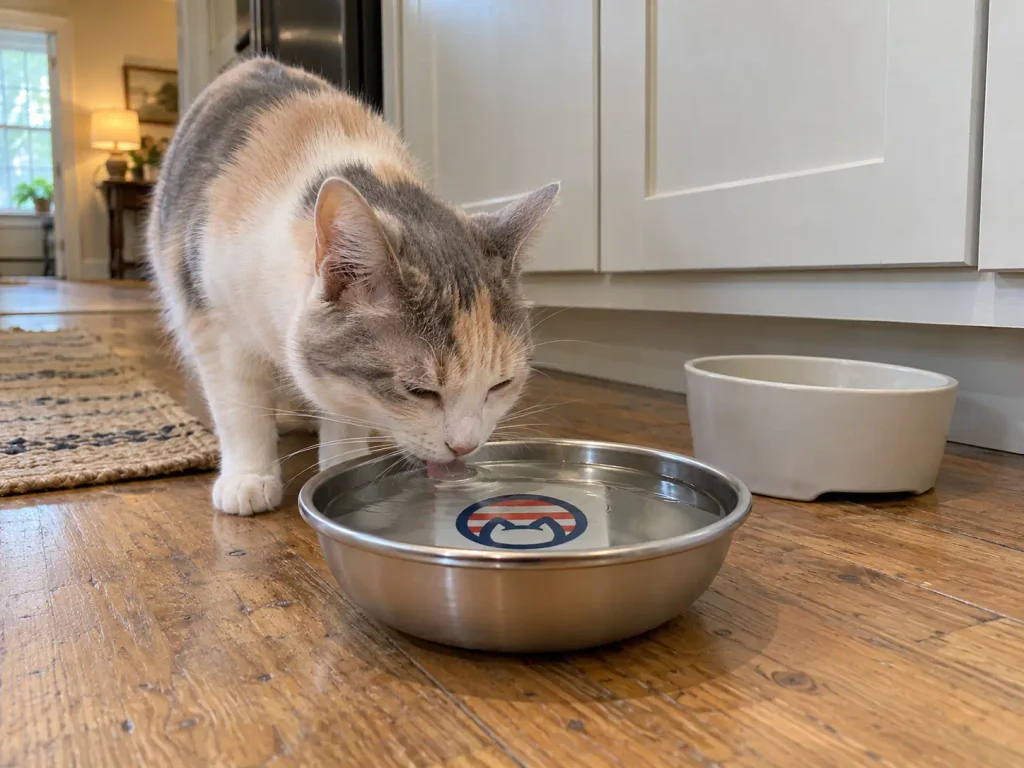
The bowl looks fine to you because you are not the one drinking out of it. Three things about a perfectly normal-looking bowl change a cat’s mind, and two of them cost nothing to fix.
Start with the bowl material. Plastic holds smell, and the fine scratches that every plastic bowl picks up within months hold bacteria in a way glass and steel do not. Vet Help Direct connects that same scratched-plastic surface to chin acne, which is the version of this problem you can see.
The version you cannot see is that the water tastes faintly of the bowl. To you it is water. To an animal with a nose that good, it is water plus something, and the something has been getting stronger since spring. Whether that rises to a real problem depends on the bowl and how old it is, which is worth a look if you are deciding whether a plastic bowl is actually a problem or just a suspect.
Then the shape, which is the one almost nobody checks. A narrow, deep bowl means the whiskers brush the sides on every single sip.
Whiskers carry a dense supply of nerve endings, so a bowl that reads as completely normal to a human hand can be genuinely unpleasant to put a face into forty times a day. The tell is a cat who drinks in short bursts and backs off, or who paws at the water and licks his foot instead. That behavior gets read as fussiness constantly, and it is not: he found a workaround to a problem you gave him. How much of this is established and how much is still an open question is covered in whether whisker fatigue is real, and the honest answer has a “maybe” in it.
The third one is the fill level, and it is free. A bowl filled to the brim means his whiskers clear the rim entirely and his head barely drops. The same bowl filled a third of the way means his whole face goes inside a hard-walled cylinder. Same bowl, same water, completely different experience, and most of us fill a water bowl about a third of the way out of pure habit because that is how you fill a food bowl.
Fill it to the brim, not to the third. It is the only change in this section that takes one second and costs nothing, and it removes the whisker contact and the head-dip in the same move. Do it before you change anything else, so you know what did the work.
Before you buy a thing, raid your own kitchen. A wide, shallow glass or ceramic bowl already in the cabinet rules out both the material and the shape for free, and a dinner plate with a slight lip is a perfectly good one-week test. If the cat starts drinking from a cereal bowl on the floor, you have your answer and you have spent nothing. That is the test worth running first, because it tells you which of the three things above was the actual culprit rather than fixing all three blind.
If that test says the bowl was the problem and the only bowls you own are the scratched plastic ones this section just ruled out, that is the point where buying something is a reasonable answer instead of a reflex. The Americat Company stainless steel cat bowls come as a pair in food-grade 18/8 steel, which does not hold odor and does not develop the scratch texture plastic does, and they are wide and shallow enough that the whiskers clear the rim. The pair matters more than it sounds, for reasons that come up two sections from now. The catch is that steel is loud and light: a cat who pushes his bowl around the kitchen will slide a steel one further than a heavy ceramic one, and if that is your cat, ceramic is the better call.
Where the Bowl Is Standing, and Why the Cat Disagrees
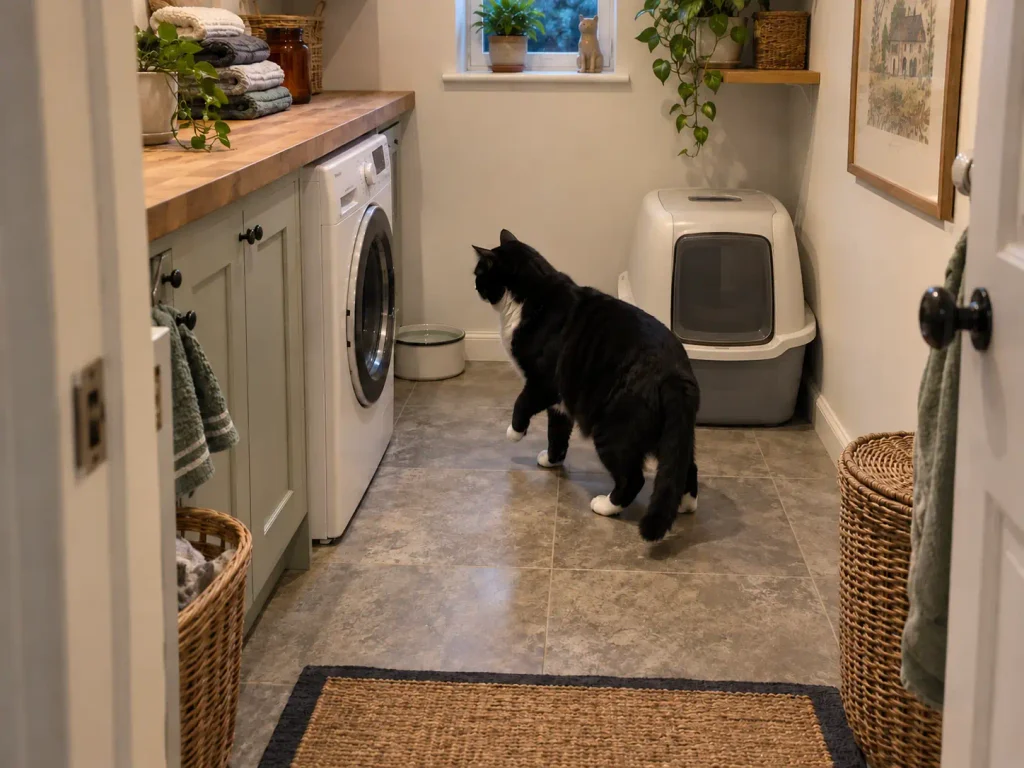
This is the section where the cat is right and you are wrong, and it is worth saying plainly. You put the bowl where it was convenient. He is applying a rule he did not choose and cannot negotiate.
The big one is the litter box. Putting food and water next to the box is convenient for cleaning, keeps the mess in one room, and is the single placement a cat’s instinct rules out. In the wild, a cat does not drink where it eliminates, for reasons that stopped being optional a long time before your apartment existed.
As veterinarian Fiona Gilston explains about bowl placement, “Separating the litter tray from the water bowl in your house can help your cat be more inclined to use the litter tray as well as being more inclined to drink their water.” That is not fussiness. That is a restriction, and restrictions do not respond to persuasion.
Right beside the food dish is the other one, and it surprises people more because it looks so tidy. Cats do not naturally drink at the place they eat, which is why the matching-bowls-on-a-mat setup that looks correct to us quietly underperforms.
It is a real effect and it has its own answer elsewhere in the bowls room, so all you need here is the practical version: move the water away from the food and see what happens. Three feet is a start. Another room is better.
Then there is which way he faces. Vet Help Direct notes that cats prefer to drink facing out into the room rather than with their back to it, and prefer to be able to approach from more than one side.
A bowl wedged into a corner or pushed flat against a wall means he has to put his back to the doorway to use it. In a quiet house with one cat, he may not care. In a small apartment with traffic through the kitchen, a dog, a toddler, or a second cat, that corner reads as a spot with one exit, and cats have opinions about spots with one exit.
The apartment version of this problem is that you cannot move the litter box. One bathroom, one viable wall, and the box is already in the only place it fits. Fine.
Move the water instead. A second station in a bedroom or at the end of a hallway costs nothing, needs no drilling, and is not subject to your lease. The instinct is about the distance between the two things, not about which one you relocate.
One last suspect that nobody connects: the washing machine. A bowl standing two feet from a machine that kicks in on a timer teaches a cat that this particular spot occasionally roars at him without warning. He stops using it, you refill it every day without noticing it stays full, and the two events never get linked because they don’t happen at the same time of day. If your water is near an appliance with a schedule, move it and give it three days.
In a House With More Than One Cat, Nobody Is Watching the Right Thing
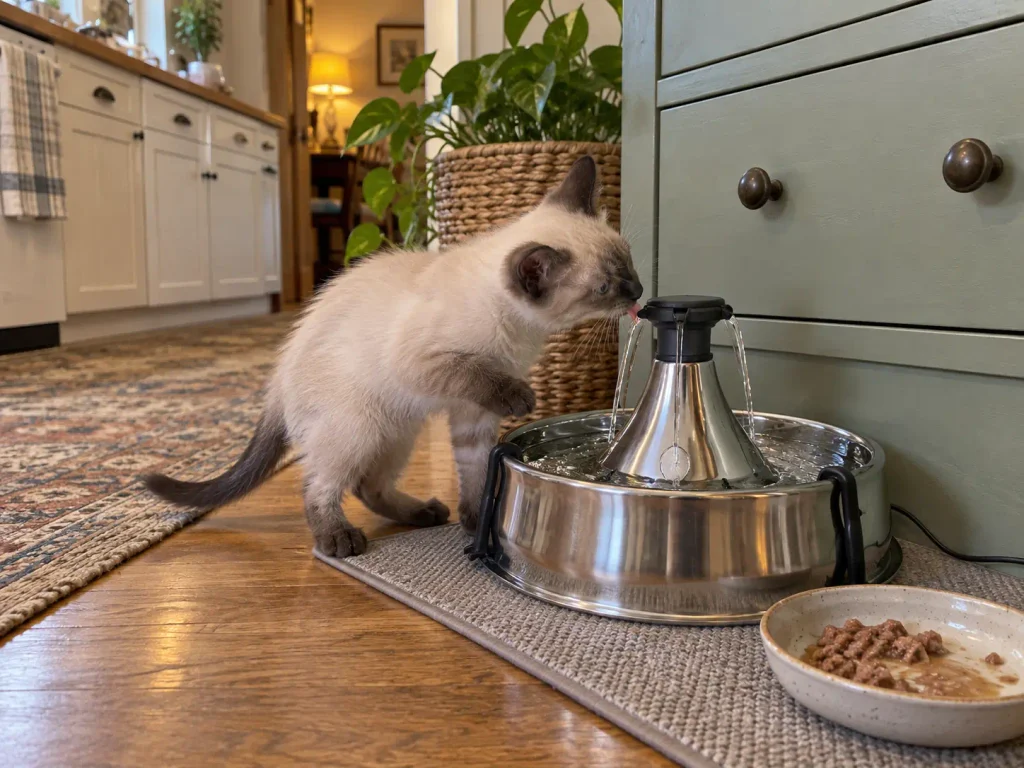
You have been checking the water level. The water level tells you that a cat drank. It does not tell you which one, and in a house with two or three cats that distinction is the whole question.
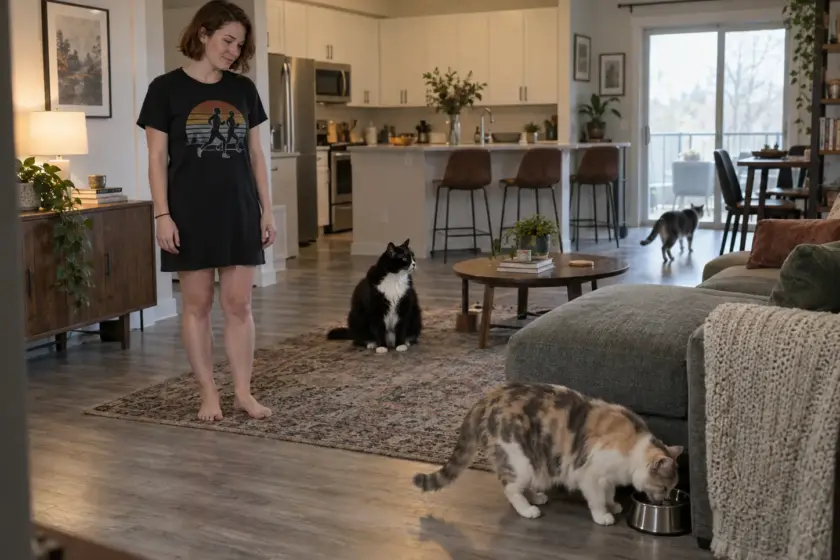
This is the blind spot none of the standard articles raise. In a multi-cat home, one cat can stop drinking almost entirely and the bowl will still empty on roughly its normal schedule, because the other one is drinking normally and picking up the slack. You look at the bowl every morning, see it lower than yesterday, and conclude that everyone is fine. The Cornell Feline Health Center’s guidance on feline hydration names the mechanism directly: a cat can have its water intake cut by territorial friction with another cat in the house.
Being “banned from the bowl” is the phrase that shows up in cat forums, and what makes it hard to catch is that there is usually nothing to see. No growling, no chasing, no fur on the floor. One cat sits somewhere with a view of the kitchen, and the other one decides the trip is not worth it today.
The rule is the same one you already know from litter boxes, and it exists for the same reason: one water station per cat, plus one spare, in different parts of the home. Two cats means three stations, and the point of multiple water sources is reach, not volume. Not one big bowl that holds three cats’ worth of water, which solves a volume problem nobody had while leaving the actual problem untouched.
The part that gets skipped is “different parts.”
Three bowls lined up against the same kitchen wall is one station as far as the cats are concerned, because a cat who is being kept away from that area is being kept away from all three. They have to be far enough apart that one cat cannot supervise them all from a single spot. That is the entire mechanism, and it means the question is never just how many bowls you have but where they stand. The count math for a bigger household gets its own treatment over in the bowls room; what matters here is the separation.
In a small apartment, “different rooms” is more flexible than it sounds. Vertical counts. A bathroom counter, a bedroom windowsill, a shelf a cat already jumps to: all of these are separate stations in the way that matters, because getting to them requires a different route than the kitchen. A 500-square-foot apartment has more usable water locations than it has floor space, as long as you stop thinking about floors.
So how do you actually find out who is drinking, given the bowl will not tell you? Not by measuring, which we will get to. Watch instead, and watch at the right moments: cats tend to drink shortly after eating and during their active stretch in the early evening, so five minutes of paying attention at dinner is worth more than a week of checking the water line.
Then separate the stations far enough that the next time you glance at one, a drop in that bowl means something specific rather than something general. That is what you are buying with the third station. Not more water. Information.
Count the Water That Is Already in the Food
Before you decide the cat is not drinking enough, work out how much water he is getting without the bowl. Cats evolved with a low thirst drive and a body built to pull most of their water out of prey, so a cat on wet food who “barely drinks” may be doing perfectly well. A cat on dry food drinking exactly the same amount is a different situation, and the bowl looks identical in both cases.
Cornell puts the baseline at about four ounces of water per five pounds of lean body weight per day, from all sources combined. For an average ten-pound cat that is roughly a cup a day in total, and the words doing the work in that sentence are “all sources.” Not a cup out of the bowl. A cup including everything he eats.
That changes the arithmetic completely, because the moisture content of wet food runs somewhere around 78 to 80 percent and dry kibble is closer to 10 percent. A cat eating mostly wet food is taking a large share of his daily total at dinner, before he has gone anywhere near the bowl. The bowl barely moving is the expected result, not a symptom. Flip it around and a cat on an all-dry diet has to make up nearly the entire cup by drinking, which is why the same quiet bowl means two completely different things in two different kitchens.
Here is the gap in the standard advice, though. Every article cites the ounce figure, and none of them mention that you cannot check it. Measuring bowl consumption in a real apartment is close to useless: water evaporates from an open bowl in a warm room, a faucet that drips gets discovered and becomes a water source, there is a glass on your nightstand, and if there is a second cat you already know the problem.
The number is a useful baseline for understanding what normal looks like. It is not a home test, and treating it like one produces false alarms in both directions.
The cheapest test in this article: stir a tablespoon of warm water into the food he already eats, tonight, before you buy anything. Warm rather than cold, because it carries more smell. If he finishes it, you have added water without asking him to change his mind about a bowl, and you can work up from there.
That tablespoon scales. Work up gradually to a few, stir in a spoon of plain unsalted broth if plain water gets ignored, or swap a single meal a day to wet food and leave the rest alone. Both routes add real water to the daily total, neither requires the cat to accept a new object in the apartment, and both are reversible on the spot if he objects. Start small enough that he doesn’t notice, because a cat who notices a doctored meal will remember the bowl it came in.
Running water goes last, and deliberately so. Some cats genuinely drink more from a moving source, and the honest version is that some do not, which is worth knowing before you spend anything: the evidence is thinner than the marketing, as the research on whether fountains actually work lays out.
The conventional advice is to open with a fountain. In practice it belongs here, after the free tests have told you what you are actually dealing with, because a fountain that fixes nothing is an expensive way to find out the bowl was next to the litter box. In an apartment there is also the noise question, which matters more when the thing is running all night ten feet from your bed and is covered in whether fountains are safe and livable in a small apartment.
If you’ve run the free tests and the answer really is that he’ll drink from a moving source but ignores a still one, the PetSafe Drinkwell Stainless 360 is the one that fits the situations this article keeps describing. It holds 128 ounces, it is drinkable from any side, so two cats are not queuing at a single spout, and the full stainless basin closes the loop on the plastic-taste problem from three sections ago. The pega, and it is the reason half the one-star reviews on every fountain exist: it has a filter and a pump, and both need cleaning on a schedule nobody reads off the box. A fountain you don’t maintain is a stale bowl with a motor in it.
Closing the Loop
Work backward from the last two weeks before you work forward from a symptom list. A change you can undo is the cheapest answer available to you, and you can test it tonight.
Treat the bowl you own as a suspect rather than a constant. Wide, shallow, not plastic, filled to the brim, and standing somewhere he can drink facing the room instead of the wall.
In a multi-cat home, the water level answers the wrong question. Separate the stations until a drop in one of them tells you something about a specific cat.
Check back in three weeks. Not three months, because everything in this article depends either on a cat accepting a change or on you keeping a routine, and both of those fail inside a month or not at all. At three weeks, look at three things: is the new spot still in use or did it get quietly abandoned around week two, is the bowl actually being emptied and refilled rather than topped up, and can you still answer the question of who drinks where.
Start by moving the bowl to the other side of the room and filling it to the brim. It costs nothing, it takes ten seconds, and if it works you have both your answer and the money you didn’t spend.
Amazon’s Audible — free for 30 days
Your cat won’t let you read. Let someone read to you.
Audible is Amazon’s audiobook library — thousands of titles, read out loud, on your phone. Free for a month, plus one audiobook to keep forever.
Frequently Asked Questions
01Why won’t my cat drink water all of a sudden?
A sudden stop usually traces back to something that changed in the same period: a new bowl, a new food, a move, another animal in the house. Work through the last two weeks first, because those causes are the ones you can test by undoing them. If nothing changed and he has genuinely stopped, that is a call to your vet rather than a bowl problem to solve.
02How Do I Get a Cat to Drink More Water Without Buying Anything?
Fill the existing bowl to the brim, move it away from the litter box and the food, and stir a splash of warm water into the meal he already eats. Those three cost nothing and account for a large share of cases. A fountain is worth trying after they have failed, not before.
03My Cat Is Eating Normally but Not Drinking. Is That Still a Problem?
It can be either, and the food is what decides. A cat on mostly wet food takes in a lot of water at dinner, so a quiet bowl may mean nothing at all. A cat on dry food who has stopped drinking is a different situation, and one worth a vet call rather than a wait.
04How Long Can a Cat Go Without Drinking Water?
Not long enough to wait and see. Rather than counting hours, watch for the signs that change the answer: no urine in the litter box, dry or tacky gums, hiding and not getting up. Any of those is a same-day call, and how much time is left is a question for your vet, not for a blog.
Leave a comment