Are Cat Water Fountains Safe in a Small Apartment
Are cat water fountains safe? Yes, and here's how to keep one that way in a small apartment (cord checks, cleaning cadence + noise fixes).

Alfredo RamsesFounder · August 26, 2026 · 18 min read

On this page8 sections
- 1What Is Actually Running in Your Apartment All Day
- 2When This Stops Being a Fountain Question
- 3The Cord Is the Whole Electrical Risk
- 4The Slime Is Biofilm, and It Is Telling You Something
- 5The Noise, and Why an Apartment Makes It Worse
- 6Two Cats Change the Answer
- 7The Short Version
- 8Frequently Asked Questions
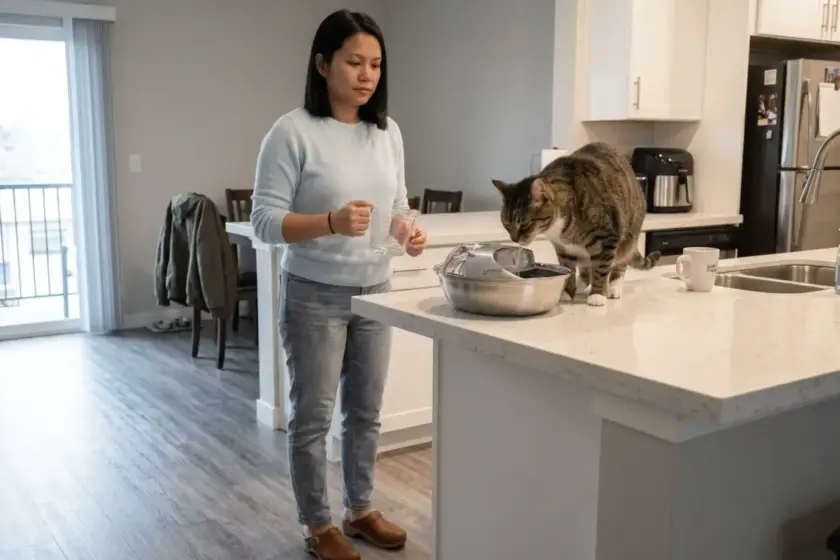
The fountain is already plugged in. It has been humming on the kitchen floor for a month, and the three things actually keeping you up are the cord going into the water, the slick film you felt on the inside of the reservoir last time you refilled it, and the noise it makes at two in the morning fifteen feet from your pillow. Nobody who asks whether cat water fountains are safe is asking about the abstract idea of safety. They are asking about a specific appliance sitting on a specific floor, and the honest answer starts with which of those three fears is mechanical and which one is a cleaning schedule wearing a scary costume.
Quick Answer
Yes, a cat water fountain is safe in an apartment, and the risk is not the one most people picture. The pump is sealed and low-voltage; what matters is a cord already damaged by age or teeth, sitting in a wet spot, on an outlet with no GFCI protection. The slime is biofilm, not mold.
What Is Actually Running in Your Apartment All Day
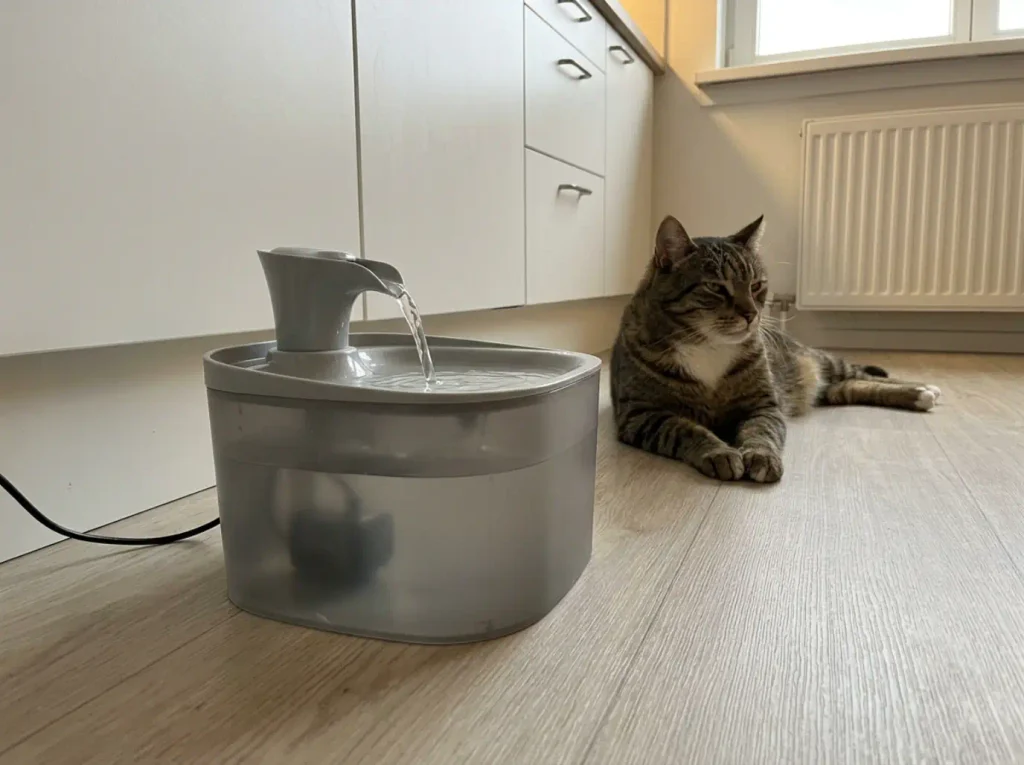
Nobody reads the pamphlet. The fountain came out of the box, went on the floor near the only outlet that was free, and it has been running ever since. So here is what is in there, because every risk further down this page attaches to one of these parts.
The whole point of the machine is running water, which taps a moving water instinct that predates plumbing. Whether the thing is worth having at all is a separate question, and what a fountain actually changes for the cat drinking from it is the argument this page deliberately does not re-run.
The part sitting in the water of any pet water fountain is a small submersible pump, and it runs on low-voltage DC. The transformer that steps mains current down lives outside the water, in the block at the plug end, which is the single most reassuring fact about these machines and the one nobody bothers to tell you. What is submerged is an impeller spinning on a magnet.
Not a heating element, not a mains connection. That is why the failure mode of a dying fountain is a burned-out motor and a plastic smell, not a fire.
The cord is sealed at the factory and rated for exactly what it is doing. It is built to sit in water indefinitely. The risk arrives later, when that seal has been compromised by age, by teeth, or by being yanked out of the reservoir at an angle two hundred times over two years.
And the single most common way these units die has nothing to do with electricity at all. It is running dry, which is what an auto shut-off pump exists to prevent: a float or water-level sensor cuts the motor before it starts pulling air. Owners describe the same sequence over and over in fountain threads: the low hum turns into a gurgle, nobody registers it for a day or two, and by the time someone looks the reservoir is nearly empty.
The gurgle is the impeller pulling air instead of water. It is not a defect and it is not the motor failing. It is a refill problem that becomes a motor problem if you let it run for a week.
When This Stops Being a Fountain Question
Someone typing “are cat water fountains safe” at eleven at night is often not asking about the appliance. They are asking whether their cat is okay. Those are two different questions and only one of them belongs on this page, so let me get the other one out of the way properly instead of burying it in a footnote at the bottom.
A cat whose drinking changes noticeably in either direction, suddenly drinking far more or suddenly stopping, is a same-day phone call to a vet. Not a fountain adjustment, not a different filter, not a new model with a better flow rate. Straining in the box, crying in the box, or anything that looks like blood is a vet visit today, and nothing written here changes that or delays it.
The fountain is not the variable being tested in any of those situations. It is a machine on the floor.
What this page can answer is whether that machine is a hazard and how to keep it from becoming one. That is furniture, plumbing and noise. It is genuinely useful and it is genuinely not medicine.
Worth knowing while we are drawing that line: no cat water fountain has ever appeared on the CPSC’s recall list. There is no pattern of documented incidents to be scared of, which cuts both ways. It means the safety case for these things rests on ordinary practice around low-voltage appliances near water rather than on a federal record of nothing having gone wrong. Nobody else writing about this says so, and it is more honest than pretending an absence of data is a certificate.
The Cord Is the Whole Electrical Risk
Here is the apartment version of this problem. Your kitchen has two outlets. One is behind the fridge and has been unreachable since you moved in. The fountain has to live somewhere within reach of the other one, and that other one is next to the sink.
What a Damaged Cord Actually Does in Water
Insulation is not permanent. It breaks down from flexing, from age and from constant moisture contact, and once the seal is compromised the submerged cord stops being a sealed length of wire and becomes a live one. That is the entire mechanism, and it explains why “should the cord go in the water?” is the wrong question.
A factory-sealed cord in water is fine. A frayed cord in water is not. The variable is the condition of the cord, not the presence of water.
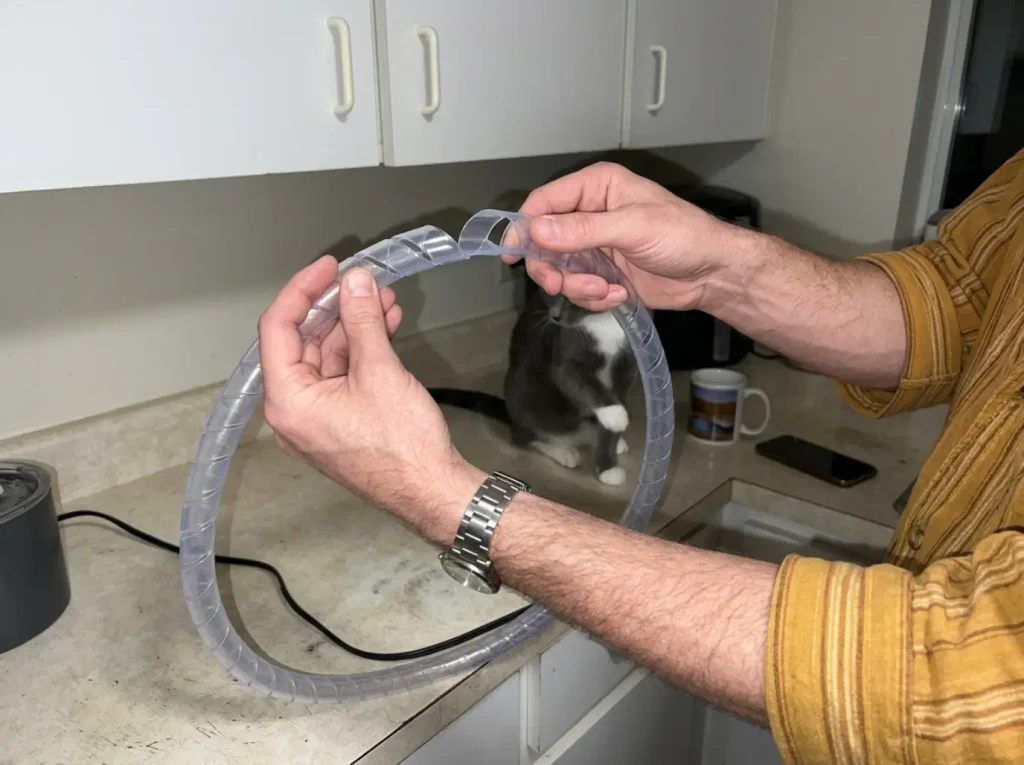
Which makes the fix a ten-second inspection rather than a rule about placement. Run the cord through your fingers from the adapter to the reservoir, once a week, feeling for nicks, kinks and tooth marks. You are not looking for anything subtle. A compromised cord announces itself.
Do the cord check on refill day, not as its own task. You are already standing at the sink with the reservoir in your hands and the cord in the way. A separate weekly reminder gets ignored by week three; a step folded into something you already do survives.
GFCI, and Why It Is the Only Thing That Matters
A GFCI outlet is the one with TEST and RESET buttons on it, and it de-energizes the circuit the instant current starts going somewhere it should not. It is the reason a failed cord stays a ruined cord instead of becoming an incident. US kitchens and bathrooms built or rewired since the seventies mostly have them. Older apartments, and there are a lot of older apartments, often do not, and in a rental you are not rewiring anything.
Go look at the outlet the fountain is plugged into right now. If it has the two buttons, you are done and you can stop thinking about this section. If it does not, a plug-in GFCI adapter is the renter’s version of the fix.
It goes in the wall, the fountain goes in it, and nothing gets drilled or rewired. What it is not is an excuse to reach for an extension cord: running one across a kitchen floor to solve poor outlet access puts more cable in the splash zone, which is the opposite of the fix.
Before any of that, though, do the free thing. Route the cord so it does not lie in the splash zone. Cats push water out of these bowls, that is half of what they are for as far as the cat is concerned, and a puddle that reaches a coiled cord on the floor is a situation you created for nothing.
Run it up and behind, along the base of the cabinet, away from where the water lands. Costs nothing. Removes most of the exposure.
The Cat Who Chews Cords
If you live with a cord chewer, everything above changes weight. This is not a reason to give up on a fountain, and it is not the cat being difficult. A thin flexible cord at floor level, in the room where the food is, is the most interesting object in his territory and he is right about that. It is an equipment problem with an equipment answer.
The Chewsafe Pet Cord Cover Anti-Chew Cable Sleeve is a 10-foot bitter-apple-infused cord protector that covers the exposed run between the reservoir and the wall, which is the only stretch a cat can actually get his teeth around. Ten feet is more than a fountain run needs, so you will have some left over for the lamp cord he has also noticed. The limitation is honest: bitter apple deters most cats and a minority are entirely unbothered by it, and for that minority a sleeve is a physical barrier rather than a repellent.
For a determined chewer, or for a kitchen where the only outlet really is behind the fridge, there is the option of removing the cord from the room altogether. The Wireless Cat Water Fountain Cordless runs on a battery with a motion sensor, holds 108 oz, and answers the cord question by not having one. It is the premium end of this category and it trades a permanent problem for a recurring one, because a battery that needs charging is a fountain that can be off without you noticing.
Worth it for a chewer. Overkill for anyone whose cat has never looked at a cable.
The Slime Is Biofilm, and It Is Telling You Something
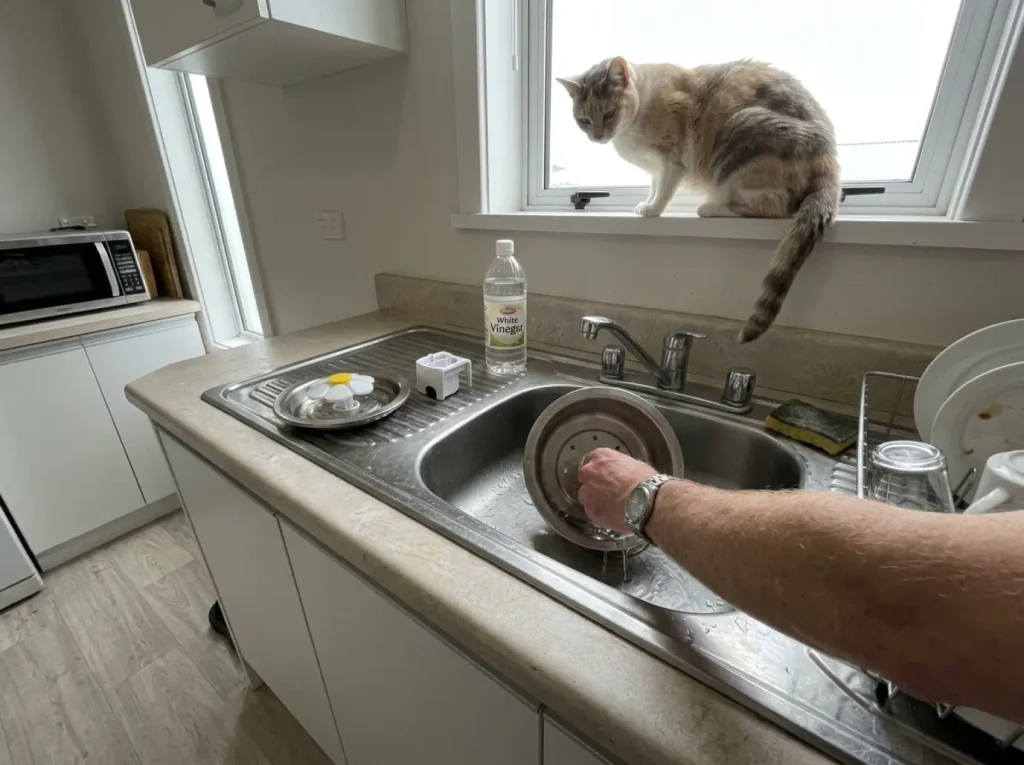
You put your hand in to refill it and the inside of the reservoir has that texture, the one that belongs to a flower vase left standing a week too long. Slick, faintly resistant, comes off on your fingers. That texture is the reason a lot of people quietly decide the fountain is making their cat sick, and it is worth knowing exactly what it is before you make that call.
What That Texture Actually Is
It is biofilm: a mixed community of bacteria and fungi held together in a slick matrix, and it comes from two places. Most of it arrives from the cat’s own mouth, transferred a lick at a time. The rest lands out of the air, the way anything lands in standing water in a room where people live.
It is not mold. It is not a manufacturing defect, and it is not evidence that you bought a cheap fountain.
It forms in every fountain, of every material, at every price, BPA-free plastic included, and in every plain water bowl that ever sat out overnight. Stainless steel and ceramic slow it down. Nothing prevents it, because preventing it would mean the cat’s mouth never touching the water, at which point you have a decorative object.
The reframe that matters: biofilm is a clock, not a hazard. Its presence tells you how long it has been since the last clean, the way a full sink tells you how long since the last wash. What it is not is a verdict on the machine.
The Cadence That Keeps It Down
Two numbers, and they are small. A rinse of about sixty seconds daily, and a full strip-down of ten to fifteen minutes weekly. That is the standard that community advice and manufacturer instructions converge on from opposite directions, which is usually a sign the number is real.
For the weekly clean, use plain white vinegar. It breaks the matrix down, it is safe around cats, and it is already under your sink. Skip bleach completely. Not because a diluted rinse would necessarily hurt anything but because the vessel in question is one your cat drinks out of daily, and vinegar does the identical job without you having to be confident about your rinsing.
The filter is the consumable this whole cadence runs on, and it is the part that quietly gets skipped for months. Most of these units stack two stages: a mechanical filter that catches hair and grit, and carbon that handles taste.
A 3-pack of Catit replacement carbon filters covers a couple of months at the standard two-to-four-week filter change cadence, and buying three at once is the trick that makes you actually change it, because the reason people run a filter for eight weeks is almost never budget. It is that there was no spare in the drawer. Note that these are the Catit-shaped cartridges specifically; every brand’s fountain takes its own shape and none of them interchange.
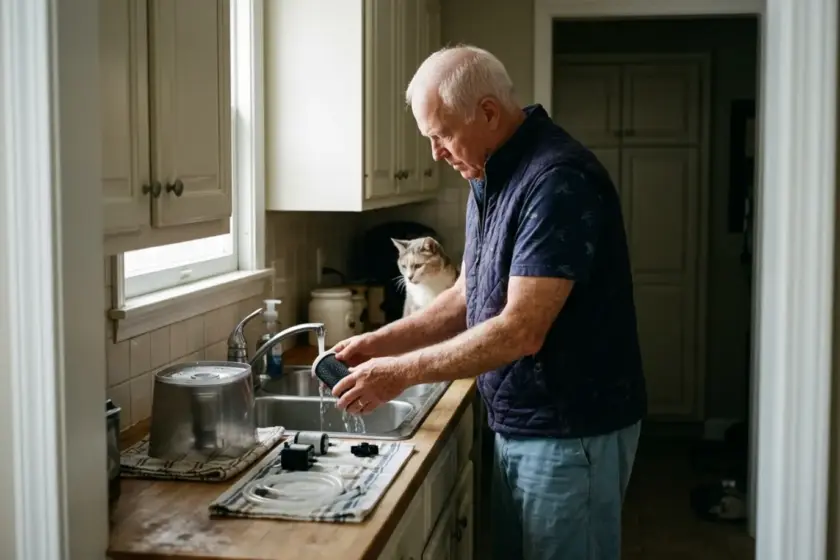
Rinsing and swapping the filter is the maintenance floor. Above it sits taking the pump apart properly, which is the part nobody does, and that is where the biofilm you cannot see is actually living.
If the reservoir feels slick before the week is out, that is the fountain telling you your apartment runs warmer than average, not that you bought the wrong model. Shorten the interval to every four or five days and stop shopping for a replacement.
Where the Material Actually Helps
Plastic scratches. Every plastic reservoir develops a fine web of scratches from scrubbing, from grit, from a year of being handled, and each scratch is a trench that biofilm settles into and a sponge cannot reach. That is the real argument for stainless steel or ceramic, and it is a maintenance argument rather than a health claim.
A smooth surface stays clean with less effort. A scratched one fights you.
If you are replacing a plastic reservoir that has gone cloudy and rough, the Catit Stainless Steel Flower Fountain is a 3 L stainless bowl with a footprint small enough for a kitchen where counter and floor space are both already spoken for. Its limitation is the reservoir size: 3 L is a comfortable single-cat unit and a tight two-cat one, and it will want refilling more often than you expect in a warm apartment.
I used to think the plastic-versus-steel argument was mostly marketing dressed up as hygiene. Then enough threads made the same point about scratched reservoirs, and the mechanism is plain once you have seen it. It is not that plastic is unsafe.
It is that plastic gets harder to clean, and cleaning is the whole safety lever. If your plastic reservoir is a year old and still glass-smooth, keep it.
The Noise, and Why an Apartment Makes It Worse
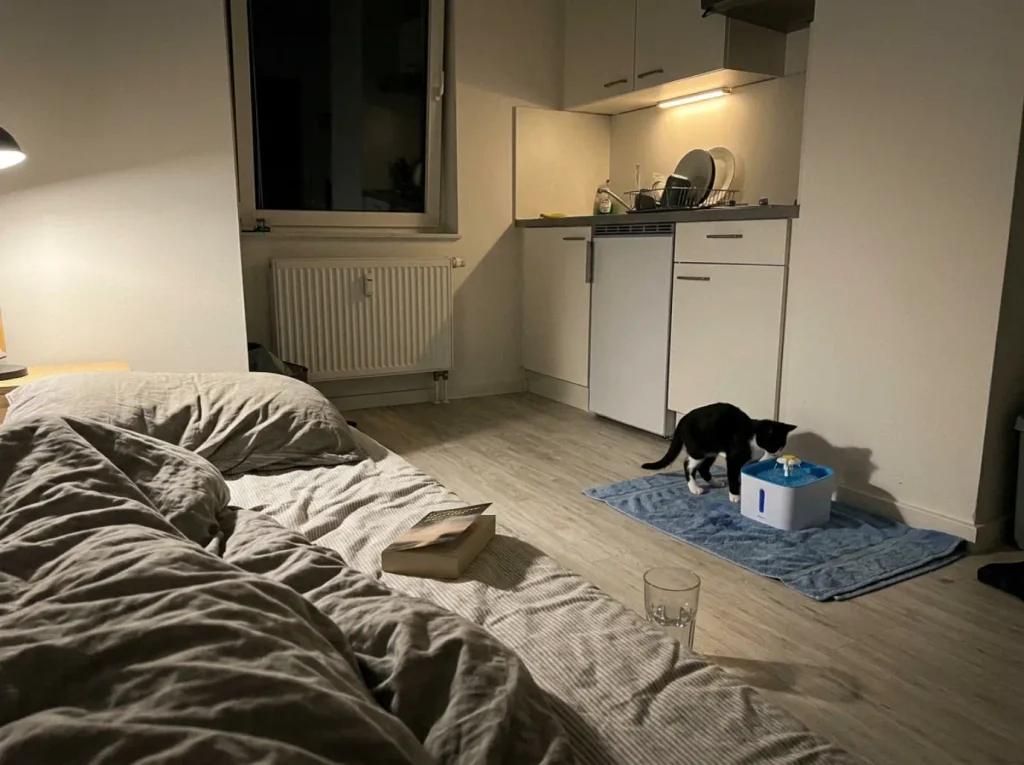
In a one-bedroom the fountain is maybe fifteen feet from where you sleep, and depending on the layout there is no door between the two. This section is about comfort on its face and about safety underneath, because the fountain that gets unplugged at midnight is a fountain your cat wakes up to as a bowl of stagnant water.
What a Normal Fountain Sounds Like, and What a Gurgle Means
A working pump is a low continuous hum, closer to a buzz than to anything mechanical. Most manufacturers claim somewhere under 35 decibels and the honest ones land near it. That hum does not get louder as the unit ages, which is the misconception that sells a lot of replacement fountains.
The gurgle is a different sound entirely, and once you have identified it you cannot un-hear it. It is intermittent, it has a swallowing quality to it, and it means the water level has dropped far enough that the impeller is pulling air. That is the sound that gets a fountain unplugged at two in the morning by someone who has decided it is broken.
It is not broken. It is thirsty, and the same low level that makes the noise is what grinds the motor down. Keeping the reservoir above its minimum line solves the noise and the wear at once, which is why the schedule that keeps the reservoir above the gurgle line is worth setting deliberately rather than refilling when you happen to notice.
The Free Fixes, in Order
Start with a folded towel underneath it. Almost all of what you hear from the bedroom is not the motor, it is motor vibration transmitted into a hard floor and re-radiated by it, and a folded dish towel or a spot of carpet interrupts that transfer. It is also the fix worth trying before you shop for a quiet fountain, because it costs nothing and it addresses the actual transmission path.
This is the fix people in fountain threads keep landing on after buying a quieter model that turned out to sound identical on tile. It is free, it takes four seconds, and it should always be attempt number one.
Then fill it to the top line rather than to whatever level feels reasonable. A full reservoir means a shorter drop from the spout to the surface, and splash noise scales with drop height. Half-full fountains are louder fountains, and the extra splash is where most of the mess on the floor around a fountain comes from too. A spill that reaches the cord is the one worth caring about.
Then move it. One room further from where you sleep does more than any model change on the market, and in a studio where there is no further room, the far wall still beats the near one.
Two Cats Change the Answer

With one cat a fountain is an appliance. In a multi-cat household it is a resource, and resources get guarded. Almost nobody writing about fountain safety separates these two situations, and they have different answers on both the hygiene side and the floor-plan side.
Biofilm on a Shorter Clock
Two mouths build the matrix roughly twice as fast, because most of the biofilm was always arriving by tongue. So the weekly strip-down becomes a five-day one, and the filter that was lasting four weeks starts looking tired at two. If you moved into a two-cat household recently and the fountain suddenly feels slimier than it used to on the same schedule, nothing is wrong with the fountain. The schedule was written for one cat.
The N+1 Rule, Applied to Water
The AAFP’s environmental needs guidelines recommend one water station per cat, plus one, which for two cats means a floor of three access points. Not three fountains. A fountain, a bowl in the bedroom and a bowl by the window counts perfectly well. What does not count is three vessels lined up at the same feeding station, which reads to the cats as one place.
And two moderate fountains in separate rooms beat one large fountain in the kitchen, every time. This is a floor-plan answer, not a capacity answer, and it is the point where most people troubleshoot in the wrong direction. If one of your cats will not touch the fountain, look for the other cat before you look at the machine.
Resource guarding at a water station rarely looks like a fight. A cat does not need to be blocking anything to make another cat stay away; presence is enough, and the under-drinking that follows happens gradually enough that you will not notice the day it started. The pattern that comes up again and again in multi-cat threads is a household that buys a bigger fountain, sees no change, and then solves the whole thing by putting a small second one in the other room.
For the household that has already spread its stations out and just wants the main one to stop needing a refill every second day, the PetSafe Drinkwell Stainless 360 holds 128 oz in a stainless reservoir with an all-round drinking edge, so two cats can drink at once without either one being crowded. Its real limitation is footprint. It is a big object, and in a small kitchen it wants a corner you may not have going spare, which is exactly why it is the second purchase and not the first.
Put the second fountain in a different room, not beside the first. Two bowls side by side is one water station as far as the cats are concerned, and the cat who was avoiding the first one will avoid the pair.
The Short Version
The cord is the electrical risk worth taking seriously, and it is covered by two things: a GFCI-protected outlet, and ten seconds of running the cord through your fingers on refill day.
The slime is biofilm and it is a clock rather than a hazard. A daily rinse and a weekly strip-down with white vinegar keep it where it belongs, and a smooth reservoir makes both jobs shorter.
The noise decides whether the fountain stays plugged in at all, and every fix worth trying first is free. A gurgle is a low-water signal, not a dying motor.
🗓️ Three months from now, look at three things: the cord, the impeller and the inside of the reservoir. Fountains are one of the few things in a cat’s apartment that wear out on an object clock instead of an acceptance clock, so the check-back is genuinely quarterly rather than the usual three weeks.
Tonight, put a towel under it and move it one room further from where you sleep. If the hum stops being a problem, you just talked yourself out of buying a new fountain.
Amazon’s Audible — free for 30 days
Your cat won’t let you read. Let someone read to you.
Audible is Amazon’s audiobook library — thousands of titles, read out loud, on your phone. Free for a month, plus one audiobook to keep forever.
Frequently Asked Questions
01Do vets recommend water fountains for cats?
Veterinary guidance generally supports giving cats more ways to drink, and a fountain is one of them. What a fountain cannot do is treat or prevent a medical problem. If your cat’s drinking has changed, that is a vet call rather than an equipment decision.
02Are cat water fountains safe to leave on all the time?
Yes, and running continuously is what they are designed for. The risk is running one dry: the pump pulls air, the hum turns into a gurgle, and the motor wears out. Keep the reservoir above its minimum line and the always-on part takes care of itself.
03What are the disadvantages of a cat water fountain?
Three real ones: the cleaning cadence it commits you to, the noise it makes in a small apartment, and the cord that has to reach an outlet. None are dealbreakers, but they are the three things people underestimate before buying.
04Is the slime in my cat’s fountain something to worry about?
That slick film is biofilm, not mold, and it forms in every fountain regardless of material or price. It signals that the cleaning interval has gotten too long rather than a fault in the machine. Rinse daily, strip it down weekly with white vinegar.
05Can a cat water fountain shock my cat?
The pump is sealed and low-voltage, and no cat water fountain has ever appeared on the CPSC’s recall list. The scenario worth guarding against is an already-damaged cord sitting in a wet spot, which is what the weekly cord check and a GFCI-protected outlet are for.
Leave a comment