Best Litter Box That’s Easy to Clean, Not Self-Cleaning
Plastic keeps 45% of bacteria after cleaning, steel keeps 2%. The real levers for an easy-to-clean litter box are grade 304 + zero lid seams.

Alfredo RamsesFounder · August 25, 2026 · 19 min read

On this page8 sections
- 1Easy to Clean and Self-Cleaning Are Not the Same Purchase
- 2The Surface Is the Whole Lever, and It Is Measurable
- 3Count the Seams Before You Count the Features
- 4The Middle Tier Nobody Names, a Box That Sifts Without a Motor
- 5When the $600 Box Is Genuinely the Right Answer
- 6What to Buy If You Want to Spend Almost Nothing
- 7The Short Version
- 8Frequently Asked Questions
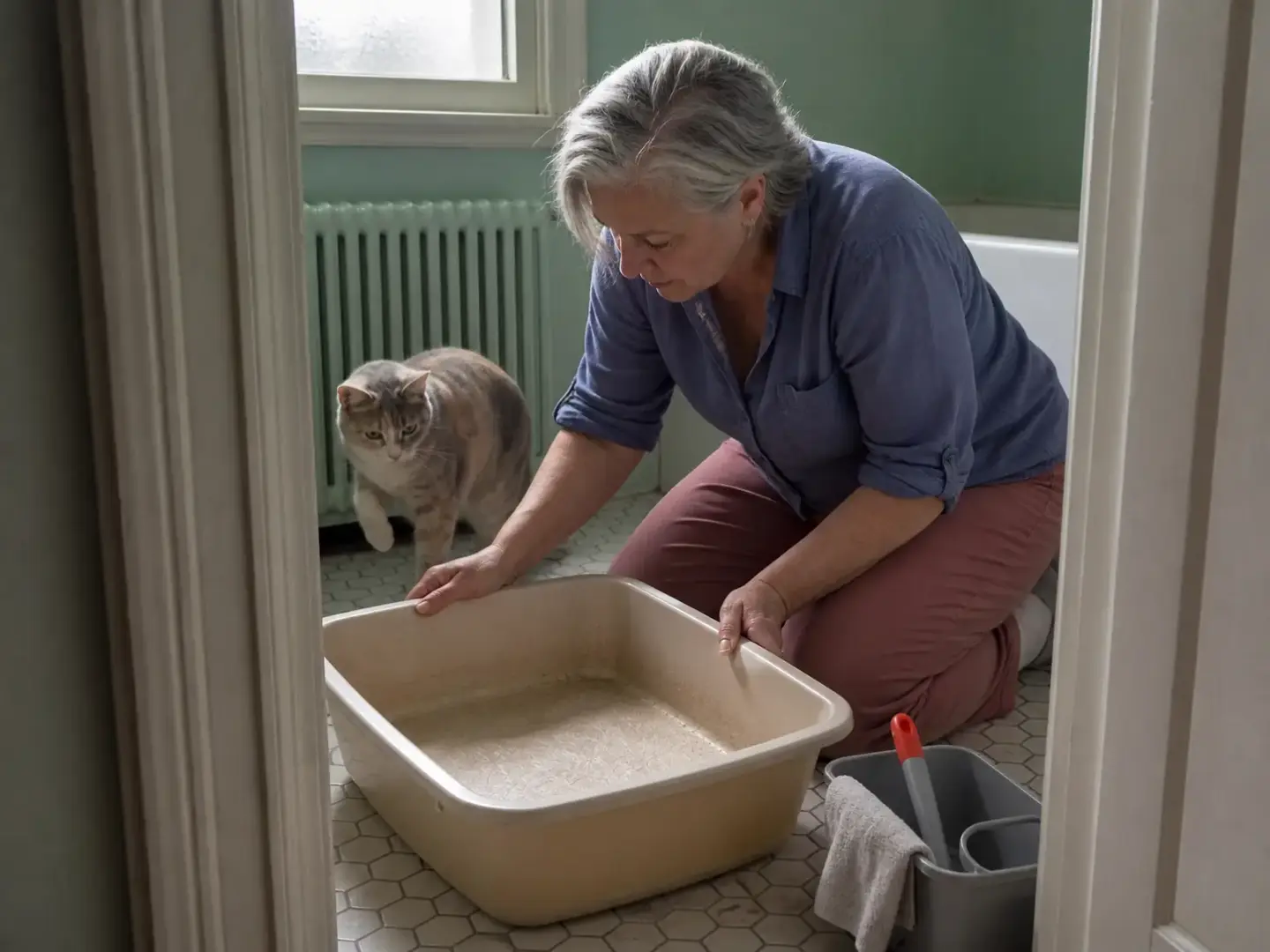
Run your hand along the inside of a plastic litter box that is about a year old, a day after you scrubbed it, and there it is anyway. Not filth. A faint plasticky ghost of ammonia that survives soap. The phrase people use in litter threads for exactly this is never smells clean, and it is not imagination and it is not your litter: it is the surface itself, and there is a measurable reason for it.
The other thing nobody says out loud is that the gap between a box that is easy to clean and one that cleans itself is roughly $550. Here is what actually makes a litter box quick to clean by hand, the middle tier almost nobody names, and the narrow case where the expensive machine is the right call.
Quick Answer
Easy to clean is decided by the surface and the number of seams, not by a motor.
- The easiest box to hand-clean is stainless steel, open, with rounded interior corners and no lid seam.
- Every extra part, a hood, a scatter shield, a snap-on rim, is one more seam holding urine.
- A rolling sifting box is the middle tier: no motor, no outlet, no daily scoop.
- Self-cleaning is a different budget, not a better version of the same thing.
Easy to Clean and Self-Cleaning Are Not the Same Purchase
You typed “easy to clean” and got five articles about robots. That is not you searching wrong. Three of the five results currently ranking for this exact query are self-cleaning litter box roundups, and the substitution is close to universal, which happens when the highest-commission product in a category is allowed to define the category’s vocabulary.
So separate them, because they are properties of different parts of the object. Easy to clean is the surface and the shape: what the box is made of, how many pieces it has, whether your scoop can reach the corner. Self-cleaning is the motor. They do not travel together, and a self-cleaning box can be genuinely unpleasant to deep-clean, because a motor housing has more places for waste to hide than a rectangle does.
An automatic box starts around $600 to $800 as a one-time purchase before litter and consumables.
There is a story that repeats in cat forums, and it is why this distinction matters more than it sounds. Someone spends the money, the big rotating drum arrives, and the cat sits down two feet away and stares at it for a week. The machine cleaned nothing. Nothing went in it.
From here on this article uses three tiers, and they are not a scale from worse to better. Hand-clean is surface plus shape. Mechanical sifting is a moving part with no motor. Automatic is a motor and an outlet: an automatic litter box does the scooping, a litter pan does not.
Most people searching this query belong in the first tier and have never been shown it properly. If you are still deciding everything at once, the full walk-through of choosing a box by size, sides and entry is the level above this one.
The Surface Is the Whole Lever, and It Is Measurable
Everyone already knows plastic boxes go bad. Almost nobody can say why, so the advice stops at “replace it every year,” which is a recurring cost dressed up as a solution.
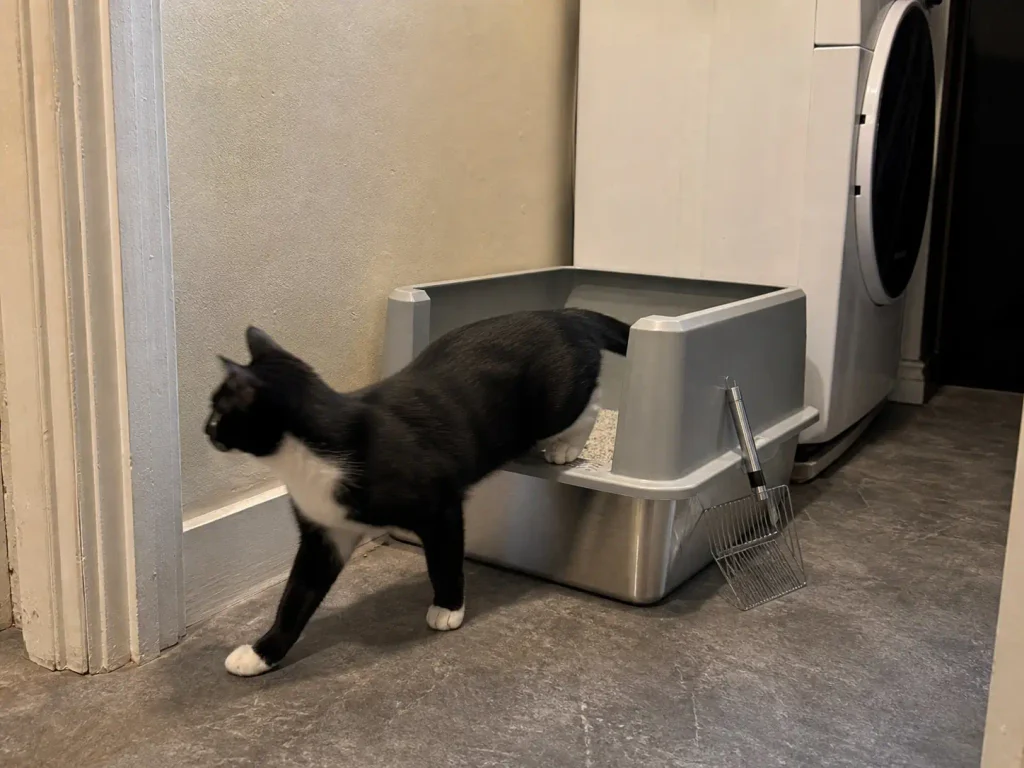
Here is the mechanism, and it is not dirt. After a normal cleaning, plastic surfaces retain roughly 45% of bacteria against roughly 2% on stainless steel, and in the same comparisons steel came out about 95.6% better on odor control across 48 hours. That is not a preference for shiny over matte. That is two different surfaces doing two different things with the same amount of scrubbing, and it is how far the metal actually gets you on smell when you separate the material from everything else.
Why Scrubbing Harder Stops Working
Every scoop pass and every dig session sands microscopic grooves into a molded plastic pan. Not scratches you can see, at first. Grooves finer than the weave of any rag you own, and a groove that fine cannot be sterilized by wiping across the top of it, because nothing physically enters it. Urine residue does, though, because liquid does not need a rag’s help to find a gap.
So the pan accumulates. Each groove holds a little, the grooves multiply with use, and the box gets steadily worse at a rate that tracks how diligent you have been about scooping. That is the part that feels unfair, and it is real. The box you clean most aggressively is the box you are sanding hardest.
Stainless steel does not participate in this, and the reason is that it is non-porous. Urine sits on top of it instead of soaking into it, so a wipe takes essentially all of it and nothing builds up between deep cleans. The surface you clean in month eighteen is the same surface you cleaned in week one.
What 304 Means on the Listing, and What 201 Means
There is one number worth finding on a steel box listing, and it is not the capacity. It is the grade: 304.
That grade is the same stainless used for veterinary instruments and commercial food-prep surfaces. It resists scratching and it takes hot water, disinfectant or diluted bleach without degrading, which is what makes “you can actually sanitize this” a true statement rather than a marketing one, and it matters for how you are told to wash it: the AAFP and ISFM environmental needs guidelines call for soap and hot water only, and warn specifically against ammonia-based cleaners. A surface that survives that weekly, for years, is the whole argument.
Matte plastic gets sold as the low-glare, hides-scratches option, and hiding a scratch is not the same as not having one. The cheaper 201 grade looks identical in a product photograph and dents and scratches sooner, which quietly reintroduces the exact groove problem you paid to escape.
If the listing does not say 304, assume it is not. Sellers who paid for 304 put it in the title.
The One Thing Steel Does Not Fix
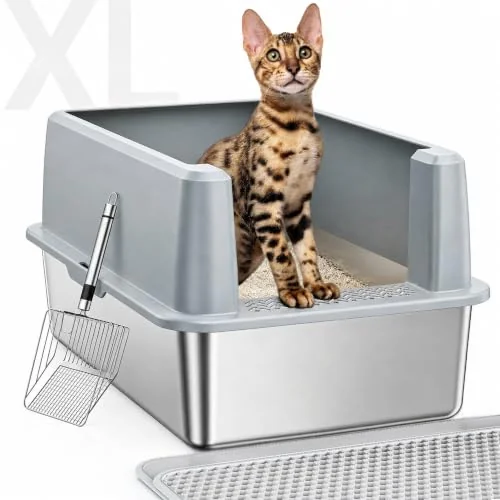
An XL pan is not the right answer for every apartment, and the material argument does not require the biggest version of it. The Kirecoo Large High Sided Stainless Steel Cat Litter Box is 23.6 by 15.7 by 11.8 inches, which is the same non-porous surface in a footprint that fits a normal bathroom corner, at a lower price. The trade is length: 23.6 inches of interior is generous for a mid-sized cat and short for a genuinely large one, so run your own cat’s measurement before you decide the small one is fine.
But there is a limit to what any of this buys you, and it is worth being blunt about it before you spend money on the wrong half of the problem. Steel fixes the pockets. Steel does not fix the shape. And the shape is where most of the remaining smell lives.
Count the Seams Before You Count the Features
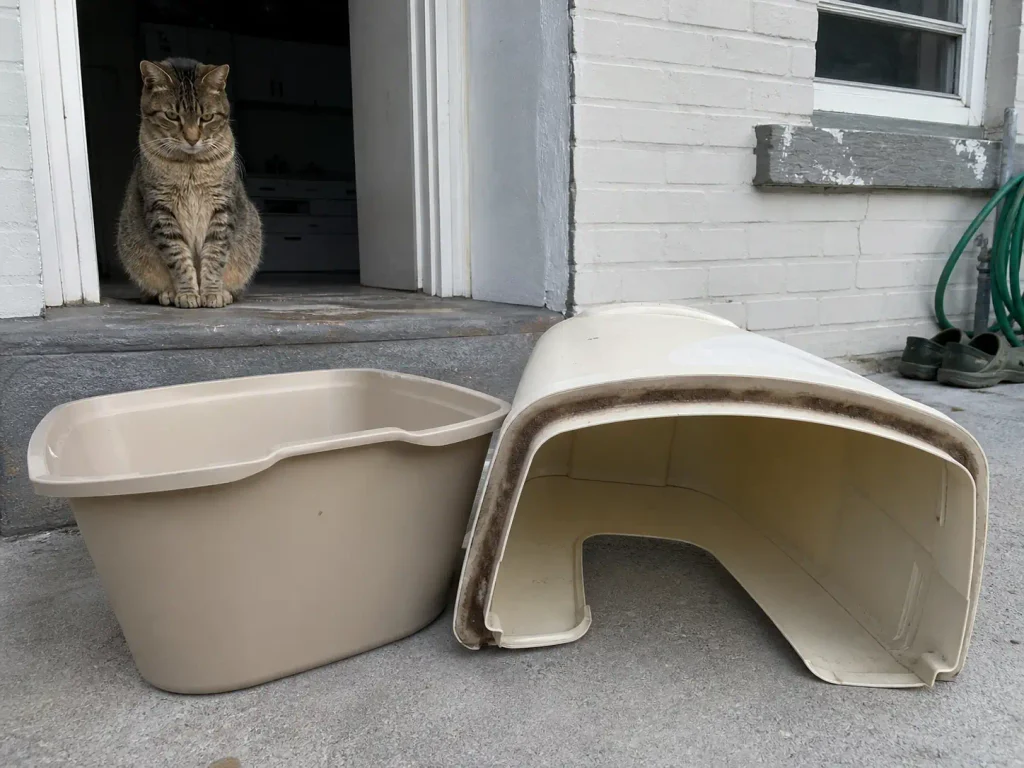
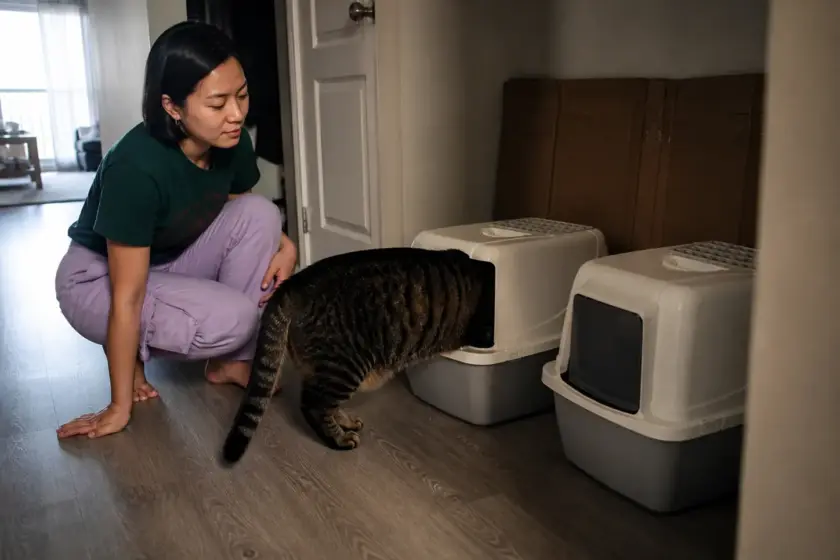
This is the part that changes how the shopping page reads. Every feature sold as an upgrade, the hood, the scatter shield, the snap-on rim, is presented as more box. For cleaning purposes it is more places for urine to sit where no rag reaches.
There are two failure points and neither one is about material. The first is the hard 90-degree molded interior corner, which your scoop cannot square into. The second is the overlap seam where a lid or a shield meets the base, which is frequently not urine-tight.
The Corner Your Scoop Cannot Reach
Look at a scoop and then look at the base-to-wall join of a molded pan. The scoop is a flat blade with a straight edge, the join is a right angle, and the blade meets that angle at a single line. Everything sitting in the last quarter-inch of that angle stays there, gets a fresh layer on top of it, and turns into the thing you smell when you walk in after being out for two hours.
A rounded interior corner removes the problem instead of managing it, because a curve is a shape a flat blade can follow. Corners and seams are the two words worth carrying into a product page, because urine trapped in seams is a shape failure that no material grade fixes. It is also why a nonstick surface on steel is worth more than a BPA-free plastic label on a molded pan: the first changes how waste releases, the second only tells you what the plastic is not. This is why “rounded corners” belongs on your buying criteria next to the material grade rather than in the nice-to-have column, and why two boxes made of identical steel can be a minute apart at scoop time.
The Seam Nobody Photographs
Here is the honest part, and it complicates the recommendation above. People who bought steel specifically to escape scratches still report the seam trapping urine, where a lid or a scatter shield overlaps the base. The material solved the groove problem exactly as advertised. It did nothing at all for the joint, because a joint is a shape decision and steel is a material decision.
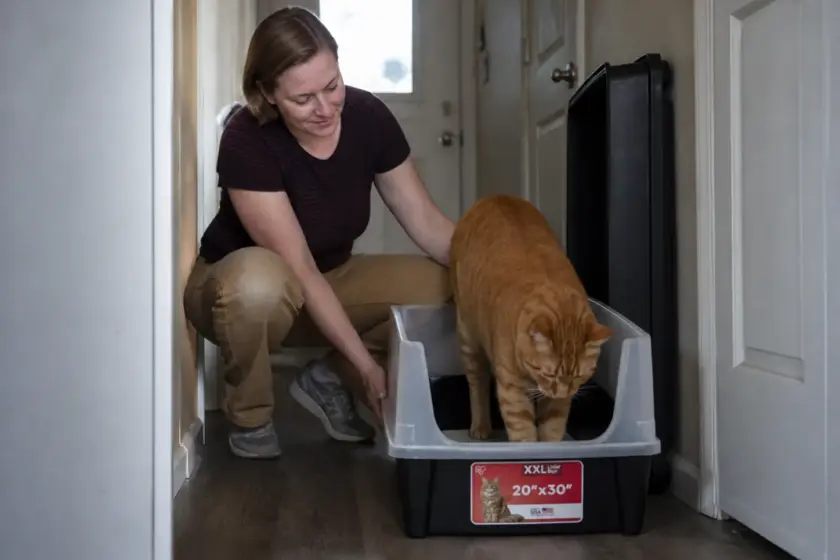
Which produces the rule this whole section exists to give you: fewer parts beats better parts. A high-sided box is fine here, and it helps with litter tracking; what costs you is the lid, not the wall height. An open pan with rounded corners outperforms a hooded litter box of the same material, every single time, on cleaning effort. If you are choosing between two boxes and one of them has a hood, you have already chosen.
Take the Lid Off First
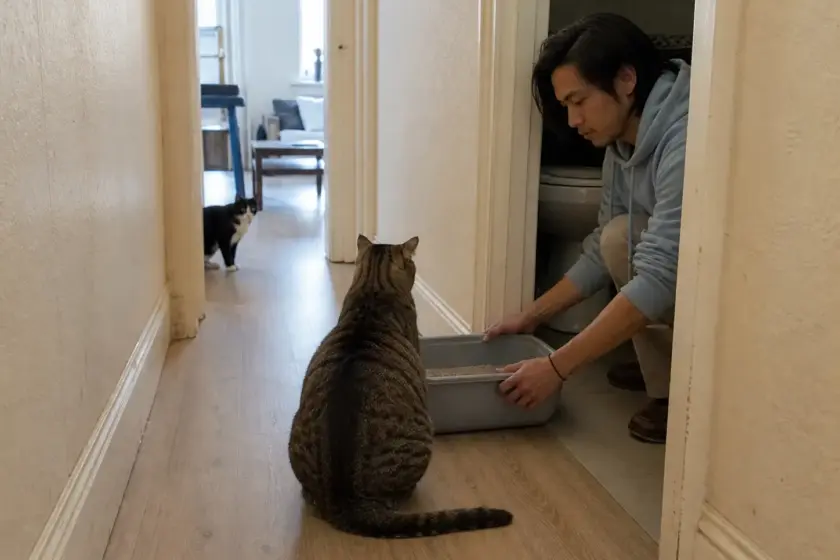
Before buying anything, do the free version. Take the lid and the scatter shield off the box you already own and run it open for two weeks. That deletes every seam the box has at zero cost, and for a surprising number of homes the cleaning problem ends right there and the purchase never needs to happen.
Run a finger along the inside base-to-wall join of the box you own right now. If it catches on a lip or a ridge instead of curving away under your fingertip, that is where the smell is living, and no amount of scrubbing reaches it. Do the same along any line where two pieces of the box meet.
What you give up by going open is scatter and privacy, and pretending otherwise would be dishonest. Both are real problems. They are also different problems with different fixes, a mat handles one and placement handles most of the other, and neither belongs in the cleaning budget. If your reason for the hood was that you cannot stand looking at the box, that is a legitimate reason and it has its own answer in hiding the box inside furniture without making it worse, which is a placement decision rather than a lid.
The Middle Tier Nobody Names, a Box That Sifts Without a Motor
By now the answer is steel and open, and you are thinking the obvious objection: yes, but I still have to scoop it every day. Fair. How often the box actually needs scooping is a daily commitment for most homes, and daily is exactly the thing that slips.
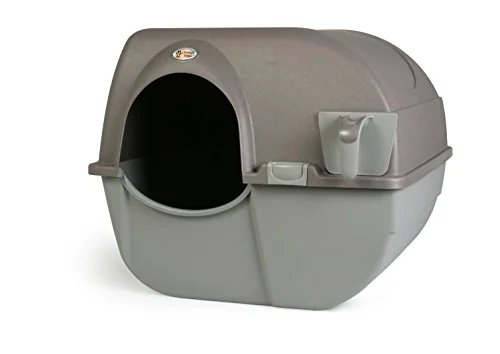
There is a tier between hand-scooping and the robot, and no competitor in this search result names it as a third option. It is a sifting litter box, and it has been sold for years.
What the Roll Actually Does
A rotating inner grate separates clumped waste from clean litter when you roll the box over, and the waste drops into a pull-out waste drawer you empty. No scooping. No electricity, no outlet, no app, no motor to fail. Owners describe it as the box that “rolls the mess away,” which is a plain description rather than a slogan.
Why It Works in a Rental When the Robot Cannot
Here is the constraint that rules out the entire automatic category for a lot of readers, and no roundup connects it to the cleaning question. An automatic box has to sit near an outlet.
Go and look at where your box is right now. In an older apartment the only sane spots for a litter box, the bathroom corner, the closet floor, the gap beside the washer, are frequently the exact places with no plug within reach. An extension cord across a bathroom floor is not a plan, and running one to a closet you keep shut is not a plan either. That kills the automatic tier on the spot, regardless of what you were willing to spend.
That is what makes the sifting tier genuinely renter-friendly: it goes anywhere a plain pan goes, because it is a plain pan with a grate in it. No cord, no siting decision, no negotiating with the landlord about anything.
The Litter It Forces You to Use, and the Part That Wears Out
Two constraints, and both are hard. The first: it only works with clumping litter. Crystal litter and non-clumping litter fall straight through the grate along with the waste, so if you switched litters for dust or tracking reasons, this tier gives you nothing and takes your litter choice away as well.
The second is the honest downside, and it is not the sifting itself. The sifting works. What ages is the mechanism around it: the latch or the drawer loosening over months of rolling, and the sifting holes clogging with fine clumping-litter dust. The repeated complaint pattern is a box bought to save scooping time that needs replacing inside a year, which changes the arithmetic if you were treating this as a permanent purchase rather than a consumable one.
Roll it every day even though it can go two. The mechanism clogs from fine litter dust packing into the grate holes, and a daily roll is what keeps that from setting. Two-day gaps are how a box that worked in month one stops sifting cleanly by month six.
When the $600 Box Is Genuinely the Right Answer
This blog does not sell anything, which means it also does not get to refuse to name the case where the expensive thing wins. There is one, it is specific, and most people reading this are not in it.
The Constraint It Actually Solves
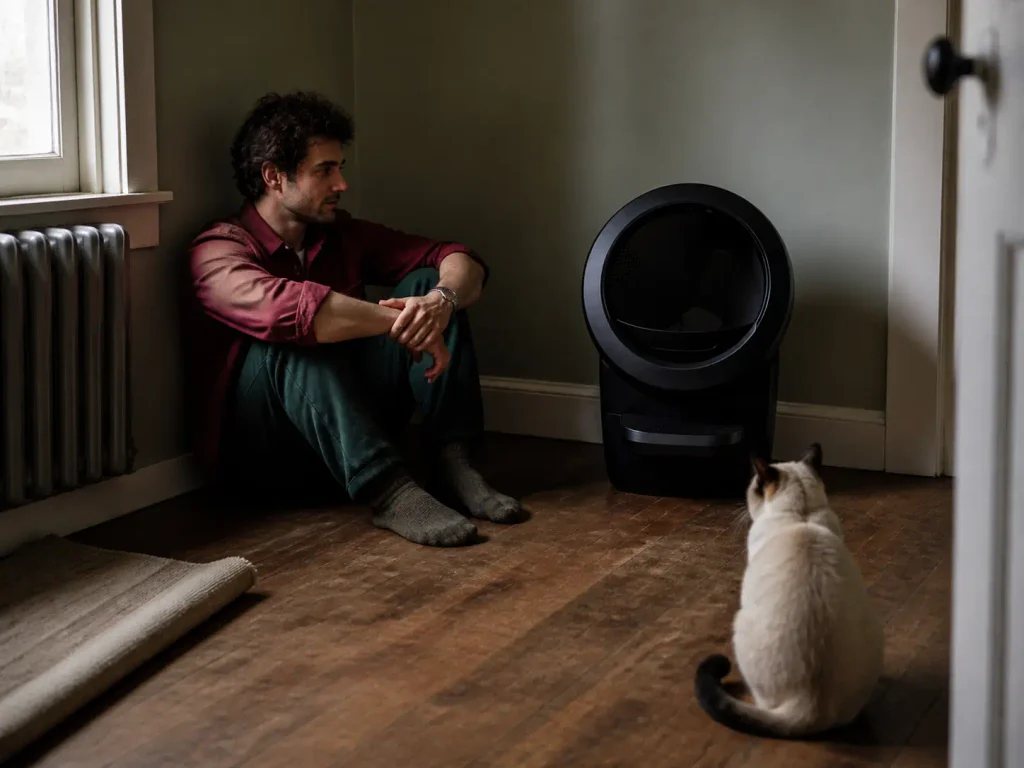
An automatic box is a different budget, not a better tier. It is $600 to $800 as a one-time purchase, and the point of this article is that you should arrive at that number deliberately rather than sideways, from a search for “easy to clean.” The Litter-Robot 4 with Step & Fence is the category’s reference point at 22 inches wide by 27 inches deep, which is a real piece of furniture in a small apartment and worth measuring for first.
The constraint it solves is not hygiene. It is presence. If you are away from home for long stretches, or if bending over a low pan twice a day is genuinely hard on you, the problem is not being there to scoop, and no amount of rounded corners fixes that.
A machine does. That is a scheduling problem with a purchase attached, and it is a legitimate one.
Two Cats Change the Math
One cat and several cats are not the same question here. More cats means more clumps per day, and a multi-cat litter box setup is where a machine earns its keep, and a machine that clears after each use earns its keep faster in a house producing four clumps a day than in one producing one.
It also collides with the box-count rule. How many boxes two cats actually need is more than two, and buying three robots is not a plan anybody should have. What tends to work is one machine and plain steel pans for the rest.
The Cat Has to Agree to It
And the cat gets a vote, which is not a formality. Some cats are visibly uneasy around a large enclosed rotating mechanism, and owners report better acceptance with flatter, more traditional rectangular automatic designs than with the big drums. A machine the cat will not enter has cleaned nothing, and it is the most expensive way to discover your cat had an opinion.
One thing that sits outside this decision entirely: if a cat who has been using a box suddenly stops, new box or old, that is a vet visit before it is a furniture problem. Not a signal to buy a different box.
If you have decided you are in this case, leave here for how self-cleaning boxes work and who actually needs one rather than take a thin version of it.
What to Buy If You Want to Spend Almost Nothing
Not everyone reading this is going to buy a steel box, and the article should not pretend otherwise. A plain plastic pan is a legitimate choice, as long as you know exactly what you are agreeing to.
Fewer Parts, at Any Price
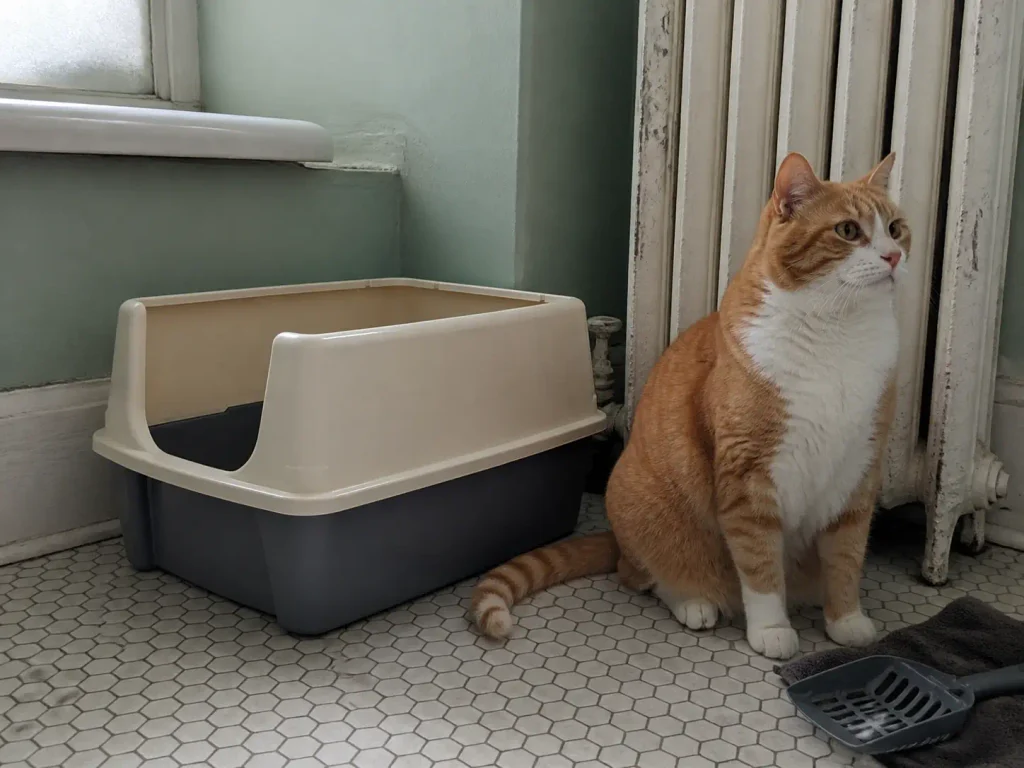
The people who deliberately choose a plain open plastic pan usually do it for this article’s reason, arrived at independently: no lid, no shield, nothing extra to trap waste. Fewer parts, fewer seams. It is the steel argument at the other end of the price range, and it is not a lesser version of the logic.
The Amazon Basics Large Cat Litter Box with High Sides, Open Top is the floor: large, high-sided, open top, no lid and no scatter shield, which makes it the simplest shape available and therefore the easiest cheap box to clean. Its limit is the material and nothing else, which is the whole trade and the next section is about it.
What You Are Agreeing To
You are agreeing to the scratches. The mechanism from earlier does not skip you because you were sensible about the shape: the pan will accumulate grooves, it will stop smelling clean somewhere in its second year, and it will need replacing. That is the deal, and it is a fine deal taken knowingly. It is only a mistake when nobody told you and you assumed the box had failed at something.
Whether it costs more or less than steel over five years depends on how long you would have kept the steel box, and honestly it lands close enough to be a preference rather than an error. Buy the cheap pan on purpose or the steel one on purpose. Drifting into a hooded plastic box because it looked tidier is the option that is not.
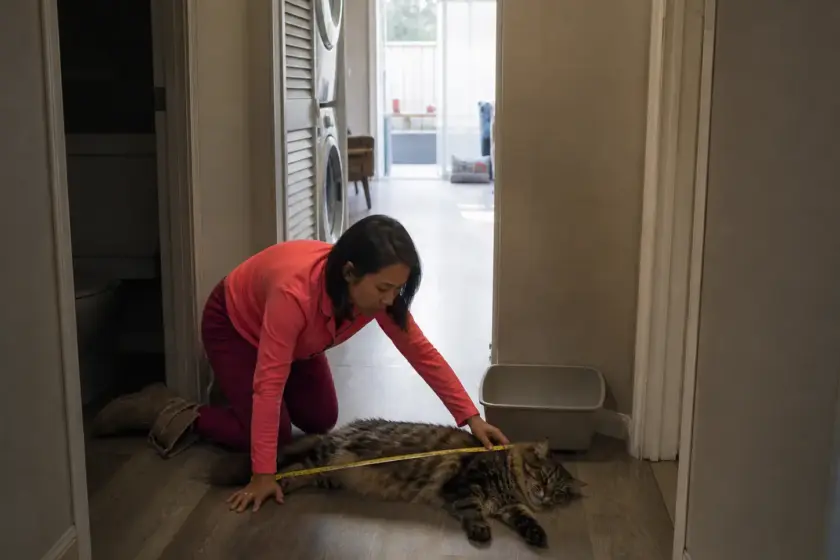
Two things that do not bend for budget. Do not buy small to save money, because the size a box actually needs to be, in inches is a rule about your cat’s frame, and a too-small box creates a problem no material fixes. And put the money you saved into a scoop that doesn’t bend or clog, because a bad scoop makes any box on earth feel harder to clean than it is. For the wider version of this tier, what a good box under fifty dollars looks like covers the price question this article stays off.
If you go plastic, write the month you bought it on the underside in permanent marker. You will not remember otherwise, and “it’s about a year old” is the exact moment the scratch problem starts winning the argument.
The Short Version
The lever is the surface and the seams, not the motor. A 304-grade steel pan with rounded corners and no lid is the easiest box to clean by hand, and it costs a fraction of a machine that would clean it for you.
Before buying anything at all, take the lid and the scatter shield off the box you already own and run it open for two weeks. That deletes every seam it has, for free, and for a lot of homes that is the entire fix.
If you want out of the daily scoop but not into a $600 purchase, the rolling sifting box is the tier in between, on two conditions: clumping litter, and accepting a mechanical part that wears out on a timeline closer to a year than a decade.
Give it three weeks and then ask the honest question, which is not whether the box is cleaner. It is whether you are still cleaning it as often as you did in week one. If the routine has already slipped, the box shape is not the thing that needs changing.
Take the lid off tonight. It costs nothing, it takes ten seconds, and if the smell is gone by the weekend you just saved yourself the entire purchase.
Amazon’s Audible — free for 30 days
Your cat won’t let you read. Let someone read to you.
Audible is Amazon’s audiobook library — thousands of titles, read out loud, on your phone. Free for a month, plus one audiobook to keep forever.
Frequently Asked Questions
01What is the cleanest type of litter box?
An open stainless steel pan with rounded interior corners and no lid. The material is non-porous so nothing soaks in, and with no hood there is no overlap seam where urine collects out of reach of a rag.
02What is the most hygienic cat litter box?
Hygiene comes down to whether the surface can actually be sanitized, and 304-grade stainless steel can be. It takes hot water, disinfectant or diluted bleach without degrading. Plastic keeps roughly 45% of bacteria after cleaning against about 2% on steel, because the scratches hold what the scrubbing misses.
03Is a self-cleaning litter box easier to clean?
Not in the sense most people mean. It removes the daily scoop, but the unit still needs periodic deep cleaning, and that job is harder on a machine with a motor housing than on an open pan. Easy to clean and self-cleaning are two different purchases at two different prices.
04Do I need to scoop a sifting litter box?
No. You roll it, and the clumps drop into a pull-out tray you empty. But it only works with clumping litter, and the grate holes need a daily roll to keep fine litter dust from clogging them.
05What litter boxes do vets recommend?
Veterinary guidance focuses on size and surface rather than brands: a box large enough for the cat, with a surface that can genuinely be sanitized. That points toward large, open, 304-grade steel, the same material grade used for veterinary instruments.
Leave a comment