Best Litter Box Mats That Actually Trap Anything
Don't buy a litter box mat until you measure the box's exit width (+ one full stride past the opening). Most mats fail on geometry, not material.

Alfredo RamsesFounder · August 23, 2026 · 21 min read

On this page11 sections
- 1Measure the Box Before You Look at a Single Mat
- 2Digger or Walker, Because the Answer Changes Completely
- 3The Dual-Layer Pick, and What It Costs You
- 4Where Honeycomb Falls Apart, and Reviewed Says So Too
- 5The Single-Layer Picks, for Walkers and Tight Floors
- 6The Small-Apartment Problem Nobody Prices In
- 7Two Cats Change the Cleaning Math, Not Just the Size
- 8Cleaning by Material, and the One That Cannot Go in the Machine
- 9What Still Ends Up on the Floor, and Why That Is Fine
- 10Conclusion
- 11Frequently Asked Questions
You already own a mat, and you are still sweeping the same hallway. That is who searches for the best litter box mat, and the annoying part is that the mat is probably not defective. When Reviewed ran its own testing, wet messes defeated three of the honeycomb mats it had just named as winners.
The mat that wins on one floor loses on another. So this one measures the box before it names a product, and splits the picks by what your cat does on the way out rather than by what the listing claims.
Quick Answer
Four things decide whether a litter mat works on your floor, and only one of them is the mat.
- Measure the box’s exit width first, then add one full stride of clearance past the opening. That is the mat.
- A cat that kicks litter while digging needs a dual-layer mat. A cat that carries it out on its paws needs surface texture, and the cheaper single-layer mat wins.
- Waterproof and litter-trapping are two separate specs. Most listings only advertise the one they pass.
- If the box lives in a hallway or a small bathroom, skip dual-layer. It needs open floor to empty and you do not have it.
Measure the Box Before You Look at a Single Mat
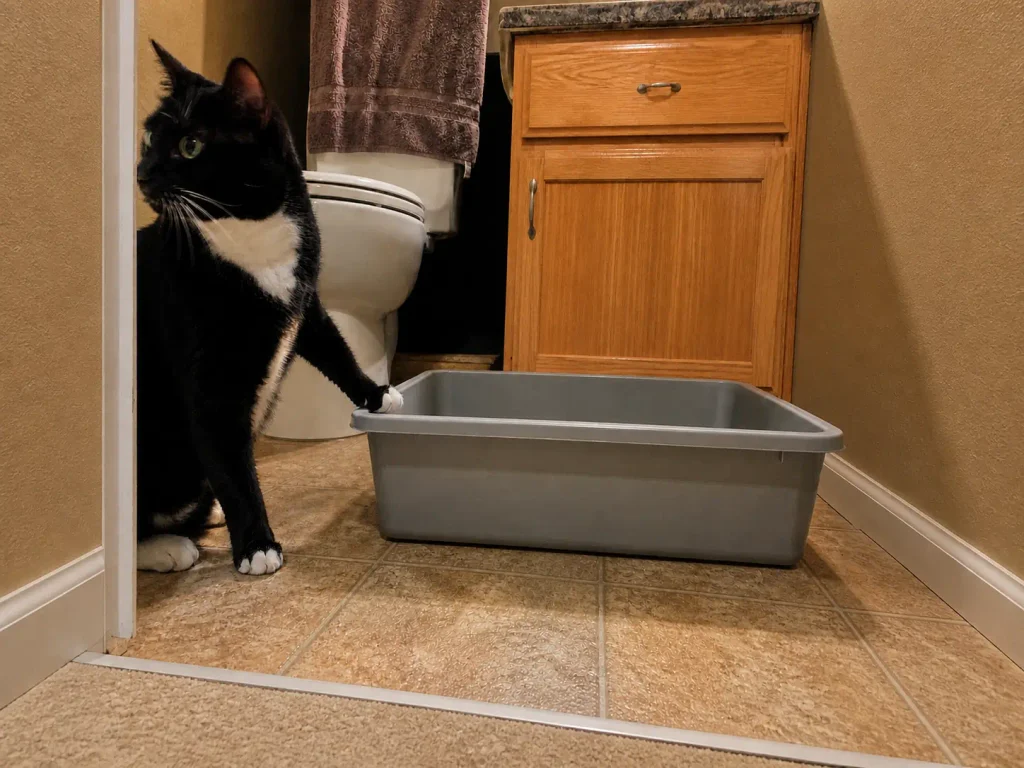
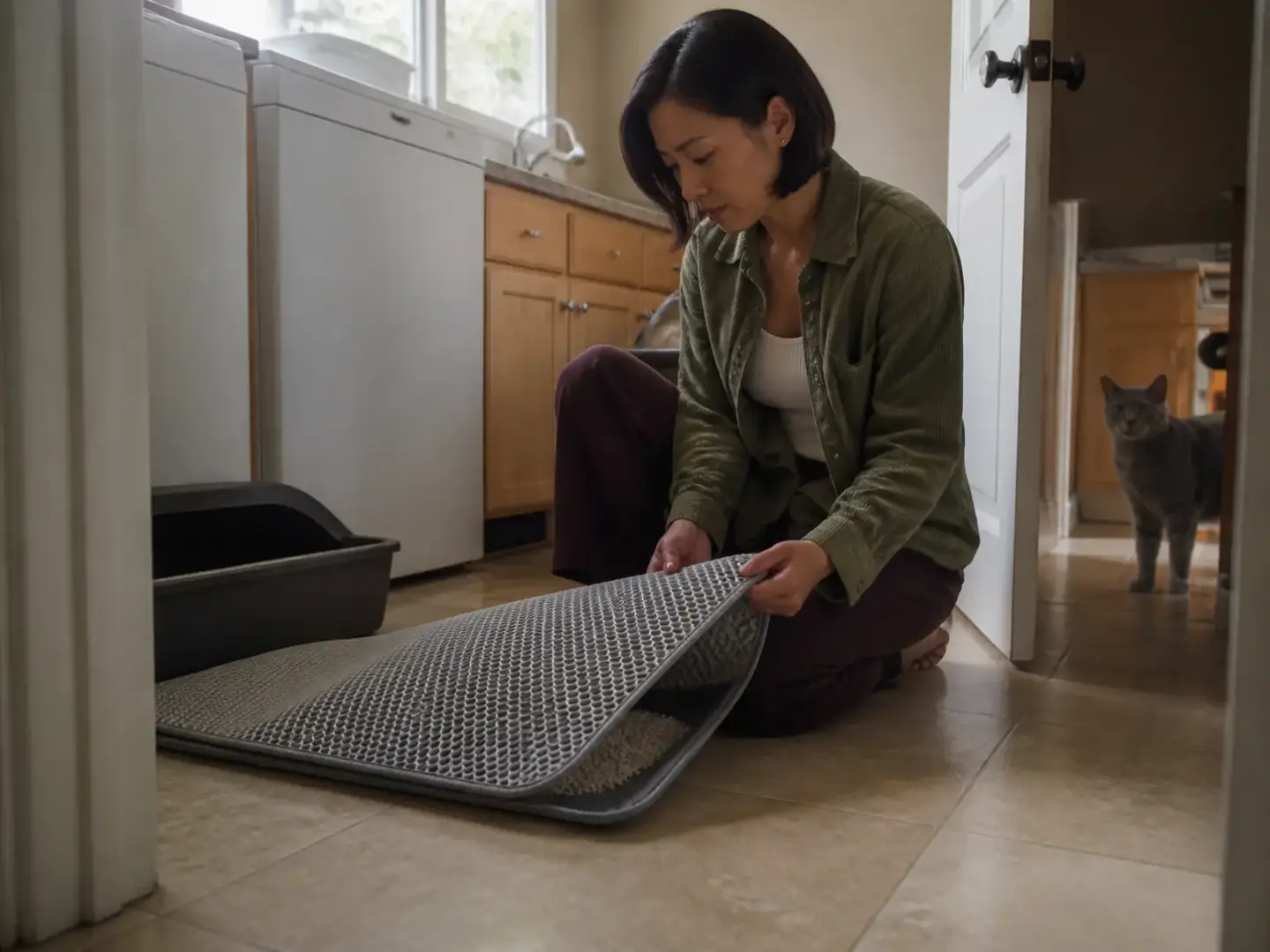
Everyone buys the mat that looked big enough in the photo. Then the litter starts appearing on step three, an inch past the edge, and the mat gets blamed for a failure that was decided at checkout.
Mat sizing is the third of the three fixes for litter tracking, and they have an order, and it is the one people attempt first and measure last. The mat did not fail. It was sized against the box instead of against the cat’s walk away from it.
The rule, which nobody publishes as a formula even though every sizing guide implies it: cover the box’s exit width, then extend roughly a foot and a half past the opening. Not the footprint. The opening, and the floor the cat lands on after it.
The Two Numbers You Actually Need
The first is exit width, measured across the front where the cat comes out. On a front-entry box that is the full width. On a covered box it is the door, often five or six inches narrower than the shell.
The second is exit clearance, and it decides everything. The first two steps carry most of the granules, because that is when the pads are still loaded. Give the mat eighteen inches past the opening and steps three and four land on it too. Give it eight and you have bought a doormat that hands the litter scatter over one step later.
Standard Versus Jumbo, and Why the Mat Label Lies About It
A jumbo mat cut for a 24-inch box can be genuinely undersized for a standard one, because the extra inches went into width you did not need instead of length you did. A mat sold as large is large relative to something the listing never names.
This is also where people find out they are solving the wrong problem. If the box itself is undersized, the cat is already standing half in and half out and litter is going over the rim before any mat gets a vote. Settle what size the box itself should be first.
The 30 by 40 Floor for Two Cats and Up
For a multi-cat household, treat 30 by 40 inches as the floor rather than the ceiling. Two cats do not just double the litter, they double the exits per day across the same surface, and an extra-large mat buys back the margin an undersized one never had.
Before buying anything, pull the box forward a few inches. A lot of mats sit pinned under the front lip, so a third of the trapping surface is holding up plastic instead of catching litter. Ten seconds, no money.
Measure First
Two measurements, taken in this order, before any mat goes in a cart:
- Exit width — across the opening the cat uses, not the shell. Standard boxes: 15 to 19 inches. Jumbo: 20 to 24 and up.
- Exit clearance — about 18 inches of mat past the opening, so steps three and four still land on it.
Digger or Walker, Because the Answer Changes Completely
Two people buy the same well-reviewed mat. One says it changed everything, the other says it does nothing. Neither is lying. They own different cats, and nobody sold either of them a mat for the cat they actually have.
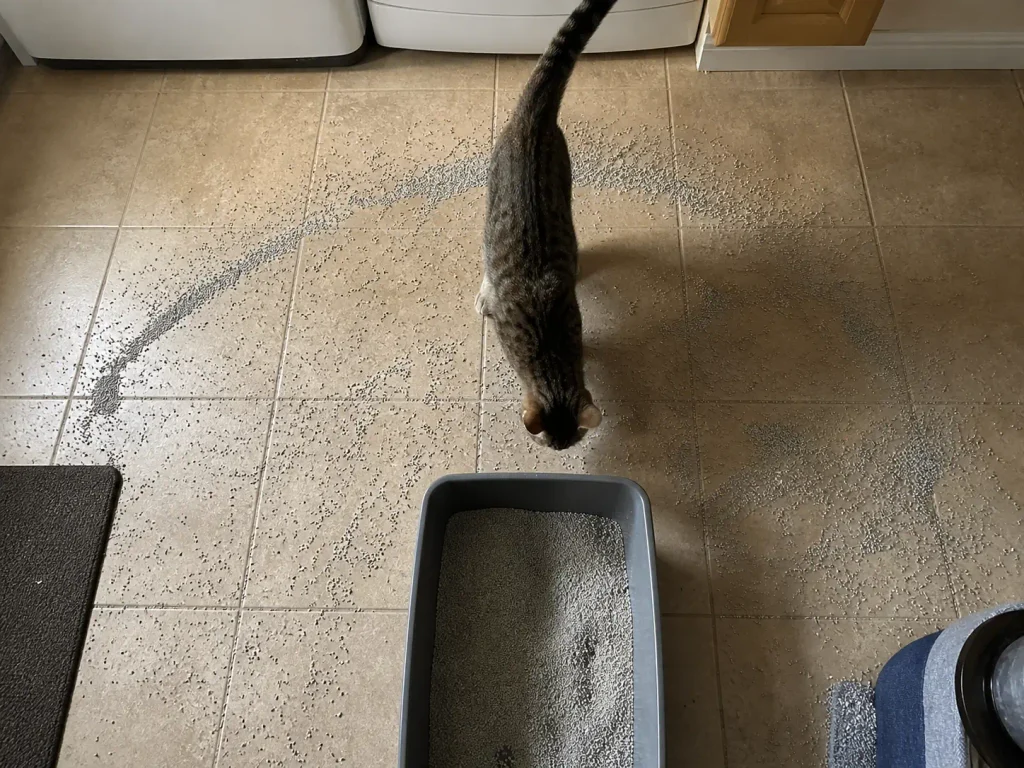
The walker carries granules out stuck to damp paw pads. The litter is on the cat, not in the air, and paw wiping on contact is the entire job.
The digging cat throws litter into the air before it ever steps out. Texture is irrelevant to airborne litter, because the granule was never on a paw to be wiped off. The mat has to catch what falls and hold it below the surface, where a passing paw cannot drag it back. That is containment, and no amount of surface roughness performs it.
The mechanism follows. A blackhole style mat and the other honeycomb dual-layer designs hold a perforated top sheet apart from a solid base. Single-layer mesh, a PVC mat or a rubber mat, silicone and jute all wipe on contact. Same category, two different machines, and the table below splits them on the five things that decide it.
What a Walker Actually Deposits, and Where
A walker leaves a trail: dense at the litter box exit, thinning with distance, following the route the cat takes next. If it bends around a doorframe and stops halfway down the hall, that is paw transfer running out of material. Nothing was thrown. It was carried, and it ran out.
What a Digger Throws, and Why Texture Cannot Catch It
A digger leaves an arc. Granules land in a spray around the box, including behind it and along the wall, in places no cat has walked. That litter never touched the mat, because it went over the top of it.
And the cat is not being destructive. Kicking litter is how a cat covers, and one that digs hard is usually doing the job properly in litter too shallow to bury anything. A cat that wants to bury will dig until it hits plastic and keep going. Adding depth fixes more scatter than a mat upgrade, and it costs nothing but the next scoop of what you already buy.
The Five-Second Diagnosis on Your Own Floor
You do not need to watch the cat, just the distribution. A wide arc with granules behind the box: digger, buy containment. A narrow trail leading away: walker, buy texture. If it is both, buy for the digger, because a containment mat still has a surface and a texture mat cannot become a container.
The exit changes the arithmetic too: a front-entry litter box throws the whole problem forward onto the mat, a covered litter box keeps some of the spray inside the shell, and a top-entry litter box drops most of it on the lid.
| Mechanism | Traps By | Best For | Cleaning Method | Floor Space to Empty | Wet-Mess Tolerance |
|---|---|---|---|---|---|
| Dual-layer honeycomb | Litter falls through the top sheet into a sealed gap | The digger | Lift, spread the layers, tip back into the box | Yes, roughly the mat’s own footprint | Poor — cells clog and stop sifting |
| Single-layer mesh or coil | Raised loops scrape the pads on contact | The walker | Shake out over the box, vacuum, machine wash | None | Fair — dries slowly, but rinses |
| Single-layer silicone | Raised channels hold granules in the grooves | The walker, on a damp floor | Tip, rinse in place, done | None | Good — waterproof, wipes clean |
| Natural fiber (jute) | Coarse weave catches granules in the pile | The cat that avoids plastic | Spot-clean and vacuum only | None | Poor — absorbs, and cannot be soaked |
If you are still not convinced a mat is worth the floor space at all, how far a mat can carry the problem on its own gets settled properly one article upstream. Everything below assumes you have decided it is.
The Dual-Layer Pick, and What It Costs You
The honeycomb mat is genuinely the best trapping mechanism in this category, and also the one most likely to be in a dumpster within six months. The reviews only ever tell you one of those.
The Mechanism in One Paragraph
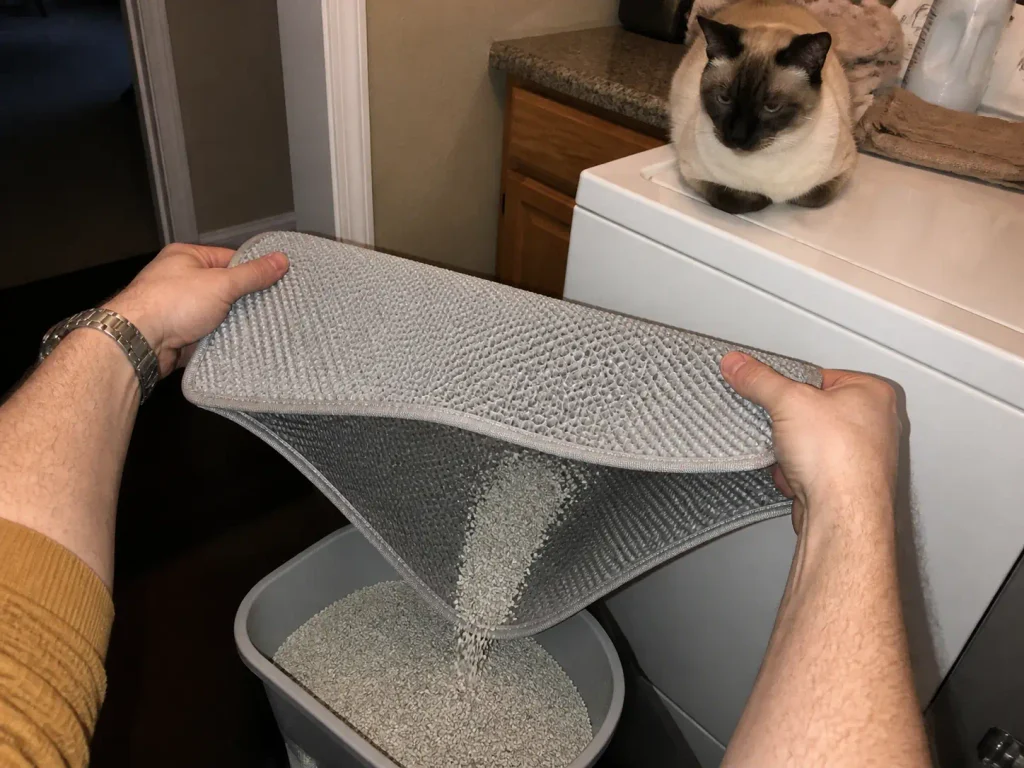
Two layers held apart at the edges, with a grid of holes punched through the top. A granule lands, gets stepped on, drops through a cell and sits in the gap where a paw cannot reach it. On flat mesh the litter stays on the same plane as the cat and every crossing can redistribute it. In a honeycomb it leaves that plane and does not come back.
Emptying It, and the Minute a Week That Keeps It Working
The cost is a ritual. Lift the mat, hold it over the open box, spread the layers at one corner, tip. Done weekly it is under a minute.
Skipped for a month the gap fills and the mat becomes a surface with holes in it. It has not broken. It is full.
Before replacing one that seems dead, check whether the box is parked on its back edge. A dual-layer mat pinned shut cannot sift, because there is no gap left to sift into. That fix is free.
Waterproof Is a Separate Spec from Trapping
These two get sold as one thing and they are not. Trapping is what the top layer does with dry granules. A waterproof mat is a claim about the base and about liquid, which decides whether an accident reaches the floorboards.
Listings advertise only the spec they pass, so if the box sits on hardwood, read for a urine-resistant mat specifically. An EVA foam mat listing tends to be clearest, because the copy sells the two layers separately.
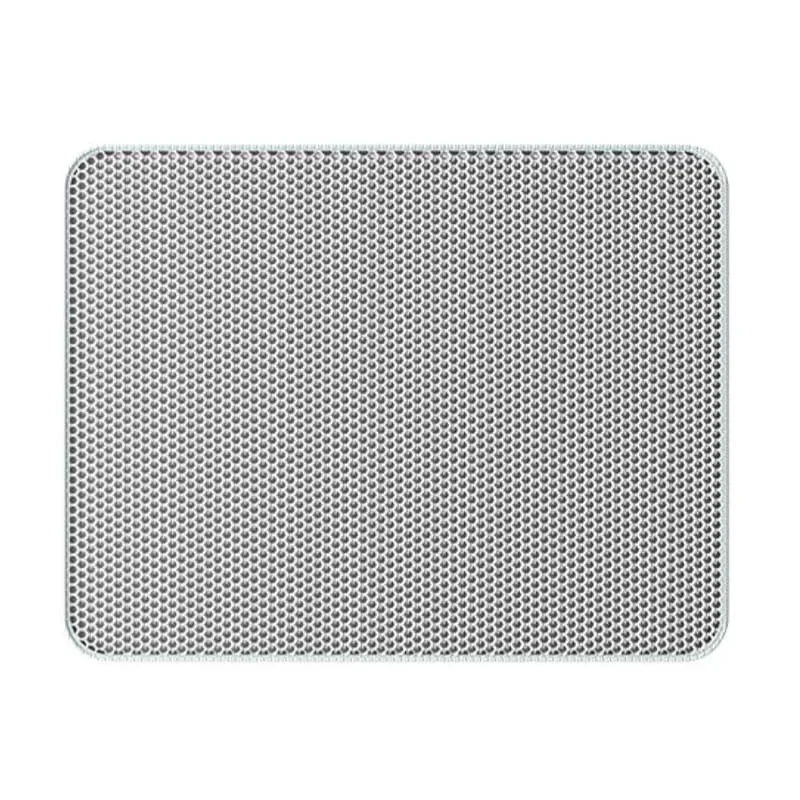
Empty the mat on the same day you do a full litter change. Two jobs in one trip, and the mat never reaches the saturation point where it starts handing litter back.
Where Honeycomb Falls Apart, and Reviewed Says So Too
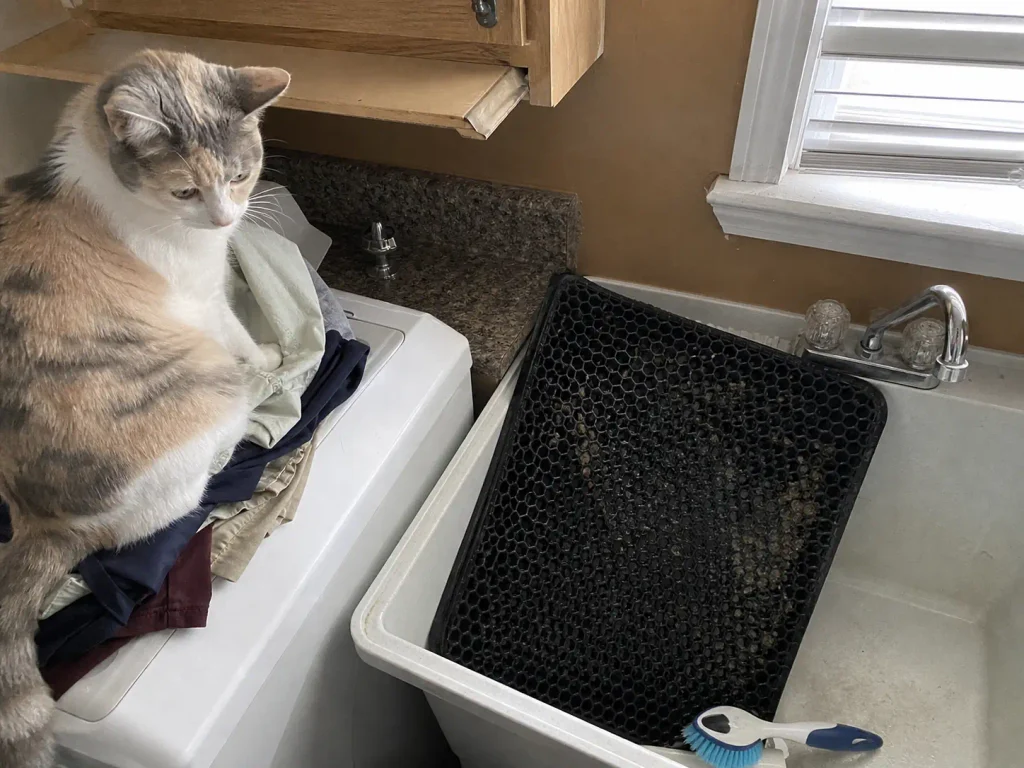
This is the paragraph the roundups leave out, because it complicates the ranking. When independent testing found that wet, gunky messes can defeat even the best honeycomb-style mats, it was not describing the cheap ones. It was describing three of its own top picks.
What the Testing Actually Found
A honeycomb mat works because dry litter behaves like sand. Introduce anything wet and the geometry turns against itself: damp litter bridges the holes instead of falling through, and once a cell is bridged it stays bridged, because there is no way to push from underneath. You cannot scrub a sealed two-layer sandwich from the inside. You can hose it, dry it for a day and hope, which most people do exactly once before deciding the mat is done.
The Humid-Bathroom Version of the Same Failure
You do not need an accident for this. A box in a windowless bathroom that gets a hot shower twice a day runs a slower version of the same experiment: paws come out slightly damp and the cells fill with something tacky rather than loose. It takes months instead of minutes, and it looks like the mat wearing out rather than clogging, which is why almost nobody connects the two.
Two Households That Should Skip Honeycomb Entirely
The first is a house where the cat has occasional accidents near the box. A line under that before moving on: a cat that has started missing a box it used fine last month is a vet visit before it is a mat problem. Make that call first, and treat everything here as the floor question it is.
The second is a house where the box lives somewhere that gets wet, or where nobody is realistically going to carry a mat outside and hose it down. If either describes your place, the best-trapping mat on the market is the wrong buy.
The Single-Layer Picks, for Walkers and Tight Floors
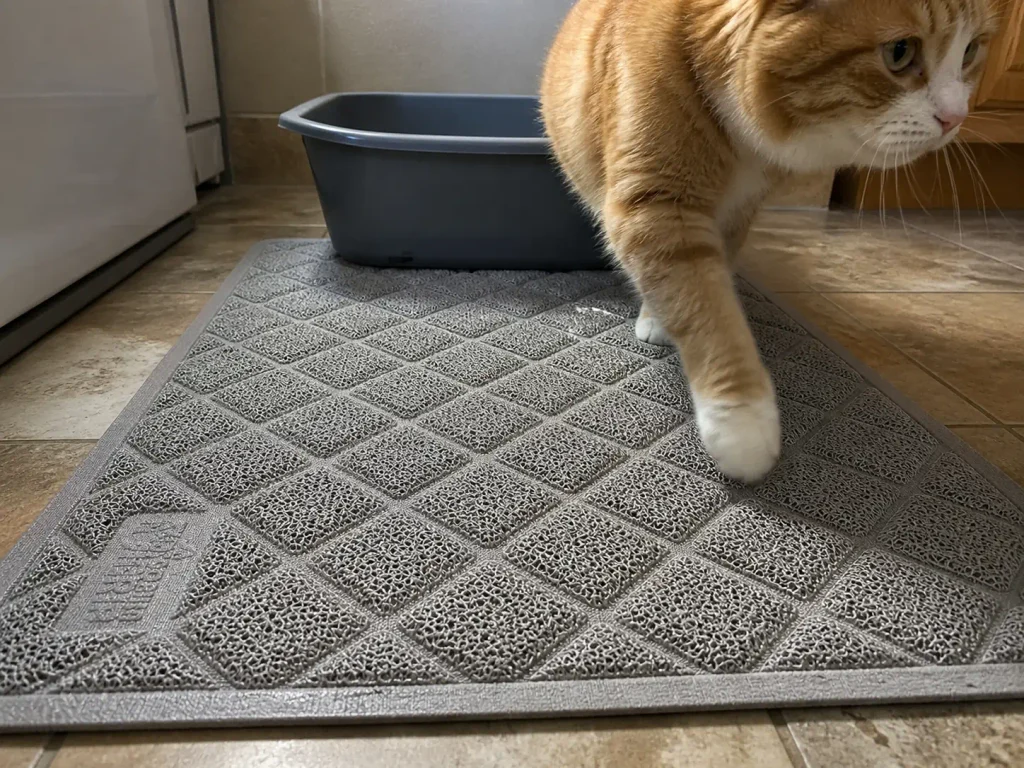
If the cat is a walker, the expensive dual-layer mat is solving a problem this house does not have. Which is the opposite of what every roundup tells you.
Coiled Mesh, and the Cat It Is Actually For
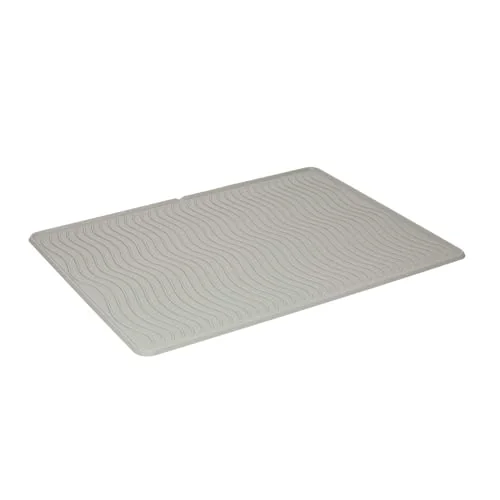
Coiled mesh is raised loops with gaps between them, usually over a non-slip backing. The loops scrape the pads on contact, the granules drop into the gaps, and you shake the mat out over the box or vacuum it. No emptying ritual, no floor space requirement, and it goes in the washing machine when a shake is not enough. For a dry floor and a walker, that is the entire specification.
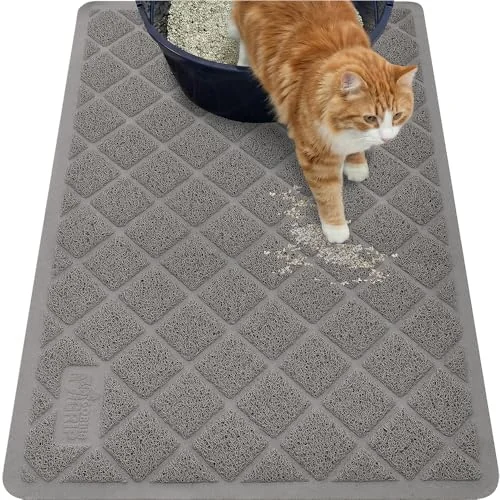
Silicone Channels, and the Rinse-in-Place Cycle
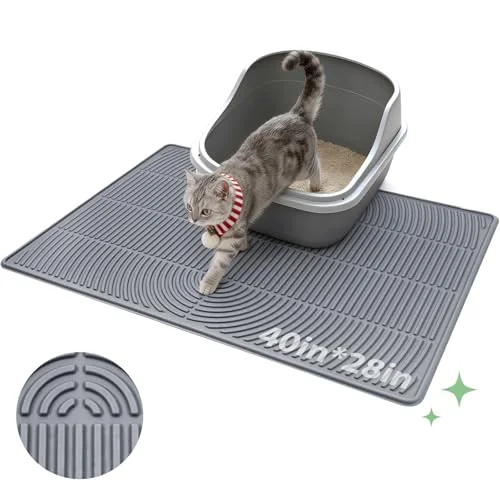
Silicone takes a different route: raised channels molded into a single waterproof sheet, granules sitting in the grooves. What you buy is not better trapping. It is a cleaning cycle that takes under a minute and needs no floor space at all. Tip the litter back into the box, rinse the mat where it lies, put it down.
The Slot That Catches a Claw, and How to Spot It First
One failure mode here costs more than litter on the floor, and it shows up in reviews as a line that is easy to skim past: a mat with slots wide enough to catch a claw, and a cat that responded by avoiding the box rather than crossing it.
That cat was not being dramatic. It found the surface unpleasant underfoot and made a rational call about a resource that had become uncomfortable to reach. A mat the cat routes around is worse than no mat, because now you have the tracking and a box being used reluctantly. Run a finger through the gaps first: if a slot swallows your fingernail and holds it, it is wide enough for a claw.
Mesh if the floor stays dry and the budget matters, silicone if there is any chance of moisture. And before either: low-dust litter with a heavier grain does more of this work than the mat. Fine-milled clay litter sticks to a damp pad, coarse crystal litter mostly does not, and grain size is the whole story.
The Small-Apartment Problem Nobody Prices In
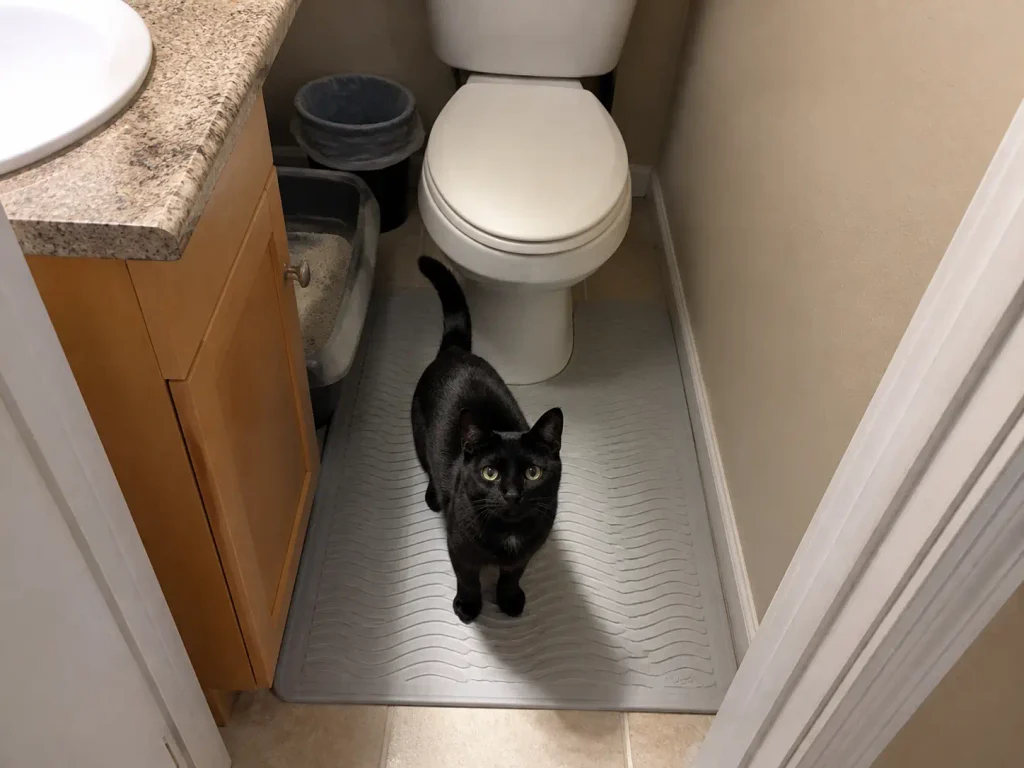
The box is in the bathroom, wedged between the toilet and the tub. Or in the hallway where the door swings. There is no clear floor in front of it, because if there were you would be standing on it. Every roundup recommends the dual-layer mat to that reader without mentioning that emptying it needs a second empty patch of floor a small apartment does not contain.
Why the Dual-Layer Mat Needs Floor It Does Not Have
Emptying a honeycomb mat means lifting it, holding it over the box and pulling the layers apart. That takes clearance in every direction the mat occupies lying flat, plus your own arms. In a bathroom that small, the only surface with that much room is the one the mat is already on.
So the mat gets carried somewhere else. To the tub, the kitchen, the balcony, trailing a thin line of exactly what it trapped along the route. The mess does not end, it relocates, and now it is in two rooms. If the room was never going to work, litter box placement is its own question and the layout that works when there is no spare room settles it.
The Rinse-in-Place Workaround
Single-layer silicone is the renter-friendly answer, and it is not a compromise. The mat lies in the bathroom, gets tipped back into the box, gets rinsed in the tub it is already next to, and goes back down.
No lifting across rooms, no second patch of floor. For a small unit that is not second-best. It is correct.
Turning the Box Before Buying Anything
Before changing mats at all, turn the box ninety degrees so the exit faces the open side of the room rather than the wall. Free, and it sometimes makes the clearance problem evaporate, because the mat now extends into the room instead of a corner.
One tension worth naming. The tucked-away corner is your preference; the open approach is the cat’s. When those conflict the cat wins, and not out of sentiment. A box the cat hesitates to enter creates a much more expensive problem than a visible one, and you will be solving that for months.
In a bathroom, put the mat where the bath mat is not. Two absorbent things side by side and the litter ends up in the one you step on barefoot.
Two Cats Change the Cleaning Math, Not Just the Size
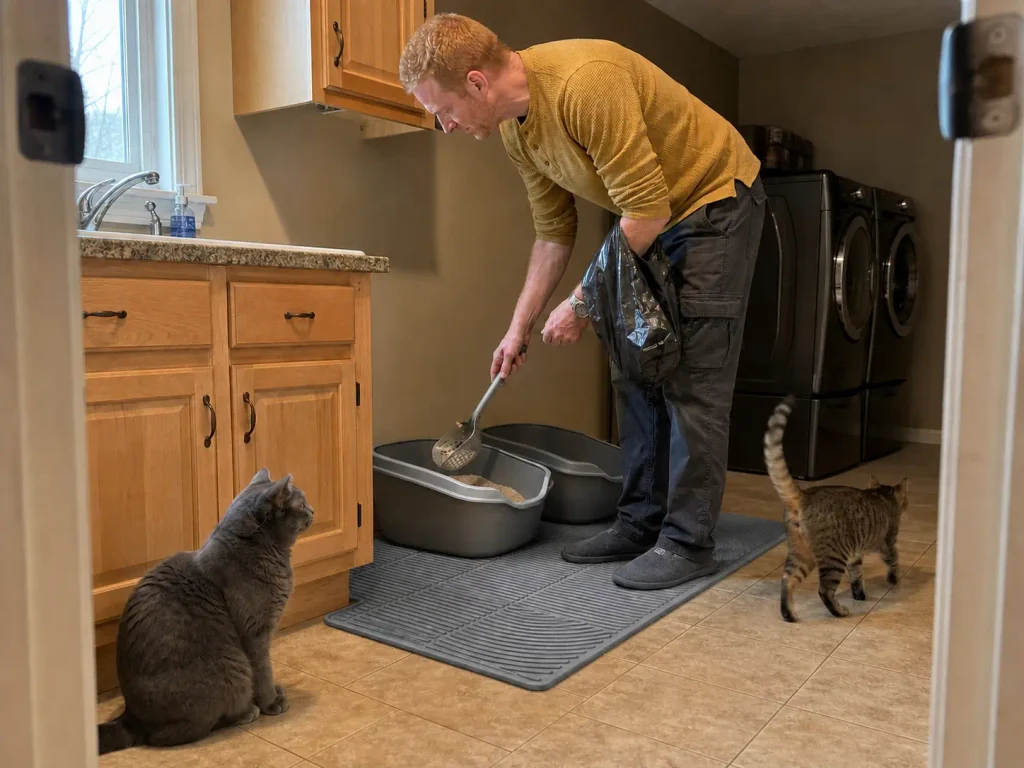
Two cats is not twice the litter on the mat. It is the same mat reaching the point where it stops accepting anything, twice as fast. After that it does something worse than nothing: it hands granules back to every paw that crosses it.
The Saturation Point, and What Happens After It
Every mat here has a saturation point and none of them advertise it. A honeycomb’s cells fill and stop sifting, a coiled mesh clogs between the loops, a silicone mat’s channels fill to the level of the ridges. Past that point a mat is a surface, not a trap, and a loaded surface in a doorway redistributes rather than catches.
Which is why the multi-cat floor of 30 by 40 inches is not about fitting more cats. Nobody needs 40 inches of mat for two animals weighing ten pounds each. The number is about how long the mat runs before it saturates.
One Big Mat or Two Mats, per Box
Two boxes means two exit paths, and one mat stretched between them usually catches neither, because the exit-stride rule fails at both ends at once. Each box gets the clearance rule applied individually, which means the 1+1 logic governing box count applies to mats too.
That assumes the box count is right. Two cats sharing one box have a bigger problem than tracking, so check how many boxes two cats actually need first.
The budget move here is unglamorous and effective: two cheap mesh mats, one per box, instead of one expensive mat trying to cover both. Two saturation points, two schedules, and if one gets destroyed you replace one.
The Frequency That Actually Keeps Up with Two Cats
One cat, weekly. Two cats, twice a week, and past that the schedule matters more than the material. A cheap mat cleaned twice a week beats an expensive one cleaned monthly by a margin that is not close, which is the real reason the cleaning cycle should drive the purchase.
Cleaning by Material, and the One That Cannot Go in the Machine
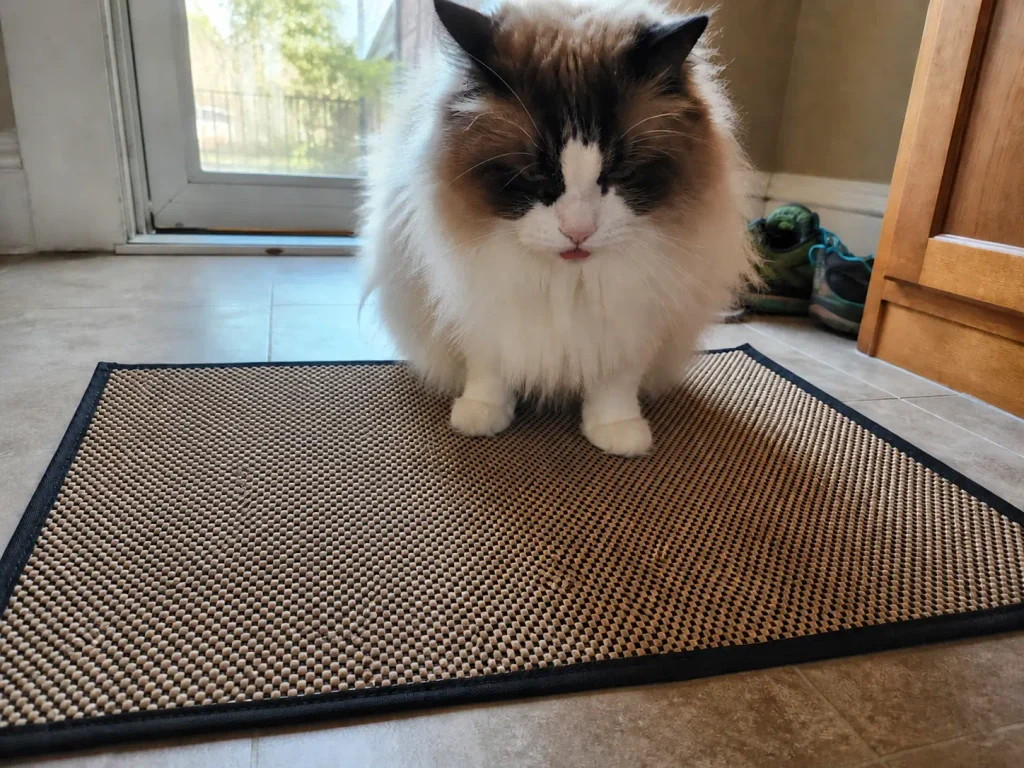
The mat you keep is the one whose cleaning routine fits the way you already live. Everything else gets shoved under the radiator by week three and replaced by a folded towel.
The Four Cleaning Routines, in Order of How Forgiving They Are
Mesh and coil are the most forgiving: shake it out over the box with the litter box scoop still in your hand, vacuum when that stops being enough, machine wash when it needs more. There is no schedule you can fall far enough behind on to ruin it.
Silicone and rubber come next, at tip, rinse, done. Honeycomb is third, at lift, spread, tip back, weekly, and it is the one that gets skipped. A sisal mat or a microfiber mat behaves like jute, which sits last on convenience and first on comfort: spot-clean and vacuum only.
Why Jute Is Spot-Clean Only
Natural fiber is spun rope pressed into a weave, held by tension plus whatever backing is bonded to it. Soak it and the fibers swell, dry unevenly and loosen at the edges. In exchange you get the softest surface underfoot of any material here, and users report jute mats lasting two to three years of daily traffic.
The tradeoff, out loud: jute is the pick for a cat that dislikes standing on plastic, and the pick against for a person who wants a mat they can throw in with the towels on a Sunday.

Matching the Routine to the Week You Actually Have
Be pessimistic about yourself. If the week is unpredictable, buy the most forgiving routine even if it traps slightly less. A mesh mat shaken out whenever you remember beats a honeycomb mat you have been meaning to empty since the eleventh.
Shake the mat out over the open box, not over the trash. What falls off is clean litter, and it belongs back where it came from.
What Still Ends Up on the Floor, and Why That Is Fine
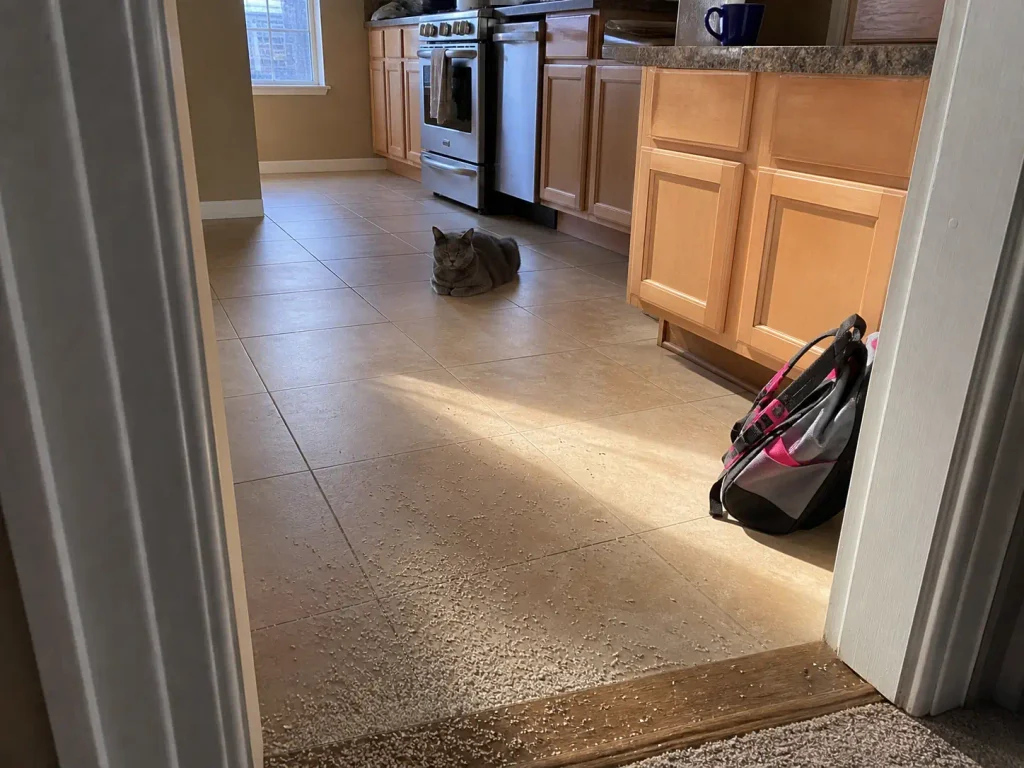
Three weeks in there is still some litter past the mat, and the question is whether that means it failed or whether that is what litter tracking looks like when a mat is working. Almost always the second, and a reader expecting zero throws away a mat that was doing its job.
What Working Actually Looks Like on the Floor
The realistic outcome is most of it, not all of it. A mat that catches the first two steps has done what the design permits, and the granule that survives to step four was never the mat’s to catch. Check two things at three weeks: is the litter line closer to the box, and is it thinner. If both moved, the remainder is the cost of housing a cat.
The Four-Step Check When Nothing Changed
If nothing changed, go in this order before buying a replacement. Check which way up it is, since reviewers regularly report a mat going from trapping nothing to catching nearly everything after a flip.
Then litter box mat size against the exit-stride rule. Then whether it is saturated, because a full mat and a bad mat look identical from standing height. Only after all three is it the wrong type.
The Two Upstream Fixes That Beat a Second Mat
If the mat is right and the floor is still gritty, stop buying mats. Smaller grain size does more of this work than any mat, because a granule that does not stick to a pad never gets carried anywhere. And a higher-sided box, if the mat has gone as far as it can stops the digger’s arc at the source.
One variable this article deliberately left alone: where the mat goes matters as much as which one it is.
Conclusion
Measure the box’s exit width and add a full stride of clearance past the opening. That number decides more about your floor than the material does, and almost everyone skips it.
Watch the floor for one day before buying anything. A wide arc around the box means digger, and only a dual-layer mat contains that. A narrow trail means walker, and the cheap coiled mesh mat is genuinely enough.
If the box has no clear floor in front of it, single-layer silicone is not a compromise. It is the correct answer for that room.
Check back in three weeks, not three months. The cat accepts or rejects the mat within days, and a cleaning routine loosens by the third week if it is going to. Look for a litter line that moved closer to the box and got thinner.
Before any of that: turn the box ninety degrees and flip the mat you already own so the textured side faces the floor. If the line moves closer, you just saved the purchase.
Amazon’s Audible — free for 30 days
Your cat won’t let you read. Let someone read to you.
Audible is Amazon’s audiobook library — thousands of titles, read out loud, on your phone. Free for a month, plus one audiobook to keep forever.
Frequently Asked Questions
01Why is my litter mat not trapping anything?
Check which way up it is first. The textured side goes down against the floor, and reviewers regularly report a mat going from useless to catching nearly everything after a flip. If it is already the right way up, it is either saturated or too narrow for the box’s exit width.
02What is the best material for a cat litter mat?
There is no single best one, because the material answers a different question than most people ask. Honeycomb dual-layer traps the most for a cat that digs. Coiled mesh and silicone wipe paws for a cat that walks litter out. Jute is softest underfoot but cannot go in the machine.
03How big should a litter mat be?
At minimum, as wide as the box’s exit and extending about a foot and a half past the opening. For two or more cats, treat 30 by 40 inches as the floor rather than the target, because a smaller mat saturates before the week is out.
04How often should you clean a litter mat?
Weekly for one cat and twice weekly for two, because a saturated mat stops trapping and starts handing granules back. Dual-layer mats need lifting and emptying on that schedule. Silicone ones just get rinsed where they lie.
05Will a mat work for a cat that digs aggressively?
Only a dual-layer one, and only if it is wide enough, since surface texture cannot catch litter that is already airborne. Check the mat has no slots wide enough to catch a claw: a cat that finds it unpleasant will step around it, and then you lose everything.
Leave a comment