How to Make Litter Box Smell Go Away and Keep It Gone
Litter 2-3 inches deep + scooping twice daily + the lid off. The three numbers that stop litter box smell, and why a covered box makes it worse.

Alfredo RamsesFounder · August 22, 2026 · 18 min read

On this page9 sections
- 1Why the Box Still Smells an Hour After You Cleaned It
- 2Scoop Twice a Day, and Why Once Is Not Enough
- 3Get the Depth Right, and Pick a Litter That Can Clump
- 4Take the Lid Off, Even Though It Feels Backward
- 5Move the Box to Where the Air Moves
- 6What to Add, and What to Stop Adding
- 7Two Cats Change the Whole Answer
- 8The Order Is the Whole Trick
- 9Frequently Asked Questions
You scooped the box this morning. By six in the evening the apartment announces itself the moment you open the door, and you are standing there wondering what else you are supposed to be doing. Here is the part nobody leads with: knowing how to make litter box smell go away is almost never a product problem. It is a sequencing problem, and most people are already doing three of the right things in an order that cancels them out.
Below is what is actually generating the smell, the fixes that stop it ranked by cost (the first two cost nothing), and what changes the day a second cat moves in.
Quick Answer
Five changes, in this order. The first four are free.
- Scoop twice a day, not once. Ammonia runs on a clock.
- Keep litter 2 to 3 inches deep so clumps reach the bottom.
- Take the lid off. A cover concentrates odor, it does not remove it.
- Move the box toward moving air, not into the smallest room.
- Dump and wash the whole box weekly, and replace the box yearly.
Why the Box Still Smells an Hour After You Cleaned It
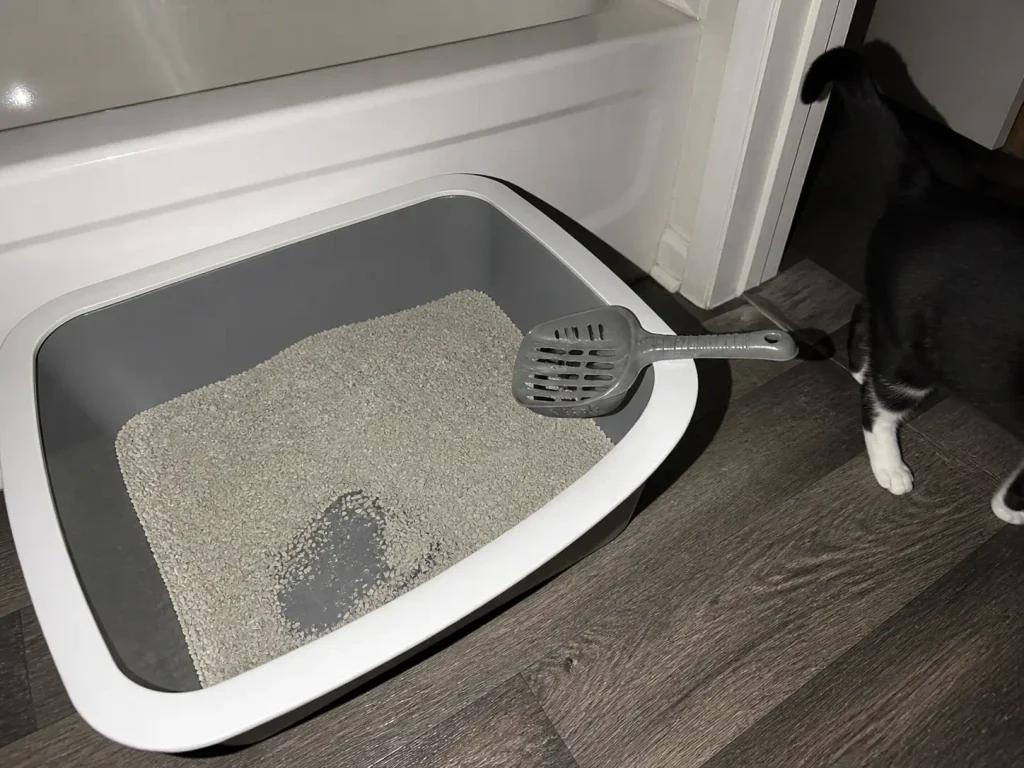
The pattern is what gives it away. If the smell built up steadily over weeks you would suspect the litter. But it does not do that. It disappears when you clean, stays gone for a few hours, and comes back on a schedule you could set a watch by.
That is exactly why litter box odor comes back after you clean and why buying a different brand keeps not working. You are not failing at cleaning.
You are losing a race you did not know you had entered.
Ammonia is not dirt. It appears when bacteria break down the urea in urine that is already sitting in the box, and that reaction runs on its own timer regardless of how spotless the surface looks. Scooping removes the solid evidence. It does not stop the clock on anything still in there.
That chemistry is also what an ammonia smell specifically means when you catch it as a distinct sharp note rather than a general funk, and it is the reason two households with identical routines can smell completely different.
So the real question is not what to buy. But it is not really about time either, at least not the way people mean it when they say they clean often enough. It is about which of three clocks is running out on you.
The first one is depth, and it is the one that catches most people. If the litter sits under 2 inches, urine goes straight through it and reaches the plastic, where it spreads into a thin layer at the bottom of the box. No scoop reaches that. You lift out clean clumps, the box looks fine, and the source never leaves the room.
The most repeated sentence in litter threads is some version of “it smells fine right after I clean it and bad again by evening,” and that sentence is not a complaint. It is a diagnosis.
The two-minute test: press a finger down through the litter in the corner your cat actually favors, not the middle. If you can feel the plastic, depth is your problem, and nothing else on this page will work until you fix it.
The second clock is the box itself. Plastic picks up fine scratches from a year of claws and scoop edges, and odor settles into those scratches and stays. Past roughly the one-year mark the box is no longer a container for the smell.
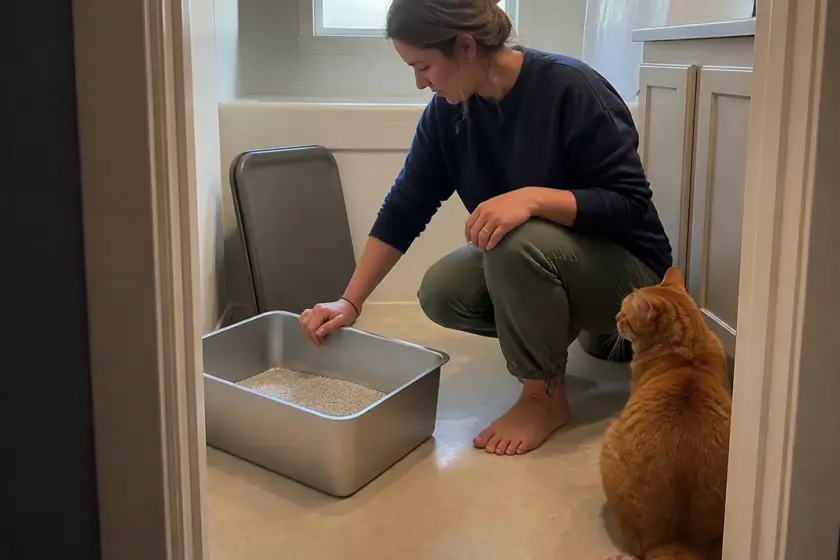
It is the source, and fresh litter in an old box smells like the old box within a day. Replacing it is the one piece of litter box hygiene that no amount of washing substitutes for. That is also the honest reason some people move to metal boxes after their second or third plastic replacement: a stainless steel litter box has nothing porous to scratch into. A litter box liner delays the same problem rather than solving it, since the liner is what tears and traps urine underneath itself.
The third is the full change. Topping up fresh litter over saturated litter is not a reset, it is a burial, and it is what most people mean when they say they change the litter regularly.
None of these three is fixed by scooping harder. That is the whole point of leading with them.
Scoop Twice a Day, and Why Once Is Not Enough
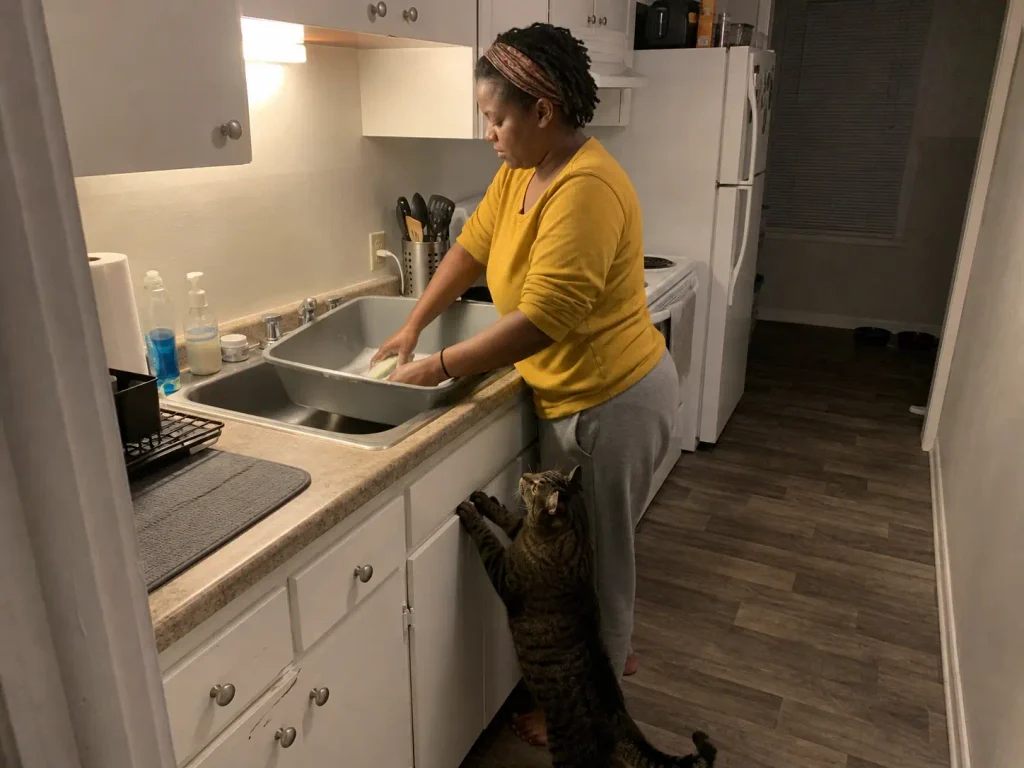
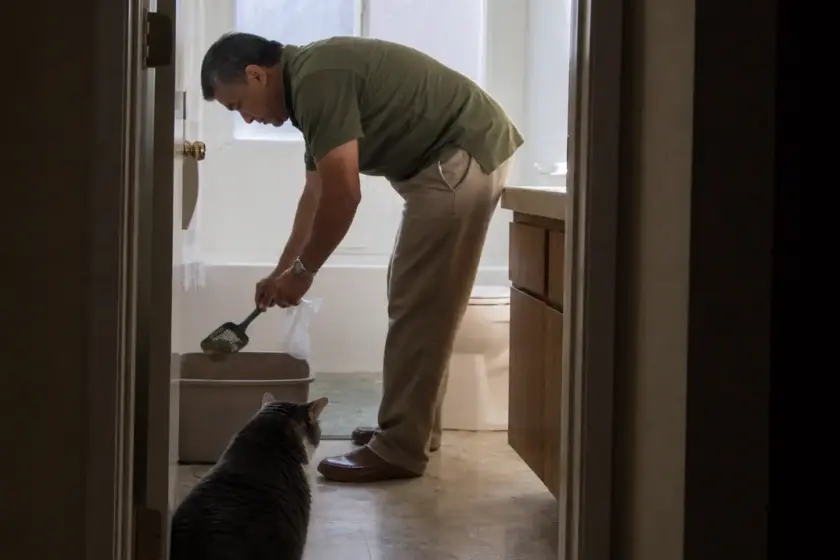
Everybody already knows they should scoop. What almost nobody has been told is that once a day is the floor, not the target. One pass keeps the box from becoming genuinely dirty.
Two passes keep ammonia from establishing at all, and that gap is the difference between a room that is fine and a room you notice from the hallway. The second pass takes about forty seconds, because there is half as much to lift.
Timing matters more than effort. The evening pass earns its keep, because whatever arrives overnight otherwise sits eight or nine hours untouched, comfortably past the point where the reaction gets going. Clear the box before bed and you have removed the longest sitting window of the day.
Scoop twice in the afternoon instead and you have done more work for less result. That is how often you should scoop in odor terms rather than hygiene terms.
Then the weekly reset, the part that gets quietly dropped. Once a week for one cat on clumping litter: everything out, box washed with mild soap and warm water, dried, refilled to depth. That weekly deep cleaning is the reset the daily pass cannot do.
Not topped up. Dumped. Fresh litter over old buries the saturated layer and pushes the depth past the point where clumps hold, so you get a deeper box that scoops worse.
One hard rule while you wash it: never use an ammonia-based cleaner on a litter box. To a cat’s nose that reads as an existing urine mark, which is an invitation rather than a cleanup.
Mild soap, warm water, done. Save the enzymatic cleaner for accidents outside the box, where breaking down the residue is the actual job. And skip the ozone generator entirely, whatever the listing claims: ozone is not something to run in a room a cat lives in.
All of this costs nothing, and it sits before any product on this page on purpose. The most common failure in the whole topic is treating “I scoop every day” as proof the routine is sound, then going shopping instead of adding the second pass.
Get the Depth Right, and Pick a Litter That Can Clump
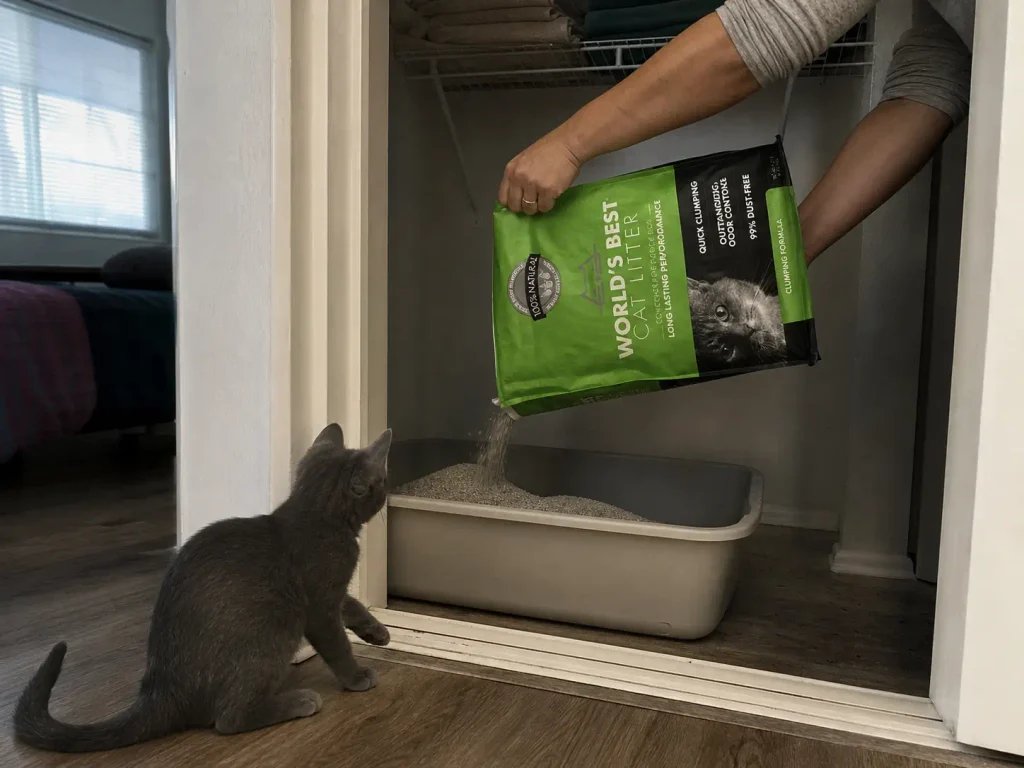
Ask how much litter to use and you get “enough” from every direction. The real answer is a range with a consequence at both ends: 2 to 3 inches, measured at the deepest part of the box.
Below 2 inches, urine hits the plastic and pools where no scoop goes, which is the first clock from earlier. Above 4, you get the opposite failure. A clump forming in very deep litter has more loose material around it and less holding it together, so it breaks on the lift.
You feel it happen: the scoop comes up and half the clump crumbles back in. Non-clumping litter never gets that far, since there is no clump to lift in the first place and the whole deposit stays in the box until the full change.
More is not safer here, and how much litter to use is a real range rather than a minimum.
Put a strip of tape on the outside of the box at the fill line once, and you never measure again. The weekly refill turns into a glance, and you catch the slow creep downward that top-ups hide.
The clump is the whole mechanism. A litter that forms one tight clump all the way through takes the entire urine deposit out of the box in a single lift. A litter that crumbles takes maybe half and leaves the rest reacting under the surface. That is physical removal, which is a different thing from what “odor control” branding usually means, since that phrasing normally describes something added to cover the smell rather than something that carries it out the door.
Depth first, brand second. Any clumping clay litter held at 2 to 3 inches beats a premium litter at one inch. Once your depth is right, though, a litter that holds together on the lift makes the daily pass noticeably cleaner, and the World’s Best Cat Litter Original Series in the 14 lb bag is a corn-based clumping litter that comes up whole rather than in pieces. It is lighter than clay, which matters if you carry it up stairs, and dustier on the pour, which matters if you are sensitive to that.
Unscented litter, always. Scented litter does not remove ammonia. It sits next to it, so the room now smells of two things instead of one, and the cat, who has opinions about texture and smell that he did not ask you to share, gets a box that fights back at the entrance. The deodorized bag is bought for your nose and paid for by him.
That trade shows up again in the next section, larger.
Take the Lid Off, Even Though It Feels Backward
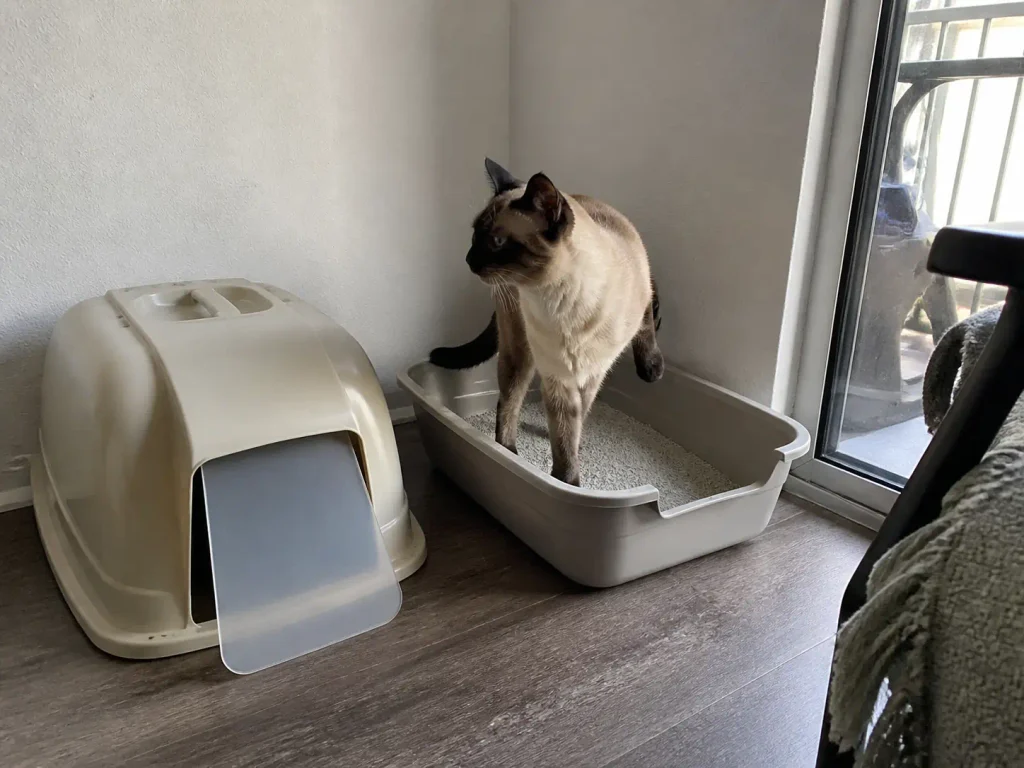
This is the one that gets argued with, so here is the mechanism rather than the verdict.
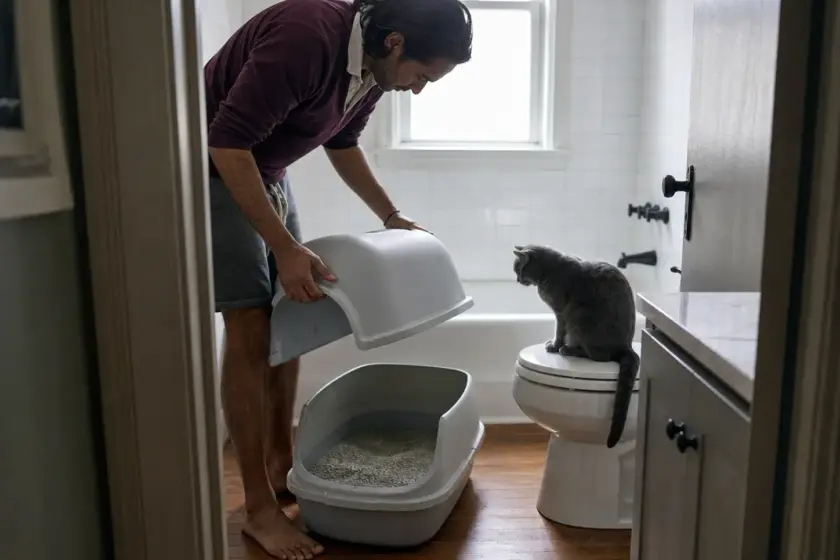
A covered litter box does not remove odor from anywhere. It relocates it.
Ammonia that would have dispersed into the room’s air stays concentrated inside the enclosed space under the hood, and the room genuinely does smell better for a while, because the smell is being stored rather than cleared. The reservoir keeps building. Then it comes out in a slug every time the flap swings, which is why a covered box tends to produce sudden smells rather than a constant one, and why the timing feels random when it is not. An uncovered litter box has no reservoir to release, so what it produces is lower and steadier.
The cat gets the stored version at face height, on entry, every single visit. That is the sharpest divergence between his interests and yours in this entire topic, and it is worth naming plainly: the lid was bought for your eyes and for what a guest sees walking past. That is a preference. His objection is a constraint, and constraints do not negotiate.
The risk is not just that he dislikes it. A box that smells strongly enough at the entrance is a box a cat may quietly start declining, and the ones who do usually used it fine for the first month, which is what makes the connection so easy to miss. At that point you have traded an odor problem for a much worse one somewhere else in the apartment.
Take the lid off and here is what the first week looks like:
- Days one and two smell worse, not better. The stored reservoir is clearing all at once and it is unpleasant. This is the part people quit during.
- By day three or four the level drops below where it was with the lid on, and stays there.
- Your cat starts entering more readily, often within a day, because the entrance no longer hits him with anything.
- Scooping gets faster, because you can see the entire surface instead of working blind around a hood.
If the tidiness is the sticking point, that is a real constraint too and the answer is design rather than a hood. Which box designs hold the least smell comes down mostly to open shape and material, not to how much of the box is enclosed. There is a full comparison of covered versus uncovered boxes if you want the trade laid out end to end.
Move the Box to Where the Air Moves
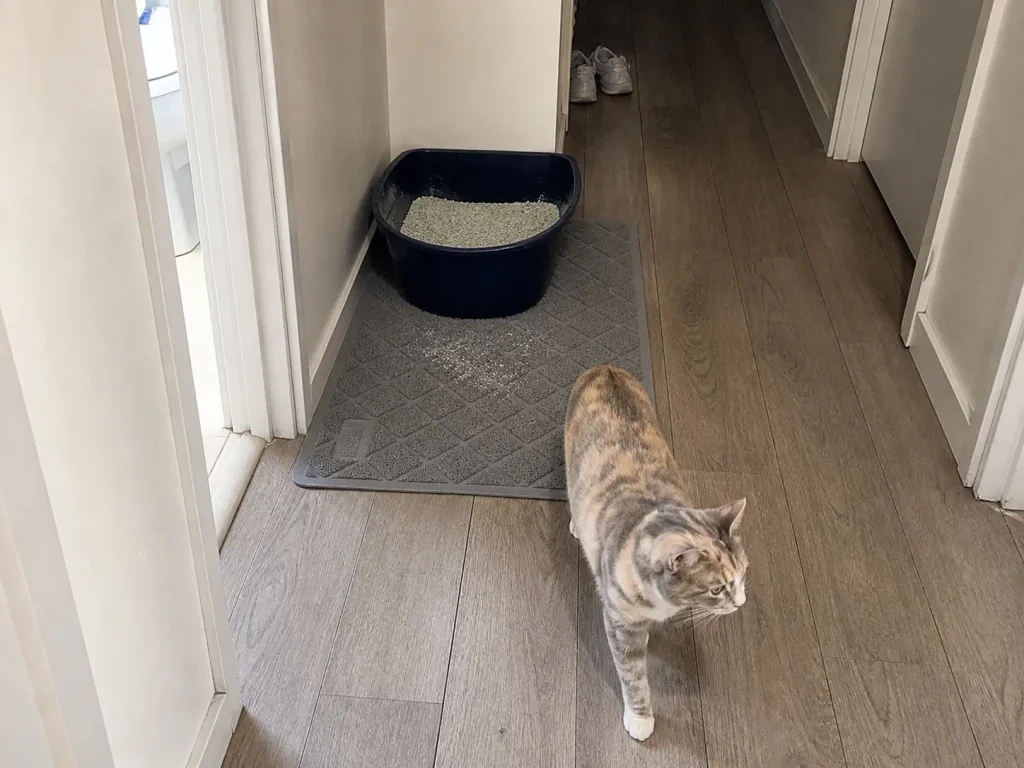
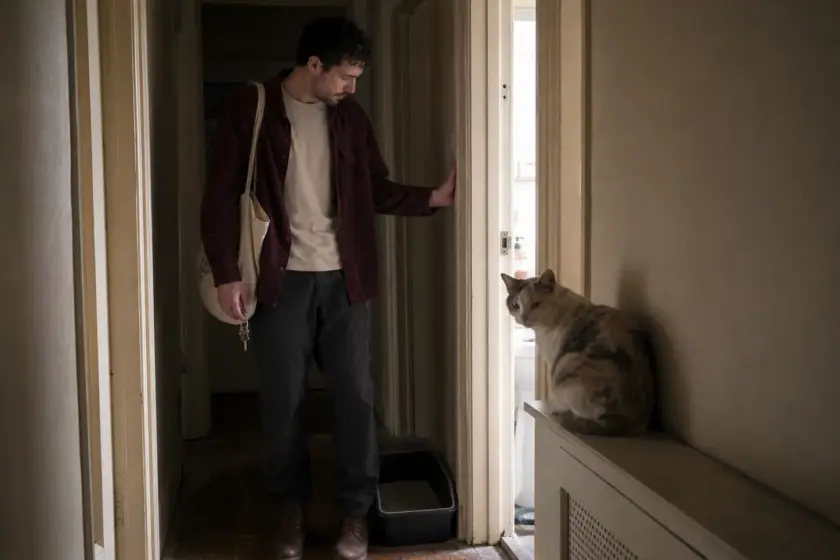
The instinct is to hide the box in the smallest, most closed-off space you have. It is the worst available choice by the only measure that counts, which is why where the litter box goes makes litter box placement an airflow decision rather than a decorating one.
Odor leaves a room by air exchange. That is the only mechanism. A box in a closed powder room, a cabinet, or a hall closet sits in the opposite of a ventilated area and gets effectively none, so the concentration climbs no matter how faithfully you scoop, then leaves in a wave every time the door opens. Same box, same litter, same routine, different result, entirely because of where it sits.
The principle in one line: pick the least enclosed spot you actually have, not the most hidden one. Moving a box six feet toward a window or an open doorway beats switching litter brands three times, and it is free. Do that before you buy anything in the next section.
Now the honest version for a small apartment, because this is where most advice stops being useful. In a studio apartment there may be no ventilated spot that is also out of the way, and pretending otherwise helps nobody. You have to pick a side: accept the box being visible in exchange for it being bearable, or accept a hidden box and treat the twice-daily routine as fixed rather than aspirational.
Both work. What does not work is a hidden box plus a once-a-day routine, which is what almost everybody defaults into. The layout that works in a small apartment goes through the specific spots worth considering when you have one bathroom and no closet.
None of this needs a landlord’s permission, incidentally. No fan to install, no vent to add, no holes in anything. It is furniture arrangement.
One thing spreads the smell past the box no matter how well you place it: tracking. Litter carried out on paws holds the same residue the box does, so a cat who exits at speed extends the odor footprint several feet, and you end up cleaning a smell that is no longer in the box. A mat catches it.
The Gorilla Grip Cat Litter Box Mat at 35 by 23 inches is deep enough for a full exit stride rather than just the first step, which is where smaller mats fail. The coiled mesh needs shaking out over a trash can every few days, and it fixes nothing about placement. It just stops the problem from spreading.
What to Add, and What to Stop Adding
You have probably already been down this aisle. Baking soda, scented crystals, a spray, something with a leaf on the label. By now you are suspicious of the whole category, and you should be.
The rule for all of it: an additive is a layer on top of a working routine, never a replacement for one. Buying the mask before finding the source is the most expensive habit in this topic, and it is what the aisle is built around. Which is why what to put near the box, and what makes it worse is a better question than what to put in it.
I used to rate baking soda higher than the rest of that shelf. Enough threads describing the same result later, the more accurate read is that it does a little, briefly, then gets dug through and buried within a day. Which is a fairly good description of doing nothing.
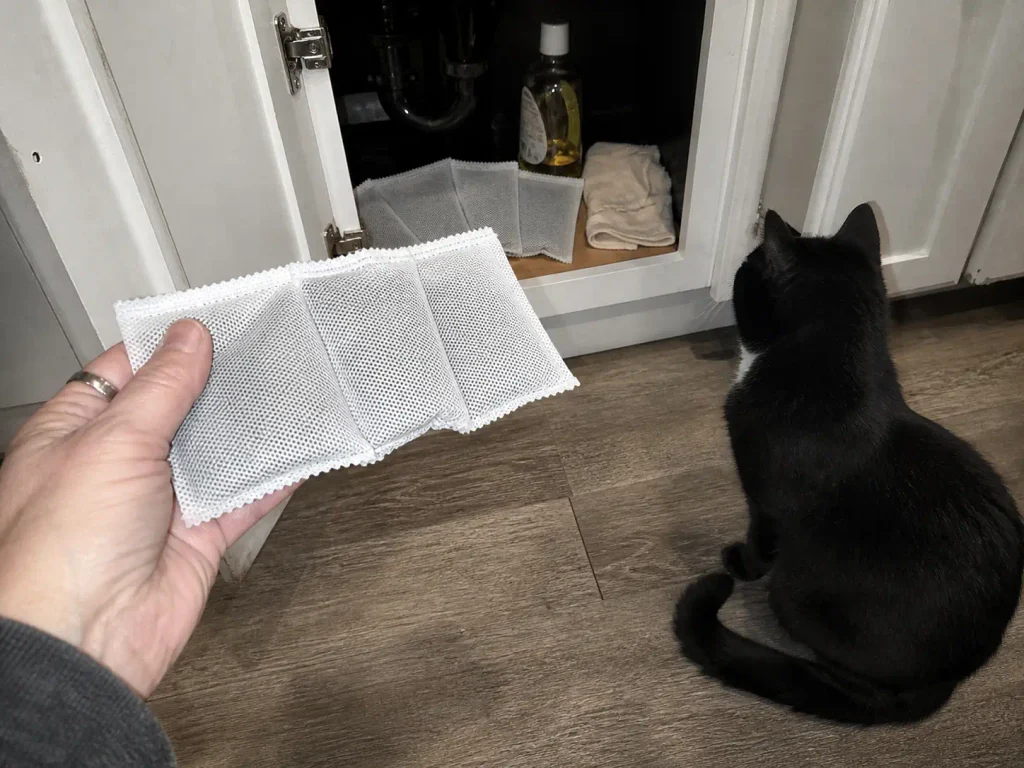
Activated charcoal is the one that earns its space, and the reason is adsorption rather than absorption. It works as an odor absorber in the literal sense, not as an odor neutralizer that reacts with anything. Odor molecules stick to the enormous surface area inside the carbon and stay there. Nothing gets covered up and nothing gets added to the air.
Placement is where most people waste it: under the box or beside it, not stirred through the litter, where it gets excavated and scattered in a day.
Test an additive by removing it for three days, not by adding it. Anything you cannot notice the absence of was not doing the work you were crediting it with, and you have been paying to replace it on schedule.
For charcoal you can place and forget, the PurifyLogix Activated Charcoal Litter Box Pouches come six to a pack, coconut-shell carbon, sitting under or beside the existing box without touching your litter or your brand choice. Six is roughly a year at the interval carbon actually needs. They also stop working before they look any different, which is the standard complaint about every pouch on the market.
Same material, much lower price per ounce: the Kitty’s Odor Stopper is 4 lb of bulk activated charcoal, and if you will portion it into an open jar yourself, it is straightforwardly the better buy. Same carbon, no packaging, more of it. The catch is that loose charcoal is messy and stains anything porous it touches, which is exactly what the pouches charge you to avoid.
Skip the scented anything. Fragrance stacks a second smell on the first one, the room ends up smelling of two things, and your cat gets one more reason to hesitate at the entrance.
The air purifier goes last, and its position in this section is the argument. A purifier filters the air near the box. It never touches the source sitting in the litter, so it can only clean up what already escaped. Run one over a broken routine and you own an expensive fan.
Run one over a routine that works, in a small apartment where the box has nowhere ventilated to go, and it takes the edge off the last stubborn bit. The Purrified Air Litter Box Air Purifier is built for this job rather than being a room unit pointed at a box, using a carbon filter plus zeolite media.
Its reviews are genuinely mixed, and that is worth saying plainly: the people who fixed depth and cadence first tend to rate it well, and the people who bought it as the fix rate it badly. Which is the whole point of it being last.
Two Cats Change the Whole Answer
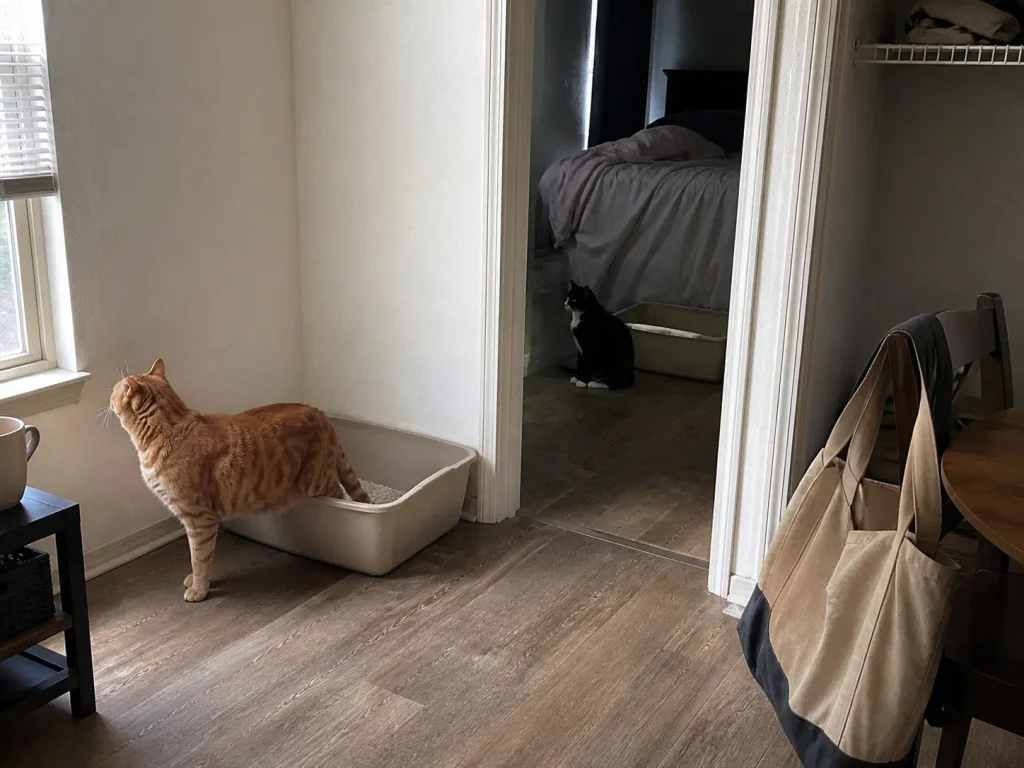
Everything above quietly assumes one cat. Run exactly that routine with two and you get a home that smells, then conclude the advice does not work. The advice is fine. The arithmetic changed underneath it.
The rule for a multi-cat household is one box per cat plus one, so two cats need three boxes. It reads as excessive right up until you stop treating it as a behavior rule and start treating it as an odor rule.
Fewer boxes means each one fills faster between scoops, so every box spends a larger share of its day past the point where ammonia gets going. Three boxes for two cats is not three times the cleaning. It is the same waste spread thin enough that none of it sits long.
The count is not a blog convention either: the AAFP and ISFM guidelines on feline environmental needs put resource count, litter tray included, among the basic requirements for a household with more than one cat. There is more on how many litter boxes two cats actually need, including where the rule bends.
The cadence scales with the count, not instead of it. Twice daily per box, and the weekly full change moves to twice weekly once boxes are shared, because shared boxes saturate at closer to double the rate rather than the same rate spread around.
If a third box will not fit, the third box’s job can be done by the second scoop of the day. Space or minutes: the routine needs one of the two, and you get to choose which one you can actually give it.
Which brings up the collision nobody addresses. A studio with two cats does not have room for three boxes, and telling someone it does is how an article stops being useful. The workable version is two boxes in genuinely different locations, plus a twice-daily routine treated as fixed.
And “different locations” is doing real work there. Two boxes against the same wall count as one box to the cats, because what a second box provides is somewhere else to go when the first is occupied or the other cat is standing near it. Two boxes in two rooms beat three boxes in a row, for odor and for whether they get used at all.
The Order Is the Whole Trick
Three things to take away from all of this.
Fix the order, not the products. Depth and cadence come before anything with a price on it, and if you get those two right you may never reach the rest of this page.
The lid and the hiding spot were both bought to solve exactly this problem, and both make it worse. Removing them costs nothing and shows a result inside a week, which is a rate of return no purchase on this page matches.
Two cats is a different arithmetic problem, not a harder version of the same one. Solve it as a count and a cadence rather than as a shopping list.
Check back in three weeks. Not three months, because three months of a smelling apartment is not a plan, and because three weeks is roughly when a new routine quietly loosens. Two things to look at when you get there: whether the second daily scoop is still happening, or has drifted back to one, and whether the depth is still at 2 to 3 inches or has crept down through top-ups without you noticing.
Start tonight with the free half. Take the lid off, move the box six feet toward wherever the air actually moves in your home, and give it a week. If that works, the rest of this page was optional and the money stayed in your pocket.
Amazon’s Audible — free for 30 days
Your cat won’t let you read. Let someone read to you.
Audible is Amazon’s audiobook library — thousands of titles, read out loud, on your phone. Free for a month, plus one audiobook to keep forever.
Frequently Asked Questions
01Why does my litter box still smell even after I clean it?
Almost always one of three things: the litter is under two inches deep so urine reaches the plastic where no scoop goes, the box is over a year old and holds odor in surface scratches, or the full change is overdue and you have been topping up. Surface scooping reaches none of the three.
02How do I stop my house from smelling like cat litter?
Move the box toward air movement rather than away from noses, and take the lid off if it has one. Odor disperses by air exchange, so the hidden closed-off spot that feels considerate is the one that concentrates it. Then hold a twice-daily scoop.
03What actually removes cat urine smell rather than covering it?
Removal is physical: a clumping litter at correct depth that lifts the whole deposit out, a weekly full change, and activated charcoal, which holds odor molecules instead of masking them. Fragranced products add a second smell to the first one rather than removing either.
04How often should I replace the litter box itself?
About once a year for a plastic box. Plastic takes on fine scratches from claws and scoops, and odor settles into them permanently. Past that point the box is the source, and new litter in an old box smells like the old box.
05Does an air purifier fix litter box smell?
It helps at the edges, and only after the routine works. A purifier moves air near the box but never reaches the source sitting in the litter. If depth, scooping and placement are not sorted first, a purifier is an expensive fan.
Leave a comment