Cat Territory in a Small Apartment Comes Down to Exits
Find out why your cat guards one spot in a small apartment, and open a second exit tonight with the furniture you already own (no drilling).

Alfredo RamsesFounder · November 3, 2026 · 19 min read

On this page7 sections
- 1Cat Territory in a Small Apartment Is Held by Routes, Not Floor Space
- 2Why One Favorite Spot Fails Once a Second Cat Moves In
- 3How to Count the Exits and Loops From Your Cat's Favorite Spot
- 4Free Moves That Change the Count Before You Buy Anything
- 5When Counting Exits Stops Being a Layout Question
- 6Open One Exit Tonight, Then Recount
- 7Frequently Asked Questions
Watch where your cat parks himself once the room fills up: the bench by the front door, the gap behind the sofa, the end of the bed with a wall at his back. None of those spots is about the view. Cat territory in a small apartment is held by the ways in and out of a place, not by the square feet around it, and a cat who seems stubborn about one doorway is usually guarding the last route he has left. The AAFP and ISFM guidelines on feline environmental needs lean the same direction by asking for safe places with more than one entry.
Below you will count the exits from his favorite spot, see why a single spot stops working once a second cat is in the picture, rearrange for free first, and find where the floor plan no longer explains the problem.
Quick Answer
In a small apartment, a cat’s territory is a set of routes, not an area. Count how many ways he can leave his favorite spot without passing the other cat: one exit is a dead end, two is the working minimum, and a loop around a piece of furniture is better. Start with a chair, not a purchase.
Cat Territory in a Small Apartment Is Held by Routes, Not Floor Space
In a small apartment a cat will often turn the hallway door into his border: he sits facing it, growling at the door when voices carry from the other side, as though the apartment ended there. Cats are territorial about edges like that. To you the hallway is a few steps of floor; to him it is the edge of his personal bubble, the zone he expects to keep, and the way he is defending space at that door shows you which routes he considers his.
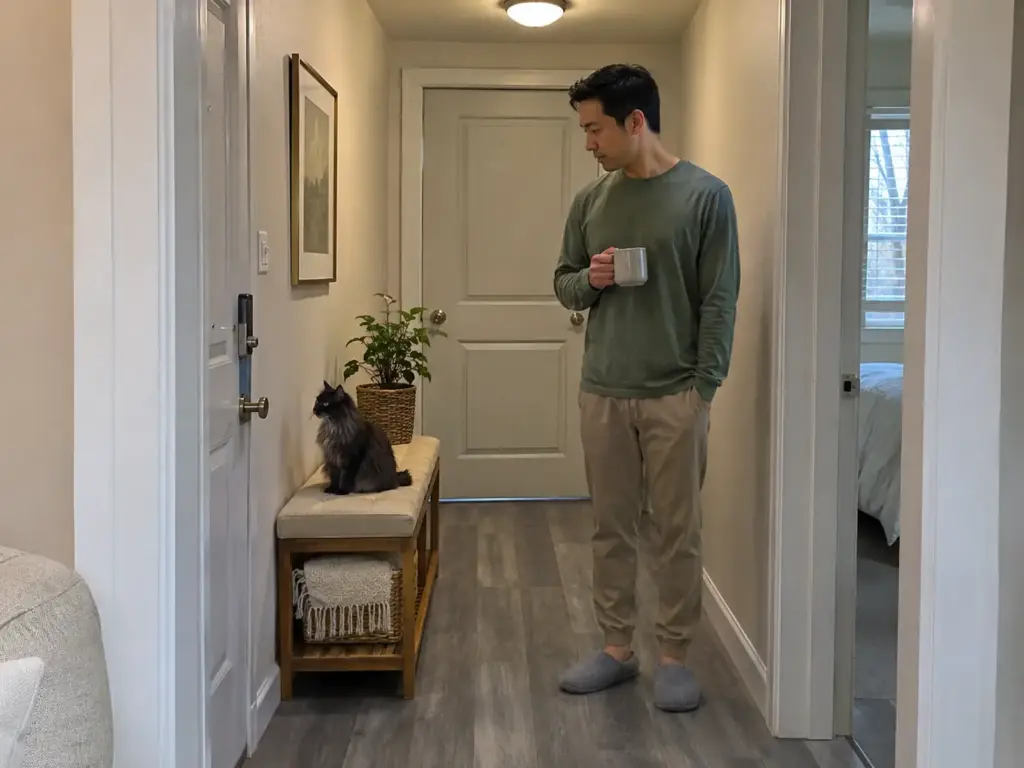
What a cat is claiming: a spot, a route, a window, the other cat
A claim is never a square of floor. It is a resting spot, the path he takes to reach it, a window with a view, and sometimes the other cat or one particular person. He announces it by sitting in the spot when you walk in, blocking a passage, standing guard over a bowl or marking. In a small apartment the trigger is nearly always a change to the layout: a new cat, a move, a sofa that now sits against a different wall.
The window is the claim people overlook. The guidelines ask for a resting place with a view of the outdoors, and in a small apartment there may be one sill that qualifies, so the cat who holds it holds the best seat in the home and the other cat feels the loss on every walk past it.
Under all of it is a plain preference for safety. Cats are solitary hunters, and the AAFP and ISFM guidelines on feline environmental needs describe them as favoring a familiar territory where they know their physical and social surroundings, because that sense of control keeps stress down. Faced with a threat a cat avoids or hides, and fighting usually appears only as a last resort when escape is not possible. A cat who looks territorial is very often a cat making sure he still has somewhere to go.
Cats do not hold a home as one block, and the usual way to read it is how a territory splits into sleep, food and shared-room zones. A small apartment squeezes all three zones into the same few rooms, so they overlap and one blocked route is felt in all of them.
Why adding height is only half of the answer
Height is the first fix anyone reaches for, and it earns the spot: an elevated place adds vertical space and lets a cat watch his surroundings, which is how the guidelines describe a perch. The trouble starts with the route. A shelf at the end of a dead-end corridor, or a tree in the one free corner of a studio, is a new spot with a single way down. If the other cat can settle at the foot of it, the cat above has height and no exit.
So the common advice needs a correction: height counts only when it adds a path. Put the perch where he can step up from one side and leave by another, or add a middle step so he can come down without passing the other cat’s bed, and the same piece of furniture does a different job. And two tall pieces that share one approach are still one route.
One cat or two: what changes in the count
With one cat the count is short: how many ways out of his favorite spot, and where do they lead? He can lose a route to a chair or a closed door, but nobody else is standing in it. Two cats multiply the work, because each spot has to let its cat leave without passing through the other’s, and the guidelines ask for at least as many safe places as there are cats, kept apart from each other.
Two cats can be calm in one apartment and tense in another of the same size. What changed is the number of independent routes, and that can move without a single square foot of difference.
Before you move a single piece of furniture, lower yourself to his height in his favorite spot and look out. Whatever a chair back or a sofa arm hides from you there is hidden from him as well, and that is usually where the first move is.
Why One Favorite Spot Fails Once a Second Cat Moves In
You bought the shelf, the cat ignores it, and the new cat is lying right under it. Neither cat has a behavior problem. The shelf has one way down, and the second cat closed it just by sitting at the foot.
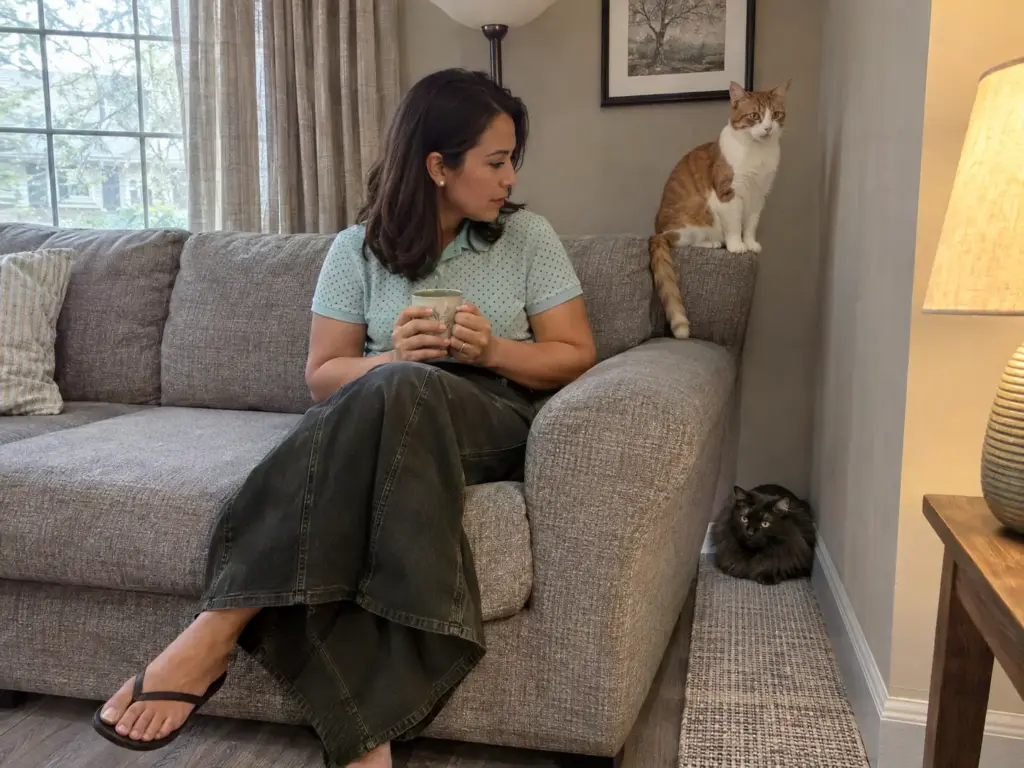
The spot with one exit: how a newcomer or a new piece of furniture removes the retreat
A favorite spot works because the cat can withdraw to it. If he cannot see a threat from there he feels safer, even when he is not fully hidden, and that is all the spot is for. The weak point is the way out.
According to the AAFP and ISFM guidelines, “a safe place should have more than one entry so that access cannot be easily blocked by another cat.” The gap behind the sofa, a cat nook in the corner of the bedroom, the bench by the front door: put one cat in the doorway of any of them and the cat inside has nowhere to go.
A new piece of furniture does the same thing with no second cat in the room. The bookcase set against the end of the hallway, the armchair that now closes the gap between sofa and wall: both remove a route, and a spot that lost its second exit behaves like a spot with a newcomer in the doorway. The cat is right about the constraint, and his reaction is the correct reading of a smaller map.
Why the same shelf works in a house and fails in a studio
In a house a cat who loses one corner has another: a spare bedroom, a landing, the far end of a hall. In a studio apartment the corner the other cat blocks is often the only one, so the same shelf that gave one household a calm tenant gives the other a standoff at its base. Nothing is wrong with the shelf; the studio just has no second corner to make up for it.
There is a quieter version of the same failure. Two cats sharing the good sofa corner look like friends, but cats in multi-cat homes often learn to time-share a resting place, visiting it at different hours, and a rota like that only looks like peace. It holds until something shifts the schedule: you start working from home, a new piece of furniture changes the order of the walk, a second window gets covered. Then both cats arrive at the one spot at once, and the cat who got there second has no other door to leave by.
That is also where the instinct to split the room goes wrong. A screen, a see-through divider or a gate across the middle looks like a neutral fix, but it lets each cat watch the other all day, and watching turns into breakouts: one cat gets past the barrier and the standoff starts for real. A solid barrier holds because it takes away the sight as well as the access. Even then the split leaks wherever the two halves share a hallway, and the cat on the wrong side learns to wait there, stalking, until the other one turns his back.
When the change is sudden, the vet comes before the layout
Everything on this page assumes a cat’s habits shifted because his home did. If a cat who never marked starts to, goes outside the litter box, drops the spot he has used for years, or turns up with a wound, that belongs with your veterinarian before you move a single piece of furniture. Maddie’s Fund guide to urine marking in cats starts from the vet too, telling readers to begin there and rule out medical causes. Why he changed is a question for the exam room, not for the floor plan.
If instead two cats who always got along have started fighting, that case is covered on a separate page where the vet also comes first: two cats who got along start fighting more.
How to Count the Exits and Loops From Your Cat’s Favorite Spot
Anyone can do this with a pencil. It takes one sheet of paper, your cat’s favorite spot and about ten minutes at floor level, and what comes out is a number for each spot that tells you what to move.
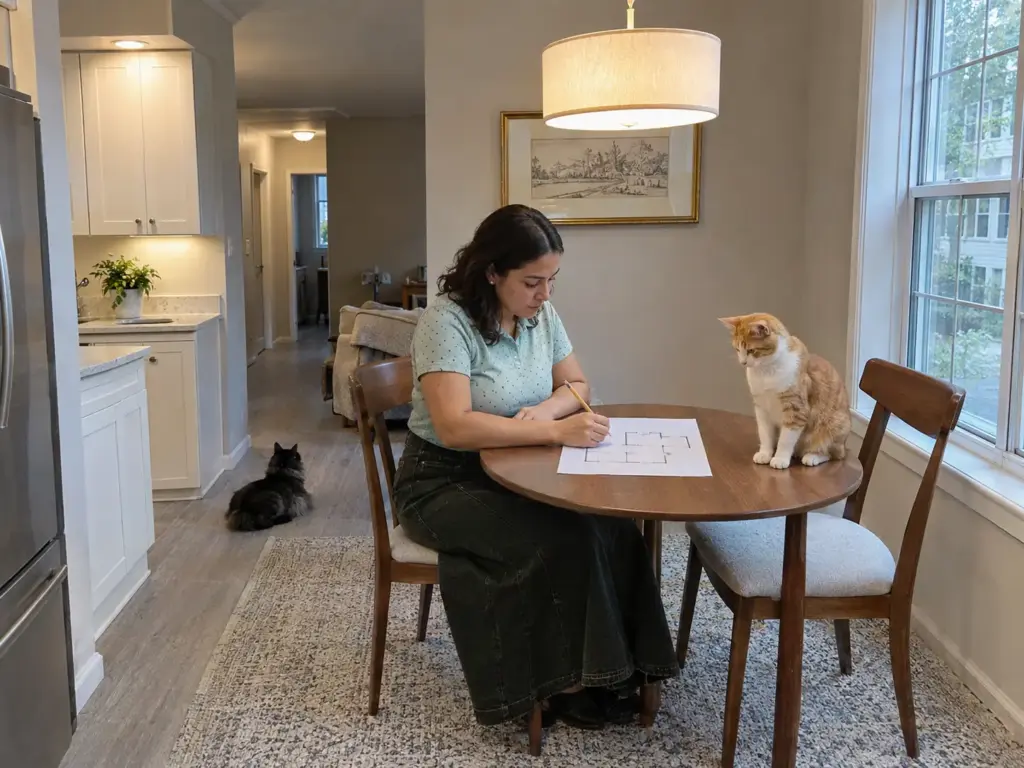
What to stand in and what to count: exits, loops and sightlines
Get down in the spot itself: the bed, the windowsill, the gap behind the sofa. Sketch the rooms as boxes, mark the spot, then trace every way out of it that does not pass within a leap of the other cat’s spot. Each one is an exit. A loop is a route that goes around a piece of furniture or a wall and comes back to where it started without crossing anything the other cat holds, so a cat can keep moving instead of backing out.
Last, mark what he can see from where he sits; those are the sightlines, and they run to the door, the other cat’s bed, the bowls.
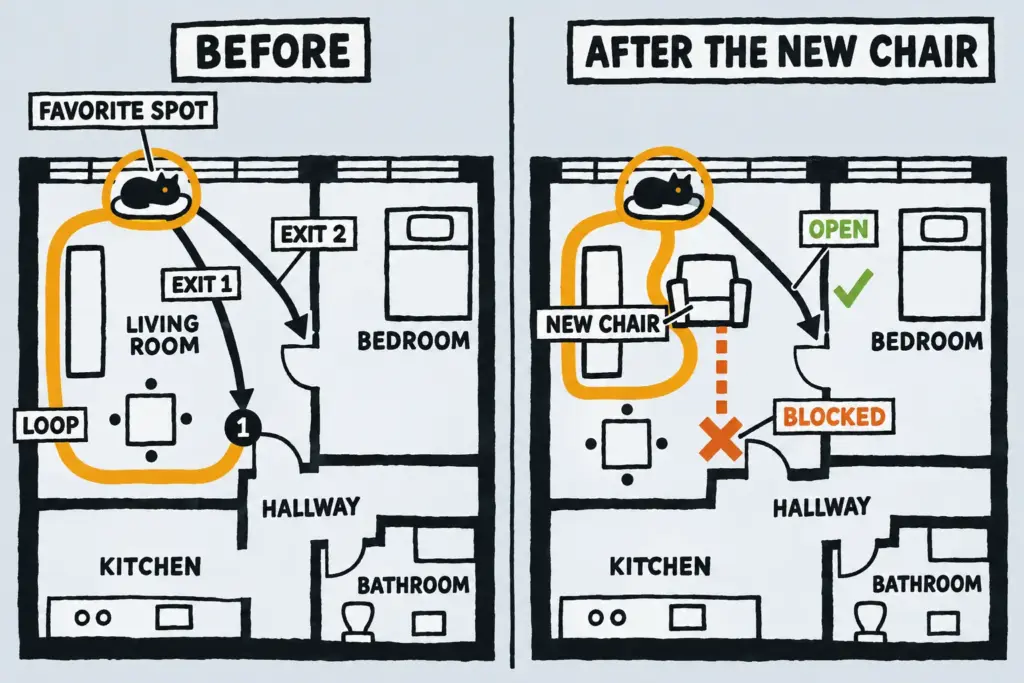
Keep the three apart on the paper, because they fail separately. A spot can have two exits and no loop, which works until the other cat stands at the junction. It can have a loop and a single exit, which still dead-ends. And it can have both with a sightline straight across the floor to the other cat’s bed, which turns every exit into a walk past a stare.
Work through this from every spot he uses, sheet in hand:
- Exits. Count the ways out that stay more than a leap from the other cat’s spot.
- Loops. Mark any route that circles furniture or a wall and returns without crossing.
- Sightlines. Note what he sees from the spot: the door, the window, the bowls, the other cat.
- The other cat’s view. For each exit, check whether the other cat can see it from where he lies.
Draw each cat’s routes in a different color. The places where the two colors cross are where the meetings happen, so that is where a chair, a door or a screen will change the most.
Reading the count: when the number is too low
One exit is a dead end, however big the room: the first cat to sit in the way closes it. Two separate exits is the floor that holds up, and it matches the rule VCA Animal Hospitals sums up from the AAFP and ISFM, that cats should have “at least two options for each resource, such as two feeding areas and two resting areas.” A route is a resource too, and the sheet tells you how many options a spot really has. Better than two exits is two that part ways within a step of the spot.
Two cats raise the bar, and here a number everybody quotes turns misleading. Two exits sound safe until both open onto the same stretch of floor in plain view of the other cat’s bed; then the cat is leaving through either door in front of an audience. An exit the other cat can see does not count, so with two cats tally only the exits that start out of his sight.
Anything doubled up counts once. Two bowls on one wall are a single bowl to the cat, two litter boxes pushed together are a single box, and two exits that begin in the same corner are a single exit. The rule of one litter box per cat plus one, extended to every resource is that arithmetic applied to bowls, boxes and beds; your sheet applies it to routes.
What size apartment is too small for a cat? The count answers it, not the square footage
An apartment is too small for a cat when his spots have one exit each, or when two cats must use the same route to reach anything they need. No number of square feet separates those cases from the good ones. A studio with a loop around the bed, a window spot and two exits from the cat’s corner is a better home for two cats than a larger layout whose only bedroom is a dead end beyond a closed door.
So a low count in a small place is mostly a rearrangement job, not a reason to look for more space. Fix the spot with the fewest exits first, recount, and only then decide whether the apartment is the problem.
Free Moves That Change the Count Before You Buy Anything
The best first test changes one route and leaves everything else alone, and it can be undone in a minute if the cat votes against it. None of these free moves needs a drill, so you can leave no holes in the walls and keep your rental contract out of it.
Open a second exit with what you already have
Start with whatever is actually closing the exit. A chair pushed against the end of the sofa, the door of the spare room kept shut, the sofa pressed flush to the wall: move the chair, open the door, pull the sofa a few inches out so there is a lane behind it. Then tidy the route so it does not end in furniture (a path that runs into a laundry basket is a path that stops).
The places he needs to reach get the same test. The way to the box cannot end in a dead end, so check it against where a litter box actually fits in a small apartment before you settle on a corner. Bowls follow the same logic: two stations that share one approach are one station, and feeding two cats in a small apartment by floor plan shows how to separate them.
Split the view: a window and a solid screen
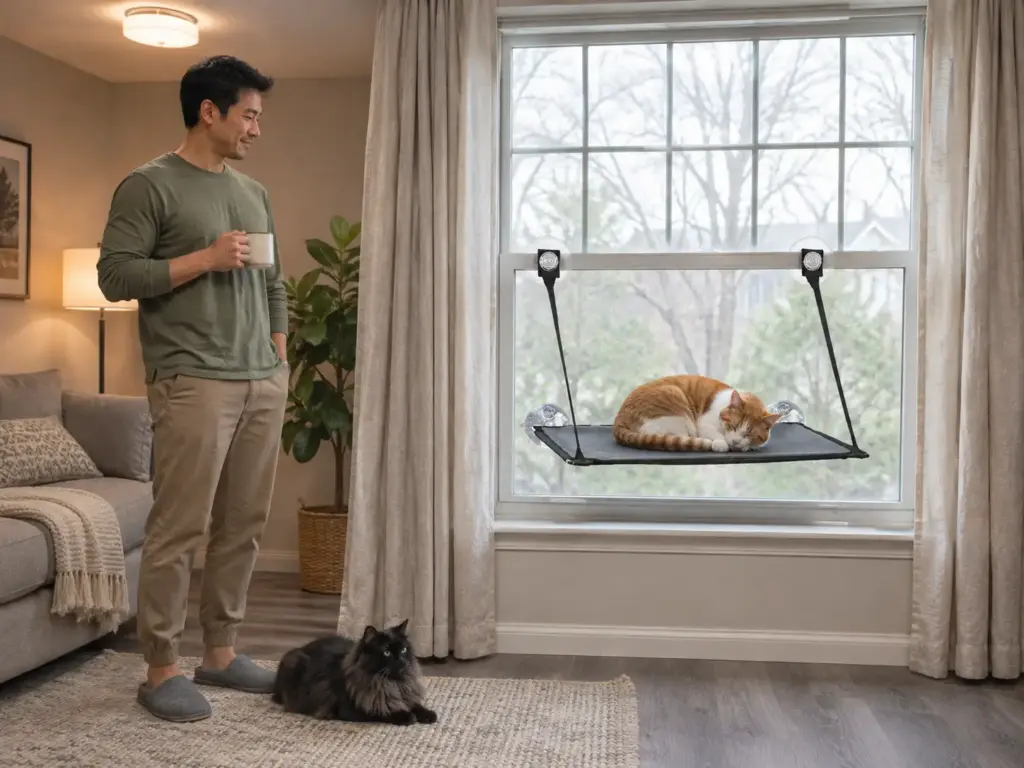
A window gives a cat his own sightline without using any floor. A folded blanket or a cushion on the windowsill is the free version: it turns the window into a second spot with its own view, so the cat who lost the sofa has a place to claim that is not in the other cat’s way. A window hammock does the same job and keeps the floor clear.
If the sill is too narrow for a cushion, the K&H Cat Window Perch EZ Mount Kitty Sill gives him a raised seat with a view. The listing describes it for a window about 27 inches wide and 23 inches high, so measure the opening first; a window of about that size is the whole condition, and a much smaller one means this perch is not the answer.
For the staring, the screen has to be solid. A panel, or a bookcase turned so its back faces the cat’s spot, cuts the sightline on both sides. Put it where it breaks the line to the other cat’s bed, not where it cuts a route. And run a simple toy rotation: keep the toys in a drawer between play sessions, because the ones left on the floor stop being interesting.
Add height, then a gate only if a door is the problem
Height comes next, because a level above the floor adds a route without removing one; wall shelves do the same job where the lease allows them. The Yaheetech 54 inch Cat Tree, a multi-level tower with scratching posts, stands 54 inches tall and gives a cat a second level to use while the other holds the floor. It takes a corner of floor, and the listing does not say how it is anchored, so find a way to secure it before putting it beside a route you need.
Place it so the way up is on one side and the way down on another, because a tree whose only approach passes the other cat’s bed adds a spot, not a route. Kittens and older cats do better with low steps or ramps than with a jump to the top.
A gate is the last resort, for the case where a doorway really is the problem and one cat can pass what the other cannot. The Carlson Extra Tall Walk-Through Pet Gate with Small Pet Door is 36 inches wide according to its listing, and its small pet door is the part that changes the route count without moving furniture: a small cat passes through, a larger one waits on his side. A gate also closes the route for any cat who does not fit the pet door, and it lets both cats see each other, so it changes who can pass, not who can look. The listing does not say how it holds a doorway without a drill, so check that before counting it in a rental.
In a one-room studio there is no doorway to hang a gate in, and the split has to come from a door that closes at set hours instead, which is the idea behind splitting one room by door and by clock.
Make one change, leave it for a week and recount on the same sheet. Move three things at once and you will not know which one the cat accepted.
When Counting Exits Stops Being a Layout Question
You moved two pieces of furniture, opened a door, and the tension is still there. That is not a failure. Either the count is still low, or the plan was never the whole explanation.
Recount after a week, then look at who still blocks whom
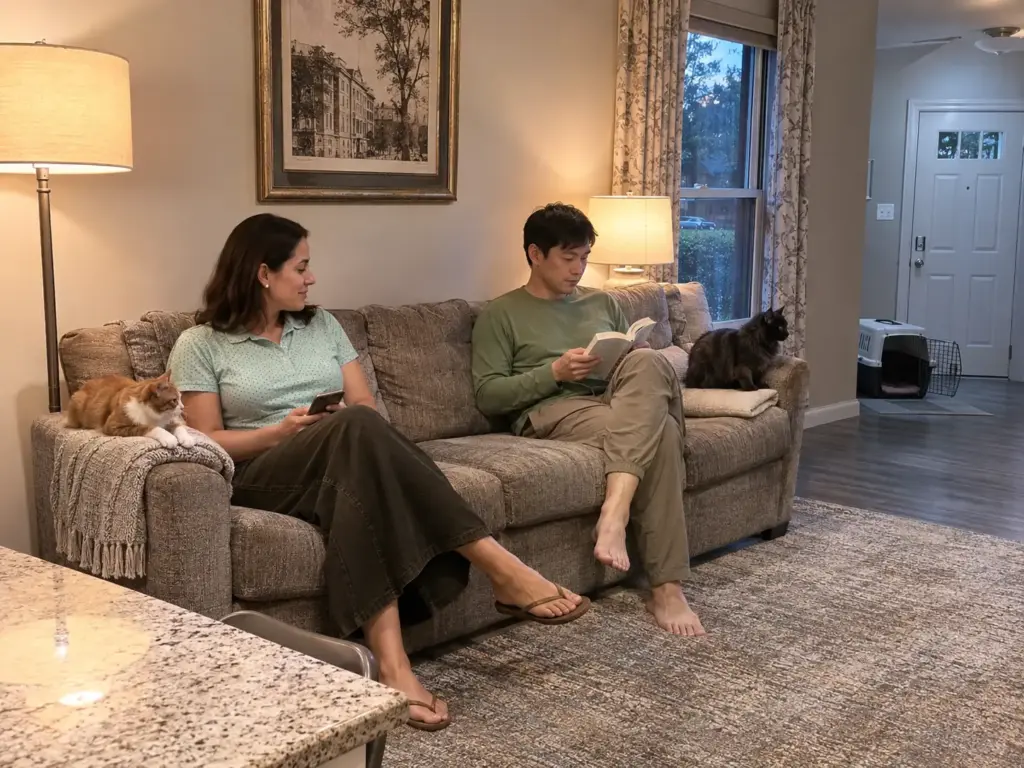
A cat accepts or rejects a change somewhere between a few hours and a couple of weeks, so give each move at least a week before you judge it. Then take the sheet and recount, spot by spot. A higher number with the same standoff means one cat still sees or reaches the route the other uses; find the junction where the two colors cross and move something there. A higher number with a calmer room means the count was the problem, and you can stop.
When two cats meet in a standoff, give each a way out
When two cats freeze facing each other, the question for the room is whether both can leave. Fighting tends to be what is left when a cat has no escape, so the first move belongs on the floor plan: clear the route either cat would take, with no furniture in it. A barrier or a closed door comes after that, and only if the routes still cross. If a standoff has left a wound, or either cat has changed his habits since it began, it is the veterinarian’s turn before any more rearranging.
What a new cat does to the count
A new cat adds one cat and takes routes away: every resident exit now has to avoid another spot, and the newcomer starts with no known exits at all. Furniture cannot repair an introduction that is going badly, and a count that looks fine on paper can hide a cat who spends his days hiding. If one of them stays out of sight for days, or the two keep meeting in the same tight place, read signs a cat introduction is failing and then slow down with how to introduce cats in a small apartment, stage by stage.
If the count has gone up and the tension has not come down, stop moving furniture. The next step is how the cats were introduced, and if there is a wound, a call to the vet.
Open One Exit Tonight, Then Recount
In a small apartment a cat’s territory is the set of routes he can use without meeting the other cat, so the numbers to track are exits and loops, not square feet. One exit is a dead end, two is the working floor, and the exits that count are the ones the other cat cannot watch. Free moves go first, and a purchase belongs only where the count shows one specific route missing. Anything sudden in how a cat marks, where he goes to the toilet or where he sleeps, and any wound, goes to the vet before furniture.
Recount a few days after each change and again at two weeks. If the count rose, the tension should ease by then; if it did not, the cause is somewhere the floor plan cannot reach.
Tonight, find the chair, box or sofa corner that closes the only exit from his favorite spot and move it a foot. Then watch which way he walks.
Frequently Asked Questions
01Are cats ok living in a small apartment?
Yes, cats do well in a small apartment as long as every spot they use has more than one way out. Floor area is a weaker measure than routes, so count the exits from each favorite spot and fix the one that has only a single exit.
02What size apartment is too small for a cat?
No square footage is the cutoff; an apartment is too small when each of a cat’s spots has a single exit, or when two cats must share one route to reach anything. Count the exits and loops first, and rearrange before you decide the space is the problem.
03Is it okay to live with a cat in a small apartment if I rent and can’t drill?
Yes, because the moves that raise the exit count need no drilling: shift a chair, open a door, pull the sofa a few inches off the wall, put a cushion on the sill. For more than one cat, add the rule of one of each resource per cat plus one.
04Why does my cat growl at the hallway door?
For a cat in a small apartment the hallway door is often the edge of the space he treats as his, and voices on the other side sound like someone crossing it. A growl that is new, or that arrives with other changes, goes to your veterinarian before the layout.
05How do I know if it is territory or something medical?
Treat a sudden change as a vet question first: marking when he never did, skipping his usual spot, going outside the litter box, or any wound. Call before moving furniture. If nothing about him changed and the tension follows the layout, count the exits.
Leave a comment