Cats Suddenly Fighting More? Look at the Last Six Weeks
Cats suddenly fighting more? Call the vet, then date the first quiet sign & find the change at home with a simple weekly sheet (no cart).

Alfredo RamsesFounder · November 3, 2026 · 15 min read

On this page5 sections
You are in the kitchen when it shows: two cats who have shared a sofa cushion for years end up at opposite ends of the room, one of them hissing, and the second bowl has sat untouched since morning. With cats suddenly fighting more, the vet call comes before anything else in the house, because a sudden change in how a cat behaves is a question for someone who can examine him. What looks sudden to you was usually a smaller shift a few weeks earlier, in the territory or in how one cat smells, and the cat doing the hissing is reacting to a home that changed under him. Below you date the rise, see what a trip out does to the smell, and put back the last thing that moved before any shopping.
Quick Answer
A sudden change in behavior goes to the vet first, so call and bring dates. The rise usually traces to a change in the home weeks earlier: date the first quiet sign, list what came in, moved or left, and put back the last change before any purchase.
Put a Date on the Rise, Then Walk Back Through the Weeks Before It
Ask someone whose cats started fighting after years together what changed and the first answer is nothing. The second, a minute later, is a visitor, a new rug, a bowl that got moved when the floor was mopped. A home keeps a record of all of it, and the cats read that record better than you do, since cats prefer consistency to change and the territory they have mapped is the thing they least want rearranged.
What to do in the minute of a fight, and how to split up an apartment that has no spare room, is covered in the guide to stopping cats from fighting when there is no second room. This page is for cats fighting after years together, and it looks the other way, at the weeks before the first hiss. It starts with the one call that cannot wait.
The Vet Call Comes First, and the Calendar Is What You Bring to It
Phone to book the vet check before you move a bowl. According to the ASPCA’s guide to aggression between cats, “Any sudden change in your cat’s behavior could be an indication of an underlying medical condition.” Tell the clinic about any of these when you call: a wound or torn fur, a cat eating or drinking less, a change in how either one uses the litter box, a cat hiding more than usual, or a fight one of them cannot get out of. Those are a call today, not something to watch.
But a clinic cannot look at your living room. The dates you collect in the next few sections are the history that fills that gap: when the first quiet sign showed, what came into the apartment, what moved. “It started about two weeks ago, the week the sofa was swapped” gives a vet more to work with than “it came out of nowhere,” and the page takes a few minutes with a pen.
How to Date the Rise: The First Skipped Bowl Beats the First Fight
Do not date the first fight. Date the first quiet sign, because it usually comes weeks earlier: a bowl the pair no longer shares, a cat who now sleeps in another room, a litter box that gets skipped. (A skipped box is also worth a mention to the vet, so it goes on the page either way.) Put that date at the top of the sheet and look back from it, two to six weeks.
Six weeks is the far edge, not a rule. If the first skipped bowl was ten days ago, your window is ten days, and the carrier trip from two months back goes on a separate line, kept in case the rest comes up empty.
Make sure what is rising is fighting. A real fight is a few seconds of violence followed by a long stand-off of hissing and keeping apart, while a chase where the roles swap and nobody hisses afterward is play. If you cannot tell which one you are watching, counting a week of sessions sorts play from the real thing before you build any calendar. The litter area is the other place two cats cross paths, so how many litter boxes two cats need, and where they go is a good check against what you have set up.
What Goes on the Calendar: People In, Things Moved, What Appeared at the Glass
Rule the sheet into four rows with one column per week: people in, things moved, the window, and whatever left the routine. The fights go on a fifth line at the bottom, so you can see which weeks ran ahead of them and by how much.
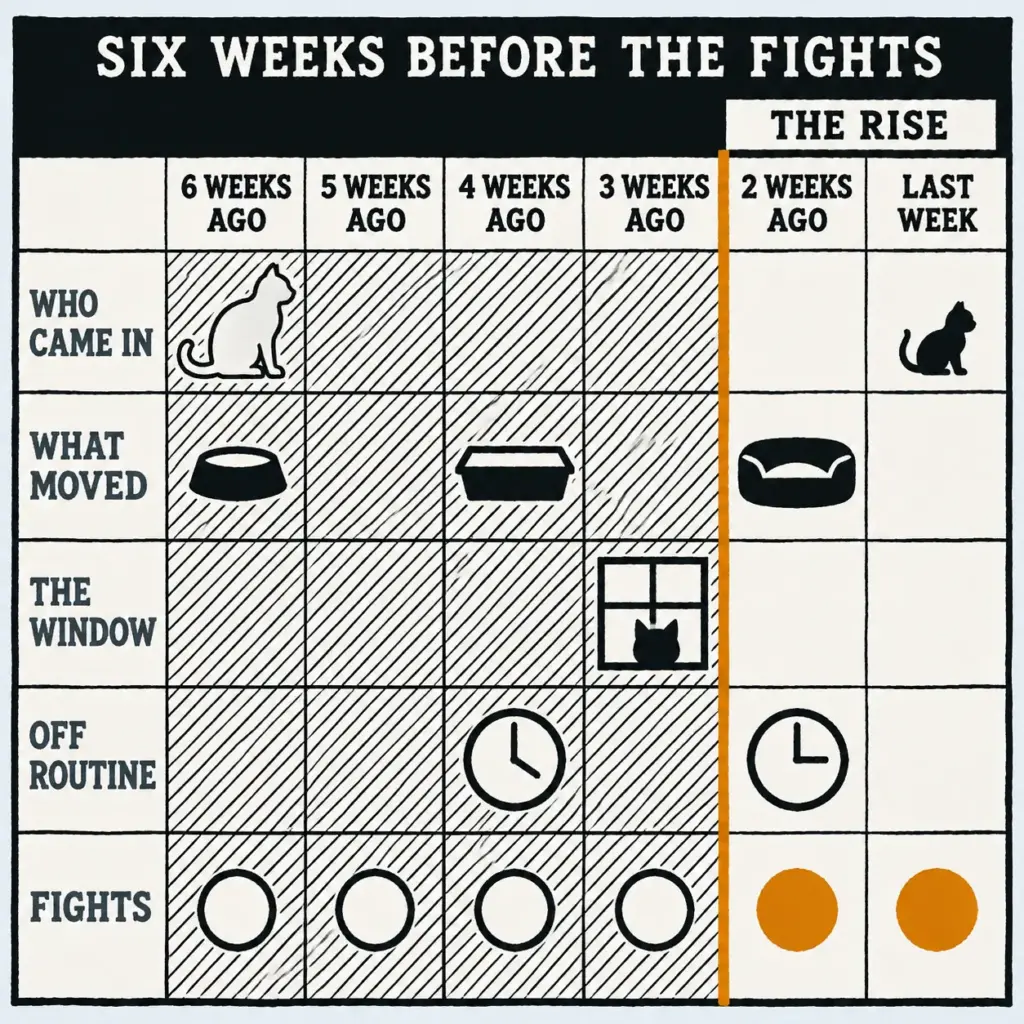
- People in: a visitor who stayed the night (an open suitcase on the floor counts, since it brings a new smell), someone who moved in or out, or a kitten, whose arrival has a full staged plan in how to bring a kitten in without crowding the cat who lives there.
- Things moved: bowls, litter boxes, the sofa, a rug, a cat tree. Bowls are the easy one to forget, and where two bowls go in a small apartment shows how far apart they should end up.
- The window: an outside cat at the window, the glass door or the cat flap, and the day you first saw it.
- Out of routine: a cat away for a day, new hours at work, meals shifted, a trip out in the carrier (what that does to the smell is covered below).
Small items go on the sheet too. A swapped rug changes the floor a cat has crossed every day for years, and a change that seems too small to count is exactly the one nobody remembers at the appointment.
Tape the sheet to the fridge today and fill in the week’s changes every Sunday, even if the fights have stopped. A date written when it happened is worth more than one rebuilt from memory after the next fight.
The Window Row: Cover the Part the Outside Cat Can See
This row earns more attention than its size on the page. A cat who sits at the glass for an hour each evening is watching something outside, and a cat who cannot reach what he sees may take it out on the nearest housemate: the one at the glass is the trigger, and the one at the bowl behind him pays. The fights can start the same day an outside cat first appears, so this is the one row where a single date goes on the calendar, not a week.
Cover the lower part of the glass so a cat outside cannot meet his eyes. The curtain or blind you already have does it today if you lower it to the height a sitting cat reaches. Pull the feeding stations and the litter box away from the window and from the cat flap too, so nobody has to eat or use the box with one eye on the door.
If the glass still shows after that, or the room needs its light, a frosted window film is the next step. The rabbitgoo Frosted Glass Window Privacy Film is a 35.4 by 78.7 inch sheet that sticks by static, with no adhesive and no drilling, and frosted glass keeps the daylight while taking away the eye contact. Expect to spend time chasing out air bubbles, and on some panes the film grips badly.
A Trip Out Changes the Smell, and the Housemate Notices
Picture the cat coming home from the groomer: the carrier door opens, he steps onto the rug, and ten minutes later the cat who stayed behind is rigid in the doorway, hissing and growling at someone he has known for years. Both cats are right about what they smell. One of them now smells like a place the other has never been. The scent after a trip out is a change like any other, and almost nobody writes it down.
One Cat Leaves, and the One Who Stays Meets a Stranger
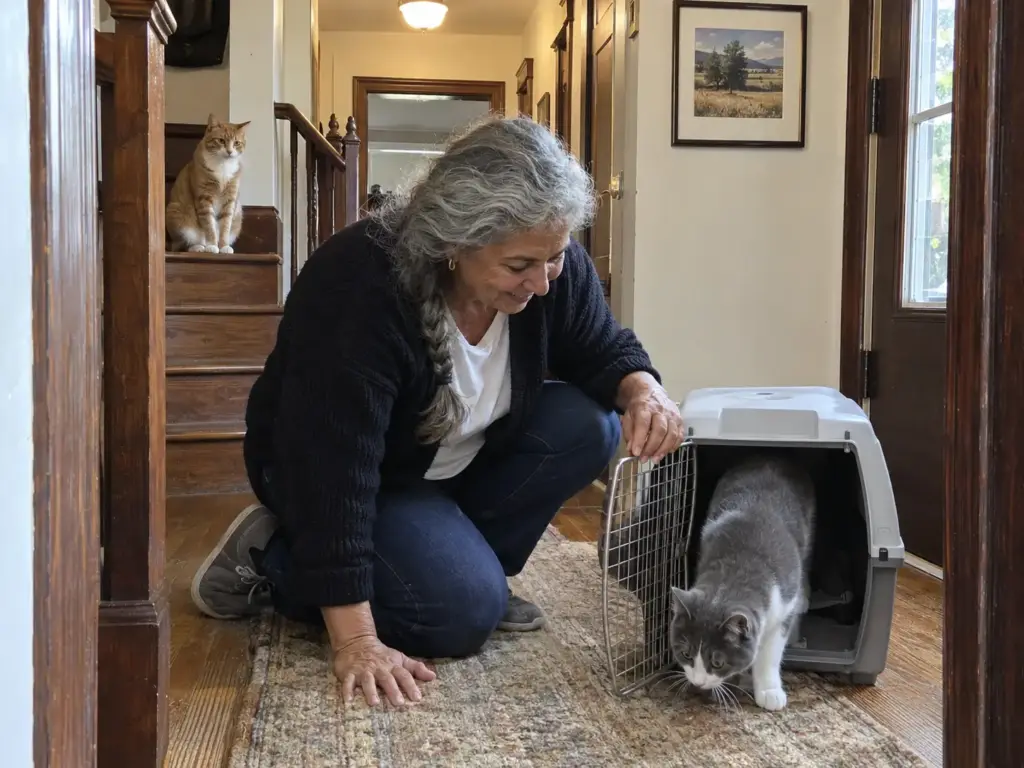
Cats who share a home share a communal scent, built up from rubbing on the same furniture, the same doorframes and each other. A trip out wipes some of it off and adds a clinic, a bath or a stranger’s apartment, and the cat who stayed can no longer match the arrival with the housemate. Cats Protection puts it plainly: “If your cat smells strange after a trip out, they might be treated like a stranger.”
From the couch it looks like this: the cat at home freezes at the sight of the other, stares from the stairs, or hisses at a cat he curled up against the night before, while the one who came back looks lost in his own living room. It can last for hours and sometimes for a few days, which makes it easy to file as one more fight when it belongs on the sheet as a trip. Any outing counts: a vet visit, a bath, the groomer, a boarding stay, a sitter who spent the weekend.
The Cat Who Went Out Is Not the Problem
The cat at home has a stranger in the hallway by every sense that counts to him, and the cat who returned is carrying a place he was taken to, not a grudge. Neither deserves a scolding, and scolding either one adds a second thing for both to be wary of. If the cat who came back is hiding, not eating or acting off in himself, that is the vet question from the first section and not a smell, so say it on the phone and come back to the housemate here.
Cats Protection’s minimum of three to five days behind a barrier is for pairs being brought back together after real fights, and a smell is a smaller job. In an apartment with one bathroom and no spare bedroom, three days of separation for a cat who only went to the groomer would cost the pair far more than the smell does. Start with hours.
Giving the Smell Time to Even Out
Put the two in separate rooms for a few hours with a door between them, and let each smell the other along the gap. When they meet again, watch for the loosening: the cat at home sits down, looks away, goes back to what he was doing. If the smell is not evening out by the next day, a swapped item can speed it up, and why scent swapping fails and where the item goes explains where that cloth or blanket belongs.
If the hissing outlasts the first couple of days, stop calling it a smell. It goes on the calendar as a rise, and the three to five days behind a door or a gate is the clock to follow, with how long a pair should stay behind a gate before meeting again laying out the steps.
Before the cat who went out comes back in, leave his bowl and his litter box exactly where they always were. The first thing he meets at the door is then the house smell, and the cat at home meets him on ground he recognizes.
Put Back the Last Thing That Moved Before You Buy Anything
Your cart may already hold a diffuser. Take it out for a week. The calendar tells you what to do first: the last entry before the rise is the first thing to undo, and that step needs effort and no purchase.
Undo the Most Recent Change First, Then Watch for a Week
Return it to where it was: the bowl to its old corner, the litter box to its old wall, the sofa to its old angle, the new rug into the closet. Then keep the sheet open for seven days and mark every hiss, every chase and every quiet meal. If the fights drop, you have found the cause. If they do not, the home explains only part of the rise, and that is useful to tell the vet, not a failure of the method.
The diffuser is the item everybody reaches for first, and with a bowl moved or a cat at the glass it soothes the mood and leaves the trigger where it was. It belongs after the undo, not before. Some changes will not go back (a person who moved in, a new kitten), and the calendar still helps there, because it shows which of the things around that change can be returned.
If the Fights Go On: A Gate With a Door, and a Mood Aid With a Limit
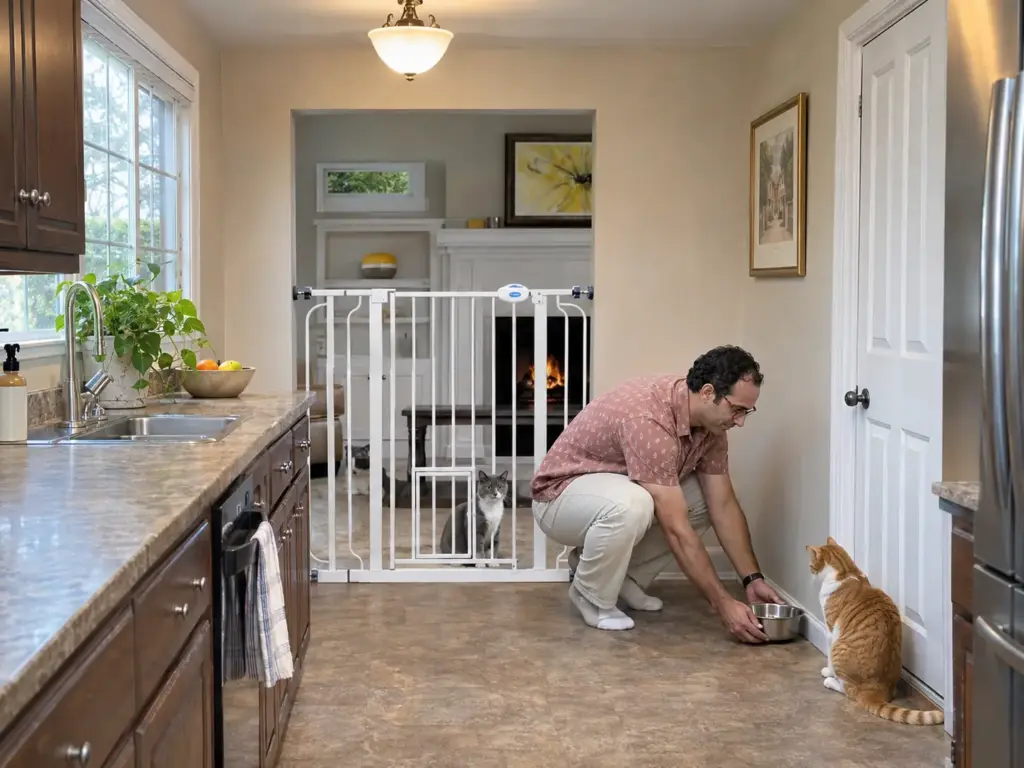
When a week of undoing changes nothing, the next step is distance with a view: each cat in a room of his own for the first days, then a gate across the doorway so the two can see each other without sharing a room, as the first stage of a gradual reintroduction. The ASPCA’s method for pairs coming back together starts with a closed door, opened one inch once both cats are relaxed on either side of it, then a bit more, and shut again at the first hiss or swat. Cats Protection puts the minimum behind a barrier at three to five days before any meeting face to face.
Measure the gap first, because the Carlson 36 inch Extra Tall Walk-Thru Dog Gate with Small Pet Door is a tall pet gate that stands 36 inches high, spans 29 to 37 inches wide and keeps the cats in sight of each other without sharing a room. The swing door is only 16 inches wide, which is narrow for a person to step through, and the listing is worth checking for whether the small pet door can be shut, since an open one is a doorway.
The ASPCA’s test for leaving the two alone together is a couple of feet: they have to eat and play that close in peace. Until they do, someone is in the room. In practice that looks like this:
- Two bowls a couple of feet apart, and each cat eats without stopping to watch the other.
- Play within that same distance, with nobody cornered and nobody following the other around.
- Two resting spots where either cat can leave without walking past the other.
While you repair the cause, a mood aid can help, and the FELIWAY MultiCat diffuser kit with one 48 mL refill plugs into a wall outlet with nothing to drill (for a choice between diffusers, see which pheromone diffuser suits a pair meeting in an apartment). It is a mood aid, not a cure. In some homes it changes nothing at all, and a refill lasts about a month, so it is a running cost.
When to Stop Watching and Call
The week is up and the sheet shows fights as often as before: stop watching and call. The same goes at any point if a cat stops eating, hides or changes from one day to the next, and the ASPCA’s own instruction is to see the vet right away. If one of the two is an intact male, that is the first thing to raise at the clinic: neutering is the vet’s decision, not something a sheet of dates can settle.
When both have been seen and the home is back to how it was, but the fights go on, the next call is to a behavior specialist: a certified applied animal behaviorist (CAAB or ACAAB) or a board-certified veterinary behaviorist. Take the sheet.
Read the sheet aloud to the vet, with the dates, instead of trying to remember. The first quiet sign, the last thing that moved and the day the fights began are the three lines they will ask for.
Start the Sheet Tonight and Hand It to the Vet
Date the first quiet sign before anything else, because the rise began there and not at the first hiss. The same sheet is the history a clinic needs, and it holds the most likely suspects: the last thing that moved, the cat at the glass, the carrier trip. A smell from a trip out evens out with time and the old bowls in the old places. Put the last change back before a cart gets involved, and what does not drop belongs with the vet and, after that, with a behaviorist.
Keep the sheet open for the week after the last change goes back, and a second week if the first looks mixed. If those days look quieter, the home was the reason, and if they look the same, the page is ready for the appointment.
Tonight, lower the blind to the height of a sitting cat’s eyes, return the bowl to its old corner if it moved, and write today’s date at the top of a sheet.
Frequently Asked Questions
01Is it normal for cats who live together to fight?
An occasional scuffle between two cats who share a home is normal; a rise in fights that was not there before is what deserves a look. A sudden change goes to the vet first, then the calendar of the home tells you what moved.
02Why are my cats suddenly fighting after years of getting along?
What looks sudden usually began weeks earlier, with a change in the home or in how one cat smells, and the vet comes first. Write down the first quiet sign, then everything that came in, moved or left in the two to six weeks before it.
03Can cats be friends again after fighting?
Yes, a pair that fights can be brought back together, but it takes time and small steps, and a reunion in one go tends to undo it. The stages, from a door opened an inch to shared rooms, are in how to introduce cats in a small apartment, stage by stage.
04Can a trip to the vet make my cats fight when I get home?
Yes, the cat who went out comes back smelling like another place, and the one who stayed home can treat him like a stranger for hours or a few days. Give them separate rooms for a few hours first. If the cat who came back seems off in himself, call the clinic.
05Should I separate cats that suddenly fight?
Yes, for a few hours once the fight is over, with a door between them and no shouting; then put back the last thing that moved. The minute of the fight itself is in the guide to cats fighting with no second room.


Leave a comment