Signs a Cat Introduction Is Failing Show Up Between Sessions
Failing or just slow? Compare three sessions at the same gate, check the doors, then back up one step (or call a vet) [plain steps for an apartment].

Alfredo RamsesFounder · Updated November 1, 2026 · 15 min read


On this page8 sections
- 1The Textbook Warning Signs, and the Attack That Skips Them
- 2When a Change in Eating, Drinking, or the Litter Box Goes to the Vet First
- 3One Hiss Is Normal, but the Same Reaction at the Same Gate Is a Pattern
- 4The Door Someone Else Opens, and Who Can Reach Whom
- 5Back Up One Step Instead of Pushing On
- 6How Long a Failure Takes to Show, and When Stopping Is Honest
- 7Check the Doors, Keep the Log, Step Back One Stage
- 8Frequently Asked Questions
You have a gate across the spare-room doorway, two cats who have not so much as swatted at each other, and a quiet house you cannot read. The quiet might be slow progress. It might also be one cat who has stopped coming out, and the signs of a cat introduction failing show up more clearly in how sessions repeat than in how any single one looks.
According to the American Association of Feline Practitioners’ 2024 intercat tension guidelines, tension “most frequently occurs when introducing a new cat into the home,” which is the stage you are standing in. Below you will find the textbook signs and where they run out, how to compare the same gate across sessions, the layout and the doors behind the worst days, and the point where the question goes to a vet.
Quick Answer
Failing and slow look alike for the first weeks, so compare sessions instead of judging one.
- The same reaction at the same gate, session after session, is the signal.
- Sessions that keep getting shorter, or a cat that hides, count as signs.
- A calm face can mislead, so watch who can reach whom.
- Any change in eating, drinking or litter use goes to the vet first.
The Textbook Warning Signs, and the Attack That Skips Them
This article assumes you are already working through the stage-by-stage plan for introducing cats in a small apartment: separate rooms first, scent next, then the gate. The plan tells you what the stages are. What it cannot tell you is how to read a gate once a cat is on each side of it, and that starts with the signs you have probably met already.
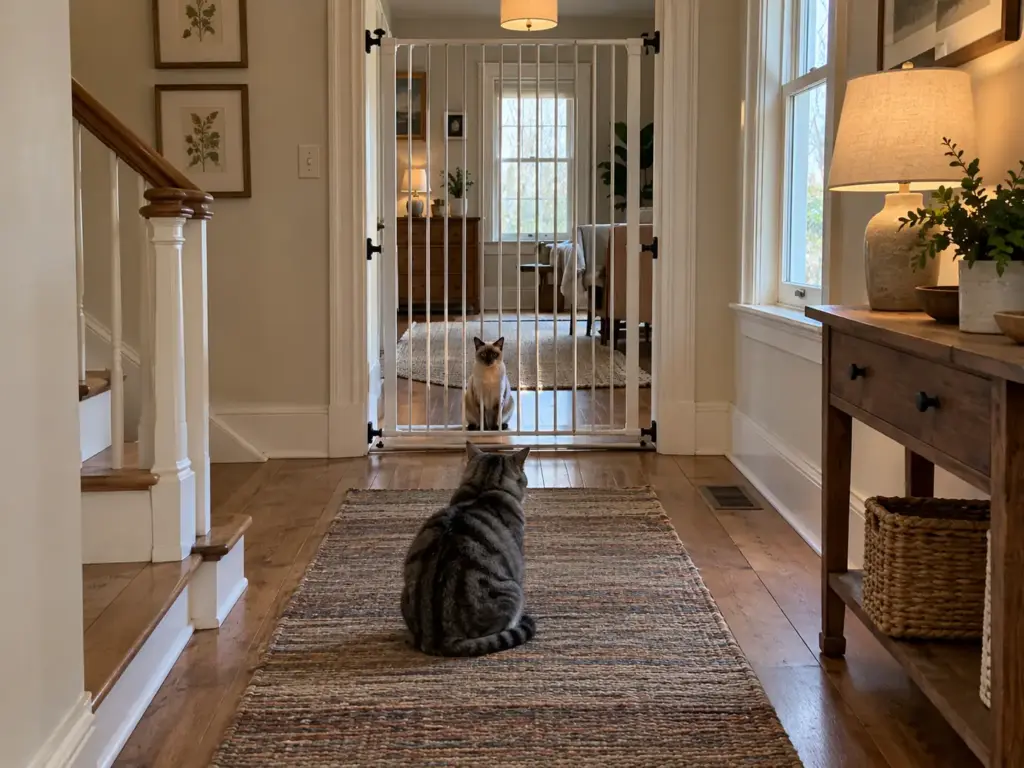
The signs every list agrees on
These are what a cat does when the other one is too close, in four groups:
- Dilated pupils and staring between cats that neither one breaks
- Flattened ears, either back or sideways, and tail swishing that is hard rather than idle, or a tail that puffs up
- Fur raised along the spine, a hiss, a growl or a loud howl
- One cat bolting from the room, or sliding under the nearest furniture, the moment the other shows up
Say it once and move on. If you see these, you already know to end the session. The useful question comes after: are you seeing them for the first time, or for the fifth?
One or two hisses at the start are expected, so what actually means stop
Hissing during introduction sessions is not a verdict by itself. A hiss at first sight is a cat saying the gap is too small, and cats.com puts one or two short hisses at the start of a session inside the expected range. That reading covers one moment only.
The reason to stop the introduction for the day comes from the repeat: the hissing keeps going once the cats have had time to settle, it grows into growling or a lunge at the bars, or the same cat does the same thing at the same distance as last time. And counting hisses, useful as it is, can point at the wrong cat.
When the attack comes with none of them
Picture the third week of an introduction, with the newcomer cat kept in the office and the resident in the bedroom. There was no warning and no interaction beforehand, then the attack, and a terrified resident afterward. Sometimes the newcomer goes straight for the other cat with no hissing, staring or howling first.
In a case like this, the hissing comes from the cat being chased. The newcomer stayed silent and only howled when she could not reach her. Read that scene by the textbook and the resident, who is doing everything on the list, looks like the problem. A list of faces can point at the victim.
That fits what researchers describe. In a 2024 study in the Journal of Feline Medicine and Surgery, tension between household cats is common but, “because it often manifests as subtle behavioral changes, it can go unnoticed,” and a pair can look calm because the signs you are scanning for are not the ones this pair uses. So the rest of this article reads sessions and layout, not just faces.
Write two lines before you tell anyone how the session went, one per cat: where it was, what it did, how it ended. The version you say out loud drifts toward fine. The lines do not.
When a Change in Eating, Drinking, or the Litter Box Goes to the Vet First
Everything in this article is read in the house: where the cats are, how far apart, how long a session lasts, what each one does at the gate. Furniture, doors and distance are things you can change, and that is the part we can help with.
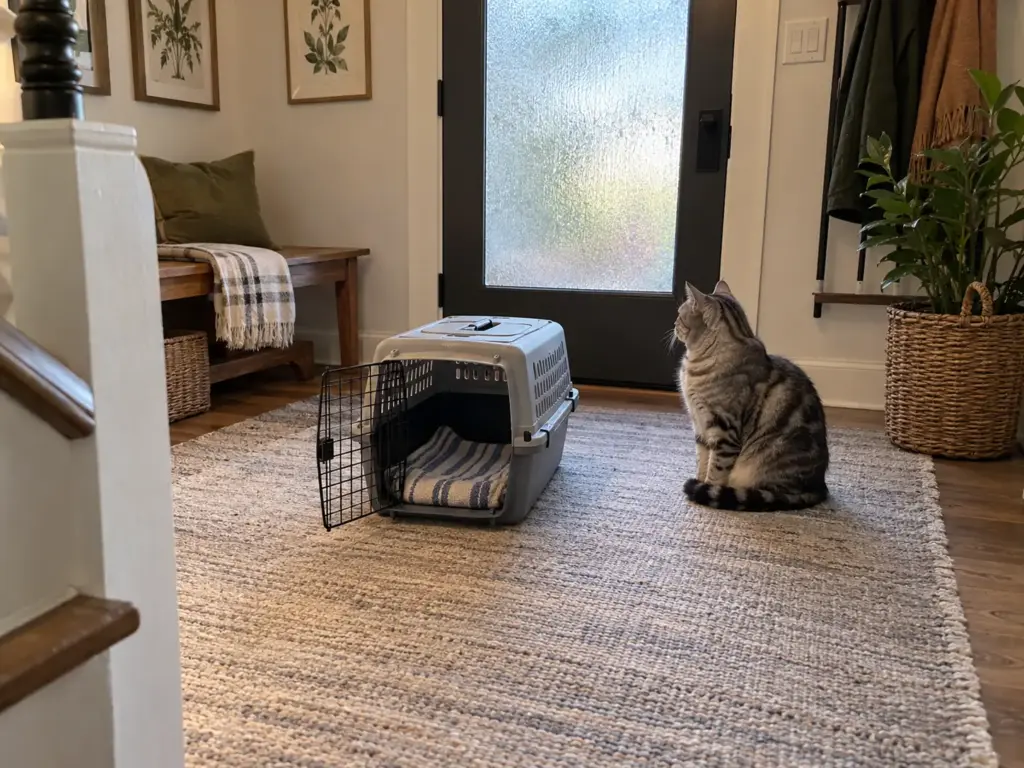
A change in eating, drinking, litter box use or weight is a different kind of sign, and so are swallowing trouble and any wound. Those go to a vet first, before a single piece of furniture moves. That is when to call a vet, and it comes before any of the layout advice below. This article will not tell you what such a change means or whether a cat is sick or stressed, because a hallway cannot answer that question.
For conflict that needs sorting out quickly, cats.com points readers to a vet or a cat behaviorist. The order matters: the vet when a habit has changed, the behaviorist for a pattern you have already confirmed in your own notes.
One Hiss Is Normal, but the Same Reaction at the Same Gate Is a Pattern
Picture the end of a session. You are tired, and your verdict arrives before you have thought about it: that one was fine, or that one was bad. A verdict like that is a mood, and a mood is the least reliable measuring tool in this whole process.

Count the hisses, then compare the sessions
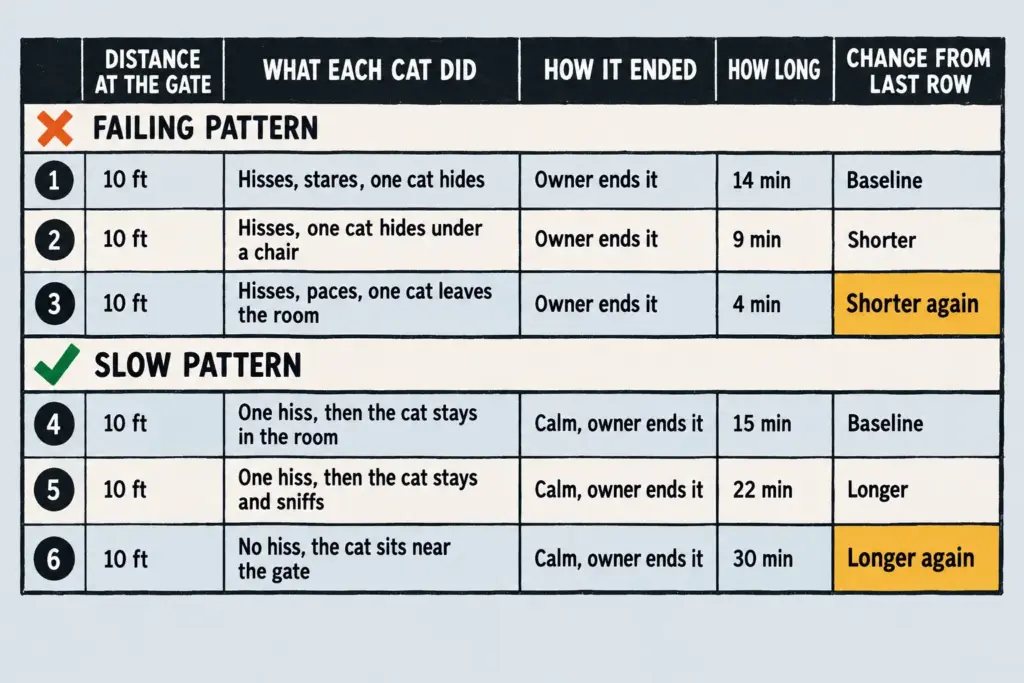
Hold three things the same from one session to the next: the same gate, the same distance between the cats, and the same point in the daily routine (before a meal and after one are different sessions). Then write down what each cat does. With those fixed, any difference between sessions belongs to the cats and not to the setup.
Compare the last three sessions, not the last one. A bad session after four good ones is a bad day. The same reaction at the same distance three times in a row is a pattern, whatever the fourth looks like.
The calendar will not settle it either. cats.com says to keep new cats apart for at least two to three weeks, and Joey Lusvardi, a certified cat behavior consultant at Class Act Cats, says it is not uncommon for an introduction to take weeks or even months. Put the two together and you get a floor and a long range, which leaves day ten without a verdict in either direction. The real clock runs on gates rather than days when you ask how long before introducing cats.
Sessions that keep getting shorter
Failing has a recognizable shape across a log. The reaction is the same at the same distance every time. Sessions getting shorter is the quietest part of it: the one that used to run through a whole meal is now over at the first stare. One cat leaves the room, or goes to ground, as soon as the other turns up.
Slow is less dramatic, though just as unglamorous. The distance is the same, but the reaction is shorter. A cat stays in the room instead of leaving.
The time before you end a session gets longer, even if only by a minute. Direction beats speed.
The calm that is really hiding
A resident that hides in a corner and waits for its food bowl can look like a household settling down. A hiding cat is not a calm cat, and the difference is easy to test: is he somewhere by choice, or somewhere because it is the only place the other cat is not?
A calm cat stays in the room when the other shows up, eats near the gate, and lets a session run longer than the last one. A cat in a corner, eating only when the coast is clear, has not relaxed. He has found the one spot the layout gives him. And in a multi-cat household, each pair is its own introduction: a third cat means another pair to read, with its own row in the log, rather than one verdict for the whole house.
Use the same order for every entry (distance, first cat, second cat, how it ended, how long) so three entries can be read side by side in ten seconds. A log you can scan is the one you will keep up on the days you would rather not.
The Door Someone Else Opens, and Who Can Reach Whom
You control the sessions. You do not control the rest of the household, and some of the worst moments in a failed introduction start there.
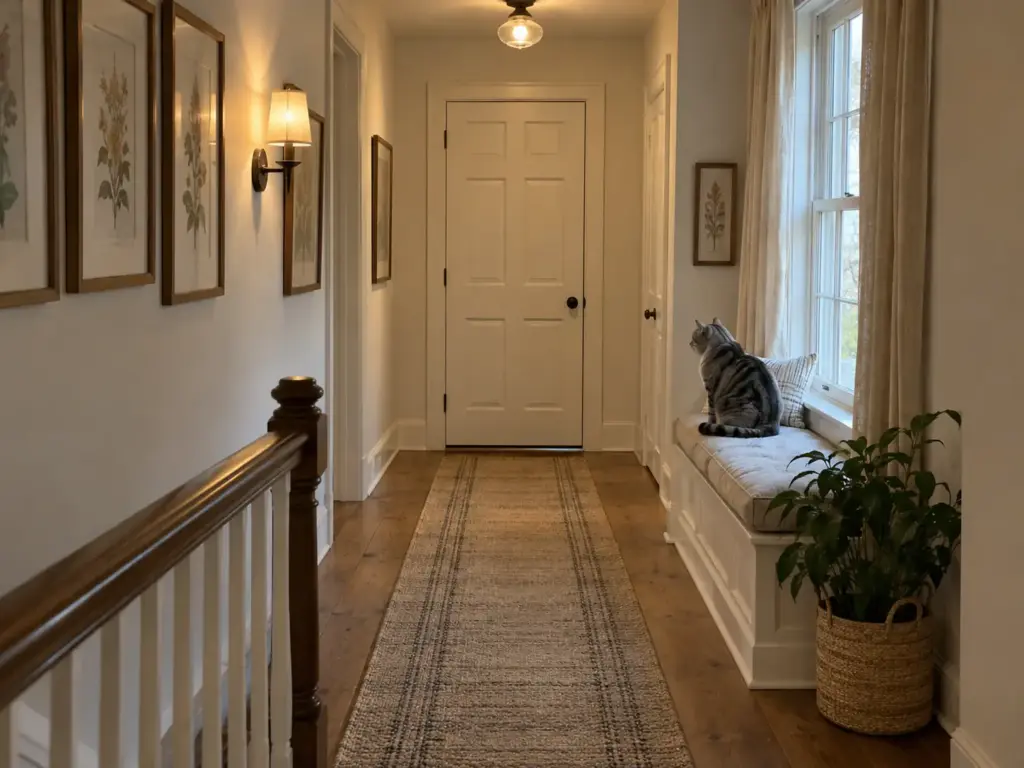
The door someone else opens
Then the partner opened the bedroom door without knowing the new cat was right behind him. What followed came with no warning at all, and nothing in that moment was a hiss, a stare or a howl. It was an accidental door.
Nothing needs buying to prevent it. Set one rule about doors and say it out loud to everyone who lives there or visits: the door stays shut unless the person who set up the session is the one opening it. No sign, no lock.
In a small apartment with a single hallway and one bedroom door, that rule is most of your layout. The person at the door did nothing wrong with what he knew, and the rule is what was missing.
Distance, and a place for each cat to go
The resident sat ten feet from the baby gate, hiding under a chair. Take the number as theirs and measure your own hallway: stand at the gate and pace out the longest straight line the resident has. Each cat needs a spot the other cannot reach, and an escape route that is not the only line of sight. (A cat who has to walk past the gate to get anywhere has no refuge, however large the room.)
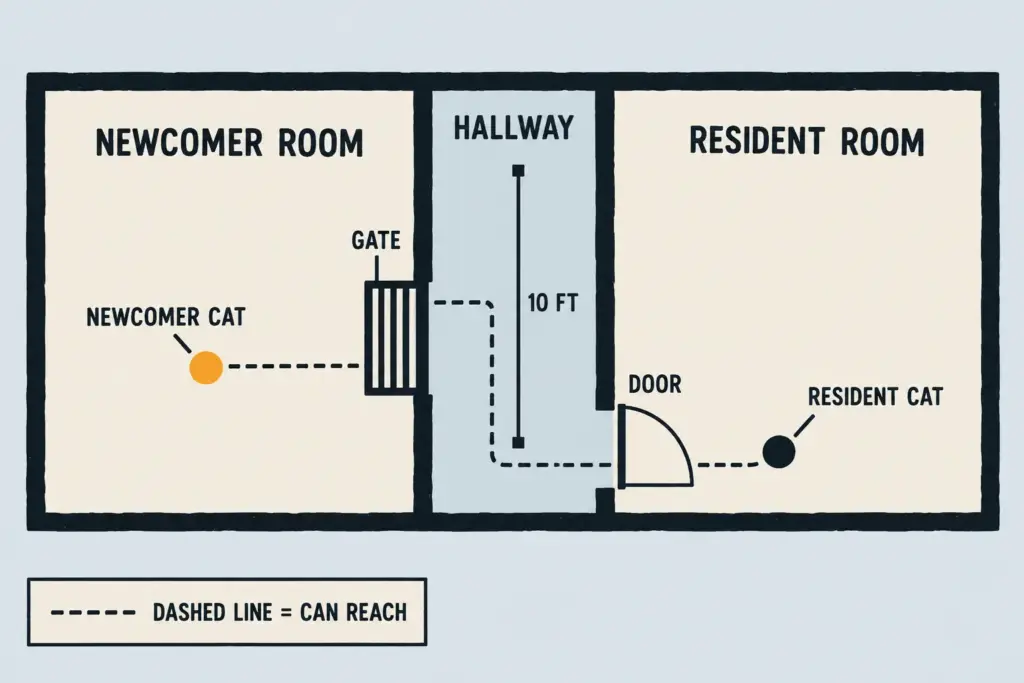
None of this needs a drill, which matters in a rental. A bookcase top, a window bench or the back of a sofa gives the hiding cat somewhere above the floor, and the door and hallway you already have are the rest of the equipment.
Keep litter boxes and food bowls out of the stretch where the two cats cross. Class Act Cats counts stations in the cats’ pass-through among the things that set conflict off, and where a litter box fits in a small apartment matters more than usual during an introduction, because a box in a crossing turns every errand into an encounter.
How tall the gate has to be
Start with what you own. Class Act Cats suggests cardboard to block the top of a gate, so cut a piece to fit the introduction gate you already have before you look at another. It is the free test of whether height is your problem at all.
A baby gate sits well below five feet, which makes it a barrier for a crawling toddler and a step for a cat who wants over it. The newcomer cat tried to climb the baby gate after a few stares, and the session ended. Class Act Cats says a barrier of 59 inches or taller can work, which is just under five feet. Measure your top rail from the floor and compare it with that number.
It is a floor, not a promise. The same source says no height guarantees a cat will not jump. And a taller gate only helps if height is why yours fails: if the same reaction shows up at the bars at any height, the pattern is the problem and more height changes nothing.
Back Up One Step Instead of Pushing On
The log says failing, and what you hear is start over. You picture the weeks going with it. One step back costs days.
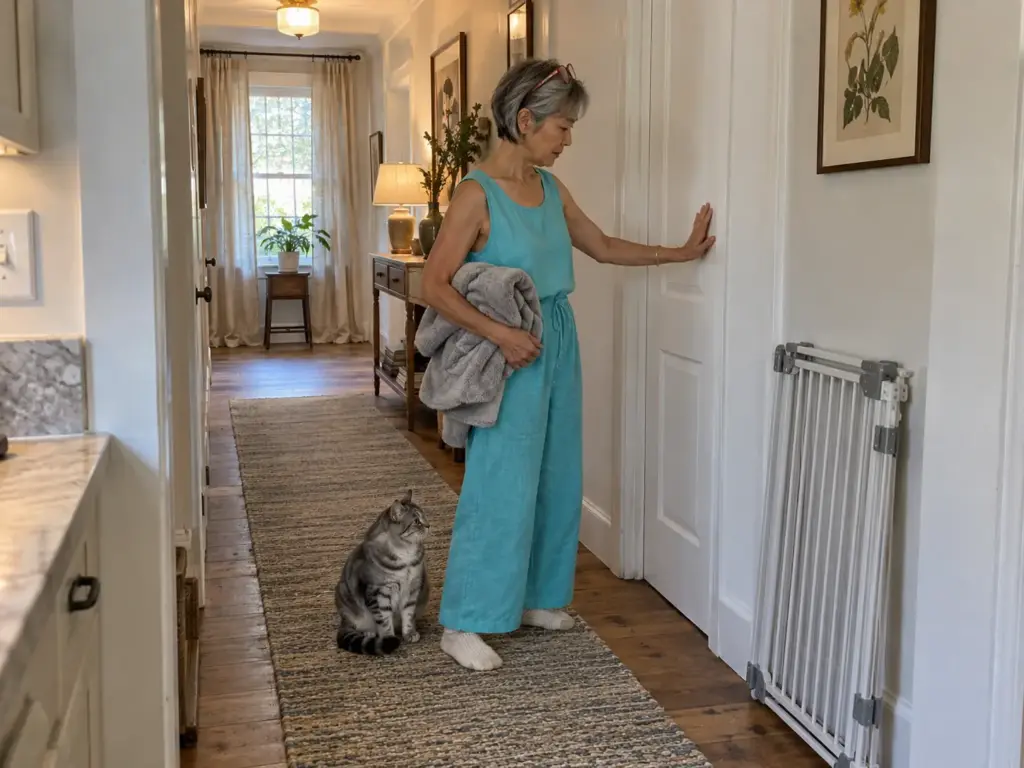
What backing up looks like in a small apartment
Class Act Cats is blunt about it: pushing on after a hiss or a fight worsens the relationship and ends in a reintroduction from the beginning, while going back a step is the quicker route. Go back to the last stage where nothing went wrong, not to day one, and use your log to find it. It is the last row before the reactions started repeating.
In a one-bedroom with one door, the stages are short, so the step back is short too. The cats eat on either side of a closed door again, or stay in separate rooms for the day. If the log shows trouble from the first gate session, the earliest stage worth returning to is a day-one test before anything else, and you start there instead of at the gate.
What to keep from the stage you left
Keep feeding on either side of a door and keep the scent step going while you back up. Neither needs the cats to see each other, so they keep adding progress while the gate rests. How feeding two cats in a small apartment works by floor plan shows where the two stations go when you have one room to work with.
The cat who sat in the corner is not settled. The next session starts from the stage where both cats ate with a door between them, not from the one where the hiding began.
When you step back, change one thing: the distance, the door rule or the length of the session. Change three and the next three sessions will look better or worse without telling you which change did it.
How Long a Failure Takes to Show, and When Stopping Is Honest
A failure shows over several sessions, and the verdict on a success takes longer. That gap is why the next three questions come up.

Weeks to months, and sometimes years
Class Act Cats puts the range at weeks or even months, and thecatsite goes further: months and even years. Some pairs take years before the two cats are comfortable together. Other pairs are still living in different rooms of the apartment years in.
Those are long tails, and the reason to read them is that they take the deadline out of the question. A month of slow sessions is not a failed introduction.
When it is time to call a behaviorist
People ask when to give up, and no day count answers it. Two things do. The pattern does not change after you step back a stage, and the household cannot keep the plan running, whether for time, doors or space. When both are true, the call goes to a vet first if any habit has changed (see the vet section above), then to a cat behaviorist.
When a lease or a move is the deadline
Sometimes a lease is up in June and, if the cats are not introduced by then, one will have to be rehomed. A deadline changes the decision, and it is fair to say so without drama. If the newcomer is a kitten, adding a kitten to a resident cat’s home has its own plan and a different pace.
Parallel living is a result too. Cats who live in different rooms for years are an outcome some households choose, and the owners who reported it described it plainly, as a household that works.
Check the Doors, Keep the Log, Step Back One Stage
Compare sessions, not moments. A bad day is one session; a failing introduction is the same reaction at the same gate three times. Check the doors and the distance before you read faces, because the worst day in these threads began with a door and a layout, not a hiss. And when the log says failing, step back one stage and change one thing.
Three weeks after you change something, read the last three rows of your log and ask one question: does the same reaction still turn up at the same point in the session? If it comes later, shorter or quieter, the introduction is slow. If it holds, a vet or a cat behaviorist is the next call.
Today, before the next session, tell everyone in the house which door stays shut and who opens it, and put a notebook where you will see it. One line per cat after each session. A week from now, notice whether the lines under each name are changing or are the same line copied.
Frequently Asked Questions
01How do you know if a cat introduction is going well?
A cat introduction is going well when the same reaction at the same gate gets shorter or quieter across several sessions, not when one session was calm. Cats that stay in the room, eat near the gate and take longer to end a session are the good signs.
02Is hissing normal during a cat introduction?
Yes, one or two short hisses at the start of a session are normal during an introduction, and the signal is a repeated pattern, not a single hiss. The same cat at the same distance, session after session, or hissing that escalates, means end the session and back up a step.
03How long should a cat introduction take?
There is no fixed number of days for a cat introduction, and sources describe weeks to months, with some pairs taking longer. Two to three weeks apart is a floor, not a finish line, so judge by the sessions and not the calendar.
04When should you give up on a cat introduction?
Not on a day count: stop only when the pattern does not change after you step back one stage and your household cannot keep the plan running. Talk to a vet and a cat behaviorist first. Some households keep the cats in separate rooms for good.
05Can an introduction be failing if the cats never hiss?
Yes, an introduction can be failing even when the cats never hiss. Research describes tension that often shows as subtle changes, and an attack can come with no hissing, staring or howling beforehand. Watch the layout and the sessions, not only the face.




Leave a comment