Resource Rule for Multi Cat Homes and Why a Spare Fails
Resource rule for multi cat homes: 3 of each for two cats, 4 for three, plus a 2-question check for every station [IRIS 30 in, Amazon Basics 19 in].

Alfredo RamsesFounder · November 3, 2026 · 17 min read

On this page8 sections
- 1The Resource Rule for Multi Cat Homes: One per Cat, Plus One, in Separate Places
- 2A Spare Counts Only if the Cat Can Reach It Unseen
- 3Signs the Count Is Failing in the Room, Not in the Cat
- 4Count What the Home Already Has, Then Buy Only the Missing Station
- 5When the Apartment Has No Room for the Spare, This Gives First
- 6Keeping the Count Honest After Any Change in the House
- 7Move One Bowl Today, Then Watch Who Shows Up at It
- 8Frequently Asked Questions
Your apartment has three litter boxes for two cats, and one of them is still a clean, untouched rectangle of litter. The cat who walks past it is not wasting your purchase; he is reading the room, and from where he stands that box is in the wrong place. The resource rule for a multi cat home is a count, one of each thing per cat plus one, and the count is the easy half: the half that decides whether the spare works is where each station sits. Below you get the rule, the two-question check that tells you which stations count, the signs a count is failing in the room, a tally for two and three cats, and what gives first when the apartment has no space for the extra.
Quick Answer
The resource rule for multi cat homes is one of each resource per cat plus one extra, litter, food, water and beds included, with the stations in separate places. A station counts only if the cat can reach it without being seen by the other cat or crossing its route. Two stations in one corner count as one.
The Resource Rule for Multi Cat Homes: One per Cat, Plus One, in Separate Places
Tell someone with two cats to add one more, and the question comes straight back: one more of what, and where does it go? The rule answers the first half and leaves the second to the home. Every station sits inside a territory somebody claims, and the zone-by-zone map of who claims which part of the apartment shows how a home divides up before you count anything.
What the Rule Counts (Litter, Food, Water, Beds, Perches, Scratchers)
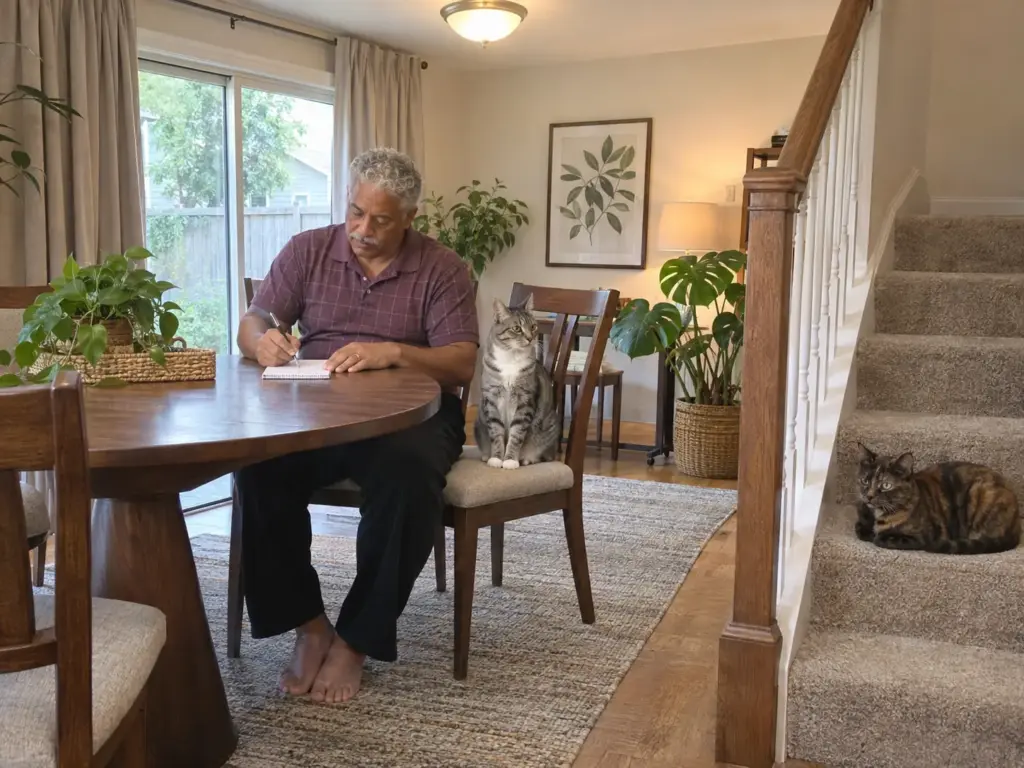
The rule covers everything a cat uses and defends: litter trays, food stations, water stations, beds, perches and scratchers. One per cat plus one: two cats means three of each, and three cats means four. Food and water apart is part of the rule: water is its own line, separate from food, since cats tend to drink away from where they eat and may skip the bowl altogether when another cat is looking on.
Why the Extra One Exists
The spare is not a luxury. When one cat reaches the only litter box and finds the other already inside, he has two options: wait in the hallway or find somewhere worse. The extra station is the escape route, a second place where he can eat, drink or go without a negotiation.
It also explains a sight that confuses a lot of households: three boxes in the apartment and only one box gets used. The count is right and the spot is wrong, and the cat is reporting the spot.
Where the Formula Comes From
The N+1 rule, the plus-one wording, belongs to International Cat Care. According to International Cat Care’s guide to multi-cat households, “In terms of appropriate numbers of resources, a commonly used formula is one resource per cat plus one extra, positioned in different locations.” The same guide works the arithmetic for a trio: four of every resource, spread through the home in separate locations.
The AAFP and ISFM guidelines do not use the plus-one wording; they set a floor from the cat’s side. According to the AAFP and ISFM feline environmental needs guidelines, “A cat should have a choice for each resource; for example, a minimum of two resting areas, two feeding areas and two toileting areas.” Food and water are kept apart from each other, and every cat gets its own separate feeding stations.
Count at the cat’s eye level, not yours. Kneel in the doorway of each room and write on paper which stations you can see from there, one line per type. A box you can see from the hallway is a box the other cat can see from the hallway.
A Spare Counts Only if the Cat Can Reach It Unseen
You find both cats eating in the same corner and decide they get along. The AAFP and ISFM guidelines warn against exactly that reading: cats that gather to eat or sleep may be doing it only because the food or the bed sits in a single place and there is nowhere else to go. Friendship and a lack of options look identical from the sofa.
The Two-Question Check
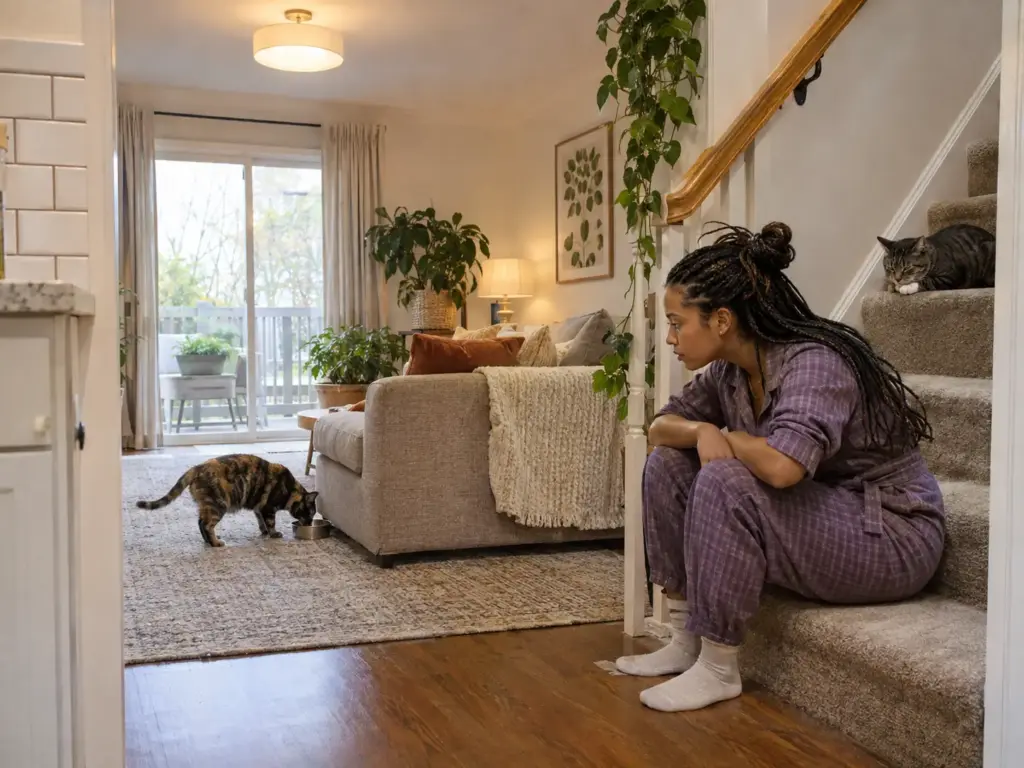
Stand where the cat stands when he reaches a station and ask two things. First, can I see the other cat’s station from here? Second, does my route to this one cross the path the other cat takes to his? A yes to either one and the station counts for half at best; a yes to both and it counts for nothing.
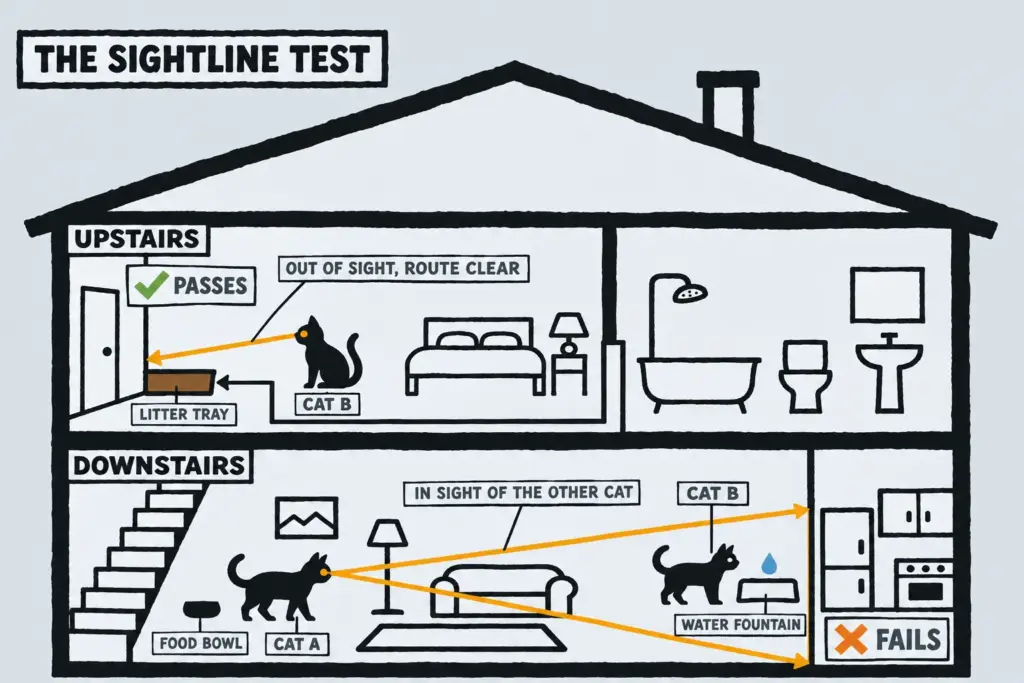
This is a working method, not a published standard. The guidelines give the principle: resources placed out of view of other resource locations give a cat easy access and a sense of control. The two questions turn that into a sightline check you can walk through the apartment.
They also settle a tension in the advice. Bowl placement matters in two ways: a bowl should sit away from corners and walls so the cat can face any direction while he eats, and a visual barrier between cats helps too. The check holds both: the station looks out on the open room, and the other cat’s station is not part of that view.
Run it for every station, in every room, and write the result down. Litter boxes tend to fail first, because they end up wherever the apartment has a spare wall.
Why Two Trays in One Corner Are One Tray
A cat counts places, not objects. International Cat Care advises against grouping litter trays in one location because cats read them as a single litter resource. The same point runs through the American Veterinary Society of Animal Behavior’s piece on separated key resources: each resource belongs in its own area, and litter boxes should be spread across different areas or rooms rather than lined up in a row, so litter boxes in different rooms count for more than a tidy line of them.
Lining the boxes up along one wall is the tidy answer and the weakest one (it also leaves a cat with a single place to be cornered, however many boxes there are). Food and water follow the same logic: keeping food and water on separate trays means separate places, not two bowls on one mat.
Time-Sharing Looks Like Friendship
Many cats in a shared home learn to take turns, visiting the common bed or bowl at different hours so they never meet. To the person it looks like a settled routine. To the cat it is a schedule worked out to avoid a meeting. A cat who only eats when the other has left the room is time-sharing, and that means the home has one working station where it should have two.
Perches follow the same logic. International Cat Care recommends two ways onto each perch so one cat cannot trap another. A cat tree jammed into a corner has one way up and one way down, and the second cat reaches the top only if the first one lets him.
Signs the Count Is Failing in the Room, Not in the Cat
The cat who waits at the kitchen door until the other has finished, or who eats at odd hours, looks strange. He is keeping a schedule. A broken count shows up as small, repeated things you can watch without interpreting anything.
Blocking, Staring and Waiting at the Doorway
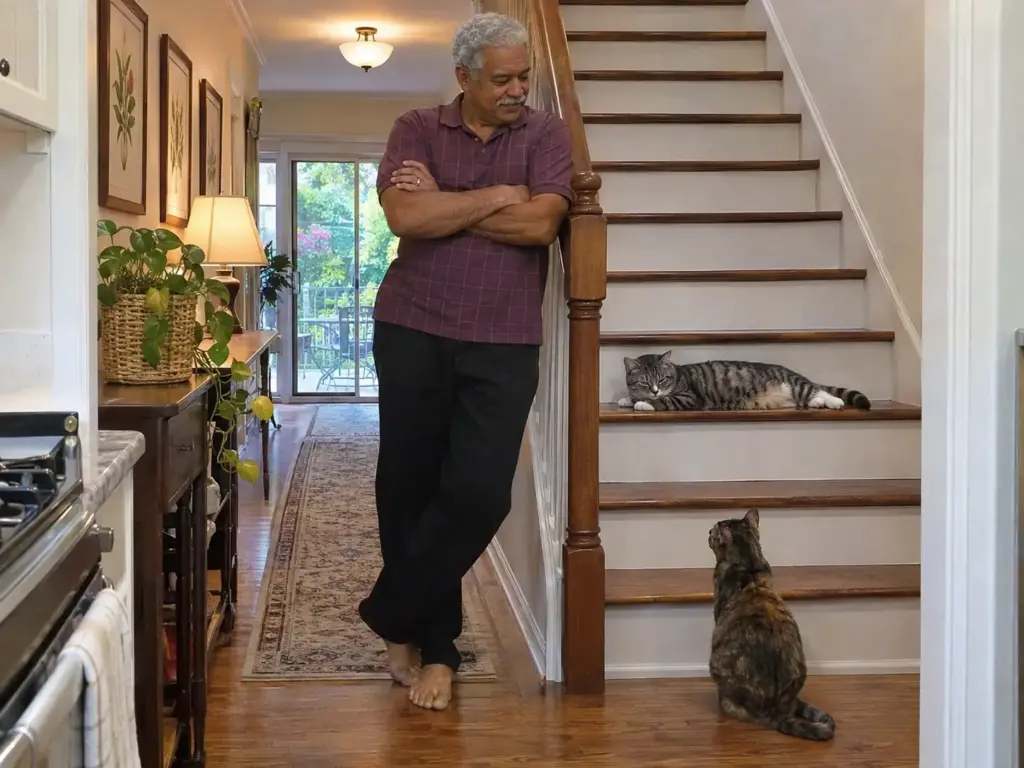
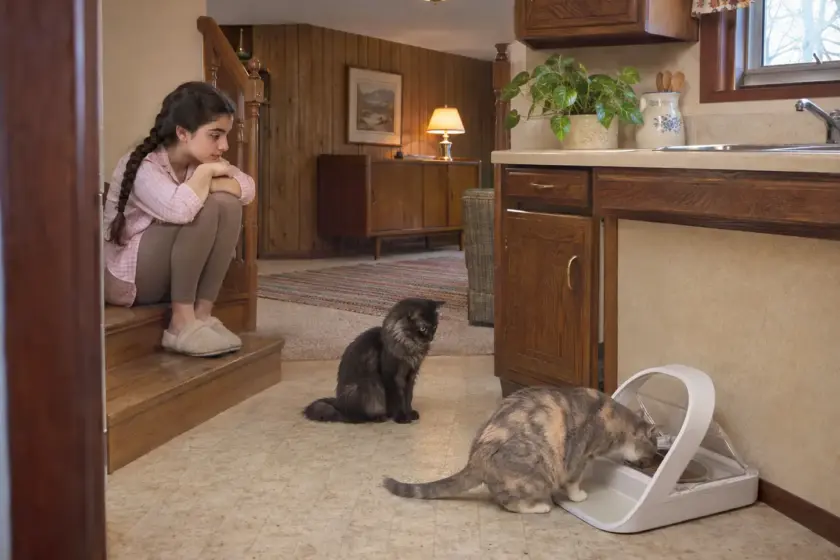
These are things a cat does, visible from the sofa: sitting in a doorway or the hall so the other has to walk past, staring while the other eats, waiting until he is done, eating only when the other is out of the room, retreating somewhere out of sight. Avoiding and hiding are the quiet end of the same pattern, sometimes called silent conflict, and they usually go unnoticed until something louder happens. A cat holding a doorway or a bowl is showing resource guarding in its mildest form.
Picture two kittens and two boxes: one waits at the door while the other finishes, then goes through the same routine in the same spot. There are two boxes and one choice. When a cat holds a doorway like that, how one cat’s routes shrink when another cat watches the doorway shows what the cat on the other side loses. A cat who drags his bowl across the floor to somewhere else is solving a version of the same problem, and why cats drag a bowl across the floor explains the moves.
Neither cat is the villain. The doorway cat is using the best spot he has, and the waiting cat is avoiding a bad meeting. The station is wrong, not the cat.
One Station Used, the Spare Untouched
Two identical boxes can read as a single choice, and a cat that can’t decide which one to use may use neither. An open tray in a pair’s home can get kicked clean by the more particular cat, and the pair ends up sharing one large box. A new box that goes in beside the old one does nothing for days, because the cat already has his.
When one cat crowds the other, the second box is not optional: it is what keeps the cat on the losing end off the carpet.
When a Sudden Change Goes to the Vet First
If a cat changes how it eats, drinks or uses the box from one day to the next, call the vet first; the furniture comes after. The patterns above build over weeks, and those are the ones a floor plan can explain.
Keep a one-week log of which station each cat uses and when. The station that never shows up in the log does not count, no matter how many are in the apartment.
Count What the Home Already Has, Then Buy Only the Missing Station
If you think the rule means five purchases, count what is already in the apartment first. In most homes that comes down to moving two things to another room. Walk the home with a pencil and write down, for each type of station, where the stations are today and which of them pass the check.
Free Moves Before Any Purchase
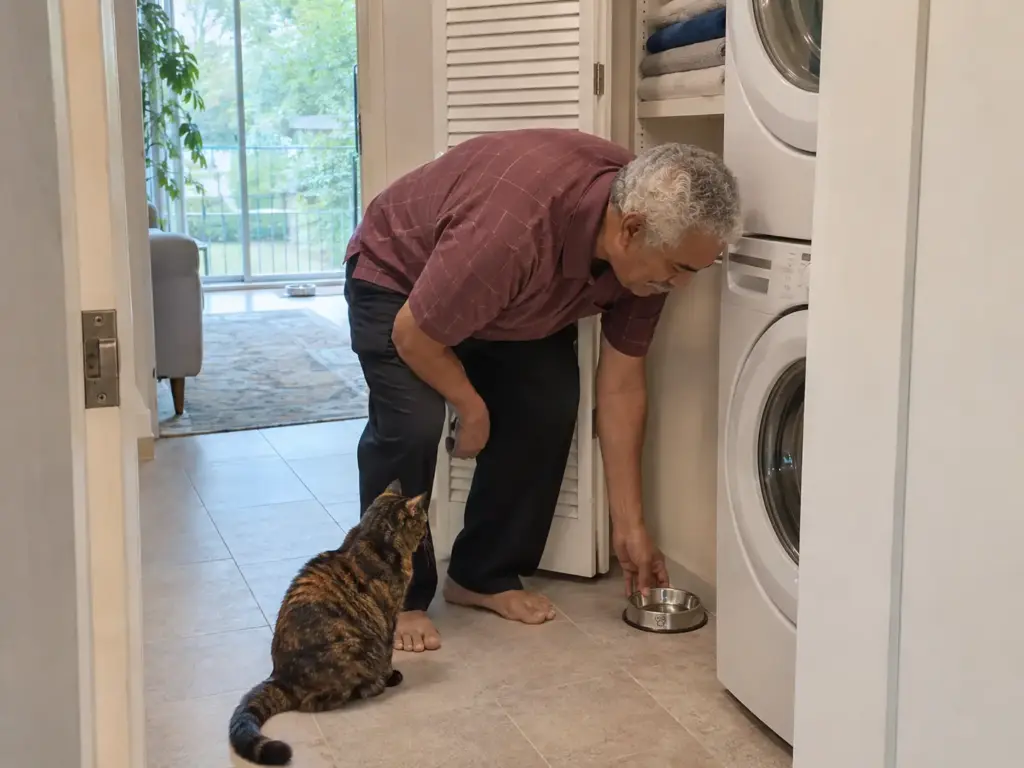
Three moves cost nothing: carry an existing bowl or box to a different room, open a door that has stayed closed, or lift a station onto a shelf the other cat cannot see from his spot. Each one gives a cat a second place to go, and each is reversible if he refuses. The smallest is a single bowl: moving one bowl before buying anything shows whether the spot was the problem.
Move first, watch for several days, and only then count what is still missing. The cheapest extra is a second tray in a different spot; a second brand of box in the same spot adds nothing.
The Tally for Two Cats and for Three
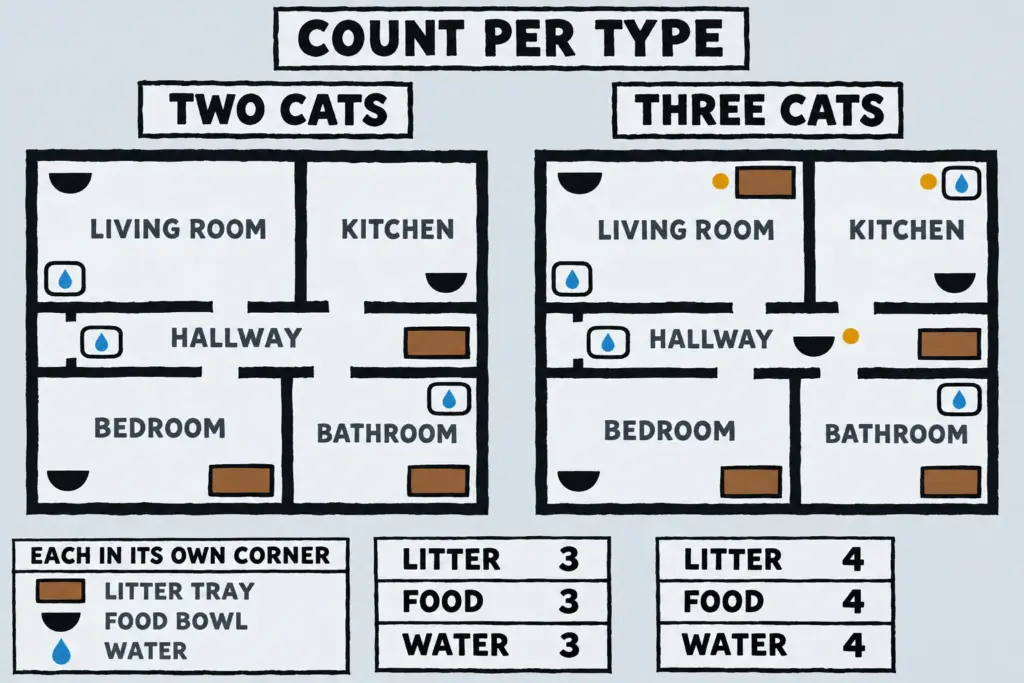
For two cats, aim for three of each type, every one of them passing the check:
- Litter: three boxes in three places, with at least one out of view of the other two. The litter count for a pair is worked out in full there.
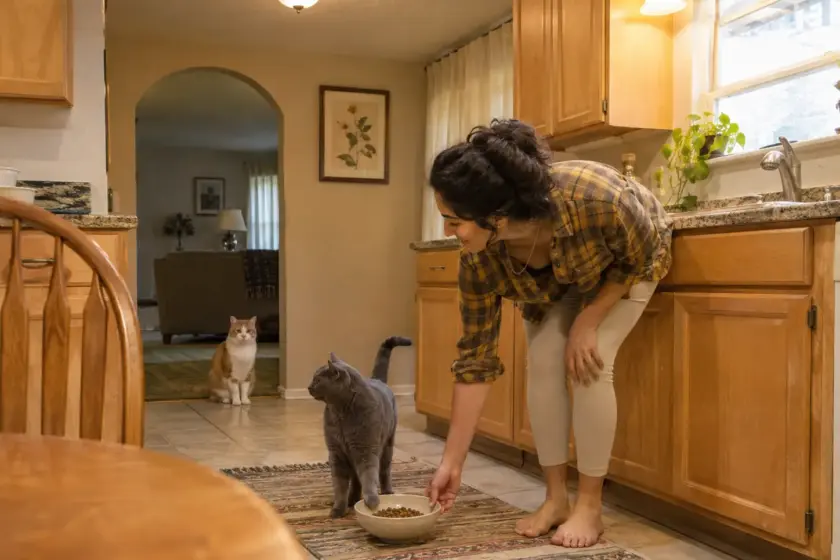
- Food: three feeding stations, one per cat plus a spare. How two cats split a food station covers the split.
- Water: three water stations, none of them beside a food station.
- Rest: three beds or hiding spots, each with more than one way in; a cardboard box on its side counts as one.
- Perches and scratchers: at least three of each, with two ways onto every perch.
For three cats the arithmetic becomes four of each, and the placing gets harder: four litter areas that do not see one another, four feeding stations, four places to drink. The water side of a trio is worked through in the water count for three cats. Most apartments cannot give four distinct places for every type, which is where the order of trade-offs further down comes in.
Where a Bowl, a Fountain or a Second Tray Earns Its Place
Buy only the station the floor cannot supply, and name the spot before you name the product.
The reflex for a second litter station is the biggest box on offer.
In a home with floor to spare, the IRIS USA XX-Large High Sided Cat Litter Box is the version of that reflex that works: 30 × 20 × 14 inches, open on top, with a scatter shield on the high sides, so a long-bodied cat can turn around in it and still watch the room. The size has a cost too. At 30 inches it belongs in a room, not a hallway, and in a small apartment a smaller box in the right spot beats this one in the wrong spot. If you prefer steel, the iPrimio Stainless Steel Cat Litter Box measures 23.5 × 15.5 inches with a detachable 6 inch wall and an open top; it still needs a real spot, not a leftover gap.
If the home is one feeding station short after the first move, the WROSWT 2-Pack 304 Stainless Steel Cat Food Bowls give two shallow stations at once, 5.98 inches across and 1.22 inches deep, 13 oz each, with shallow sides. But thirteen ounces suits a meal, not a day of free feeding, and a bowl only becomes a station once it sits where the other cat cannot see it.
Water gets its own place, away from the food. The Veken stainless steel cat water fountain, 108 oz holds 3.2 L and comes with three filters, so two cats are not both depending on one refill. It needs an outlet and a flat, dry spot, so choose the station first and the fountain second.
When the Apartment Has No Room for the Spare, This Gives First
A rental that bans drilling, with no spare room, still has to get to the rule. The order below is a working method, not a published ranking: it starts with the moves that cost the cat and the apartment the least and puts a purchase last. Height and a second exit come first, then moving the station to another room or behind another door, then a smaller version of the same station, and only then something new.
Height and a Second Exit Before a Second Spot on the Floor
Vertical space costs no floor. A bowl on a high shelf, a bed on a bookcase and a perch with two ways up all add a station without adding a footprint.
The guidelines ask for a safe place with more than one entry so another cat cannot block it, and a perch with a single way up is exactly that trap for the second cat. Give it stairs on one side and a shelf on the other. Food can rise too: a cat bowl at the right height tells you how high is high enough.
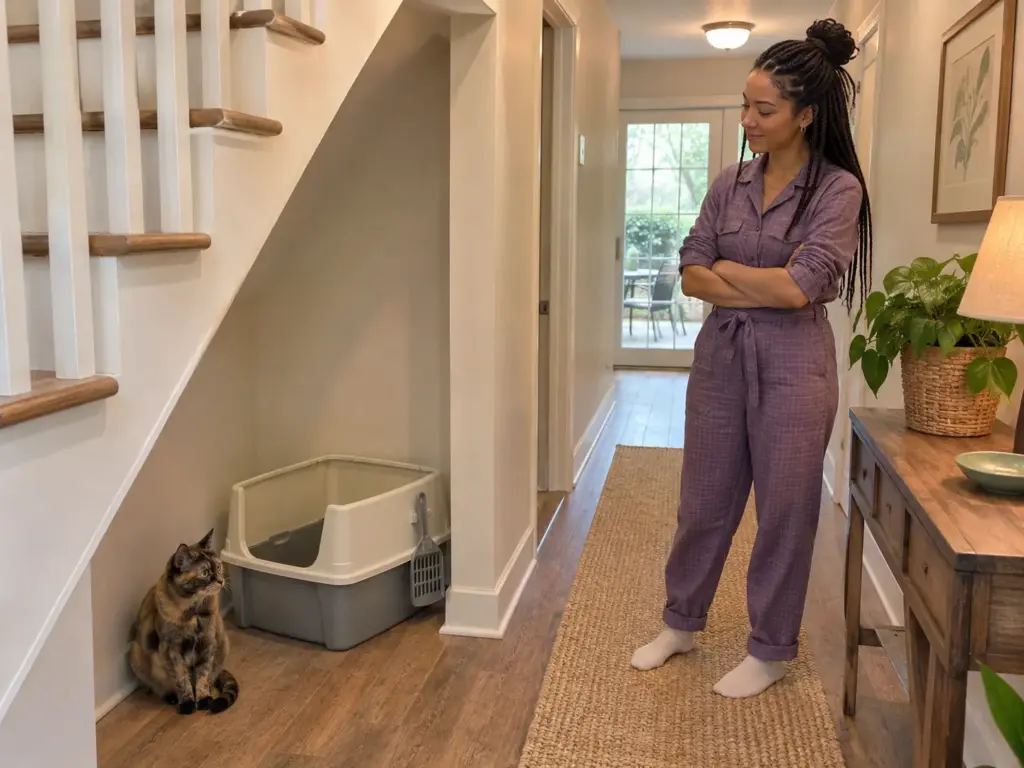
Litter cannot go up, so it moves. The second step is another room, or behind a door that stays ajar, in a spot where the other box is out of view. Where a litter box actually fits in a small apartment goes through the spots a small floor really has. Try these two steps for a week before anything else is added.
A Smaller Version of the Same Station
When the floor has room for only a small station, shrink the station and keep the spot. The Amazon Basics Large Cat Litter Box with High Sides, Open Top measures 19 × 15 × 11.75 inches, an open top with high sides that holds the scatter in and fits where a 30 inch box cannot. A long-bodied cat will find 19 inches short, which makes it a fine spare and a poor main box for him.
Feeding shrinks too: a floor-plan way to feed two cats in a small apartment lays out where two stations go when the kitchen is a single wall. For water, the Veken 95 oz plastic fountain has a 2.8 L tank, smaller and less expensive than the steel one, and the smaller tank means topping it up more often.
A pair that shares well can live on one large box scooped twice a day while the apartment has no room, and the second box waits. That ends when one cat starts crowding the other. From then on the second box is what keeps the carpet clear.
Cats That Will Not Share Set the Real N
The N in the rule is not the number of cats in the home. It is the number of cats that will not share. Cats that rub against each other, sleep in contact, play together or groom each other belong to one social group (sub-groups, in International Cat Care’s wording), and that group can share a bed or a perch. Food is different: every cat keeps its own feeding station, and a second group in the same house gets resources that are physically separate from the first group’s.
So three cats that split into bonded cats and a loner call for two groups’ worth of stations, not three cats’ worth. And even with a self-cleaning unit in the house, an automatic litter box still needs a fourth box for three cats.
Run each move as a trial. Lift a bowl to a shelf or put a box behind a different door, then watch for a week to see who uses it. A station nobody visits was in the wrong spot, and that is cheaper to learn with the bowl you have than with a new one.
Keeping the Count Honest After Any Change in the House
The rule loosens quietly. A new sofa blocks a line of sight, a door gets closed, a cat arrives, and a count that passed in spring fails by summer without anyone deciding it should.

Scoop the Box That Counts, Twice a Day
A box nobody wants to enter has left the count. International Cat Care puts scooping at no less than twice a day, and that is the number that depends on the home: for a box two cats share, it is the floor, not the target. Once a day is not enough there. How often to scoop for your setup is worked out in how often to scoop, per cat per day.
Walk the Floor Again When a Cat Arrives or a Room Changes
Rerun the two questions whenever the house changes, because the N and the lines of sight both move. Put any station that exists but that nobody uses back on the list. For a newcomer, adding a kitten without crowding the resident cat covers how to bring one in without squeezing the cat who was there first.
Set a calendar reminder for every change in the house, not every month. A new sofa, a new cat or a moved bed each get their own five-minute walk-through with the two questions.
Move One Bowl Today, Then Watch Who Shows Up at It
Count the stations by type, run each one through the two questions, and move before you shop. A spare that fails the check is not a spare, and the cat who skips it has read the apartment correctly.
Today’s step: carry one existing bowl to a spot the other cat cannot see from his, and leave the old one where it is. Notice which cat eats at the new spot. A few days of that tells you whether the spot was the problem. Look again a week in, and again whenever a cat arrives or a large piece of furniture changes rooms.
Frequently Asked Questions
01What is the resource rule for multi cat homes?
The resource rule is one of each resource per cat plus one extra, in separate places. International Cat Care states the formula, and the AAFP and ISFM guidelines ask for at least two of each. A station counts only if the cat reaches it unseen.
02Is three cats in a house too much?
Three cats are too many only if the floor cannot hold the stations: the rule asks for four of each resource, in places that do not see one another. If it cannot, give ground in the trade-off order above.
03Do two cats really need two litter boxes?
Under the resource rule, two cats get three litter boxes in separate spots, because the extra is the one a cat can reach when the other is in the first. A pair that shares well can manage one large box scooped twice a day until space allows more. If one cat crowds the other, the second box protects the carpet.
04Does the rule still apply to cats that sleep and groom together?
Cats that sleep and groom together can share a bed or a perch, but every cat still keeps its own feeding station. What counts is which cats will not share, not how many cats live in the home.
05Do beds, perches and scratchers count in the rule?
Yes, beds, perches and scratchers count alongside litter, food and water, and each one goes through the same two-question check. Give every perch two ways up so another cat cannot block it.
Leave a comment