Best Microchip Cat Feeder When One Cat Waits Behind the Lid
Best microchip cat feeder compared: SureFeed (32 pets, 8 1/4 in opening), PawsPik 16 cups + Petlibro collar tag, and the gap each leaves open.

Alfredo RamsesFounder · November 3, 2026 · 15 min read

On this page9 sections
- 1A Microchip Cat Feeder Gates the Bowl, Not the Claim
- 2When the Eating Changes, the Vet Comes Before Any Feeder
- 3The Cat Left Outside: Where It Waits and What It Sees
- 4The Lid and the Side Gap: Where a Gate Still Fails
- 5Chip or Collar Tag for the Cat That Has to Wear Its Key
- 6Registering Each Cat and the Weeks of Training
- 7Which Feeder Fits Which Home, and What Each One Leaves Open
- 8Gate the Bowl First, Then Give the Shut-Out Cat a Place
- 9Frequently Asked Questions
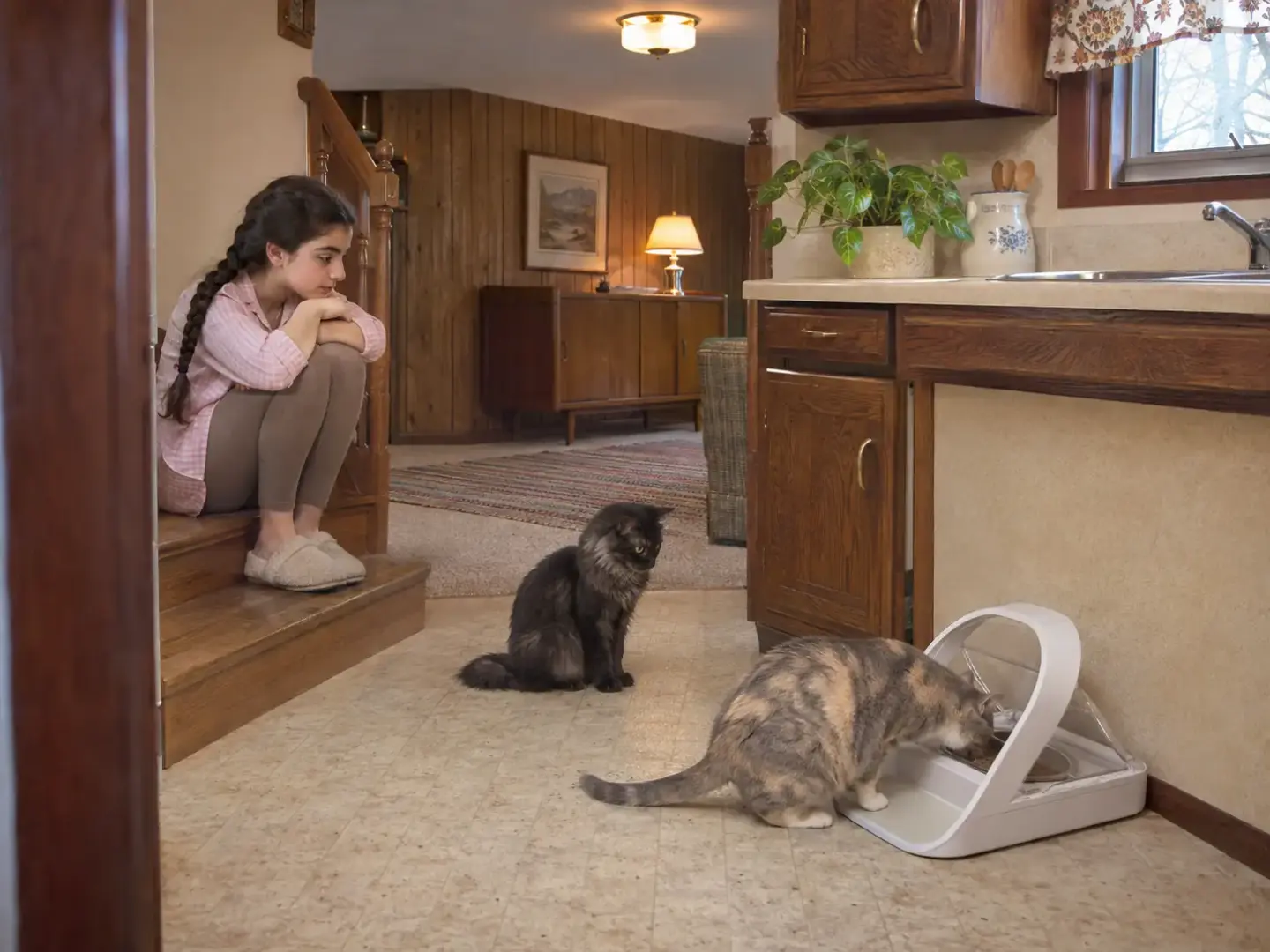
The lid lifts for one cat while the other sits two steps away with his eyes on the opening, and nothing about that is a fault: he has a place to eat and a clear view of a door that opens for someone else. Even the best microchip cat feeder settles whose head reaches the bowl and nothing else. What follows tracks the cat left outside through the three places a gate fails, then answers which unit fits: what the lid opens for, when the vet comes first, where the shut-out cat waits, the gap beside the opening, chip against collar tag, the weeks of training and the home each feeder suits.
Match the home to the gate, and note what each one still leaves open.
| Your home | The gate that fits | What it leaves open |
|---|---|---|
| One cat with a chip, one without | SureFeed chip gate | The gap beside the lid |
| A cat that cannot be chipped | PETLIBRO collar-tag gate | A collar that stays on, and dry food only |
| Two cats, each on his own food | PawsPik, one unit per cat | How many units the apartment can hold |
| A cat on a diet the vet set | The vet sets what goes in the bowl; the gate only decides who reaches it | The diet itself stays the vet’s call |
A Microchip Cat Feeder Gates the Bowl, Not the Claim
What the lid actually opens for
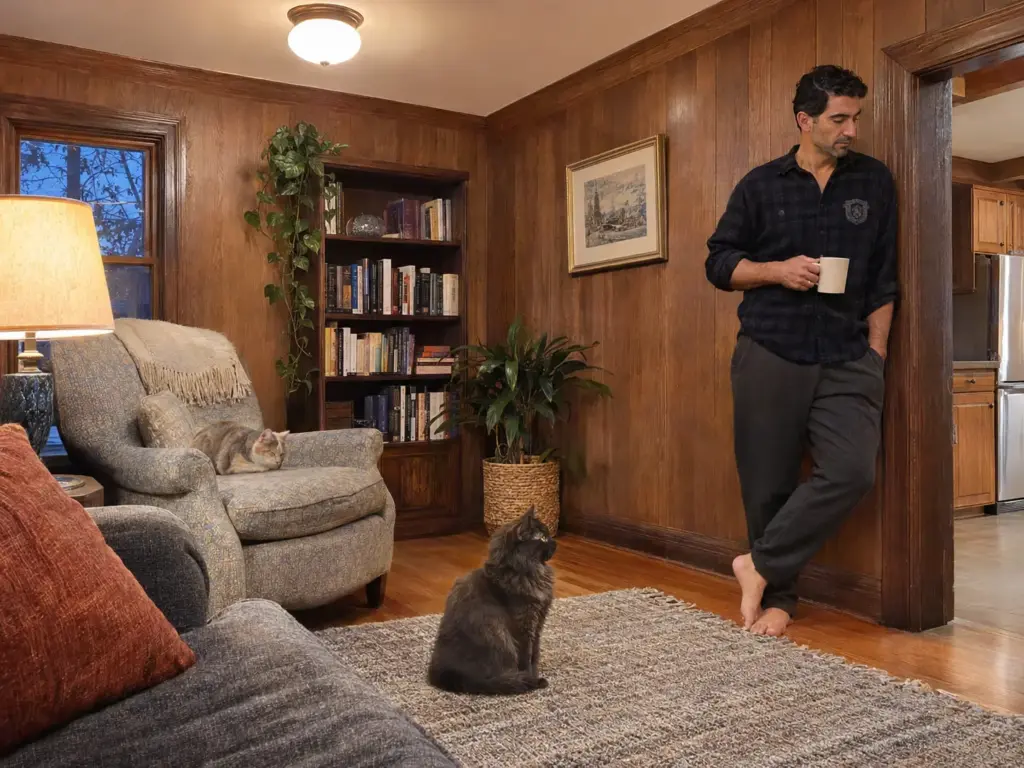
A microchip cat feeder does not recognize a cat. It reads a number, either the implant under the skin or a tag on a collar, lifts the lid when that number is on its list and lowers it when the number leaves. Every other animal meets the same shut lid, and the cat that meets it still sees the bowl, still smells it and still watches the one cat allowed in.
A microchip gate gives selective access to the food, and that is all it gives. It has no say over where each cat sits, sleeps or watches from, and that side of the house is the one described in how a cat splits a home into zones and defends them.
The SureFeed reads 9-, 10- and 15-digit chips and stores 32 identities, so an older implant still counts and memory will never run out in a home of two or three cats.
Get the registered cat’s chip number in writing before the purchase (the vet’s records have it, and a scan at the next visit confirms it reads). Then decide, on paper, where the other cat will eat once the lid is closed to him.
The homes this solves, and the one it doesn’t
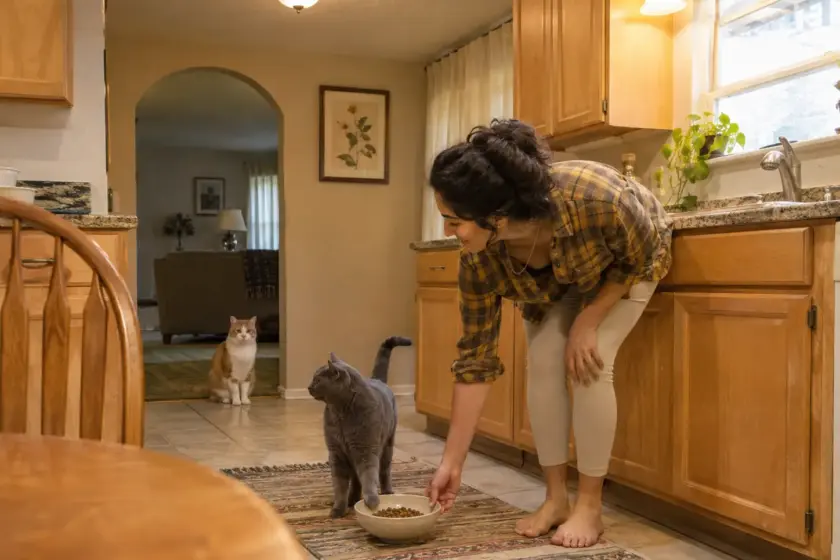
The gate earns its place in three homes: food stealing between two cats, a cat that has to eat alone, or a dog that clears the cat’s bowl. In those it works from the first day. With a single cat and no dog it is almost never needed, and in a multi-cat household it settles the bowl and leaves everything else where it was: the room, the order of the queue, the tension in the doorway. A cat shut out of the bowl is not shut out of the kitchen.
One brand, the PawsPik, supports only one animal per unit, which changes how many units a pair of cats needs.
Where the decision between a chip gate and no gate is already made
Deciding whether a chip gate is worth having at all is worked through in whether a chip gate beats a plain timed feeder for several cats. Everything here starts from the gate and follows the cat on the wrong side of the lid.
When the Eating Changes, the Vet Comes Before Any Feeder
If a cat suddenly eats much less or stops eating, gains or loses weight, or changes how he eats from one week to the next, that is a conversation with the vet, and it comes before any decision about lids. Nothing in a kitchen layout explains it, and a feeder will not either.
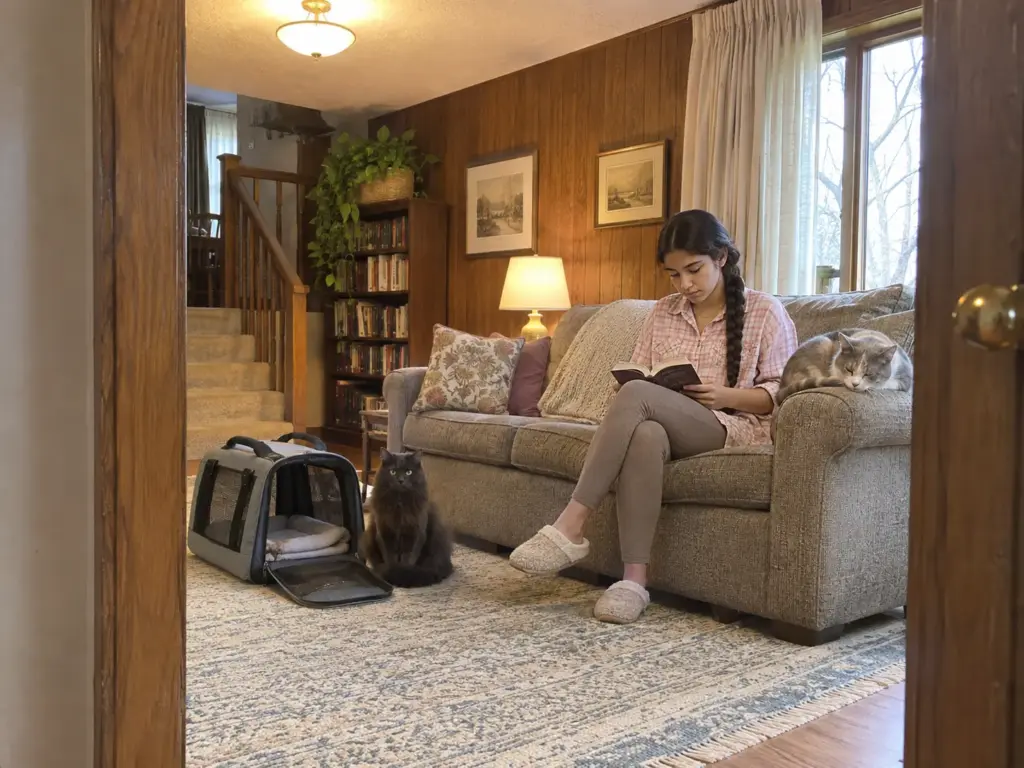
Prescription food, or any other controlled diet a vet has set, works the same way. What goes in the bowl, how much and how often belong to the vet, and the gate only decides who reaches it, so nothing here gives a portion, a meal count or a schedule.
Two more cases go to the same place. A gate that stops reading a cat it used to read needs a chip scan at the vet’s or at a shelter before anything else, because the fault may not be the gate’s. And once the gate is in, a cat on the outside who eats much less or not at all gets the vet before another change to the kitchen.
None of this cancels the purchase; it puts the visit ahead of the lid. For the floor-plan side, where to put two feeding stations in a small apartment draws the layouts.
The Cat Left Outside: Where It Waits and What It Sees
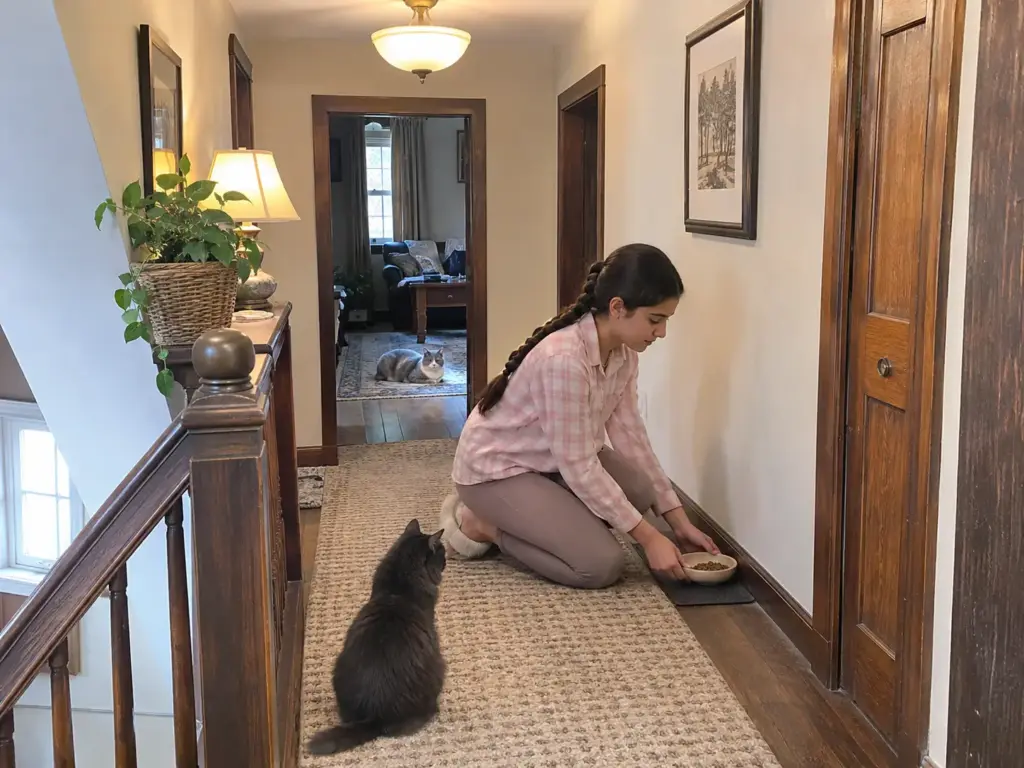
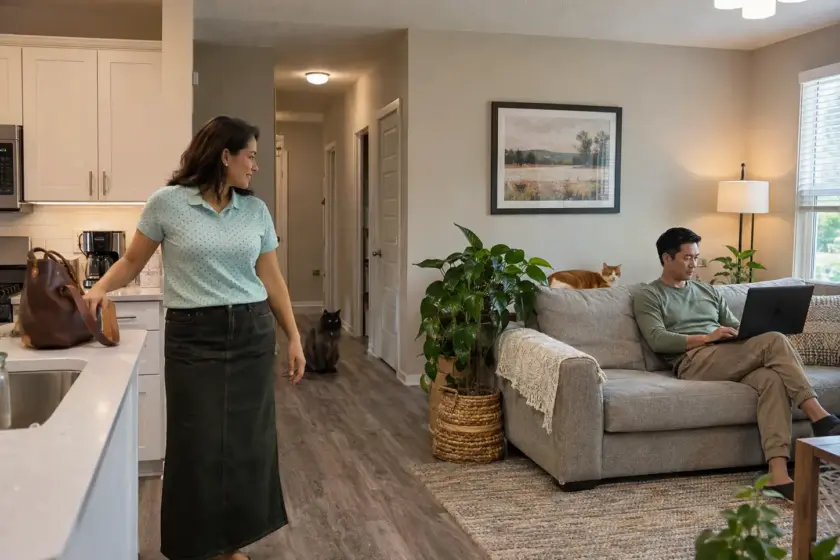
Put the gate on the wall and the cat outside it keeps three things the lid never touches: his place in the room, his view of the opening and the minutes he spends waiting. He learns fast. A cat who has watched the lid lift for his housemate enough times has also learned when it lifts and where to be standing when it does.
Where the shut-out cat waits
He sits within a step or two of the lid, on the line between the opening and the doorway, or in the hall where he can hear it move. The waiting is about place. The spot beside the opening is where the meal happens, and a cat who knows when the lid lifts does not need to be hungry to sit there. With two cats the wait is a queue of two; with three, the one closest to the lid sets the moment and the others arrange themselves around him.
A watcher is not a case of bowl guarding, and the difference matters for what you do next. How to tell the cat who watches the lid from the one who holds the bowl is covered in what a cat that holds the bowl does, and how to tell it from a cat that eats.
What it sees of the lid
A lid that rises for someone else is a signal repeated at every meal, and the cat outside reads it from wherever he can see it. A gate in the open middle of a kitchen wall gives him that view from the doorway, from the hall and from his favorite perch. A corner or an alcove is the better spot: the opening is seen from one direction instead of the whole room, so his line of sight to the lid is short and breaks easily.
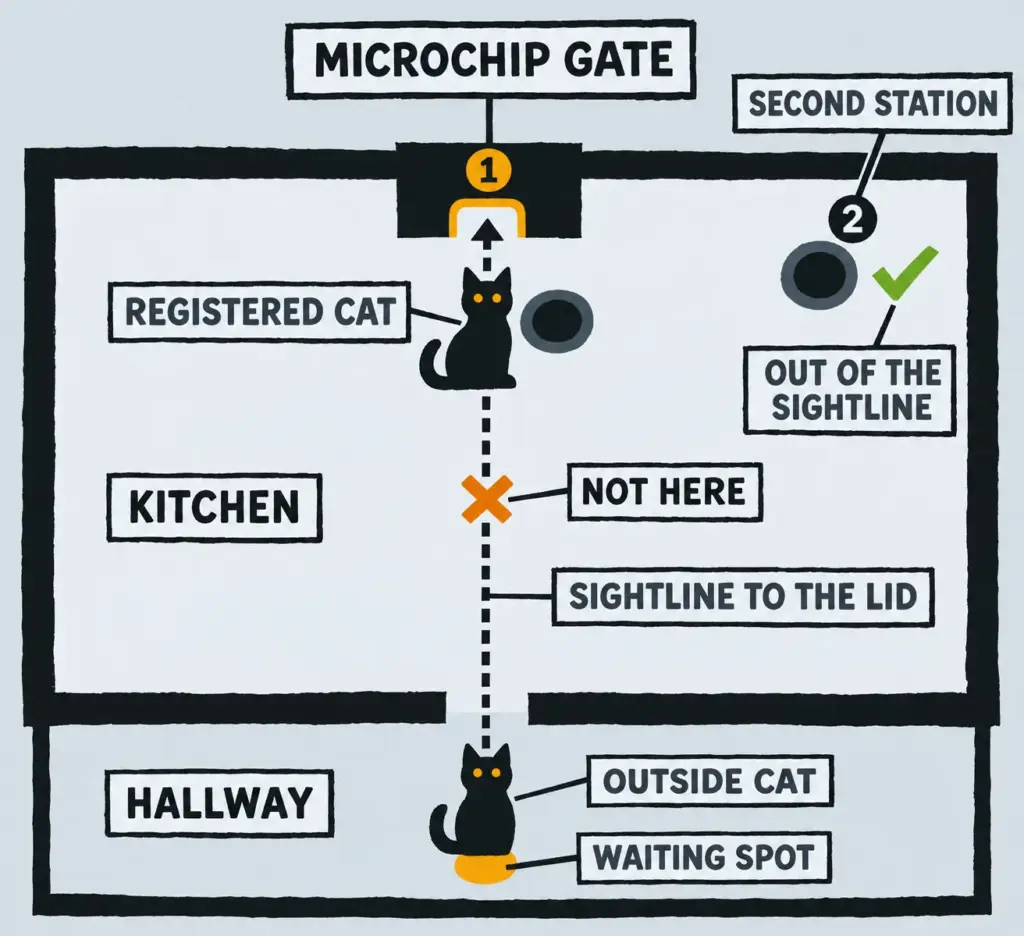
Where the opening faces matters as much as where the unit stands. No printed figure gives a distance for it, so the check is a plain one: sit where he waits and look for the opening. If you can see it, he can.
What costs nothing: a door and a second station
Before a second unit, the cheapest fixes. A closed door does what the gate does for as long as the meal lasts: feed the registered cat in a separate room, open the door when the bowl is empty, and the lid never has to decide anything. (It works until the cat on the outside starts waiting at the door instead of the lid, which is a better place for him to wait, since he cannot see the bowl from there.)
Then the shut-out cat’s own bowl goes somewhere the lid is out of sight. In a small apartment with no spare room that means another wall, with his back to the first one. The count of stations a home needs and the sightline check between them are worked out in one of each resource per cat plus one, and the sightline check; here it only matters that his station sits out of the line of the lid.
Give the outside cat his own station, out of the line between his waiting spot and the lid, before concluding a second unit is needed. A cat with a bowl of his own who cannot see the lid from it has nothing left to wait for.
The Lid and the Side Gap: Where a Gate Still Fails
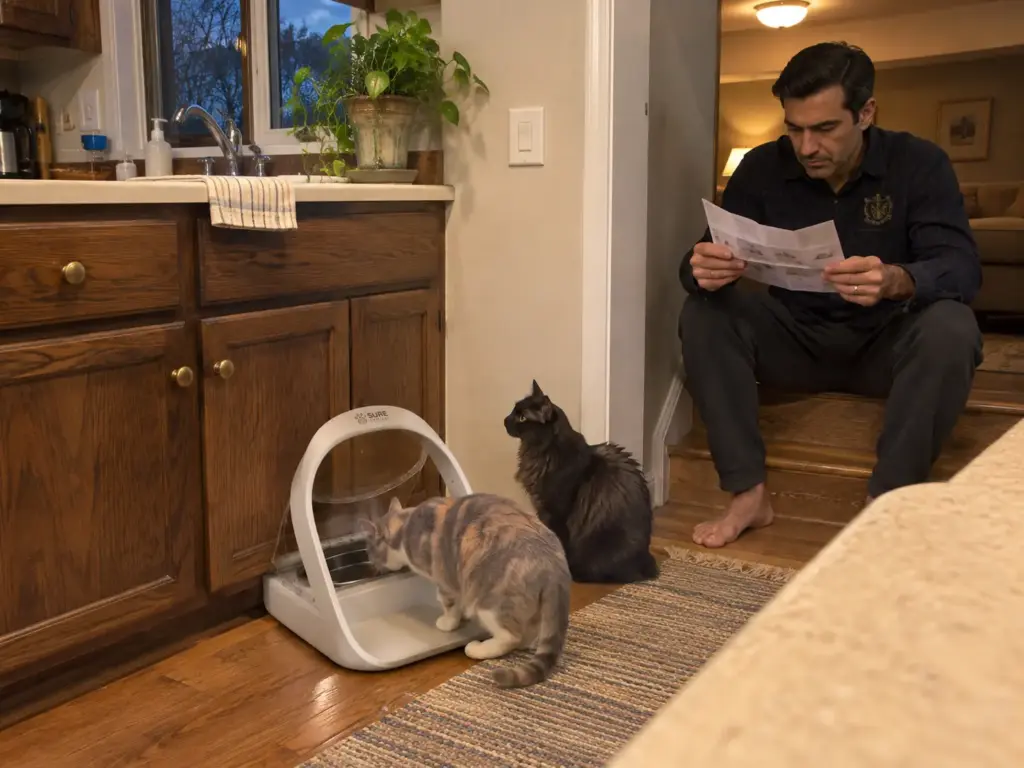
The lid is a shared moment
The lid opens for the registered cat and stays up while he eats, so for that stretch the opening belongs to whoever stands closest. The cat on the outside learns this moment faster than anything else about the unit. He stays at the side, head turned, until the registered cat backs out, and he is waiting at the opening the second it is free. The bowl holds 400 ml, about 1.6 cups or two pouches of wet food, which is one meal and not the day, so the moment is short but it comes at every meal.
How long the lid waits to close while a chip is still in range is a question for the manual. Until you have read the answer, assume that a cat who keeps his head in the opening keeps the lid up with him.
The gap beside the opening
The opening is 8 1/4 inches wide and 6 1/8 inches high, and one cat’s head does not fill it. The unit most households start from is the SureFeed Microchip Pet Feeder, MPF001. It reads 9-, 10- and 15-digit chips, stores 32 pets and takes wet food or dry, and the width that makes it easy for a registered cat to eat is the same width that leaves room beside him. The lid guards the front of the opening; whatever fits next to the registered cat gets in with him, and a cat who has been shut out for a few days finds that out.
The number that decides it is your own cats’ heads, and no printed figure gives it. Measure each cat across the broadest part of his face, add the two widths and compare the sum with 8 1/4 inches.
If both heads fit at once, the opening is not a barrier, and the unit needs a wall on one side to become one. A feeder against a wall, ideally a corner, closes that side entry. With three cats the remaining side fills sooner.
When the animal at the side is a dog, the fix changes, and a feeding station sized by how far a dog can reach is built for it.
What to do on the first week before spending more
For the first week, only watch. Stand across the room and let one whole meal play out, noting where the cat outside waits, when he moves and which side of the opening he takes. Keep one unit per registered cat and set it against a wall before buying a second. A wall is free; a second unit isn’t.
Watch one whole meal from the far end of the room before you touch anything. Where the shut-out cat waits and which side of the opening he favors tell you where the wall or the second station goes.
Chip or Collar Tag for the Cat That Has to Wear Its Key
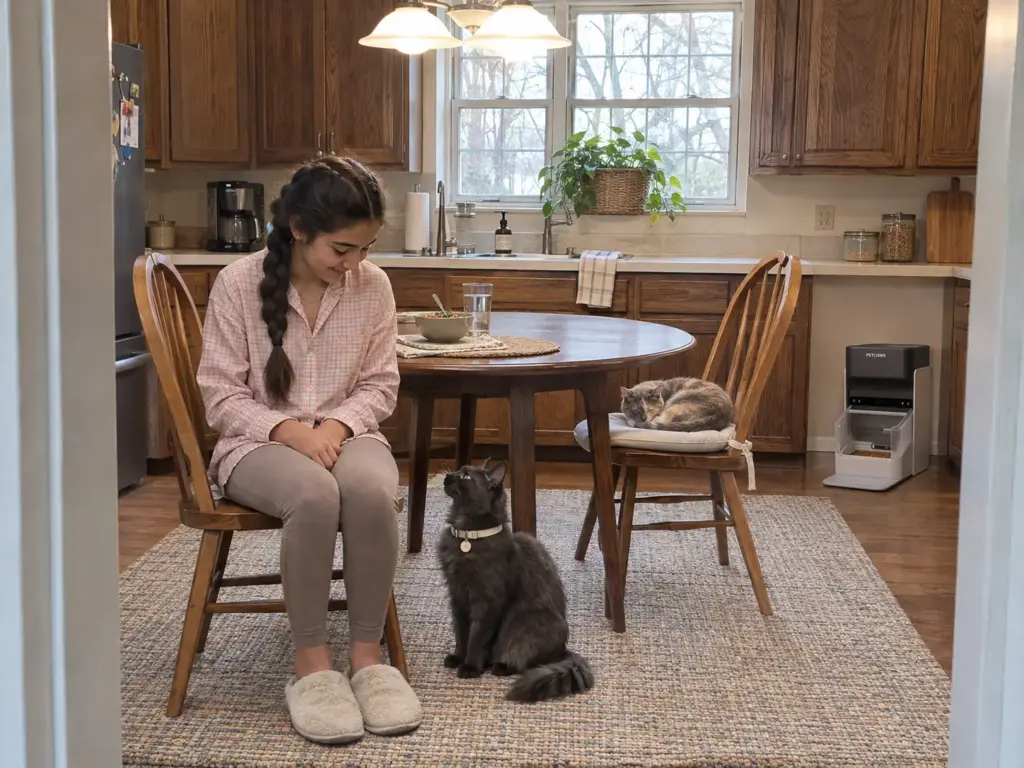
Reading the implant
An implanted chip needs no collar and goes wherever the cat goes, which makes it the cleaner key. The unit reads the number, so the number has to be readable: check it before the purchase leans on it. The implant sits between the shoulder blades, which on a large cat is a long way back from the nose, so the head must be well inside the opening before the lid picks up the chip. A big cat’s lid can look slow when the cat is simply not far enough in.
The SureFeed also works with the maker’s collar tag, which means a cat that cannot be chipped is not always out of that unit. Two cats cannot share a key, though. Every cat the lid should open for needs his own registered chip or tag, and a gate cannot tell two cats apart that carry the same one.
Confirm that the chip number actually reads before the purchase depends on it. A gate bought around a chip nobody has scanned is a guess with a lid on it.
The collar route for a cat that cannot be chipped
The SureFeed is the obvious pick for a home with chips; for the cat that cannot be chipped, the better call is the PETLIBRO RFID Automatic Cat Feeder, Collar Tag-Activated. The tag on his collar opens the lid, the hopper holds 3 liters, and the app handles the schedule. Its limits are two.
Dry food only, and a collar that has to be on the cat every hour of the day. The day it snags, slips off or goes missing, the lid stays shut for the cat it was bought for. And a collar is a thing some cats refuse to wear at all, in which case the cat has made the call and the unit is the wrong one.
When a registered cat stops being read
When to call is the one decision here that no setting makes for you. If a gate stops reading a cat it used to read, the first stop is a chip scan at the vet’s or at a shelter, not a fix in the kitchen. Whether the number on file and the number the chip returns still match is something to find out there, and nothing else should be touched until it is.
Registering Each Cat and the Weeks of Training
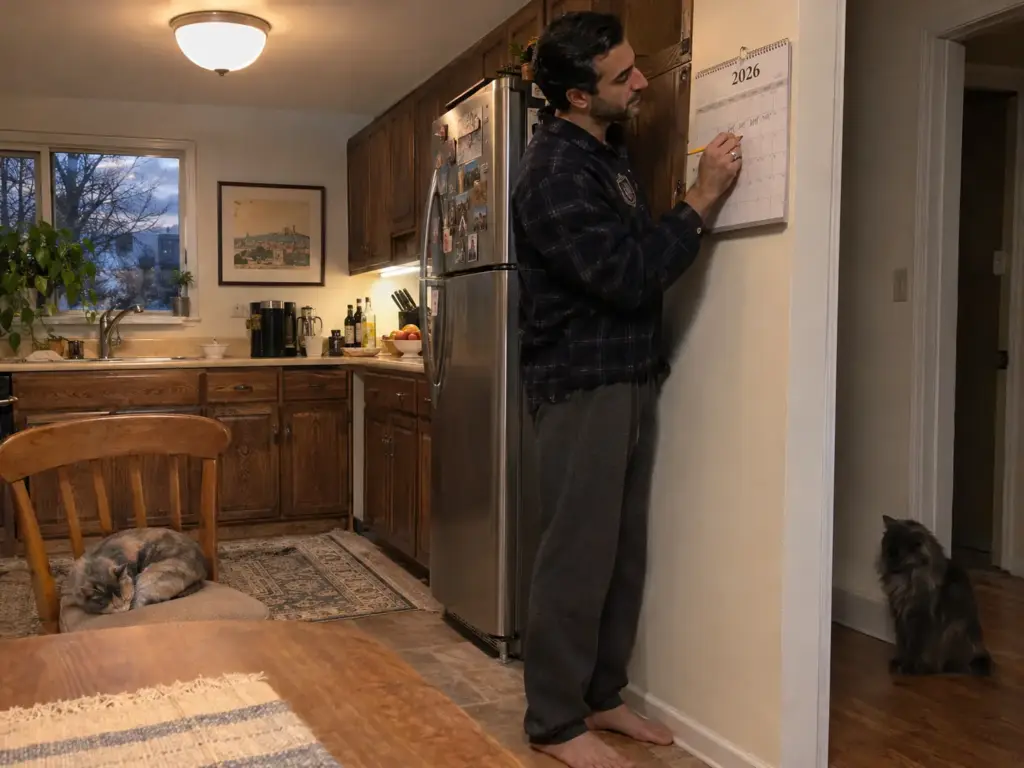
The four stages of the lid
The maker’s training mode runs in four stages, and at each one the lid closes a little more than at the last. None of them can be skipped. The sequence exists so that a timid cat meets a moving lid in small steps instead of all at once, and a cat who is hurried past a stage will usually stay away from the unit altogether.
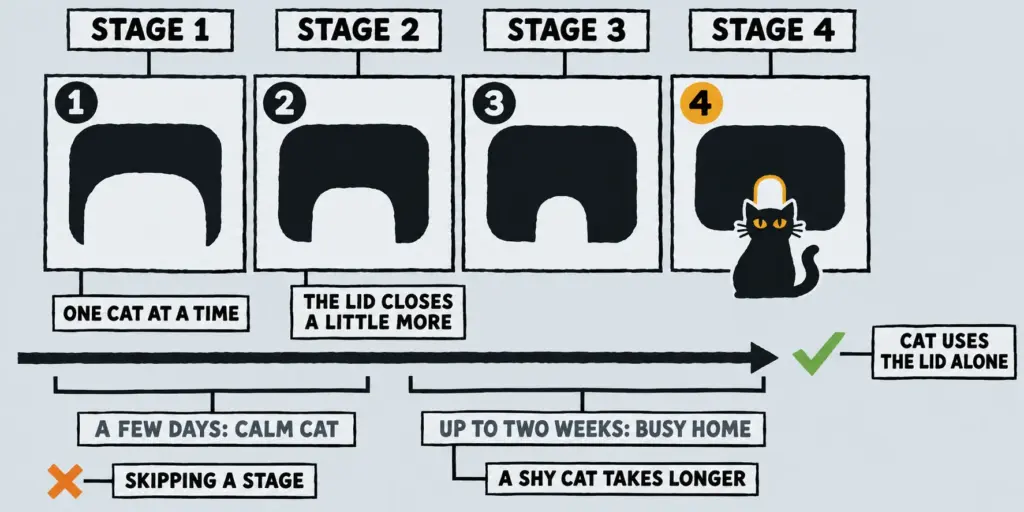
Run each stage with one cat at a time, and stay on a stage until that cat uses the lid without hesitation. The next stage is not a reward for the clock.
How many cats one unit holds
The unit stores 32 identities. In a home of two or three cats, memory is never the limit; the limit is the moment at the lid, because every extra registered cat is one more meal with someone waiting behind him. The unit runs on four C cells, and the maker’s figure is about six months on a set.
How long the learning takes
A calm cat can have it in days. In a home with several cats the settling can take up to about two weeks, and the timid ones set the pace. A light on the unit signals training mode and low batteries, and the manual lists the colors, which is worth reading before a lid that will not open gets blamed on the cat. If a cat stops eating during training, that is a call to the vet, not an adjustment to the lid.
Which Feeder Fits Which Home, and What Each One Leaves Open
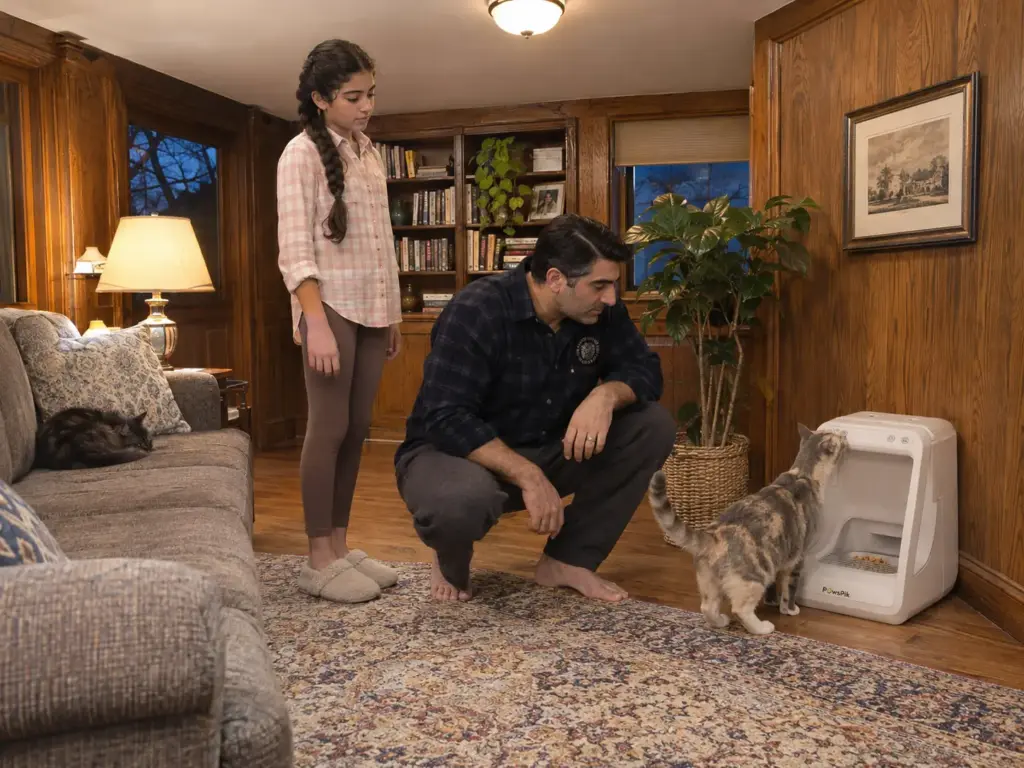
One chip gate for the home that already has chips
The SureFeed fits the home where one cat is chipped, another slides in beside him and a gate that takes wet or dry food is wanted. It leaves open the gap beside the lid, and a wall closes that for free. What remains is deciding how many cats the lid has to learn.
One unit per cat when the diets differ
Two cats on two foods need two keys and two bowls, and the PawsPik Automatic Microchip RFID Cat Feeder, 16 Cup is built for that. Its hopper holds 16 cups of dry food, it accepts 15-digit chips and comes with an RFID tag, and it supports one animal per unit, so a pair needs a pair.
Four RFID sensors do the reading, and on a large cat, whose chip sits near the shoulders, the head has to be well inside before the lid opens. What goes in each unit is the vet’s to set; the unit only keeps it from the other cat. For the hours-away side of the choice, which automatic feeder fits the hours you are away ranks the rest.
The collar tag when the chip is not an option
One line, already covered: the collar-tag unit is for the cat that cannot be chipped, with the collar always on and dry food only. If a gate still feels like the wrong first move, how far sharing food between two cats can go before a chip feeder is needed lays out the cheaper rungs, with the chip as the last one.
Gate the Bowl First, Then Give the Shut-Out Cat a Place
A microchip feeder answers who eats, and nothing else. The cat outside keeps the room, the view of the lid and the wait. The gate fails at the moment the lid is shared and at the gap beside the opening, and the cheap moves, a closed door at mealtime and a second station out of the lid’s line, come before a second purchase.
Give the unit a few days to a couple of weeks to be learned, then watch one meal from the far side of the room. Where the cat outside goes when the lid closes tells you whether the layout is holding.
Today, with nothing bought: feed the registered cat behind a closed door for one meal and put the other cat’s bowl where he cannot see the lid. Any change in how a cat eats, before the gate or after it, goes to the vet first.
Frequently Asked Questions
01Do microchip cat feeders work for a cat that is not microchipped?
Yes, if the unit reads a collar tag instead of an implant, though the cat then has to wear that collar at all times. The Petlibro collar-tag unit takes dry food only, and a diet set by a vet stays the vet’s call.
02Can one microchip feeder be set up for two or more cats?
Yes, the SureFeed stores 32 identities, but one cat reaches the bowl at a time, and the cat waiting behind him sets the timing at the lid. A unit that supports one pet only, like the PawsPik, means one unit per cat when diets differ.
03Can a cat still get into a microchip feeder?
A second cat can slide in beside the registered one while the lid is open, because an opening of 8 1/4 by 6 1/8 inches may leave room for another head. Standing the unit against a wall closes one side.
04How long does a microchip cat feeder last on batteries?
The SureFeed runs on four C cells, which the maker rates at about six months. A lid that stops opening for a registered cat means a chip scan at the vet’s or a shelter first.
05Does a microchip cat feeder work with wet food?
Some do: the SureFeed takes wet or dry food, and its bowl holds about 400 ml, roughly 1.6 cups or two wet pouches. The Petlibro collar-tag unit and the PawsPik are dry-food units.
Leave a comment