Can Cats Feel Jealous? What Changed in the Home First
Can cats feel jealous? Yes. Count 7 days of attention, read a 5-row sign-to-cause table & fix the bowl, lap or window spot for free first.

Alfredo RamsesFounder · November 3, 2026 · 17 min read


On this page9 sections
- 1Can Cats Feel Jealous? Yes, and the Word Hides a Lost Claim
- 2A Change Over a Few Days Goes to the Vet Before Anything in the Home
- 3Four Things the Home Changed for the Cat: the Lap, the Bowl, the Spot, the Schedule
- 4Count a Week of Attention Before You Judge the Split
- 5Which Sign Points to Which Cause, with the Free Fix First
- 6Two Bowls in Two Places Come Before Any Purchase
- 7Splitting Time and Space in a One-Room Apartment
- 8Count the Week, Move One Bowl, and Call the Vet if It Came Fast
- 9Frequently Asked Questions
One cat gets up the moment your hand moves toward the other, hisses once, and drops into the lap you just made room for. It looks like a scene, so it is fair to ask can cats feel jealous, and the short answer is yes, with a caveat about how anyone knows. The word helps less than it seems to, because a cat cannot tell you what it feels; it can only show you what it is protecting, and that is a lap, a bowl, a window spot or a stretch of your evening. This guide gives the yes and its limit, the one rule about the vet, a week of counting, a table that matches each sign to a cause, and the arrangements that work in an apartment with a single room.
Quick Answer
Yes, with a caveat: the feeling is inferred from what the cat does. Underneath, it is usually a lap, a bowl, a resting spot or a schedule that changed, and the cat is defending it. A change that arrives within a few days goes to the vet before any change at home.
Can Cats Feel Jealous? Yes, and the Word Hides a Lost Claim
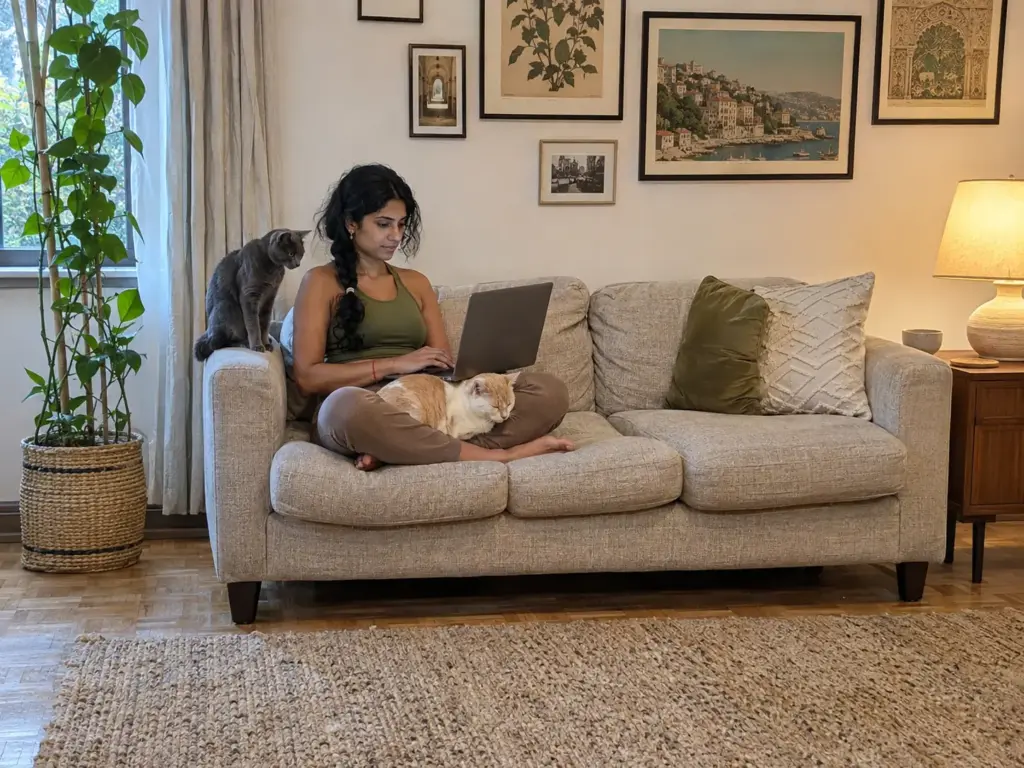
Watch the order of events in your own living room. You sit down, the cat on the couch arm stays where it is, and nothing happens until the second cat steps within reach of your hand. Then the first one moves, and it moves toward the lap, not toward the other cat. That order tells you what the cat is tracking: it is reacting to the moment a place it counts as its own is about to be shared.
What the evidence supports and what it only suggests
Nobody can ask a cat what it feels, so jealousy in a cat is always inferred from what the animal does. What the behavior supports is narrower than the word. Sandra Mitchell, DVM, a veterinarian who writes for PetMD, puts it this way: “In cats, jealousy can present as aggression; they show aggression toward other cats that threaten their security, especially if their status or territory is compromised.”
Read the end of that sentence twice, because status and territory are doing the work, and neither is a feeling you can see. Her next point is that a cat does not become insecure without a reason, which makes the reason the first thing to look for.
What the evidence only suggests is the human part: resentment, a grudge, a cat making a point. That reading is a story we add, and it sends people toward scolding when the useful move is rearranging. Cats are territorial by design, and according to Cornell Feline Health Center’s guide for new cat owners, “Cats are naturally territorial, which can sometimes lead to conflicts over food, water, owners’ affection, and places to rest or eliminate.” Food, water, your affection, a place to rest: that list covers what a cat can feel it is losing in a shared home.
What the hiss is protecting
What a hissing cat defends is usually a moment, not an object. When a second cat comes near during petting, the cat being petted stops purring and leaves, and the same cat stays put for as long as the other one is out of the room. The total minutes of attention did not change; the timing did. A lap holds exactly one cat, so for the cat on it, a second cat approaching is a plain loss, and leaving or blocking are the two answers available.
The cat is right about the constraint, since a lap really does hold one. You are right about the preference, that you would like to pet both. Only one of those two can be negotiated, and it is the second.
Some cats cross the house at a run the moment they hear you talk to the other cat, just to be in the middle of it. Inserting itself is also a claim, and it asks for the same fix. Which part of the apartment each cat treats as its own is mapped in the guide on how a cat claims each zone of an apartment; this article stays with the lap, the bowl and the schedule.
One cat or two changes the answer
With one cat, the rival is never a cat. It is a visitor, a dog, a new partner, or a work schedule that took the evening away, and the reaction follows that change in the house. With two cats, the rival lives in the apartment, sees every petting session and shares every lap you offer, so neither cat ever gets to reset. Both cases start with the same question (what changed) and end in different arrangements, so the table later in this guide carries a column for one cat or two.
Before you call it jealousy, write down what changed that week: which place, which resource, which hour. The answer is nearly always on that list, and it is the one thing on it you can move.
A Change Over a Few Days Goes to the Vet Before Anything in the Home
Every list of jealousy signs lumps in stress signs such as hiding, peeing or pooping outside the box, and eating less. The same behaviors turn up when a cat is unwell, and nothing in a living room can tell the two apart. This guide does not try to, and it offers no home fix for those signs: that sorting belongs to a vet.
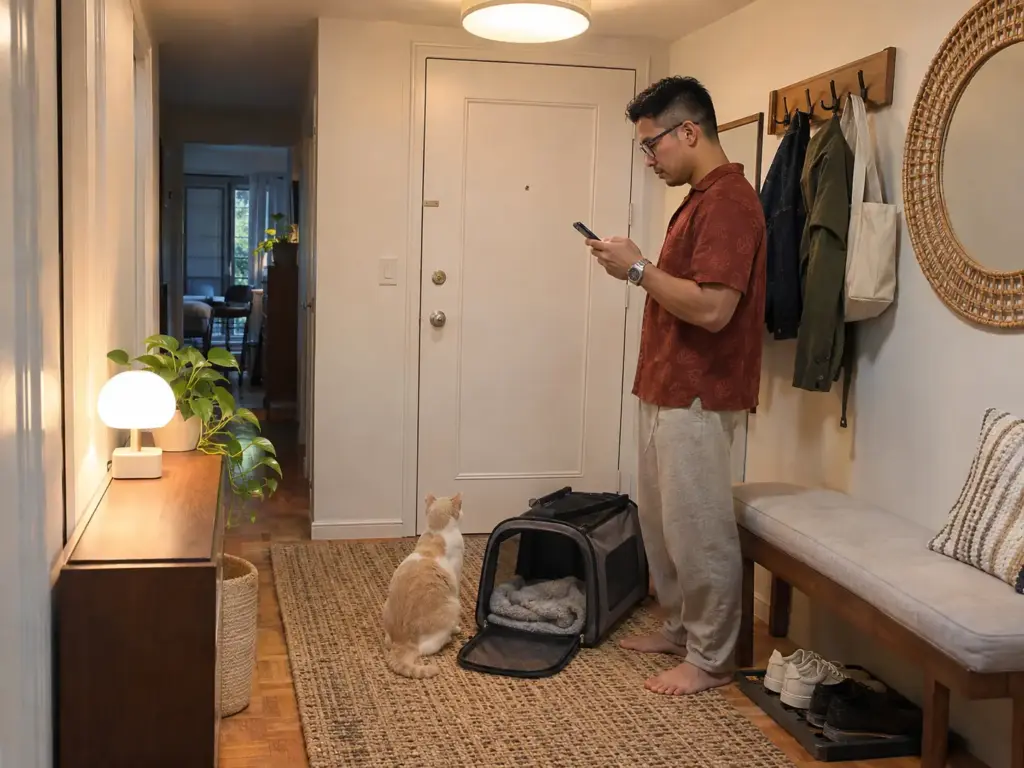
If the change arrived within a few days, or has no visible cause, book a vet visit before you move a single piece of furniture. PetMD’s advice on a change in personality is the same: talk to the vet.
What belongs to the house is a pattern with a date and a moment. Someone arrived, a schedule shifted, a couch moved, and the reaction shows up at the same point every time, in the lap or at the bowl. That kind of change you can map, count and fix at home, and the rest of this guide does exactly that. If the second cat only came home recently, read the guide on when an introduction between two cats is going wrong first, then come back.
Four Things the Home Changed for the Cat: the Lap, the Bowl, the Spot, the Schedule
When you have a jealous cat on your hands, the home has usually changed one of four things for it, and each has a scene you will recognize.
The lap and the petting
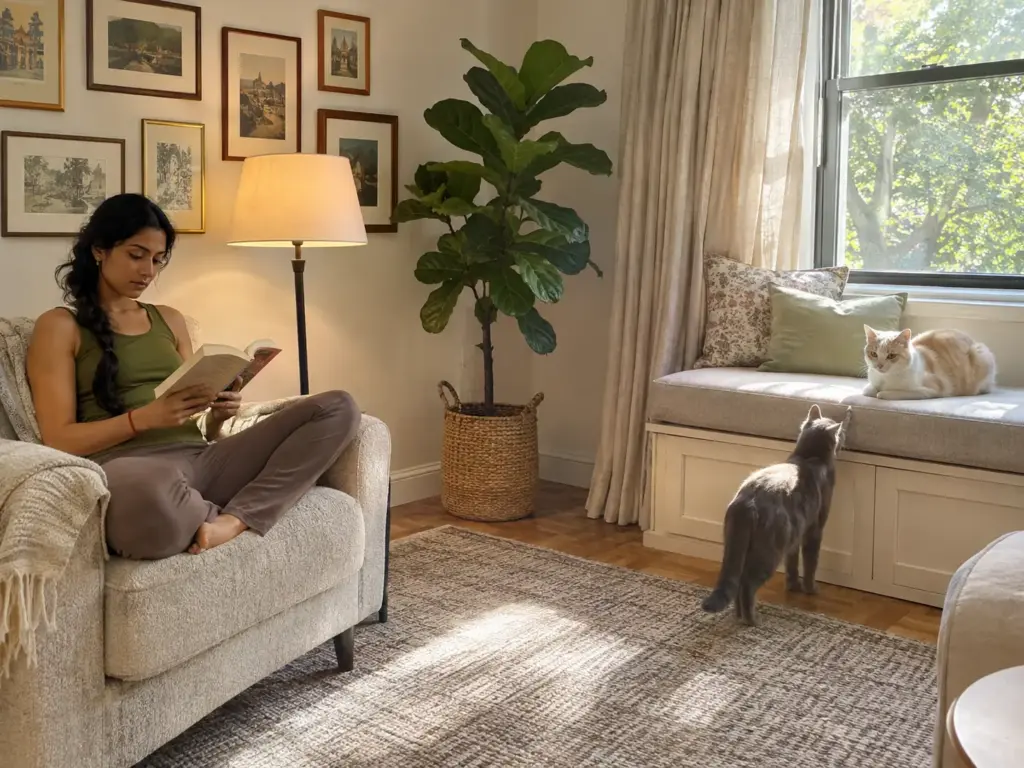
The lap is the clearest case because it holds one cat. Watch what the reaction attaches to. Some cats stay when the other approaches and push harder into your hand; some leave the second the other arrives; some interrupt from across the room. All three are tracking timing, so note the moment each one happens, not the minutes.
A third cat makes it worse in a predictable way: the attention has to stretch across more waiting animals, and every petting session has an audience.
The food bowl
A bowl becomes a claim when the other cat can see it, which is the textbook case of resource guarding. One cat eats faster because it is watched, another eats less for the same reason, and a slow eater loses food to a quick one without anyone seeing it happen. Cats.com’s advice is to feed multiple cats separately so that one is not eating more than its share, and the cheapest version of that advice is a different corner for each bowl.
The resting spot
The sofa corner, the end of the bed or the window ledge that used to belong to one cat is a resource, and the second cat taking it is the loss the first one reacts to. Cornell’s rule for litter boxes is the number of cats plus one, and the same count works for places to rest: separate beds or perches, one per cat and a spare.
In a small apartment that number depends on where the spare sits. A spare in plain view of the first spot is only a second place to fight over. Separate litter boxes follow the same arithmetic, worked out in how many litter boxes two cats need.
A newcomer or a changed schedule
A new animal in a space the resident already dominates can bring fear and uncertainty, as Oakland Veterinary Referral Services puts it: “When a new cat is introduced to a space that your cat already dominates, it can cause feelings of fear and uncertainty.” The fear is about the room. For a kitten, how a gradual introduction keeps the resident from feeling crowded is laid out in adding a new kitten without crowding the resident cat.
A dog changes the picture. Many cats take a dog’s presence calmly and still react sharply when another cat gets attention, so with a dog the first job is usually the bowl: keeping a cat’s bowl out of a dog’s reach comes before anything else. A new baby or a new partner works through the schedule instead. A new job, or a person who now sits in the evening spot, changes the cat’s share of attention without changing the cat, and the reaction follows the calendar.
Write down the exact moment the reaction appears: when you pet the other cat, when you open the food, when you sit down. The moment names the resource, and the resource is what you rearrange.
Count a Week of Attention Before You Judge the Split
Most people are sure their attention split is even. A week of tally marks either backs that up or doesn’t, and both results are useful.
What to count and when
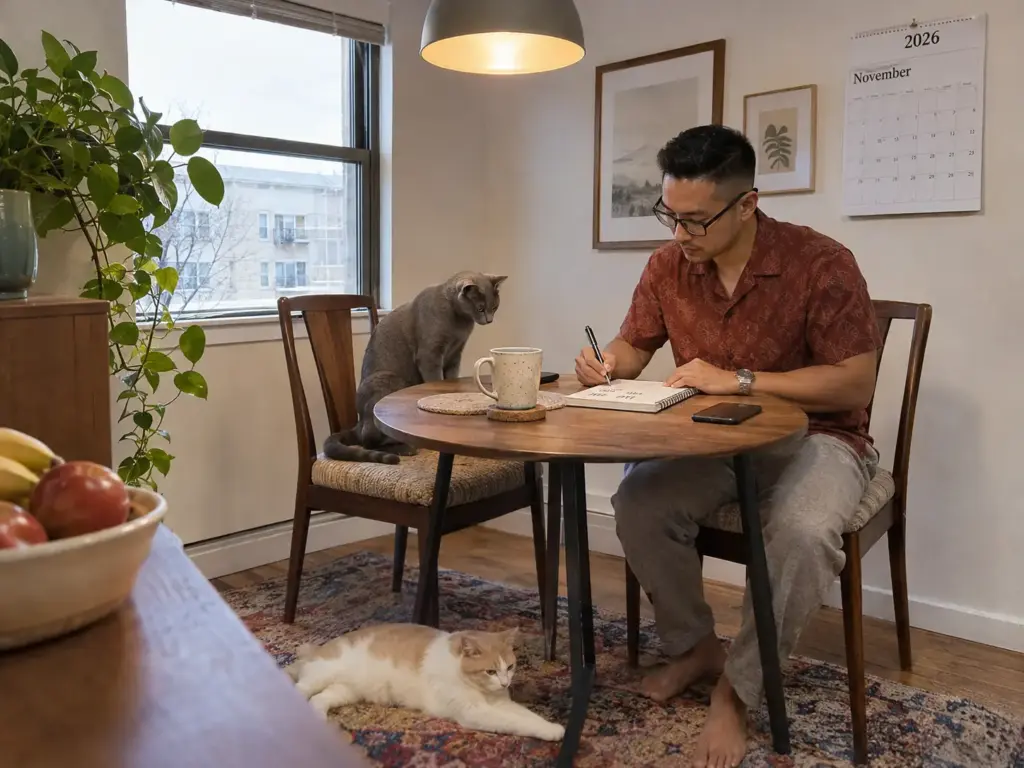
For seven days, keep a note on your phone or a page by the couch with a row for each cat. Write down the minutes of attention each cat gets alone (petting, play, being talked to with the other out of the room), and put a tick in the row every time one cat interrupts while the other is being petted or fed. Add the time of day to each tick. This guide does not invent a figure for how many minutes a cat needs; the number that matters is the gap between your two rows.
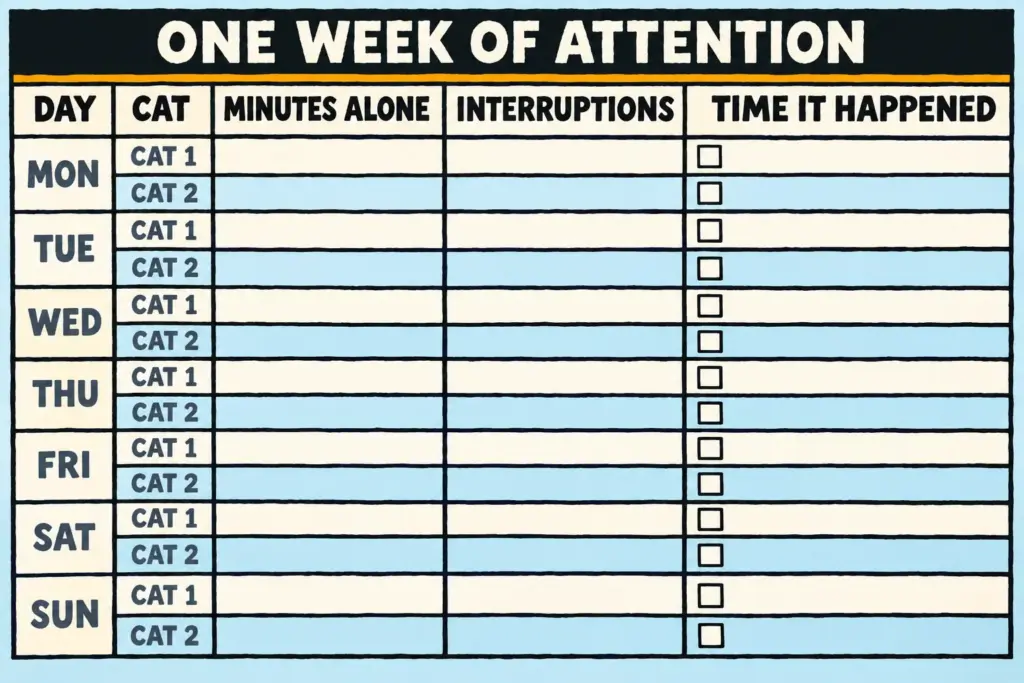
Time counts as alone only when the other cat is out of sight, ideally behind a door. Petting one cat with the other watching from the arm of the couch goes in the interruption column, not the attention column, because the watching cat is part of the event.
Counting the interruptions
Interrupting petting covers anything a cat does that puts it between your hand and the other cat: a hiss, a swat, stepping into the lap, a meow that starts the moment the petting does, the run from across the house. Note which of three moments set it off (petting, feeding, sitting down), since each points to a different resource. Two or three interruptions a day at the same hour say more than twenty scattered ones.
Reading the numbers without blaming either cat
A lopsided week explains a lot without any theory: if one cat got three times the lap time, the other’s reaction is a cat describing a real shortage. An even week with the same reaction at the same moment points somewhere else. Equal petting is the standard recommendation, and it fails here for a specific reason: the total was never the trigger, the other cat’s presence during it was. That cat is holding a claim on a moment of your time, so the answer is a schedule in which each cat has a window with the other out of the room, and equal totals come second.
If the count comes out even and the cat still reacts, stop adding minutes. Change when and where the petting happens, because the moment is the problem, not the total.
Which Sign Points to Which Cause, with the Free Fix First
The same behavior can have four different sources, so the table matches each sign to its most likely cause and puts the fix that costs nothing in the third column.
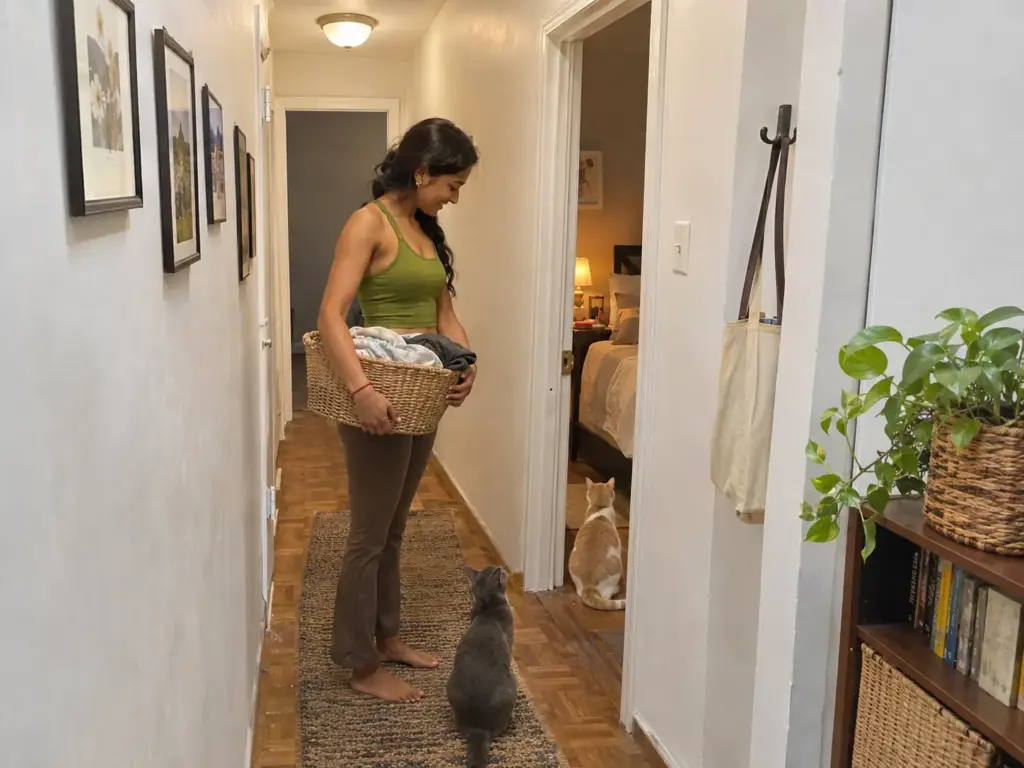
How to read the table
Find the row that matches what your week of ticks showed, not the behavior that bothers you most. A cat that blocks the lap and a cat that sits in front of the other’s bowl look alike from across the room and need different arrangements.
| Sign | Likely cause | Free fix first | One cat or two |
|---|---|---|---|
| Blocks the lap or steps between your hand and the other cat | Lap competition | Pet each cat in its own sitting, with the other out of the room | Two cats; with one cat the rival is a person or a dog |
| Plants itself at the other’s bowl or eats the other’s food | A food station in view of the other cat | Move one bowl to a corner the other cannot see | Two cats |
| Takes over the other’s sofa corner, bed or window ledge | A resting spot that lost its owner | Give each cat a named spot and keep one spare in a third place | Two cats |
| Follows you closely after a new job or a new routine | A routine change | Set a short, predictable window for each cat | One cat or two |
| Reacts to a new person, dog or baby by staying close to you | A newcomer in the room | Put the cat’s bowl and bed where the newcomer cannot reach | One cat or two |
There is no row for hiding, peeing outside the box or overgrooming, and that is on purpose. Those belong with the vet, as the earlier section says, and a table of house fixes would suggest otherwise.
The fixes that cost nothing
The five rows above share a small set of moves, and none of them requires buying anything:
- Pet one cat at a time, in separate sittings, with the other out of the room.
- Move one of the two bowls to a spot the other cat cannot see from its own bowl.
- Name a resting spot for each cat and keep one spare in a third place.
- Close a door during one-on-one time and keep that window at a predictable hour.
- With a new dog or person, put the cat’s bowl and bed out of their reach.
Pick the row that matches your count and change one thing for a few days before touching a second.
Two Bowls in Two Places Come Before Any Purchase
In most two-cat homes the two bowls already exist; they just sit together on the same mat. Before any purchase, treat that as a placement problem.
Move what you already have
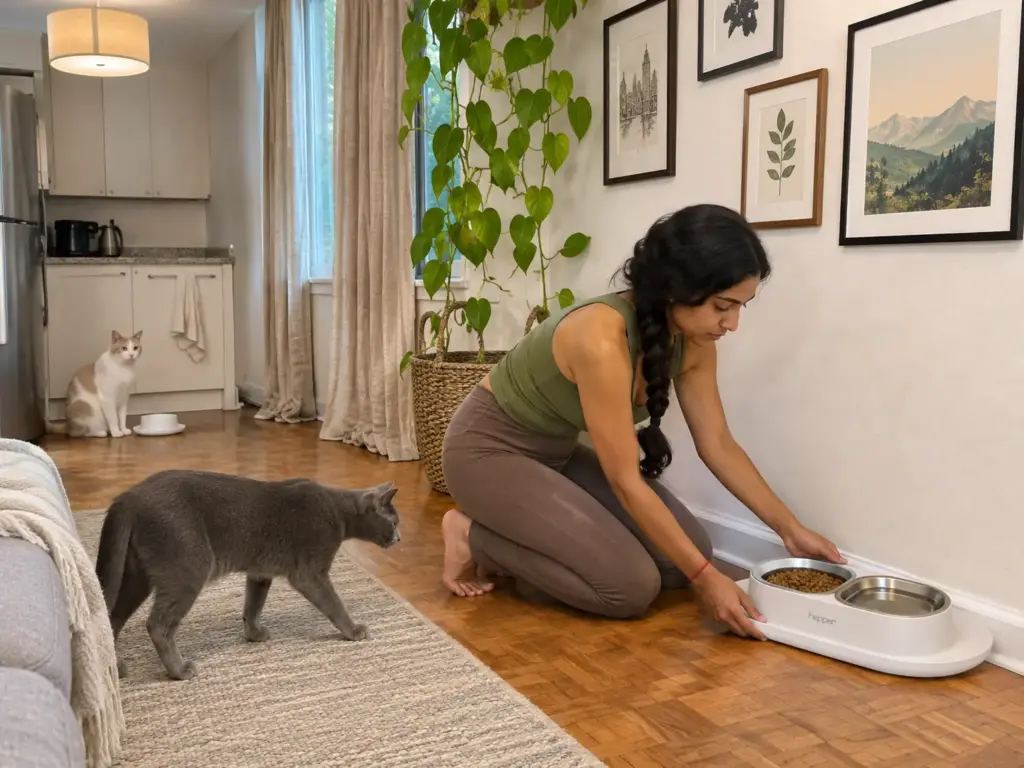
Carry one bowl to a different spot, out of the other cat’s line of sight: another corner of the kitchen, the hallway, the far end of a counter. That one move gives each cat a station of its own: separate bowls in separate corners, which is the point of feeding two cats apart.
Feeding them separately also means neither one eats more than its fair share, the same concern Cats.com raises about multiple cats. If the two eat at different speeds, the quick one finishes first and walks over to the other bowl; distance and a corner stop that walk. The longer form of the question is in whether two cats can share one bowl.
When a two-station bowl earns its place
Some apartments don’t have two corners. In a studio with one counter and one stretch of kitchen wall, the free move runs out, and a single piece that holds two stations becomes reasonable. The floor-plan version of this question is covered in feeding two cats in a small apartment, by floor plan.
For that studio, the Hepper NomNom Modern Cat Bowl is an elevated stainless steel unit with two 10 oz bowls, so the cats never share a plate even when they share a corner. It is the most expensive way to do this, and its limit is plain: both stations sit within sight of each other, so it ends the sharing of one dish and not the staring. Where a second spot exists, the free move still beats it.
The obvious pick isn’t always the right one. The Catit Style 2-Bowl Glass Diner Set is two separate 6.8 fl oz glass dishes, and the separation is the useful part: one can go in the kitchen and one down the hall, which a fixed two-bowl unit cannot do. Each dish holds less than a NomNom bowl, so it suits portioned meals better than a full day of dry food, and glass belongs on the floor, since a fall off a counter edge breaks it. For two cats and two rooms’ worth of apartment, it does the same job at the budget end.
Splitting Time and Space in a One-Room Apartment
Advice on separating cats assumes a second room. When two cats share one room, the work is done by a door, a clock and one resting spot that belongs to one cat.
A closed door does the work of a second room
The second room in a one-room apartment is the bathroom, or a hallway with a door. Shut the other cat out of the main room, give the cat that stays a wand toy and the lap to itself, then swap. The rule is one cat at a time: while the door is closed, the cat inside has no one to compete with, and the cat outside has no view to compete over.
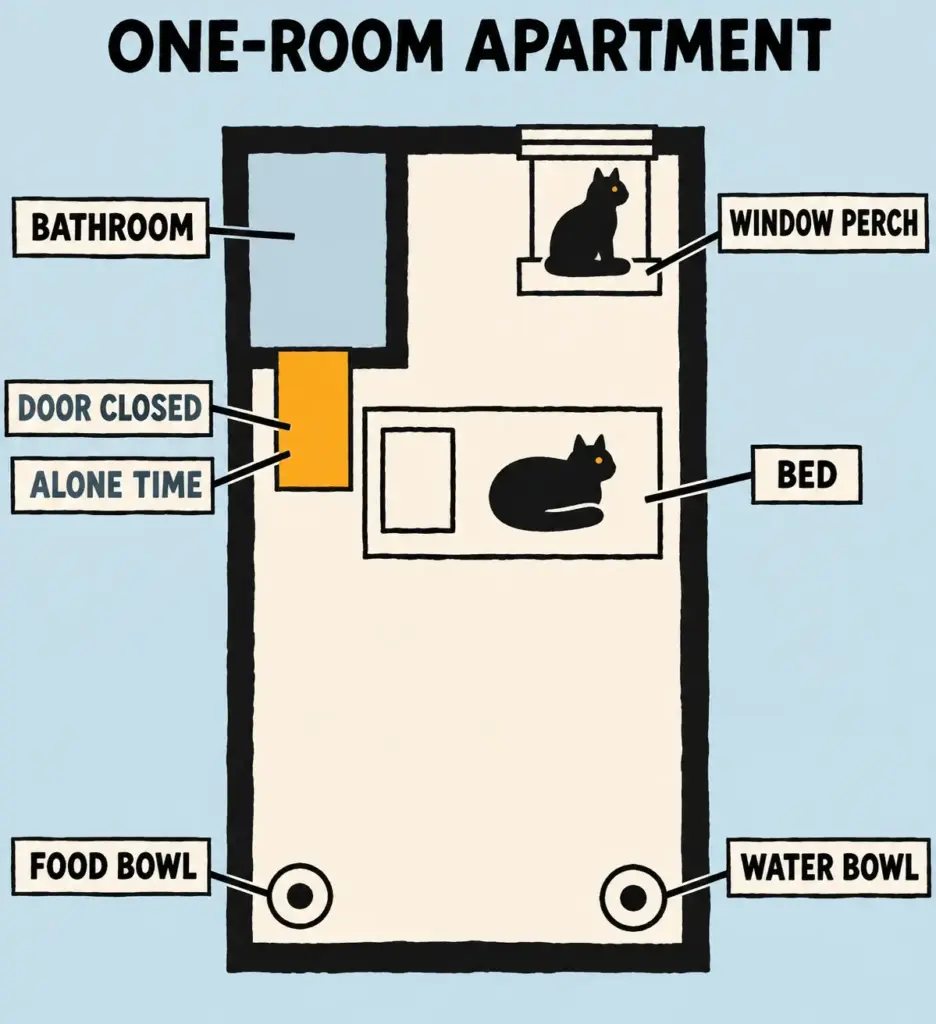
Expect a protest at the door for the first few days; that is the cat describing the change, not giving a verdict on it. If the bathroom also holds the litter box, where a litter box fits in a small apartment covers whether it is the right place for the box before it becomes the waiting room too. The window of time matters, and the length matters less: a cat can learn an hour of the day, and an attention session that arrives at random is just one more thing to compete for.
A resting spot the other cat does not take
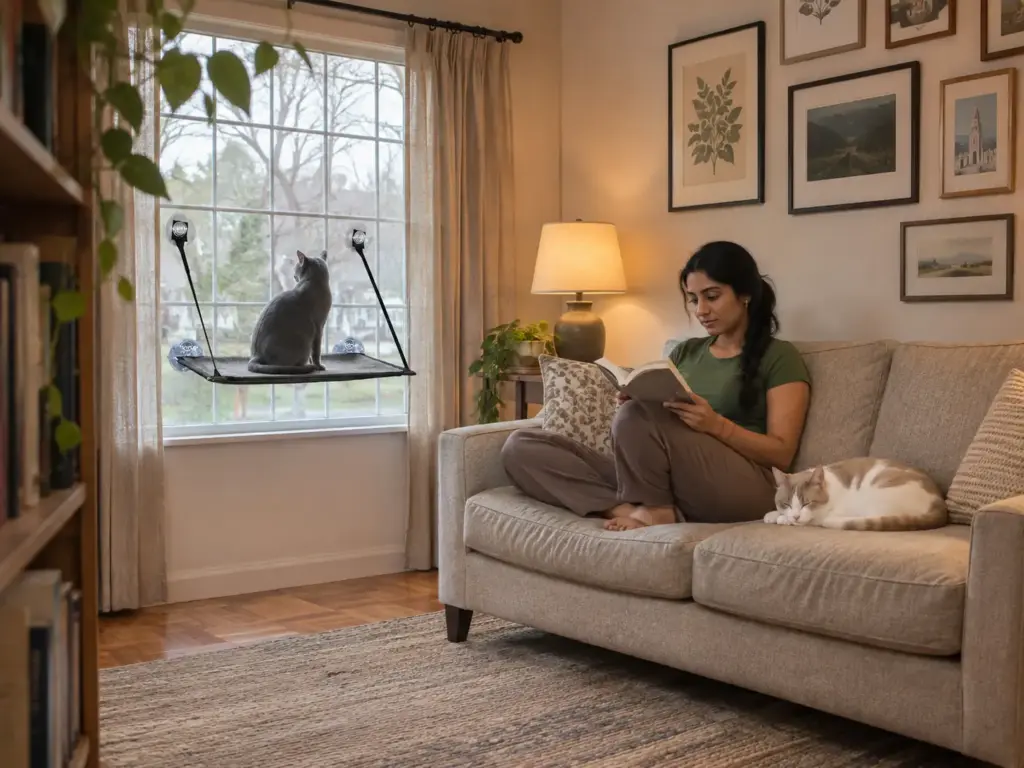
Before buying anything, put a cushion on a piece of furniture that is already there, as high as the furniture allows, and see whether one cat adopts it and the other leaves it alone. If the window is the spot, the K&H Cat Window Perch EZ Mount is sized for glass 27 in wide by 23 in high and attaches with suction cups, so nothing gets drilled into a rental. A high seat that only one cat uses takes one item out of the contest.
Its weak point is the suction cups, which can fail in extreme temperature changes. A window that swings between a sun-baked afternoon and a cold night deserves a look every few days, and a press on the cups costs nothing.
Time alone works when it is predictable. The same hour every day carries more weight with a cat than a longer session that shows up at random.
Count the Week, Move One Bowl, and Call the Vet if It Came Fast
Jealousy is a fair word for a real reaction and a poor one for choosing a fix. Count the week first, because the numbers show whether the split or the moment is the problem. Moving a bowl and staggering the petting cost nothing and come before any purchase; the NomNom, the Catit and the window perch are for the apartments where the free moves run out. And a change that came on within a few days goes to the vet, whatever the table says.
What to look at again is the moment, not the totals. After a few days of a predictable window for each cat, the hiss at the lap or the stand-off at the bowl should loosen. If it has not loosened after two weeks, redo the count with the time-of-day column filled in, and call the vet if anything about the cat itself has changed.
Tonight, write both cats’ names on a page and put a tick under the one you pet first. Tomorrow, carry one bowl to the other end of the apartment.
Frequently Asked Questions
01How can I tell if my cat is jealous?
Look for the same reaction at the same moment: hissing, blocking or following close when you pet or feed the other animal. Write down when it happens, since the moment points to the resource. If the change came on within a few days, call the vet before changing anything at home.
02Why does my cat get jealous when I pet my other cat?
Usually it is defending the lap or the moment, not the total petting time. A lap holds one cat. Pet them in separate sittings, with the other out of the room, so each gets a window of its own.
03Can cats get jealous of dogs?
They can react to a new dog the way they react to a new cat, though many take a dog’s presence more calmly than another cat’s attention. Keep the cat’s bowl and resting spot where the dog cannot reach them.
04Does equal attention stop it?
Not if timing is the trigger. Equal totals can leave the moment unchanged. Give each cat a predictable window alone, and compare the count of interruptions from one week to the next.
05Should I separate my cats if one seems jealous?
Separate the time, not the cats. A closed door for one-on-one time is enough in most apartments. If the change came on suddenly, call the vet first.
Leave a comment