Cat Guarding Food Bowl and How Many Full Meals It Eats
A cat guarding the food bowl may not be eating from it. Run the one-week meal count, then fix what the guard sees and the meal's length (renter-safe).

Alfredo RamsesFounder · November 3, 2026 · 16 min read

On this page9 sections
- 1What a Cat Guarding the Food Bowl Looks Like Before Anyone Fights
- 2What to Rule Out Before You Move a Single Bowl
- 3A Cat Can Hold the Bowl and Never Eat From It
- 4A Guard That Follows the Bowls Around the Apartment
- 5Where the Bowl Sits: the Wall, the Doorway and What the Guard Can See
- 6Slowing the Meal So the Spot Is Less Worth Holding
- 7Running the Count a Second Time
- 8A Full Bowl Proves Nothing Until You Have Counted a Week
- 9Frequently Asked Questions
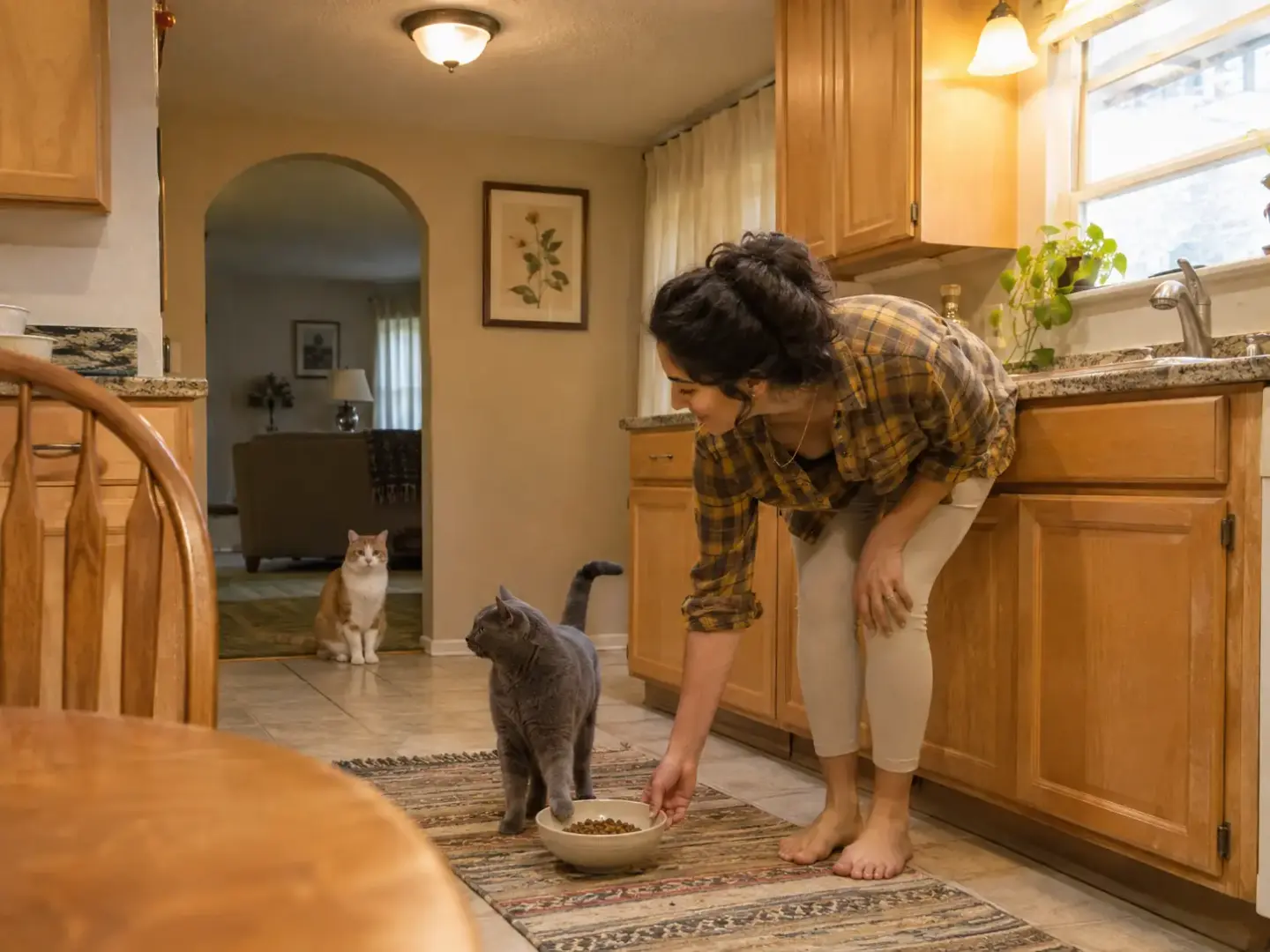
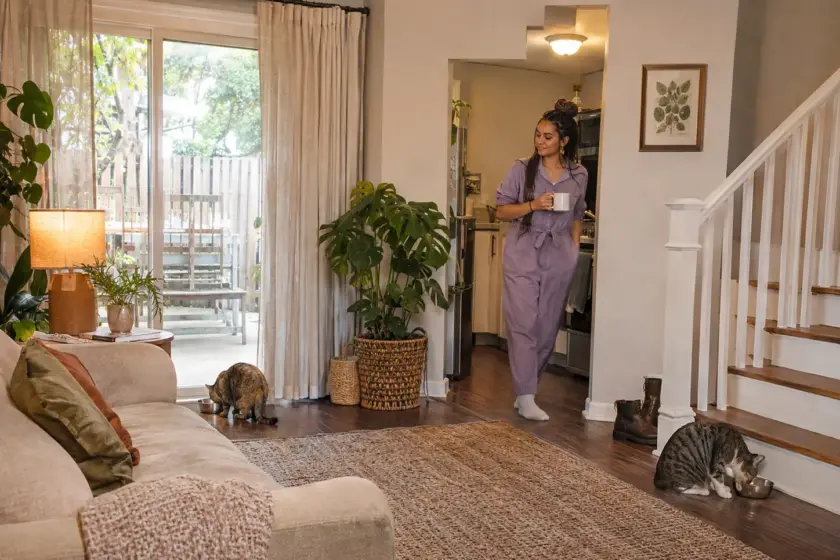
Picture the kitchen from the sofa: the bowl is full, one cat is planted over it with his eyes on the hallway, and the other sits several steps back with his paws tucked, waiting. A cat guarding a food bowl is rarely defending dinner. He is defending a spot he cannot afford to lose, and the cat sitting out is reading that situation correctly. What decides everything is whether the guard actually eats from that bowl, and this article shows how to tell holding from eating, when the first move is a call to the vet, and what to change in the room once you know.
Quick Answer
A cat guarding a food bowl is holding a spot, and holding is not eating. Count the full meals each cat finishes in one week, with the other animal in the room and without. If the guard finishes only when alone, change what he sees from the bowl and how long the meal lasts, not the bowl count.
What a Cat Guarding the Food Bowl Looks Like Before Anyone Fights
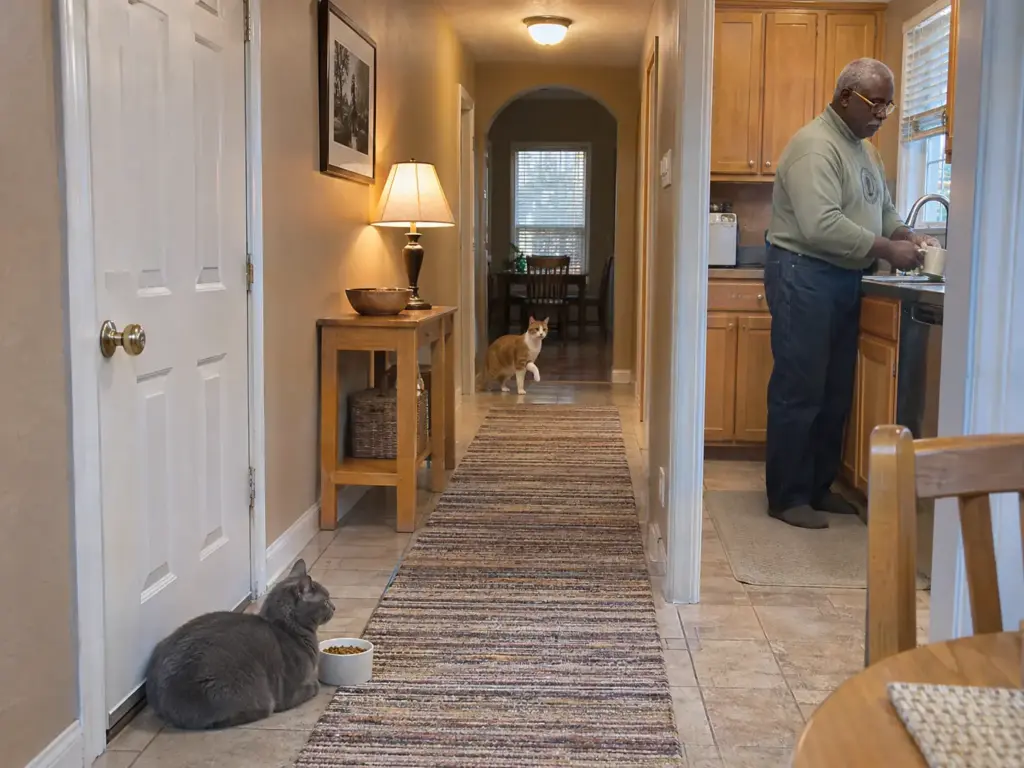
The first sign is a lookout posture, and it shows long before there is any hissing. The guard plants himself in front of the dish or beside it, stares at wherever the other cat is, or lies a few feet off with his face tight and his shoulders squared to the route that leads to the bowl. Nothing in that picture looks like a fight, so from the sofa it reads as a cat who enjoys his dinner.
Some people call it food aggression, but at this stage nobody has swiped at anybody. Where this sits among the other ways a cat claims space is laid out in how a cat claims a spot, zone by zone, including the cat that guards the bowl; here the camera stays on the bowl.
Standing over it, staring, eating with an eye on the doorway
The version people recognize as bowl guarding is the bodyguard: a cat who stands over the dish, or sits beside it, and tracks every movement across the room.
The scale varies. According to Pam Johnson-Bennett’s guide to resource guarding in cats, “the cat may just guard their own bowl or may guard all the bowls.” The first is a cat with one dish to defend. The second is a cat whose whole kitchen is a checkpoint, and that changes what a spare bowl can do (more on that shortly).
Then there is the guard who does eat, and does it at speed, head up, jaw working, eyes on the doorway. The speed is a tool. A dish that is empty in half a minute leaves nothing for the other cat to take, so this version has a clock in it as well as a location.
The same posture at the water station is described in what a bowl-guarding cat looks like when nobody is fighting, which helps if you want to compare the two. A home with a single cat has other reasons to hold a bowl, and this article stays with the two-cat standoff.
Who loses the meal while the guard holds the spot
The cat who loses is the one sitting a few steps back, and he rarely looks like he is losing. He doesn’t cry at the empty room or knock the dish around. He waits, washes a paw, and drifts off once the guard moves away. In many homes the shy cat won’t touch his own dish while the other one stands near either bowl, and the person reads the untouched food as a small appetite.
The tell is across the kitchen: the guard’s own dish is often nearly full, because he was never there to eat.
Read the two bowls at the end of the evening before you change anything. A guard’s dish that is nearly full beside a waiting cat’s dish that is untouched points at the spot. Two dishes that are both half-eaten point somewhere this article will not go, and that is the vet’s end of the conversation.
Nobody is the villain in that kitchen. One cat is defending a spot he feels he could lose, the other is reading the risk accurately, and the guard who goes in for food stealing from the second dish turns the standoff into traffic in both directions. Both are describing the same cramped feeding arrangement. The arrangement is the thing out of step.
What to Rule Out Before You Move a Single Bowl
Hold off on rearranging if any of these fit: a cat who never guarded anything and began overnight, a cat who is eating less or skipping meals, a guard who is getting thinner, or a cat who flinches or cries out when touched near the bowl. Each of those goes to a veterinarian first. Both cats.com and Cat Behavior Associates say a sudden change belongs with a vet before it belongs with a behavior plan, and that order is worth keeping.
Why a cat changes overnight is not something this article tries to answer, and it won’t guess. What it covers is the floor of the house: where the bowl sits, what the cat can see from it and how long the meal stays out.
A Cat Can Hold the Bowl and Never Eat From It
A cat beside a food dish can be doing one of three things: eating, waiting for his turn, or holding the spot. From the sofa they look identical, because all three are a cat near a bowl, and only the first puts any food in him. Telling them apart takes a pencil more than a theory.
When the bowl stays full and the cat stays put
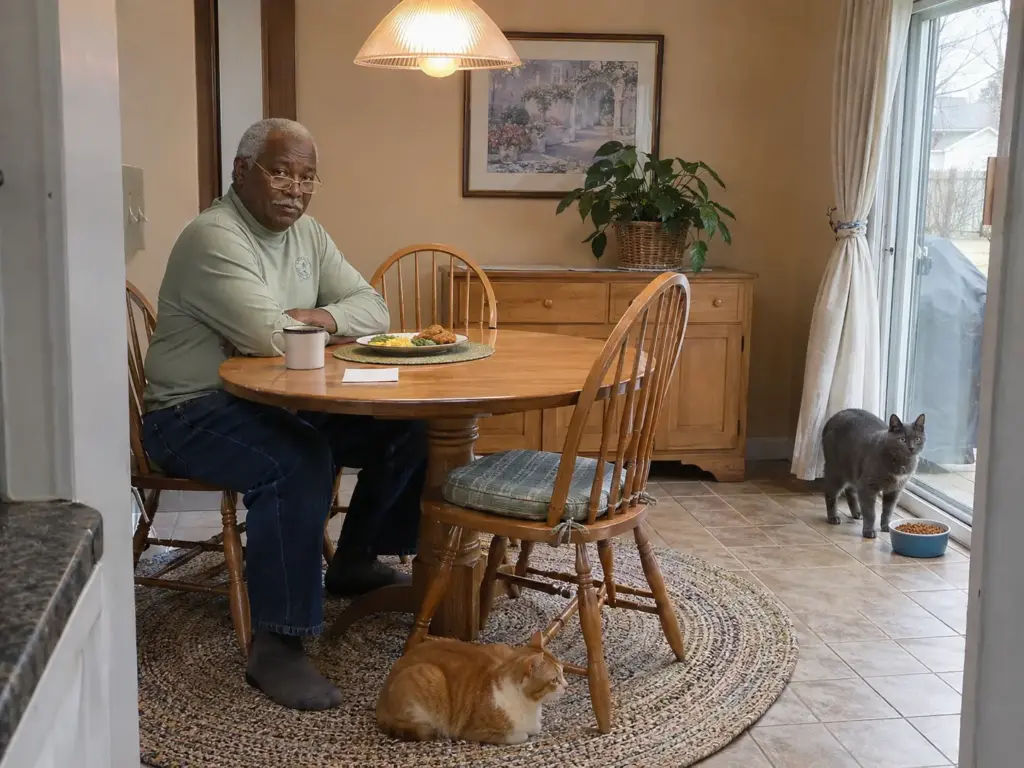
Some guards never eat from the dish they are standing over. The dish is a place he is occupying, and the occupying is the activity; the food is incidental. It is easy to miss in a home where the bowl gets topped up through the day, since a dish that is always full looks the same at breakfast and at bedtime and answers no questions. A cat who sits at a full bowl with his eyes on the doorway has told you what he is doing, if you are watching his eyes and not the kibble level.
So “he doesn’t seem hungry” and “he looks like he’s eating plenty” are both guesses. The dish cannot tell you which, and neither can the sofa. Measured portions for one week can.
The one-week count: finished meals, with the other cat in the room and without it
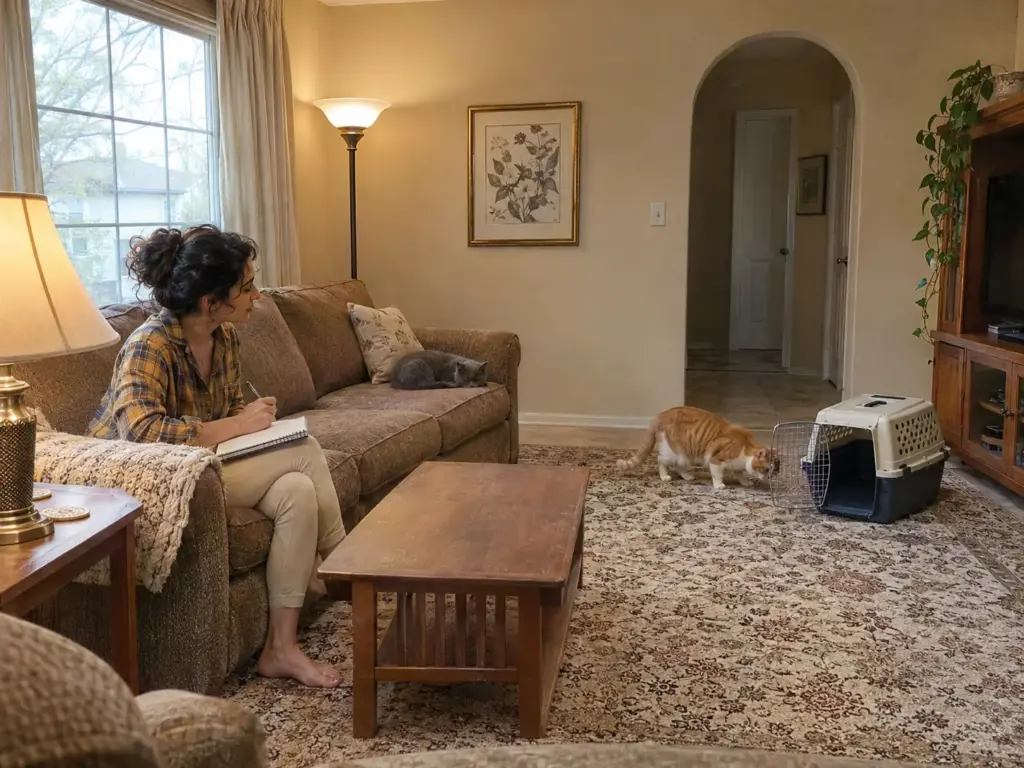
Draw two columns on a sheet of paper, one for the cat who holds the bowl and one for the cat who waits, and seven rows for the seven days. Give each cat his own measured portion at each meal and alternate the conditions: one meal with both cats in the room, the next with a closed door between them. In each cell, mark whether the meal was finished and whether the other animal was there. With three cats, each waiting cat gets his own column.
A meal counts as finished when the dish is empty and the cat did not walk away from it halfway. A visit never counts, however long it lasts. This tallies meals, not trips to a dish, and a cat can visit a bowl all afternoon and finish nothing.
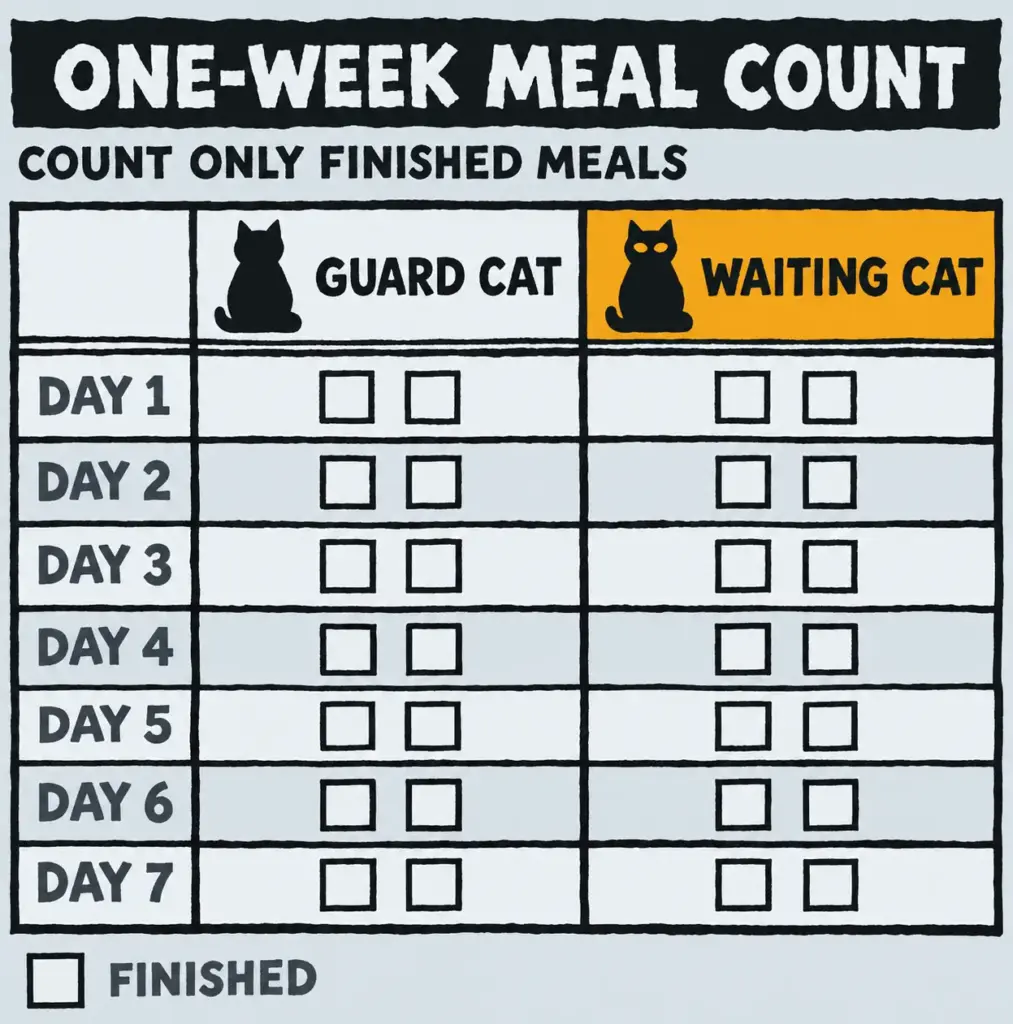
Start on an ordinary day and leave the house exactly as it is for all seven. Move a dish on day three and the sheet turns into a record of the change instead of a picture of the problem, and you lose the baseline you will compare everything against.
Reading the two columns
Look at the guard’s column first. A guard who finishes nearly everything when the other cat is behind the door and almost nothing when the other cat is in the room is protecting the spot, not skipping dinner. His appetite is fine. His situation is the problem.
Then look at the waiting cat, because that is the column the rest of the work aims at. If it runs low with the guard in the room and recovers when they are apart, the house has to change for that cat: what he can see, where he eats, how long the food stays out. If the guard’s column runs low in both conditions, or the totals for the week fall, that goes to a veterinarian, and the list near the top of this article applies. One week of meals is a small sample, so read it as a pattern and not as a verdict.
A Guard That Follows the Bowls Around the Apartment
You put a second bowl in the hallway and the guard moved with it. That is predictable once you see what he is doing. Spreading bowls across more than one spot is standard advice, and it works only while the guard has to choose between them: a cat can stand in one place at a time, which is why Pam Johnson-Bennett recommends more than one location.
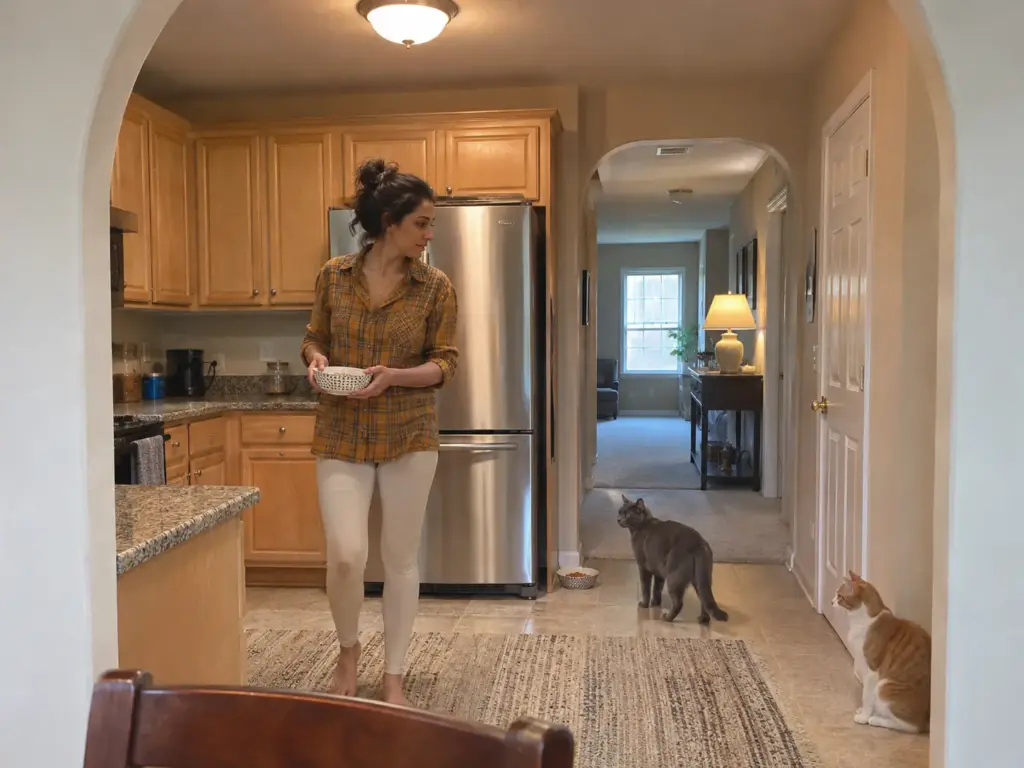
But if he can watch the second bowl from the first, he never has to choose, and each new dish becomes one more thing to hold. Two bowls next to each other are really one bowl to a cat who sees both at a glance. How to count the stations a home really has for two or three cats is its own exercise, and a guard like this is the case where adding a station is not the answer.
The other standard answer, a separate room for each cat, runs into the open door. A doorway is a window to a cat, and a guard who can walk to the other dish between bites has not left his post. A cat who eats in another room with the door open is still inside the guard’s sight, and the door is what counts. For the cats who still share one dish, whether two cats can share a bowl at all covers where that stops working.
What moves a guard like this is what he can see from each bowl and how long a meal stays out to be held. The sightline comes first.
Where the Bowl Sits: the Wall, the Doorway and What the Guard Can See
In a rental there are no walls to move, and the things that can move are a dish, the end of a shelf and a door. For this problem those are usually enough, and they are free.
The free moves: pull the bowl off the wall, face the room
A dish pushed flush against a wall puts the cat at it with his face to the plaster and the room at his back. He can’t see who is coming, so he eats at speed or doesn’t eat, and a guard in that position has every reason to stay tense. Move the dish a cat’s length out from the wall, so the cat can eat with the wall behind him and the room in front. Same dish, same kitchen, and a different view at every bite.
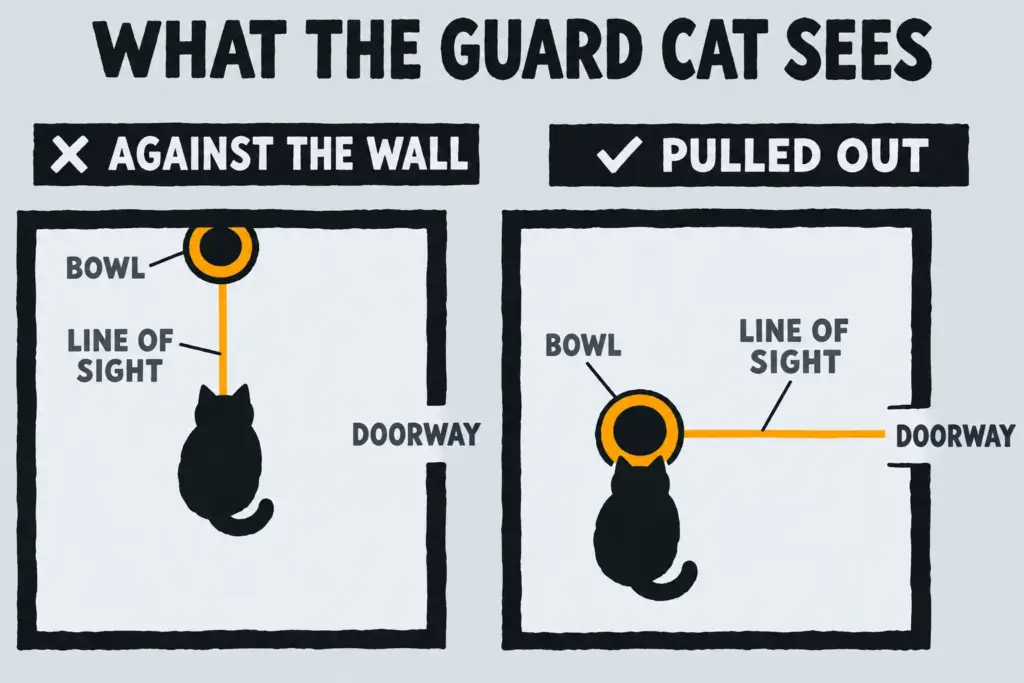
Set the waiting cat’s dish so that he can see the doorway from where he sits, without turning around. A cat who can see who is coming eats a few bites in a row. A cat who has to turn to check eats one bite and checks again.
The doorway matters here. A dish that faces the doorway beats one that faces a cabinet, because the cat who can see who is coming can afford to take his eyes off the door and eat.
A barrier the guard cannot see past
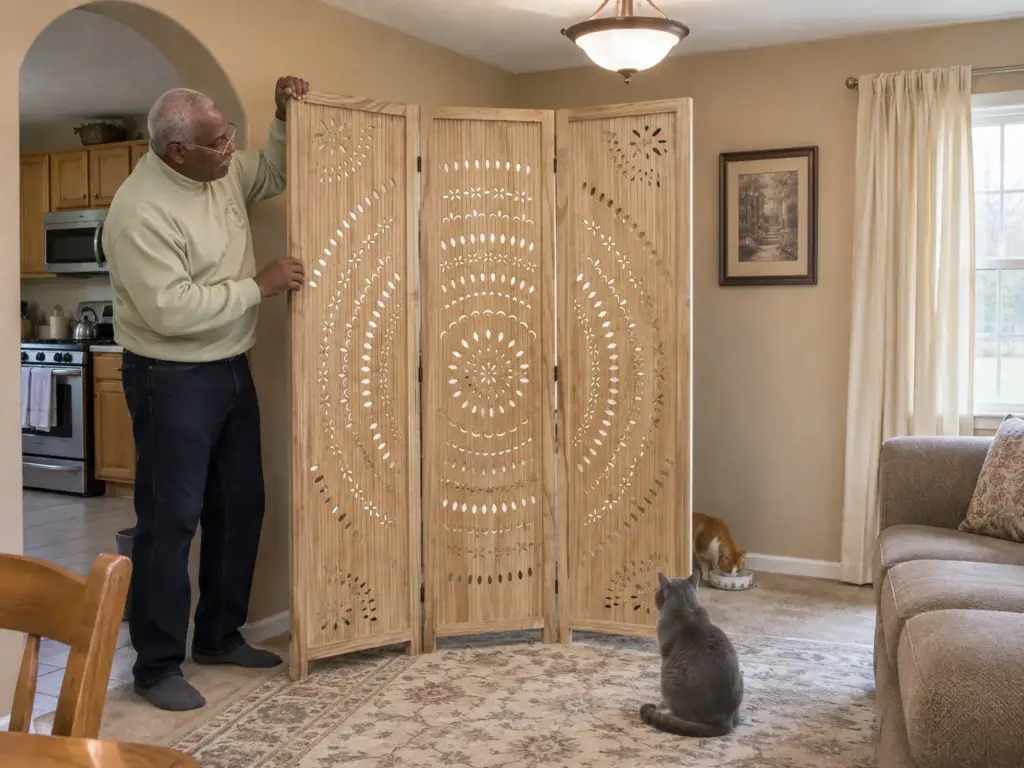
Use what the apartment has first: a closed door between the two feeding spots, the end of a bookshelf, the back of the sofa. When the layout won’t allow that, the 5.6 Ft Folding Room Divider is the portable version: three panels, 5.6 feet across, no assembly and no drilling, so it works in a rental and folds away when nobody is eating. It cuts the view only where it stands, and a guard who walks around the end sees the other dish again.
Distance is the other lever, and the one number on offer is a floor. A veterinary technician’s handout on feeding multi-cat homes, hosted by the American Association of Feline Practitioners, says: “Feeding cats at least 3 feet apart can alleviate some of the stress, however, eating in private can be better.” Three feet is a long stride in a small apartment, and larger numbers, five feet among them, get repeated without a study behind them; how far apart food and water should sit and where that rule comes from traces that rule.
The same handout adds that simply providing a barrier so the cats cannot see each other can make a difference. Sightline matters more than feet: a guard six feet from a dish he can see is still guarding it.
Elevated or not, and what a two-dish bowl does to a guard
If the idea is height, a lift is free: a way to lift a bowl with things already in the house. A raised dish suits some cats and not others, and it does nothing about a guard.
The Hepper NomNom Modern Cat Bowl is the tidy store version: a spill-proof, raised stainless steel bowl, 16 inches long, 9 inches wide and 2 inches tall, with two dishes that hold 10 ounces each. For one cat who wants wet and dry food in the same place, that layout is fine. For two cats it works against you, because two dishes 16 inches apart are one feeding station to a guard, who can stand at one end and watch the other. The limit is the shape, not the build.
With one cat, what moves is the dish. With two or more, what moves is what each cat sees from his own. A small apartment gives you less room to do that, and feeding two cats in a small apartment, floor plan by floor plan goes through the layouts one at a time.
Slowing the Meal So the Spot Is Less Worth Holding
A guard who finishes a meal in half a minute is treating the food as something to eat now or lose. A big meal in one place also rewards standing guard. Smaller, slower meals spread around the apartment give him less to hold and less reason to hold it.
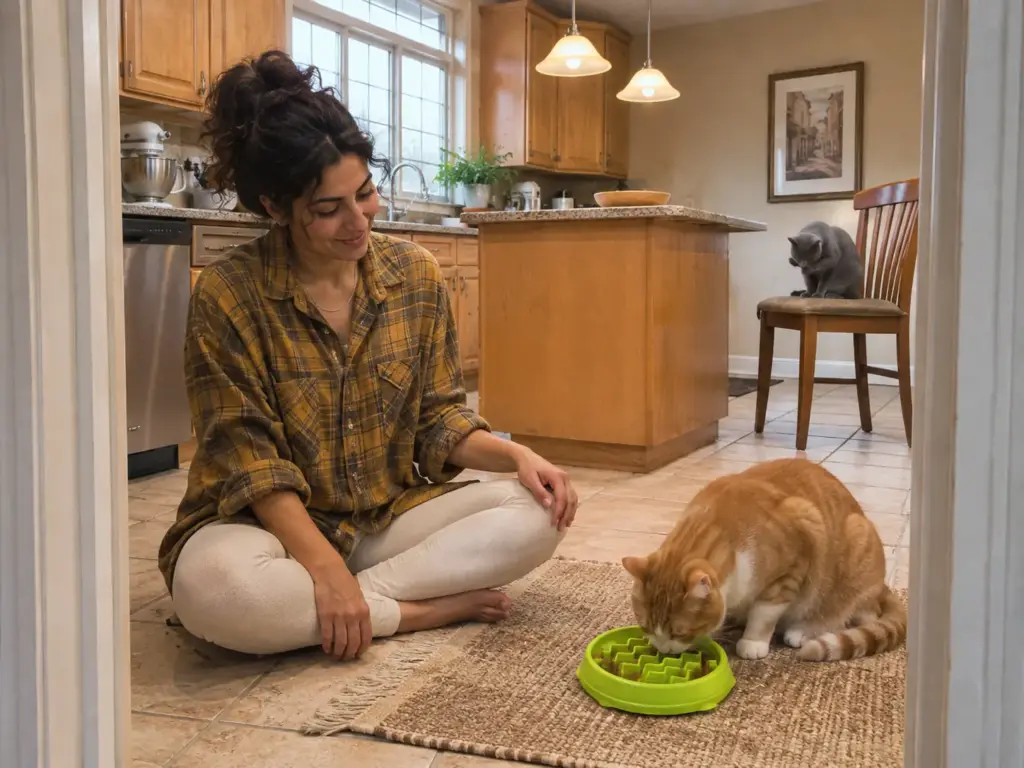
Free feeding, a dish topped up all day, hides the whole question, since a dish that is never empty never shows who is eating. Scheduled feeding in several small portions gives the meal a start and an end, and a guard has less to defend once the food is not sitting in one place all day.
Smaller, more scattered meals, for free
Cats left to themselves eat many small meals a day; cats.com puts the range at 10 to 20, with five portions in 24 hours as the minimum. You don’t need a gadget to move that way. Put a handful of dry food in several paper cups or cardboard tubes and tuck them into different rooms: behind a chair leg, on a window ledge, along the hallway. A small cup runs out quickly, and an empty cup is nothing to hold.
A slow bowl for the cat that eats fast
If the cups show that pace was the problem, a slow bowl does the same job at the dish for one fast eater.
Run the cardboard-cup version for a full week and count again on the same sheet. If the waiting cat’s column rises, pace was a large part of it and a slow bowl can finish the job. If it doesn’t move, a slow bowl won’t move it either.
The Catstages Kitty Slow Feeder Bowl in the three-quarter-cup size is 5 inches across and 1 inch deep, and it slows the cat who inhales his food. Small is the trade-off: a large cat needs two or three refills to finish a full serving, and the bowl slides on smooth floors like tile.
For a big appetite the Catstages is the wrong pick, because a bowl you refill halfway through a meal has ended the pace you were trying to set. For that cat, the IRIS USA 2-Cup Slow Feeder Bowl is 8.88 inches wide and 2.25 inches tall, holds two cups and is the more budget-friendly of the two. Amazon lists it for dogs, in a short-snouted size, so you are buying a dog’s slow-feeder bowl that cats eat from too. The plastic takes tooth marks if the cat chews it, and marked plastic is harder to scrub clean.
Spreading dry food across the apartment
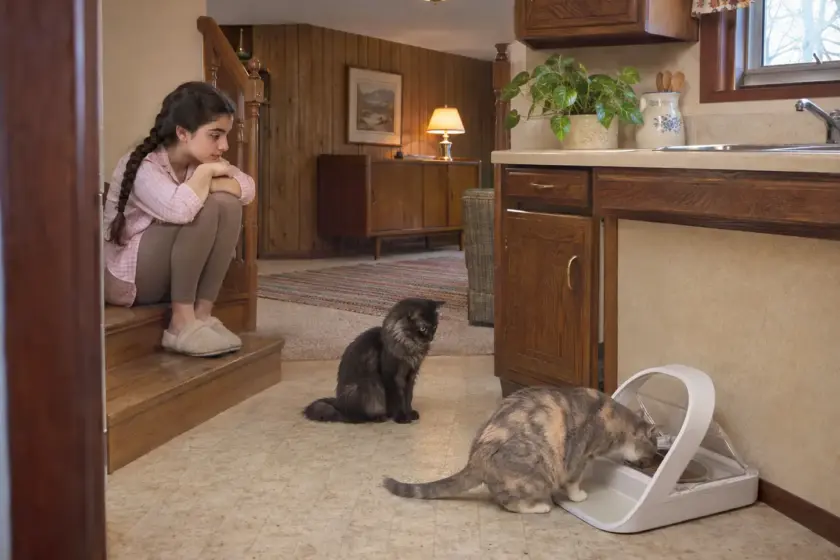
For dry food or treats, the SPOT Doc and Phoebe’s Cat Hunting Feeder is a puzzle feeder made of three mouse-shaped feeders you can set in different rooms, so the food lives in three spots instead of one dish. It is the lasting version of the paper cups. It only works with dry food or treats, so it does nothing for a cat on wet food. Timed meals from a machine are a separate family of products, and which automatic feeders suit a home with more than one cat covers them.
Running the Count a Second Time
A change to the feeding spot holds for a few weeks and then drifts, because dishes migrate back to the wall after cleaning and the door gets left open. Run the count again a week after you move anything, on the same sheet and under the same conditions, so the two weeks can be compared line by line.
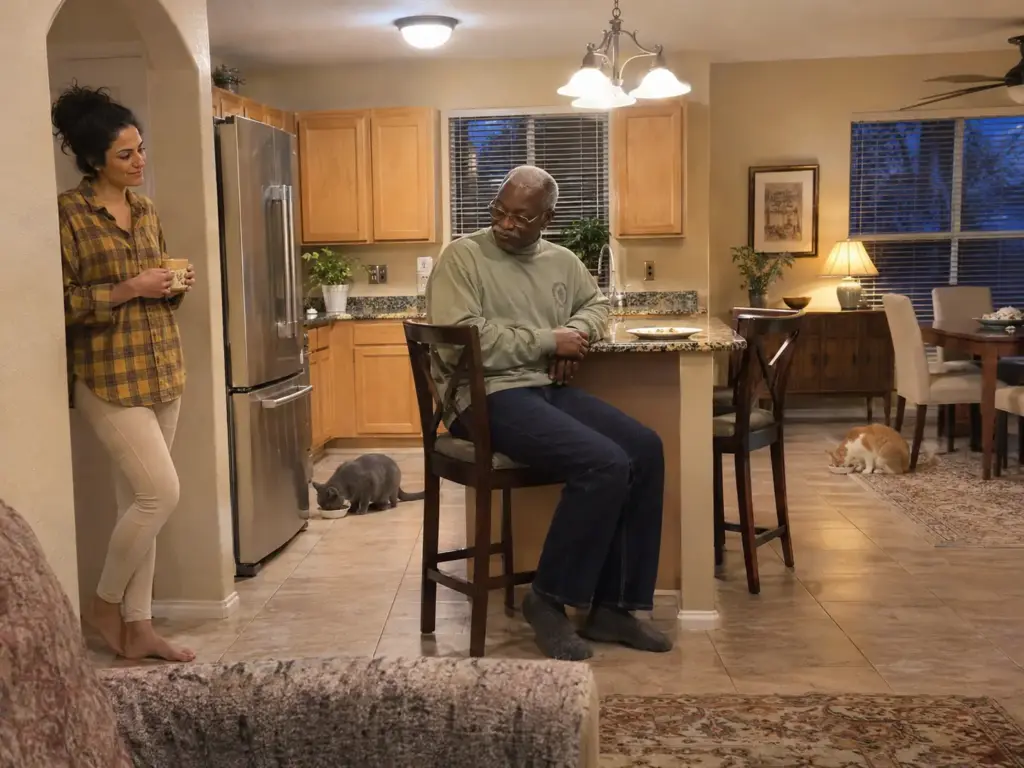
Watch the waiting cat’s column, the one that should rise. If it hasn’t, the guard is still holding the spot, and the next move is a different change: what the guard can see, or how long the meal lasts. Change one at a time and count again, because two changes at once cannot be read. If both columns stay low with the other animal out of the room, or the weekly total falls, you are back at the vet list from the start of this article.
A Full Bowl Proves Nothing Until You Have Counted a Week
A full dish does not tell you whether a cat eats, and a week of marks does. What you change first is what the guard sees from the dish and how long the meal stays out, not the number of dishes in the apartment, since a guard who follows bowls treats each new one as another post. And if the guarding began overnight, or the eating dropped, the first move is a veterinarian, before any furniture goes anywhere.
Look at the waiting cat’s column again after a week in the new spot, and give him a few more days before calling it a failure: a cat has to trust a new place before he uses it. Today, draw the two columns and mark the next meal. Next week, pull one dish a cat’s length off the wall so the cat eating from it faces the room, and count again.
Frequently Asked Questions
01How do I stop my cat from guarding its food bowl?
Start with what the house is doing: where the guard stands, what the other cat can see from his dish and how long the meal stays out. Change one of those first, then count finished meals again. If the guarding began suddenly, call the vet before moving anything.
02Is my cat guarding the bowl or just not hungry?
Count the meals each cat finishes for one week, with the other animal in the room and again with the room empty. A cat who finishes alone but not in company is holding the spot, not skipping dinner. If the total falls even when he is alone, that question goes to the vet.
03Will a second bowl stop one cat from guarding the first?
Only when the guard cannot keep both bowls in view; a guard who can see them both treats each new one as another spot to hold. Change what he sees and how long the meal lasts before adding a third.
04How far apart should two cats’ food bowls be?
A veterinary technician’s handout hosted by the AAFP says to feed cats at least 3 feet apart, and eating in private can be better. Treat that as a floor: whether the cats can see each other counts for more than the feet.
05When does a cat guarding food need a vet before anything else?
A sudden start in a cat that never guarded, eating less, skipped meals, weight loss or flinching when touched near the bowl all go to a vet first. Everything else is the room, the sightline and the clock.
Leave a comment