How Long Does Cat Shedding Last, Measured Week by Week
How long does cat shedding last? 2-4 weeks of peak in a 6-8 week season, plus a weekly brush log with a two-weeks-falling rule [for apartments + 2 cats].

Alfredo RamsesFounder · October 6, 2026 · 19 min read


On this page8 sections
- 1How Long Cat Shedding Lasts Depends on Which Stretch You Count
- 2When a Shed Outlasts Its Window, Ask the Vet Before You Blame the Sofa
- 3An Indoor Cat May Not Get a Clean Ending, Only a Slower Pace
- 4One Cat or Several, the Apartment Is Never Clear All at Once
- 5Read the End Off Your Own Brush, Week by Week
- 6What to Do With the Hair While the Weeks Run
- 7Trust the Slope on Your Own Brush, Not a Number of Weeks
- 8Frequently Asked Questions
You vacuumed the sofa this morning, ran a palm across the cushion tonight, and there is already a fresh gray film on the spot where the cat sleeps, so you go looking for a number of weeks and come back with two that do not match. Your cat is doing the sensible thing with a coat that runs on thousands of separate clocks: each hair lets go when its own cycle is done, so an apartment never comes clean on one particular day.
So, how long does cat shedding last? The answer below is checked against the American Animal Hospital Association and against the two figures pet brands put out, which never get squared with each other. You will get both numbers and why both hold, the changes that make this a question for your vet, what an apartment does to the ending, one cat versus several, how to read the end off your own brush, and what to do with the hair while the weeks run.
Quick Answer
The heaviest stretch of a shed usually runs two to four weeks and the full season about six to eight, so both numbers can describe one cat. An indoor cat may only slow to a baseline, with no clean end. A weekly brush log shows where yours is; bald patches or irritated skin go to the vet.
How Long Cat Shedding Lasts Depends on Which Stretch You Count
Anyone who has lived through a spring with a long-haired cat tends to believe whichever number matches the state of their couch. Both numbers are measuring something real. They are just not measuring the same thing, and once you see which stretch each one counts, the week count stops looking like a coin toss.
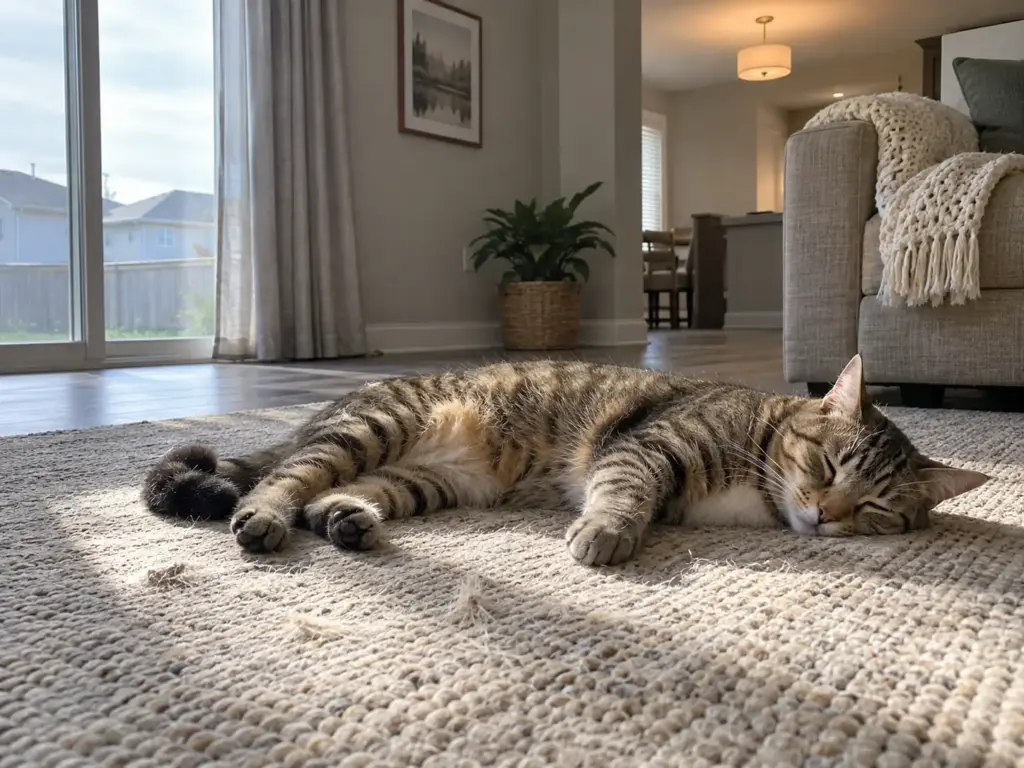
The heavy stretch and the full season are different measurements
Cat’s Love, a cat-care brand, puts the shedding season at six to eight weeks on average. Charm, a pet-food maker, says the heaviest stretch lasts two to four. Read side by side they look like a disagreement. They are really two rulers laid on the same coat: one counts only the weeks when the haul peaks, the stretch owners call blowing coat (a coat blow, in the forums), when the winter coat lets go and a thick undercoat comes out in clumps, and the other counts the whole climb up and the slow slide back down.
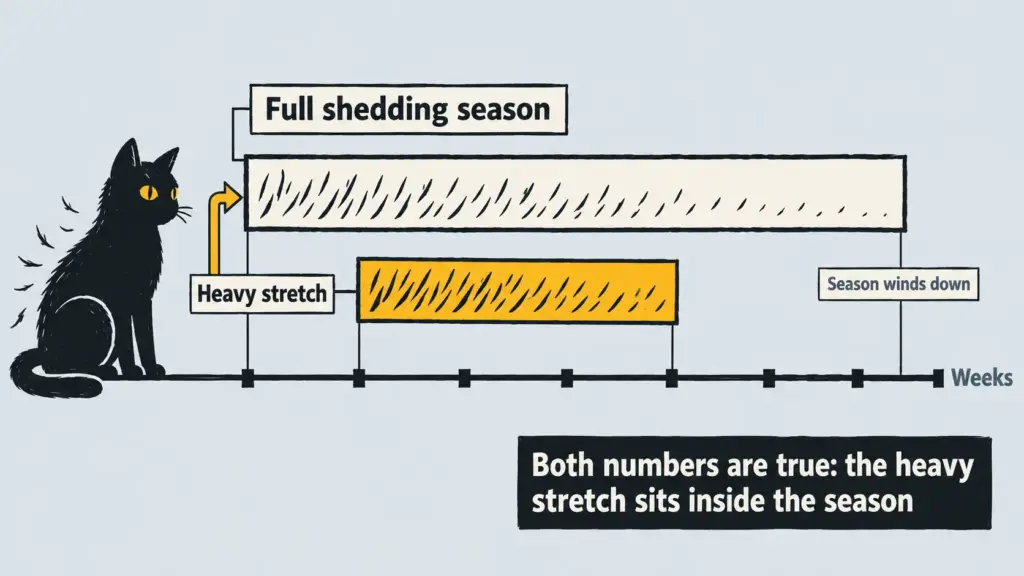
Put the short bar inside the long one and the two figures stop arguing. A cat can spend a few weeks filling the brush every evening inside a season that started quietly before that and keeps trailing off after it. Ask him when it started and he would point to the first warm light on the windowsill, long before you noticed anything on the sofa.
The six-to-eight figure is the one most owners hold on to, and for a short-haired cat it is often the wrong one to wait for. Hill’s notes that seasonal shedding mostly affects cats with longer hair or thicker coats. A cat with a double coat, a dense undercoat under the longer guard hair, has far more to drop than a sleek, short-coated one, which may give you a bump instead of a storm, so look at the coat in front of you before you start counting weeks.
Why hairs finish on separate clocks
According to the American Animal Hospital Association’s explanation of the hair-growth cycle, “Shedding is a normal part of your pet’s hair-growth cycle.” In that hair growth cycle, each hair goes through active growth (anagen), a transition (catagen) and a resting phase (telogen), and some dermatologists name the moment it actually falls as a fourth phase, exogen.
Seen from the sofa, a coat is not one switch that flips in April. It is thousands of hairs sitting at different points of that cycle at any given moment, so the first ones to reach the end drop onto the rug while others are still weeks from it. That is why a season is measured in weeks and never in days: the last hairs to finish their rest come loose long after the first ones were vacuumed up.
Hill’s adds that each phase runs longer or shorter depending on the time of year, the cat’s health and his breed. The same coat can therefore run a different schedule from one year to the next, and two cats on the same couch can finish weeks apart without either of them doing anything unusual.
So there is no morning when the shed simply stops. There is a slope, and the slope is what you learn to read.
Where the numbers come from, and how far to trust them
Both figures come from pet-brand websites, not from a study that followed a group of cats with a brush and a scale. Neither says which coats or which homes it was based on. No vet association publishes a week count per breed or per coat length either, so none appears here; a figure like that would be invented, and you would be measuring your cat against fiction.
Use two to four and six to eight as a range to orient by, nothing more. And keep in mind which of the two you are quoting when you tell yourself it should be over by now.
Hill’s is blunt on the other half of the question: shedding is natural, and there is nothing you can do to stop it. A brush changes where the loose hair ends up. It does not move the end date of the season by a single day.
The number worth having belongs to your own cat, and building a baseline for your own cat is where it starts. A few ordinary weeks on record give you something to hold the heavy ones against, which is more than any figure from a brand can do.
When a Shed Outlasts Its Window, Ask the Vet Before You Blame the Sofa
Almost everything about shedding can be handled with weeks, brushes and upholstery. A few changes take it out of that frame. Hill’s draws the line plainly: shedding that does not look tied to the season, paired with bald patches, heavy scratching or behavior that is not normal for the cat, means making an appointment. Take any of these to your vet:
- A heavy shed that is not easing well past its usual weeks
- Bald, thin or patchy areas in the coat
- Skin irritation: red, crusty or scabbed patches
- A coat that turns greasy, or flakes like dandruff
- A cat who stops grooming, or grooms one spot without letting up
- Any change in appetite, energy or litter box habits

An ordinary shed looks like hair coming loose evenly across the whole coat, intact skin underneath, and a haul that shrinks as the weeks pass. Why one cat’s shed is dragging on, what to give him and how much hair counts as too much all belong to the person who can examine him, and when shedding becomes a problem gets its own article on this site. What the calendar can explain stays here, and that part gets counted on the brush.
An Indoor Cat May Not Get a Clean Ending, Only a Slower Pace
On r/CatAdvice, the owner of a medium-haired indoor cat described brushing two or three times a week with a deshedder and a regular brush on top, and still: “it never stops.” The reply that helped was not a product. It was a question about whether the cat had always shed like that, because if he had, what the owner was fighting was probably the cat’s normal amount and not a season at all.

What the lamps and the thermostat do to the calendar
An outdoor cat reads the year off the sky, and the signal has a name, photoperiod: the length of the day. A short science feature from Indiana University’s public radio, A Moment of Science, puts daylight hours first: research points to the amount of sunlight outside as the main factor in when a cat sheds. Indoor cats get less natural light and more artificial light, so they lose track of the seasons and shed fairly steadily through the year. That steady trickle is what owners mean by year-round shedding.
Hill’s adds the other half, that artificial light and a temperature-controlled home can change both when and how much a cat sheds.
Your cat’s coat is answering the apartment you gave him: lamps on well after sunset, the same temperature in February and in August, and hardly a clue about which month it is. On that point he is right and the wall calendar is wrong. How the mechanism works in detail is a subject of its own (why indoor cats shed year round), and for the question of duration it only matters that the calendar you are watching is not the one his coat reads.
What a taper looks like when there is no end
A taper is the amount you collect dropping week after week and then settling at a low number that never reaches zero. That settled number is his baseline, the amount of hair a healthy indoor cat lets go of in an ordinary week. It is our working definition and not a clinical term, but it is the only finish line an apartment cat reliably gives you.
Waiting for spring to be over is the usual advice, and for a cat who never leaves a lamp-lit apartment it has you waiting for a day that is not coming. Ask a different question: has the haul stopped falling? If it has, and it settled low, the shed you were waiting out is finished, even if the couch still collects a little hair every day. Owners who describe themselves as barely keeping up are usually still on the steep part of the slope or living with a baseline they have not measured yet.
- A shed with an end climbs, peaks and drops to a small haul within weeks.
- A taper without an end falls slowly and levels off above zero.
- Both are ordinary when the skin and the cat’s habits look the same as before.
Write down the date the heavy week started, once, at the top of whatever you keep the log in. Without a starting line, a taper that has run five weeks feels like it has run three months, and the date is what tells you whether you are looking at a long shed or a slow one.
The season you can still see, and where to read about it
Indoors does not erase the seasons completely. A cat who spends long afternoons on a sunny window perch sees more real daylight than one who naps in an inner hallway, and an indoor cat can still show a small rise in spring, as the lighter summer coat comes in, and another in fall. If you want the month-by-month picture, the summer article covers when the spring and fall bumps still show up indoors. For counting weeks, a small bump on top of a steady trickle is enough to know.
One Cat or Several, the Apartment Is Never Clear All at Once
One owner of two cats, writing on a community forum, described the split that every multi-cat apartment knows: one cat “could fill a pillow,” the other barely sheds. The couch where they both sleep had become “completely unusable,” the bedroom door stayed shut, and hair survived the washing machine even with two extra rinse cycles. With a second cat, the duration question has a different answer.

Staggered sheds keep the hair coming
Hill’s notes that how long each phase of the hair cycle lasts depends on breed and genetics. Two cats on one couch can run on different schedules, and nobody can tell you by how many weeks, because no source measures it. What you can see is the effect: one cat is tapering while the other is just getting going, and the hair on the floor never drops the way you expected.
So the shed has not refused to end. Two sheds are overlapping, and the one you are cleaning up after may not be the one you are watching. With several cats, the finish line is each cat returning to his own baseline, one at a time, and the apartment reaches its lowest point only when the last of them gets there.
Tell which cat is carrying the load
The cat whose hair you notice most is not always the one shedding most. Owners on r/CatAdvice describe short hair as shotgun pellets that scatter into fabric and are harder to collect, while long hair clumps together and lifts off in one piece. Short hair spreads thin and hides; long hair piles up where you can see it. One owner of four cats, three of them long-haired, found the short-haired one was the heaviest shedder of the lot, the kind of cat another owner called “secretly a hair factory.”
The two cats behind this site make the same point without any story attached. A very large, long-haired Maine Coon and a compact British Shorthair with a short, dense coat do not fit the same brush or the same number of minutes, and their piles mean different things. Keep each cat’s haul separate, and the log tells you which one is still in his heavy stretch.
Brush each cat on a different day of the week. Two piles on the same towel on the same evening merge into one number, and then you cannot tell whether the household is tapering or one cat is tapering while the other keeps climbing.
Read the End Off Your Own Brush, Week by Week
Owners in r/CatAdvice say it outright: they do not know whether their cat’s shedding is normal or excessive. One first-time owner only found out the cat shed “a lot” because the groomer said so. A weekly log answers that question against the only cat that matters. It is our own method, not a veterinary standard, and it needs nothing you do not already own.
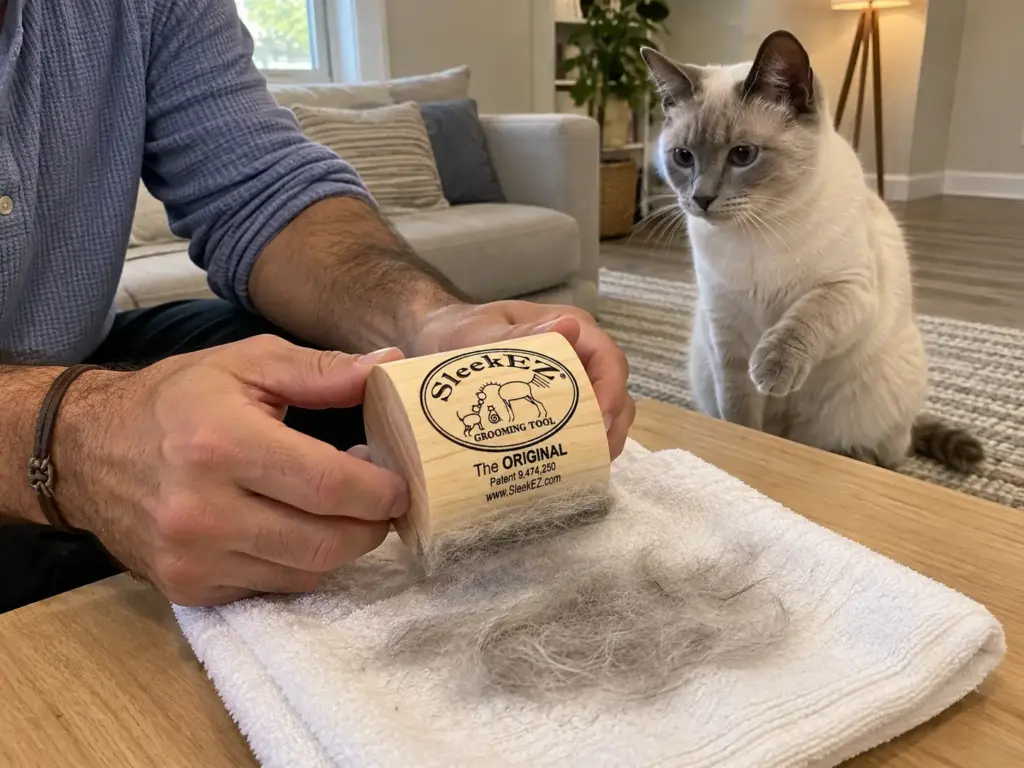
Same brush, same minutes, same spot
Once a week, brush the cat with the same tool, for the same number of minutes, on the same surface, at roughly the same time of day. Lay a light towel underneath, collect what comes off, and record it. A photo works, and so does a quick weigh on a kitchen scale if you have one that reads small amounts. Without the same conditions, the comparison falls apart: five minutes against ten is not a trend, it is two different experiments.
The brush you already have is fine for this; a fixed tool only makes one week easier to compare with the next.
If you want one dedicated to the log, the SleekEZ Cat Brush for Shedding is a fixed deshedding tool about 5.5 by 3 inches, small enough to live folded inside the log towel, and using the same one every week keeps the piles comparable. A low-star review complains that the plastic tabs at its sides can sit higher than the teeth, so on some cats the blade may not reach all the way down to the skin. That complaint is from one reviewer, so test it on your own cat for a week before you trust its numbers.
Photograph the pile on the same towel, under the same lamp, from the same height, with a coin beside it for scale. Weeks of photos taken like that line up in your camera roll as a strip you can read in five seconds, and no one has to remember what last Sunday looked like.
What counts as an ending: two weeks of falling hauls
The rule this log runs on: the heavy stretch is over when the haul falls two weeks in a row under the same conditions. One smaller pile can be chance. Two smaller piles in a row, with the same brush and the same minutes, are a slope. If the haul keeps falling slowly and then settles without reaching zero, you have found the baseline from the indoor section, and that is also an ending.
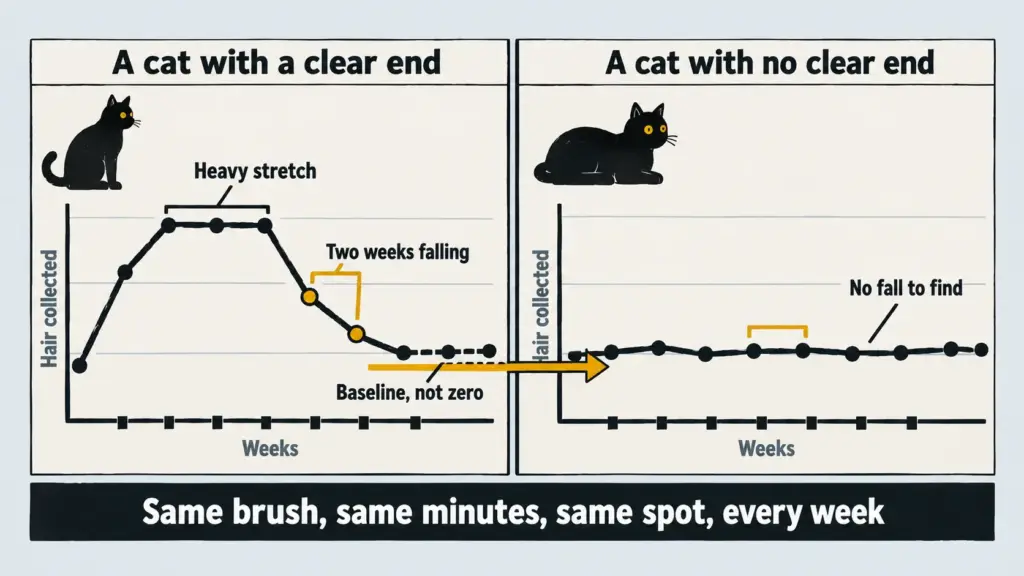
But a weak week does not count. If the cat walked off after two minutes, the brush measured his patience, not his coat, so mark that week and leave it out of the comparison. The kitchen scale sounds like the precise option, and for a long-haired cat it is; for a short-haired one, whose haul can weigh almost nothing, the photo on the towel tells you more than a scale that barely moves.
When the log goes flat instead of falling
A flat line at a low level is a baseline, and you can stop waiting. A flat line at a high level, or one that climbs again well past the weeks his heavy stretch usually takes, goes back to the list in the vet section, and nothing more is needed from the log than showing the vet those weeks.
The log has a blind spot worth knowing. One owner on r/CatAdvice put it this way: brushing “feels like it loosens a bunch more that they’re going to just lick up or roll onto furniture.” The pile on the towel is the hair that came out with the brush, not every hair the cat lost that week. Because the blind spot is the same every week, the trend still holds, even if the total does not.
What to Do With the Hair While the Weeks Run
One owner on r/CatAdvice described the routine exactly: vacuum the living room, empty the canister, turn around, and “there’s already a fresh layer forming on the couch.” They put it as “barely keeping up rather than getting ahead of it.” In a small apartment the weeks a shed takes are long enough to plan around. The aim is to decide where the hair lands.
Free first, the door, the throw and the wash
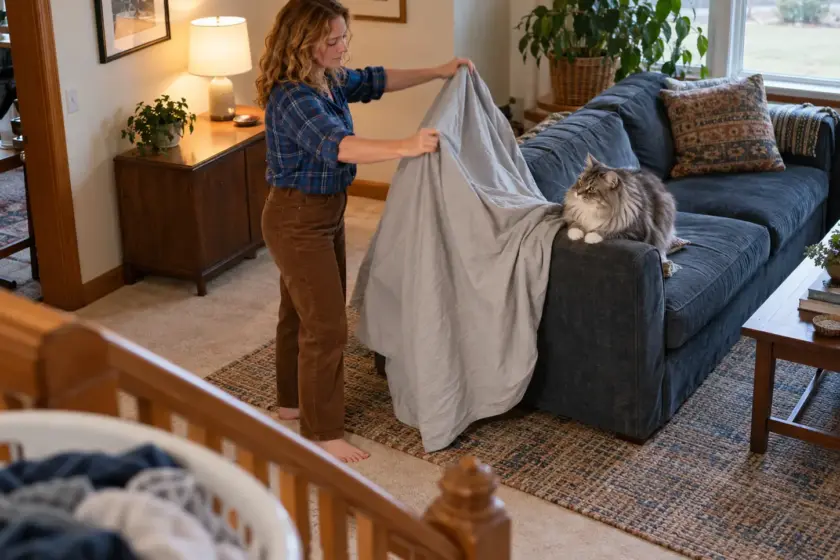
The forum owner with two cats kept the bedroom door shut, and that one move kept hair off the bed and out of the washing machine. A washable throw on the spot where the cat really lies (not the spot you would like him to lie on) catches most of what would otherwise work into the sofa fabric. Hill’s suggests washing pet bedding about once a week, vacuuming furniture and rugs at least weekly, or covering the sofa with machine-washable slipcovers or throws, and keeping two sets of throws means one is always on the couch while the other is in the wash.
- Keep the bedroom door closed for the heavy weeks.
- Put a washable throw on the cat’s real lying spot.
- Wash throws and bedding once a week, with a second set in rotation.
- Run a damp rubber glove over the sofa before reaching for the vacuum.
Wash the throw on the same day you brush for the log. One weekly date covers both jobs, and the clean throw goes back on a cat who has just had his loosest hair taken off, so it stays cleaner longer.
Brush before the sofa gets it
The common reaction to a heavy shed is to brush harder and more often to get it over with. Brushing does not shorten the season, as Hill’s says plainly, so the better plan is to brush at a pace the cat accepts and treat each session as hair that went into a brush instead of into the cushion. One r/CatAdvice owner built it into the morning: breakfast and brushing on one rug, every day, until the cat started sitting on that rug by himself the moment he heard the spoon hit the bowl.
Start with a damp rubber glove you already own, run over the cat in the direction the coat lies; it does the job of a rubber curry brush on a short coat. If you want something that does more for a short coat, the Cat Brush with Soft Rubber Pins is about 8 by 4.5 inches, washes clean under the faucet, and one r/CatAdvice commenter said a rubber tool pulls out loose undercoat a normal brush misses. It shares the limit of every brush: it frees hair without catching all of it, so some lands on the bed and the sofa anyway (the same blind spot the log shows).
Pick up what lands
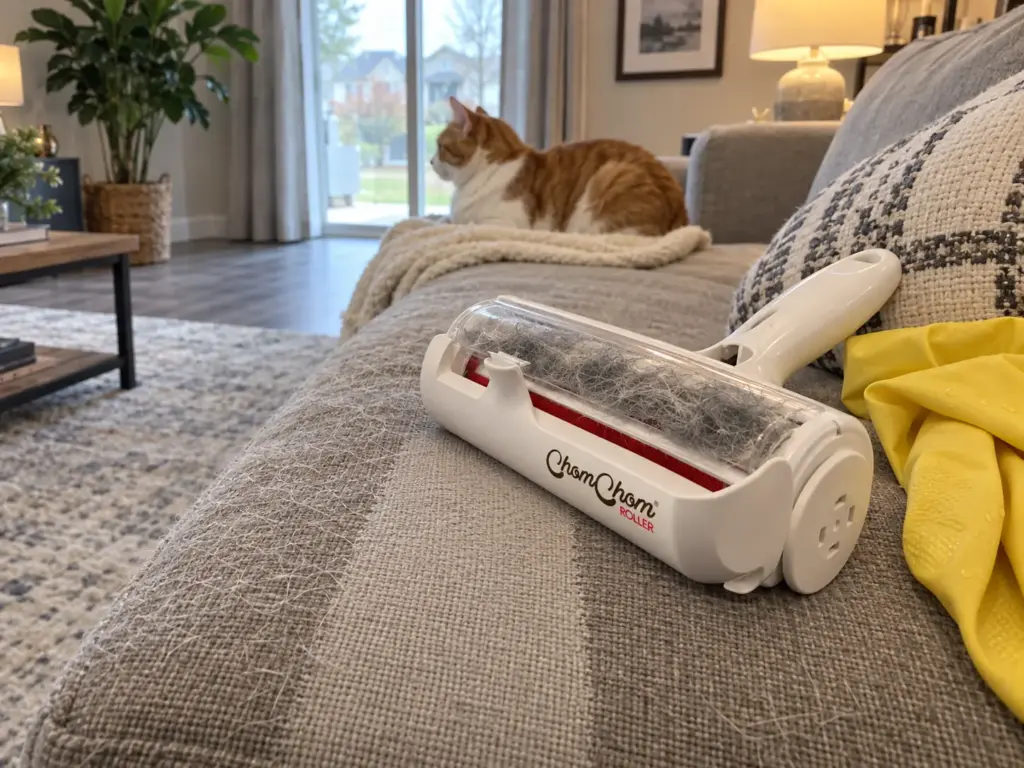
For hair already on the couch, one r/CatAdvice commenter found a damp rubber glove or a rubber squeegee dragged across the cushions worked better than the vacuum.
For the sofa arm and bedding, the ChomChom Roller Pet Hair Remover is reusable, with no adhesive sheets to keep buying, which suits a shed that lasts weeks. Review summaries point to its limits: the hair chamber is small and fills fast, and each pass covers only about eight inches, so doing an entire sofa with it is slow work. Use it on the arm and the cushion he favors, and leave the rest to the glove.
A metal comb and a pet hair vacuum both have a place in a household that sheds heavily, and the article on how to reduce cat shedding goes into tools in more depth than counting weeks needs.
Trust the Slope on Your Own Brush, Not a Number of Weeks
Two to four weeks is the heavy stretch and six to eight the whole season, and both are rough figures from pet brands; the one that fits is your own cat’s. An apartment cat may never give you a clean end, only a pace that slows to his baseline, and with two or more cats those slopes overlap, so the apartment clears last. A shed that runs well past its weeks, or comes with thin patches, irritated skin or a change in habits, is for the vet, and everything else gets counted on the brush.
Three weeks after your first entry, lay the photos side by side and see whether the piles are getting smaller, holding level, or growing, and let that decide your next step. Tonight, before anything else, shut the bedroom door and put a washable throw on the spot where your cat actually sleeps, then notice how much less hair is on your pillowcase by the next wash.
Frequently Asked Questions
01What month do cats shed the most?
Cats that see real daylight usually shed hardest in spring and fall, while an apartment’s lamps and steady temperature flatten both peaks into a gentler curve. The months that stand out for your own cat show up on a weekly log faster than on any wall calendar.
02Do cats eventually stop shedding?
A healthy cat never stops shedding completely, because each hair runs its own growth cycle, so a heavy stretch slows down to the cat’s baseline instead of ending. A weekly log shows whether the haul is falling or flat, and a flat or rising one past its usual weeks is a question for your vet.
03What triggers a cat to start shedding?
Daylight is the main trigger: the hours of sunlight outside tell a cat’s coat when to let go, and changes in temperature add to it. Indoor cats under lamps and steady heating lose track of the seasons and shed more evenly all year, a mechanism this site explains in its own article.
04How much is too much shedding for a cat?
No count of hairs per week can answer that for your cat, so compare this week’s haul with his own baseline instead of a number. Bald or thinning patches, irritated skin, a cat who stops grooming or overgrooms, or changes in appetite or energy all go to your vet.
05How long does cat shedding last if my cat lives indoors?
An indoor cat may never reach a clean end, only a slow taper toward the amount of hair he loses in an ordinary week. Count the heavy stretch as over once your weekly haul falls two weeks in a row with the same brush, the same minutes and the same spot.



Leave a comment