Do Cats Shed More in Summer? Yes, but the Hair Moves
Do cats shed more in summer? Spring shed to fall bump (AAHA, VCA) + where hair lands near fans, vents & the coolest floor, with a monthly brush log.

Alfredo RamsesFounder · October 6, 2026 · 18 min read

On this page8 sections
- 1A Little More, and the Big Shed Isn't in July
- 2When the Calendar Stops Explaining It, Call the Vet
- 3What Summer Does to the Apartment, and Where the Hair Lands Now
- 4One Cat or Several: Each One Picks a Different Cool Spot
- 5Coat Type Decides How Often You Brush in the Heavy Weeks
- 6The Summer Cut and Other Fixes That Move the Problem
- 7Follow the Cool Spot, Brush by Coat, Write Down the Month
- 8Frequently Asked Questions
It is July, you run a hand along the sofa cushion, and your palm comes away grayer than it did in May, so you start to wonder whether it is the heat, the cat or the apartment. Your cat is doing exactly what his coat was always going to do: the long spring shed began weeks ago, and summer is where it finally shows, and where the hair starts landing in places it never landed before.
So, do cats shed more in summer? A little, and the calendar below is checked against what the American Animal Hospital Association, VCA Animal Hospitals and International Cat Care publish, not against a hunch about the weather. What follows is the real timing, the changes that belong to a vet, what a hot apartment does to loose hair, how two cats split it, and the brushing pace each coat needs in the heavy weeks.
Quick Answer
A little more, yes, but the heavy shed starts in spring and trails into early summer, with a smaller bump in fall. An indoor cat in a steady-temperature apartment sheds on a flatter, softer curve. What summer really changes is where the hair lands. Bald patches or red, crusty skin are a question for your vet.
A Little More, and the Big Shed Isn’t in July
The hair on the sofa in July feels like proof that this year is worse. It is mostly proof of timing. Three claims about the season look like they contradict each other, and once you lay them on a calendar they describe the same coat.
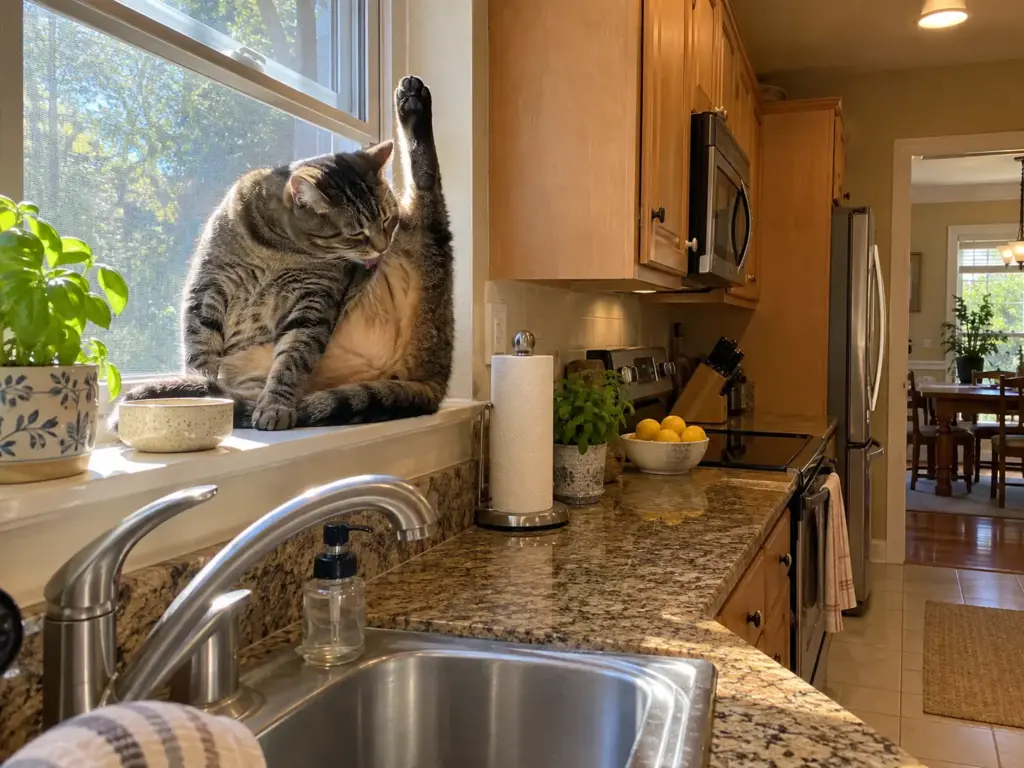
What the calendar says: spring into early summer, and a smaller bump in fall
Catster says cats shed more in summer. The Spruce Pets, in a piece reviewed by a veterinarian, puts the two heavy seasons in spring and fall. PawBasic, a grooming service firmly on the summer side, settles the argument in its own wording: in spring and early summer, it writes, cats are still losing their winter coat. VCA Animal Hospitals names the two heavy sheds as late spring and late fall.
Put together, the hair you are finding in July is the tail of one long seasonal shed that started as the daylight hours stretched out, with the lighter summer coat coming in underneath, and the second, smaller rise arrives in fall as the winter coat grows back in.
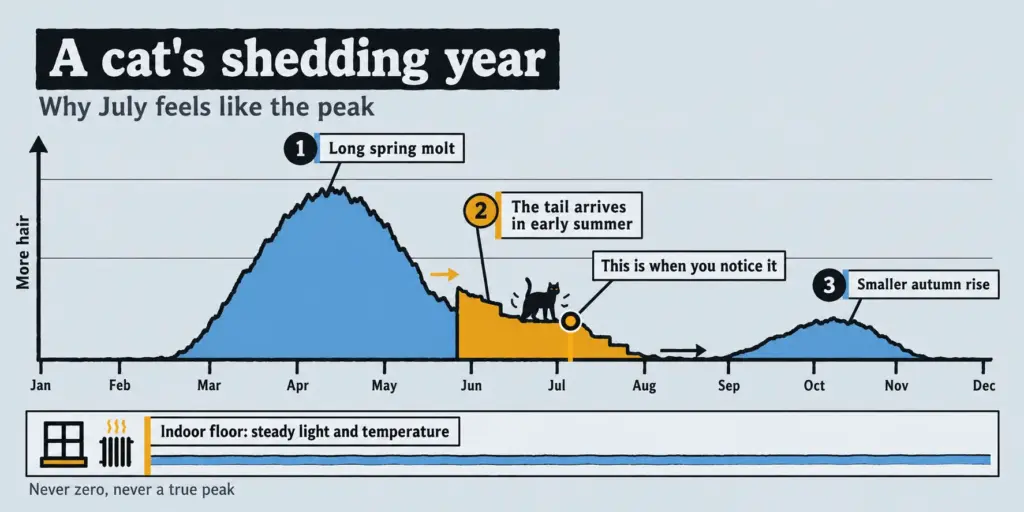
So why does July feel like the peak? Because hair that has been coming loose since April adds up. Summer is also when you sit on the couch in shorts, when the windows are open and the fan is on, and when every loose tuft gets pushed out of the corner where it used to sit quietly. The cat sheds a bit; the apartment shows it a lot.
That changes when to start paying attention. Bracing for August is a month or two late for a cat who sees real daylight: the heavy brushing weeks begin as the days lengthen in spring, when seasonal shedding picks up and owners talk about blowing coat, and by midsummer you are mostly cleaning up after a shedding season that already crested. Start the extra brushing when the evenings get long, not when the thermometer climbs.
Why an apartment with steady light and air conditioning blurs the seasons
An outdoor cat reads the year from the sun and the temperature. An indoor cat lives with lamps on well past sunset, air conditioning holding the living room at the same number in July that the heater held in January, and very little that tells his coat which month it is. According to the American Animal Hospital Association, “Indoor pets may shed more consistently year-round due to artificial lighting and stable temperatures, while outdoor pets often show more dramatic seasonal changes.”
VCA says something close from the other direction: cats that share our homes shed undercoat and guard hair at low levels all year. One owner on r/CatAdvice, writing about a street-rescue cat in Santa Monica, described exactly that flat line, with the same amount of hair in winter as in summer. That cat is not broken. He lives in a place with no real seasons inside the walls.
Where your cat sits during the day moves him along that scale (a cat who spends long afternoons on a sunny window perch sees more of the real daylight than one who naps in an inner hallway, so expect his curve to land somewhere between the outdoor cat’s and the hallway cat’s). The full mechanism of why indoor cats shed year round is a question of its own. For the summer question, it is enough to know that the steadier your apartment, the softer the spring bump, and the less July will look different from March.
Check the calendar against your own cat, month by month
No calendar knows your cat. The way to find his baseline and his curve is the weekly brush test: once a week, the same day, the same brush, the same patch of coat, a light towel underneath, and a one-line note of how much came off. Write the month next to every entry.
After a few months the log stops being a list of Sundays and starts showing a shape. A cat with a real spring shed shows a rise through the spring months and a slow slide after it. A cat who lives in a steady, lamp-lit apartment shows a nearly flat line with a small wobble.
Neither is a problem, and neither needs a number from a chart to be read: you are comparing your cat with himself. The same log will also tell you how long a heavy stretch lasts for him, which varies enough from cat to cat that it is better measured than guessed.
Pin the brush test to one fixed weekday and write the month beside each note. A log kept on whatever day you remember ends up recording your mood about the sofa, while a log kept on the same day records the season.
When the Calendar Stops Explaining It, Call the Vet
Everything above assumes the coat is coming out evenly and the skin under it looks the way it did in March. AAHA puts the threshold plainly: “If your pet’s shedding looks different than usual, it’s always worth getting it checked out by your local AAHA-accredited veterinarian.” These are the changes that take the question out of the calendar and hand it to your vet:
- Bald or thin patches, or skin you can see through the coat
- Red, crusty or scabbed skin, or any sign of skin irritation
- A coat that turns greasy or flaky
- Shedding that jumps suddenly, or arrives well outside the cat’s usual months
- A cat who stops grooming himself, or overgrooms one spot without letting up

Hair coming loose evenly over the whole coat, with intact skin underneath, is what an ordinary shed looks like. This article does not try to explain why a particular cat is losing hair, what to give him, which shampoo to use, or how much hair counts as too much: each of those belongs to the person who can examine him. When shedding turns into a problem is a bigger question than a list can hold. For a cat whose skin and habits look the same as they did in spring, the calendar covers the rest, and the rest is the apartment.
What Summer Does to the Apartment, and Where the Hair Lands Now
In July the sofa sometimes looks cleaner, and the bedroom floor looks worse. Your cat did not swap coats. He moved house without leaving it, because a warm apartment asks for a cool floor, and on that point he is right.
The cool spot moves, and the hair moves with it
On r/CatAdvice, one owner of a long-haired cat wrote that he “practically lives under the bed due to the heat.” Another, in an indoor home on the Texas Gulf Coast, described the spot that wins every summer: “There’s a vent he loves to sit under to cool himself.” Between them, those two lines draw the summer map of a hot apartment. The cat leaves the sofa for the coolest surface he can find (the bedroom floor, the bathroom tile, the strip of carpet under a vent), and the loose hair goes with him, because where a cat lies is where he grooms and where his coat drops what it is letting go of.
In a small apartment such as a studio or a one-bedroom, everything a cat does happens a few steps from everything you do, so his summer spot often ends up beside your bed, your desk or the closet with your dark clothes in it. That is why the hair seems to multiply. It has simply arrived somewhere you notice.
The usual answer is to vacuum more, and in summer it misses the point. Vacuuming the winter spots harder cleans the places he no longer uses. Find where he is lying now, look under the bed and below the vents first, and clean that zone on the same rhythm you brush him. The hair load did not grow as much as the collection zone moved, and the cleaning should move with it.
Fans, open windows and the air conditioner
A fan does more than cool the room. It lifts loose undercoat off the floor and rolls it toward the edges, so tufts gather along baseboards, under the couch and against the return vent. Open windows on two sides do the same thing with a cross breeze, which is how a room that was swept in the morning has gray drifts by evening.
The air conditioner collects its share too. HomeServe, an HVAC services company, notes that pet hair clogs filters faster and that homes with heavy shedders may need to change them more often than the label says; East Valley Animal Hospital gives the same advice. In many rentals the filter behind the return grille is the tenant’s to check (your lease will say), and of everything on this list, it alone also keeps the cooling working properly.
Pull the air conditioner filter once a month for as long as the shed lasts and hold it up to the light. A gray felt on the intake side means the system is already working harder than it should, and it is a far easier job than finding out in August.
None of this needs a landlord’s permission. Three changes that leave the lease alone:
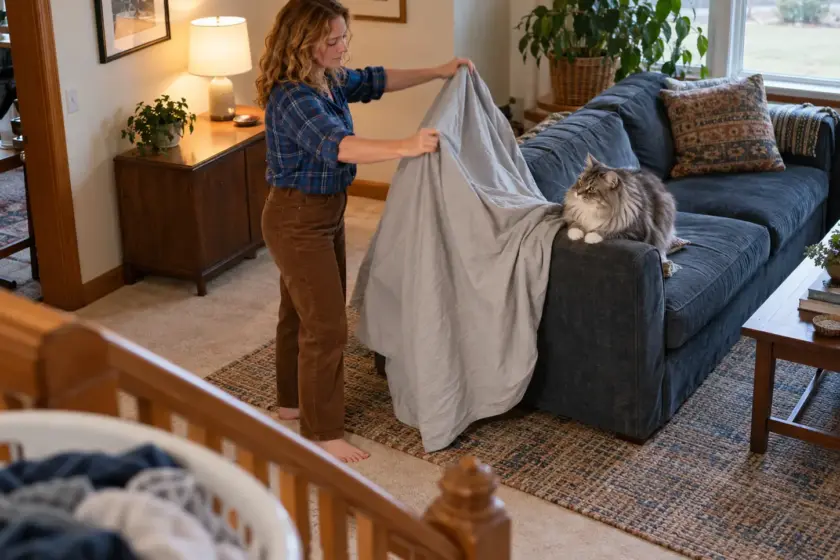
- A washable throw that moves to wherever the cat sleeps this month, not where he slept in winter.
- The fan aimed so it does not blow across his spot and spread the hair through the room.
- A damp cloth over the floor around his cool spot before the fan gets a chance to scatter what fell there.
Free first, then a roller for the fabric
Brush the cat before you buy anything. Every hair that ends up on the brush is a hair that never reaches the duvet, and a few minutes in the evening does more than any gadget aimed at the furniture. After that, a damp cloth (or a slightly damp rubber dish glove) dragged across upholstery rolls loose hair into strands you can pick up by hand, and a lint roller you already own handles the rest of a cushion. The throw you already own, laid on his new spot, catches the rest and goes in the wash once a week.
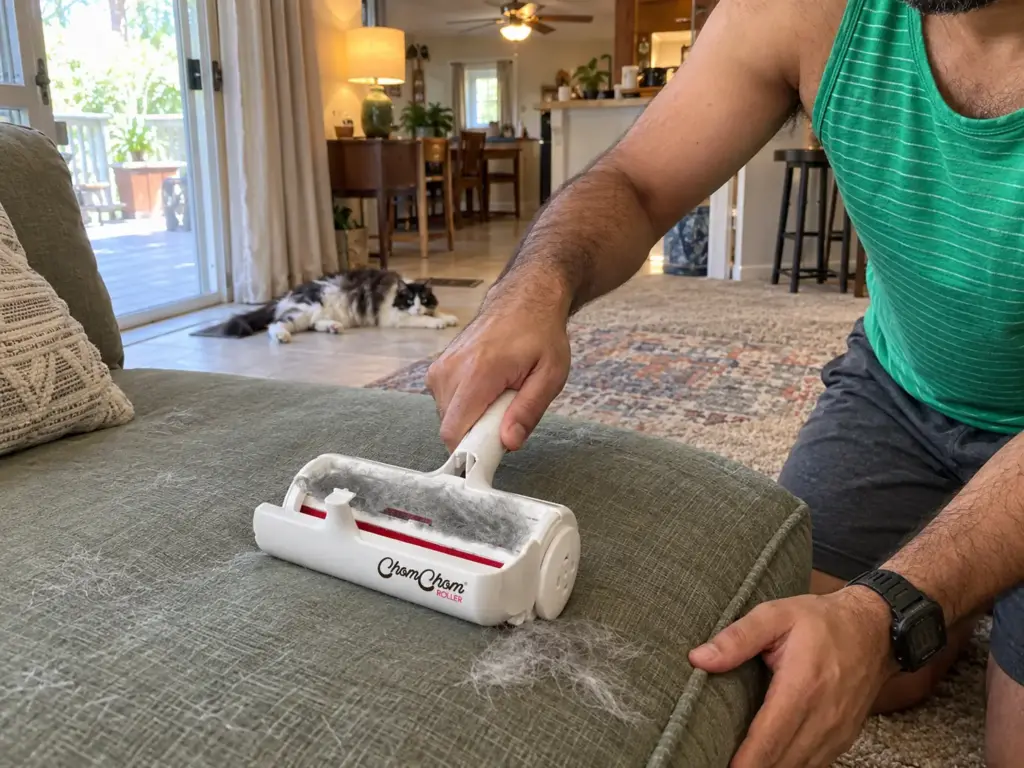
What is left is the hair already worked into fabric: the bedspread he took over, the armchair beside the window. That is where the ChomChom Roller Pet Hair Remover earns its place. It is a reusable roller about 7.5 inches across that traps hair in a chamber you empty into the trash, with no tape refills to run out of in the middle of the shed.
Not everyone loves it. Some owners say they had to roll it back and forth excessively on stubborn spots and that it feels cheap in the hand, so keep the damp cloth for the big sweeps and save the roller for fabric.
Vacuuming the rugs and getting hair off your clothes are their own chores, and they belong to the cleanup around the house rather than to the question of the season.
One Cat or Several: Each One Picks a Different Cool Spot
In a multi-cat home, nobody can say whose hair is on the sofa. And in summer the answer gets harder, because the cat who claims the cool floor and the cat who keeps the couch are loading different parts of the apartment. Mix their hair together and the brushing you do for one hides how much the other is shedding.
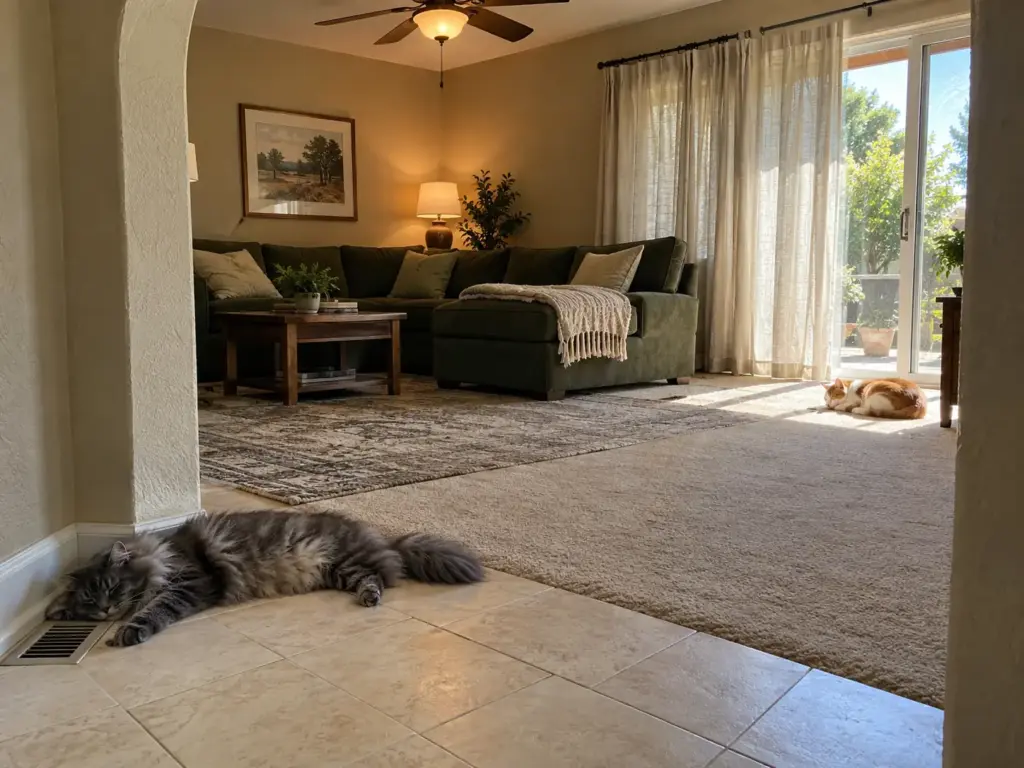
Run the brush test per cat, not per household
Give each cat his own light towel and, if their coats differ, his own brush. Same weekday, same patch of coat, one note per cat. The towel with more hair belongs to the heavier shedder, which is not always the cat who leaves more hair in view (a pale coat on a dark sofa looks guiltier than it is, and so does a cat who simply sits in the middle of the room).
Coat type matters more than the head count. In this house the two coats are a very large long-haired Maine Coon and a compact British Shorthair with a short, dense coat, and no single brush or schedule suits both. Running the test per cat is how you find out which one sets the pace in the heavy weeks.
Use a towel of a different color for each cat and keep them folded apart between sessions. Once two piles of hair touch, nobody can tell them apart, and the log is only as good as the separation.
Where each cat’s hair ends up
Each cat picks his own cool spot, and the hair load splits by spot. One may take the tile in front of the bathroom while the other stretches under the vent in the bedroom. When an apartment has only one truly cool floor, both cats want it, and the one who loses the argument settles somewhere warmer or waits his turn.
Giving each cat’s own spot a cool option, such as a second cooling mat in another room or a corner of tile cleared of boxes, takes the queue out of the hottest weeks. It will not make either cat shed less. But the hair lands in two places you know about instead of drifting through the whole apartment, and two washable throws on two spots is a routine you can actually keep.
Coat Type Decides How Often You Brush in the Heavy Weeks
You brush every day and still find hair on everything. That does not mean the brushing is failing, and it does not mean every cat needs the same schedule. The numbers in circulation disagree because they describe different coats:
- AAHA: five to ten minutes, two or three times a week, can significantly cut loose hair, and daily for heavy shedders.
- PawBasic: three to five times a week in summer.
- The Spruce Pets: once a day at the peak.
- East Valley Animal Hospital: daily for long and medium coats, weekly for short ones.
- Catster: a deshedding tool no more often than once a month.
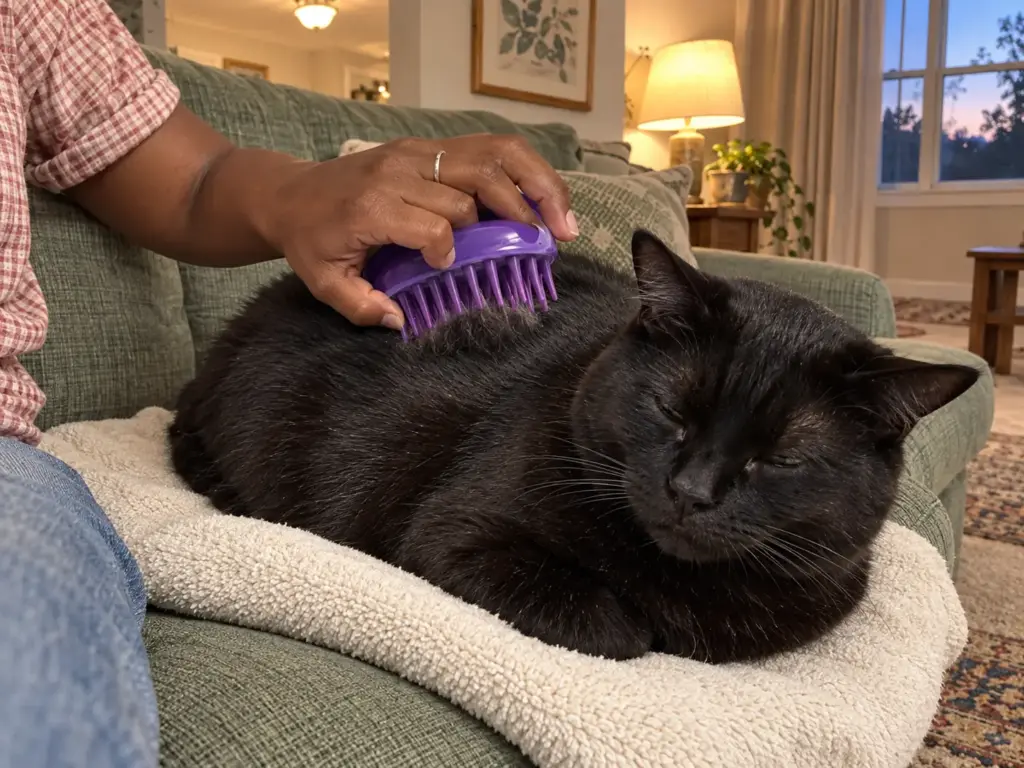
Everyone wants one number, and there isn’t one. Coat first, then your own log: those two settle which of those ranges fits the cat on your couch.
Short, dense coats
A short-haired cat with a dense coat, like a British Shorthair, can shed as much as a long-haired one, and the short hairs tend to work into upholstery weave and dark clothing instead of drifting off. For this coat, AAHA’s two or three sessions a week is a sensible floor, rising toward daily only when your log shows the spring rise.
The tool everyone names for shedding is a deshedding blade, and for this coat it is usually not the first one to reach for. A rubber brush does the nightly surface pass better: the Cat Brush with Soft Rubber Pins, Washable Silicone Pet Brush measures about 8 by 4.5 inches and rinses clean under the faucet, and the soft pins lift loose hair from a dense coat without scraping. It loosens hair without collecting it, so some of what it brings up ends up on the bed and the couch anyway; brush over the towel from your log, or in the spot you are about to wipe.
Long coats and a thick undercoat
VCA Animal Hospitals’ grooming guide says long, silky or curly coats need daily brushing, and short coats less often. For a very large long-haired cat with a double coat, the heavy weeks from spring into early summer are when the undercoat lets go in quantity, and a quick pass over the topcoat leaves most of it behind.
The first tool for this coat is a metal comb with long teeth, widely spaced, that reaches through the outer coat to the dense layer underneath; run it in the direction the hair lies, a section at a time.
For the undercoat weeks, the SleekEZ Cat Brush for Shedding is a deshedding tool about 5.5 by 3 inches built to pull loose undercoat in volume. Its size cuts both ways: reviewers call the blade super small, which means a big long-haired cat needs many passes to cover his whole coat. If that turns every session into a negotiation, the rubber brush above is the gentler fallback, slower but easier for the cat to accept.
Mats are not something a harder session fixes; a tight knot against the skin is a job for a groomer or the vet.
Reading your own log: when to step up and when to ease off
International Cat Care notes that daily grooming, particularly while a cat is molting, removes most of the loose hair for him. Your log tells you when that stretch has started. When the towel comes back heavier two weeks running, step up toward daily. When it drops back to the level you logged in winter, ease off to the floor for his coat type.
Then let the log argue with the calendar instead of you. If your cat lives in a cool, lamp-lit apartment and his line stays flat through July, there is nothing to step up for, whatever the season says. If he spends his days in a sunny window and his towel fills up in May, that is his peak, and August is the tail.
Brush at the end of the day, once he has already settled in his cool spot, not at playtime. A cat who is lying down and half asleep tolerates a long session far better than one who has somewhere to be.
The Summer Cut and Other Fixes That Move the Problem
One owner on r/CatAdvice wrote about brushing a Ragdoll twice a day and finding that “it still feels impossible to manage,” with a flatmate frustrated because the hair was everywhere, “even sometimes in my food.” When the hair keeps coming after that much effort, the owner has not failed. The shortcuts that tempt people in summer mostly relocate the hair rather than reduce it.
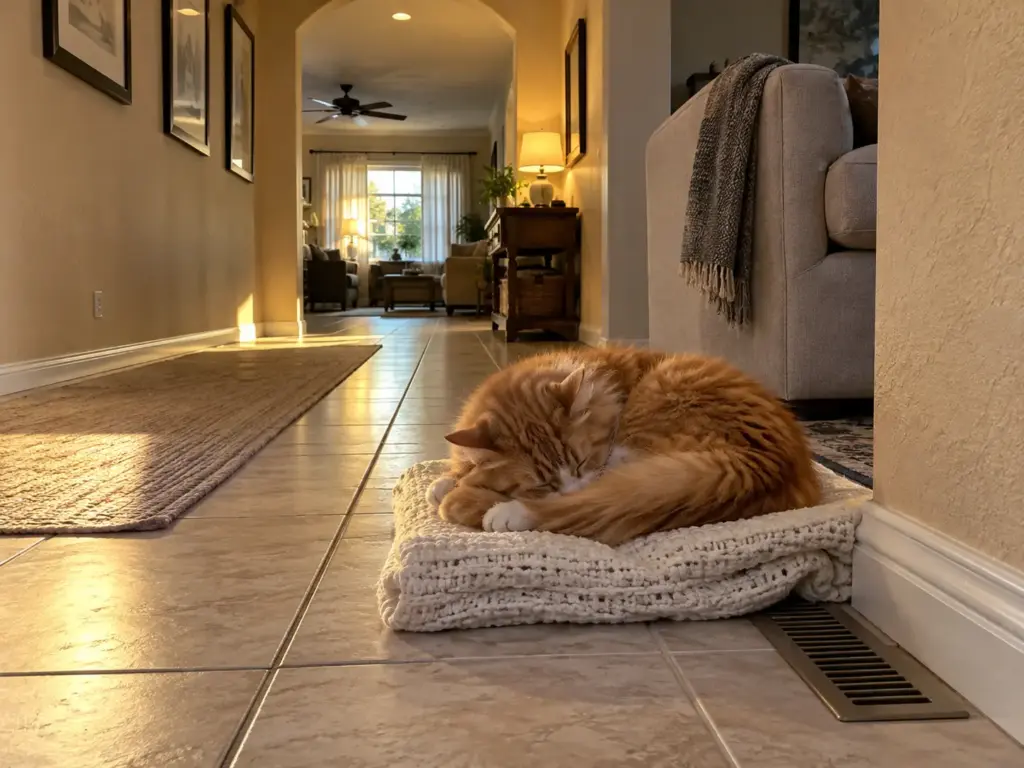
The lion cut question goes to the groomer or the vet
The lion cut, shaving a long-haired cat’s coat short for the summer, is a shortcut many owners ask about. Catster says shaving does not reduce shedding and can backfire, and East Valley Animal Hospital says cutting the coat does not stop the shed.
In one long r/CatAdvice thread, a vet and a groomer gave the same owner opposite answers: the vet said a cut was only for matting, the groomer said local cats get one every summer. This article does not settle that for your cat. It is a decision for the groomer or the vet who can see him, and the same goes for extra baths and supplements.
Why brushing harder still leaves hair everywhere
A brush can only remove hair that is already loose. Pressing harder or brushing for longer does not loosen more of it; it mostly uses up the cat’s patience, and then the next session is shorter. The ordinary summer fixes fail in the same way:
- Shaving the coat, which shortens the hair on the floor without changing how much of it falls.
- Starting the extra brushing in August, once the shed has already crested.
- Longer, harder brushing sessions, which wear out the cat’s patience before they wear down the shed.
What actually lowers the load that reaches your furniture is quieter: brushing at the pace his coat needs, a washable throw on the spot he moved to, and a roller for the fabric he claimed. None of it shortens the summer. It just keeps the hair where you can deal with it.
Follow the Cool Spot, Brush by Coat, Write Down the Month
Summer is the tail of a long spring shed, not a new peak, and a steady, air-conditioned apartment flattens even that. What the heat really changes is location: the hair follows your cat to the coolest floor in the place, so the cleaning has to follow him too. And the brushing schedule comes from his coat and his own log, while any change in the skin or the pattern goes straight to the vet.
Three weeks from today, set that week’s towel note beside this week’s and look under the bed at the same time: a smaller pile and a clean patch of floor where he lies mean the routine is holding.
Today, move the washable throw onto the spot where he has been sleeping this week, and write the month at the top of a fresh page for the log.
Frequently Asked Questions
01Do cats shed more in summer than in winter?
Slightly more, mostly at the start of the warm months, because early summer is the tail of the spring shed that began as the days lengthened. Fall brings a smaller rise, and an apartment with steady light and temperature flattens both.
02Do indoor cats shed more in summer?
Less than most owners expect, because artificial lighting and stable temperatures make indoor cats shed more evenly across the whole year, according to AAHA. What summer does change is where the hair lands, since the cat moves to the coolest floor.
03How often should I brush my cat in summer?
It depends on the coat: two or three short sessions a week is a sound base for most cats, and daily for long coats and heavy shedders in the peak weeks. A weekly brush test logged by month shows when to step up.
04Should I shave my cat in summer?
That is a decision for a groomer or a vet who can see your cat, and this article does not answer it. What is in your hands is brushing at the right pace for his coat and moving a washable throw to his new cool spot.
05Does the air conditioner change how much my cat sheds?
No source measures that directly, but stable indoor temperatures tend to flatten the seasonal swing, as AAHA notes. The hair that does fall ends up in the air conditioner filter sooner, so check it monthly during the heavy weeks.



Leave a comment