Best Elevated Cat Bowls for Senior and Flat-Faced Cats
Elevated cat bowls sorted by cat: 6.2 in wide for stiff shoulders, tall + tilted for flat faces, 5.5 in the width nobody prints. Free test first.

Alfredo RamsesFounder · September 15, 2026 · 21 min read

On this page8 sections
- 1What a Raised Bowl Is Actually Fixing
- 2Measure Your Cat Before You Shop
- 3Ceramic, Stainless Steel, or a Stand You Put Your Own Bowl On
- 4The Picks, and Which Cat Each One Is For
- 5Two Cats Change the Answer, and One Stand Doesn't Fix It
- 6Where It Goes, and What the First Three Weeks Look Like
- 7What to Do Next
- 8Frequently Asked Questions
He walks up to a full bowl, takes four mouthfuls, walks away, and comes back twice before the plate is empty.
You have already decided he has gone picky in his old age. He hasn’t. He is negotiating with a dish that makes him crouch, and eating in short bursts is the only way he can tell you. The honest starting point for the best elevated cat bowls is that the one controlled trial anybody has run on bowl shape found no measurable difference in how much cats ate, but most owners still swore their cat preferred the wide dish. So this guide measures your cat first, then names the picks, because most cats need far less lift than the tall products in the photos are selling.
Quick Answer
Sort by which cat is in front of you, not by which bowl ranks highest.
- Senior cat with stiff shoulders: the widest shallow ceramic dish, around 6 inches across, on a low base.
- Flat-faced cat: real height plus a wide, tilted, shallow dish, because the muzzle cannot reach down into a deep well.
- You don’t know the right height yet: an adjustable stand that holds the bowl you already own.
- Before you buy anything: put his own bowl on a stack of books for a few days. Free, and it answers the question.
- What elevation does not do: treat vomiting. That one is a vet visit, and no bowl changes it.
What a Raised Bowl Is Actually Fixing
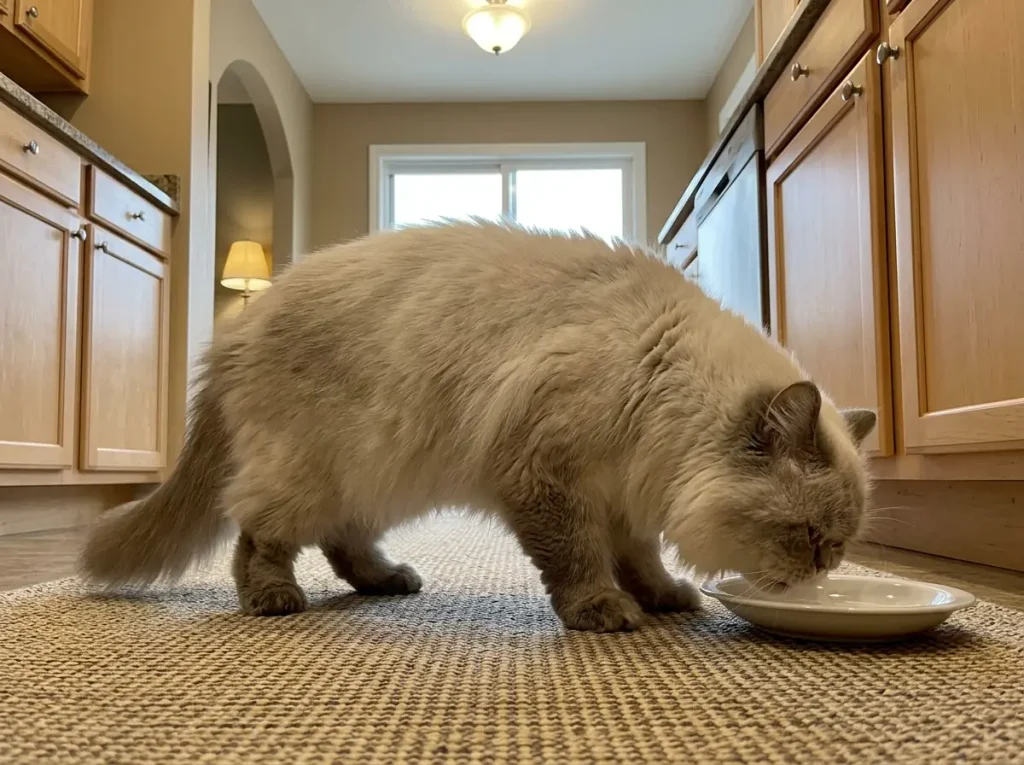
Most raised stands get bought because a photo made the corner of a kitchen look tidier. That is a fine reason to buy furniture and a bad reason to expect a change in your cat, because elevated bowls help some cats and not others and the split is not subtle. Lifting a dish changes exactly one thing: the angle of your cat’s neck while he eats. It does not give him more food, easier food, or better food. It is a small mechanical adjustment, and the cats it helps are the ones for whom that small adjustment was the whole problem.
Two groups get something real out of it.
Older cats with stiff shoulders and elbows, because holding a low crouch for the length of a meal is work when those joints hurt, and the neck strain of that angle adds up meal after meal. And flat-faced cats, the brachycephalic breeds, whose muzzle simply cannot reach into a deep dish sitting on the floor without pressing their face against the rim. For a healthy adult cat with a normal muzzle and no joint complaints, an elevated bowl is neither an upgrade nor a downgrade. He will eat from it.
He would also have eaten from the floor. There is no penalty here, but there is no prize either, and the listings will not tell you that.
The useful part is that you can see which group your cat is in, and you can see it in a single meal.
A cat who is struggling braces one front leg out wide instead of standing square. He drops a shoulder toward the bowl rather than lowering his head to it. He eats in short bursts, straightens up, and goes back down.
That last one is the pattern owners misread most often, because it looks like disinterest in the food and it is actually a break from the position. The reframe that turns this around for people is small and it is the whole article in a sentence: she has not gone picky in her old age, she cannot get down there comfortably any more. Same cat, same food, different problem entirely.
One boundary before we go any further, and it is worth stating plainly because the category’s own marketing blurs it.
These bowls are widely sold as anti-vomit bowls. A tilted shape has a plausible case for reducing regurgitation, which is undigested food coming straight back up minutes after a fast meal. It has no evidence behind it as a treatment for actual vomiting.
If your cat is vomiting regularly, losing weight, or turning down food entirely, that is a vet visit today, and no bowl on this page touches it. Everything below assumes the vet side is already handled and what is left is furniture. If you are still not sure the whole idea is worth your money, the honest version of that argument is over in whether an elevated bowl is worth it at all.
Watch one meal before you spend anything. If he eats standing square with his head level and his shoulders relaxed, elevation is not your problem and a stand will not become one.
Measure Your Cat Before You Shop
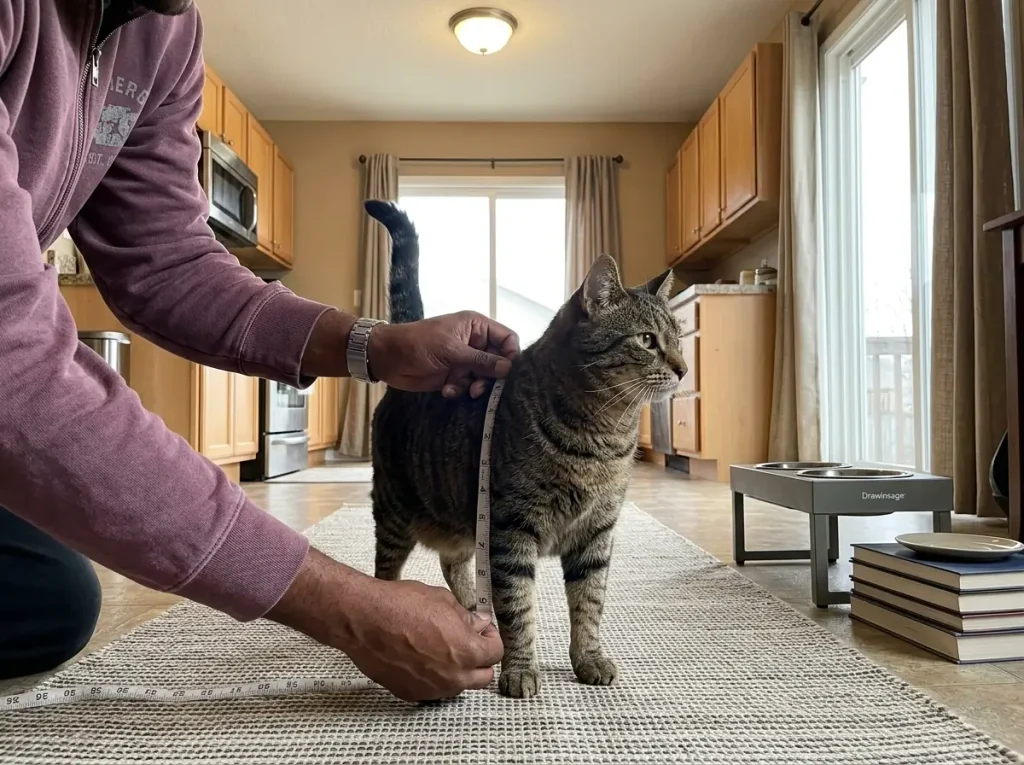
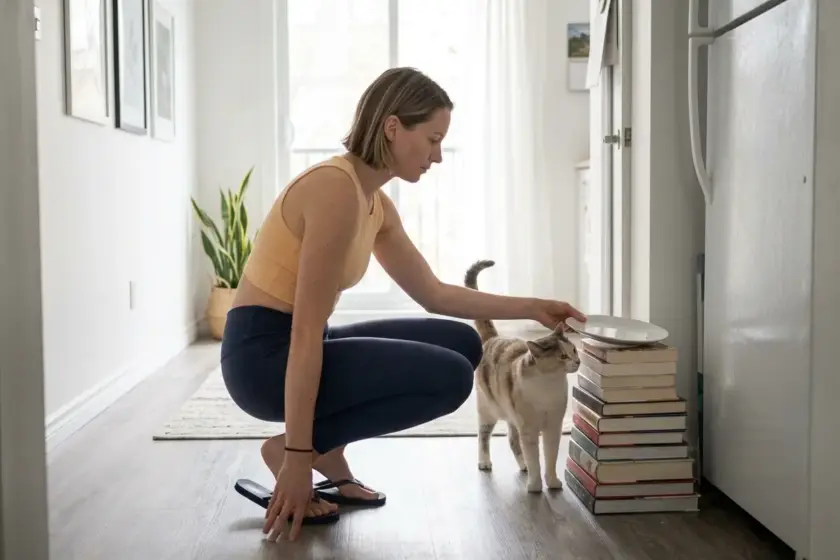
Start with the free version, because it works and because it costs you a weekend instead of a purchase. Put his existing bowl on a stack of sturdy books, a shoebox, anything flat and stable that gets it an inch or two off the floor.
Leave it there for a few days, not one meal, and watch how he stands. If the bracing stops and he eats through in one go, you have your answer and you know roughly your number. If nothing changes, you have just saved yourself a stand, and the full set of no-purchase options lives in raise the bowl you already own. Either result is worth more than any review, including this one, because it was run on your cat.
Now the number.
Every listing on the market announces the perfect height, and not one of them has met your animal. The landmark that matters is the joint where the front leg meets the shoulder, measured with your cat standing normally on a flat floor. That is where you want the food sitting. Published ranges land between roughly 2 and 6 inches, and here is the part the ranges hide: most cats sit at the bottom of that spread. The tall products exist for the minority, for large cats and for genuinely arthritic ones, and buying at the top of the range because taller sounds more helpful is how people end up with a cat eating with his chin up.
Kitten bowl height is not adult bowl height either. A long-legged tabby and a small senior calico in the same apartment need two different numbers, and the gap between them is wider than the adjustment most stands offer. The full breakdown, if you want it as a table, is in the full height breakdown in inches, by cat size.
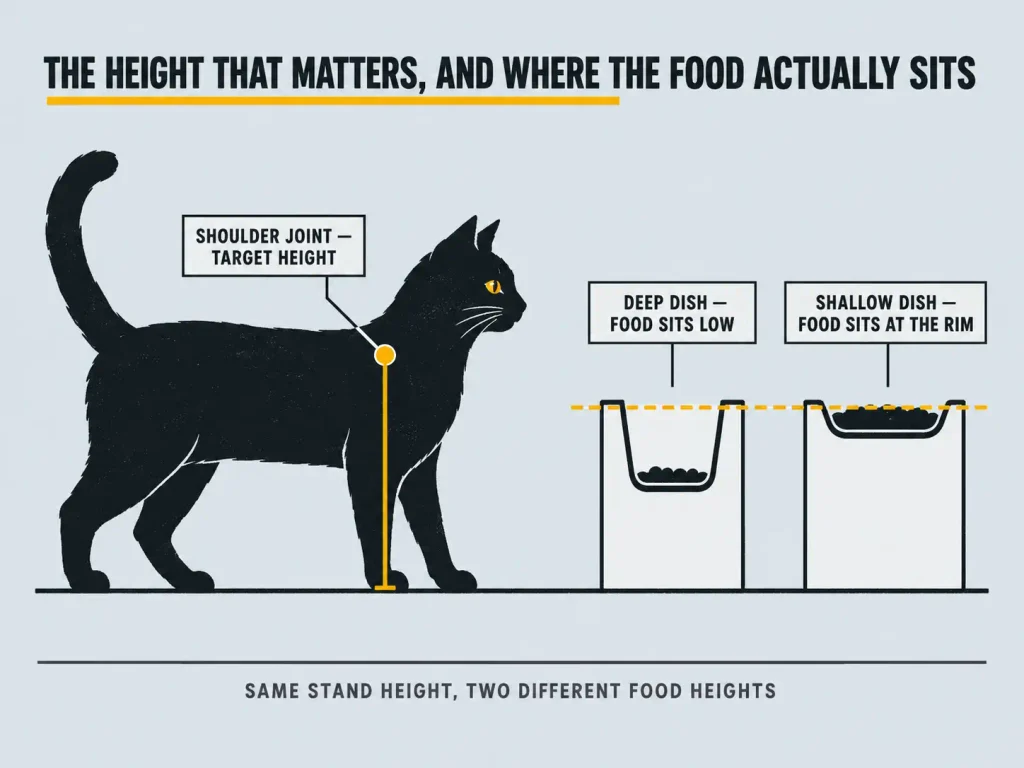
And now the mistake almost everyone makes, including people who did measure. They measure to the top of the stand. Your cat eats the food, not the furniture. A deep dish sitting on a tall stand puts the food right back down where it started, which is why two stands advertised at the same height can perform completely differently for the same cat. Measure to where the kibble actually sits.
That single correction rules out a good half of what gets recommended in roundups, because deep bowls photograph better than shallow ones and the depth never appears in the height spec.
Width is the other half, and it is a separate spec that solves a separate problem. Below about 5.5 inches across, the whiskers brush the sides on every mouthful no matter how high the bowl sits, which is the contact people mean when they say whisker fatigue.
Six inches and up is the safer target for a cat with a wide face or long whiskers. Height fixes the neck. Width fixes the face. A tall narrow bowl on a beautiful stand has fixed one of your two problems and left the other exactly where it was.
If you measured and nothing on the shelf matches your number, that is not a failure of measuring. That is the fixed-height market telling on itself.
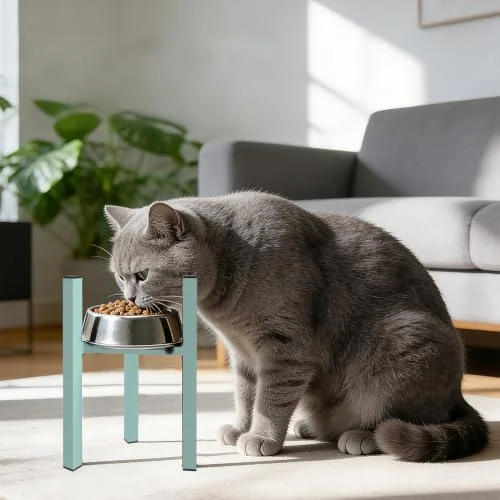
Measure to the food, not to the stand. Two stands sold at the same height can put the kibble two inches apart, and the deeper one is usually the better-looking one.
Ceramic, Stainless Steel, or a Stand You Put Your Own Bowl On
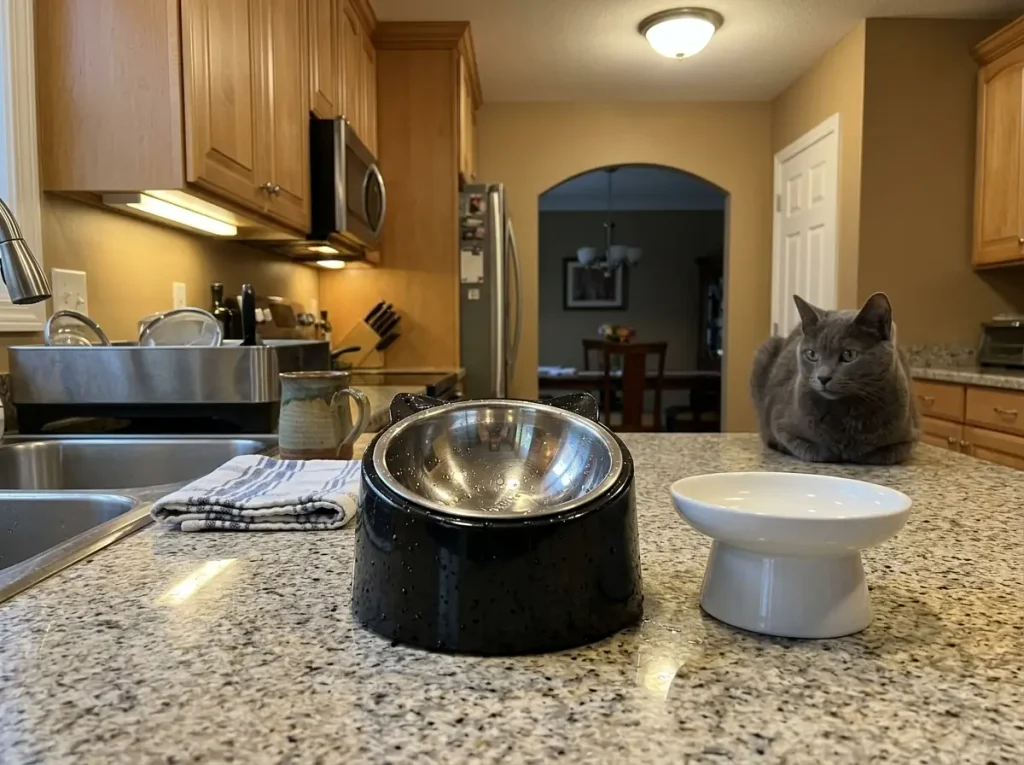
This is the question people research last and regret first. The shape decides whether your cat is comfortable, but the material decides what you live with, because this thing gets washed by hand or by machine roughly twice a day for the next several years.
Ceramic is the default for a reason. It is heavy enough to be non-tip in practice, so a determined cat cannot push it across the kitchen mid-meal, it is non-porous while the glaze stays intact, and the widest shallow shapes on the market are made in it because ceramic can be formed into a broad shallow saucer that steel struggles to hold rigid. The catch is that it chips, and a chip in the glaze is the end of the non-porous part. A ceramic bowl with a cracked interior is a replacement, not a repair.
Stainless steel has the opposite profile. Nothing to crack, nothing to craze, dishwasher safe indefinitely, and it does not care how many years it has been in service. What it is, though, is light. Without a non-slip base, a steel dish sitting loose on the floor travels, which is why the good ones come seated in a weighted stand rather than sold as a bare bowl. If you have a cat who pushes his food around, that weight is not a luxury feature.
Plastic is the one this article does not recommend for a dish in daily use. It scratches, and the scratches hold residue that a rinse does not reach. It is not a catastrophe and nobody needs to throw one out tonight, but for a surface that touches wet food twice a day it is the worst of the three and the cheapest to replace. The deeper mechanics of what fails in each material, including glaze crazing and steel grades, sit in what actually fails in ceramic, steel and plastic bowls.
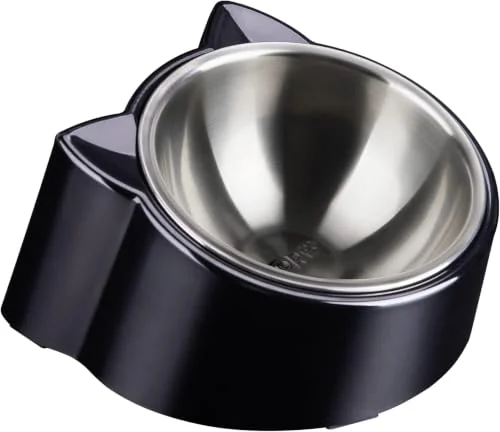
There is a fourth answer that is not a material at all, and it is the cheapest correct one for a lot of households: buy only the elevation. If the dish you already own is wide enough and shallow enough, the bowl was never the fault. Plenty of people arrive at a stand-only setup after replacing two full sets and realizing the dishes had been fine the entire time. Keep the bowl, change the height, spend once.
The Picks, and Which Cat Each One Is For
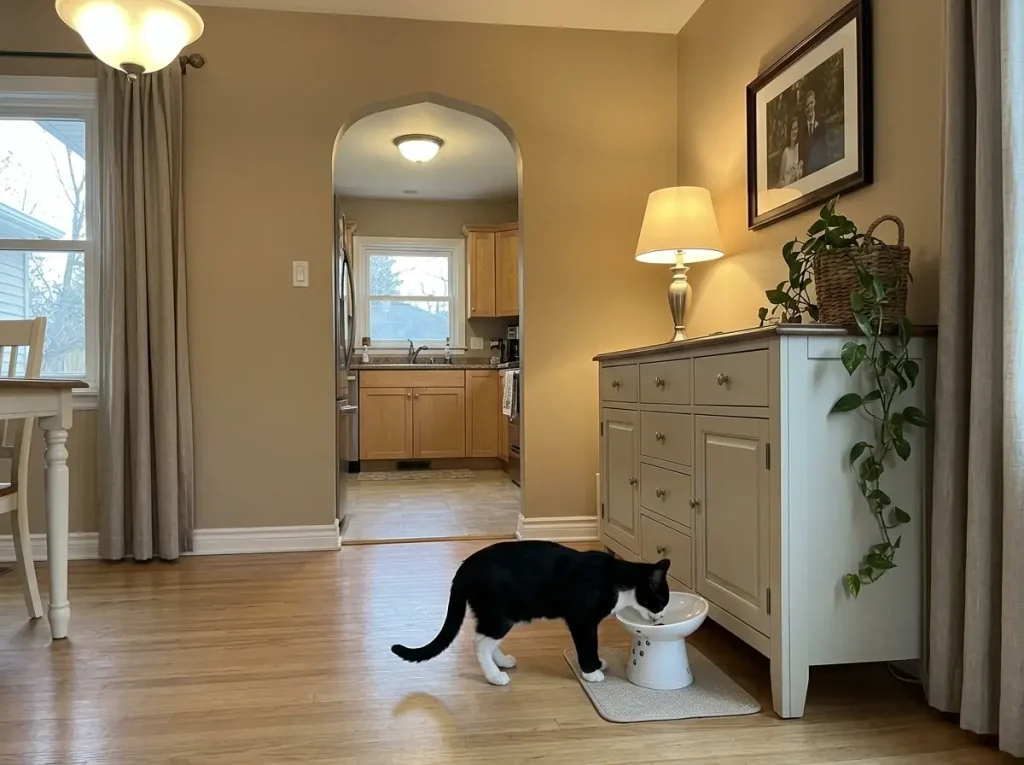
Six bowls are not all better than each other. They are better for different animals, and ranking them against one another produces a list that is useless the moment your cat is not the average one it was written for. So this sorts by the cat.
| Pick | Height | Bowl width | Material | Best for |
|---|---|---|---|---|
| CEEFU Extra Wide | About 5 in base | 6.2 in, shallow | Ceramic | Senior cats with stiff shoulders |
| Necoichi Extra Wide Tilted | Up to 6 in, 15° tilt | Extra wide, ~2 cups | Ceramic | Flat-faced cats and real lift |
| Necoichi Whisker-Friendly | Standard pedestal | Shallow, ~1 cup | Ceramic | Smaller portions, same shape |
| Y YHY Tilted Elevated | Tilted, low lift | 5 in, tight for wide faces | Ceramic | Smallest budget footprint |
| CATPRO Tilted Feeder | 15° tilt on stand | Standard | Stainless + melamine | Anyone who wants non-porous |
| Drawinsage Stand | Adjustable | Your own bowl | Metal | Height you measured yourself |
For a senior cat with stiff shoulders, the answer is width before height. A broad, shallow ceramic dish on a low base removes the deep crouch and the whisker contact in one move, which matters because those two problems arrive together in older cats and get treated separately by almost every roundup. This is also the case where the honest framing has to hold: the only controlled trial on whisker-friendly bowls enrolled 38 cats to test whisker stress directly, and found no difference in how much they ate, how fast they ate, or how much food they dropped. What it did find was that 63% of owners said their cat preferred the wide dish, and 24% preferred the regular one. Read that as a comfort preference with real support and no performance claim attached, which is exactly what that study actually found when you go past the headline.
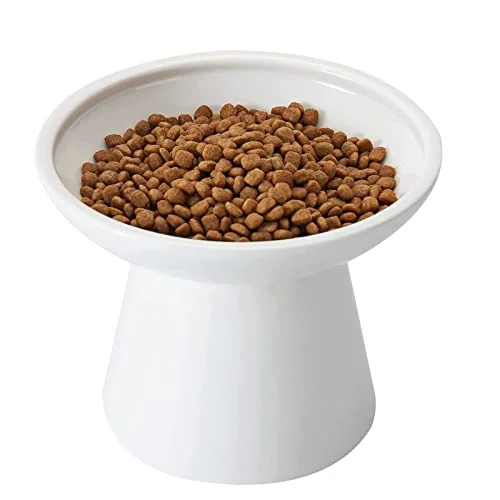
For a flat-faced cat, you need both specs at once and you cannot compromise on either. Real height, because the muzzle is short and cannot travel down into a dish. Wide and shallow and tilted, because that face has to meet the food at an angle rather than reach into a well. This is the profile the tall tilted designs were actually built for, and it is the one case in this article where the taller product genuinely is the better product.
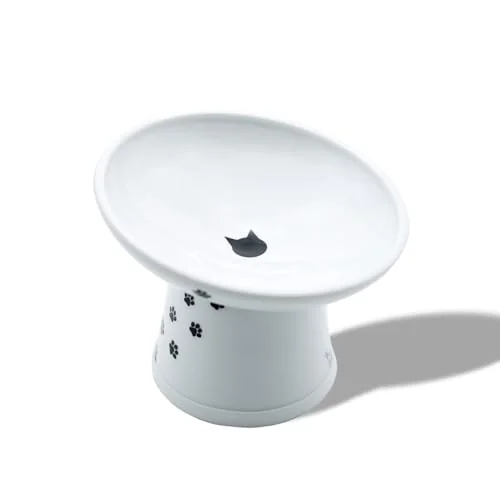
If your cat eats less at a sitting, the same shallow pedestal shape comes in a smaller size, and buying the big one for a cat who leaves half of it is how dry food goes stale in the dish.
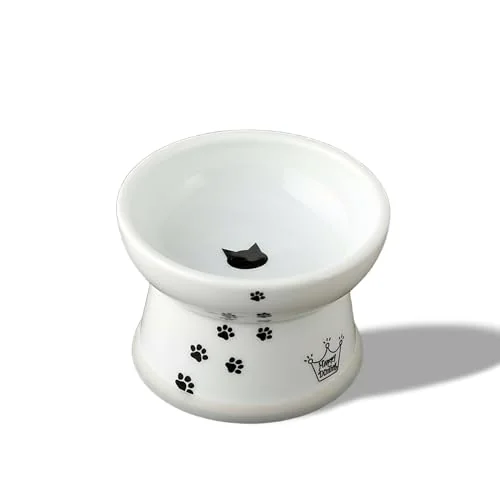
For a fast eater who brings it back up minutes later, the tilted designs are the ones with a case, and the case needs stating carefully. Food coming back up undigested shortly after a rushed meal is regurgitation, and gravity helping it travel the other way is a plausible mechanism. That is the whole claim. It is not a treatment for vomiting, which is a different process entirely, and a cat doing that regularly needs a vet rather than a purchase.
For a tight budget, the small tilted ceramic bowl does the same job in a smaller footprint, and in a galley kitchen the smaller footprint is a feature rather than a compromise.
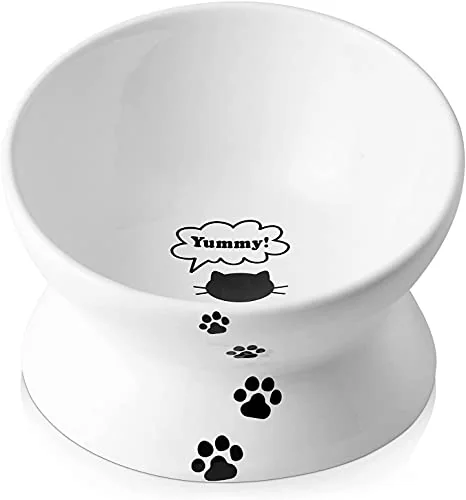
And one thing the roundups never print. Among owners of genuinely flat-faced cats, a recurring resolution in those threads is not a purpose-built product at all. It is a wide flat side plate on a low platform, arrived at after the official stands turned out to be too deep for that particular face. The expensive answer is not always the winning one, and a category that sells shape is a category where a plate sometimes has the right shape.
A tilted bowl and a wide bowl solve different problems. If the whiskers are the issue, width wins, and tilt does nothing for it.
Two Cats Change the Answer, and One Stand Doesn’t Fix It
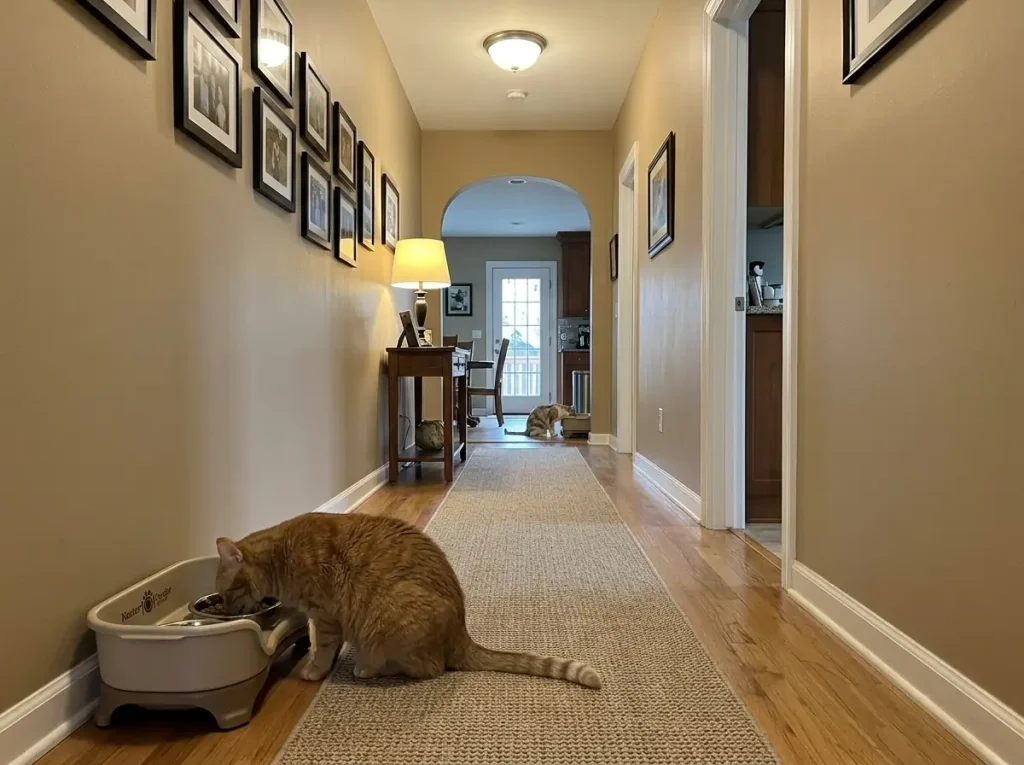
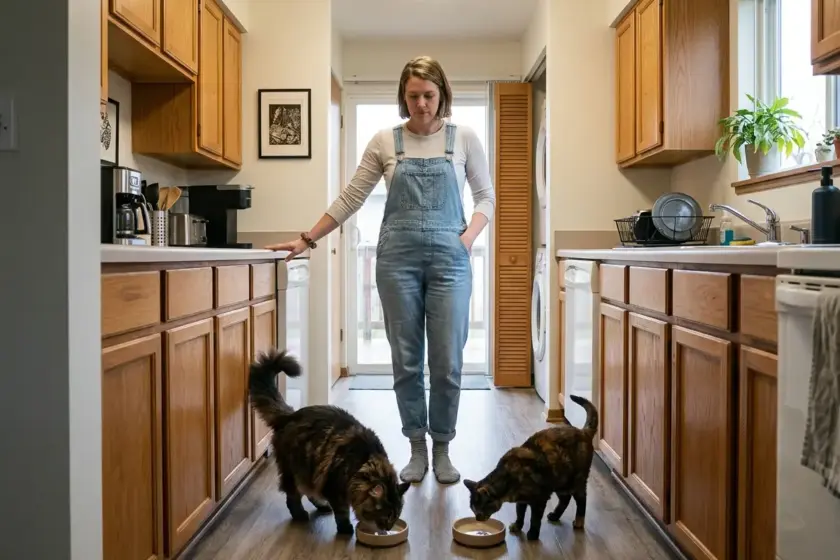
Before you buy a second anything, move what you already own. Take one of the two dishes off the shared stand and put it in another room, or on a different surface at a different height, and leave it that way for a week. This costs nothing and it resolves a surprising share of these situations outright, because the problem was almost never the number of bowls.
Here is what is going on. What you are watching is resource guarding, and the rule shelters and behavior people work from is one feeding station per cat, plus a spare, and the word doing the work in that sentence is station. A station is a separate place.
Two dishes bolted to one board is one place with two holes in it, and to a cat who is being crowded, that distinction is the entire problem.
You bought the twin stand because it was tidy and it fit neatly under the window. Within a week the confident cat is eating from both sides and the other one is waiting by the door. Nothing about the stand is defective. It just answered a different question than the one you had. The general version of this rule, and why the spare matters, is two cats, two bowls, plus one.
The signal to watch for is quiet, which is why it goes unnoticed for months. Nobody is fighting. One cat eats in short bursts and looks up between mouthfuls. Or he waits until the other one has left the room entirely, then eats fast. That is a cat eating under pressure, and it looks almost identical to a cat who is not very hungry.
In multi-cat households where people finally separated the feeding zones properly rather than just adding a second dish to the same base, the standoff often resolves inside a week. Not because the second cat got braver. Because he stopped having to negotiate for a spot.
So if the free fix has run its course and you do want to buy, buy a second station, and put it somewhere else. A larger no-spill unit works well in that role precisely because it is substantial enough to be a destination of its own rather than an add-on to the existing one.
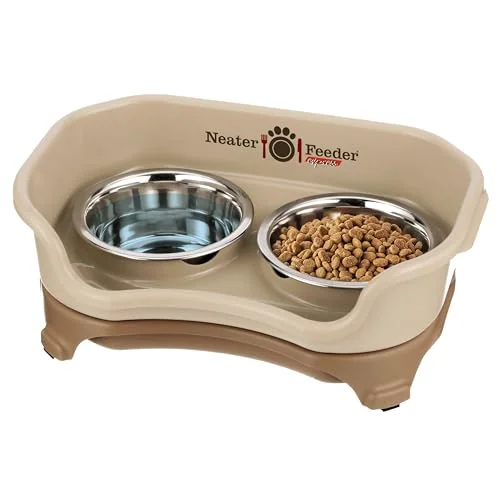
None of which makes the twin-dish design a bad product. It is a good product being sold to the wrong household half the time. A double stand is genuinely right for one cat: food on one side and water on the other, or wet on one side and dry on the other, in a single tidy unit that stops the second dish from wandering across the kitchen. That is what it was designed to do, and it does it well.
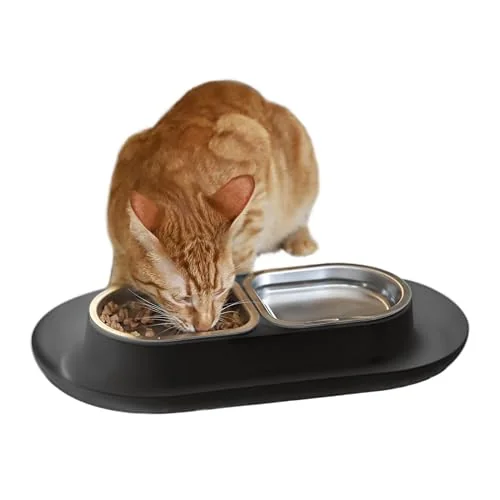
Two dishes on one board is one place to a cat. If the second cat waits, move a dish to another room before you buy anything.
Where It Goes, and What the First Three Weeks Look Like
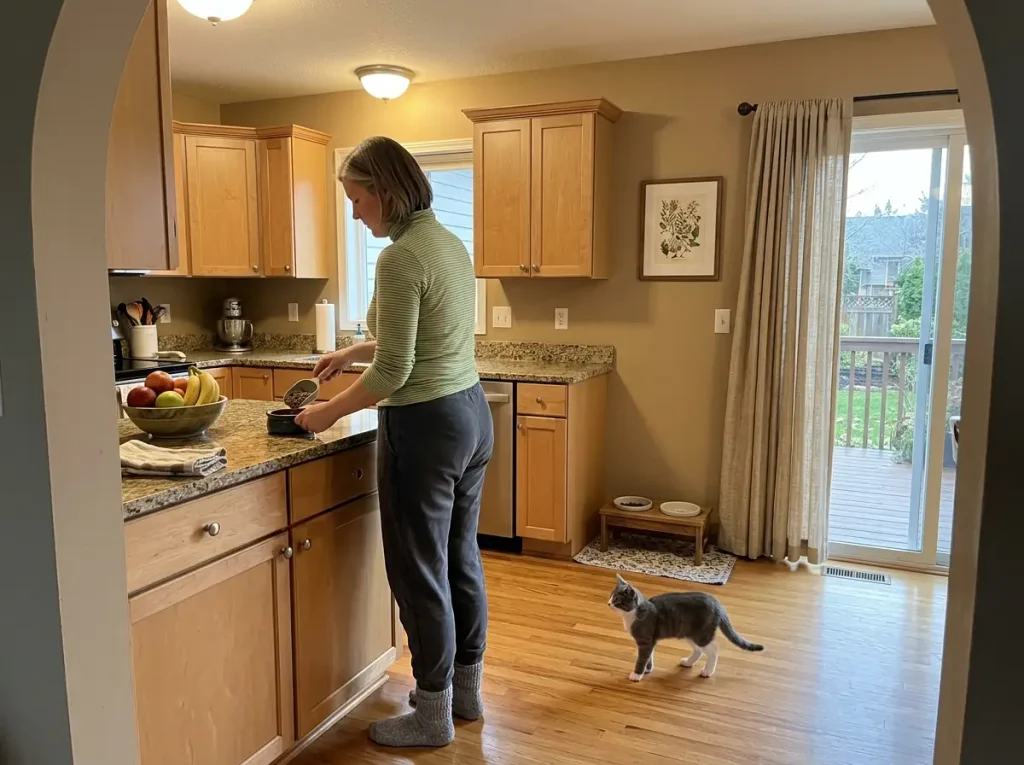
A stand your cat refuses to use is worse than the floor was, because now it is furniture too, and it is furniture in a kitchen that did not have spare floor. Most refusals are about where the thing went, not what it is.
Start with the physical fit, which no roundup mentions because roundups end at checkout. A raised station has a footprint and a height, and in a small kitchen those fight each other for the same square foot. Two spots fail reliably.
Under a counter overhang, where the extra height means a cat lifts his head into the underside of the cabinet and learns to eat with his neck twisted, which undoes the entire point of raising it. And beside a walkway, where someone catches it with a foot twice a week.
A cat who has been startled at his bowl twice remembers the bowl, not your schedule. Measure the floor before you order, the same way you measured the cat.
The two placement rules that survive everything else are simple. Away from the litter box, with actual distance rather than a token gap, and away from the loudest appliance in the room, which in most apartments is the fridge compressor cycling on. Neither of these is new advice. What is less commonly said is that they apply harder to a raised station than to a floor bowl, because a cat eating with his head up has less peripheral view of the room behind him and is more sensitive to being surprised at the dish.
Then make the swap boring. The new station goes exactly where the old bowl was, and the only thing that changes is the height. Change the height and the location in the same week and you have a refusal you cannot diagnose, because you no longer know which of the two he objected to. One variable at a time. It costs you nothing and it is the difference between a fix and a mystery.
By week three you will know. Either he walks up and eats standing square, head level, all the way through the meal, or he is still bracing to one side and taking breaks. That second outcome does not mean elevation was the wrong idea. It usually means the number is wrong, and it is more often too high than too low, which is why the adjustable option earns its place.
And the fix for a genuine refusal is nearly always to move it back to the original corner first, before you change anything about the stand itself. Cats accept new objects in familiar places far more readily than familiar objects in new places.
One more thing while you are in here: raising the water bowl is a different question with a different answer, mostly because water bowls tip more and because cats prefer to drink well away from where they eat. If you are rebuilding the whole feeding setup, that is also the moment to think about the cat a fountain actually works for, which is a narrower group than the marketing suggests.
What to Do Next
Measure to the shoulder joint, and measure to the food rather than to the rim of the stand. Most cats need less lift than the tall products are selling, and the ones who need real height are a minority you can identify by watching one meal.
Width does the whisker work and height does the neck work. They are two separate fixes for two separate problems, and one bowl does not always do both, which is why the picks above are sorted by cat instead of ranked against each other.
With two cats, a second location beats a second dish on the same board every time. A stand is furniture. A station is a place, and cats negotiate over places.
Check back in three weeks. That is long enough for a cat to accept a change or reject it, and the question to ask is narrow: is he eating standing square, or is he still bracing to one side?
Tonight, put his own bowl on a stack of books. If he eats standing square by the weekend, you have learned his height and skipped the first purchase entirely.
Amazon’s Audible — free for 30 days
Your cat won’t let you read. Let someone read to you.
Audible is Amazon’s audiobook library — thousands of titles, read out loud, on your phone. Free for a month, plus one audiobook to keep forever.
Frequently Asked Questions
01Are elevated bowls actually better for cats?
For a cat with stiff shoulders or a flat face, yes. Raising the dish changes the angle of the neck while he eats, and that is the whole mechanism. For a healthy adult cat with a normal muzzle it makes no measurable difference, and there is no penalty either way.
02Do cats prefer deep or shallow bowls?
Shallow and wide. The only controlled trial on this found no difference in how much cats ate or how fast, but most owners reported their cat preferred the wide dish. Treat it as a comfort preference, not a performance upgrade.
03What height should an elevated cat bowl be?
Aim the food, not the rim of the stand, at roughly where the front leg meets the shoulder with your cat standing normally. In practice that lands most cats between two and four inches, with taller options existing for large or arthritic cats.
04Do anti-vomit cat bowls work?
The tilted shape may help a cat who gulps and brings food back up minutes later, which is regurgitation. It does not treat vomiting. A cat who vomits regularly needs a vet, and no bowl changes that.
05Can two cats share one elevated double bowl?
They can, but a lot of pairs will not. Two dishes fixed to one board reads as one location to a cat, so the confident one can hold it. If the second cat waits or eats in bursts, split them into two separate stations.
Leave a comment