Cat Water Fountain Filter Cleaning, Every Two Weeks
Swap the carbon every 2-4 weeks, rinse the foam weekly, soak minerals 15 min [and know why rinsing a cat water fountain filter never lifts the biofilm].

Alfredo RamsesFounder · August 26, 2026 · 12 min read

On this page8 sections
The water looks clear, so the filter must be fine. That is the test almost everyone uses, and it is the one test that cannot see what is happening in there. Learning how to clean a cat water fountain filter starts with accepting that it saturates and gets colonized underneath days before the flow ever visibly weakens, which is why PetSafe’s maintenance documentation puts a number on the schedule instead of telling you to watch the water. Below: what the filter traps, the two-week clock, the teardown in order, the pump nobody opens, what a second cat changes, and how to do it all in one sink.
Quick Answer
Five steps, every two weeks, in this order.
- Unplug the fountain and empty the reservoir.
- Rinse a reusable carbon filter 30 seconds; replace a saturated one.
- Rinse the foam pre-filter separately. Different part, different clock.
- Scrub the pump housing and impeller cavity with a small brush.
- Rinse thoroughly, reassemble, refill. Every two weeks, not when it looks dirty.
What the Filter Is Actually Catching
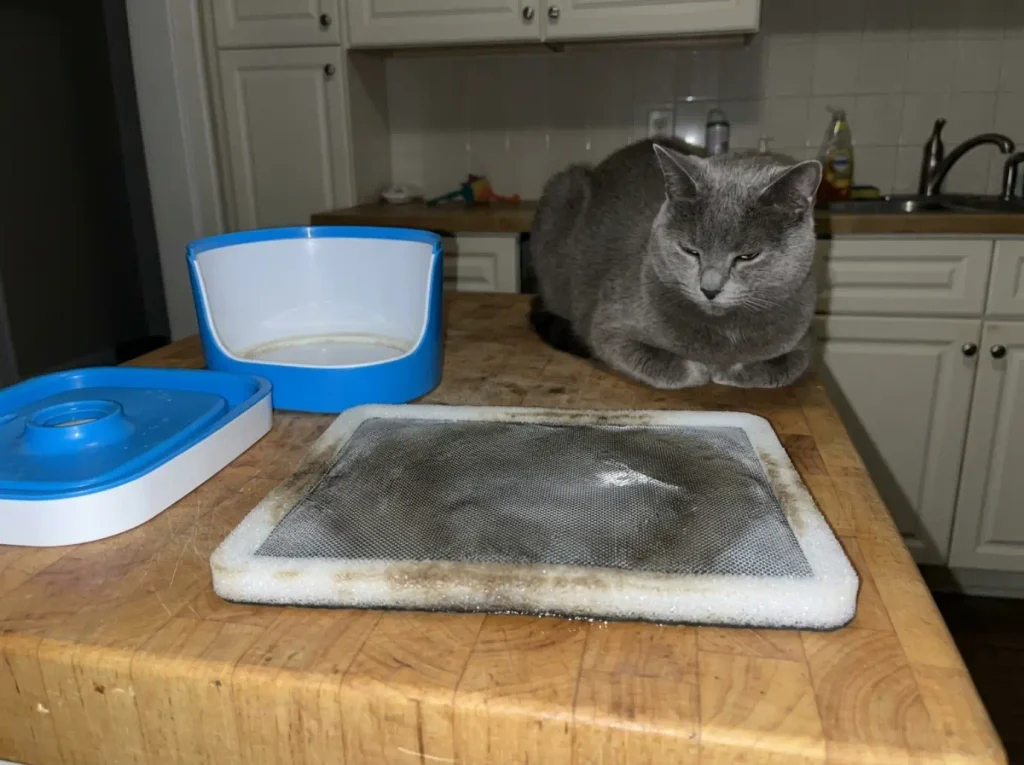
Everyone reads “filtered water” on the box and draws the same conclusion: the filter is a tiny treatment plant, and as long as it sits in there the water is being cleaned. It is a trap. Traps fill up. If you are still deciding whether a fountain earns its place in your kitchen at all, that distinction matters more than any feature on the packaging, because a trap you never empty stops being an upgrade over a bowl.
What the activated carbon does is adsorb dissolved organic compounds: saliva residue, food particles, the taste of chlorine in your tap water. Real job, done well. What carbon does not do is neutralize bacteria, or strain bacterial cells out of the water at all. Once the medium saturates, biofilm colonizes the carbon surface itself, and the part doing the cleaning quietly joins the other side.
Underneath it, the foam pre-filter handles the coarse stuff: shed hair, kibble crumbs, grit tracked in off paws. Different material, different job, different lifespan. Treating the two as one component is where most of the confusion here comes from, and the manufacturers do very little to clear it up.
Which is why the visible check is the wrong test. A fountain runs clear water straight over the top of a saturated filter, and by the time the flow weakens enough to notice, the cat has usually been backing off it for days. A fountain exists to give a cat running water instead of stagnant water, and a filter left too long quietly undoes that.
The word everyone eventually reaches for is slime, that stringy coating on the reservoir wall and around the spout. That is the late symptom, and it shows up long after the decision that produced it. Left far enough, the dark patches people call mold follow it.
PetSafe’s own maintenance documentation calls for a monthly pump teardown, cut to every two weeks in multi-pet homes, which tells you the manufacturers know the invisible clock is there even when the marketing copy doesn’t mention it.
The honest test is not looking at the water. It is running a fingertip around the inside wall of the reservoir, below the waterline. Smooth means clean. Slightly slick means biofilm has already started, and no amount of rinsing takes that off. It gets scrubbed, or it stays.
The Two-Week Clock, and Why It Isn’t Weekly
People do one of two things with a fountain filter. They forget it for months because the fountain looks fine, or they swap it weekly out of low-grade anxiety and burn through cartridges. A reusable filter rinses and goes back in; a disposable filter does not, and knowing which one you own changes the whole routine. Both come from the same missing number.
The manufacturer filter replacement schedule for a carbon filter cartridge is every two to four weeks, depending on use and water hardness. That range is not a marketing hedge. It is the window in which the medium saturates and starts releasing back what it spent the previous two weeks trapping.
Two weeks is the working default for a multi-cat household, or for a single-cat household on hard water. Four is the ceiling, not the target. It sits between the weekly cleaning the foam asks for and the monthly cleaning the pump does.
And the foam sits on a completely different clock, which is the part nobody says out loud:
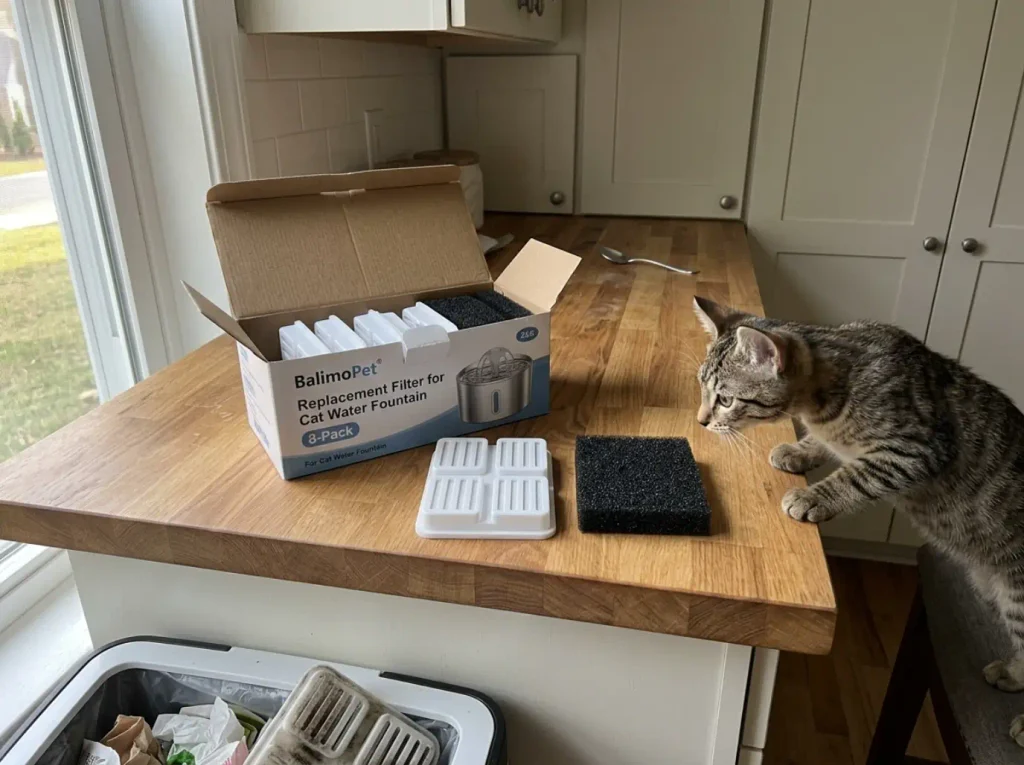
- Foam pre-filter: rinse weekly, replace every one to two months. The foam itself degrades and holds bacteria inside its structure, so rinsing stops being enough well before it looks worn out.
- Carbon cartridge: replace every two to four weeks. Two weeks is the default, four is the outer edge.
- Pump teardown: monthly for one cat, every two weeks for more than one.
The full-unit wash of reservoir, tower and spout rides its own roughly weekly rhythm, and how often the water itself gets changed is a fourth question entirely. Four schedules, not one. Collapse them into one task and the filter is what gets lost, because it is the only one you cannot see.
For the parts themselves, the BalimoPet 8-Pack ships eight carbon cartridges and eight foam sponges in one box, which is about the clearest physical proof going that these are two parts on two clocks, and it fits most non-brand fountains rather than locking you to whoever made yours. The catch is that “compatible with most” is doing real work in that sentence, so measure your old cartridge first. Catit owners have an exact brand match for the Fresh & Clear line in the Catit 3-Pack carbon cartridge, at a higher cost per filter than the universal route.
Taking It Apart in the Right Order
The reason people skip the teardown is fear of breaking it. Naming what resists, and why, removes that entirely.
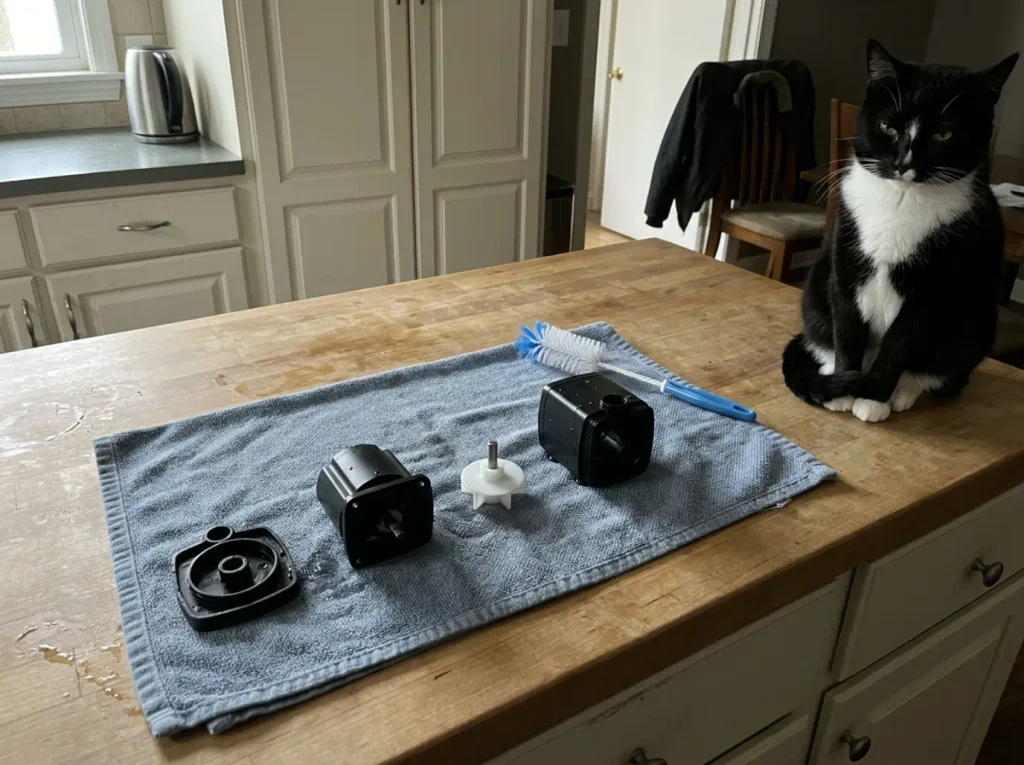
Unplug first, every time. Nothing here happens with the pump powered, and no step is made easier by plugging it back in early. Then, in the order that works on nearly every impeller-pump fountain and not just one brand: faceplate off, teardrop stator up and out, then the impeller.
The impeller is held in place by a magnet, and it will resist when you pull. That resistance is the magnet doing its job, not the part breaking. It is also the single most common reason a first-timer stops halfway, decides they are damaging something expensive, and reassembles a dirty pump.
Wash with warm water and unscented dish soap. Scented soap leaves a residue a cat can taste, and a cat who tastes soap in his water stops using the fountain, which is exactly the outcome this whole routine exists to prevent. Fragrance-free soap is the whole specification: no bleach, nothing harsh.
Disassemble only what is meant to come apart: the motor housing does not go under the faucet, only the parts designed to come off it. For the fuller account of the motor, the standing water, and what actually is worth worrying about, that is its own topic.
Lay the parts on a towel in the order they came off, left to right. Reassembly then needs no memory and no manual, which matters because the manual is the thing everybody has already lost.
The Pump Is the Part Nobody Touches
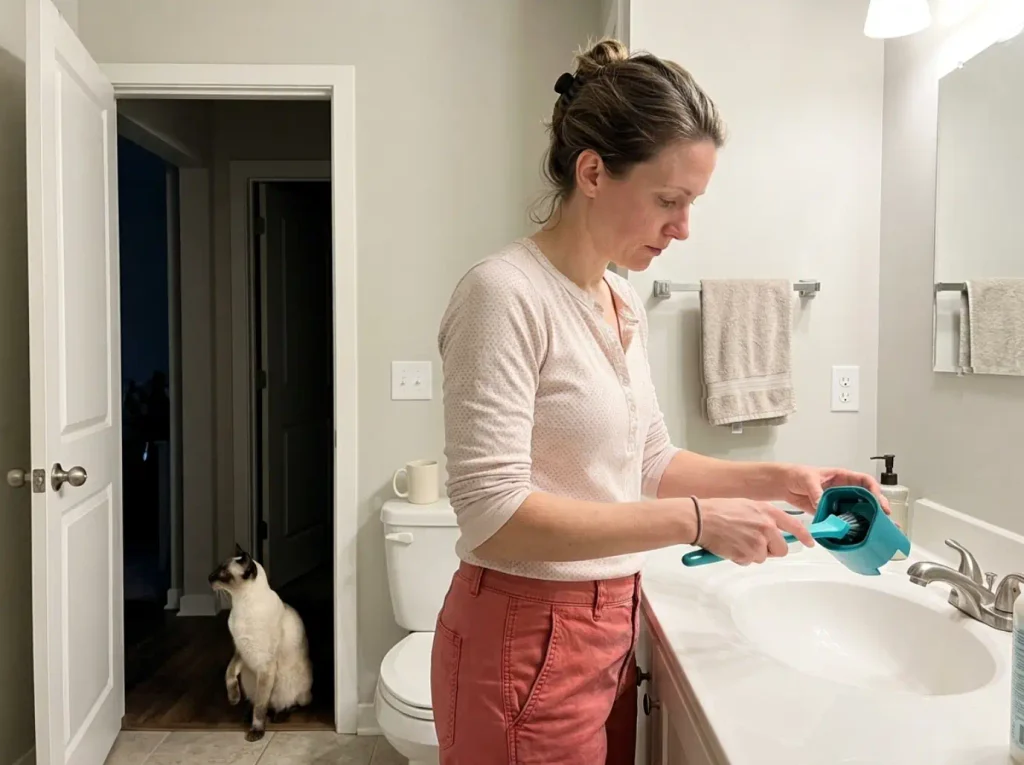
The filter gets swapped. The bowl gets rinsed. And the pump runs a year untouched with a ring of grime in the impeller cavity, doing all the work while being the one component nobody has ever opened.
Biofilm has to be physically scrubbed off. That is the whole thing, and it is why running parts under the faucet feels productive and does almost nothing. Once bacteria colonize a surface, water pressure does not lift them; something has to abrade them off.
A bottle brush, a small bristle brush, or the old toothbrush in your bathroom drawer covers the entire tool requirement. For the impeller cavity and the narrow seams that a sponge or a foam swab cannot physically enter, the XANGNIER 10-piece cleaning kit has a crevice brush and swabs sized for that geometry, though several of the ten pieces will sit unused. Drinkwell owners get a closer match from the PetSafe Drinkwell 3-brush kit, shaped to that pump specifically, which counts for something given the teardown steps above come from PetSafe’s own documentation.
Mineral buildup is a separate problem with a separate fix. Equal parts white vinegar and warm water, soak 15 minutes, then scrub. That is PetSafe’s spec, not a guess, and it replaces the “soak for a while” every general guide falls back on. Visible limescale, the chalky white hard water stains that ring the reservoir, earns 20 to 30 minutes at 1:1 or 1:2. Past that you are just waiting.
Soap for the slime, vinegar for the scale. Doing one and expecting it to fix the other is why so many fountains stay noisy and slow right after what felt like a thorough clean. A noisy pump is a maintenance signal, not a dying motor, and so is a weak flow: both are the same restricted flow rate reported two different ways. Grime in the impeller cavity makes that noise long before the motor is near failing, and if you want a fountain quiet enough for a bedroom, that starts with ruling out the dirt.
The free version works. An old toothbrush and hot soapy water clear an impeller cavity as well as any kit. What a kit buys is reach into the narrow tube, not better cleaning. Try the toothbrush first and only buy if the tube stays slick.
What Changes With a Second Cat
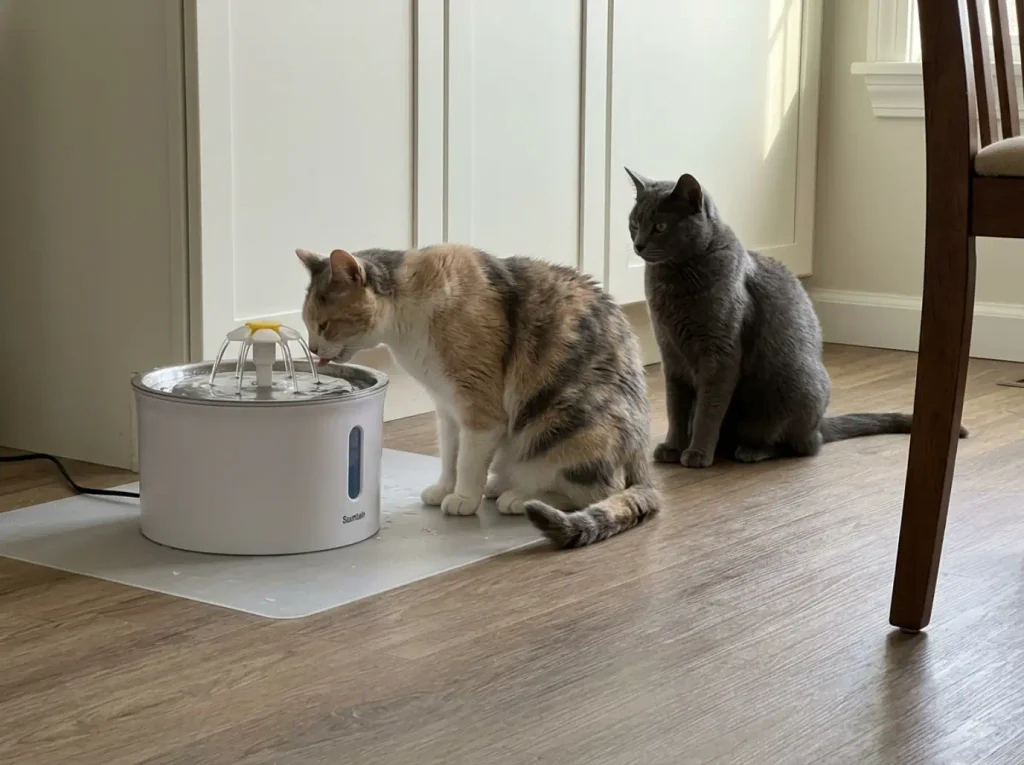
Two cats is not slightly more of the same load. It is double the saliva and double the shed hair through one filter, on a schedule the box printed for one cat.
PetSafe puts a real number on this where most sources shrug: monthly pump cleaning as the baseline, every two weeks in multi-pet homes. Carry that halving across to the filter and a two-cat household lives at the two-week end of the range, never the four-week end. Past two cats there is no published formula, and inventing one would be worse than admitting the gap.
A second fountain is often a better answer than a shorter cleaning interval, and the reason has nothing to do with hygiene. Cornell’s feline health center notes that individual cats respond differently to fountains, and that access conflicts in multi-cat homes can block water intake on their own. One cat quietly holding the spot keeps the other away from it, and no amount of scrubbing solves a territory problem.
Water intake is the reason anybody bought a fountain in the first place, given what urinary health and kidney health rest on, and a blocked cat drinks less no matter how clean the bowl is. Worth reading what the study found when it measured whether fountains raise intake at all before buying a second one.
When a cat backs off the fountain, he is reporting something. It might be the filter. It might just as easily be that the other cat has claimed the corner. Either way he is describing a real constraint, and the move is to find out which one, not to decide he has turned fussy.
One boundary, stated once: a cat who stops drinking altogether, or whose litter box habits change, is a vet visit before he is an equipment problem. Everything here assumes the vet has already cleared him.
Doing All of This in One Sink
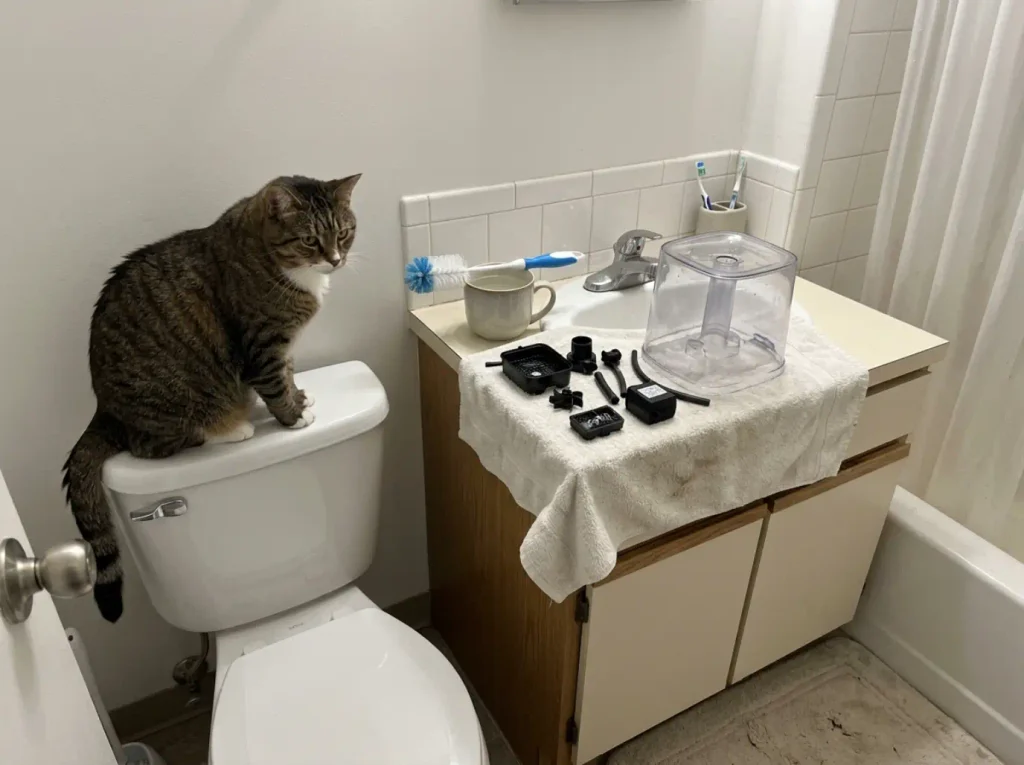
Every cleaning guide written for this quietly assumes a garage utility sink and a free dishwasher rack. You have one bathroom sink, a dish rack already full, and a cat who wants the fountain running again before bedtime.
It fits, and it is the most renter-friendly job in this whole article. Pump parts are small, they all hand-wash, and they all air dry on a dish towel on any counter, which is the entire reason this works in a small apartment. The whole job runs under an hour start to finish, vinegar soak included. Nothing here needs an overnight soak, which is the detail that turns this from a weekend project into a weeknight one: 15 minutes for routine mineral maintenance, 30 for visible crust, and no step where parts sit blocking your only sink until morning.
Do not assume the dishwasher either. Some reservoirs are top-rack dishwasher safe and plenty are not, and the pump never is. Check the part before it goes in, or skip the dishwasher entirely and lose nothing, because hand-washing was always the thorough option here.
- A bottle brush or an old toothbrush: the only tool the job genuinely needs.
- Unscented, fragrance-free dish soap: for the biofilm.
- White vinegar: for the mineral scale, mixed 1:1 with warm water in a mug or a small bowl.
- A dish towel: the drying rack, laid flat on any counter.
That is the entire setup, and it lives at a bathroom sink without asking for counter space you already committed elsewhere. One last thing: refill and restart before you go to bed, so the cat finds it running rather than empty. A fountain left dry overnight is a cat drinking out of the toilet by morning, and he is not wrong to do it.
Getting the Two Weeks to Stick
The filter is a trap, not a treatment. It fills up, and a full one is worse than none at all. That is the entire reason this runs on a clock instead of a look-and-see.
Soap for the slime, vinegar for the scale, fifteen minutes, one brush. Not the same problem, so not the same fix, and doing only one is why a “full clean” so often leaves the fountain running rough. Two cats halves the interval: two weeks, not one month.
In three months, look at the foam pre-filter rather than the carbon one. If it has gone stiff, discolored or crumbly at the edges, it has been past its life for a while, and the carbon cartridge has been quietly doing work it was never built to do alone.
Before you buy anything for this, go and check the bathroom drawer. The toothbrush already in there clears an impeller cavity, and if it works you never needed a kit in the first place.
Amazon’s Audible — free for 30 days
Your cat won’t let you read. Let someone read to you.
Audible is Amazon’s audiobook library — thousands of titles, read out loud, on your phone. Free for a month, plus one audiobook to keep forever.
Frequently Asked Questions
01How often should you clean a cat water fountain filter?
Every two to four weeks for the carbon cartridge, and two weeks is the working default rather than the ceiling. The foam pre-filter runs on a separate clock: rinse it weekly, replace it every one to two months.
02Is vinegar safe for cleaning a cat water fountain?
Yes, diluted and rinsed. Equal parts white vinegar and warm water, fifteen minutes for routine mineral maintenance and up to thirty if there is visible chalky crust. Rinse thoroughly afterward. Vinegar is for the scale, not the slime.
03Can you use regular dish soap on a cat water fountain?
Use dish soap that is unscented and fragrance-free. Scented soap leaves a residue a cat can taste, and a cat who tastes soap stops using the fountain. Never bleach or harsh chemicals.
04Why is there slime in my cat’s water fountain?
That is biofilm, and it forms wherever water sits against a surface. It has to be physically scrubbed off with a small brush. Rinsing does not remove it once it has taken hold, which is why a fountain can look clean and feel slick.
05How do you clean a cat water fountain pump?
Unplug it, take the faceplate off, lift out the stator, then the impeller. It resists because a magnet holds it, not because it is breaking. Scrub the housing and impeller cavity with warm soapy water and a small brush, then rinse well before reassembling.
Leave a comment