Best Quiet Cat Water Fountain for a Bedroom
Don't buy on the decibel spec alone (it's a day-one number). Fountain noise comes from the cable, the shell & the drop height — not the motor.

Alfredo RamsesFounder · August 26, 2026 · 22 min read

On this page8 sections
- 1What Actually Makes a Fountain Loud
- 2What Quiet Is, in a Sound You Can Actually Picture
- 3The Materials Question, and the Fountain That Answers It
- 4The Bedroom Itself, and the Fountain That Goes in It
- 5Two Cats, Two Motors
- 6Making the Loud One You Already Own Quieter
- 7What to Do Tonight
- 8Frequently Asked Questions
It is 2am, the lights are off, and the room has gone quiet enough that you can hear the fountain three feet from your pillow. Not a splash, not a drip. A low, patient hum that was completely inaudible in a store and completely unmissable now.
Here is the part nobody puts on the box: fountain noise has three separate sources, and only one of them is the motor everybody blames. The other two are the cable and the height the water falls from. This is what actually makes the sound, how to judge quiet against something you can picture instead of a marketing adjective, which fountains hold up next to a bed, what changes when there are two cats, and how to shut up the loud one already sitting on your floor.
Quick Answer
Four things decide whether a cat water fountain can live in a bedroom:
- A wireless or cordless pump is the biggest lever: no cable in the water, no vibration path into the housing
- Steel or ceramic absorbs what thin plastic amplifies
- A low tank is the usual reason a quiet fountain got loud, and that is a refill, not a replacement
- Under 25dB is roughly a whisper across a room, and that is the band to aim for beside a bed
What Actually Makes a Fountain Loud
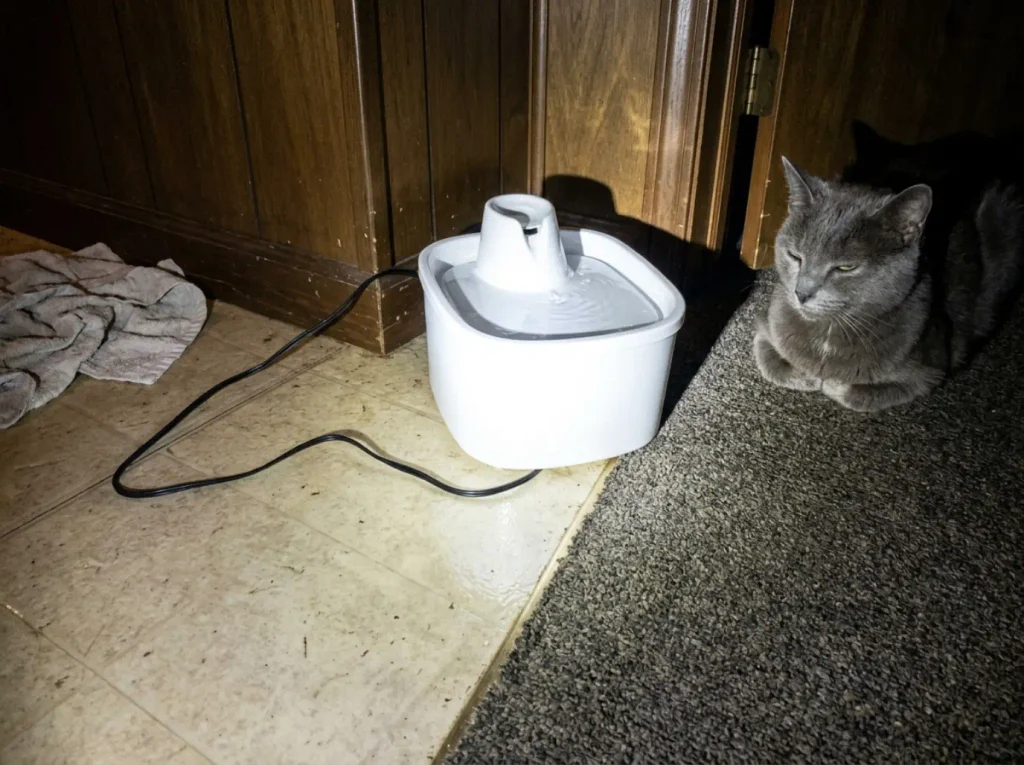
You are past the question of whether the fountain is worth having in the first place. You already have one, or you have already decided to buy one, and the only thing standing between you and the purchase is whether you can sleep next to it. The reason to tolerate a machine in the room at all is simple enough to state once and drop: Cornell’s Feline Health Center puts the daily target at roughly four ounces of water per five pounds of body weight, and a cat on dry food is rarely hitting that from a still bowl.
So the fountain stays. The question is which noise it makes and where that noise is coming from.
Before you spend anything, do the free thing. Fold a towel, or cut a scrap of silicone or neoprene mat, and put it under the base. If the hum drops or disappears, the fountain was never the problem. The floor was, and you just fixed it for nothing.
This is the first move for a reason: a hard floor under a vibrating plastic shell is a soundboard, and a soundboard is louder than the thing driving it.
The Cable Is a Vibration Path, Not Just a Cable
A corded fountain has a pump sitting in the water with a power cable running out of it, through the reservoir, over the lip of the housing, and down to the floor. That cable is the giveaway. It is a rigid physical connection between a spinning motor and every hard surface it touches, and the community has a name for it: an acoustic bridge.
Motor vibration does not stay in the water where it would be damped. It travels the cable into the basin wall, out through the housing, and into whatever the fountain is standing on.
A wireless pump has no such path. The magnetic rotor is driven by induction from a base that never gets wet, or in the newest cordless designs the electrical assembly stays entirely outside the water. Same motor speed, same water volume, and the vibration has nowhere to go but into liquid, which absorbs it. That is the whole mechanism, and it is the single largest difference between a fountain you notice at night and one you do not.
Why the Shell Matters More Than the Motor
Two fountains can run identical pumps and sound nothing alike. Thin ABS plastic is a hollow shell with a resonant frequency, and when the pump happens to sit near that frequency, the housing does exactly what a drum skin does: it takes a small vibration and broadcasts it. Forums call it the acoustic drum effect, which is a better name than anything the manufacturers use.
Dense stainless steel or ceramic has mass, and mass absorbs. It converts the same vibration into a tiny amount of heat instead of a sound you can hear from bed.
This is also why the palm test works, and why it takes five seconds.
Rest a flat hand on the fountain body while it runs. If you can feel the buzz in your palm, the noise is vibration, and a pad under the base will cut most of it. If you feel nothing and still hear it, the noise is water, and no pad on earth changes that. Only the spout design does.
Where the Water Lands
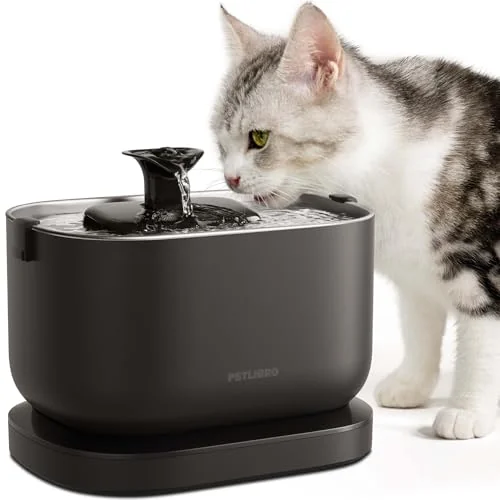
The third source has nothing to do with electricity. An open spout that throws water into the air and lets it free-fall into the basin makes impact noise, continuously, forever. It is the same sound as a slow tap into a full sink, and in a silent bedroom it is arguably worse than a hum because it is irregular. A ramped or wall-hugging spout does not free-fall at all: the water leaves the outlet and slides back down a surface by surface tension, and the impact noise never gets created in the first place.
Which is why “quiet pump” on a listing tells you two-thirds of nothing. A near-silent motor under a tall faucet-style spout is a loud fountain. Check the shape of the water path in the photos before you check the decibel claim.
What Quiet Is, in a Sound You Can Actually Picture
Every listing in this category says whisper quiet. Not one of them says what a whisper is, which makes the phrase worth exactly nothing when you are standing in a store trying to decide.
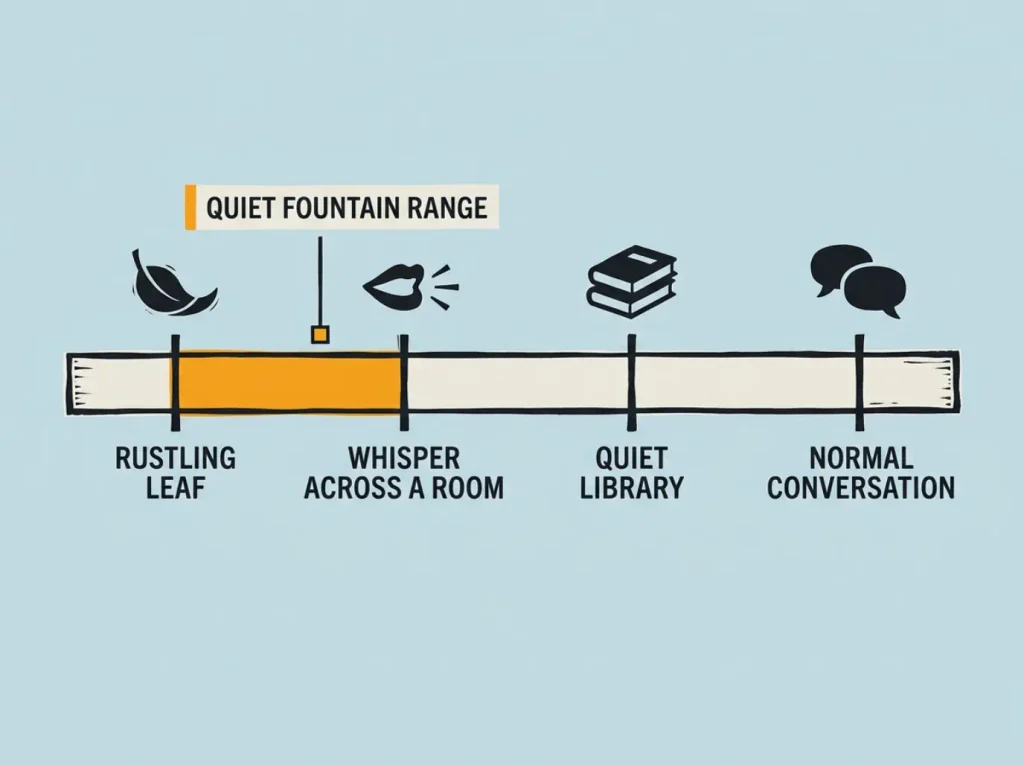
So here is the anchor. A whisper across a room measures around 30dB. A quiet library sits near 40dB. Normal conversation is around 60dB.
Anything under 20dB is below the whisper line and genuinely inaudible from a bed. The 23dB figure that shows up on the better cordless units sits just under a whisper, which in a real bedroom with a fan or street noise means the room’s own background covers it entirely.
The same decibel arithmetic decides whether an automatic litter box can live in a bedroom, and it is worth doing that math once for both machines rather than discovering it twice at 3am.
The Band Worth Shopping For
The number to shop against is not “the quietest fountain made.” It is under 25dB at the distance you will actually sleep from it, and that second half does most of the work. Sound falls off fast with distance. A fountain that is faintly audible at two feet is usually gone at eight, which means the decision is often about where the outlet is rather than which unit you buy.
If the only place a corded fountain can live is on the nightstand, the honest answer is not a quieter fountain — it is a cordless one you can put across the room.
I used to treat the decibel spec as the whole decision and rank fountains by it. What changed my mind is how consistently the complaints in fountain threads arrive at month three from people who bought on that exact number. The spec is a real measurement. It just measures the wrong day.
Why the Spec on the Box Expires
That decibel rating is a day-one number. Plastic housings micro-warp from heat cycling and from going through a dishwasher, and a shell that has shifted even slightly no longer seats the way it did, no longer contains vibration the way it did, and measures higher at six months with a motor that has not changed at all. The pump did not degrade. The box around it did.
The practical version of this: read the three-month and six-month reviews, not the five-star ones posted in week one. Owners buy on the spec and then post two months later that it got loud, and the pattern in those threads is almost never a failed motor. It is a warped shell or a scaled impeller, which are two different fixable things. Which means a fountain thrown out at month four is often a fountain thrown out over a twenty-minute job.
Measuring It from Where You Sleep
You do not need equipment for this. A decibel app on a phone, held at pillow height with the room otherwise silent, gives you a number that is not lab-accurate and does not need to be. What it gives you is a before, so when you slide a mat under the base or move the fountain off the shared wall, you find out whether the change did anything instead of guessing.
Take the reading twice: once with a full tank and once when it is down to the low line. The gap between those two readings is the single most useful thing you will learn about your own fountain.
| Fountain | Pump Type | Housing | Capacity | At Bed Distance |
|---|---|---|---|---|
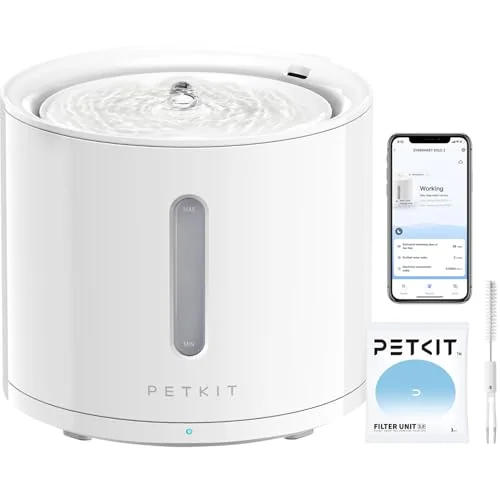
| PETKIT Eversweet Solo 2 | Wireless, magnetic induction | Plastic | 70 oz / 2 L | Under 20dB, below a whisper |
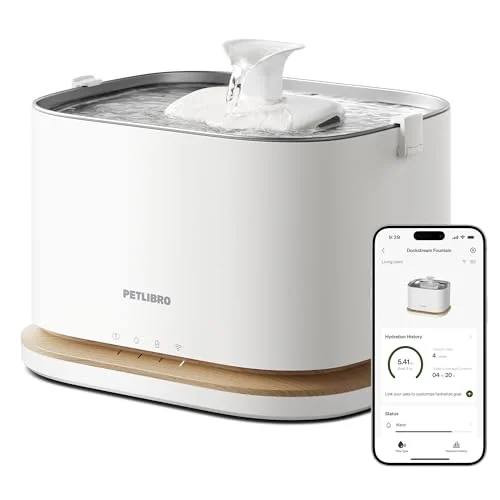
| PETLIBRO Dockstream 2 Cordless | Cordless, base stays dry | Plastic with steel tray | 101 oz / 3 L | 23dB, just under a whisper |
| PETLIBRO Dockstream 1 | Cordless, earlier generation | Plastic with steel tray | 84 oz / 2.5 L | Quiet, older pump design |
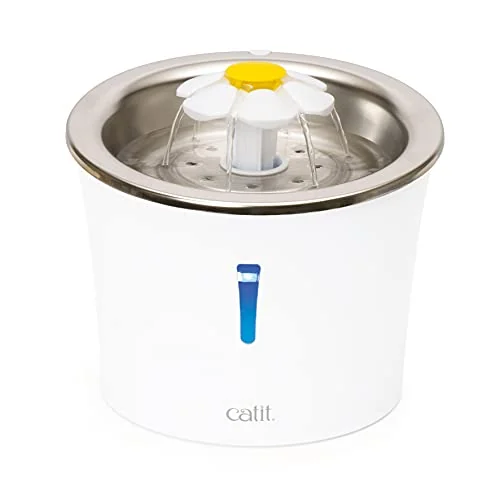
| Catit Stainless Steel Flower Fountain | Corded, submerged | All steel | 3 L | Cable path, dense shell |
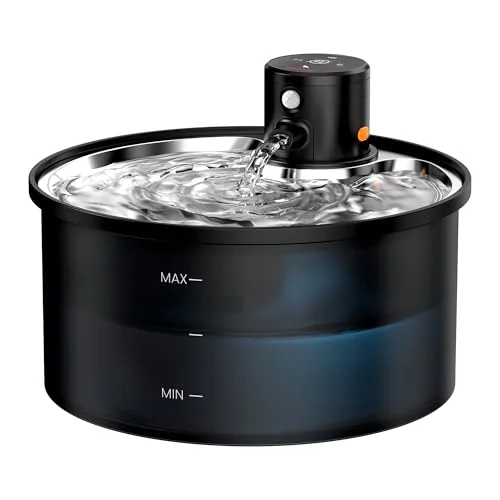
| APD APETDOLA Wireless | Wireless | Stainless steel | 135 fl oz / 4 L | Both noise levers handled |
| Wireless Cordless 108oz | Wireless, motion sensor | Plastic | 108 oz | No cable, resonant shell |
The Materials Question, and the Fountain That Answers It

The steel-versus-plastic argument almost always gets sold on hygiene: porous plastic harbors bacteria, steel does not, buy the steel one. That is true and it is also the weaker half of the case. The noise argument is stronger and nobody makes it, which is odd, because it is the one that decides whether the thing can live in your bedroom.
All-Steel Versus a Steel Tray
Dense material absorbs vibration. Thin material broadcasts it. That single sentence covers the entire mechanism, and its consequence is that a steel fountain and a plastic one drift apart over time rather than starting apart: at month one the difference is modest, and by month six the plastic shell has warped and the steel one has not moved at all.
Read the listing wording carefully, because stainless steel on a product page very often means a steel tray sitting on a plastic body. The tray is the part your cat’s chin touches, which matters for hygiene. The body is the part that resonates, which is the part that matters here.
If you want the full picture on what counts as an all-steel fountain and what is only a steel tray, that distinction gets settled properly there. This section only needs its noise consequence.
Ceramic behaves like steel acoustically, with the same mass and the same absorption. Its problem is different: ceramic chips, and a chipped basin is a hygiene problem rather than a noise one. Not a reason to avoid it. A reason to check the rim every time you refill.
Where the Grinding Noise Really Comes From
A hum and a grind are two different diagnoses. A grinding or rattling sound that shows up months in is almost never the housing and almost never the motor giving out. It is calcium scale built up on the impeller shaft, or a wrap of cat hair that got past the prefilter and wound around it. Both make the rotor fight for every turn, and both produce that dry, irregular rattle that a steady hum never does.
And here is the part that costs people money: replacing the filter does nothing for it. The filter is a cartridge in the water path. The scale is on a spinning shaft inside the pump housing. They are separate jobs with separate schedules, and confusing them is how a working fountain ends up in the trash.
The every-two-weeks filter routine keeps the water clean; it has never once quieted a grinding pump.
Descale before you replace. Pull the impeller out and give it twenty minutes in a 50/50 mix of white vinegar and warm water, then rinse it properly. That soak is the difference between a fountain that grinds and one that does not, and it is a completely different job from swapping the carbon filter, which never fixes a grinding pump no matter how many times you do it.
What a Soak Fixes and What It Does Not
The soak handles scale and it handles hair. It does not handle a cracked housing, a lid that no longer seats, or a rotor that grinds after it has been cleaned properly. Those three are genuine replacement territory.
Everything short of them is a Tuesday-night job with a bottle of vinegar you already own. Most dying fountains are scaled, not dead.
The Bedroom Itself, and the Fountain That Goes in It
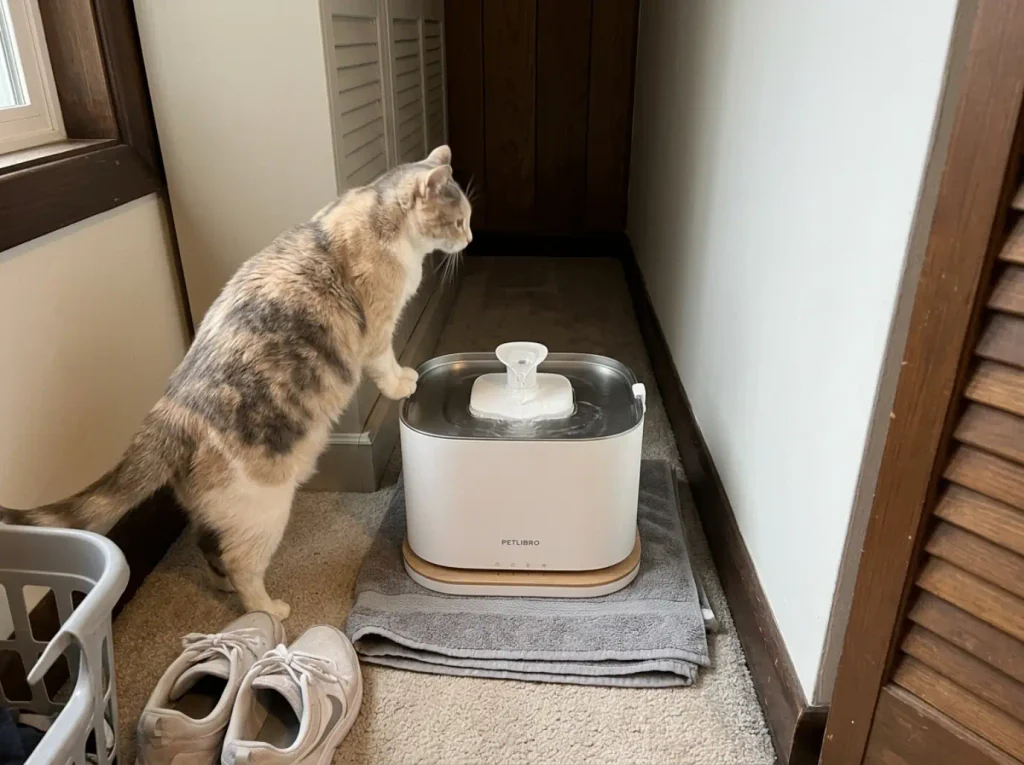
Every guide in this category tests noise in a quiet room and calls that the hard condition. It is not the hard condition. The hard condition is 2am, door closed, cat drinking, and a person who has to be up in five hours. That is the only test this article is actually about, and it has a second half nobody writes down: the cat has to still be able to reach the water.
In the Bedroom Versus Through the Wall
These are two different problems with two different fixes, and people conflate them constantly. The first is a fountain living in the bedroom, a few feet from a pillow, because there is nowhere else, and this is the small-apartment reality and it is more common than the guides assume. The second is a fountain in the kitchen or hallway that you can still hear through a thin wall, which is a transmission problem, not a proximity one.
If it is proximity, distance and surface fix most of it: off the hard floor and onto a mat, out of the corner where the room’s own acoustics gather sound, and as far from the bed as the layout allows. If it is transmission, the fix is different: move it off the wall the bed shares, because a fountain touching a shared wall is feeding vibration directly into the structure. A few inches of air between the housing and the drywall does more than any spec on the box. Whether a fountain belongs in a small apartment at all is a fair question to have settled before you rearrange a bedroom around one.
The Renter Version, No Drilling and One Outlet
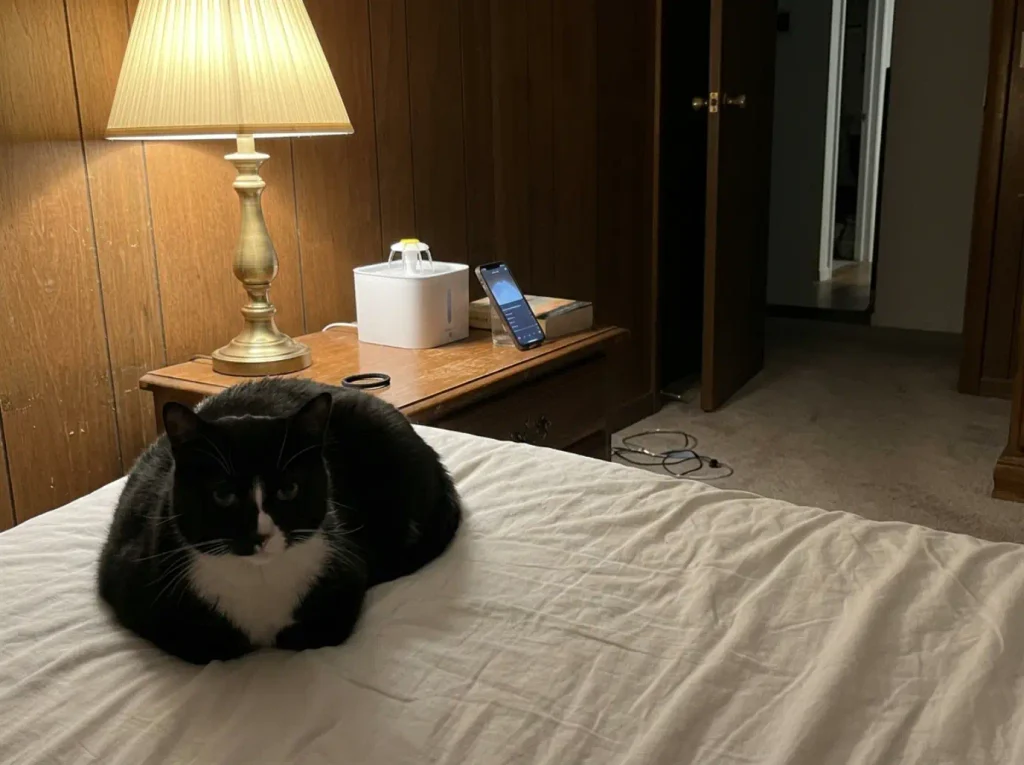
The renter version of this problem has constraints the buying guides never mention. No drilling. Furniture that cannot move because there is nowhere for it to go. And one outlet in the bedroom that already has a lamp and a phone charger in it.
In that room, a cordless fountain stops being a luxury feature and becomes the only thing that unhooks the fountain from where the outlet happens to be, which is almost always the worst possible spot acoustically.
Cordless owners in fountain threads say this themselves, and the reason they give is not the one you would expect. They did not go wireless to avoid running a cable. They went wireless because of vibration through the floor into a downstairs neighbor’s ceiling, which is an apartment problem that simply does not exist in a house.
What a Closed Door Does to the Plan
Here is the part every guide skips, and it is the part where the cat gets a vote. Moving the fountain into the bedroom moves a resource into a room the cat may not have access to at night. If your door closes at bedtime, you have not built a quiet water station. You have built a water station that is offline for eight hours a day, and the cat’s response to that is to go find the bathroom sink or the glass by your bed.
So the rule is blunt: if the door closes, the water goes outside it. The cat is not being difficult about this. He is describing a constraint you created, and he is right about it. A slightly audible fountain in the hallway that he can reach at 4am beats a silent one behind a closed door every single time.
Two Cats, Two Motors
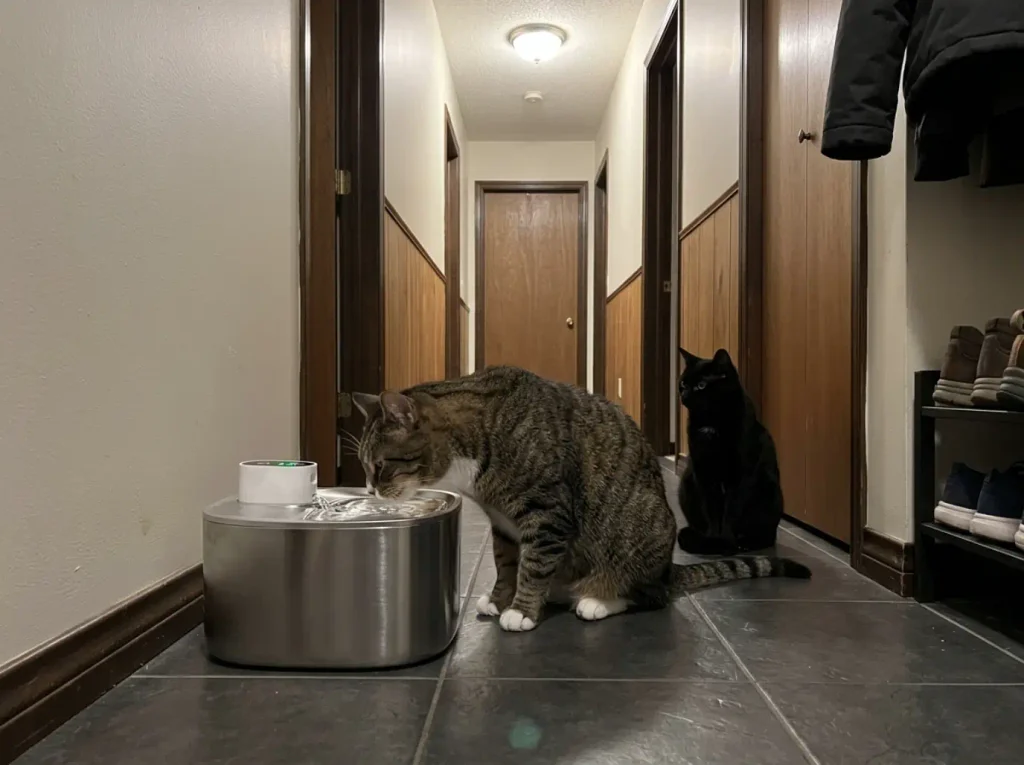
Everyone knows the litter box rule: one box per cat, plus one. Almost nobody applies the same logic to water, and the moment you do, the quiet-fountain question changes shape entirely. Two water stations means two motors, and two quiet things running in one small apartment are louder than one quiet thing.
Worth saying plainly: the 1+1 extension to fountains is this blog reasoning from the litter-box precedent, not a sourced veterinary rule. The noise arithmetic that follows from it, though, is just arithmetic.
One Fountain or Two
The case for two stations is the same case as for two litter boxes, and it has nothing to do with volume. It is about one cat not being able to sit between the other cat and the only water in the apartment. A cat who has to walk past a housemate he is avoiding in order to drink will simply drink less, and you will never see it happen because it happens as an absence.
But before you buy a second unit, move the first one. A single fountain sitting in a corridor, a doorway, or a corner with one way out is a fountain that one cat can hold. The same fountain in a neutral open spot, with two approaches, stops being holdable. That fix is free, takes ten seconds, and solves a good share of what gets diagnosed as a capacity problem.
One Bigger Tank Instead of a Second Motor
If the guarding is genuine and separate stations are the answer, fine. If it is really about running dry, a bigger tank solves it without adding a second motor to the apartment. The capacity bands cluster predictably: around 2 L for a single cat, 2.5 to 3 L for a small multi-cat home, and 3.8 L and up beyond that.
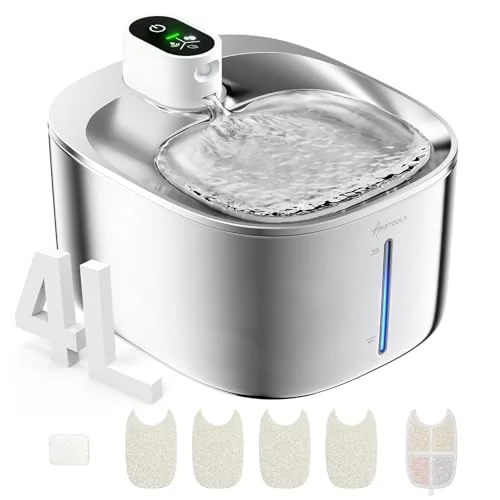
And there is a side benefit worth buying on purpose. Bigger tanks come in heavier housings, and heavier housings resonate less. A 4 L steel unit is quieter than a 2 L plastic one before you even consider the pump, because there is simply more mass in the way. That is not a coincidence in the design; it is mass doing what mass does.
Where the Second One Goes
If both units genuinely have to run, only one of them belongs near the bedroom, and the choice of which is not a coin flip. Two cats who actively avoid each other need two stations more than you need silence. That is the constraint, and it wins. What you get to decide is placement: the quiet unit goes in the room where someone sleeps, the ordinary one goes to the far end of the apartment, and the wall the bed shares stays clear of both.
If you are running two fountains, they do not need to be the same fountain. Put the quiet, expensive one in the room where someone sleeps and an ordinary one at the far end of the apartment. Buying two of the premium unit is paying twice for a problem you only have in one room.
Making the Loud One You Already Own Quieter
Most people reading this already own a fountain, and it used to be quiet. That is a different problem from choosing one, it is usually fixable in ten minutes, and it deserves saying plainly instead of being sold past.
The Four Free Fixes, in Order
Work through these in this order, because they are sorted by how often they turn out to be the answer.
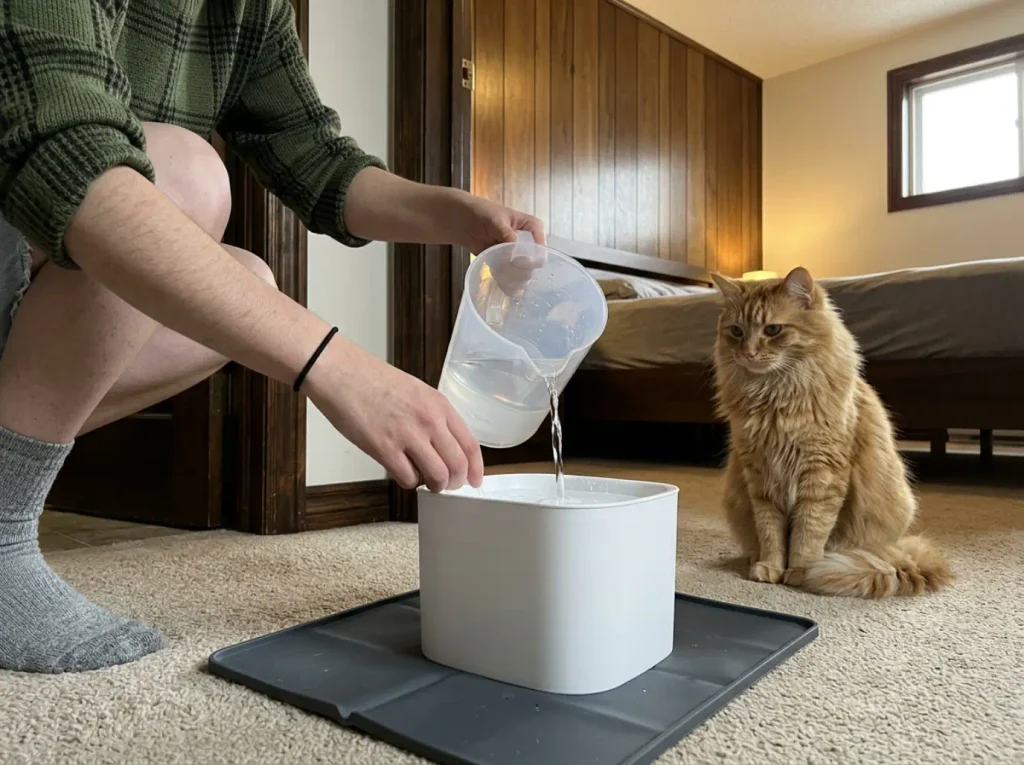
- Refill it to the max line. Low water means the intake pulls in air, which is cavitation, which is that irregular gurgle-buzz that sounds nothing like a healthy hum.
- Put a pad under the base. A folded towel, a silicone mat, a neoprene offcut. This kills floor-transmitted vibration.
- Move it off the shared wall. A few inches of air between the housing and the drywall stops the structure carrying the sound into the next room.
- Descale the impeller. Twenty minutes in 50/50 vinegar and warm water, hair removed from the shaft.
Four fixes, zero dollars. Most loud fountains are fixed by number one.
The Refill Habit That Prevents the Noise
The refill one deserves its own paragraph because it is the big one and because it is not really a hardware fact. A fountain that is silent full and audible low is telling you something about your week, not about its pump. The noise shows up on day four because day four is when the tank crosses the line, and it disappears the moment you top it up, which is exactly why people describe it as intermittent and mysterious.
Put it on a schedule and the sound never gets a chance to appear. The refill and change-out schedule that keeps the tank above the noise line is the same habit the hygiene side of this needs anyway, which is convenient: one routine, two problems. And there is a lower-effort lever alongside it. Many open-spout fountains run noticeably quieter on their lowest flow setting, or with the spout adapter that shipped in the box and went straight into a drawer.
When It Is Actually Time to Replace It
Three honest signals: a motor that still grinds after a proper descale, a cracked housing, or plastic warped enough that the lid no longer seats flush. Anything else is maintenance wearing a costume.
One caveat before you buy on noise alone. Pump failures do happen, and they happen early. A verified buyer reported a cordless pump dying at two months, which left the cats without water until it was noticed.
Quiet and reliable are two separate promises, and a fountain only makes one of them on the box. Read the warranty terms, and keep a plain bowl somewhere as a backup regardless of what you buy.
It also pays to know whether the fountain is changing how much your cat drinks at all before you spend money making a quieter version of something that was not doing much.
What to Do Tonight
Three things carry the whole decision. The cable, the shell, and the drop height are the three noise sources — work out which one you have before you spend a cent, because two of the three are free to fix. A wireless pump paired with a dense housing is the combination that is still quiet at month six, not just on day one. And the band to aim for is under 25dB at the distance you actually sleep from it, remembering that the figure printed on the box is a day-one measurement of a shell that is going to move.
Check back in three weeks. That is long enough to find out two things that both matter: whether the tank is still sitting above the low line, or whether the refill routine quietly stopped after the first week, and whether the cat is still using a fountain that got moved. Both of those fail silently, and three weeks is when they show.
Tonight, do the free version. Fill it to the line, slide a folded towel underneath, and pull it a few inches off the wall the bed shares. Three changes, no purchase. If the room goes quiet, you just kept the money.
Amazon’s Audible — free for 30 days
Your cat won’t let you read. Let someone read to you.
Audible is Amazon’s audiobook library — thousands of titles, read out loud, on your phone. Free for a month, plus one audiobook to keep forever.
Frequently Asked Questions
01What cat fountains do vets recommend?
Vets tend to recommend a fountain by what it is made of and how easily it comes apart to be scrubbed, not by brand: steel or ceramic over porous plastic. If your cat has a diagnosed urinary or kidney condition, the fountain question belongs in that conversation with your own vet rather than in a buying guide.
02What type of water fountain makes the most noise?
A corded pump in a thin plastic housing with an open, falling spout — all three noise sources at once. The cable conducts motor vibration into the shell, the shell amplifies it, and the falling water adds continuous splash on top of the hum.
03What is the best water fountain that cats cannot knock over?
Weight and a low center of gravity do it, which is why steel-bodied fountains with wide bases are the hard ones to tip. A full tank also helps: most tipping happens when the water is low and the unit is light, which is the same moment it starts making noise.
04Are there any cat fountains that do not need to be plugged in?
Yes. Cordless fountains run on a rechargeable battery for up to about thirty days, which is what makes them practical for a bedroom with one occupied outlet. Most run in motion-sensing mode rather than continuous flow to save battery, and a few cats ignore a fountain that only starts when they approach.



Leave a comment