Best Stainless Steel Cat Fountain That Is All Steel
Don't buy a stainless steel cat fountain until you check the tank and the pump housing (most are steel trays on plastic) + the 4 that pass.

Alfredo RamsesFounder · August 26, 2026 · 22 min read


On this page8 sections
- 1What "Stainless Steel" Covers on a Cat Fountain, and What It Does Not
- 2Why Plastic Fails at the Chin Line and Steel Does Not
- 3One Cat, Three Cats, and the Capacity Nobody Prints
- 4What Steel Costs You, the Cord and the Hum
- 5The Four That Survive the Check
- 6Keeping a Steel Fountain Working Past Month Six
- 7Conclusion
- 8Frequently Asked Questions
You already decided plastic was the problem. Somebody in a fountain thread put it the way most people eventually do: they bought the stainless one specifically to keep plastic away from the chin, and only found out after unboxing that the whole inside of it was still plastic.
That is not a rare unboxing. A manufacturer that sells these things says out loud that most units mix materials on purpose, because a full steel tank costs more to make than a steel tray does, and the word on the box only ever described the tray. So here is what “stainless steel” actually covers on a given listing, the four units that survive the check, and the two things steel quietly costs you.
Quick Answer
Most fountains sold as stainless steel are a steel tray on a plastic tank. Four things to know before you buy:
- The word usually describes only the drinking tray or the lid
- Check the reservoir and the pump housing in the spec line, not the title
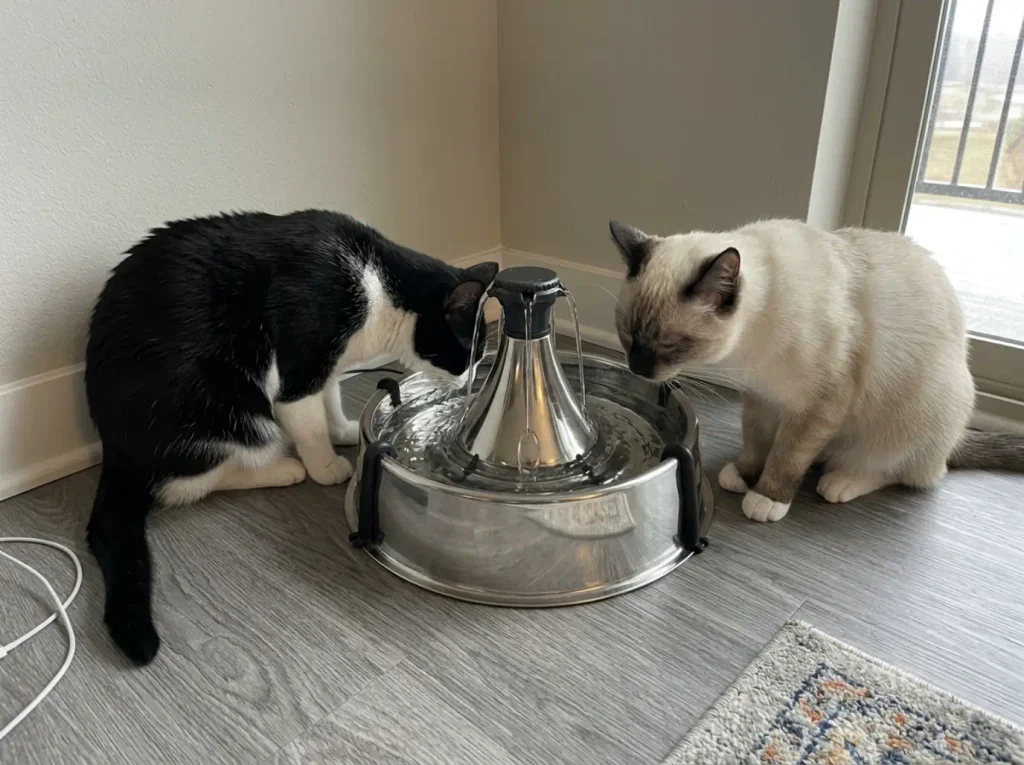
- The Pioneer Pet Raindrop is the all-steel bowl benchmark, at one-cat size
- Steel usually costs you a cord and some hum, unless you go cordless
What “Stainless Steel” Covers on a Cat Fountain, and What It Does Not
You paid the steel premium to keep plastic away from your cat’s face, and then the tank the water sits in all week is plastic. Nobody lied to you on the box. They described the tray, accurately, and let you fill in the rest. If you have not settled on a fountain type at all yet, go back a step and work out which kind of fountain suits the cat you actually have before you start arguing about metal, because material is the second decision and not the first.
The four surfaces water touches
A fountain has four surfaces in contact with water, and they are not equally likely to be metal. There is the drinking tray or bowl, which is what your cat’s chin rests against. There is the reservoir, the water tank where two to four liters sit still for days.
Then there is the pump housing, the plastic shell around the motor, submerged the entire time. And there is the spigot or water outlet, the piece the water actually falls through.
Most people arrive at a fountain through hydration in the first place, because cats have a low thirst drive and drink better from running water than from a bowl that has sat still all day. That is the premise this article takes as settled. Rank those four surfaces by how much they matter and the tray comes first, because that is the contact point, and because a shallow wide tray is also what keeps whisker fatigue off the table. Rank them by how much water they touch and by how long, and the tray comes last.
The tank holds the standing volume. The pump housing sits under it, permanently wet, in the warmest part of the unit. Those are the two the word “stainless” almost never describes.
Search the listing page for the word “plastic” before you search it for “stainless.” The order matters. “Stainless” is in the product title where you cannot miss it; “plastic” is down in the materials line where you have to go looking. If the page uses both words, the second one is telling you where the first one stops.
Why a steel tray on a plastic tank is the normal build
This is worth saying plainly, because the internet’s instinct is to call it a scam and that gets the decision wrong. Hybrids exist for a boring reason: cost. Aitakon, which manufactures in this category, states that the reservoir and pump housing usually stay plastic even when the fountain is marketed as stainless steel, and puts it down to cost and supply chain. That is a company arguing against its own marketing copy, which makes it the most useful line in the category.
And the tank is not even the whole trap. A teardown of one popular stainless model found a three-piece plastic spigot, a three-piece plastic pump, and a plastic pump holder inside a unit sold on the strength of its metal. Those are the guts. A product photo shows you a gleaming bowl from above and there is no angle from which it shows you nine plastic sub-parts underneath.
The one line on the listing that tells you the truth
Read past the word stainless in the materials line. If “BPA-free plastic” appears anywhere in that list, plastic still touches the water somewhere in that fountain, and your job is to find out where. Sometimes it is only the outlet, which is a fair trade. Sometimes it is the tank, the housing, and the spigot, which means you bought a plastic fountain with a metal hat.
Here is the part that decides whether any of this matters, and it is the reason the next section exists. If the plastic in your hybrid is the tank, and the steel is the tray, you have covered the surface that touches your cat and left the rest to a filter and a cleaning schedule. That is a defensible purchase. But if the steel is the lid and the plastic is the dish, you have it exactly backwards, and you have bought the ornament instead of the fix.
Why Plastic Fails at the Chin Line and Steel Does Not
You have a feeling plastic is worse and you are right, but probably not for the reason you would give if someone asked. It is not that plastic is dirty. Plastic comes out of the dishwasher just as clean as steel does. It is that a cat’s tongue makes it dirty in a way a sponge stops being able to reach.
What a cat’s tongue does to a plastic bowl in a month
A cat’s tongue is covered in backward-facing keratin barbs. They are built to strip meat off bone and to drag through fur, and they are dragged across the rim and the floor of a drinking dish several dozen times a day. Plastic loses that argument. So does the scouring side of your sponge, every wash, and so does a claw catching the edge.
The scale is the part nobody publishes. The grooves that result are micro-scratches in plastic, some under 50 microns wide, exactly the size bacteria need to take hold — narrower than a human hair and far too small to see under kitchen light. A bowl that looks flawless can be thoroughly grooved. That is the whole problem with judging a plastic dish by eye: by the time you can see the wear, you are years past the point where it started.
304 stainless steel, the food-grade grade, is non-porous at that scale and genuinely scratch-resistant where plastic is not. It starts smooth and it stays smooth under the same tongue, the same sponge, and the same claw.
Why steel does not need to be scrubbed harder
Once biofilm has established itself inside a scratch, ordinary cleaning does not reach it. Not because you are cleaning wrong, but because a cloth spans the groove instead of entering it. You can wash that dish daily and the colony inside the scratch is unaffected, which is the frustrating version of this problem: everything you can see is clean.
That is the actual difference between the materials, and it is smaller and more specific than the marketing suggests. Steel does not need to be scrubbed harder to stay clean. Plastic does, and past a certain amount of wear it cannot be scrubbed clean at all.
Neither material excuses you from the job, though. Steel lowers the difficulty; it does not remove the task, and the cleaning routine that actually keeps a fountain clean still runs on the same calendar whatever the bowl is made of.
Which brings the whole thing back to the trap in the section above. Bacteria colonized in those grooves transfer on contact, and the point of contact is the rim where your cat’s chin rests while drinking. A steel tray on a plastic tank protects the surface that matters. A steel lid over a plastic dish leaves the scratched surface exactly where the chin lands, and sells you the word anyway.
Where this stops being a fountain question
One boundary, stated once. Everything above is a property of two materials. If your cat’s chin is already broken out or sore, that is a vet visit, not a shopping decision, and no fountain in this article is a treatment for it. Get it looked at, and treat the material question as what it is: one variable you can remove from the environment while somebody qualified handles the rest.
Back to the equipment.
One Cat, Three Cats, and the Capacity Nobody Prints
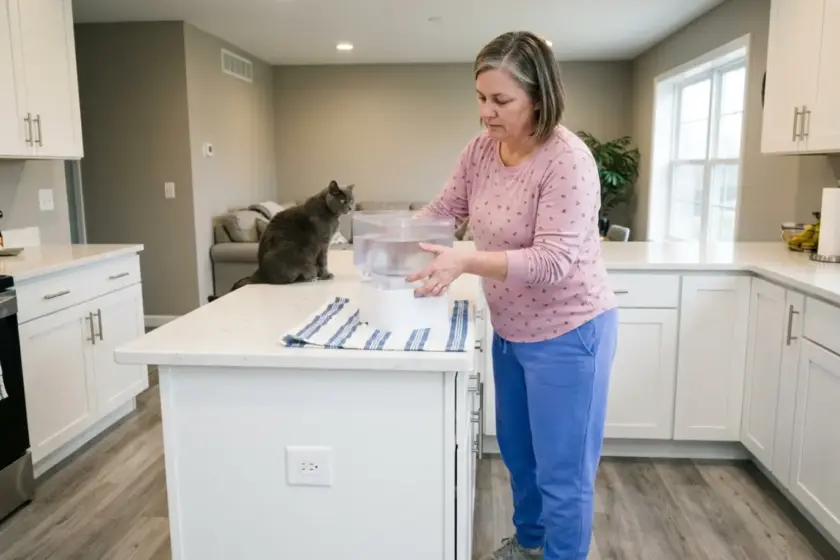
The box says multi-pet. Multi-pet is not a number, and every roundup in this category repeats the phrase without turning it into one. Three cats on a 60-ounce tank means you are refilling every other day, which means some days you forget, which means the fountain is empty on exactly the day nobody notices.
The liters a household actually needs
The working thresholds are simpler than the spec sheets make them look. Somewhere around 2 to 3 liters is the realistic minimum for more than one cat if you do not want to be topping it up constantly. Between 2.5 and 3.8 liters covers three or more cats without running dry between your normal maintenance days. And anything in the 1.4 to 1.8 liter bracket is a single-cat fountain in practice, whatever the box says about multiple pets.
So a 60 oz tank is 1.8 liters, and 1.8 liters is one cat. That is not a criticism of any unit that size. It is the unit’s honest job, and a fountain that does one cat properly is worth more than one that does three badly. The day-to-day question of how often the water actually needs changing runs on its own clock anyway, and it is not the same clock as running dry.
Why four cats changes the answer from tank size to station count
Above roughly four cats, buying a bigger tank stops working, and the reason is not volume. It is that one water station is one place, and one place is a chokepoint. The N+1 guideline — one station per cat plus one spare — exists because cats guard resources, and a cat who waits for another cat to finish sometimes just does not drink.
I used to treat this as a capacity problem and reach for the biggest tank on the page. After enough multi-cat threads describing the same thing (bigger fountain bought, same cat still not using it, still drinking from the bathroom faucet) it is clearly a geography problem wearing a capacity problem’s clothes. Two smaller stations in two rooms beat one large tank in a hallway, every time, and they cost about the same.
What to try before buying anything
Before you buy any of this, do the free version. Take a bowl you already own, fill it, and put it in a second room away from the food. Give it three days.
In a single-cat household that test usually settles it on its own. If both get used, your problem was station count and you have just diagnosed it for nothing. If the second bowl stays untouched and the fountain keeps emptying, then you have a genuine capacity question in a multi-cat household, and it is worth spending money on.
That test costs a bowl and three days. It is the single most useful thing in this article and it is the part people skip.
What Steel Costs You, the Cord and the Hum

The reason nobody warns you about this is structural. Every big roundup on the first page is comparing fifteen fountains across every material at once, so the pattern gets averaged into nothing. Scope the list to steel alone and it jumps out immediately: the quiet ones are usually the plastic ones.
Why steel usually means corded
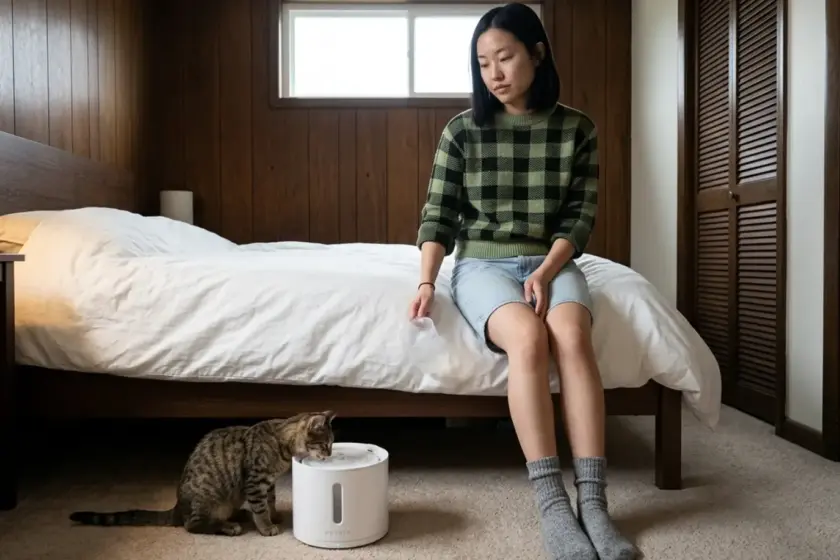
Cordless pumps run somewhere under 20 to 25 dB. Traditional submersible pumps, which is what steel fountains overwhelmingly use, run 30 to 40 dB. That is not a huge number on paper and it is a very noticeable one at two in the morning in a studio apartment where the kitchen and the bed are eleven feet apart.
Steel tends to mean corded, and corded tends to mean audible. Not always, and the exception is below. But if you are shopping by material and you assumed the heavier, more expensive, more grown-up option would also be the quieter one, that assumption is backwards.
The metal body that makes the pump louder, not quieter
Here is the genuinely counterintuitive one. A steel housing can act as a resonance chamber for pump vibration, amplifying a hum that a plastic body would have absorbed. Two fountains running the identical pump can sound different, and the metal one can be the loud one, purely because metal transmits vibration and plastic damps it.
That is not a defect and it will not appear in any spec sheet, because decibel ratings are measured on the pump and not on the assembled unit sitting on your countertop. Which is also the good news: it is a transmission problem, and transmission problems have free fixes.
Before you decide a fountain is too loud, get it off the hard surface. A mat or a folded towel under a metal body removes most of the hum, because a good part of what you are hearing is the countertop working as a soundboard. It costs nothing, it takes ten seconds, and it is the fix people skip on the way to returning the unit.
Where the outlet decides the purchase
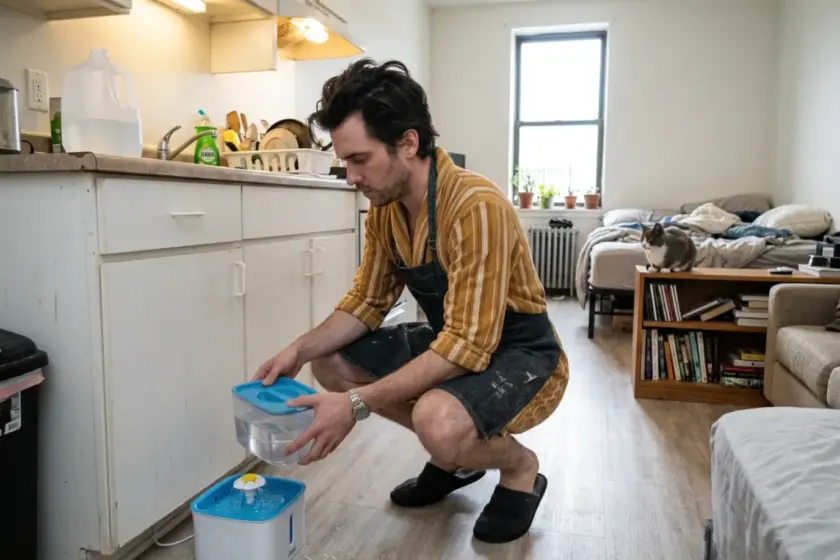
This next part is our own reading rather than something a source handed us, and it decides more purchases than any spec on the page. A corded fountain has to live within reach of an outlet, so outlet placement quietly becomes the spec that matters. A rental kitchen almost never has one where the feeding station belongs, and the feeding station belongs away from the litter box, away from the food if you want the cat to actually use it, and out of the walkway.
Running an extension cord across a small apartment floor to solve it is not a fix, it is a trip hazard with a cat attached, and a power cord taped to a rental baseboard is a deposit conversation waiting to happen. That is what makes a cordless unit renter-friendly in a way the spec sheet never says out loud.
So you end up with three constraints and one socket. Either the fountain goes where the cord reaches and the cat under-uses it, or you run an extension lead across a floor you walk on at night, which is its own set of problems that the cord, the noise, and where a fountain can safely live in a rental goes through properly. Measure the distance from the socket to where the water should actually be before you spend anything. If the answer is more than the cord, you are shopping for a cordless unit and the material question just got smaller.
The one place weight works in your favor
Steel wins one of these outright. A metal-bodied unit is heavy, and heavy resists being shoved, tipped, or systematically dismantled by a determined cat. A large breed at full lean can move a lightweight plastic fountain across a counter, and a cat who discovers a fountain can be tipped has found a new hobby.
No roundup lists heft as a reason to buy, and for some households it is the only reason that matters. A wireless pump removes the cord problem entirely, and separately a heavy fountain resists tampering in a way a lightweight fountain cannot.
It is worth saying the internals do not get the same protection, though. Owner reports on one stainless model put motor failure somewhere around the six-month mark, with replacement pumps occasionally shipping without the plastic clip that holds the assembly together. The shell is steel. The thing that actually breaks is not.
The Four That Survive the Check
Four is a short list, and it is short on purpose. Everything that turned out to be a steel lid on a plastic dish is not here, which is the entire value of the section. A fifth candidate got cut for being plastic-bodied, and padding this table to a rounder number with a hybrid would have argued against everything above it.
| Model | Capacity | What is actually steel | Power | Best for |
|---|---|---|---|---|
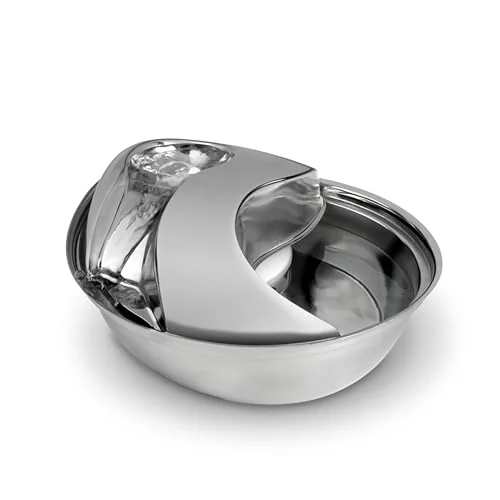
| Pioneer Pet Raindrop | 60 oz / 1.8 L | The whole 18/8 bowl | Corded | One cat, best drinking surface |
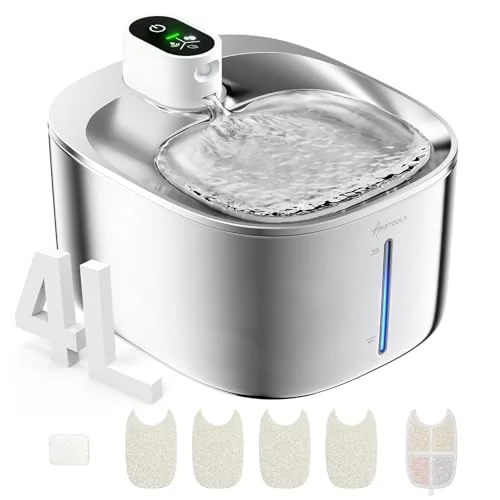
| APD APETDOLA Wireless | 135 oz / 4 L | Body and basin | Cordless | No outlet near the station |
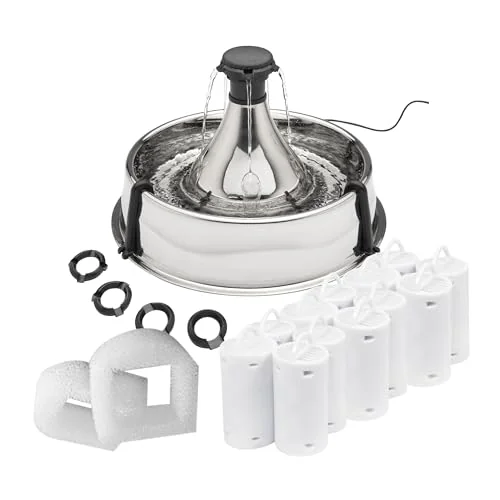
| PetSafe Drinkwell Stainless 360 | 128 oz / 3.8 L | 360-degree drinking edge | Corded | Three or more cats |
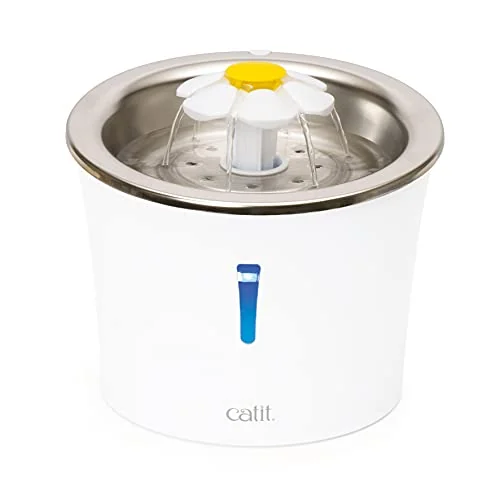
| Catit Stainless Steel Flower | 3 L / 101 oz | Top section only | Corded | Two or three cats, lower spend |
What each one had to pass to be here
Three tests, and they are the ones this article has been building. Metal where the cat’s chin touches, because a steel component nowhere near the mouth is decoration. Honest capacity labeling, meaning the number on the box matches the household the unit can actually serve. And currently available, which sounds trivial until you notice how many “best stainless” picks in older roundups are discontinued.
Notice the third column of that table is doing real work. Two of these four are genuine at the contact surface, and two of them are honest hybrids where the steel covers part of the job. That is not a ranking. It is the information the other roundups leave out, and it is what lets you decide which compromise you are making.
The multi-cat pick, and the capacity it actually clears
The Drinkwell is here for the reason the section on capacity set up: 3.8 liters clears the three-plus-cat threshold, so it is one of the few steel units that can honestly claim the label. But the tank size is the less interesting half. The 360-degree edge means several cats drink from different sides at once, which removes the single-bowl chokepoint that turns a shared water station into a queue.
The value pick, and what it gives up
If two or three cats is your number and the Drinkwell is more fountain than the situation calls for, 3 liters lands inside the comfortable zone at a lower spend. What you give up is stated plainly below, and it is exactly the compromise the first section taught you to look for.
And one honest counter-fact, because the whole section falls apart without it. Full-metal costs more than a steel-tray hybrid of the same capacity. That gap is real, and hybrids are not a con.
If what you want is the hygiene win at the surface your cat’s chin touches, a hybrid is a legitimate middle ground, and the only thing that makes it a bad purchase is not knowing that is what you bought. Which is the point of the first section, arriving back where it started.
Keeping a Steel Fountain Working Past Month Six
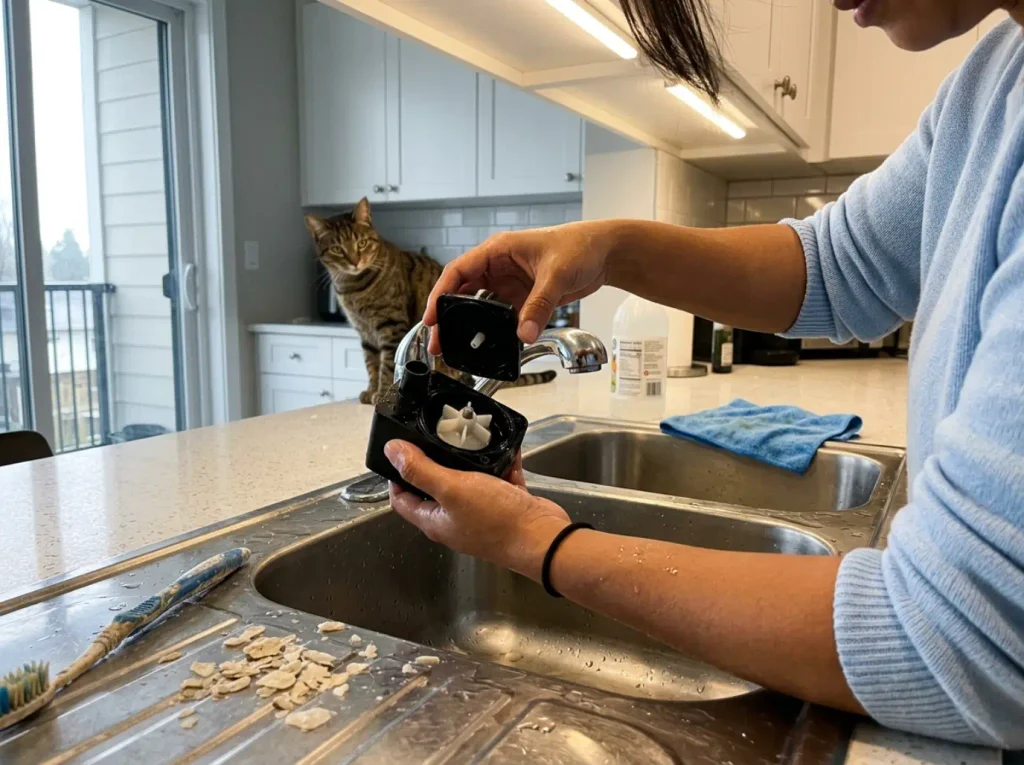
The fountain that fails is almost never the one that broke. It is the one that got harder to clean than you had time for, so it got cleaned less often, so it got worse, and somewhere around month four it quietly became a bowl with a motor in it.
The filter clock steel does not change
Filter replacement runs 2 to 4 weeks regardless of material, driven by water hardness and how many cats are drinking from it, and an activated carbon filter ages on the same clock in a steel unit as in a plastic one. Steel buys you nothing here. If you went metal expecting the maintenance calendar to relax, it does not, and a fountain that goes six weeks on a carbon filter is a fountain circulating water through a saturated sponge.
What steel does change is the deep clean, and it changes it more than the marketing bothers to explain. A non-porous bowl comes clean with a normal wash, and a steel bowl is usually dishwasher safe where a printed plastic one warps on the top rack. A scratched plastic one needs a brush worked into grooves you cannot see, which is why so many people quietly downgrade the job to a rinse.
The pump is still the part that dies
Everything above the waterline can be immaculate metal and the motor will still be the thing that ends the fountain’s life. Owner reports on stainless units put failure somewhere around the six-month mark on some models, and replacement pumps that ship without the plastic clip holding the assembly together are a documented complaint rather than a rare one.
So check that the pump is sold as a separate part before you buy the fountain, not after it stops. It takes two minutes on the manufacturer’s site and it is the difference between a fountain with a repair path and a fountain with an expiry date.
Search the manufacturer’s site for the replacement pump before you buy the fountain. If the pump is not sold on its own, the fountain has a shelf life equal to its motor, and you are buying a two-year appliance dressed as a permanent one.
Fewer plastic pieces, less work every two weeks
Every plastic sub-part inside a “stainless” unit is one more thing to take apart, rinse, dry and reassemble on cleaning day. A three-piece spigot is three pieces. A three-piece pump plus its holder is four more. That is seven small wet objects on your draining board every two weeks, and the honest thing to say about it is that this is where good intentions go to die.
Which is why the two-piece build from earlier matters beyond hygiene. Fewer pieces is a real feature that no spec sheet lists, and it does more for long-term cleanliness than the material does, because the fountain that gets cleaned is the one that is easy to clean. If you are already tired reading this, that is useful information about your own tolerance, and whether a fountain changes how much a cat actually drinks is a fair question to ask before committing to the maintenance at all.
Conclusion
Read the spec line past the word stainless. If plastic appears anywhere in the parts list, plastic still touches the water, and your only job is to find out whether it is the tank, the housing, or the surface under your cat’s chin.
Capacity is not marketing. 1.8 liters is one cat, 2.5 to 3.8 liters covers three, and above four cats it stops being a tank question and becomes a station-count one that no bigger fountain will answer.
Steel usually costs you a cord and some hum. Measure from your socket to where the water should actually be, and if the cord does not reach, that decides the purchase before any material spec does.
Pull the pump at three months and look at the impeller. Descale it if your water is hard. Three months is the right interval here specifically because this is slow wear on an object rather than something your cat has to accept, and a pump gives you no warning before it stops.
Before any of that, move the bowl you already own into a second room. Give it three days. If both get used, you had a station problem instead of a fountain problem, and you just solved it for free.
Amazon’s Audible — free for 30 days
Your cat won’t let you read. Let someone read to you.
Audible is Amazon’s audiobook library — thousands of titles, read out loud, on your phone. Free for a month, plus one audiobook to keep forever.
Frequently Asked Questions
01Is a stainless steel water fountain better for cats?
At the surface a cat’s chin touches, yes. 304 stainless is non-porous, so it does not develop the micro-scratches that shelter bacteria in plastic. The catch is that many fountains sold as stainless use steel only for the tray, so the advantage depends entirely on which parts are actually metal.
02Which type of cat fountain is better, ceramic or stainless steel?
Both are non-porous and both beat plastic at the drinking surface. Stainless is harder to break and lighter to lift for cleaning; ceramic is quieter, because it does not transmit pump vibration the way a metal body can. If noise matters more than durability, ceramic has the edge.
03What water fountain do vets recommend for cats?
There is no single model with veterinary consensus behind it, and any listing claiming one is marketing. What veterinary sources do support is the principle: accessible, clean water in more than one location. That is a placement question more than a product one.
04How do I know if a fountain is really all stainless steel?
Read the materials line rather than the title, and look for the reservoir and the pump housing specifically. If the spec sheet lists BPA-free plastic among the parts, plastic is still in contact with the water somewhere, whatever the product name says.
05Are stainless steel cat fountains louder than plastic ones?
Often, yes, for two reasons. Steel units usually use corded submersible pumps running 30-40 dB against under 25 dB for cordless ones, and a metal body can act as a resonance chamber that amplifies the hum instead of damping it. Putting the fountain on a mat removes a surprising amount of it.
Leave a comment