What Size Litter Box a Cat Needs, in Inches
An 18-inch cat needs a 27-inch box (the AAHA rule is 1.5x body length). Store "large" pans run 18-20. Full sizing chart + how to measure.

Alfredo RamsesFounder · August 25, 2026 · 19 min read

On this page8 sections
- 1The Rule Is About the Cat, Not the Box
- 2How to Measure a Cat That Will Not Hold Still
- 3What the Formula Turns Into, in Inches
- 4Why the Box Marked "Large" Is Not Large
- 5The Cat Is Already Telling You It's Too Small
- 6When the Right Box Doesn't Fit the Room
- 7The Numbers, and What to Do Tonight
- 8Frequently Asked Questions
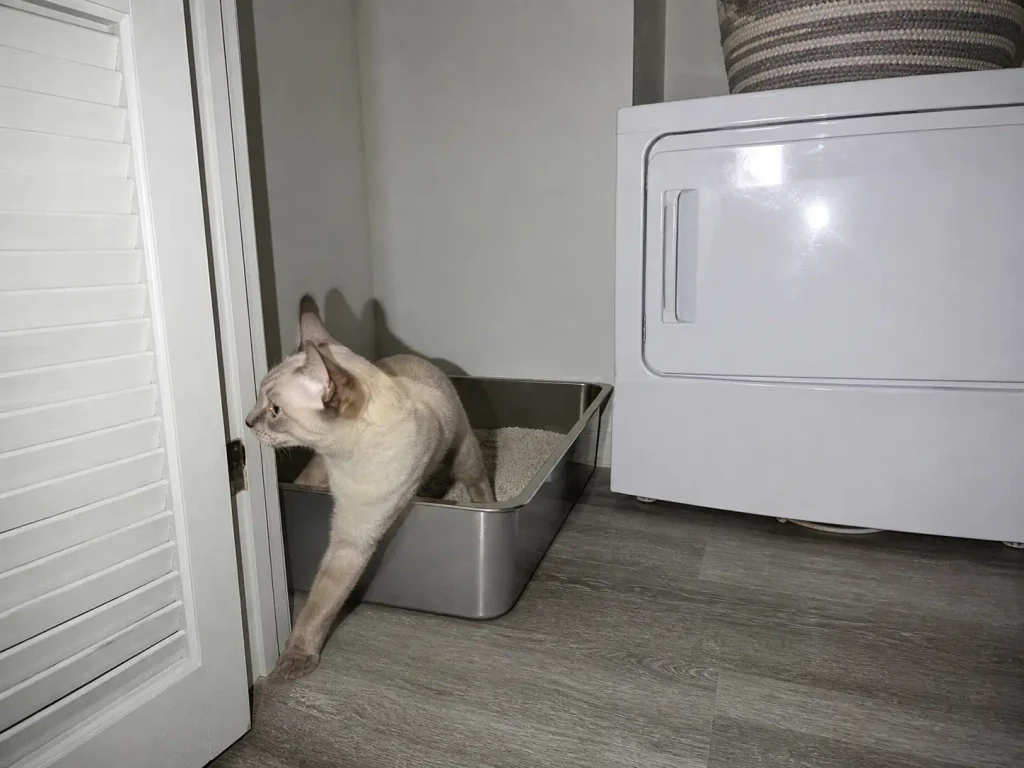
He isn’t being difficult about the box. He’s standing in it with his front paws in and his back feet on the tile, and that posture is the whole complaint: the box is shorter than he is, and he has run out of ways to say so.
The rule that fixes it isn’t a preference or a brand recommendation. Two veterinary bodies put a number on litter box size years ago, and the number isn’t about the box at all, which is why nobody standing in the pet aisle has ever managed to use it. Here’s the formula, how to measure a cat who has no intention of holding still, what the answer looks like in actual inches, why the box stamped LARGE is not large, and what to do when the right box is bigger than the spot you had in mind for it.
Quick Answer
A litter box should be at least 1.5 times your cat’s body length, measured nose to the base of the tail with the tail excluded. For an average adult cat of 15 to 20 inches, that’s 24 to 30 inches of interior length, with 24 inches as the floor even for a small cat. Interior width should be 15 to 18 inches. Large breeds need 27 to 33 inches.
The Rule Is About the Cat, Not the Box
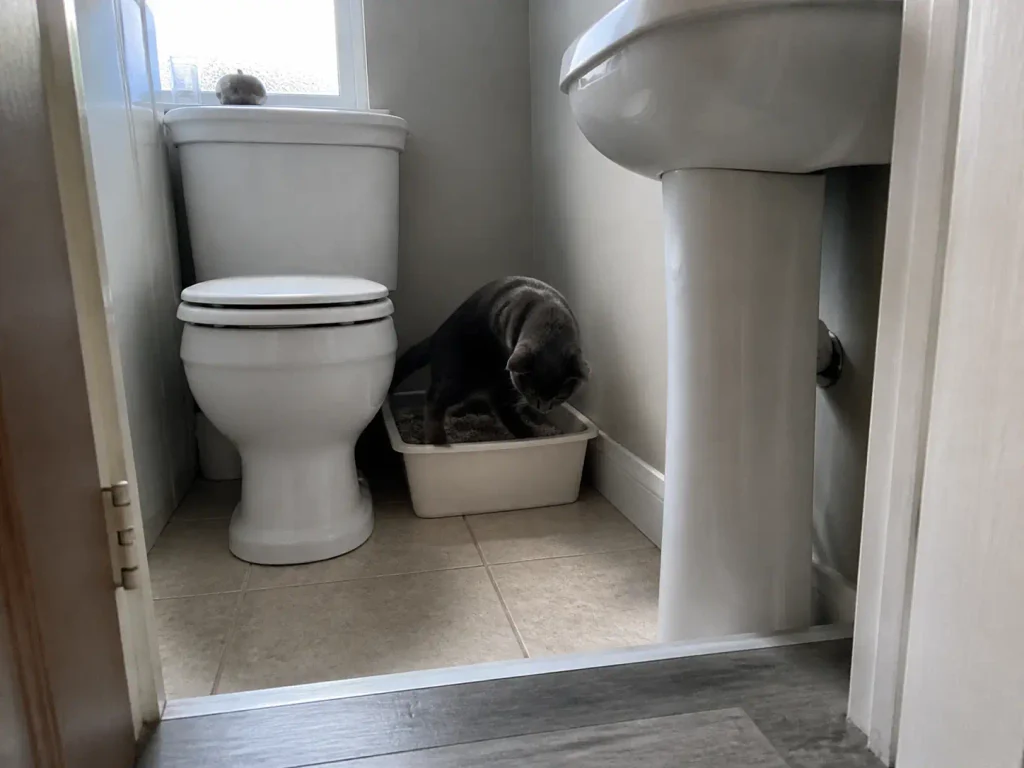
Everyone who has ever bought a litter box bought it by looking at the litter box. You stood in front of a shelf, compared three plastic pans to each other, and picked the one that seemed roomiest relative to the other two. Nobody in the history of the pet aisle has walked in holding a measurement of their own cat. That is the entire problem, and sixty seconds with a tape measure undoes it.
The rule exists and it’s not a blog invention. The AAHA and AAFP’s joint feline life-stage guidelines recommend a box at least 1.5 times the cat’s body length, measured nose to the base of the tail. Body length, not total length. The tail is excluded on purpose, and that exclusion does more work than it looks like it does.
Tails are not part of the geometry problem. A cat needs floor space for his shoulders and hindquarters; the tail goes up, or over the rim, or wherever it likes. Include it and you inflate the number for exactly the cats where inflation is least useful. A Maine Coon’s tail can add most of a foot of pure nothing to your arithmetic, and a Manx would come out needing a shoebox.
Measure him stretched out asleep on his side, not sitting up. A sitting cat folds most of his own length underneath himself and reads three or four inches shorter than he is. Measure the loaf and you will buy the box that fits the loaf.
What raises this above a comfort preference is what the same guidelines say next: an undersized box is named as a common environmental cause of house-soiling, and house-soiling is one of the leading behavioral reasons cats end up surrendered to shelters. That’s the actual stake. Not a slightly happier cat. A box that’s seven inches short sits on a documented list of reasons cats lose their homes.
The 1.5 multiplier isn’t arbitrary either, once you watch what a cat is actually doing in there. He turns, he digs, and he positions himself, which involves backing up. Then he turns again, covering waste on the way out. Four separate movements, and none of them is “stand still.”
The box has to be big enough for the longest of the four, and the shortest is the only one that fits in a 19-inch pan. That’s why a box that seems fine when he’s just standing in it stops being fine the second he starts working.
The pattern that follows is depressingly consistent. Someone spends months rotating through litters, switching brands, buying a mat, buying a deodorizer, quietly concluding the cat is being difficult, and then lays a tape measure along a sleeping cat and gets their answer in under a minute. It was never a litter problem. Size is the first of several things worth getting right when you’re choosing a litter box by size, sides and entry, but it’s the one that makes the others irrelevant if you skip it.
How to Measure a Cat That Will Not Hold Still
“Measure your cat” is an instruction written for a cat who agrees to be measured. Nobody has that cat. What you have is an animal who interprets a tape measure as either a toy or an accusation and leaves the room on principle. So here’s the version that assumes you don’t have the cooperative cat either.
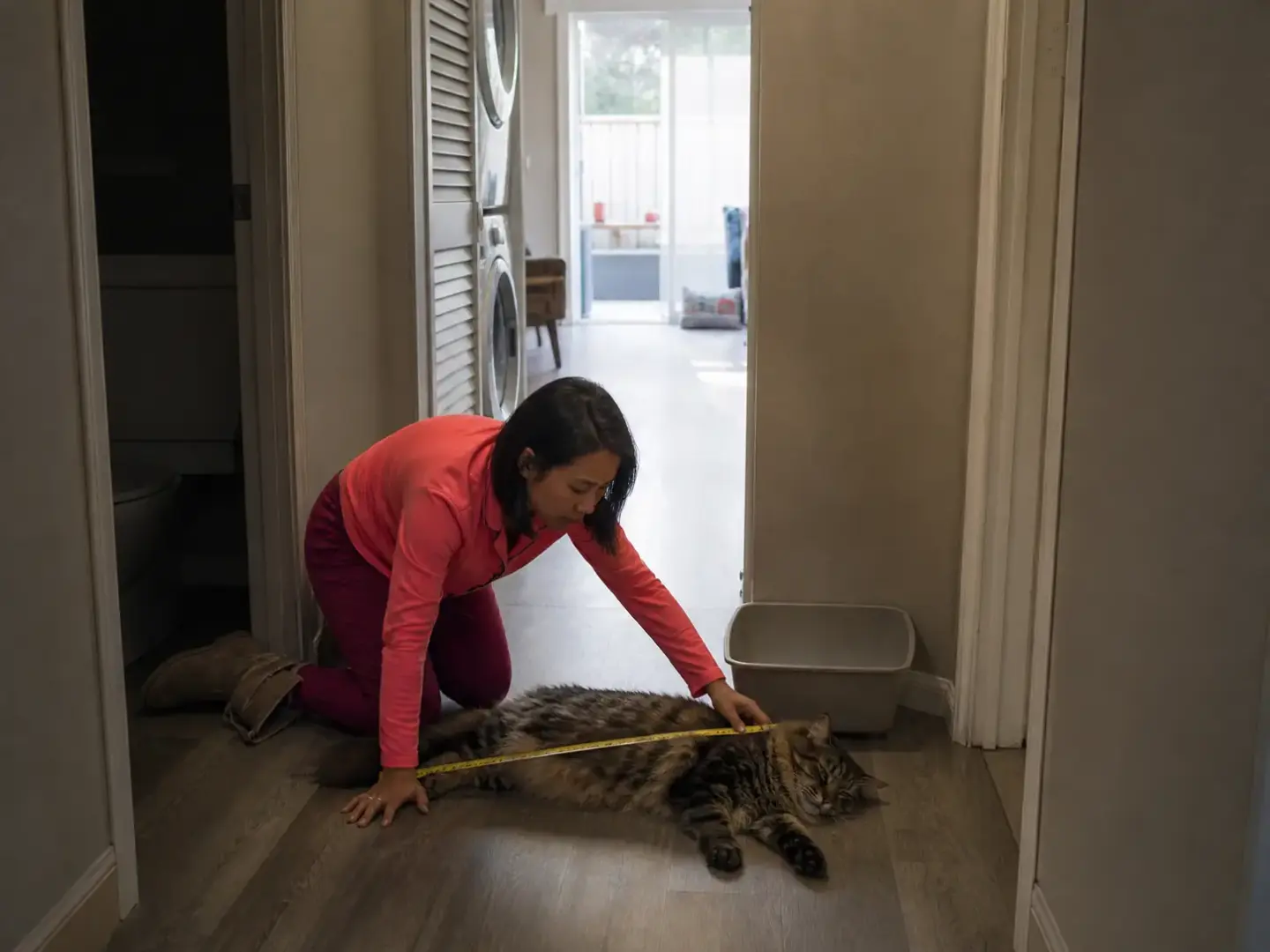
The measurement itself is simple: nose tip to the base of the tail, following the spine, with the cat either standing flat or lying stretched on one side. The base of the tail is where it meets the body, the point where the spine stops being back and starts being tail. You can feel it with a thumb. Don’t measure over a curve, and don’t measure a cat who’s curled, tucked, or in any way compressed.
Getting a still cat is the hard part. Three ways that work:
- The sleeping stretch. Wait until he’s out cold on his side with his legs extended, then lay the tape along his back without touching him. This gives the truest number because it’s the closest to his elimination posture.
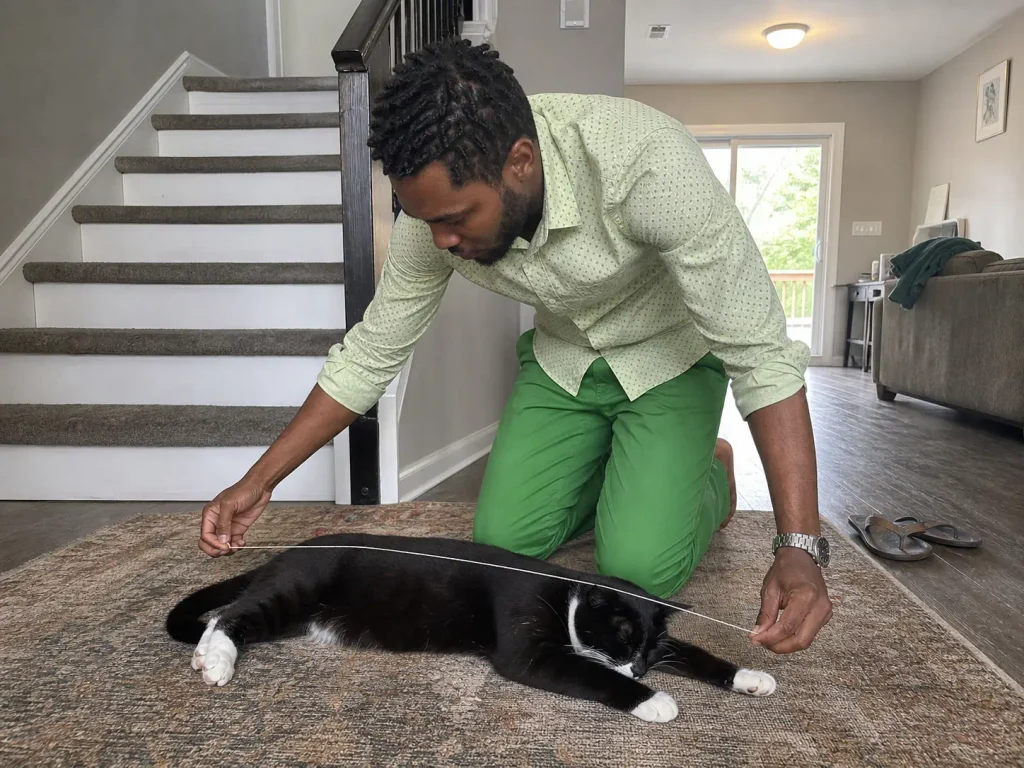
- The string trick. Run a piece of string or a phone charging cable along his back, pinch it where the tail starts, then take the string to a ruler. Cats tolerate string vastly better than they tolerate a rattling metal tape.
- The doorway method. Watch him walk past a fixed line on the floor, a tile seam or a threshold strip, and note where his nose and tail base land. Measure the gap afterward, cat not required.
If none of those work, use weight as a rough bracket and lean long. A cat under 8 pounds is likely in the 15-inch range, 8 to 12 pounds lands near 18, and anything over 13 pounds should be treated as 20 or more until proven otherwise. This is the worse method and I’d rather you used the string. But under-measuring costs you the price of a box and another month of the same problem, while over-measuring costs you nothing except floor space.
Then multiply by 1.5 and round up to the next box that exists, never down. This is the step where people talk themselves out of the result: they get 27 inches, find a 24-inch box that seems close enough, and buy it, because 24 is nearly 27 and the box is right there. The formula is a floor, not a target. Rounding down puts you back under the guideline you just did the work to clear.
And for anyone who is not going to get the tape out at all, there’s a thirty-second version that skips the arithmetic entirely. Watch him use the box once.
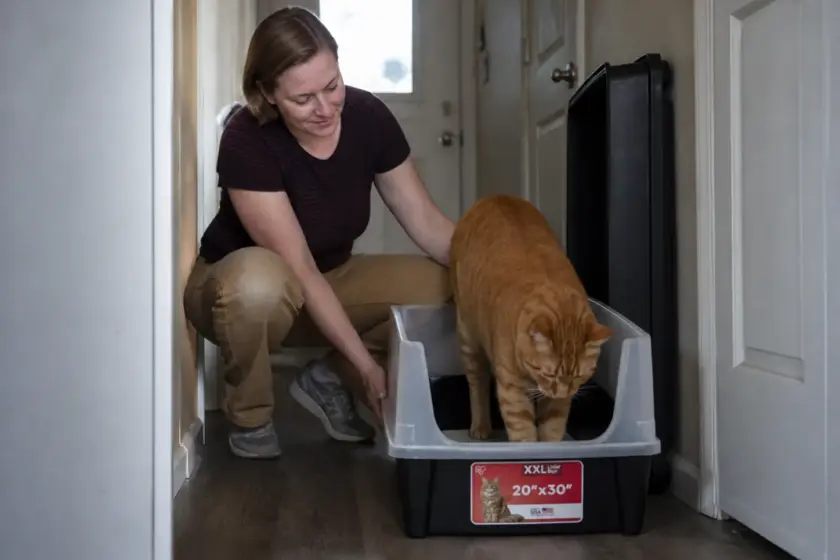
If any part of him is outside it while he’s working, front paws up on the rim, back feet on the floor, tail draped over the side like it’s furniture, the box is already too small. You don’t need the number to know the answer. The number just tells you how far off you are.
What the Formula Turns Into, in Inches
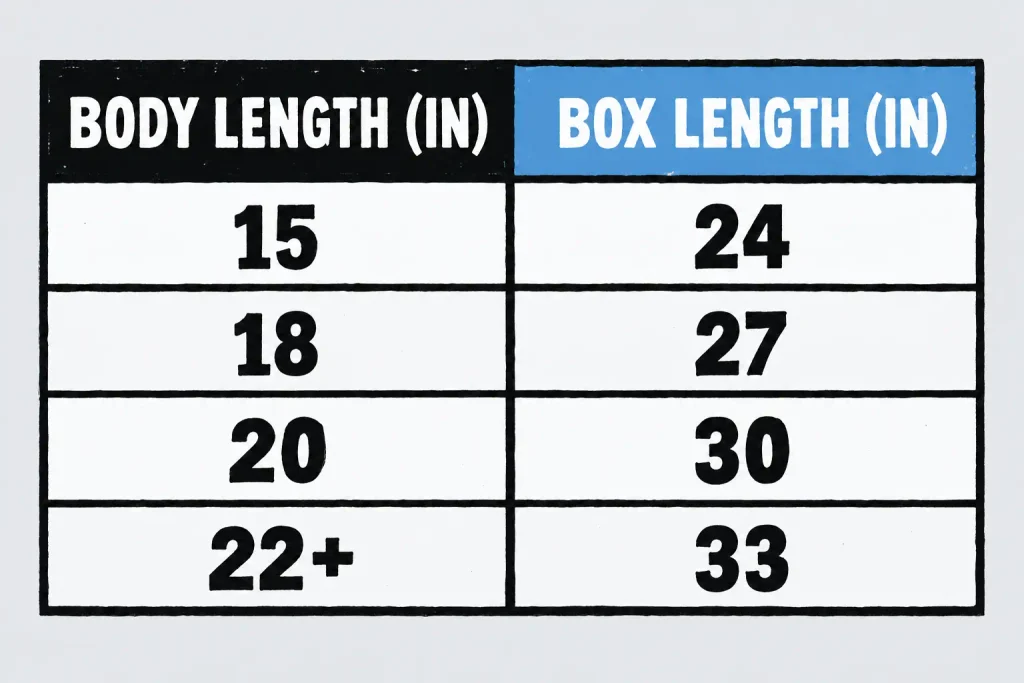
Adult domestic cats run roughly 15 to 20 inches nose to tail base, depending on breed and build. Run an average 18-inch cat through the multiplier and you get 27 inches of interior length. That’s the whole article compressed into one line, and it’s about nine inches longer than what most people currently own.
Below that sits a hard floor. The AAFP and ISFM’s house-soiling guidelines name box size as one of the most common environmental triggers, and the baseline that comes out of that guidance is 24 inches of interior length for any adult cat. Small, calm, well-mannered, doesn’t matter. Under 24 inches you are outside the guideline regardless of how tidy the cat is about it.
Width is the number everyone forgets, and it’s the one that quietly ruins long boxes. The turning arc a cat makes before he digs is a circle, not a line, and length alone doesn’t give him a circle. Interior width of 15 to 18 inches is the minimum for a full turn. A 30-inch box that’s 12 inches wide is a hallway, and he’ll use it like one: enter, do the minimum, leave without covering, because there was never room to turn around and address the problem properly.
| Your cat | Minimum interior length | Minimum interior width | What that means in the aisle |
|---|---|---|---|
| Small adult, about 15" | 24" | 15" | The floor, not the ideal. Most store boxes still miss it |
| Average adult, about 18" | 27" | 16–18" | Above almost everything sold as large |
| Large adult, about 20" | 30" | 18–20" | Storage tote or specialty XXL territory |
| Large breed, 22" and up | 33" | 20"+ | Nothing in the pet aisle reaches this |
| Kitten | Adult size, low entry | Adult width | Buy for the adult he’ll be. Cut the entry down to 2–3" |
| Senior or stiff-jointed | Adult size, low entry | Adult width | Same footprint, entry no higher than 4–5" |
The large-breed row deserves its own sentence, because it’s where the numbers stop being theoretical. A Maine Coon, Ragdoll or Norwegian Forest Cat runs 20 inches or more of body length, which puts the box at 28 to 30 inches long and 20-plus wide before anyone starts negotiating. That’s not an XL box with a bigger sticker. That’s a different object.
For a small-to-mid adult, the Kirecoo Large High Sided Stainless Steel Cat Litter Box is a useful reference point at 23.6 by 15.7 inches, because it shows what clearing the formula looks like as an object rather than a number: it works for a cat up to roughly 15.7 inches of body length, and its width sits right at the bottom of the 15-to-18-inch turning minimum. Read that as the honest floor of the range, not the ideal. If your cat measured 18, this is not your box, and no amount of wanting it to be will add three inches to it.
Two more things the tape measure won’t tell you unless you’re careful. First, interior, not exterior. Box walls taper, and they taper worst at the bottom, which is precisely where the cat stands.
A pan advertised at 24 inches on the outside can hand him 22 inches of usable interior space, and there goes the margin you thought you bought. Measure inside, along the base.
Second, litter depth is a separate problem no footprint solves. Three to five inches is what a cat needs to dig a hole and bury the result, and a correctly sized box with an inch of litter in it fails him just as thoroughly as a small box does. He can turn, he just can’t dig.
One thing this article deliberately does not answer: how many boxes your household needs. That’s a different question with a different rule, and it doesn’t change any of the arithmetic above.
Why the Box Marked “Large” Is Not Large
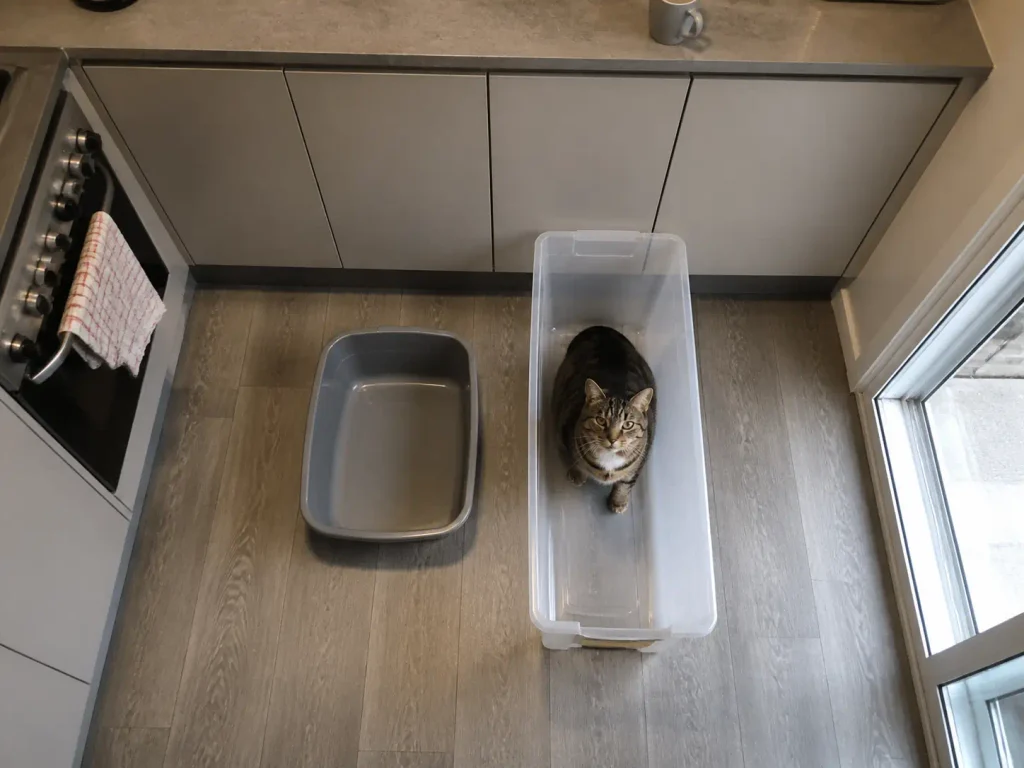
They did the responsible thing. They looked at their cat, thought “he’s a big lad,” and bought the box with LARGE printed across the front of it. And it’s 19 inches. Nobody lied to them exactly, but nobody told them the truth either, and a month later they’re back on the internet reading about litter brands.
The gap, in numbers: standard pet-store boxes cluster at 18 to 20 inches of length. An average 18-inch cat needs 27. So the “large” box is seven to nine inches short of a published veterinary guideline, sold to people who bought it specifically because they were trying to be generous about size.
It gets worse once you know that there is no industry-standard size class. “Large,” “jumbo,” “XL” and “XXL” are marketing words, not measurements. One brand’s jumbo is another brand’s regular, and no external body holds anyone to a definition. The printed inches are the only thing on that box that means anything at all, and they’re usually in six-point type on the side panel.
Photograph the printed dimensions on the shelf tag, not the word on the front. If a listing won’t publish its interior length anywhere, treat that silence as the answer and move on.
Here’s the mechanism nobody publishes, and it explains the whole mess. Litter boxes are sized to two constraints, and the cat is not one of them. The first is retail shelf depth, a real and fixed limit on what a manufacturer can get stocked: a box too deep to sit on a standard shelf never reaches a store. The second is the cat’s resting length, the folded, sitting, at-rest cat you’d picture if you’d never watched one work.
But the 1.5 multiplier exists precisely because the stretched posture of elimination is longer than the resting one. He extends, he backs up, and he digs at full reach. Boxes are built around the compact version of the animal and the guideline is written around the stretched one, and the entire retail category sits in that gap.
Round boxes lose worse than they look, for a related reason. A circle’s stated diameter is its widest single line, and the cat isn’t a line. The usable interior shrinks fast toward the edges, so exactly where his shoulders go when he turns is where the wall arrives early. A 24-inch round box gives him noticeably less working floor than a 24-inch rectangular one, which is not obvious from the packaging or the photograph.
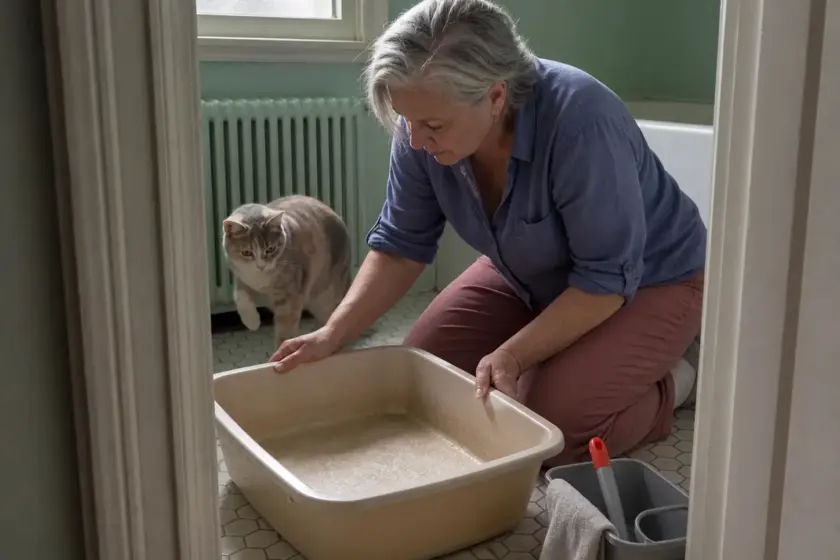
So before you buy anything, the cheap escape hatch, which is the honest answer for most people reading this. A large high-sided storage tote or a concrete mixing tub from the hardware aisle gives you real square footage for pocket change, because you’re buying a plastic container instead of a plastic container with a cat printed on it. Cut an entry down one side, sand the cut edge smooth so it doesn’t catch a paw, and you have 30-plus inches of interior for a fraction of what “XXL” costs. It’s the swap that gets recommended over and over in sizing threads, because the pet aisle does not stock a box that clears the formula for a big cat at a sane price.
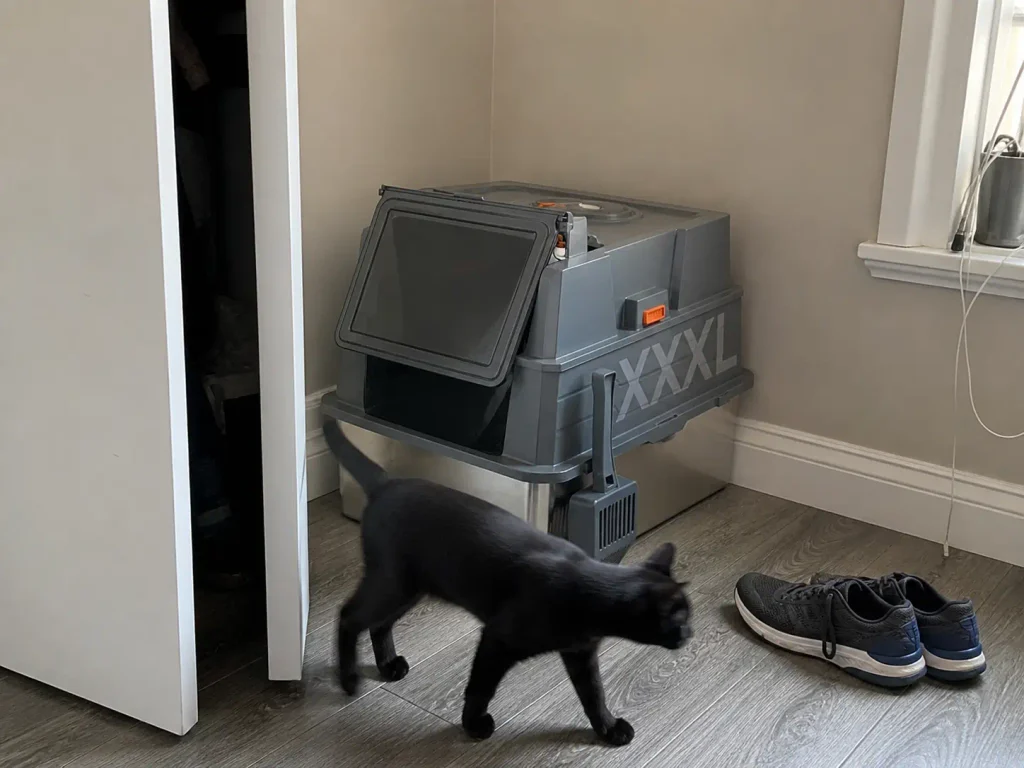
If you’d rather not take a knife to a storage bin, the bought version exists. The XXXL Stainless Steel Litter Box with Lid runs 28 by 20.5 inches, which is the rare listing that clears the 27-to-33-inch large-breed range with the width to actually match it. And here’s its real limitation, which nobody selling it will lead with: at 28 inches it is genuinely large in the room too.
This is the box you buy when your cat is a Maine Coon, not when you’d just like a bit more room. If you’re on the fence about whether you need it, you don’t. Worth knowing while you’re comparing materials: stainless steel does one thing plastic can’t, and it isn’t about size.
The Cat Is Already Telling You It’s Too Small
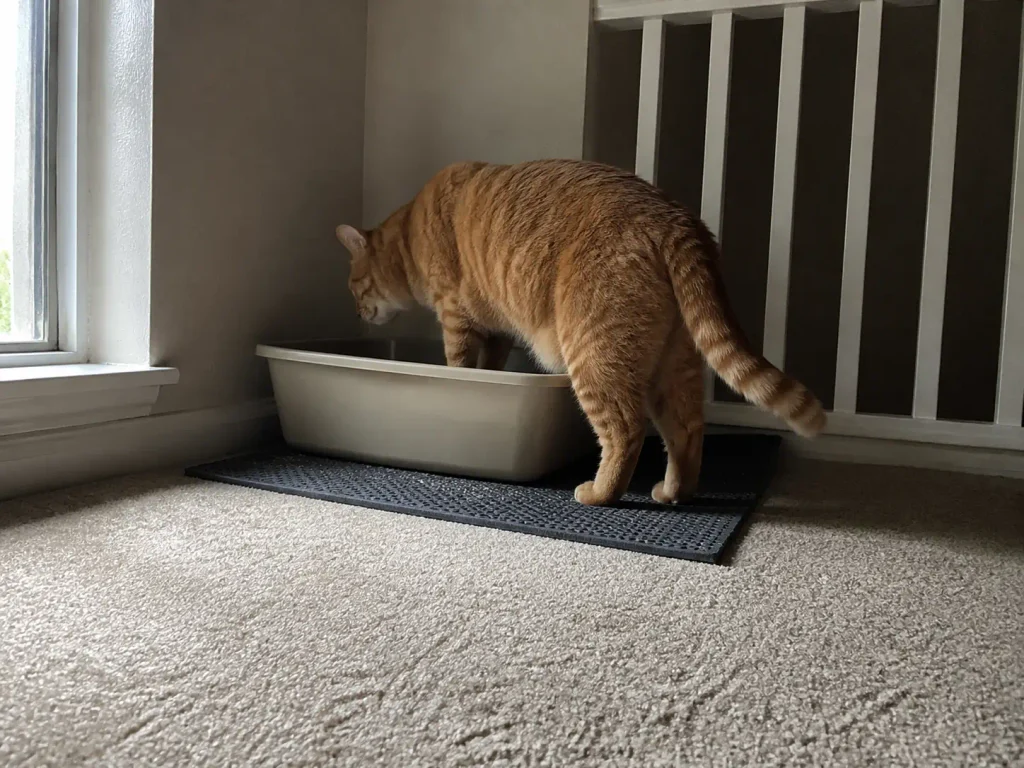
Almost everything people file under “litter box problems” has a boring mechanical explanation waiting underneath the behavioral one. The scatter, the missed edges, the going right next to the box: he is not making a point about you. He is running out of room, and these are the only four ways he has to mention it.
- Hanging over the edge. Front paws in and back feet on the floor, or the reverse. There is nowhere else to put them. He isn’t being casual about it, he’s out of box.
- Scatter that no mat fixes. A cat who can’t turn digs toward the wall instead of the middle, and the litter goes over the side because the side is where his paw already is.
- Missing the edge. Urine over the rim or against the wall behind. In the forums people write it as “he missed the edge again,” which sounds like carelessness and isn’t: the stance needs a length he doesn’t have, so he backs up until something solid stops him.
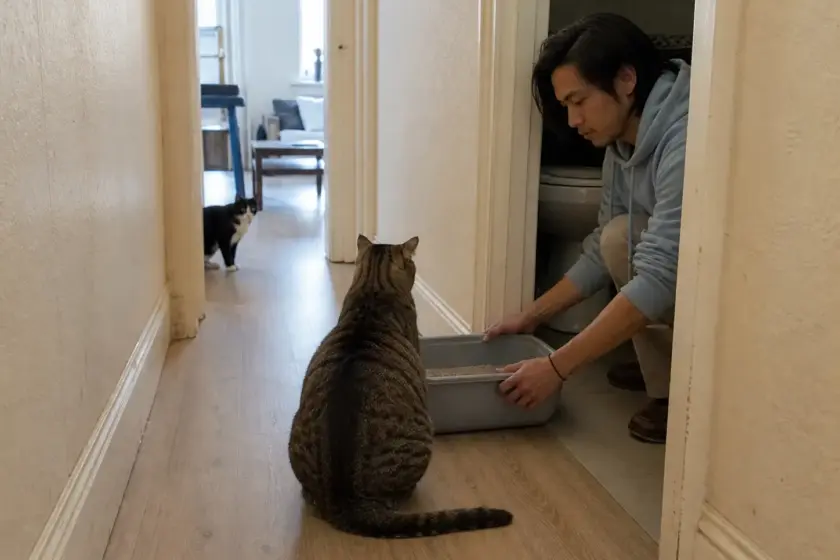
- Going beside the box, not in it. The most misread signal of the four. He’s accepting the location and rejecting the container, which is a size answer far more often than a spite answer.
The scatter one has a second lever worth knowing about, because size isn’t the only thing that governs how much litter ends up on your floor. Wall height changes how much litter ends up on the floor independently of footprint, and if scatter is the specific thing that brought you here, that’s the other half of the fix.
The fourth signal is the one that gets cats in trouble, so it’s worth slowing down on. Going beside the box reads to most people as protest, as the cat being pointed about something. It almost never is.
Think about what he’s telling you: he walked to the right room, went to the right corner, and then declined the container specifically. He agrees with your litter box placement. He’s rejecting the object. That’s about as clear as an animal without language can be, and the standard human response is to file it under litter box avoidance and assume he’s being rude.
One honest boundary before the fix. Any of these appearing suddenly in a cat who was fine last month is a vet visit first, not a box purchase. A litter habit that changes overnight is a medical question, and this site doesn’t answer medical questions. Get him cleared, then come back to the furniture.
Assuming he’s healthy and this has been going on all along, there’s a test that costs nothing. Put a bigger box in, a storage tote works fine as a stand-in, and leave the old one exactly where it is. Don’t swap, don’t remove, don’t force a choice. Keep the same routine otherwise, and scoop daily in both so neither one is winning on cleanliness.
Then watch for two weeks. If the litter scatter and the edge-misses stop, size was the problem and you know precisely what to spend money on. If nothing changes, you’ve spent two weeks and nothing else, and you’ve ruled out the most likely cause.
When the Right Box Doesn’t Fit the Room
You did the arithmetic and it says 28 inches. Your bathroom has 22 inches between the toilet and the wall, and that’s measuring generously. Every article you’ve read up to this point now pivots smoothly to recommending a self-cleaning unit that costs more than your desk. This one won’t.
So let’s say the trade-off out loud instead of pretending it away. The formula is the cat’s requirement and the room is your constraint, and exactly one of those two is negotiable.
It isn’t the cat’s. He can’t compress. What can move is nearly everything else, and in a specific order.
Location goes first, and it’s the one people resist hardest. A 30-inch box in the bedroom beats a 20-inch box in the bathroom, every time, because you’re optimizing for the wrong resident when you put it where you’d rather look at it.
Orientation goes second: a long box pushed lengthwise against a wall eats less usable floor than the same square footage set square in a corner, where it blocks two approach paths instead of one. The furniture around it goes third. A laundry hamper is more portable than a cat’s turning radius.
Before you buy anything, put a strip of masking tape on the floor at the number the formula gave you and live with it for a day. Most people find the space exists somewhere else in the apartment, and a few discover the spot they were defending was never as good as they thought.
What does not give: interior length below 24 inches, and the turning width. Those two are where behavior starts, and every symptom in the section above is what “I compromised on the length” looks like three weeks later. Compromise on the room, the view, the aesthetics, the location, the lid. Not on those two numbers.
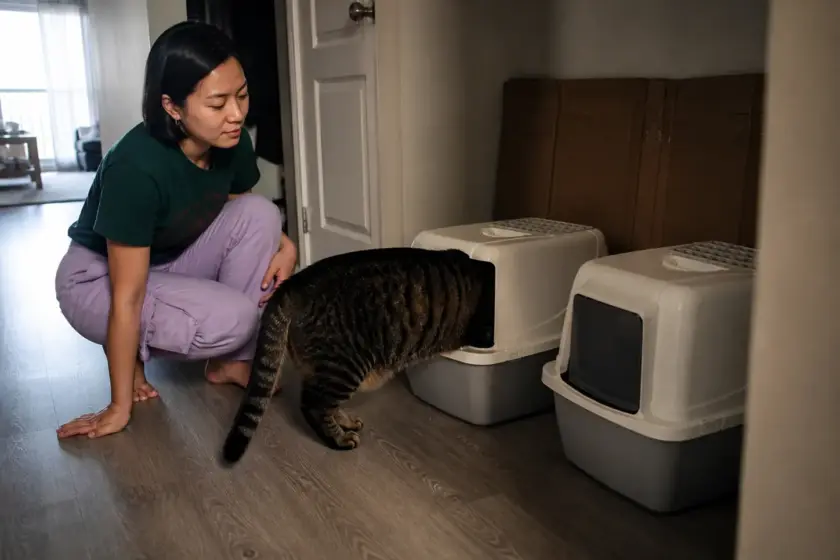
Which brings up the automatic litter box, sold hard as the small-space answer and mostly not one. The stated footprint on a self-cleaning unit doesn’t map to usable interior the way a plain pan’s does, because a lot of that exterior volume is mechanism: the rake housing, the waste drawer, the motor bay.
Several of them run smaller inside than a plain box of the same outside dimensions, which is the opposite of what you’re paying for. Judge one on interior inches like you’d judge anything else, and if the listing doesn’t state them, that’s your answer. The same trap applies to hoods, incidentally: a lid changes the usable interior more than the footprint suggests, and that’s a shape question this article deliberately leaves alone.
Entry height is the free lever nobody mentions, and it’s independent of everything above. For an older or stiff-jointed cat, 4 to 5 inches maximum from the floor to the lip he has to clear. For a kitten, 2 to 3.
That’s separate from footprint, which means a perfectly sized 28-inch box with 11-inch walls can be exactly right on paper and unusable for the cat standing in front of it. If he’s hesitating at the entry rather than inside it, height is your problem and no amount of length fixes it. Cutting a lower entry into one wall costs a utility knife and ten minutes.
None of which needs a drill, a landlord’s permission, or a permanent change to anything. The tote is a container. The relocation is reversible. The entry cut is on an object you own and take with you.
If you’re renting, this whole section costs a Saturday afternoon and nothing on the security deposit, which is more than can be said for most advice aimed at small apartments.
The Numbers, and What to Do Tonight
Measure the cat, not the box. Nose to the base of the tail, tail excluded, multiply by 1.5, round up to the next box that exists. That single arithmetic operation resolves more litter box complaints than any product on this page.
Twenty-four inches of interior length is the floor for any adult cat, 15 to 18 inches is the width minimum for a full turn, and the word “large” printed on packaging is a marketing decision rather than a measurement. Check the printed inches or assume the worst.
And if any part of him is outside the box while he’s using it, you already have your answer and you don’t need the tape measure at all. That’s a diagnosis you can make tonight from across the room.
Put the bigger box in, leave the old one where it stands, and look again in three weeks. Scatter and edge-misses stop fast when size was the real problem, usually within days rather than weeks. If nothing has shifted by then, size wasn’t what was wrong and you can stop spending money in this direction.
Try the storage tote before you buy anything at all. It costs almost nothing, it answers the question inside a fortnight, and if it works you’ll know exactly how many inches you’re paying for when you finally buy the real one.
Amazon’s Audible — free for 30 days
Your cat won’t let you read. Let someone read to you.
Audible is Amazon’s audiobook library — thousands of titles, read out loud, on your phone. Free for a month, plus one audiobook to keep forever.
Frequently Asked Questions
01What is the ideal size for a cat litter box?
At least 1.5 times your cat’s body length, measured nose to the base of the tail with the tail excluded. For an average adult of 15 to 20 inches that works out to 24 to 30 inches of interior length, and 24 inches is the floor even for a small cat. Interior width should be 15 to 18 inches so he can complete a full turn.
02Do cats prefer larger or smaller litter boxes?
Larger, consistently. A cat needs room to turn, dig, position and cover, which is four movements rather than one, and a box that only fits the standing cat fits none of them. The preference holds across studies and shelter practice.
03What is the golden rule for litter boxes?
There are two, and they answer different questions. The size rule is 1.5 times the cat’s body length. The count rule is one box per cat plus one, which is about how many boxes your household needs rather than how big each one should be.
04Is a 24-inch litter box big enough for a Maine Coon?
No. Large breeds run 20 inches or more nose to tail base, which puts them at 28 to 30 inches of interior length and 20 inches of width. A 24-inch box is the bare minimum for an average cat and roughly six inches short for a large one.
05My cat suddenly started going next to the box. Is it the size?
It can be, but a sudden change in a cat who was fine last month is a vet visit before it is a box purchase. Get that ruled out first. If he is healthy and the behavior has been there all along rather than starting abruptly, size is the first thing worth measuring.
Leave a comment