Best Dog-Proof Cat Feeding Station by Your Dog’s Reach
Don't mount that cat feeding shelf yet. Most dogs clear 3-6 feet [and a counter-surfer already proved 36 inches]. Measure yours first.

Alfredo RamsesFounder · September 15, 2026 · 25 min read

On this page10 sections
- 1Measure the Dog Before You Buy Anything
- 2Where the Wall Shelf Actually Goes
- 3The No-Drill Version, for Renters
- 4The Gate With a Cat Door in It
- 5The Microchip Feeder, Which Ignores the Dog Entirely
- 6What an Enclosed Station Does to the Smell
- 7Why Feeding the Cat in the Bedroom Stops Working
- 8Two Cats, One Diet, and a Dog
- 9Conclusion
- 10Frequently Asked Questions
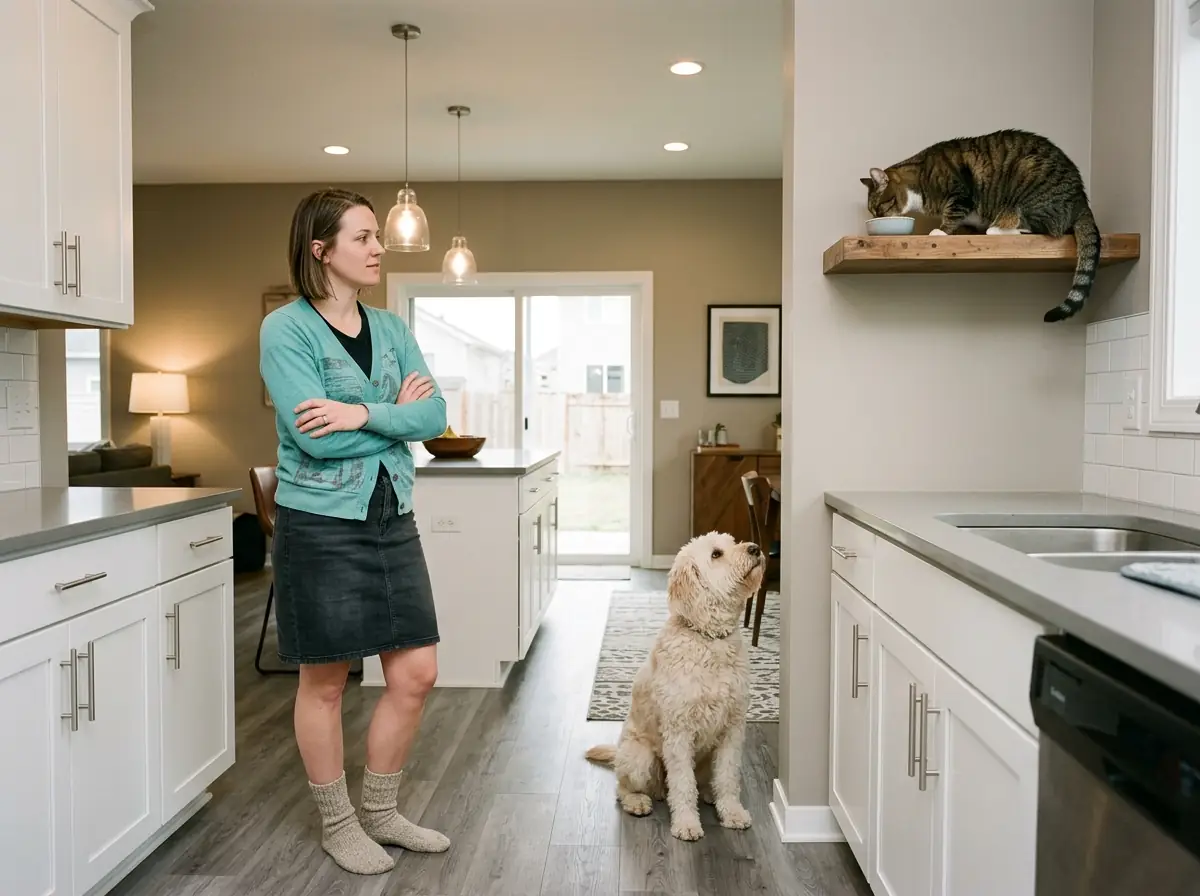
The dog has learned where the cat’s bowl lives, and he checks it the way you check the fridge.
So the cat now eats in the bedroom with the door shut, and that worked beautifully for about a month. It is still running, and the room smells faintly of chicken. Choosing the best dog-proof cat feeding station is not a shopping problem, it is a measuring problem with four real answers, and only one of those four ignores your dog’s size completely. This guide starts with the number nobody in the search results will give you, which is how high your particular dog can already reach, and then matches each route to it.
Quick Answer
Four routes work. Your dog decides which one you get.
- Measure the dog first: most clear 3 to 6 feet, and a counter-surfer has already proved 36 inches.
- A wall shelf works only above that number, and only bolted into something structural.
- A microchip feeder ignores the dog’s size entirely: it opens for one cat and nothing else.
- A pressure-mounted gate with a cat door costs you zero holes and is the renter’s answer.
- Two cats and one prescribed diet: only the microchip feeder is solving that problem.
Measure the Dog Before You Buy Anything
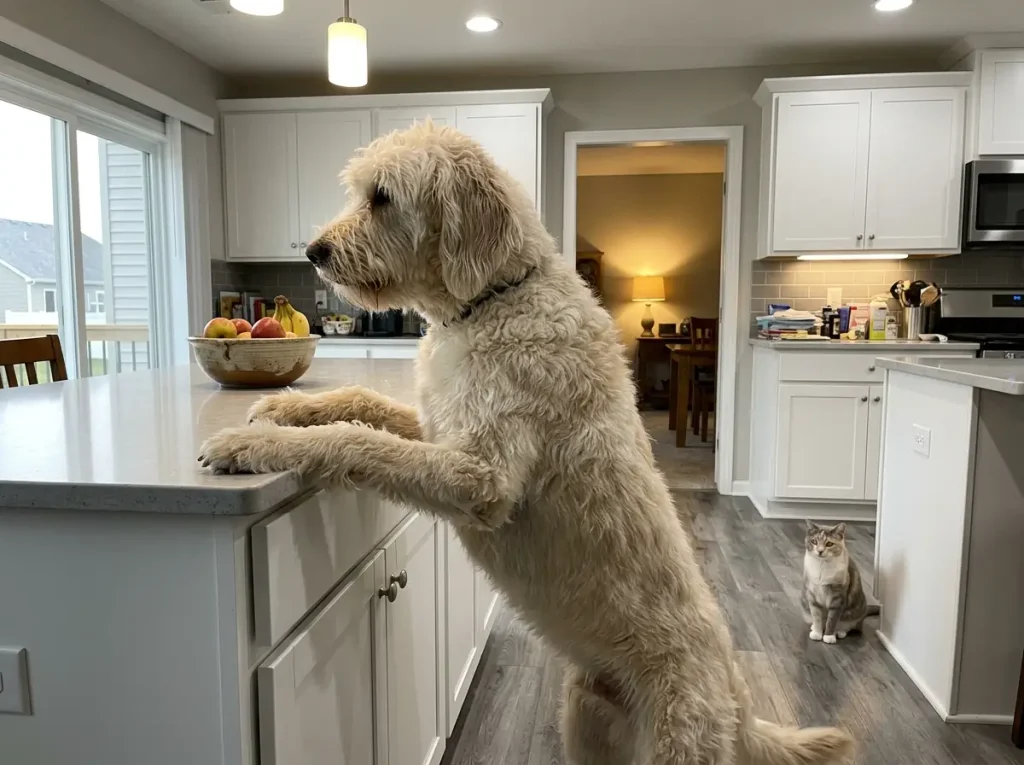
Every buying guide for this problem says some version of the same sentence: mount it as high as you like. That is advice written by somebody who does not own a dog. You own a dog that has already beaten one plan, and what you want is a number that beats this one.
Here is the honest version. A healthy adult dog typically clears somewhere between 3 and 6 feet vertically, and a motivated or athletic one goes past 8 feet, which is why agility courses are built the way they are. But that range is a starting point, not your answer, because how high a dog can actually jump relative to its size depends far more on build and drive than on dog breed size or breed reputation. There is no universally safe height for a feeding shelf.
There is only a height that is safe relative to the animal currently standing in your kitchen.
That is a different framing from every other node in this room, where raising a cat’s bowl solves a different problem for a different cat and height is about shoulder joints and neck angle. Here height is a defense measure, and the thing being defended against gets a vote.
The rough working rule is that most dogs jump between one and three times their own shoulder height. Counter feeding is the same drive expressed indoors, which is why it is such a useful signal.
The outliers are the small terrier breeds, and they are the reason this section exists at all. A Jack Russell can clear roughly four times its shoulder height, which means “it’s only a small dog” is the single most expensive assumption on this page. Small dogs are not automatically short-reach dogs. Some of them are springs with opinions.
Counter-surfing is the free measurement you already have. If your dog has ever taken food off a kitchen counter, you are not guessing at anything. That dog has demonstrated reliable reach at roughly 36 inches, in your house, on your floors, with witnesses. The number you plan around is what he has already proved, not what you hope he cannot do. Plan above the counter, not level with it.
And the gap does not stay where you left it. A shelf that was safe for a puppy stops being safe for that same dog eighteen months later, without a single thing about the shelf changing. A dog that learns to counter-surf at four years old closes the gap overnight, which is the version people describe with real surprise, because the arrangement had worked for years and then simply stopped one Tuesday.
One more thing, and it is the one people skip. Reach is not only vertical. A dog that can put its front paws on a dining chair standing next to your feeding shelf has just changed the math, because it is no longer jumping to the shelf, it is stepping to it.
Measure the launch surfaces near the station, not only the station. A chair, a low bookcase, a laundry basket that lives in that corner. If the dog can reach the intermediate thing, the intermediate thing is now part of the height calculation.
If the dog has ever taken food off the counter, treat 36 inches as your floor, not your ceiling. That is a demonstrated reach with food as the reward, which is the only kind of reach that matters here. Everything you build goes above it, with clearance.
Where the Wall Shelf Actually Goes
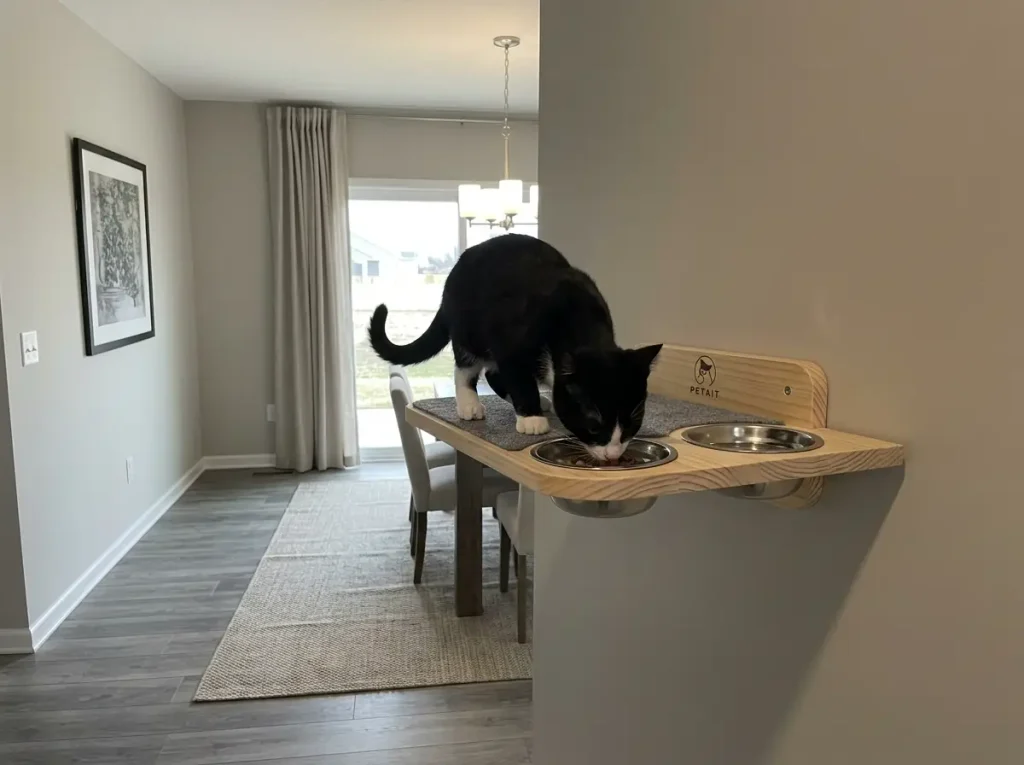
The wall shelf is the obvious answer, and it is a good one. It is also the one route on this page that fails in a way that is not a nuisance, so it is worth being precise about what it has to survive.
A 12-pound cat does not land on a shelf with 12 pounds of force. It lands with something closer to 18 to 24 pounds of dynamic impact, and it does that several times a day, every day, for years.
Adhesive strips are commonly rated for 7 to 16 pounds. Cheap plastic drywall anchors are rated 20 to 25 pounds static, which is a completely different measurement from repeated moving load. Neither one is built for this, and the dynamic force a jumping cat puts on a wall-mounted shelf is the spec that decides whether your mounting choice was adequate or just optimistic.
What owners describe when this goes wrong is not a wobble. It is a shelf pulling away from the wall mid-jump, with the cat on it.
That is the failure mode, and it is why the mounting hardware conversation comes before the shelf-shopping conversation. Into a stud, or into a rated toggle. Not into a sticker.
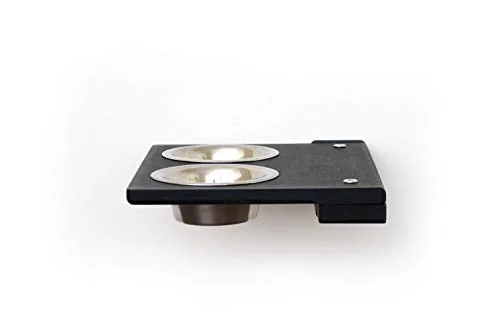
A cat shelf feeder is really two decisions wearing one product name. Height above the measured reach comes first, and the approach to the feeding platform comes second, and it is the part that gets designed backwards. If the only way your cat can get up there is by launching off a dining chair, then you have built a staircase and invited the dog to use it. The cat’s route up should be one the dog cannot copy, which usually means the cat jumps from the floor in one go, or from a surface too narrow for the dog to stand on.
Removable stainless bowls matter more on a wall mounted cat feeder than anywhere else in this article, and for a boring reason: a shelf whose bowls do not lift out is a shelf you clean while standing on something. Twice a day. Forever.
That is not a spec sheet detail, that is the difference between a station you maintain and a station that quietly gets grubby because cleaning it is a chore with a step stool in it. Stainless bowls that come out are also dishwasher safe, which is the whole reason the bowls on this kind of shelf are stainless in the first place.
The height of the shelf and the height of the bowl on top of it are two separate numbers, and the second one still follows the ordinary rules: the bowl height that suits the cat itself, measured in inches does not change just because the whole assembly is five feet off the ground. Elevated bowl height is measured from the platform the cat stands on, never from the floor.
And the thing nobody mentions in a product listing. Your cat has to be able to get up there for the next ten years. A four-year-old cat clears a five-foot jump without thinking about it.
That same cat at fourteen may not. Senior cat mobility is the quiet expiry date on this whole approach, and the day he starts hesitating is the day it stops working, usually well before anyone notices it has. Height is the one solution on this page whose shelf life is attached to your cat’s joints rather than to the product.
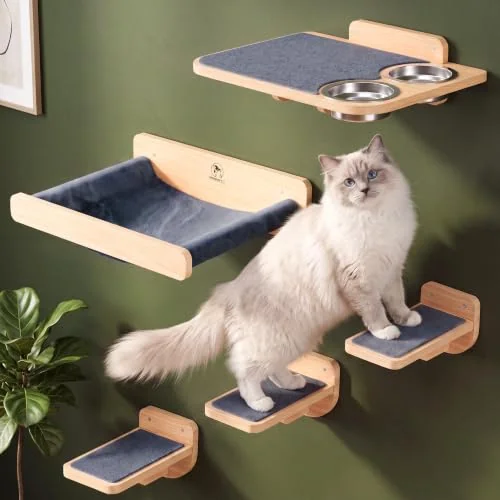
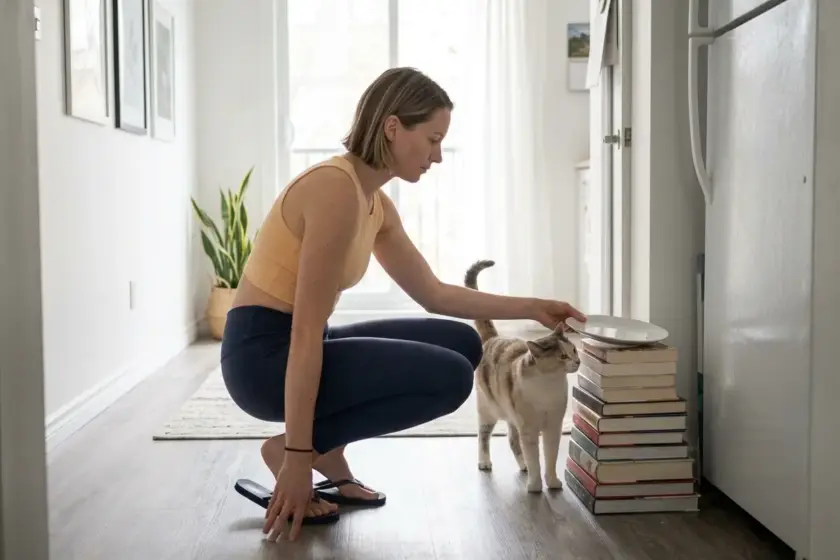
If the wall you have available is a hallway rather than a kitchen, the same idea exists in a much smaller footprint.
The No-Drill Version, for Renters
Every wall-mounted answer to this problem assumes you own the wall. Most people reading this are renting, and the honest answer for them has three tiers rather than one blunt “sorry, you can’t.”
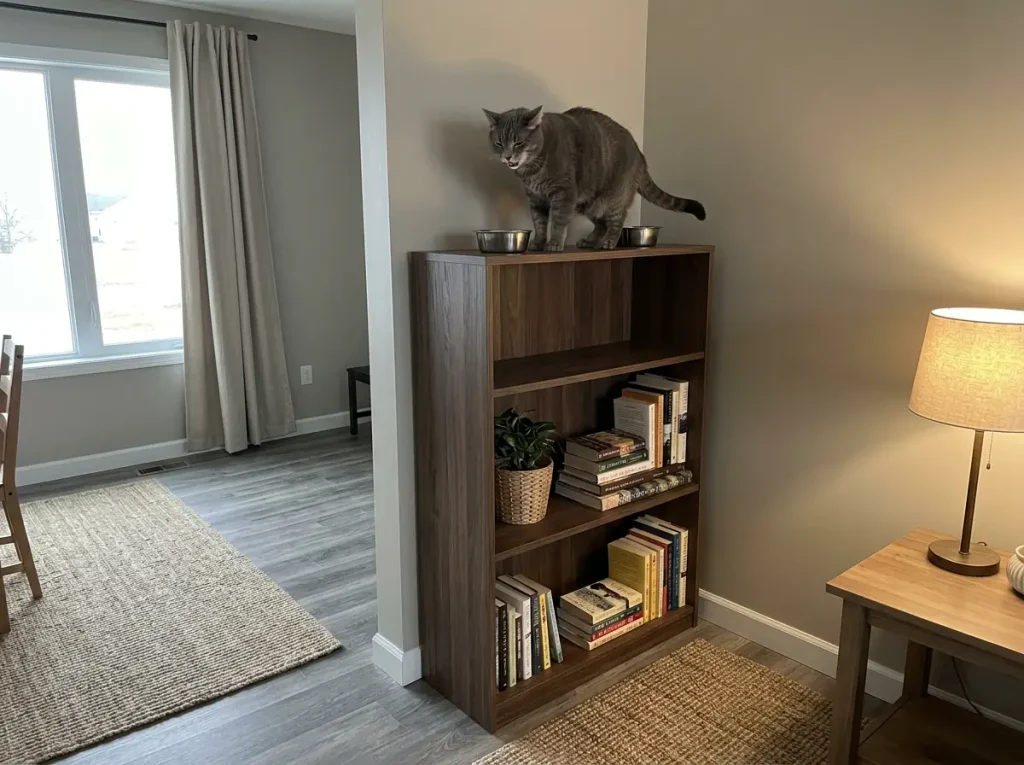
Start free, because the free tier is genuinely good here and it is the one most people skip straight past. A tall bookcase or a chest of drawers already standing in your small apartment is a barrier and a perch at the same time, and it costs nothing. Clear the top of it, put the bowls at the back edge rather than the front so a stretching dog gets nothing for the effort, and then walk around it looking for launch surfaces.
That is the whole method, and it uses raising a bowl with what is already in the apartment as its starting point rather than a purchase. Honestly, in a lot of homes this is the end of the article and nobody needed to buy a station at all.
Tier two is the true zero-contact hardware. Tension-mounted floor-to-ceiling poles and window perches are the true no-drill mount, because they touch no wall at all, which makes them the most renter friendly answer of the three when even a single screw is a lease conversation you would rather not have. They work on pressure between floor and ceiling, so they need a ceiling that is actually solid, and they need to be tightened properly rather than approximately.
Then there is the middle tier that almost nobody mentions, and it is the one that changes the decision for a lot of renters. Heavy-duty toggle bolts rated over 50 pounds, three per shelf, will hold a lightweight cat shelf in plain drywall with no stud behind it. The hole they leave is about 3/16 of an inch.
That patches with spackle and a dab of paint in roughly fifteen minutes at move-out, per hole. That is a very different conversation from “you can’t drill,” and it is worth having with a landlord before you rule the whole approach out. Most leases are objecting to damage, not to geometry.
The one tier to skip entirely is adhesive mounting. Not because it always fails, but because of what happens when it does. Every other method on this page fails by not working. Adhesive is the only one whose failure mode drops a cat from height, and it fails on a schedule nobody can see coming, since the strips lose grip gradually under repeated load rather than all at once.
And whatever goes up has to come down. A renter’s feeding station is measured by how it uninstalls as much as by how it holds, which is a spec no product listing will ever print.
Before you commit, ask yourself what this looks like in two years when you are cleaning the apartment for the walkthrough. If the answer is a patch job, fine. If the answer is a repaint, pick another tier.
The Gate With a Cat Door in It
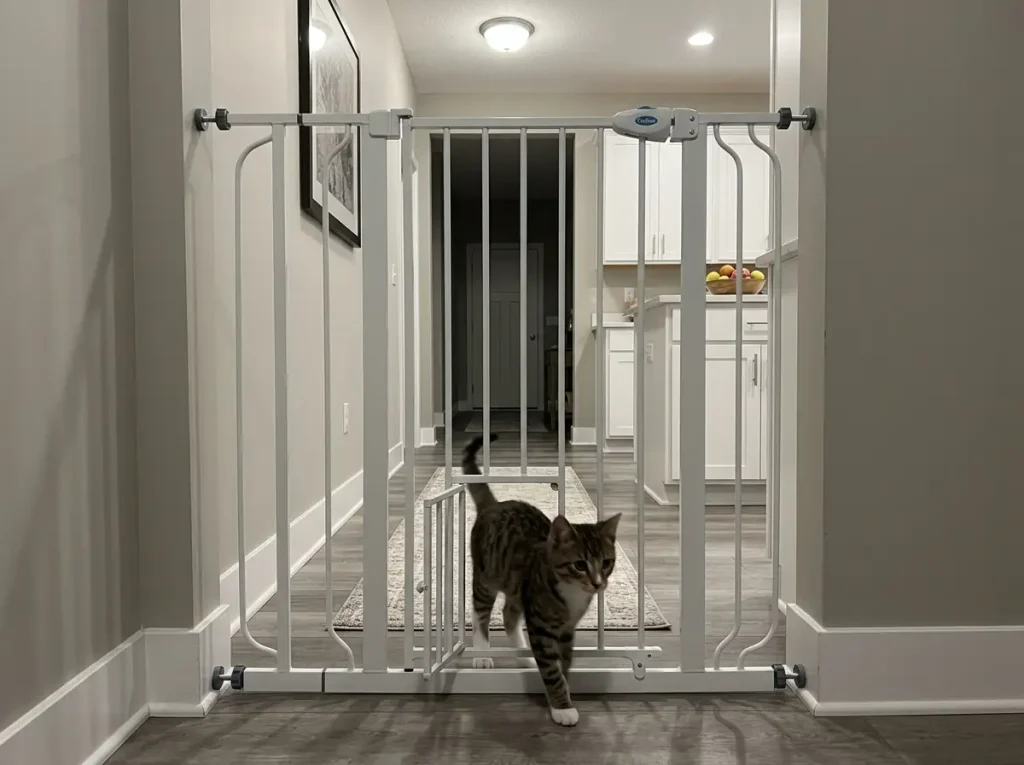
Half of this problem is not a bowl problem at all. It is a doorway problem. If the cat eats in a room the dog physically cannot enter, then height stops mattering, your dog’s jump becomes irrelevant, and the whole measuring exercise from the first section is something you can skip.
A pressure-mounted pet gate needs no holes and no permission, which already puts it ahead of the shelf for a renter. What turns it from a wall into a cat route is the built-in pet door: a small cutout the cat walks through and the dog cannot.
Size that opening by the dog’s chest and head, not by its height. This is where people get caught, because the gate is chosen against the animal’s shoulder height when the only measurement that matters is what fits through a hole. Gate pet doors commonly run about 8 by 8 inches or 10 by 7 inches. A determined medium dog will get a head and shoulders through a gap the marketing describes as small, and once the shoulders are through, the rest is a formality. The reliable way to size this is to check the cutout dimensions against your actual dog rather than against its weight class, since two 40-pound dogs can have very different chest widths.
Extra-tall matters here for exactly the same reason the first section did. A gate the dog can rest its front paws over the top of is not a barrier, it is a step. And a gate that gets climbed once will get climbed again, so the height you need is the height that never gets tested rather than the height that mostly holds.
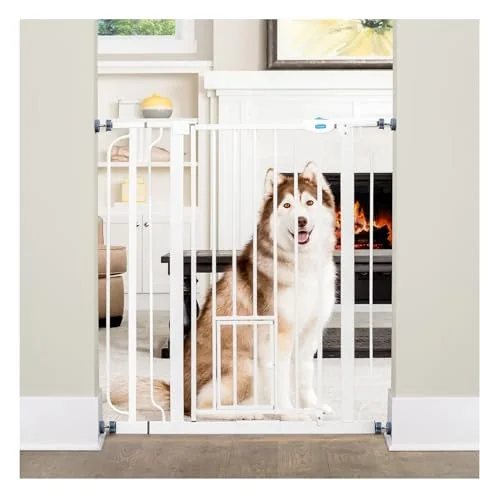
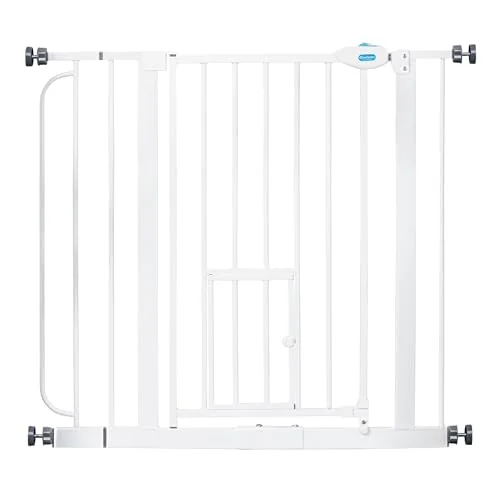
One naming note, because it trips people up when they go shopping: what you want here is sold as a pet gate or a baby gate with a pet door, and the two categories overlap almost completely. A large dog needs the extra-tall version of either.
Think about what else lives in that gated room while you are planning it, because the food is not the only dish in the house. The water usually does not need to move with it, and the water bowl does not need the same treatment for reasons that have nothing to do with the dog. Cats prefer water away from food anyway, so moving both into one gated room can quietly make a drinking problem out of a feeding fix.
A gate keeps the food in a room. It does not keep the smell in a room, and an enclosed feeding space with wet food in it develops a character of its own within days. That is the tradeoff running underneath the next two sections.
The cheapest route of all skips the gate entirely. The Door Buddy Pet Door Latch for Cats is an adjustable strap that holds an existing door open between 0 and 6 inches, turning any door you already own into a cat-only gap. Set the gap to your cat’s width and the dog’s nose is the only part getting in.
Its real advantage over shutting the door is ventilation: the room stays connected to the rest of the apartment instead of sealing, which matters for the reason the whole of section seven is about. The limitation is size overlap. If your dog is small enough to fit through a 6 inch gap, this is not your solution, and no adjustment makes it one.
The Microchip Feeder, Which Ignores the Dog Entirely
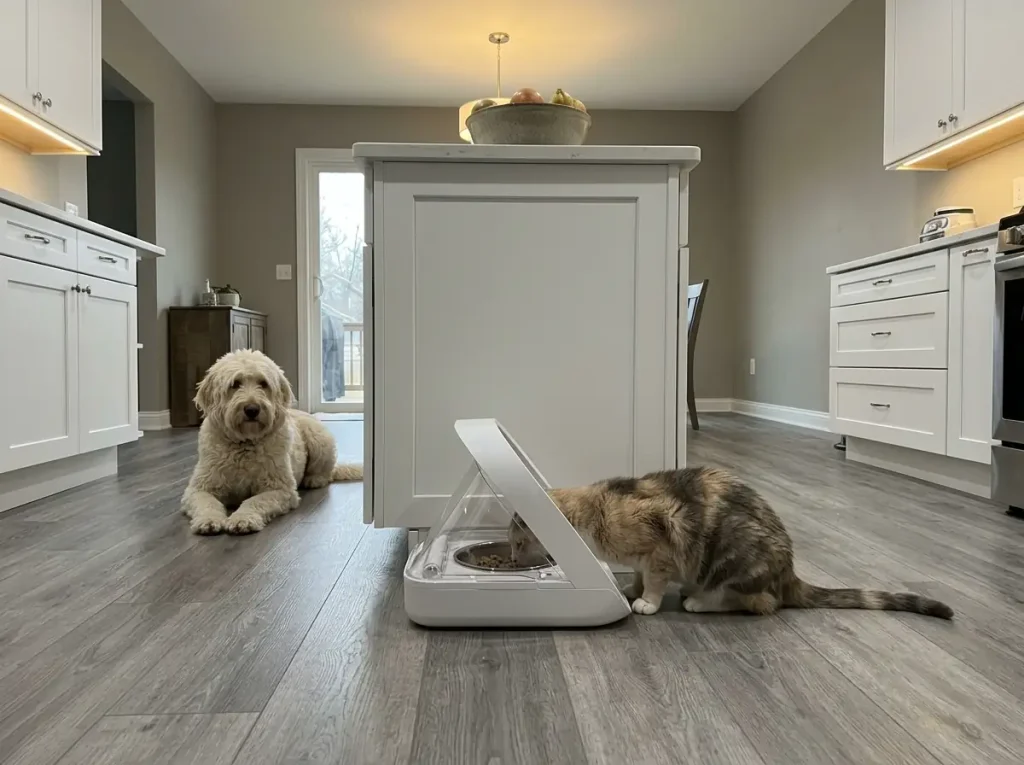
Everything above is geometry, and geometry can be beaten. By a taller dog, by a dog that learns a new trick at four years old, by a cat whose jump gets shorter with age. This route is not geometry. It is identity.
A microchip cat feeder opens for the cat’s registered chip, and an RFID cat feeder does the same job with a collar tag instead. Either way it stays shut for everything else in the house. A selective pet feeder gates by identity rather than by geometry, and it is a genuinely different mechanism from everything above. It is the same idea as a microchip pet door, scaled down to one bowl.
The dog’s size does not matter. Its jump does not matter. Its persistence does not matter, and persistence is the variable that eventually breaks every other option on this page. It is the only route here that is not a measuring problem at all, which is precisely why it is the one to pick when the measuring problem has already been lost once.
There is one measurement that still applies, and it is the cat’s rather than the dog’s. The opening runs about 8¼ inches wide by 6⅛ inches high, on a unit around 7⅞ inches tall by 9 inches wide by 12⅝ inches deep. A large cat with a broad head and wide whiskers needs measuring against that opening before anything gets bought, because a cat that has to fold itself to eat will find another way to eat. The dish inside is still a dish, so the bowl size a cat needs before whiskers start touching the sides governs what actually goes in there.
It sits on the floor or on a counter and needs no mounting of any kind, which makes it the one premium option on this page that is also completely renter-neutral. No holes, no lease conversation, and it moves house with you in a box.
Now the honest part. A battery powered feeder has a moving lid. That is two more failure points than a wooden shelf has, and both of them sit directly between your cat and the food. A dead battery on a Tuesday is a cat who cannot eat until somebody notices.
The sealed, spill proof bowl inside is the tradeoff that pays for the lid: nothing dries out and nothing gets knocked across the floor. That is not a reason to avoid it, but it is a reason to keep spare batteries in the same drawer as the food scoop rather than wherever batteries usually end up.
And it is the only route on this page that also blocks the other cat. A shelf, a gate and a cabinet all treat “the cats” as a single unit, because they gate by geometry and two cats have roughly the same geometry. This one gates by identity, which is what makes it the answer to the prescription-diet household rather than just the dog household. That distinction gets its own section further down, because it changes the answer completely.
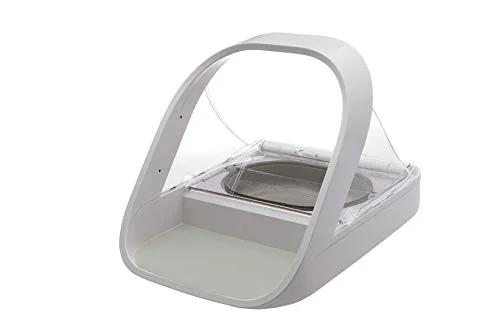
Measure your cat’s whisker span against the opening before you buy, not after. A wide-headed cat who has to back out of a feeder a few times learns to avoid it in about three days, and undoing that lesson takes far longer than the shopping did.
What an Enclosed Station Does to the Smell
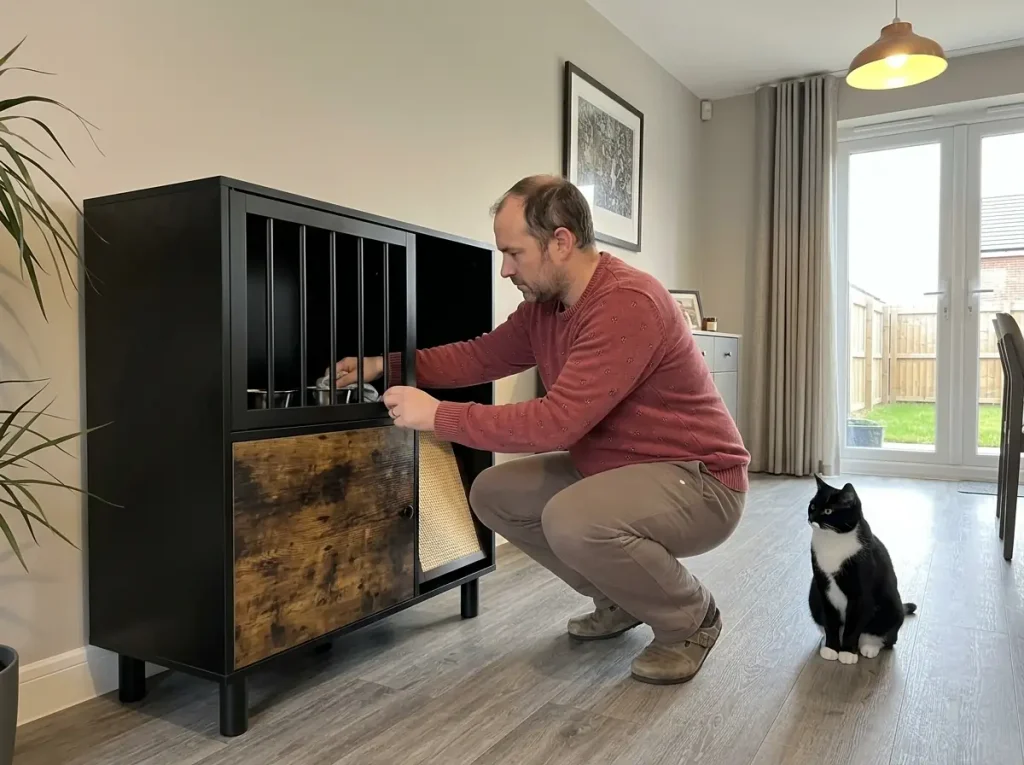
A covered feeding cabinet looks like the tidy answer for exactly the same reason a hooded litter box does. It also has the same catch, for the same physical reason, and nobody in this category will tell you about it because the photograph is the selling point.
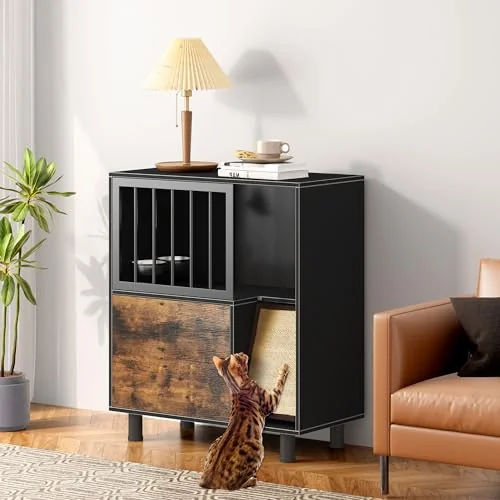
Start with what it does well, because it does one thing no other route here manages. A cabinet station blocks the dog with a grille or a small gate, holds two raised bowls at a sensible height, and stores the bag of food underneath in the same footprint. That last part is not a bonus feature. The bag is the second thing your dog is getting into, and every other solution on this page leaves it in a kitchen cabinet the dog has already worked out how to open.
Now the part the listings skip. An enclosed cat feeder, sometimes sold as an igloo cat feeder, traps odor rather than removing it. This site’s own litter box testing landed on the same conclusion every time, that an open pan beats a hooded box on smell, and for a physical reason: the enclosure does not neutralize anything, it concentrates it in a small volume of still air and then holds it there. Food behaves the same way.
Covered feeder odor works exactly like covered litter box odor: wet food in an enclosed cabinet is a small unventilated room with protein in it, and the cat food smell does not build gradually enough to notice. It arrives.
So ventilation and a daily wipe are not optional extras with a cabinet station. They are the price of the enclosure, and it is worth deciding whether you want to pay it before the cabinet is in your kitchen rather than after.
Dry food is far more forgiving in here than wet. Kibble in a ventilated cabinet is basically fine, and a wipe-round twice a week keeps it that way. Wet food is a different arrangement entirely: the bowls come out and get washed daily, or the cabinet becomes the problem you bought it to solve. If your cat is on wet food and you already know you will not be washing bowls every single day, be honest about that now and pick the shelf or the gate instead.
Footprint is the real cost, and it is the exact opposite of what the wall shelf was for. These take the floor space of a small side table, in a room that probably did not have a spare side table’s worth of space, which is why this route suits a house with a utility room far better than it suits a one-bedroom apartment.
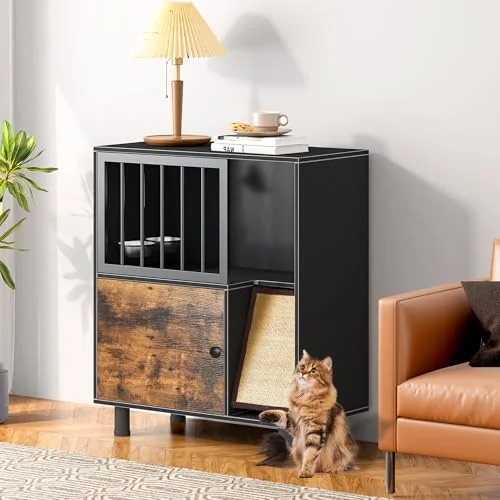
The lockable storage compartment is the underrated feature in this whole category, and it earns its place twice. Once because it stops the dog getting into the bag, which a plain cabinet does not. And once because it stops the second cat getting into a diet that is not theirs, which nothing else in a cabinet does.
Why Feeding the Cat in the Bedroom Stops Working
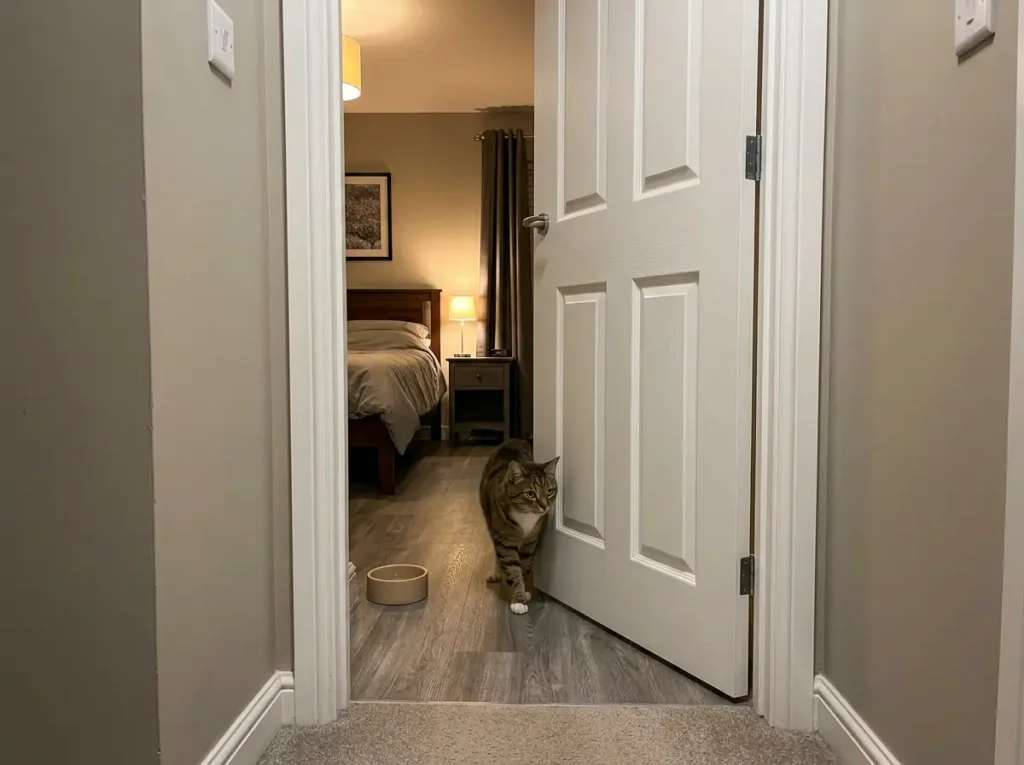
Shutting the cat in a bedroom to eat is free, instant, and obvious, which is exactly why it is the fix a lot of households are still running a year later. It does not fail on day one. That is the trap in it.
Nothing about the first month tells you this will not scale. The dog is out, the cat is fed, the problem appears solved, and there is no signal anywhere telling you to change the arrangement. The failure is slow and it arrives through the door rather than through the bowl.
A closed room accumulates food odor with nowhere for it to go, on the same timeline any enclosed space with food in it does, which is the same mechanism behind how long a smell actually lingers in a closed room. Wet food left down for twenty minutes twice a day in a sealed room is not a dramatic smell. It is a faint permanent one, and the thing about a faint permanent smell in a bedroom is that you stop noticing it and your guests do not. The room stops being a bedroom the cat eats in and becomes a room that smells of food.
Then there is the scheduling cost, which people underestimate because it is invisible until it is not. This arrangement depends on a human being home at the right times to open and shut a door. Free feeding is over. So is any day that runs late, any weekend away that needs a neighbor briefed on a routine, and any morning where somebody forgets and the cat waits.
A second cat breaks it completely. Two cats behind one door means the dog is out and nothing else has been solved. Which cat ate which bowl, whether the fast eater cleared both, whether the one on a specific diet got the right dish. The bedroom door is a species-level filter, and once the problem stops being about species it stops working at all.
The fix for the fix is small, and it is the same barrier logic as the gate applied to a door your household already owns. Hold the door ajar at a cat-width gap instead of shutting it. The cat routes in and out on its own schedule, the room ventilates continuously instead of sealing, and you stop being the doorman. Same room, same bowls, one strap.
If the bedroom routine is already running, do not dismantle it. Crack the door to a cat-width gap instead and watch for a week. If the cat goes back to eating on its own schedule, you had a door problem rather than a feeding problem, and you just solved it for the price of a strap.
Two Cats, One Diet, and a Dog
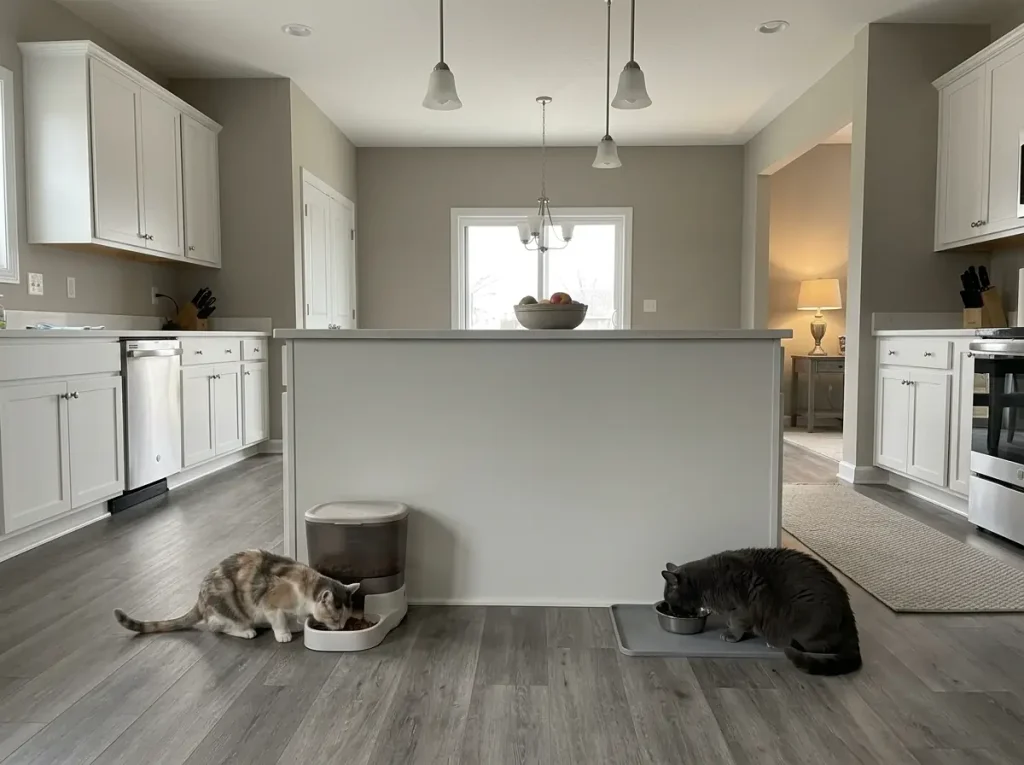
Half of the multi-pet households with this problem are not only keeping a dog out. Multi-cat feeding is the other half of the job, and almost nothing above touches it. They are also keeping one cat out of the other cat’s bowl, and most of the answers above do precisely nothing about that.
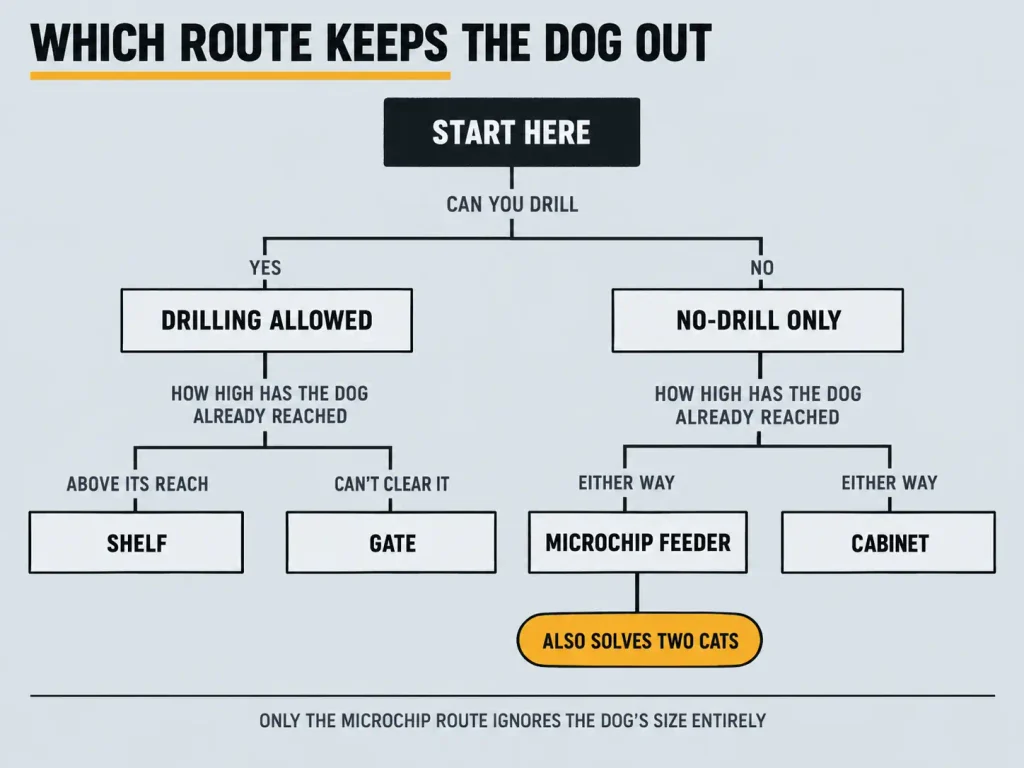
Of the four routes here, only the microchip feeder separates cat from cat. A shelf, a gate and a cabinet all gate by geometry, and both of your cats have essentially the same geometry. Whatever a shelf keeps out, it keeps out equally. Whatever a cat door lets through, it lets both of them through. If your real problem has two cats in it, three of the four options on this page are solving a different problem than the one you have.
If one of your cats is on a diet a vet prescribed, that is the entire reason the separation has to be per-cat rather than per-species. What that diet does, and whether a cat needs one, is a conversation with the vet who prescribed it. This article stops at the sentence, and everything below assumes the vet side is already settled and what is left is a resource-management problem: getting the right food into the right cat, reliably, with a dog in the house.
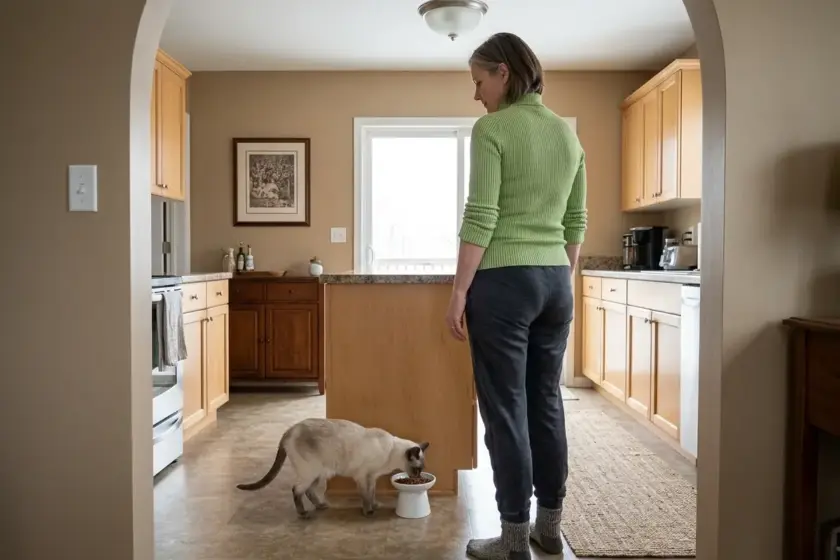
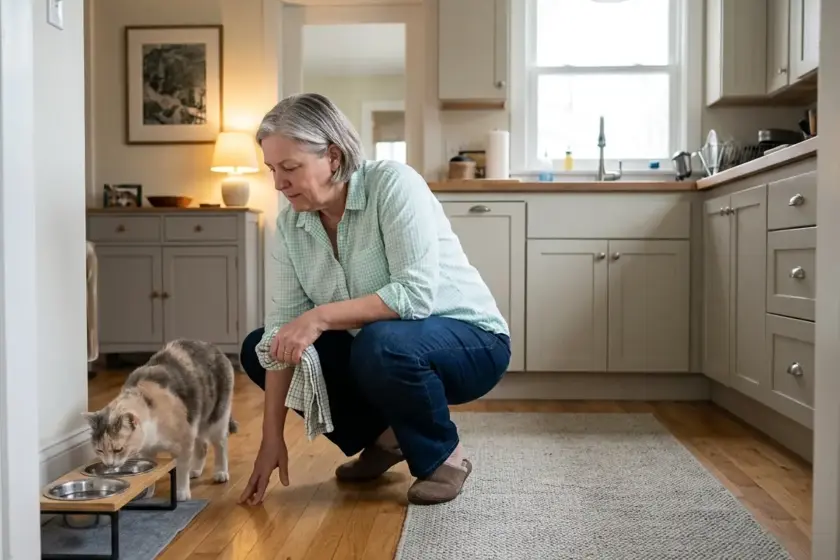
Two cats and a shelf means two stations, not one bigger one. Cats eating shoulder to shoulder on a narrow ledge is how one of them quietly stops going up, and you will read that as the cat going off its food rather than the cat declining to eat in a queue. The arithmetic is the same as the one in two cats need two bowls, plus one, and it applies to an elevated cat feeding station exactly the way it applies to floor bowls.
Resource guarding is often what is actually going on underneath all this, and it is worth naming because it changes what you are fixing. A cat defending access to food is not being greedy, it is managing a supply it does not trust, and the dog may only have made it visible rather than caused it. If one of your cats was already eating fast, or carrying food away, or standing over the dish, that was information before the dog ever arrived. The same signal shows up as a cat moving its food away from the bowl, which is a cat solving a problem rather than making one.
And the locked food compartment earns its second mention here. Whether it is a prescription cat diet or a weight management diet, the bag is the other thing both animals are getting into, and in a prescription-diet household the bag matters as much as the bowl. A dog in the wrong bag is a mess. A cat in the wrong bag is the thing the whole arrangement exists to prevent.
Conclusion
Measure the dog before you shop. Whatever height it has already reached, in your house, with food as the prize, is your floor rather than your target, and every route on this page gets chosen against that number.
If you are renting, the gate and the furniture you already own come before anything that needs a bracket. The free tier here is genuinely competitive, and the toggle-bolt tier means “I can’t drill” is worth double-checking against your actual lease rather than assuming.
And if there is a second cat in the house, only the microchip feeder is solving the problem you actually have. The other three are solving the dog half and leaving the cat half exactly where it was.
Check back in three weeks. That is long enough for the cat to have accepted the new place to eat or quietly rejected it, and long enough to find out whether the routine you built is one you are still keeping. Three weeks is also when an arrangement that was going to revert has usually reverted, back to a bowl on the kitchen floor and a dog who remembers exactly where it lives.
Before you spend anything: clear the top of the bookcase you already own, put the bowls at the back edge, and move any chair the dog could launch from. If the dog cannot get up there by the end of the week, you have just found out what you do not have to buy.
Amazon’s Audible — free for 30 days
Your cat won’t let you read. Let someone read to you.
Audible is Amazon’s audiobook library — thousands of titles, read out loud, on your phone. Free for a month, plus one audiobook to keep forever.
Frequently Asked Questions
01What is the best cat feeding station to keep dogs away?
There is no single best station, there are four routes, and your dog decides which one you get. A microchip feeder works regardless of the dog’s size because it opens by the cat’s chip. A wall shelf works only above the height that dog has already reached.
02Is there a cat feeder that is dog-proof?
Yes. A selective feeder that opens only for a registered microchip or collar tag is dog-proof by design, because it ignores size, jump and persistence entirely. Every other option is dog-proof only relative to one particular dog.
03How do you make a dog-proof cat feeding station?
The cheapest working version uses furniture you already own: clear the top of a tall bookcase, put the bowls at the back edge, and move any chair the dog could launch from. If you can drill, toggle bolts rated over 50 pounds hold a small shelf in drywall without a stud.
04Is there a dog-proof litter box too?
The same two levers work there: a height the dog cannot reach, or a doorway the dog cannot fit through. But a litter box adds a requirement a feeding station does not have, since the cat has to get in and out easily at any age, so height plays a much smaller part in the answer.
Leave a comment