Best Automatic Cat Feeder for How Long You’re Gone
Budget feeders drift 30-41% off the portion you set (best: 2-4%). Picks sorted by away-time, multi-cat theft, wet food & no-outlet kitchens.

Alfredo RamsesFounder · September 21, 2026 · 22 min read

On this page8 sections
- 1Start With How Long the House Is Empty
- 2What Your Cat Does to the Machine While You're Out
- 3Portion Accuracy, and Why a Scale Beats a Hopper
- 4The Outlet, the Router, and the Two Ways a Smart Feeder Goes Quiet
- 5The Picks, Sorted by Your Situation
- 6What Holds Up After the First Month
- 7The Short Version
- 8Frequently Asked Questions
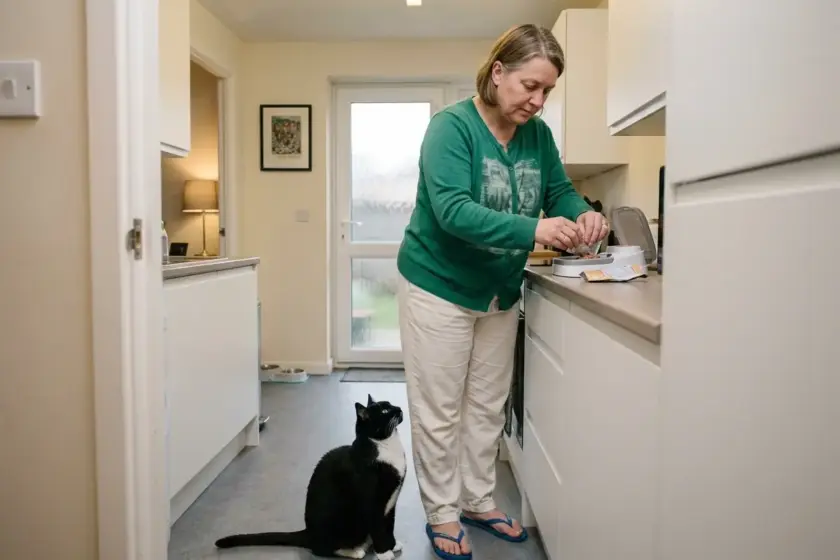
There is a weekend on the calendar, or a shift that stopped lining up with the cat’s, and now you are reading a list of thirteen feeders trying to work out which one wins. Nobody here lab-tested thirteen units, and this article is not going to pretend otherwise. What it does instead is sort the category by the failure patterns owners report over and over, and by the handful of specs that decide whether a machine is still working in month six. The best automatic cat feeder is not a model name, it is a match: how long the house is empty, how many cats eat in it, and whether there is an outlet where the cat already eats.
Quick Answer
Find your situation, then buy that type. The category decides far more than the brand does.
- One cat, dry food, gone a weekend: a sealed hopper feeder with real battery backup
- One cat and no outlet where he eats: battery-only or gravity, with no app to lose
- Portion matters because of a weight plan: a weighing feeder, never a volume hopper
- Two cats and one eats the other’s dinner: microchip or camera gating, not a timer
- Wet food past a single overnight: active cooling, not an ice pack
Start With How Long the House Is Empty
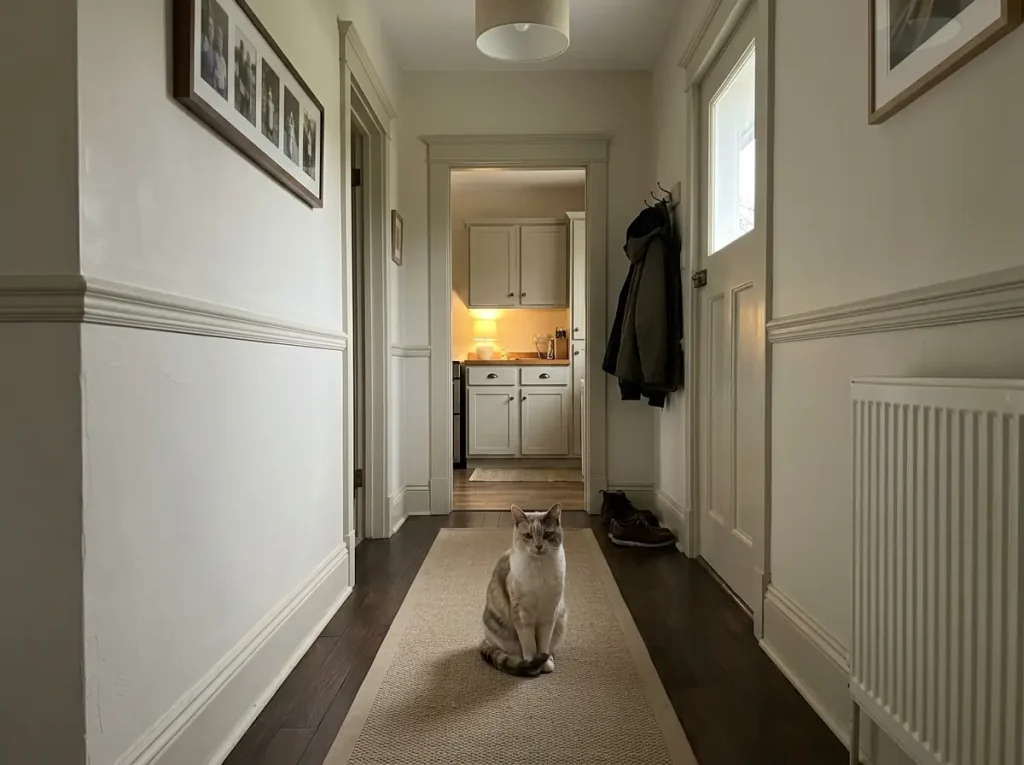
Everyone shops for this backwards. You open a ranking of thirteen machines and start comparing hopper sizes, when the number that decides the purchase is already on your own calendar: the hours between the last time someone is home and the next time someone walks in. Before any of that, it is worth being honest about whether an automatic feeder is the right call for your household at all, which the pillar handles properly. This article starts from yes, and so does the four things that decide whether one is worth it, which owns that decision gate.
There are three real brackets, and they want different machines.
- A long workday. One meal lands late or gets missed. A simple timed unit fixes it and nothing more expensive is required.
- An overnight to a weekend. Two to five meals have to fire without you. This is where sealing, jam resistance and a power story start to matter.
- A week or more. Technically solvable, and still a different conversation, because at that length the feeder is no longer the only thing the cat needs.
Capacity is a useless number as a liter spec and a genuinely useful one as a count of days. A 3L hopper holds roughly 2.9 pounds of dry food, which works out to about fifteen days of meals for one average adult cat. That is what you are buying: not three liters, but two weeks between trips to the pantry. Convert every capacity you see into days before you compare two machines, because a 5L hopper and a 1.6-cup dish are not competing for the same job.
And before anything gets bought, the free answer. For a single overnight with a single cat who self-regulates, a bowl with the day’s food in it and a second water source somewhere else in the apartment is fine. It costs nothing, and a feeder earns its place when the schedule repeats rather than when it happens once.
There is a second question hiding inside that one, and it decides which machine you need more than the calendar does: is this cat currently free-feeding from a bowl that is always full, or eating on a scheduled feeding pattern with set meal times? A cat who grazes at a full bowl and stays lean does not need portion control, he needs coverage. A cat who empties whatever is in front of him is already overeating, and handing him a gravity hopper makes that worse on a timer you cannot see.
Gravity feeders sit one step above a full bowl and solve exactly one problem: food never runs out. No portions, no timing, no idea who ate it. They are backup, not control, and reading them as anything else is how people end up with a heavier cat and a machine they blame.
One line and then back to the hardware, because this belongs to a veterinarian rather than to a product comparison: a cat who suddenly refuses to eat is a vet question first. The machine is not the variable there.
What Your Cat Does to the Machine While You’re Out
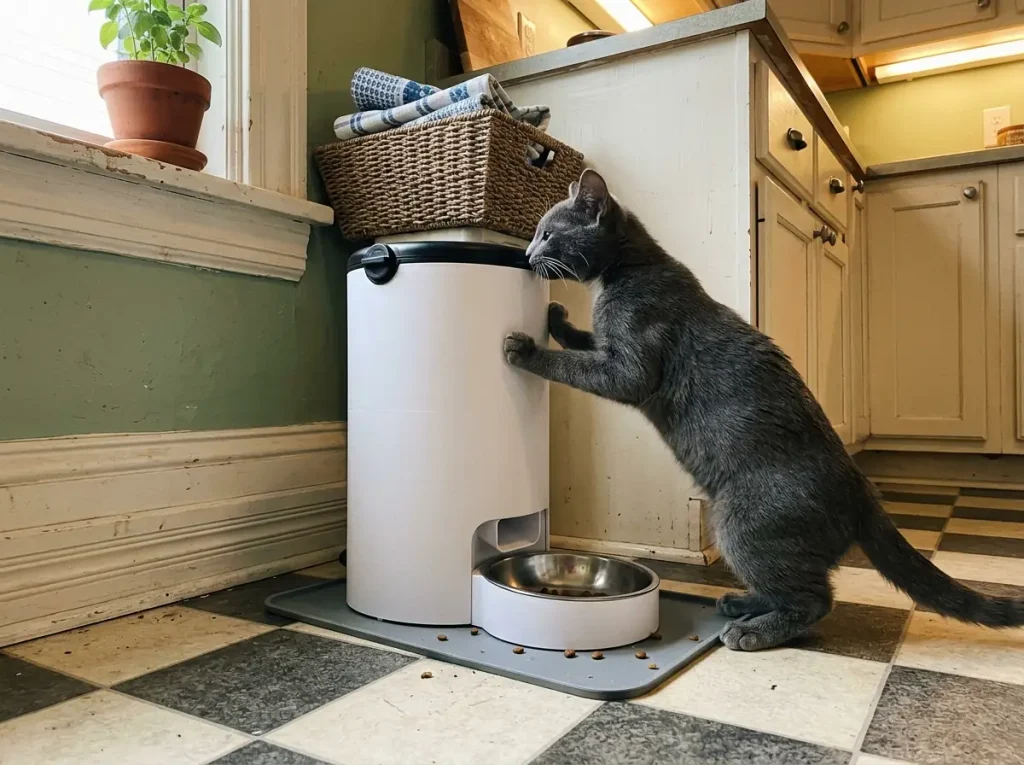
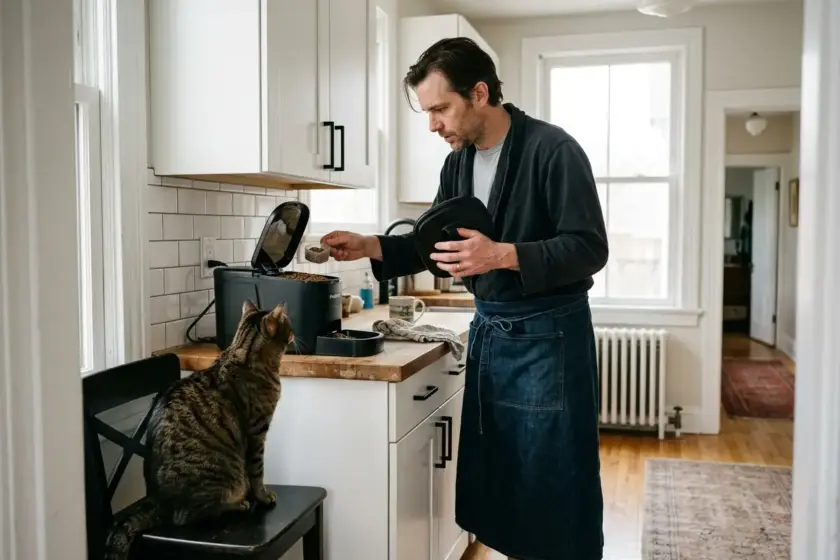
“My cat figured out how to paw the lid open within a week” is one of the most repeated lines in owner reviews of this entire category. Most people read that as a badly behaved cat. It is a badly sealed dispenser chute.
He can smell the whole hopper through a gap you cannot see, and a container of food that smells reachable is a puzzle box with a reward inside. Cats are good at those. He is not testing your authority, he is doing arithmetic on a machine you left in his apartment.
The tamper failure is not a rare defect rate, it is the recurring complaint: pawed-open lids, nosed-open chutes, and the whole hopper eaten in one sitting instead of released as one portion. One review documents a twelve-year-old cat physically breaking the housing on day one, which is a tamper-resistance failure and not a mechanical one. No warranty covers being outsmarted. What survives is unglamorous: a twist-lock lid, a fully enclosed chute, and a low profile that does not tip when eleven pounds of cat leans on it.
Here is where what the cat wants and what you want pull apart. You want an elegant machine that looks right on the counter. He wants food that arrives predictably and cannot be reached early, and those two lists overlap less than the product photos suggest.
A tamper-proof lid and a squat, tip-resistant base are his version of the specification. Buy his.
The silent failure is the worse one. A jam means kibble wedged in the auger, usually because the pieces are irregularly shaped or slightly larger than average, and the failure is quiet: no meal, no alert, nothing to see until somebody gets home. A non-connected unit has no way to tell you, and a connected one only helps if it is still connected.
Kibble shape matters more than anyone writes down, and it is the one variable you can test on your own counter for free. If you want the teardown of which part actually gives out first, and how soon, the sibling article does that job.
Run a handful of your own kibble through the chute by hand before you trust the machine with a weekend. Not the sample in the box, not a scoop of something rounder: the bag currently in your cabinet. Jams are a shape problem, and the shape you feed is the only one that counts.
Portion Accuracy, and Why a Scale Beats a Hopper
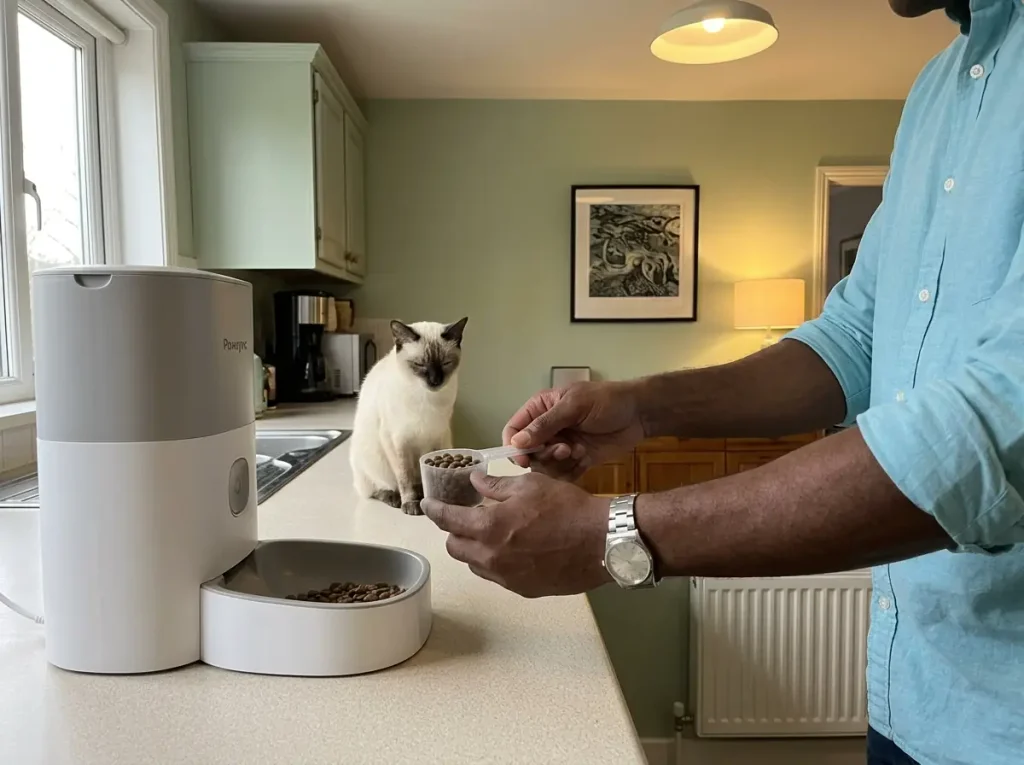
Nobody buys a feeder thinking “I wonder how close to a half cup this actually lands.” Then the vet says the cat has gained a pound, and you swear you have been feeding the same amount every day since spring. You have been programming the same amount every day. Those are not the same sentence, and the gap between them is measurable.
Across the category the measured spread is large: roughly 2 to 4 percent deviation on the best-tested units, and up to 30 to 41 percent on budget ones. In plain terms, a cheap feeder set to a half cup can deliver anywhere from a third of a cup to two-thirds of a cup, every single day, and the error does not average out. It leans the same direction each time, which is what turns a rounding error into a weight problem eight months later. The forums have a name for it before the spec sheets do: portion drift.
The mechanism is simple enough once you see it. A volume hopper feeder counts auger rotations and assumes every piece of kibble is the same size and density as the last one. A weighing feeder puts the bowl on a scale and weighs what landed in it. One measures the machine, the other measures the meal.
If your cat is on a prescription diet or any kind of weight management plan, that distinction stops being a nice-to-have and becomes the filter you shop with. A weight plan built on a 30 percent error is not a weight plan, it is a guess with a spreadsheet attached.
A note on where those numbers come from: this site did not measure these units. The figures belong to the reviewers who ran the tests and are cited as theirs, which feels worth saying out loud on a page full of recommendations.
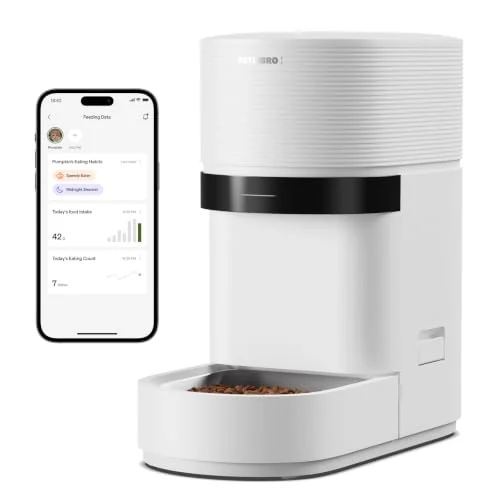
If a month of food sitting on the counter is more machine than the kitchen wants, the same weighing logic exists in a smaller box, and it closes the silent-failure gap from the last section in a way the larger unit does not advertise.
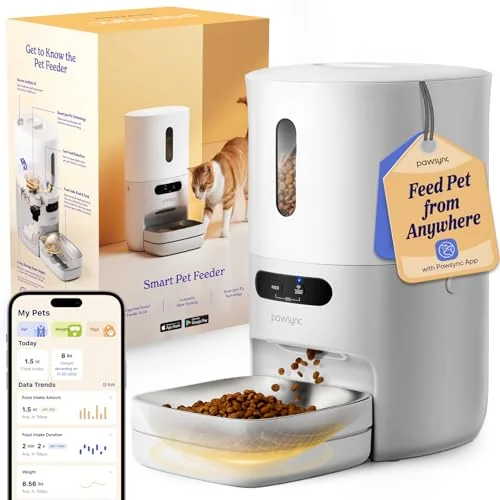
Both of those, and every connected feeder in the category, need a power story before they need an app. Some models sell a dedicated backup battery that keeps a feeder running for about 24 hours through a power outage, which is the difference between a machine that fires the next meal after a blackout and one that sits dark until you get home and reset the clock by hand. Which brings up the two ways these things go quiet, and neither of them is the motor breaking.
The Outlet, the Router, and the Two Ways a Smart Feeder Goes Quiet
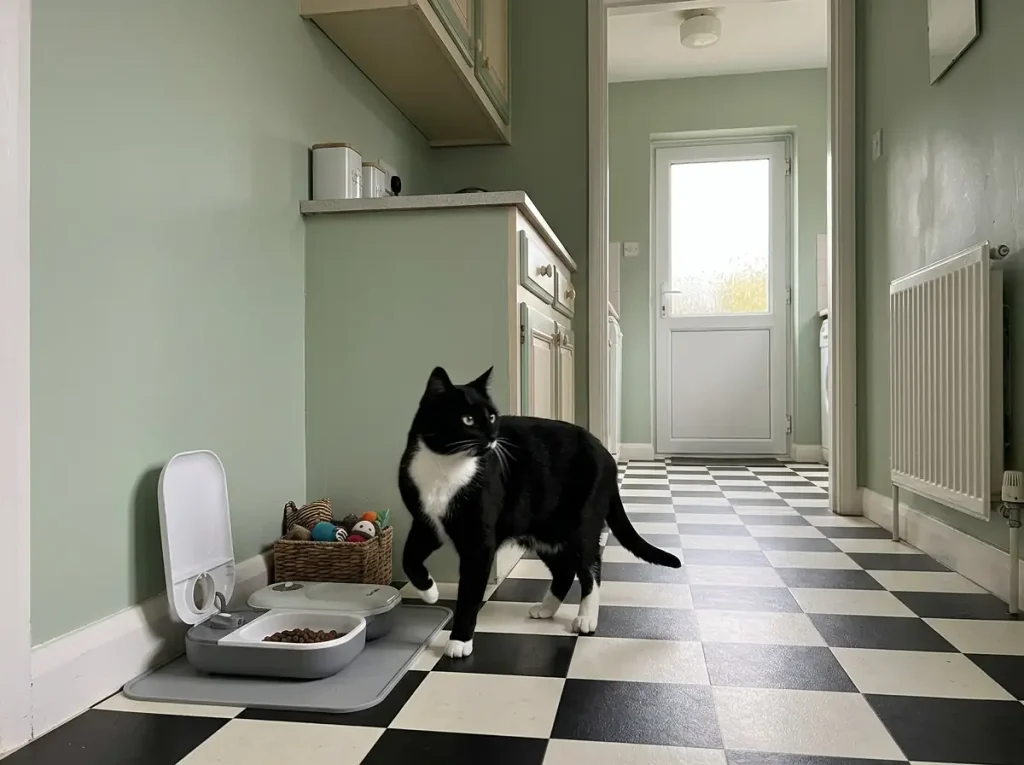
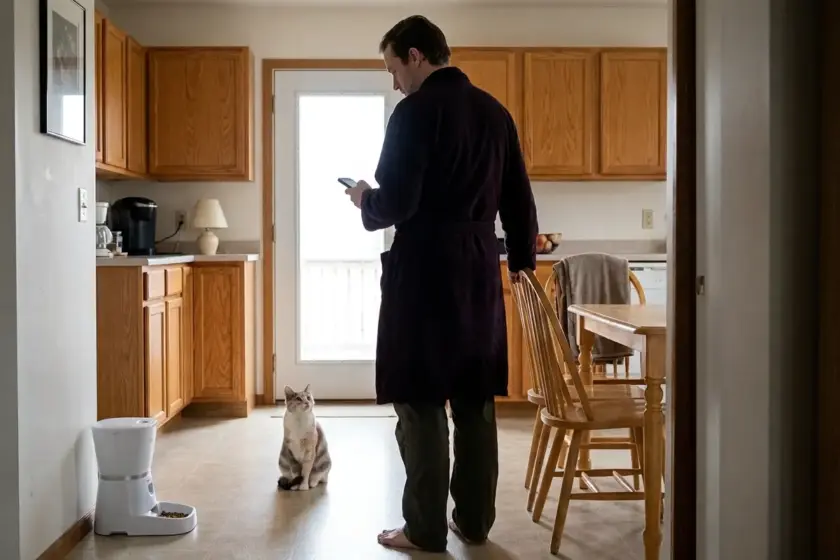
The apartment version of this problem is never on the spec sheet. There is no socket where the cat already eats, and the building’s WiFi is not yours to configure. Both are completely ordinary, and both break a smart feeder without anything on the machine being broken.
The outlet access question comes first because almost nobody asks it out loud. Is there a socket where your cat currently eats? In a rental kitchen that is genuinely not a given, and the workaround people reach for is worse than it looks: moving the feeding station to chase a socket also moves the cat’s routine, usually to the spot you picked rather than the one he did. A feeding station that has been in the same corner for two years is not a decoration you can slide four feet to the left because of a plug.
Counter space is the other half of the same constraint, and in a small apartment the two fight each other — the socket is behind the toaster, and the only clear stretch of counter is nowhere near it. The upside of this category, and it is a real one for renters, is that nothing here needs drilling or mounting. Renter-friendliness is entirely about footprint and power, which makes an automatic feeder one of the very few cat purchases a tenant never has to ask permission for.
Then the network, and this is the failure neither tested-review site discloses. App-connected units are 2.4GHz-only, and they fail to pair when a router broadcasts one combined SSID for both bands. That is exactly what mesh systems and most newer ISP-issued routers do by default, straight out of the box.
It is documented in the manufacturer’s own troubleshooting page, which spells out the 2.4GHz-only limitation, and no amount of retrying gets around it. Splitting the SSID does, if the router is yours to split. Two more ordinary situations break pairing the same way: a phone running a VPN during setup, and a building-managed network that wants a MAC address on an allowlist before it lets anything new talk.
Here is the important half, and it is the half that reframes the whole purchase. When this happens, the motor keeps working. The food still drops, on schedule, exactly as programmed.
What you lose is the remote control and the monitoring, which is precisely the thing you paid extra for. A wi-fi lockout does not starve the cat, it quietly converts a smart feeder into an expensive dumb one, four hundred miles from where you are standing.
The clean way out is not to learn to debug a router from a hotel room. It is to buy a machine with nothing to disconnect. No app, no pairing, no firmware, no account. The entire failure surface becomes “did I put batteries in,” which is a question you can answer before you leave.
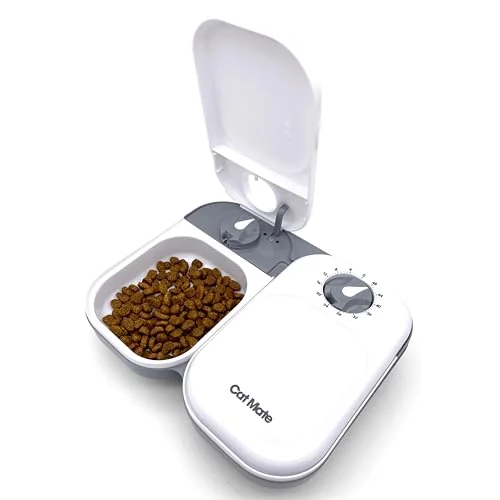
I used to treat the app as the obvious upgrade on any feeder over a certain size, on the logic that being able to see the meal fire is worth something when you are away. Enough lockout stories in owner threads, all with the same shape, and I changed my mind about who it is for: the app is worth paying for when you would actually act on what it tells you, and it is worth nothing at all when it is a reassurance feature on a machine that was going to work anyway. If you do want it, a dual power supply is the middle answer, and the PETKIT Automatic Cat Feeder with 2.4G WiFi and Dual Power is the straightforward version of it: a 3L hopper, about fifteen days of food for one cat, running on the plug with batteries underneath so an outage takes the app offline without taking dinner with it. It is still 2.4GHz, so the combined-SSID problem above is still yours to check before you travel, not after.
The Picks, Sorted by Your Situation
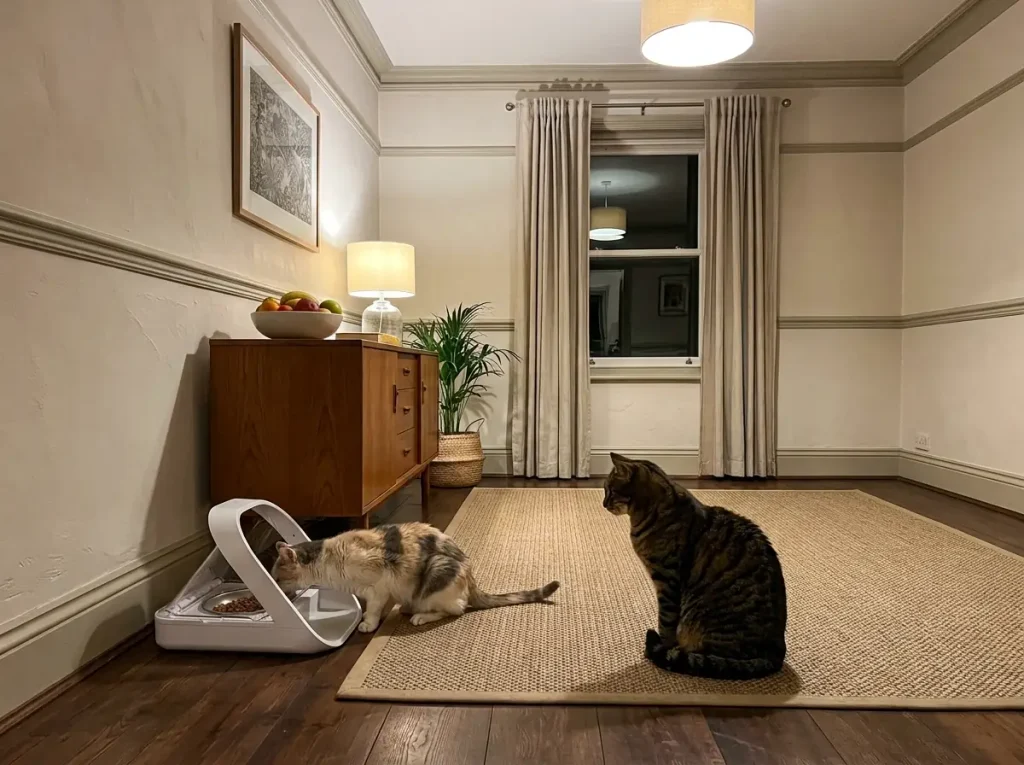
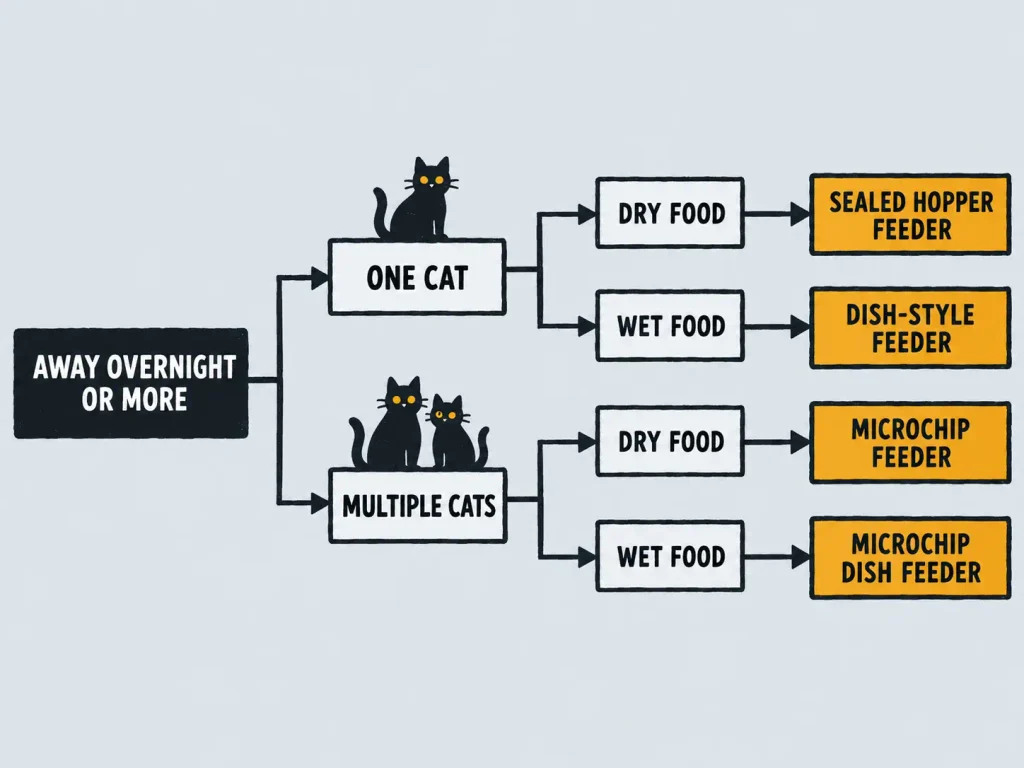
This is the part every competing list puts at the top as a countdown from one to thirteen, which leaves the reader to sort themselves. Sorting them is the job. Find your row, read that one, and stop.
Five shapes cover the whole category, and the shape decides the winner far more often than the badge does. A gravity hopper holds food and nothing else. A programmable feeder, the upright feeder most people picture, drops measured portions of dry food on a clock.
A dish-style feeder rotates covered trays and is the only shape that takes wet food seriously. An RFID feeder reads a chip or a collar tag and opens for one named cat. And a WiFi feeder is any of the middle three with an app bolted on, which buys remote monitoring and a network dependency in the same purchase.
| Your situation | Feeder type and days of food | Power and portion control |
|---|---|---|
| One cat on a weight plan | Weighing hopper, 5L, about a month | Plug plus app, weighs every meal |
| No outlet, no router access | Battery two-meal tray, one overnight | Batteries only, timer not portions |
| Two cats, one eats both dinners | Microchip dish, 1.6 cups per fill | Gated by identity, not by clock |
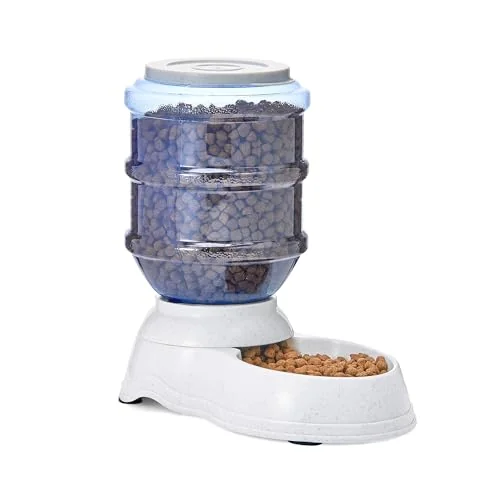
| Budget, or a backup beside a timer | Gravity hopper, 1 gallon, about a week | No power, and no portion control |
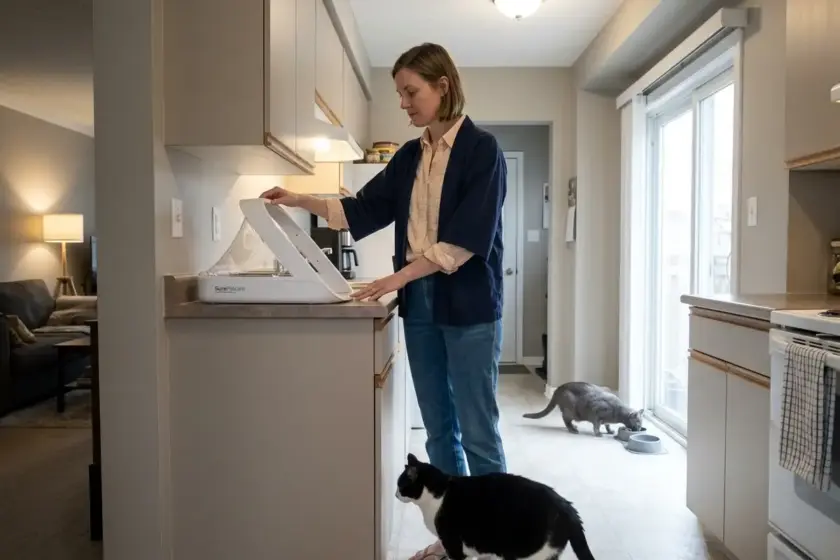
A multi-cat household changes the answer completely, and this is where that gets said out loud instead of implied by a product category. Two cats sharing one timed feeder defeats portion control entirely, because a timer puts food out and never checks who ate it. The faster cat eats his own dinner and then most of the slower one’s, every single day, and the machine reports a perfect record while it happens.
That is not a training failure and it is not a greedy cat. Food stealing is what any reasonable animal does with food that is present and unguarded, and the second cat is not the problem in that sentence. The fix is gating access rather than scheduling it, which is a resource question before it is a hardware one — why two cats and one bowl is a resource problem before it is a feeding problem covers the version that does not need a machine at all.
The full multi-cat buying guide is its own article; this section names the type that solves theft and hands off. And a household with a dog in it has a different problem again, since a dog defeats every gate a cat respects.
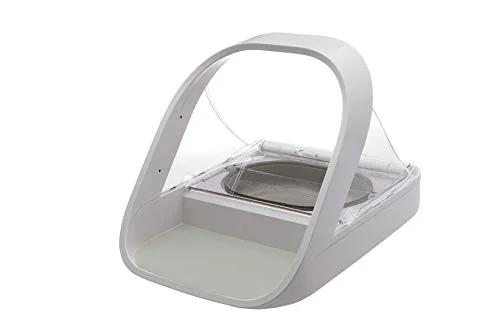
There is a second, cheaper answer to the same problem: the PETKIT Upgraded Multi-Cat Recognition Automatic Cat Feeder with Camera is a camera feeder: it identifies the cat by image rather than by chip, which costs less and is meaningfully less reliable, because a chip cannot be confused by bad light or by two similar-looking cats arriving together.
Below all of that sits the budget floor, and it deserves naming properly rather than being treated as the consolation prize. A gravity feeder has no electricity, no network and no moving parts to jam, and a one-gallon hopper covers roughly a week of dry food for one cat. It buys coverage, not control.
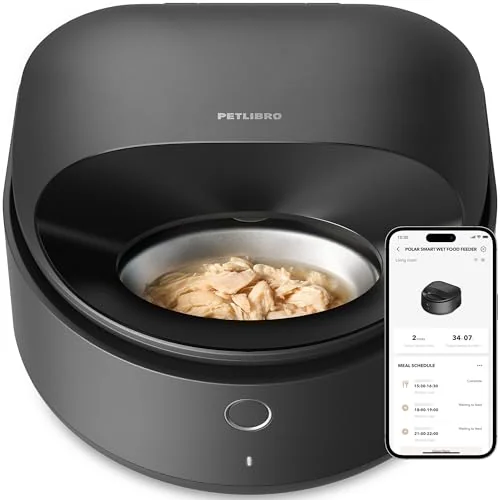
Wet food is its own machine, and the clock is the reason. An ice pack holds food safely for something like 8 to 24 hours, while a refrigerated feeder running active semiconductor cooling stretches that to around 72. That is the difference between covering a workday and covering a weekend, and the mechanics of the two-hour clock that decides whether wet food is still safe to eat belong to the sibling article rather than to this one. The pick belongs here.
The combination owners actually run is two machines, not one: the timed unit for portions, and a gravity hopper standing next to it holding a day or two of the same kibble. If the timer jams while you are away, the cat has already solved the problem himself and the worst outcome is a slightly larger dinner instead of no dinner. It works because it assumes the machine will fail rather than hoping it will not.
What Holds Up After the First Month
The feeder works beautifully for three weeks. Then the routine around it slips, quietly and in a specific order: nobody has washed the bowl, nobody has checked the hopper level in a while, and the battery in the “battery backup” has never once been tested. The machine is fine. The system around the machine is what decays.
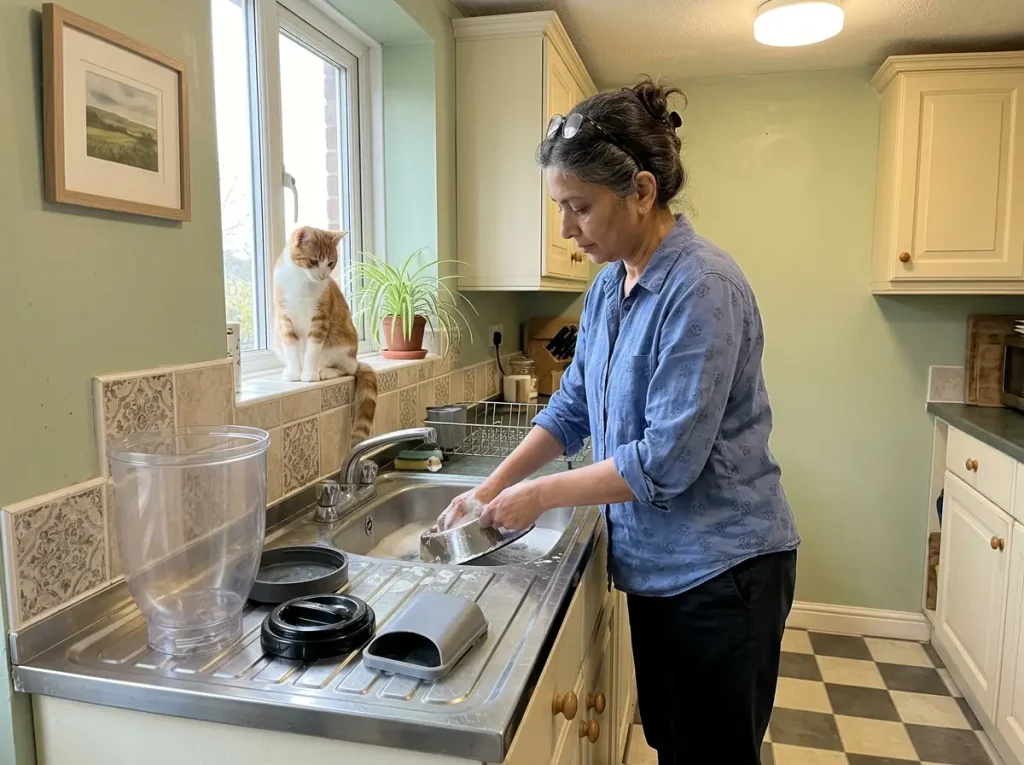
Hygiene is a buying criterion rather than a chore, and it is worth deciding before the box arrives rather than after. Stainless steel bowls over plastic, because a plastic hopper and a plastic bowl both scratch into a surface that holds old food smell, and a scratched bowl is the one thing a cat will quietly refuse to eat from.
Check which parts are dishwasher-safe before you buy, not after: the fewer pieces that have to come apart by hand, the more often it actually gets washed. A feeder that needs eight minutes and a bottle brush gets cleaned on a schedule for about a month. One where the bowl lifts out and goes in the rack gets cleaned more or less forever.
The other spec nobody checks until they are living with it is noise level. These machines announce themselves — the auger turn, the click and whirr as a portion drops — and in a studio apartment the feeder is in the same room as the bed. That is fine at seven in the morning and less fine at five, which is a scheduling decision more than a hardware one.
Then the thing nobody writes down about capacity: dry food sitting in an open hopper goes stale, and the cat notices well before you do. Capacity beyond roughly two weeks of food is capacity the cat eats stale, which is the quiet argument against buying the largest hopper you can find because it looked like better value. Buy the hopper that matches your refill rhythm, not the one that lets you ignore it longest.
That refill rhythm is the part that decays, not the motor, and the hopper level check is the thing nobody ever puts on a calendar. If you want the meal-count side of this, how many meals a day, and at what hours, without training a 5 a.m. alarm cat has it.
One line again, and it stays one line: a sudden appetite change in a cat who was eating fine from a working feeder is a vet visit, not a product question.
And the ceiling, which no list of picks ever attaches to the picks themselves. A feeder schedules meals. It is not a pet sitter: it does not check on a cat, and it does not notice that he has been under the bed since Tuesday.
Vacation feeding past a couple of days means somebody physically comes to the house and looks at him, because a cat left unsupervised for a long weekend has a food problem solved and everything else unmonitored. The machine handles the food, which is the easy half of being away.
Rehearse the outage on a night you are home, not the night before a trip. Pull the plug after dinner and go to bed. If the next scheduled meal fires on battery, the backup is real. If it does not, you found out in your own kitchen with a bag of kibble in the cabinet, which is the cheapest possible place to find out.
The Short Version
Buy on the hours the house is empty and the number of cats eating in it, not on hopper size or app features. Those two numbers eliminate most of the category before you have compared a single brand.
If the cat is on a weight plan, buy a feeder that weighs. If the kitchen has no outlet where the cat already eats, buy one with no plug and no app. Either constraint on its own rules out most of what gets recommended, and they are both questions you can answer in ten seconds standing in your own kitchen.
Two cats sharing a timed feeder is not portion control. Gate the food by identity, or accept that the faster cat is eating both dinners and stop being surprised by the vet’s scale.
Three weeks from now, check three things: has the bowl actually been washed, is the hopper where it should be, and did the cat ever settle into the schedule or is he still asking you for food at the old hour? Three weeks is the honest interval here, because this depends on you keeping a rhythm and on him accepting a new machine, and both of those either hold or slip inside a month.
Before any of it, run a handful of your own kibble through the chute. If it jams on your kitchen counter, you just saved yourself finding that out from four hundred miles away.
Amazon’s Audible — free for 30 days
Your cat won’t let you read. Let someone read to you.
Audible is Amazon’s audiobook library — thousands of titles, read out loud, on your phone. Free for a month, plus one audiobook to keep forever.
Frequently Asked Questions
01What type of automatic cat feeder is best?
Your situation decides the type, not a ranking. A sealed hopper feeder covers dry food on a schedule, a weighing feeder is the one to buy if the cat is on a weight plan, a microchip feeder is the only type that stops one cat eating the other’s dinner, and a gravity feeder is coverage rather than control.
02Can I leave my cat alone for two days with an automatic feeder?
A feeder covers the meals for that long, but it does not check on the cat. A single overnight is genuinely fine; past about a day, the accepted line among the behaviorists the review sites cite is that somebody should physically look in on him. The machine schedules food. It is not a stand-in for a person.
03Why does my cat keep breaking into the automatic feeder?
Because he can smell the whole hopper and the chute is a puzzle with a reward at the end. That is a badly sealed feeder rather than a badly behaved cat. Look for a twist-lock lid, a fully enclosed chute and a low, tip-resistant base instead of trying to train the behavior out of him.
04How accurate are automatic cat feeders at portioning?
It varies more than the boxes admit. Measured testing puts the best units at roughly 2 to 4 percent off the programmed portion and the worst at 30 to 41 percent off, leaning the same direction every day. A feeder that weighs what lands in the bowl avoids it; one that counts auger turns is guessing.
05Will an automatic feeder still work if the WiFi or the power goes out?
The dispensing usually survives both and what you lose is the app. Manufacturer support pages document app-connected feeders failing to pair on combined-SSID mesh routers, over a VPN, or on building-managed networks, while the motor keeps running. Models with a dedicated backup battery keep firing for about 24 hours through an outage.
Leave a comment