Why a Cat Keeps Peeing in the Same Spot After You Clean
Cat peeing in the same spot? Box 1.5x her length, 2 inches of litter, a UV light + enzyme cleaner & the signs that mean a same-day vet call.

Alfredo RamsesFounder · November 17, 2026 · 22 min read

On this page10 sections
- 1A Cat Peeing in the Same Spot Is Choosing a Place, Not Making a Mess
- 2The Vet Call Comes Before the Carpet, and One Sign Makes It Tonight
- 3Read the Posture and the Amount Before You Name the Accident
- 4A Place the Cat Likes, or a Route the Cat Can't Walk
- 5Why Cleaning Leaves the Cue Behind, Down to the Underlay
- 6When the Spot Is Steps From the Box, the Box Is the Problem
- 7Put a Box on the Spot, Then Walk It Back Slowly
- 8The Other Cat at the Stairs, and the Cat Outside the Window
- 9Call First, Clean the Layer Underneath, Then Walk the Box Back
- 10Frequently Asked Questions
You scrub the corner, open a window, and by the weekend the same square of carpet is dark again. A cat peeing in the same spot is not scattering accidents around the apartment: she is using one area, a specific patch of floor, and the repetition already tells you what that patch is to her. Either it still smells like a toilet under the cleaning, or it beats the box on softness and quiet, or it sits on a route she cannot cross comfortably, and in each case she is right about the constraint. This guide starts at the vet’s door, then reads the posture, the place, the layer under the carpet, the box and the other cat.
Quick Answer
A cat that keeps returning to one square of floor is reading a place, not making a mess. The spot may still smell like a toilet under the cleaning, beat the box on softness and quiet, or sit on a route she cannot cross. Straining, crying, blood, little urine or a change overnight means a same-day vet call first.
A Cat Peeing in the Same Spot Is Choosing a Place, Not Making a Mess
A cat who uses one patch of carpet again and again has made a decision, and the repetition is the clue. This article is about a single square foot of floor; for every other way a home ends up stained, the full walk through every kind of house soiling covers the wider triage. The question here is narrower: what does that exact patch have that the box does not, and why does it still say toilet after you washed it?
Same Spot or Random Spots, the Difference That Decides the Plan
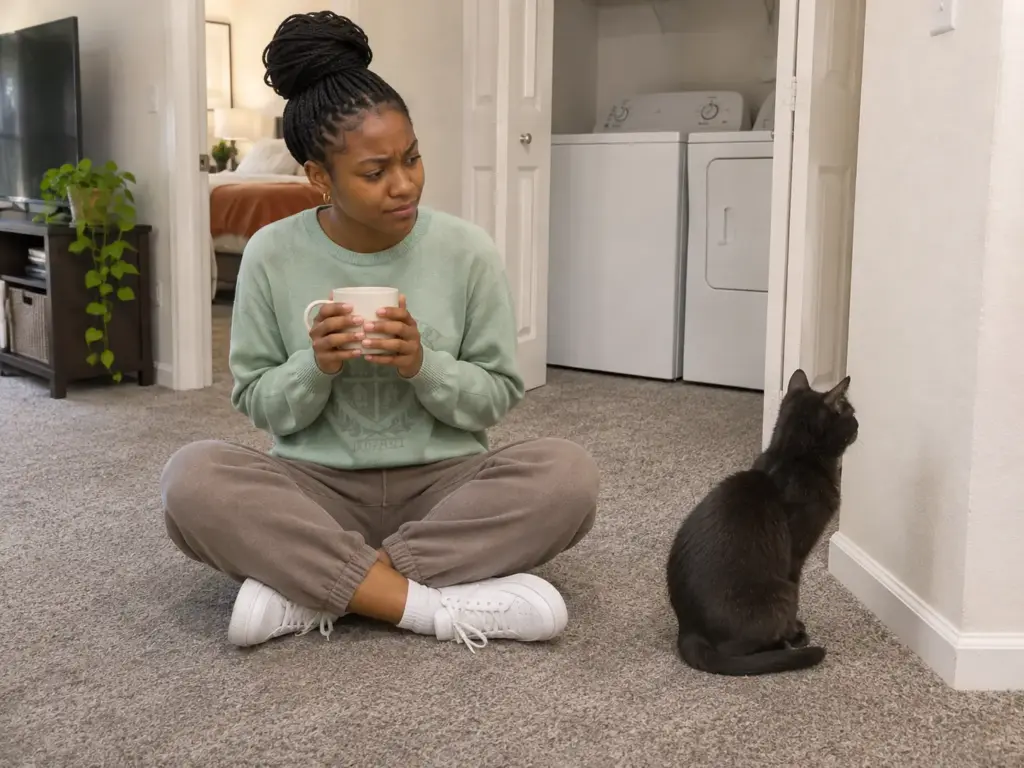
Pee scattered across several rooms points at the whole setup: the box, the litter, how the household feels to her, or a medical question for the vet. Repeated urination on one patch, visited again and again, points at the patch.
She has not forgotten what a toilet is. She has found somewhere she likes better than the place you offered, or somewhere that never stopped smelling like one. The plan for the first problem is wide, and the plan for the second is a tape measure and a close look at one corner.
What a Square Foot of Floor Offers That a Box Doesn’t
Look at the spot from her height. Carpet is a soft surface under the paws and it absorbs, so it holds a scent for weeks.
A corner against the baseboard puts a wall at her back and the whole room in view. A bedroom floor or the space behind a door is quiet all day while nobody is home. And a patch in a hallway may simply be the first safe spot she reaches on the way to the box. Any one of those can beat a plastic tray that smells of fresh litter.
The pattern repeats in homes that try the obvious move. The box goes somewhere new, the corner stays, and the cat keeps using both. Or the box sits three steps away in plain sight and the carpet still wins, because a box in view proves nothing about whether the box is any good. (And a cat can accept the box for one job and prefer a surface for the other, which turns up again two sections down.)
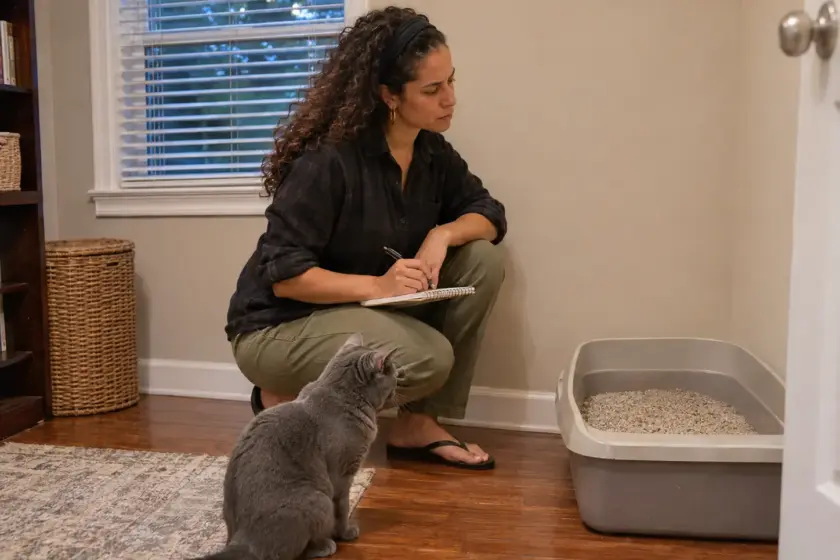
Get down on your knees and look at the spot from cat height before you clean anything. Note what is within a few inches: the wall line, a soft pile, a door that opens toward it. The patch usually explains itself from down there, and the look costs nothing.
Why Washing It Didn’t End It
You cleaned by eye, and she checks by nose. Those are two different inspections, and a surface that looks spotless to you can still announce itself to her from across the room.
The mechanism gets its full section further down, in the part about what sits under the carpet. The rule that governs the whole article starts here, though: what the cat does on the floor is a constraint she is reporting, and what bothers you about it is a preference. The constraint gets solved first.
The Vet Call Comes Before the Carpet, and One Sign Makes It Tonight
Nobody enjoys this part, because it feels like being told to stop cleaning and start worrying. It is smaller than that: a short run of signs that turn a floor problem into a phone call, and a way to make the call useful.
Why “It’s Probably an Infection” Is the Wrong First Guess
The first guess almost everyone makes is a bladder infection, and it is a poor first guess. Cornell’s note on how often a bladder infection is the bacterial kind puts bacteria at roughly one to three percent of lower urinary tract disease in young to middle-aged cats, and around ten percent past age ten.
That figure is no reason to skip the clinic. It is the reason the visit exists to rule things out, since an infection is not the likely answer. Whatever the vet finds, the floor is still the floor: a patch she keeps choosing needs the vet’s answer and a better patch to choose.
The Signs That Turn a Floor Problem Into a Same-Day Call
Straining or crying while she tries to pee, blood in the urine, very little urine or none at all, a cat who stops eating, or a sudden change in habit that arrives overnight: any one of those is a call to the clinic today, and not a weekend project. International Cat Care lists being unable to pass urine, or passing only small amounts, among the signs that need urgent attention. What those signs mean is the vet’s to say. This article stays on the carpet, the box and the apartment.
What the Clinic Needs From You Before You Touch the Carpet
Bring what you can see and nothing you have to guess. Where the spot is and what it is made of, how long she has used it, how many cats live there and how many boxes, and whether anything changed at home just before it began. If the habit shifted abruptly, what changed in the two weeks before the first accident makes a useful list to walk through first, because it is a timeline question and this article is about the place.
Photograph the patch twice, once standing and once from floor level, and write down the day you first noticed it. The clinic can use both. The photos also show you later whether the spot is shrinking, which memory is bad at judging.
Read the Posture and the Amount Before You Name the Accident
You can read this from the doorway in five seconds, before you wipe anything. How she stood, how much there is and where it landed separate three different kinds of inappropriate urination, and each one sends you to a different part of this guide.
- Standing, a small amount, up a wall, curtain or chair side: marking.
- Squatting, a flat puddle, often a few feet from the box: a problem with the box or the surface.
- Out on open floor at the edge of what she treats as hers: a boundary.
Standing, Tail Quivering, a Little on a Wall
International Cat Care’s guide to soiling indoors describes spraying, the urine marking kind, as a cat who stands, treads with her back feet, quivers her tail and sends urine backward onto a vertical surface, usually less than a full emptying of the bladder. A wet streak on a wall, the side of the sofa or a curtain fits that picture. It is a message about the house and who is in it, and it gets read as one. A big change in how much or how often she goes is the vet’s question, not a marking question, and it goes to the clinic.
Squatting on a Flat Surface, Often Feet From the Box
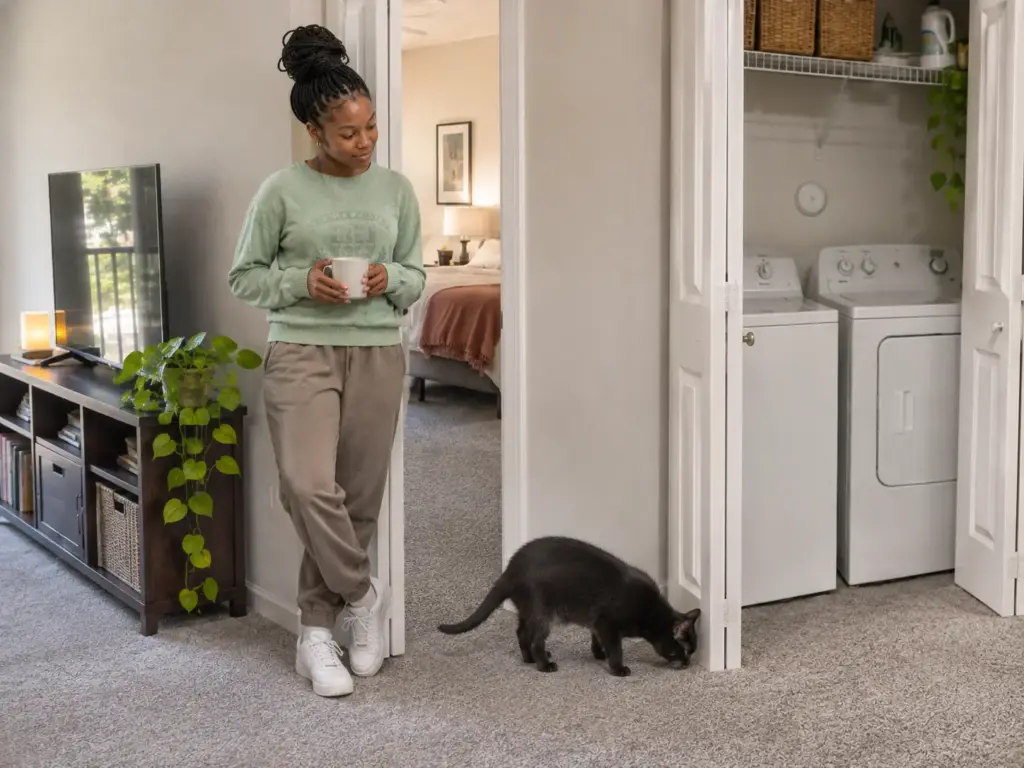
A squat on a horizontal surface leaves a puddle, and the puddle is larger. That is the family of accidents where the rug has beaten the box: softer, quieter, cleaner than the tray, or simply closer to where she was when she needed to go. The giveaway is geography. The spot is flat, soft and within a few steps of the box, and it keeps getting picked.
Open Floor on the Edge of What the Cat Treats as Hers
A puddle or a pile out in the open, at a hallway junction or a doorway, is a boundary matter more than a toilet matter. Behaviorists call it middening. She is not failing at the box; she is leaving something at the line of her ground, and the house-side answer is the route, the other cat or the window, covered in the last section of this guide.
Stool in the Box, Urine on the Carpet
A cat can use the box for one job and a surface for the other, and either way around is common.
That changes the fix. If stool goes in the box and urine goes on the carpet, she has not rejected the box. She has accepted it for one purpose and preferred a softer floor for the other.
The standard advice to add a second box assumes the new one should match the first, and here a clean copy teaches nothing. The substitute box has to offer something different: another texture underfoot, another spot in the apartment, a different height of sides.
Look before you clean. Stand at the doorway for five seconds and note the posture signs, the amount and whether the patch is flat or vertical. Wiping first erases the one clue that tells you which of the three accidents you have.
A Place the Cat Likes, or a Route the Cat Can’t Walk
A repeated spot is one of two things. Either it is a place, soft, warm, quiet and smelling of her, or it is a point on a route she cannot walk comfortably. They look identical on the carpet and they need opposite fixes: a place needs a better offer, and a route needs the path cleared.
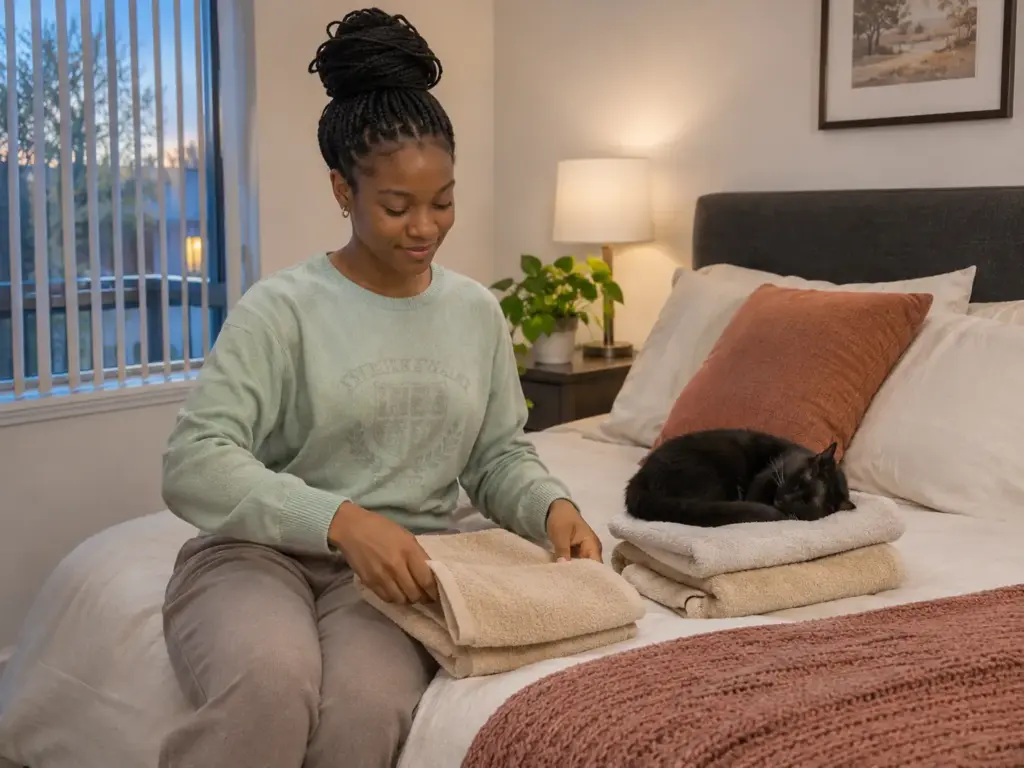
The Soft, Warm, Quiet Spot That Smells Like Her
According to VCA Animal Hospitals, “When a box is placed near the cat’s preferred location, it is often used immediately.” VCA’s guide to inappropriate elimination calls this location preference, and it gives you a clean test: if she takes a box set on the patch the same day, the argument was never with the box.
The cases that go wrong tend to look alike. The box moves upstairs or into a piece of furniture, the cat uses it, and then she returns to the old patch and starts peeing behind the box as well. The box was never what was missing. The place was.
The Spot on the Way to the Box
Sometimes the patch is not a place she likes. It is where she runs out of road. Every box sits in a far room or down a flight of steps, another cat (or a hallway she has to squeeze through) stands between her and it, and she goes at the first spot she reaches. Why a cat refuses a box that sits down a flight of stairs is the same route problem seen from the box’s side.
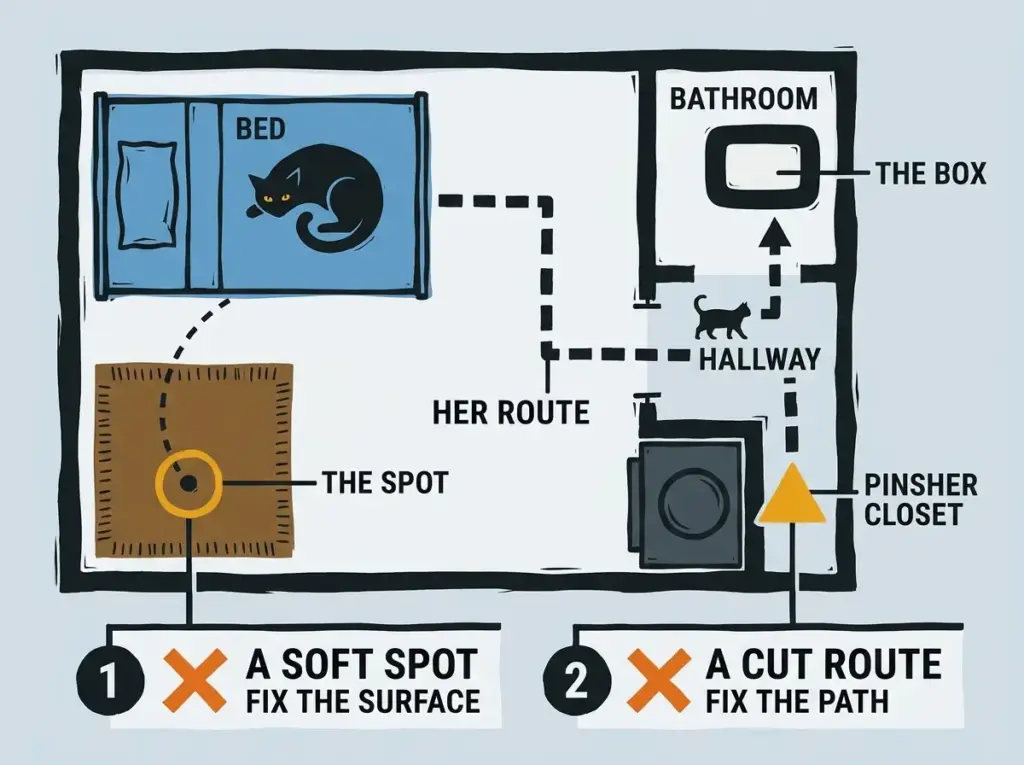
No cleaner repairs a corridor. A hallway that a second cat can block just by sitting in it is a closed door to the cat behind her, and she will take the nearest floor over a standoff. That is also why the older or more timid cat of a pair tends to be the one with the repeat spot.
When the Box Is Close but the Corner Still Wins
A box three feet away proves nothing. The corner wins when the box is too short, the litter too thin to dig in, the tray overdue for a scoop, or the lid in the way. Distance to the box matters less than what the box offers when she gets there.
When the box fails her test, vets call it litter box aversion, and the next sections measure what it is failing on. Two other checks belong here: how far the spot is from where she eats (a cat rarely uses the floor beside her food, which the section on boxes returns to) and what hour the spot gets used, since a patch used only while the apartment is empty is a quiet-place patch.
The Renter’s Version: Which Corner You Can Change
In a small rental the soft, warm, quiet places are predictable: clean laundry left on the bed, the pile in the basket, the bedroom rug, the closet corner by the washer. Some of them you can change tonight without drilling a thing or asking anybody: lift the pile onto a shelf, close the closet door, roll up the loose rug.
Others you cannot, because the wall-to-wall carpet belongs to the landlord. That split tells you where to spend effort. Change the soft places that are yours, and treat the one that is not yours as the patch to clean properly and to cover (a later section covers both).
Draw a rough floor plan by hand before any purchase. Mark the spot, the box and the walking line between them, and note the narrow points. Two minutes on paper shows whether you are looking at a place or a route.
Why Cleaning Leaves the Cue Behind, Down to the Underlay
The mismatch is simple. You want the stain gone and she wants the smell gone, and the two are not on the same layer of the floor.
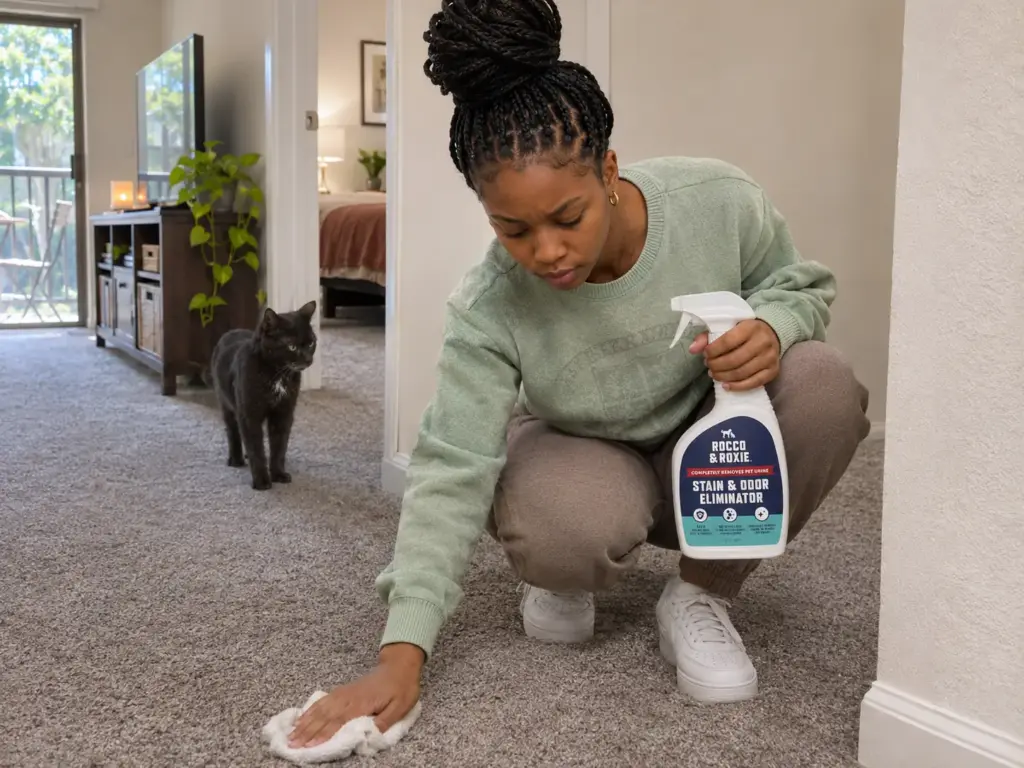
The Crystals That Water and Detergent Only Move Around
Cat urine leaves uric acid crystals that bind to porous material. According to Oregon State University Extension, “These crystals are not water-soluble, so the odor can persist for years.” University Extension on why cat urine odor survives cleaning adds that the smell can return when the item is moved or humidity rises, and carpet and its underlay are exactly that kind of material.
Water and detergent shift the crystals around without dissolving them, so the patch looks fine and keeps working. It is the same reason a litter box smell returns after a wash.
The free step comes first. Put the ammonia cleaner away, because International Cat Care points out these products smell like urine, and an ammonia wipe on that corner repaints the toilet sign in her own language. Skip the wet scrub too until you know where the old map lies.
Find the Old Map With a UV Light, in the Dark, on a Dry Patch
A UV flashlight, the blacklight kind, shows where the salts are. The ESCO LITE UV Flashlight 395nm is a 51-LED handheld that runs on three AA batteries, and its 395 nm light covers a good stretch of carpet in one sweep. Use it in a dark room on a dry patch, because the maker states it only detects dry urine, so tonight’s puddle will not glow.
How clearly stains show varies with the carpet and how dark the room gets. The light finds where the scent cue sits; it does not explain why she picked the spot.
Choosing an Enzymatic Cleaner Without Repainting the Toilet Sign
An enzyme cleaner breaks down what ammonia products leave in place, and the pick is between two bottles. The Rocco & Roxie Enzyme Stain & Odor Eliminator is a bio-enzymatic 32-ounce bottle with the Carpet and Rug Institute seal, the stronger of the two, and its flaw is that it costs noticeably more than the other. The cheaper route is the Simple Solution Pet Stain & Odor Remover, also 32 ounces, with a pro-bacteria formula; whether it lightens a given carpet is a coin toss, so it needs a test. Whichever one you take, dab it on a hidden corner first and wait for the carpet to dry.
Test any enzymatic cleaner on a hidden corner, such as under a sofa edge or inside a closet, before it goes on the spot. Let the test patch dry fully. If the color holds, you can saturate the real patch without gambling with the carpet you cannot replace.
A Browned Patch Means the Cue Sits Under the Surface
When the carpet has browned or faded, the problem has moved down. The deposit is in the underlay and, near a wall, in the baseboard, so wiping the top never reaches it.
In a rental this adds up to a calculation few people make: the stain you see is rarely the whole stain, and a landlord’s walk-through looks at the carpet edge and the baseboard, where the cue lives. Cleaning the visible patch hard enough to reach the layer below is worth far more than a second pass on the surface. That also means treating the area wider than the stain, since the crystals spread past the edge you can see.
When the Spot Is Steps From the Box, the Box Is the Problem
When the patch sits a few steps from the tray, look at the tray. It lost a contest, and the contest was measurable.
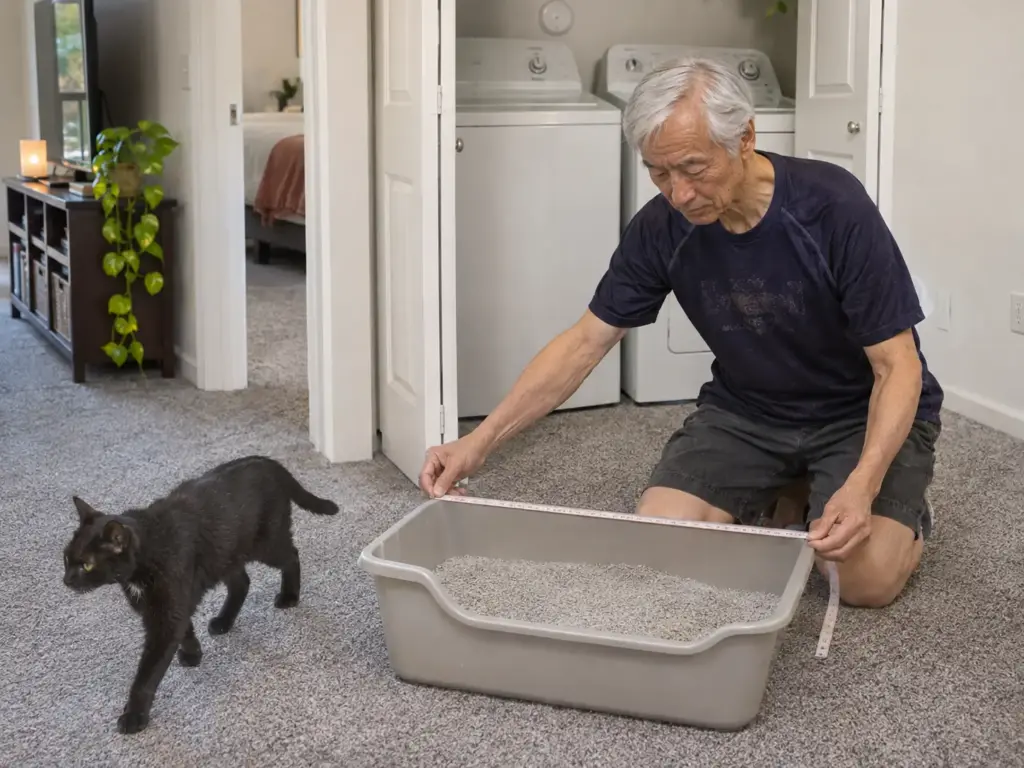
The Box Against the Cat, Nose to Base of Tail
The rule is a box about one and a half times the cat’s length, from the nose to the base of the tail, and a box too small is the commonest way to fail it. International Cat Care’s advice on litter box size says many standard boxes are too small, and VCA gives the same ratio. An 18-inch cat needs a box of about 27 inches, and the “large” box in a typical store measures about 19.
Which means the label “large” and the cat disagree, and the cat is the one holding the measuring tape. The full box sizes against a cat’s length are worked out in their own guide.
Litter Depth and Scooping, the Parts the Nose Can’t Judge
The numbers for depth disagree, and that is fine: International Cat Care cites about 3 cm, roughly an inch and a quarter, and Ohio State’s Indoor Pet Initiative on litter boxes says about 2 inches. What counts is that she can dig and bury, and a thin film over plastic is not a toilet to her. Why depth beats volume in a litter box goes through the trade-off.
Cleaning has a number too: remove solids at least twice a day, wash the box completely at least weekly, and with clumping litter a full change every two to four weeks is the guideline. How often to scoop a litter box, cat by cat fills in the daily arithmetic. A tray that smells clean to you at six in the evening may not be clean to her.
One Box Per Cat, Plus One, in a Home That Has One Cat
The guideline from Ohio State and International Cat Care is one box per cat plus one, so a single cat needs two. An apartment with one box has half of what the rule asks for. If the spot is what she is asking for, the second box can go on the spot itself (the next section builds that move).
A Lid, a Liner or a Cover That Tips the Balance
A covered box takes away the one thing a cat checks before she squats: an exit. A liner can catch a claw, and a cover can hold odor at nose height. If she accepts the box for one job and not for the other, take the lid off for a day and see what changes. It may settle the question without a purchase.
Measure the cat before you judge the box. Run a sewing tape from her nose to the base of her tail while she is relaxed, multiply by one and a half, and compare that number with the inside length of the box she uses now.
Put a Box on the Spot, Then Walk It Back Slowly
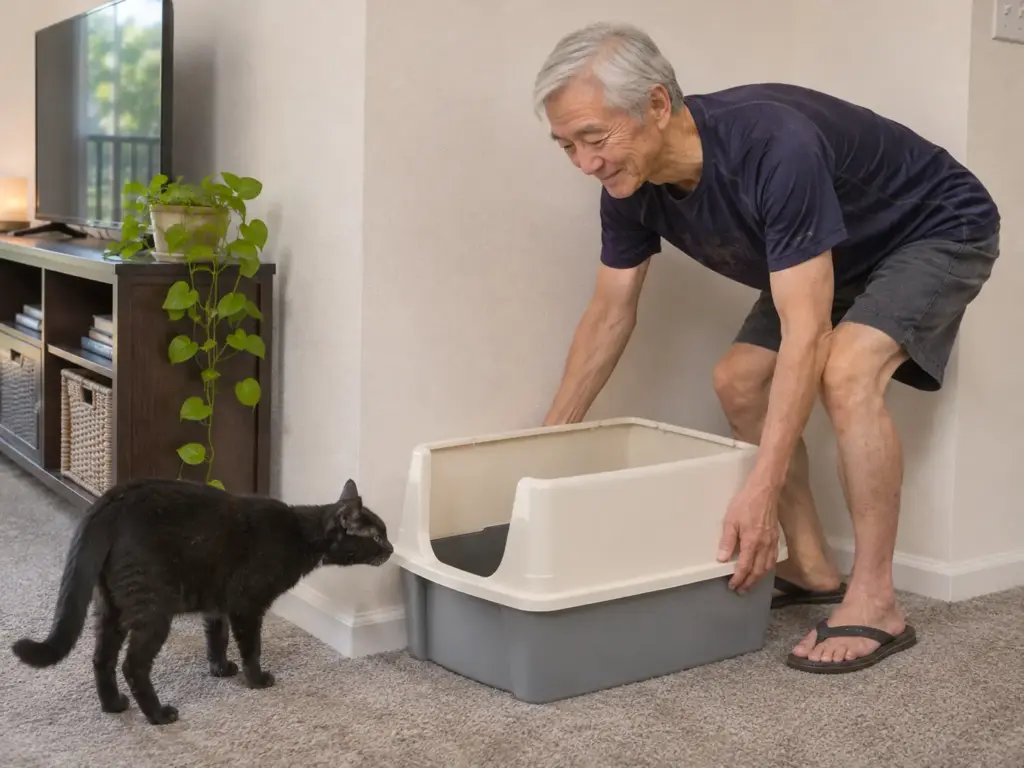
The move that works best gets tried least: put a box on the spot, leave it, and walk it away over time. Litter box placement is the one decision she has already made for you. You do not beat the cat here. You put the toilet where she already decided the toilet is.
Why a Cat Won’t Use the Floor Where She Eats
The first move is free. VCA suggests a small dish of food or a special toy on the soiled area, since a cat tends not to toilet where she eats, and a rubber carpet runner laid with the nubs facing up as a second option. Food or a toy only, and no bowl of water. For a few weeks the dish sits where the puddle used to be, and the corner changes meaning.
The Box on the Spot Itself, Left Until She Adopts It
A same-day yes tells you the patch was the whole point, and a no tells you to look at the box. For a budget open one with a lowered front, the Amazon Basics Large Cat Litter Box with High Sides, Open Top measures 19 by 15 by 11.75 inches and lets an older or bigger cat step in without a jump.
Its flaw is length: 19 inches falls under the one-and-a-half rule for a large cat, and the scoop in the box is awkward enough that a better one is worth finding. In a rental, set the box on a washable cover so the landlord’s carpet stays out of it. Where a litter box actually fits in a small apartment covers the room question.
Walking It Back, Over Days or Weeks, Not the Same Weekend
The move fails when it starts too early. The box has to stay on the spot until she will adopt the box, and only then does the gradual move begin, a few inches at a time toward where you want it, over days or weeks.
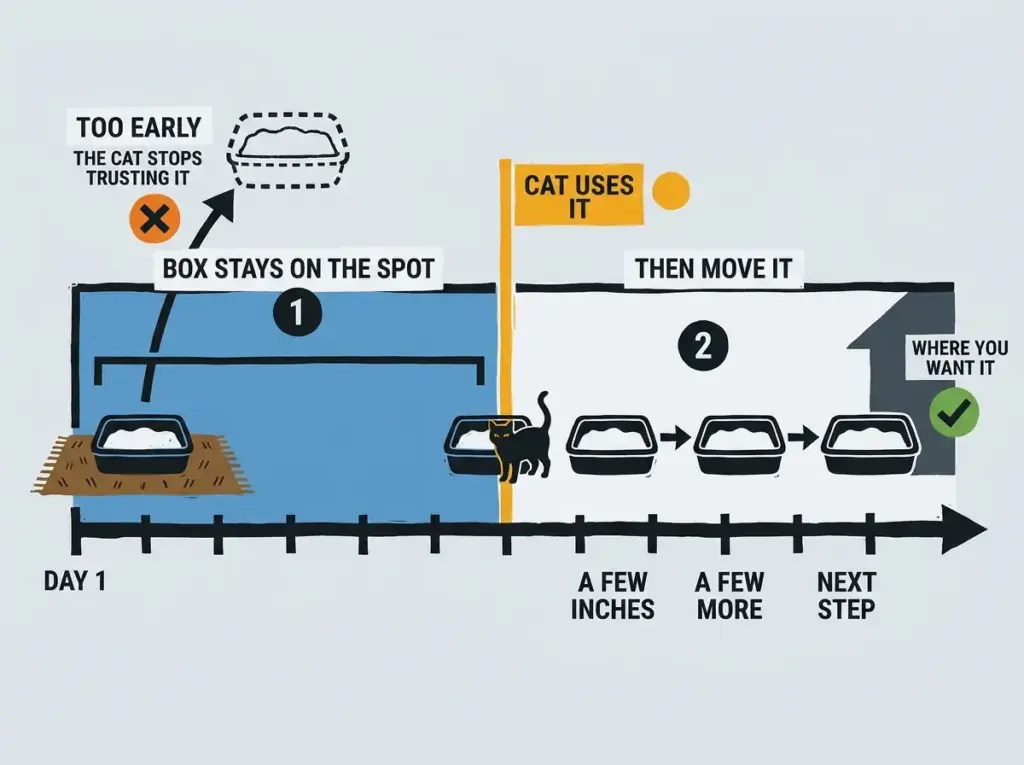
A box that moves before she has adopted it sends her back to the carpet. The same pattern follows a box that disappears into furniture: how a litter box hidden inside furniture changes what a cat does explains why she takes the tray and keeps the corner.
Why Foil, Plastic Sheeting and Citrus Mostly Move the Spot Two Feet
Foil, plastic and citrus take the square foot away without giving her another place to go, and she tends to pick the square foot beside it. The patch moves two feet along the wall and the carpet gets a second stain. A better answer gives her a spot to use and then withdraws the old one.
Do not move the box until she has used it on the spot, and then move it no farther than a hand’s width at a time. If she goes back to the carpet after a move, you went too far or too early, so return it to where she last used it.
The Other Cat at the Stairs, and the Cat Outside the Window
If the box is the right size, the litter is deep, the carpet is clean underneath and she still uses one square foot, the last place to look is how the house feels to her. This section comes last on purpose, because it is the slowest to fix and the easiest to blame.
The Guard at the Bottom of the Stairs
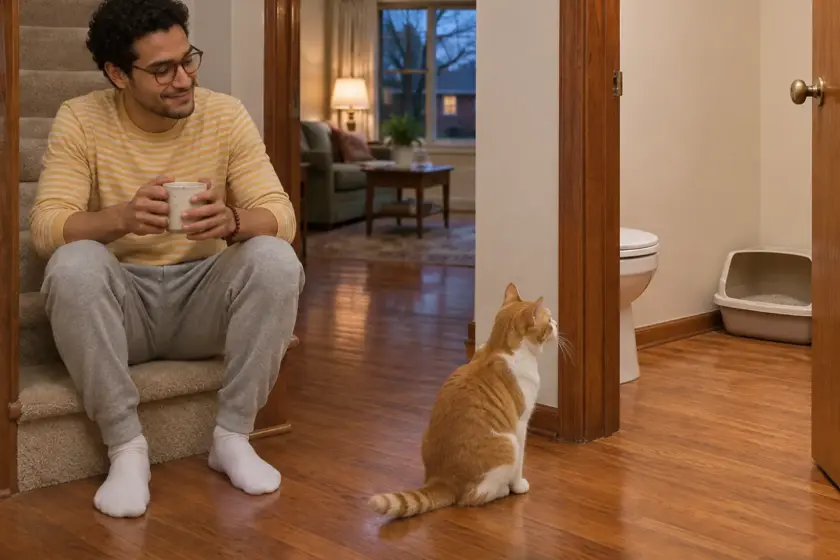
A common version: every box is upstairs, another cat plants herself at the top of the stairs, and the cat who comes down pees at the first spot she reaches. The walk to the box has turned into an ambush at the box, even if no fight ever happens.
There are plenty of boxes, all of them behind a guard. How exits and routes decide who owns what in a small apartment explains why more boxes do not fix a blocked path. The standoff looks different from the other side too: how a cat that guards a room looks from the other cat’s side.
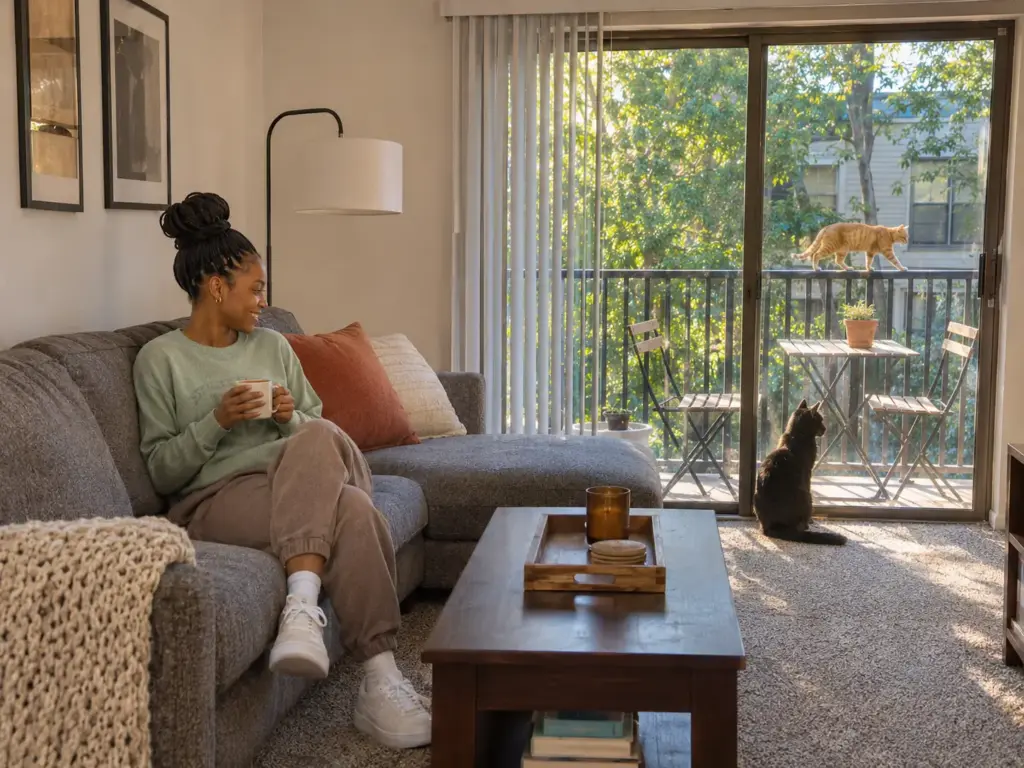
The Cat Outside the Window That Your Cat Can See but Not Reach
Outside cats, a stray in the yard or a neighbor’s cat on the balcony, can turn the floor under the window into a border. The clue is coincidence: the spot sits under the window or beside the balcony door. Cover the lower window panes or move the furniture so she cannot watch the visitor, and see whether the patch loses its meaning.
One Cat or Several, Where the Boxes Go
With one cat the culprit may be the visitor outside; in a multi-cat household, the boxes belong in different rooms and on different floors, not lined up side by side, with food, water and rest spread out too. One box more than the number of cats is the floor, and where they stand matters more than how many there are.
What a Pheromone Diffuser Can and Can’t Do
VCA lists synthetic pheromones among the aids for stress. The FELIWAY Classic Cat Pheromone Calming Diffuser Kit is a plug-in with a 48 ml vial that lasts about 30 days, and it plugs into the wall without any drilling.
Its flaw is a mixed record: in some homes it changes nothing, and it never replaces fixing the route. Treat it as a helper after the guard and the window are sorted. Where a diffuser goes in a multi-cat home has the placement.
And look for a household change: a move, a visitor, a new piece of furniture. Stress is a factor to note, not a diagnosis to treat.
Go and look at the house from cat height at the hour the spot is used. Sit on the floor near the patch and note who walks past, what is visible through the window and which way the door swings.
Call First, Clean the Layer Underneath, Then Walk the Box Back
The order carries most of the answer. The vet comes first, because a habit that changes overnight is a clinic question and the floor can wait a day. Then the square foot gets read before the cat does: the posture, the amount and whether it is a place or a route.
Cleaning goes down to the layer she can smell, with enzymes and without ammonia, and the box goes onto the spot and walks away in small steps once she has adopted it. The other cat and the window come last, and the cat is right about the constraint at every step.
The clock for this topic runs in days. If she uses the box on the spot the first day, leave it there a few days before the first nudge, and look at the dry patch with a UV light a few weeks afterward to see whether the map is fading.
Tonight, put a small dish of food on the spot and watch what she does over the next hour.
Frequently Asked Questions
01Why does my cat pee on the floor randomly, and how is that different from the same spot?
Random spots usually point at the whole setup, while one repeated spot means that place is offering something the box does not. Scattered puddles start with a vet visit; one square foot starts with reading the place. The two get fixed differently.
02What is middening in cats?
Middening is a behaviorist’s word for a cat leaving urine or stool out in the open at the edge of ground she treats as her own, outside the box. It is about territory, not a failed toilet, so the fix is the route, the other cat or the window, not a stronger cleaner.
03Can a cat’s UTI go away by itself?
That question belongs to the clinic, not to a floor guide, and the answer should come from a vet and not from waiting a few days. Straining, crying, blood, little or no urine or not eating is a same-day call.
04Why does my cat pee right next to the litter box instead of in it?
The box has usually lost to something beside it, such as a softer surface, a length under the one-and-a-half rule or litter too thin to dig in. A second box set on the exact spot is the quickest way to tell which.
05Does a blacklight really find old cat urine?
A 395 nm UV light shows dry urine in a dark room, and the maker says it works only on dry patches. It finds where the salts sit under the surface, and it does not tell you why she chose the spot.
Leave a comment