Cat Suddenly Peeing Outside the Box, and the 14 Days Before
Cat suddenly peeing outside the box? Log 14 days, call the vet (a male straining = tonight), then measure the box against his nose-to-tail length.

Alfredo RamsesFounder · November 17, 2026 · 21 min read

On this page9 sections
- 1Suddenly Peeing Outside the Box Starts With Counting Days
- 2A Sudden Change Goes to the Vet Before the Furniture
- 3The 48 Hours Between the Stain and the Appointment
- 4The Box Pass Starts With What Changed Two Weeks Ago
- 5The Cat Whose House Did Not Change
- 6One Cat or Several, What Sudden Means in Each House
- 7Clean the Spot, Then Put Things Back in the Right Order
- 8Start With Two Dates, Then Fix Things One at a Time
- 9Frequently Asked Questions
You find a damp patch beside the sofa, and the cat who has not missed the box in years is sitting in the hallway, looking at you. A cat who is suddenly peeing outside the litter box has not changed his mind overnight. Something moved, either in the house or in his health, and your first job is to work out which half you are standing in.
The Cornell Feline Health Center calls house soiling the most common behavior problem cat owners report, so this is an ordinary cat answering a change with a date on it. This guide puts a number of days on the word “suddenly,” hands the medical question to the vet where it belongs, covers the two days before the appointment, walks back through the two weeks before the first stain, splits one-cat homes from several-cat homes, and ends with cleaning and what to put back.
Quick Answer
A sudden change is a question for the vet first and a question about the house second, in this order:
- Call the vet today, and go tonight if a male strains and passes little.
- Change nothing in the box for two days and start a fourteen-day log.
- Undo the last change (litter, liner, lid, spot) before buying a different box.
- Measure the box against the cat: nose to tail base, times 1.5.
- Watch who waits at the door and who sits at the window.
- Clean with an enzymatic cleaner, never ammonia or vinegar, and never scold.
Suddenly Peeing Outside the Box Starts With Counting Days
“Suddenly” is a word with no number in it, and the number decides where you start reading the house.

Picture the person who finds a puddle on Monday morning and has the litter swapped by Monday night. The first days of sudden litter box accidents are the easiest to spoil, because every change scrambles the evidence and makes the next two weeks harder to read. The cat is not picking the floor to make a point. He is giving an answer with a date on it, and your first job is to find the date.
One Day, One Week or One Month Are Three Different Starts
Think of three windows. If it began in the last day or two, look for something that arrived this week: a trip, a visitor, a new bag of litter, a piece of furniture dropped into his path. If it has run for about a week, a change in the house and a change in the cat may be stacked on top of each other, and the vet visit stops being optional.
If it has gone on for a month or more, the stain has turned into an address, and you are working against habit as well as cause. These windows tell you which half of this guide to read first. They are not a medical clock and they promise nothing about how it ends.
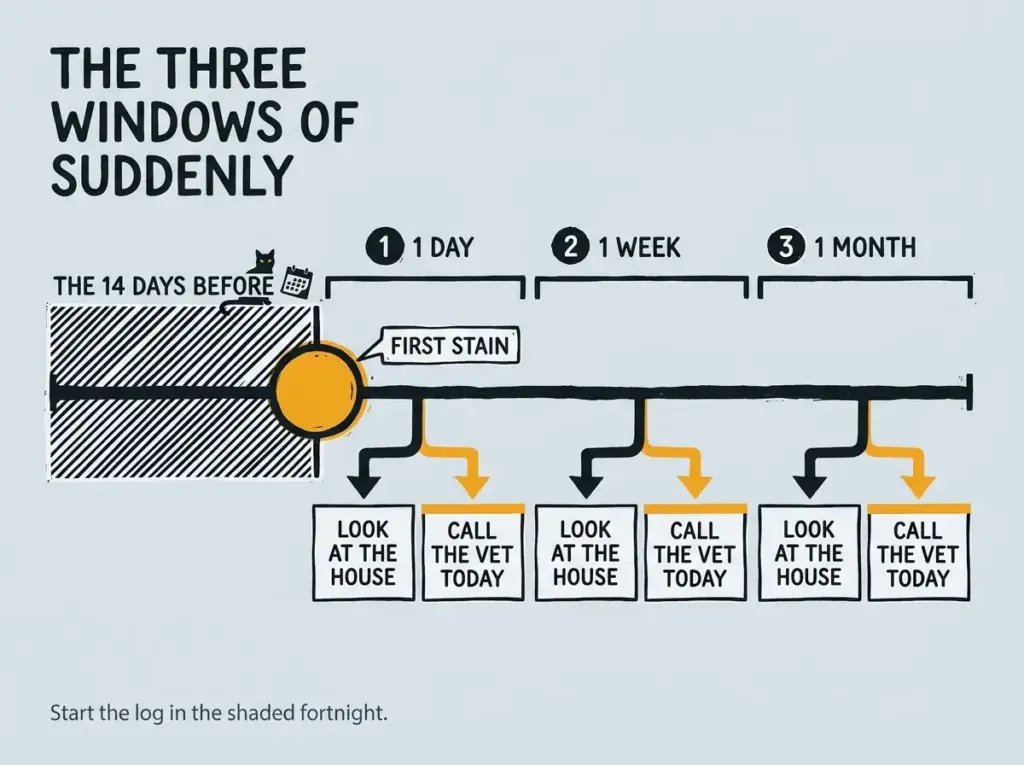
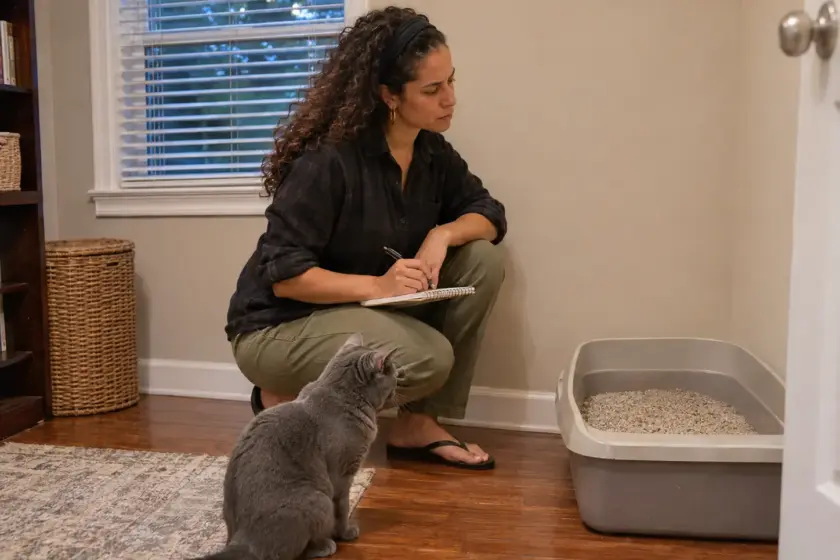
The instrument that makes the windows usable is a notebook: one row per day and five columns, holding the date, what came into or left the house, who was away, whether the box was scooped that day, and where the cat went. Start it backwards from the first stain, filling in whatever you can remember of the fourteen days before, then keep going forward from today. If all you have is today’s stain, write today’s date and the date of the last change you can recall. That is enough to bring to an appointment.
Write two dates at the top of the log before anything else: the last day the box was completely fine, and the last change you remember in the house. Those two dates tell the vet and you more than a count of stains.
Still unsure what kind of spot you are looking at? The floor-reading method that sorts a spot into a rejected box, marking or a question for the vet covers that in full, and this guide stays with the clock.
Why Earlier Is Easier, and How a Spot Becomes a Toilet
The Cornell Feline Health Center’s guide to house soiling says that the longer the behavior persists, the more likely it is to become a habit. International Cat Care names the mechanism: once a cat has urinated somewhere, his sensitive nose pulls him back to use that place as a regular toilet. To him a patch that still smells of urine is an invitation, and every day it goes unneutralized is another day of practice, which is why the clock starts when you see the stain and not when the appointment arrives.
The Reliable Cat Versus the Cat That Was Never Consistent
A cat with eight clean years behind him and a cat who has always had the odd miss are two different cases. The first forces you to find the change, because something definitely moved. The second sends you to the box itself, since a long habit of occasional misses usually comes from its size, its filling or its spot. Neither case asks you to read what is going on inside the cat, and you should not try: that part belongs to the vet.
A Sudden Change Goes to the Vet Before the Furniture
If you are standing in a pet store with a new litter box in your hands and have not called anyone, put it down. A cat who was reliable and now is not is a question for a veterinarian before it is anything about furniture, and a new box will not repair a cat who has learned that the box is where it hurts. The cat who pees on the rug is not taking revenge. If he is hurting, he has simply linked the place with the hurt.
What the Vet Rules Out, Said Plainly
The names of what a vet checks behind a change like this are short, and this list stops at the names, because the rest is the vet’s work:
- Urinary inflammation and the infections that come with it
- Crystals and stones
- Kidney trouble
- Diabetes
- Thyroid trouble
- Arthritis and other problems with moving around
Cornell’s guide to what a vet checks behind house soiling explains that urinary inflammation makes urinating painful, and that a cat can come to associate the box with the pain. The box did not change; what he feels inside it did. None of that can be read from the floor, and a new tray fixes none of it. Changing the litter on top of an unchecked cat just spreads the blame over five variables at once.
Take the fourteen-day log to the appointment instead of the sentence “he pees outside the box.” The dates and the things that came into or left the house save the vet questions that otherwise get guessed at.
The One Sign That Means Tonight, Not Monday
One sign changes the schedule. A male cat, and neutered males sit in the higher-risk group, who goes to the box again and again, strains and passes little or nothing needs a vet tonight, whatever appointment you already hold.
According to Cornell’s page on feline lower urinary tract disease, “A urethral obstruction is an absolute emergency, requiring immediate veterinary treatment.” It can turn fatal within a day or two. Stop reading and call.
A Clear Result Moves the Search Back to the House
A clean result is information, not a dead end. It shortens the list, and the search comes back to the house.
Ask the vet what is left to look at and whether a referral to a behavior specialist makes sense, since the follow-up is theirs to decide. Paying for one more visit after a clear one is a tired kind of bill, and the log is what makes the next conversation cheaper: dates and changes answer questions the vet would otherwise have to guess at. It promises nothing medical. It just spares questions.
The 48 Hours Between the Stain and the Appointment
The appointment is Thursday, it is Tuesday, there is a stain on the rug and a bag of new litter sitting in your cart. The cat has not gone anywhere. He is doing the same thing, and each thing you change blurs the clues. Two quiet days in the box are two days of clean data, and calling the clinic today is still the first move: if the date is far off, ask whether it can be sooner.

Change Nothing in the Box Yet
Litter, tray, spot, lid and liner all stay as they are for these two days. That keeps the two weeks before and the days after comparable; swap the litter now and you will never know whether the swap or the day of the week explains what he does next.
Phone the clinic and ask what they want brought or written down before the visit. That question is theirs to answer. And the one sign that means tonight stays in force the whole time: if it shows up, the waiting is over.
Blot the Spot, Note Where and How High, and Start the Log
Absorb the wet with paper towels and hold the enzymatic cleaner back until you have written the spot down. Record where it was, how high it sits from the floor if it is on a wall or the side of the sofa (measure it in inches against the baseboard), and what time you found it. Leave out color, amount and smell, which are not yours to interpret. Two numbers, the place and the height, tell a vet and a later you more than any description of how it looked.
Use the baseboard as a ruler. Note where the spot is and how many inches up it sits, not how it looks; those two numbers say more than any description.
The One Thing You Can Add Without Spoiling the Log
If you need to do something with your hands, one thing goes up without touching the box: a pheromone diffuser. The FELIWAY Classic Pheromone Calming Diffuser Kit is a 48 mL vial and a plug-in unit, and it goes in an outlet near where he spends the evening without changing the litter, the tray or the routine, so the evidence stays readable. It is a comfort measure. The maker says it calms, and nothing says it removes the cause.
It helps some cats and does nothing for others, and some units stop working within days or give off a burning smell, so check it a day or two in. It sits next to the vet visit and a second box, never instead of either. Everything else in these two days is free: a notebook and today’s date.
The Box Pass Starts With What Changed Two Weeks Ago
The litter brand changed the same weekend a visitor stayed. A liner went in “for the smell,” or a lid went on, or you came home from a trip to a box nobody had scooped for two weeks. You may not connect any of it to the puddle, and the cat does not read the calendar either; he reads a box that smells different, is shorter than it was or is occupied by someone else. A box a cat passed for years can fail in a day without anyone seeing it.
And a clean box today does not erase what he learned while it was dirty.
Build the 14-Day Log Backwards
Start at the first stain and walk back fourteen days. One row per day, five columns: the date, what entered or left the house (new litter, a liner, a visitor, a piece of furniture, a baby, an animal), who was away, whether the box was scooped that day, and where the cat went.
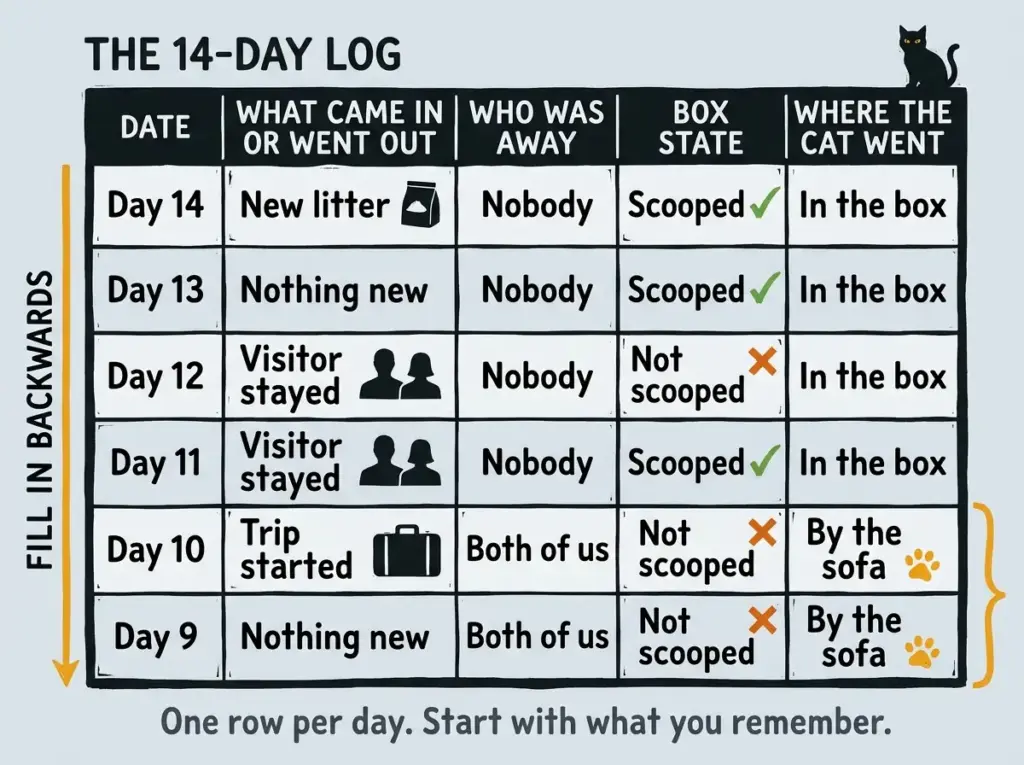
A trip with an unscooped box shows up in the log as two weeks of gaps. That gap is the cause an owner rarely sees, and it keeps shifting where the cat goes even after the box is clean again. The reverse trap is the cat who steps in and out of a clean box over and over while marking somewhere else: it looks as if he is using it, and it is exactly the pattern that hides a box problem from the person looking.
Undo the Last Change Before You Buy Anything
Free first. Put back the last thing you changed: the previous litter, the liner out, the lid off, the box back in its old spot. Then wait a day or two before undoing the next one, because a single change at a time is the only way the log can tell you which one counted. Undo three at once and the result is as unreadable as making three was.
Undo one change and wait a day or two before the next. Undoing three at once leaves the result as unreadable as changing them was.
Scoop at least twice a day, which International Cat Care also recommends. A box scooped on Sunday is about eight scoops behind by Thursday, and how often to scoop for one cat, two or three changes with every cat you add.
Most cats prefer litter without perfume that clumps, and a new perfume or a new texture are the two shifts a cat notices at once. If the last change was the litter, going back to an unscented clumping one is the move, and Dr. Elsey’s Ultra Unscented Clumping Clay Cat Litter in the 40 lb bag fits that description, though how much it tracks depends on the cat, from hardly a grain to a trail across the apartment. If you are weighing clumping against non-clumping first, the clumping vs non-clumping comparison by cat count and floor type lays it out.
Fill to about an inch and a quarter (3 cm), which International Cat Care puts at deep enough to dig without sinking his feet. Empty and wash the box every week with non-clumping litter, and every two to four weeks with clumping.
The Box That Passed Last Month and Fails This One
International Cat Care’s advice on choosing a litter tray for your cat is a box about 1.5 times the cat’s length, nose to the base of the tail. For an adult that lands at 24 to 30 inches of usable box, and the “large” boxes in stores sit around 19. A cat who measures 18 inches from nose to tail base needs about 27, and how the 1.5 times rule works out in inches for different cats is worked through there.
The Amazon Basics Large Cat Litter Box is the inexpensive open option at 19 x 15 x 11.75 inches, and by the 1.5 rule it is a box for a kitten or a small cat rather than an adult. Scooping out of it is awkward too.
A lid is a change as well. From the cat’s point of view a cover holds the smell in and takes away his 360-degree view, and what a lid does to the cat’s view and to the smell comes down to a handful of measurements. A new covered box for a cat who used an open one for years counts as a change, not an upgrade.
For an adult who clears the 1.5 line, the KITCATY XXL Stainless Steel Litter Box measures 28 x 20 x 12 inches and is steel, which does not hold smell the way scratched plastic does. At 11 pounds it stays where you put it, but the 12-inch wall is a tall step for an older or short-legged cat, and that step is the next thing to measure for an older cat.
The Cat Whose House Did Not Change
Same cat, same box, same litter, same corner as a year ago, and the reliable eight-year-old is peeing on the bath mat. The house is identical, so you cross it off the list. But a wall of 12 inches that was no trouble three years ago can be a step that costs an older cat something now.
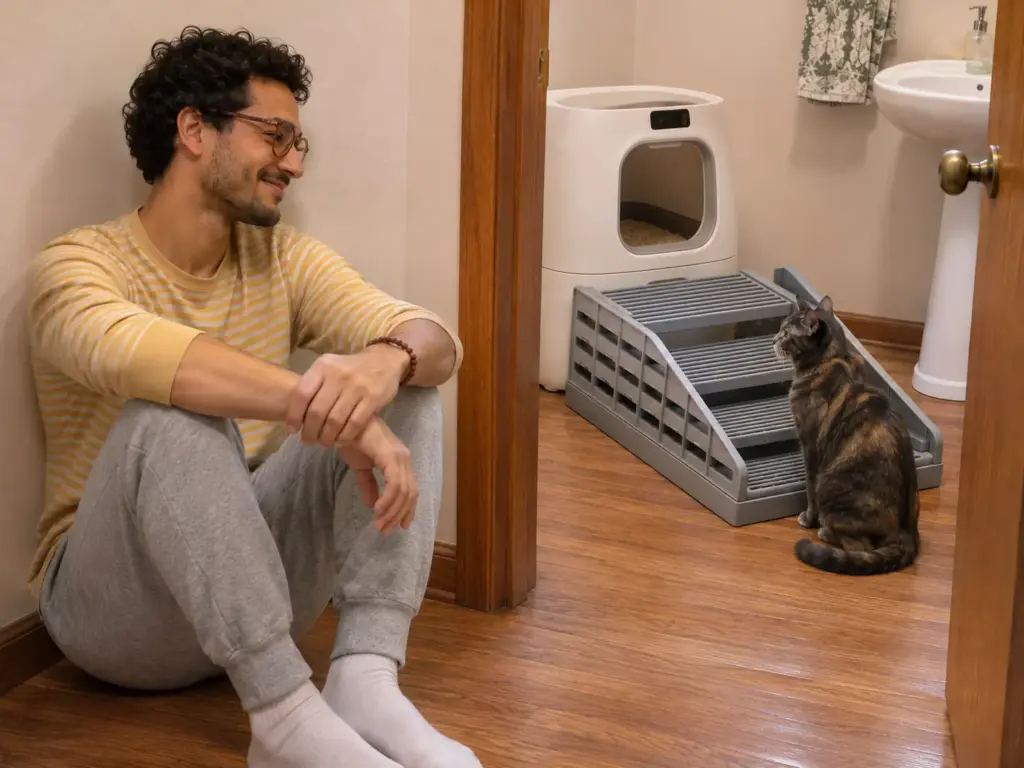
The house did not change. What changed is how far up that wall sits for him.
Step-Over Height Is the Number Nobody Gives
Step-over height is the wall he has to clear with his front paws while the back ones follow. Twelve inches is a high step, and the 11.75 of the Amazon Basics is close behind.
You find out by watching him go in: a pause at the rim, a one-paw hop, or going in with only the front feet. Free first: move the box to where he already walks, with no step between him and it, and lower the entrance by hand with a plastic storage tub cut down on one side and the edge sanded smooth. Only then think about a step.
The Himake Adjustable Litter Box Step and Ramp is 16.5 x 12.5 x 5.5 inches and stacks in 3-inch modules, so you can set the height to what he can climb without jumping. It is not very firm and it is small for a large cat. If it shifts when he steps on it, an older cat will not try it twice.
Watch him go in once, from the side, instead of looking at the box. A pause before the rim tells you more than the wall’s measurement does.
Seven to Ten Years Is Where Many Cats Start
Cornell’s page on the special needs of the senior cat puts the start of age-related change between 7 and 10 years for many cats, and says it plainly: “Even climbing into the box may be painful for such cats, prompting them to eliminate in inappropriate areas.” That is an environment problem you can measure with a tape, and not one you can read from the floor. A cat who suddenly stops jumping onto things he always used is a question for the vet, said once and handed over.
The Box That Gets Dirty Faster Than the Old Schedule Assumes
Cornell also notes that some conditions of age increase the volume of urine, so the box fills faster than the schedule you set years ago. Two scoops a day that were enough last year can leave the tray soaked by mid-afternoon. If there is more urine in the box than there used to be, that is a vet’s question and not a box problem. The box part is that the schedule has to move to match him.
One Cat or Several, What Sudden Means in Each House
Sudden does not mean the same thing in a one-cat apartment and in a several-cat one. With one cat the list is his health and his box. With several, add who waits outside the door, who owns the hallway and the stray at the window nobody counted as a change.
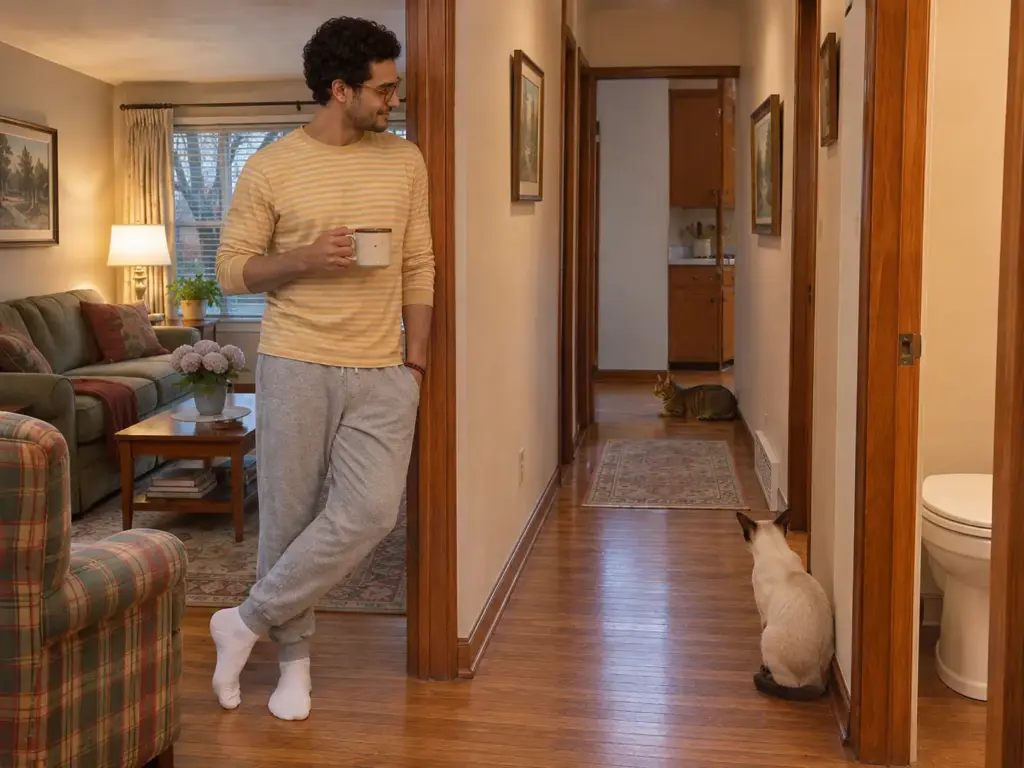
One Cat, Two Boxes in Two Rooms
International Cat Care and Cornell agree on the rule: one box per cat plus a spare, so a single cat gets two, in different places. Two boxes touching in the same corner count as one location, because a cat can block or guard both at once. In an apartment with no spare room, the second box goes where he already passes, such as the end of the hall or the bathroom floor, and not where the furniture would like it. He is right about the constraint, since a box is only a second option if he can reach it.
Who Waits Outside the Door
A box can be clean and still taken. A cat who sits outside the door, or lies in the only path to the box, sets an ambush that the other cat notices long before you do. Cornell notes that cats like a 360-degree view and more than one way out, so a box with a single entrance in a home with several cats is a trap. Why a spare tray fails when two trays share a sightline is a check you can run in five minutes, and in a small apartment the apartment with no spare room and the exit where an ambush happens shows where the exits are.
Sit through one afternoon and watch who gets to each door first and who waits outside it. Write it in the log and do not step in.
A new cat, a baby or a visitor is exactly the kind of change that starts the two weeks, and how to add a kitten without crowding the cat who lives there covers the first of those. If the resident seems to be sulking over the newcomer, what cat jealousy really is, a lost claim on a lap, a bowl or a schedule sorts out what you are seeing.
The Stray at the Window Nobody Counted
Cornell on how often cats spray and what sets them off puts it at about 10 percent of neutered males and 5 percent of neutered females, with someone likely to do it once a home holds more than seven cats, and cats outside nearby listed as a trigger. In a two-cat apartment, the neighbor’s cat on the balcony rail is a change nobody wrote down, so put it in the log like any other. And in a several-cat home, the one doing the peeing is not always the one you suspect. Sorting that out belongs to the vet and a behavior specialist, not to this page.
Clean the Spot, Then Put Things Back in the Right Order
You scrubbed with whatever was under the sink and saw the same patch a week later, or you scolded him and have felt bad since. His nose reads what yours cannot, and a scolding teaches him to hide the next one, not to move it.
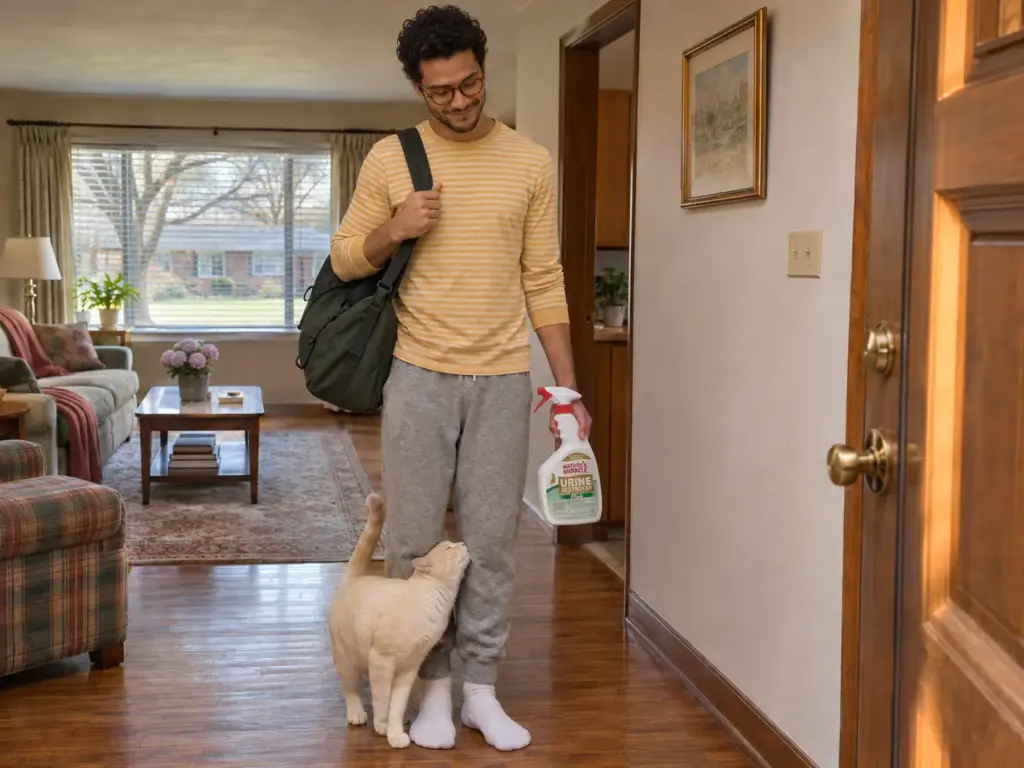
Neutralize the Smell, No Ammonia, No Vinegar
Cornell and International Cat Care (advice on cleaning an area a cat has soiled) agree that the odor has to be neutralized, not covered, with an enzymatic cleaner and no ammonia or vinegar, both of which smell like urine to a cat.
A spot that smells clean to you proves nothing. The test is whether his nose stops recognizing it. Nature’s Miracle Cat Urine Destroyer Plus is an enzymatic spray in a 32-ounce bottle that breaks down what draws him back. Its scent is strong for some noses, so it goes on the stain, not in or around the box, where the cat has to feel at home.
Wet the stain through, following the label, not with a single spritz. Let it dry untouched before anything goes back on top, and do not rub it or step on it meanwhile.
Never Punish, It Makes the Next Stain More Likely
Cornell says that yelling, hitting or scolding raises a cat’s anxiety and can make house soiling worse. He did not choose the stain to annoy you; he is answering a change, and the only thing a scolding adds is a reason to hide the next one where you will not look. If you feel guilty about one already, let it go and go back to the log.
Put Things Back in Order, and Skip the Routine That Was Already Failing
After the event that started it (a trip, a visitor, a move, a baby), do not restore everything at once. The order is the box and its routine first, meaning two scoops a day and the usual litter, then the box’s spot, then whoever was away (a visit, a move, a work schedule), and last a new cat or baby, at the pace of an introduction: apart first, then together in short stretches with food. One change at a time, with the log still being filled in so you can tell which one worked.
The one thing not to put back is the schedule that was already slipping before the trip, the box scooped “when there was time.” Bring back two scoops a day, not the old rhythm, and how often to deep clean the box, and how to do it sets the washing schedule. And if you have cleaned, changed and still see the stain, that is habit by now and not a failure of yours. It is a conversation with the vet and a behavior specialist, said once here and left there.
Start With Two Dates, Then Fix Things One at a Time
Call the vet before you touch anything else, since a sudden change in habit is their question first. While you wait for the appointment, leave the box exactly as it is and write two dates down: the last day the box was fine and the last change you remember in the house. When the vet gives you the all-clear, work back through the two weeks, undoing one change at a time (litter, liner, lid, spot) before spending anything on a new tray, then clean the stain with an enzymatic cleaner and put things back in order.
A cat accepts or refuses a change in days, so look at where he goes within a day or two of each thing you undo, and read the whole log again a week after the last change. If the spot is still in use, the log is what you hand over next.
Today, start the notebook with today’s date and the date of the last change. Take off the lid or liner if the box has one, and scoop once in the mid-afternoon as well as at night. Then notice where he goes.
Frequently Asked Questions
01Why is my cat suddenly peeing outside the litter box?
A sudden change in litter box habit is first a question for the vet, because several health problems can change where a cat urinates and none of them shows on the floor. Then look at what changed in the house, and date the two weeks before the first stain with a log. Cornell’s guide covers the ground.
02How long should I wait before taking my cat to the vet?
You do not wait: call the day you see the change, and go tonight if a male cat keeps returning to the box, strains and passes little or nothing. If the appointment date is far off, ask the clinic for an earlier slot.
03Is my cat peeing outside the box out of revenge?
No, he is not taking revenge: he is answering something in the house or in his health, and house soiling is the most common behavior problem cat owners report. Cornell warns that punishment raises anxiety and can make it worse.
04What should I clean the spot with, and is vinegar okay?
Use an enzymatic cleaner and skip ammonia and vinegar, because both smell like urine to a cat and invite him back to the spot. Blot first, write down where the spot is and how high it sits, then clean.
05Why is my outdoor cat suddenly peeing in the house?
A cat who goes outdoors and suddenly urinates inside is first a question for the vet; after that, look at what changed around the house and the box. Cornell lists cats outside nearby as a trigger for marking. An open, unscented box scooped twice a day is what he needs to go back to it.

Leave a comment