Are Litter Box Enclosures Bad for Cats? Size Decides
Don't trust the "cats don't mind covers" study (it used a box roughly twice the size of the one in your hallway) + what really decides it.

Alfredo RamsesFounder · August 25, 2026 · 20 min read

On this page8 sections
- 1What the Research Actually Measured
- 2The Size Math That Decides It
- 3What the Lid Does to Air, and to Your Scooping
- 4One Cat or Two, and Why It Changes the Answer
- 5When a Cat Says No, and What That Isn't
- 6Keeping the Enclosure You Already Bought
- 7The Verdict, and What to Do Tonight
- 8Frequently Asked Questions
You did the responsible thing. You looked it up, you found the line everyone repeats about cats not minding a cover, and you bought the enclosure. Now there is a cat who puts his front half in, thinks about it, and backs straight out again.
He is not being difficult about a box that looks perfectly fine from where you are standing. The study behind that reassuring line is real and it says what people say it says, but it ran on a box roughly double the size of anything sold with a lid on it. So the honest answer to are litter box enclosures bad for cats is that the lid was never the problem. Here is what the science actually measured, the one number that decides your box tonight, when a second cat changes the answer entirely, and what to do with the cabinet already sitting in your hallway.
Quick Answer
Litter box enclosures are not inherently bad for cats. The research found no population-level preference, but it used a box far larger than almost anything sold with a lid, and it scooped that box daily. A covered box a cat can turn around in, scooped every day, in a one-cat home, is fine. Shrink it, hide the mess so it gets scooped less, or add a second cat who can guard the single doorway, and the same enclosure becomes the reason he stops using it.
What the Research Actually Measured
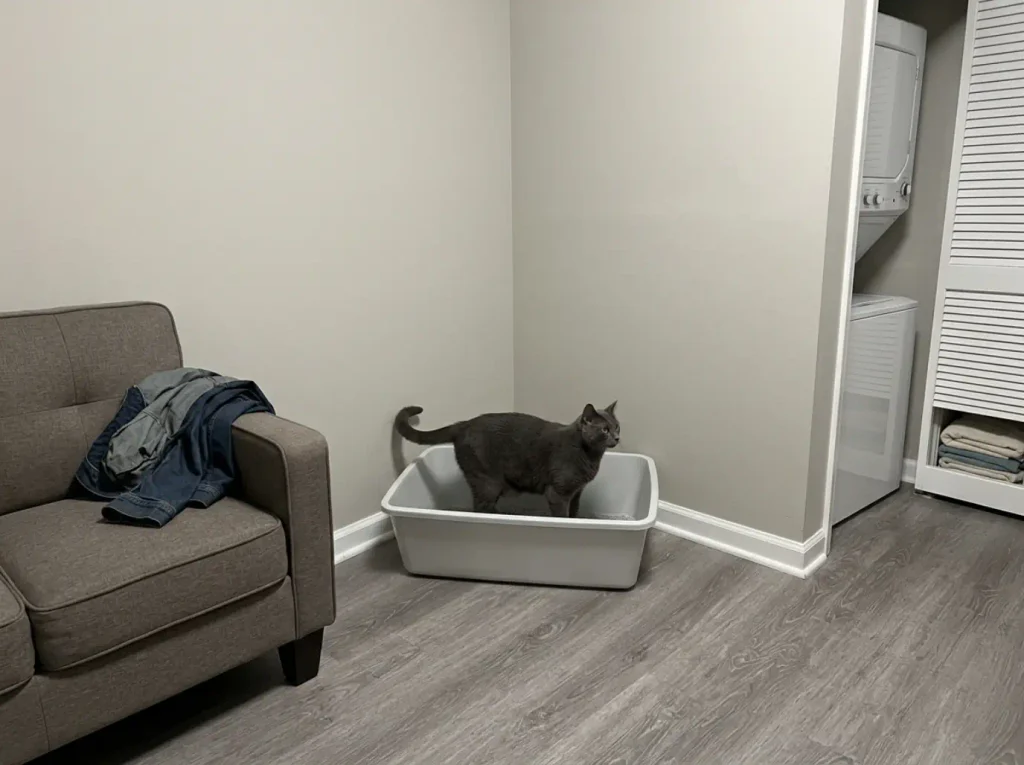
Everyone who has googled this question has hit the same sentence: studies show cats have no preference between covered and uncovered boxes. It reads like the end of the conversation. It is closer to the beginning of one, because the caveats attached to that finding are the entire article.
The study is Grigg et al., published in the Journal of Feline Medicine and Surgery in 2013. Twenty-seven cats, a covered litter box and an open litter box placed side by side, both kept identical in every other respect, and the cats free to use whichever they preferred. Across the group there was no strong pull in either direction. That part is solid, and anyone telling you otherwise is arguing with the data.
What the Study Found, and What It Did Not
The boxes were not boxes. They were modified plastic storage bins measuring 32.5 by 19.75 by 19 inches, and that number is the one that never makes it into the articles quoting the conclusion. Go and read the behaviorists’ own review of the covered-box literature and the dimensions are right there, next to the finding, where they have always been.
Nearly three feet of interior floor. Not a hooded pan off a shelf, not a cabinet with a cat door cut into the side. A bin big enough that a cat could walk in, turn a full circle, dig, cover, and walk out without ever touching a wall.
So what the Grigg 2013 study out of the Ross University study group established is that cats do not object to a roof. It did not establish that cats do not object to a small room, because it never built one. The variable it controlled for was the lid. The variable it quietly held generous was box size.
The Third of Cats Who Did Have an Opinion
Buried under the group average is the number that should have been the headline. Eight of the twenty-seven cats had a strong individual preference. Four of them wanted the cover, four of them wanted it gone.
That is roughly one cat in three with a real, measurable opinion, split evenly, which is exactly why the average came out flat. Two opposite convictions cancel each other on a chart and disappear. Your cat does not live on that chart. He is one animal, and he has either got an opinion about this or he has not, and the population trend has no way to tell you which.
The data also leaned one way on size. Cats over about thirteen pounds trended toward the uncovered litter box, which is not a personality trait. That is a large animal reporting a space problem.
The Two Conditions the Study Assumed
Two more things were true in that experiment, and neither one is true in most homes.
The boxes were scooped every single day, by design, because a study comparing box styles cannot let cleanliness become the variable. And the cats were tested alone or separated from their housemates, so no cat was ever queuing, waiting, or watching another cat go in.
Daily scooping and no roommates. Those are the conditions under which cats did not mind a lid. Reproduce them and the reassurance holds up.
Miss either one and you are outside what was measured, which is where most of the people asking this question are actually standing. If you want the wider picture of what a cabinet changes in a room, we have the full breakdown of what an enclosure changes in a room as a companion to this one.
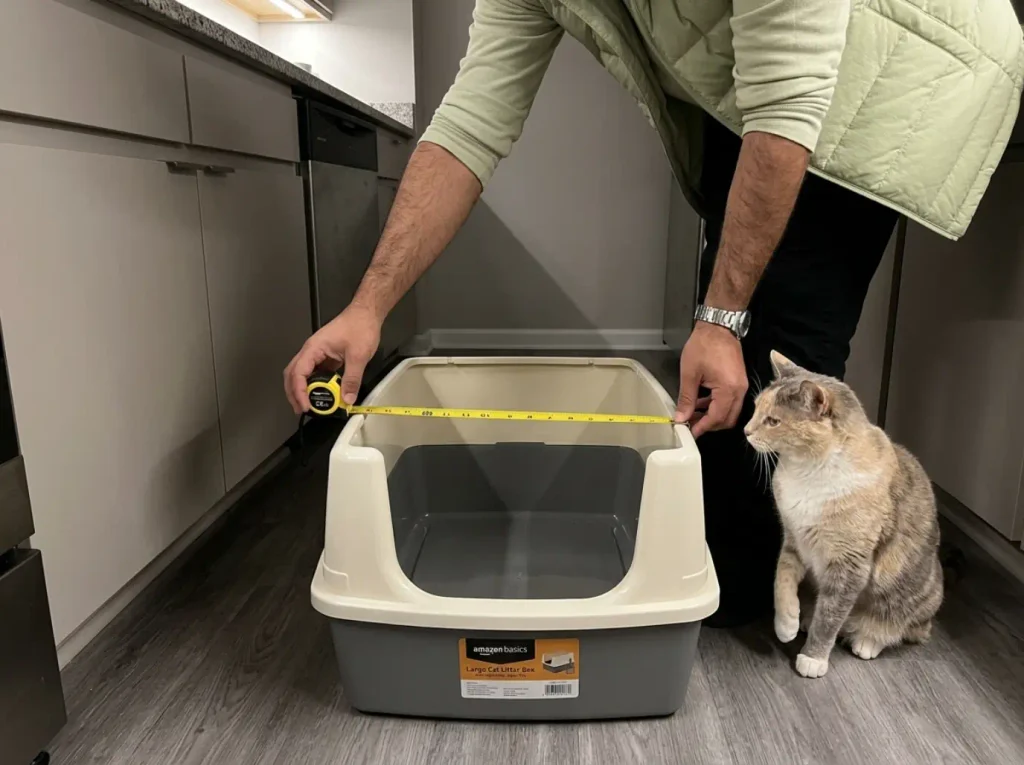
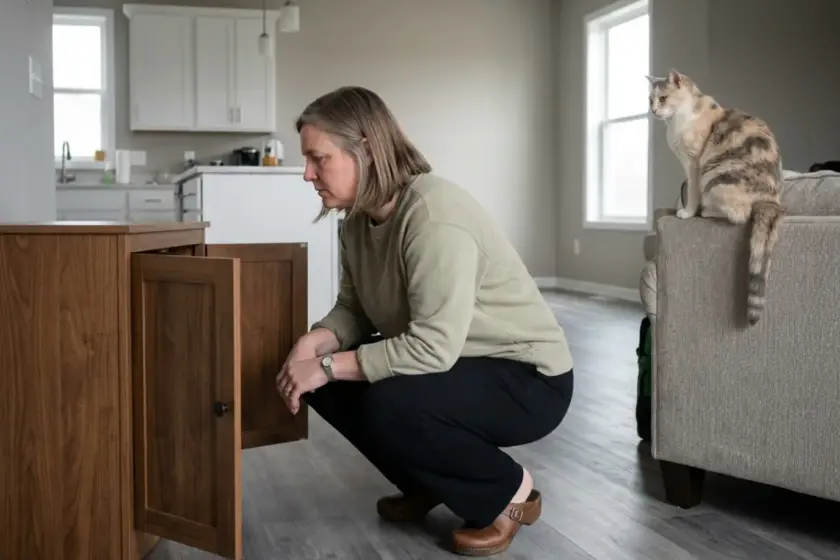
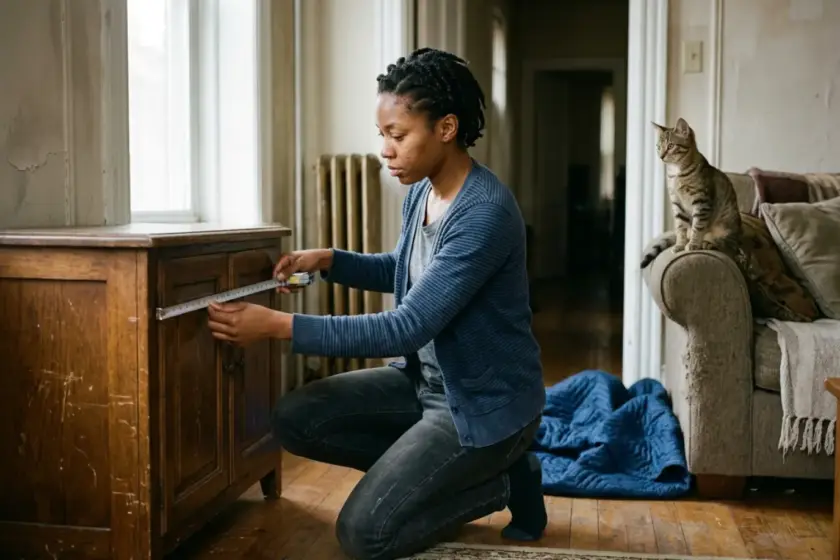
Before you decide the enclosure is the problem, put a tape measure inside the one you own. Interior floor, corner to corner, not the outside of the cabinet. The number on the listing describes the furniture, and the furniture is not what your cat has to turn around in.
The Size Math That Decides It
This is the part every page in the search results gestures at and none of them finishes. They cite the study, they quote the conclusion, and they leave you holding a box you now have no way to grade. You own the thing. You want to know whether it passes.
The 1.5x Rule, and Where to Measure It
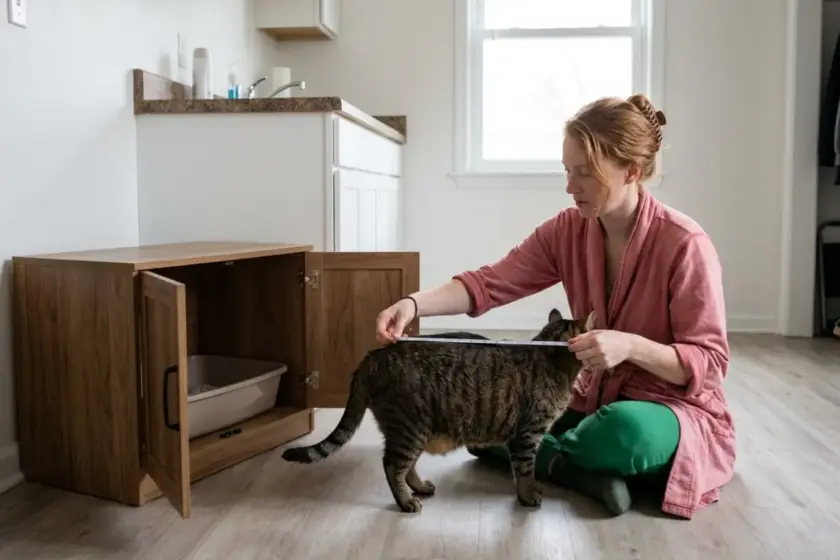
Stretch your cat out and measure from the tip of his nose to the base of his tail. That figure is his cat body length, and every number below is derived from it. The interior floor of the box should run about 1.5 times that length, and the interior width should be about equal to it. That is the standard, and the inch-by-inch version of the sizing rule works through where the number comes from and how it changes with a kitten or an older cat.
Notice what the rule is not. It is not a size label. Nobody selling boxes has agreed on what large means, and nobody has to, because the word is marketing rather than measurement. A tape measure settles in thirty seconds what a listing will argue about all day.
Why “Large” on the Box Means Nothing
Run the numbers side by side and the gap is not subtle.
The study box: 32.5 by 19.75 by 19 inches. A common commercial covered litter box sold as large: about 19.5 by 15.25 by 17 inches, which is roughly half the interior volume. Even the biggest hooded litter box in wide circulation, the ones badged XL, land around 21.75 by 17.75 by 18.125 inches, still short of the study box on every single axis.
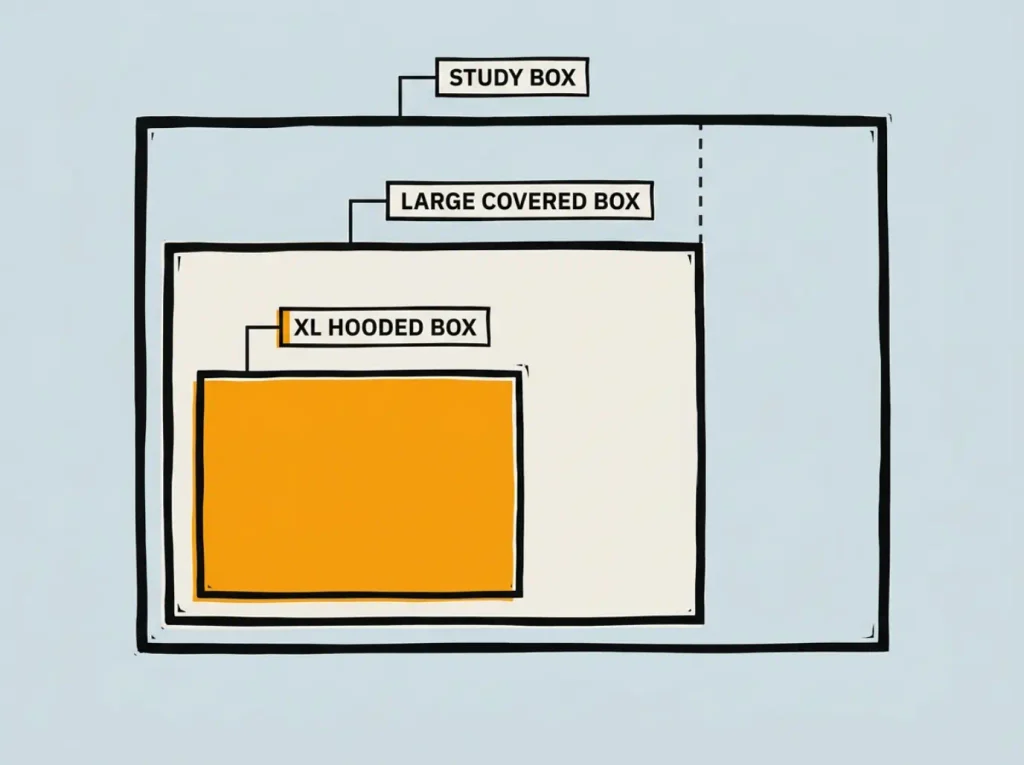
Half. That is the whole story of this article compressed into one word. When someone tells you the science says cats are fine with covered boxes, the covered box the science used is not on sale anywhere, and the closest thing to it is a storage bin from a hardware store with a hole cut in the side. Which, for what it is worth, is what both cited studies actually used.
What the Lid Costs You in Usable Height
Floor space is the headline failure. Height is the quiet one.
Two inches of clumping litter sits on that floor, which comes straight off the interior height before the cat is even in the picture. Then there is entrance height. Entry hole size runs around six inches in one study replication, low enough that a large cat ducks to get through it. He ducks in, and then he has to turn around inside a space that was already too small before you took two inches off the ceiling.
That is where the backing-out comes from. He is not refusing the box, he is solving a geometry problem you handed him, and backing out is the only correct answer available.
Measure before you buy anything. A large share of “my cat hates the enclosure” cases are a cat who physically cannot turn around, and that is a thirty-second check with a tape measure and no purchase. If yours fails and you decide to go open, the Amazon Basics Large Cat Litter Box with High Sides, Open Top for Easy Access is a genuinely roomy open pan at 19 by 15 by 11.75 inches, with sides tall enough to hold litter scatter without putting a roof over the exit. It is still under the study’s footprint, because nearly everything is.
For a cat much over thirteen pounds it will feel snug, and that is worth knowing before it arrives. Same for senior cat mobility: a cat with stiff hips is measuring the walk in, not the floor once he is there.
What the Lid Does to Air, and to Your Scooping
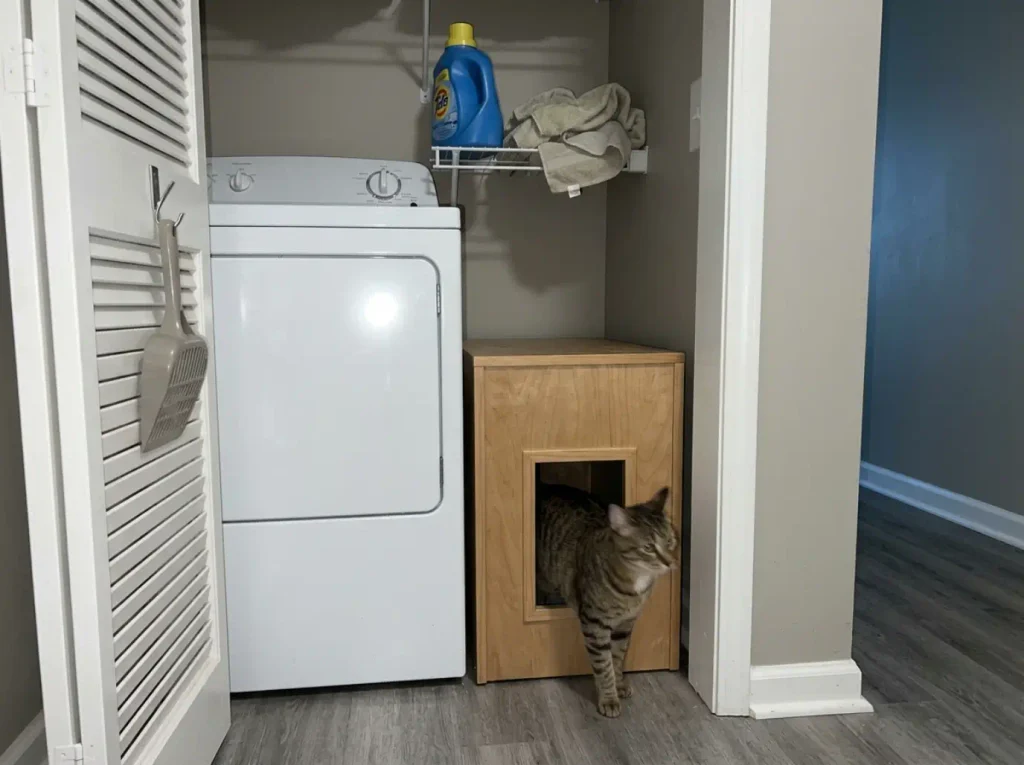
You bought the enclosure because the room smelled. And it worked. The room does smell better, which is the part nobody argues with and the part that makes this so hard to see clearly.
The smell did not leave. It went somewhere, and where it went is a sealed plastic space with one hole in it, which happens to be the space your cat puts his entire head into twice a day.
Where the Smell Actually Goes
A lid is not a filter. It has no mechanism for removing anything. All it does is stop air moving, and still air is exactly what ammonia buildup needs to concentrate rather than disperse. This is not slow, either: ammonia starts building about half an hour after the pee, and inside a hood it has nowhere to go and nothing to dilute it.
Then there is what most people mean by ventilation, which is one opening. One opening is not ventilation, it is a mouth. Air needs somewhere to come in and somewhere to leave before anything moves through a cabinet at all. A single cat door in the side of a litter box cabinet produces a still box with a hole in it, and the difference between that and a genuinely vented enclosure is not a small one.
The Scoop You Stop Doing Because You Can’t See It
Here is the mechanism that does the real damage, and it has nothing to do with airflow.
Research cited alongside the Grigg review found real-world covered boxes get scooped closer to once every five days, against the daily scooping the study built in. Five days. Read that against a finding that was measured under daily conditions and the reassurance quietly evaporates.
I used to treat that scooping frequency gap as an owner problem, the kind of thing you fix by telling people to try harder. Enough of the same story in litter threads changed my mind. It is not laziness, it is invisibility.
You scoop what you see. An open pan in the corner of a room is a standing reminder that files itself into your day without effort, and a closed cabinet is a piece of furniture that looks finished whether or not anything happened inside it this week. The enclosure removed the cue along with the view, and the habit went with it. If that is the failure you recognize, a box built so the daily scoop stays a ten-second job is a more useful lever than any amount of resolve.
So the cover does two things at once, in opposite directions. It puts trapped odor right at the cat’s nose, and it removes the visual trigger that kept you clearing that odor out daily. The box gets dirtier, faster, in a smaller space, and it gets attention less often.
The Studio-Apartment Version
Litter box furniture exists because you do not want to look at a litter box. That is a completely legitimate want and nobody should pretend otherwise, least of all in a one-bedroom where the box is visible from the sofa.
It just is not a want the cat shares, and when a preference collides with a constraint, the constraint wins. He is describing what he can physically use. You are describing what you would rather see.
And small apartments are where this bites hardest, because they are exactly where the enclosure gets chosen for cosmetic reasons and exactly where those reasons fail worst. There is no spare bathroom to isolate the smell in, no separately ventilated room, no distance. The renter-friendly answer and the good-looking one are not the same answer here. So the cabinet goes into a closet or a corner with no airflow, which is the single worst place you can put a still box.
An open pan in a genuinely ventilated corner of a studio apartment does more real odor control than an enclosed litter box crammed into a closet. Less pretty. It is the version that works.
If the enclosure has one opening, it is a container, not a vent. Take the back panel off, or leave the cabinet door propped open on its latch. That gives you the second opening air needs to cross the box, it costs nothing, and you can do it before you finish reading this.
One Cat or Two, and Why It Changes the Answer
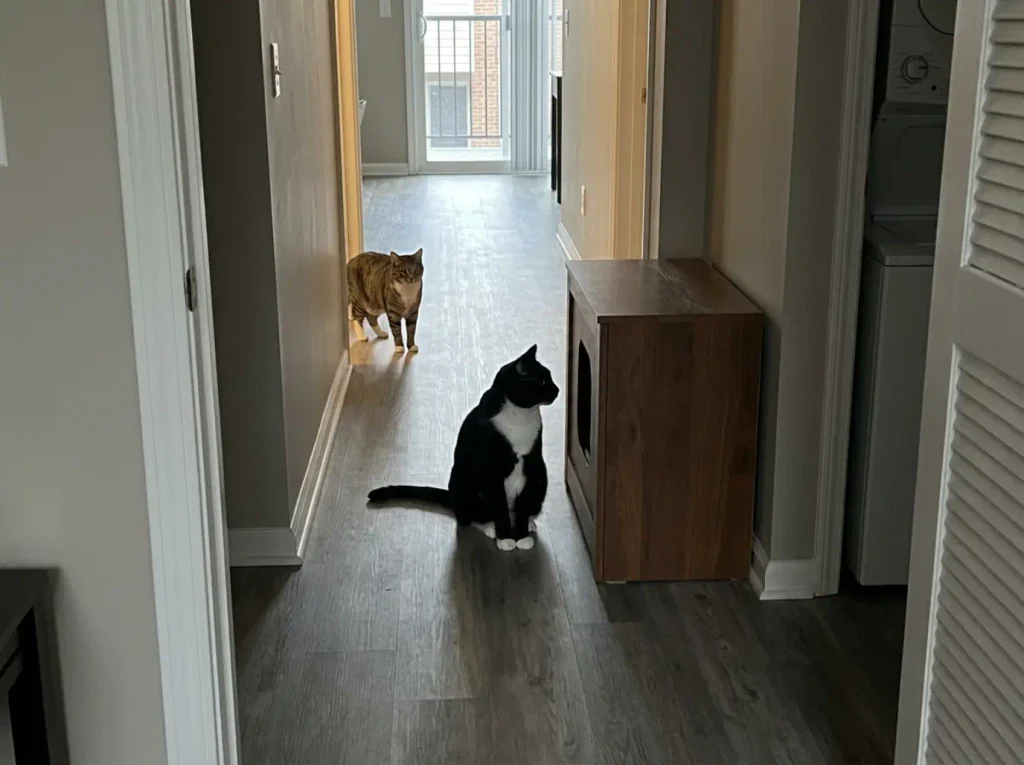
In a one-cat home, a hood is a size question. In a two-cat home it is a door question, and doors are how cats manage each other.
The Single Entrance Is Also the Single Exit
A covered box has one way in. That same hole is the only escape route, and a resource with one exit is a resource that can be controlled by whoever is sitting near it. Behaviorists call the ambush risk it creates an ambush zone, and it is not a dramatic name for a rare event. It is a description of the geometry.
None of this makes the guarding cat a villain. A single-exit resource is genuinely worth guarding, and a cat who has worked that out is a cat doing arithmetic correctly. The problem is the doorway, not his character.
The pattern shows up in multi-cat household threads with the same shape every time: accidents start the week the hood goes on. Not a grudge, not a phase, not the timing being a coincidence. A chokepoint appeared in the house and one cat priced it in immediately.
- One cat parked within a body length of the entrance, doing nothing in particular. That is not resting, that is a toll booth.
- A cat who pauses at the opening and checks the room before committing, every time.
- A cat who leaves the box at speed rather than walking out.
- Accidents that started the same week the enclosure did, especially near the box rather than far from it.
What the Study Never Tested
This is the part worth being precise about, because it gets stated backwards everywhere.
Grigg’s cats were tested alone or separated from their housemates. So the study did not find that hoods are safe in multi-cat homes. It never asked. There is no result to reassure you with, because the question was outside the experiment, and an untested scenario is not the same thing as a cleared one.
The vantage point matters here too, which is the behaviorists’ own term for a box position that lets a cat see the room while eliminating. Sightlines are not a luxury for a cat in a vulnerable posture with another cat in the house. A hood removes the sightline completely, and in a single-cat home that costs him very little because there is nothing to watch for. Add a second cat and you have taken away the information he needs at the exact moment he is least able to act on it.
Raising the Walls Instead of Adding a Lid
There is a fix for people who want the cover for the right reason, which is usually litter tracking and scatter rather than smell.
Raise the side walls of an open box instead of putting a roof on it. High sides catch nearly everything a digging cat throws sideways, which is where the mess actually comes from, and they do it without sealing the exit or blocking the view. As long as your cat can step over them comfortably, and an older or arthritic cat may not, you get most of the scatter control and none of the chokepoint.
One more thing that catches people out with cabinets. The n+1 rule counts locations, not pans. Fitting two boxes inside one enclosure gives you one location with two boxes in it, which solves nothing about the doorway, because both boxes are still behind the same door in the same corner of the same room. The box count two cats actually need is about spreading them out, and an enclosure works directly against that by design.
When a Cat Says No, and What That Isn’t
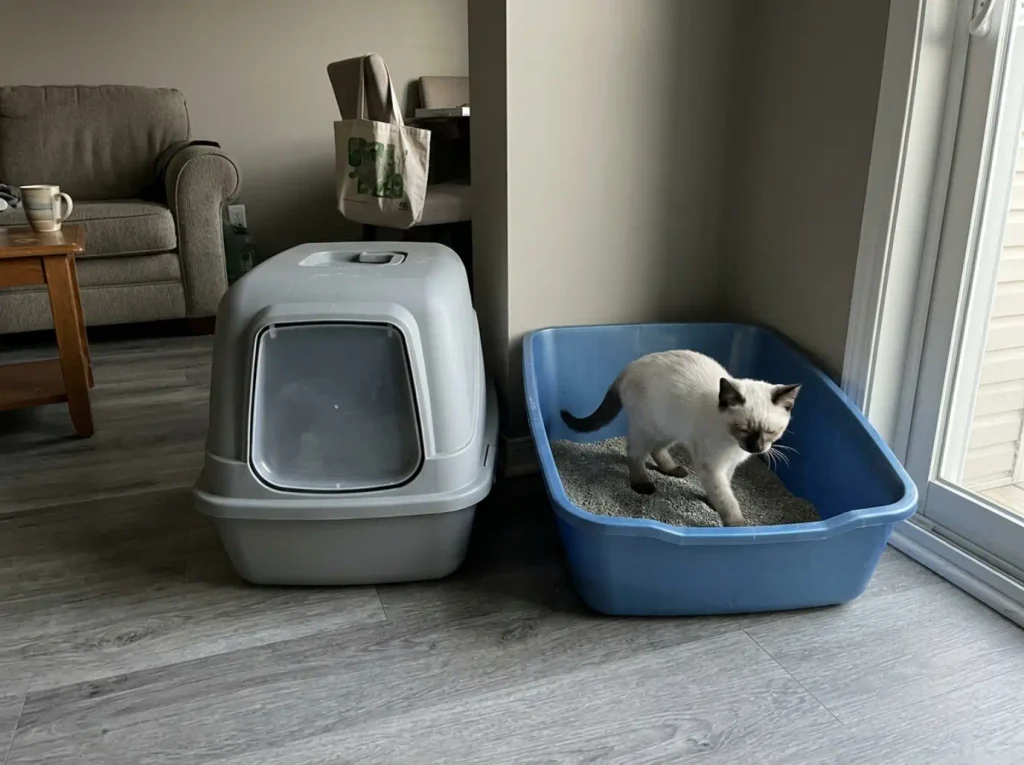
You want to know whether your specific cat is one of the eight in twenty-seven with an actual opinion. That is a fair question and it has a clean answer, and it does not require guessing at his motives.
What a Real Preference Looks Like
The signs are physical and they are consistent. Hovering at the entrance without going in. Going in and coming straight back out. Standing in the box with one back foot permanently outside it.
Then the louder end of the same scale, the one that gets filed under litter box avoidance or house soiling when it turns up in a forum title. Backing out rather than turning around, which is the geometry problem again. Scratching at the walls or the door of the cabinet instead of at the litter. Elimination outside the box, right up against the outside of the enclosure, which is about as close to a written statement as a cat can produce.
Not one item on that list is misbehavior. Every one is the cat reporting a constraint using the only vocabulary available to him, and the last one especially, which reads like defiance and is actually a cat choosing the closest acceptable spot to the one he cannot use.
The Cafeteria Test, and What It Costs
Stop interpreting and let him vote.
Put the covered box and an open box side by side. Same litter, same depth, both equally clean, both in the same part of the room. Leave them a week and watch which one gets used. That is the litter box cafeteria test, it is what researchers do when they want a preference rather than a theory, and it costs nothing beyond owning a second pan.
A week is long enough to get past novelty and short enough that you are not living with the question. And it settles the one-in-three problem for your cat specifically, which no article, this one included, can do from a distance. If you want the fuller comparison before you set it up, the head-to-head on covered versus open, by the numbers runs through the same study in more detail.
Run the test with both boxes equally clean, and scoop them at the same time each day. A cat choosing the open box because the covered one has not been touched since Tuesday is telling you about your scooping, not about the lid.
Where This Stops Being About the Box
There is a line through all of this and it is worth stating plainly, once.
Straining, crying in the box, blood, going repeatedly with nothing to show for it, or a sudden change in a habit a cat has kept for years is a vet visit, not a furniture decision. Some of that list overlaps with a urinary tract infection and none of it is a question a box can answer. This article cannot answer any of those and it is not going to try. Everything above assumes the vet has already cleared him.
Worth noting on the design side: an open litter box makes waste monitoring passive, because the visibility of waste is simply there while you scoop instead of something you have to go looking for. That is a real advantage of the open design and it is where it ends. Noticing something changed is your job. Working out what it means is the vet’s.
Keeping the Enclosure You Already Bought
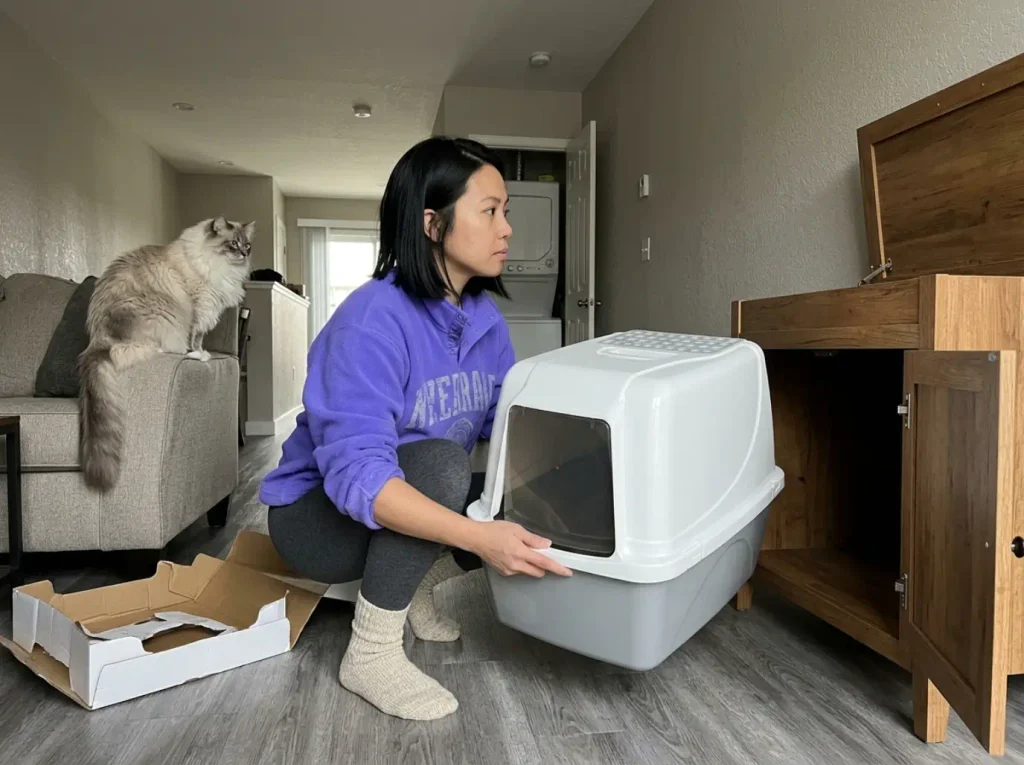
Most people reading this are not going to throw out the cabinet, and most of them do not need to. It was not money wasted. It works under four conditions, and here they are.
The Four Conditions
The interior floor measures up against the 1.5x rule for your actual cat, measured inside the pan rather than off the listing. It has a second opening, so air crosses it instead of sitting in it. It gets scooped daily, which now takes a deliberate reminder because the cabinet will not give you one. And it is not the only box in a multi-cat home, in a different room rather than a different shelf.
Four conditions. Three of them are free and the fourth is a second pan.
If your enclosure meets all four, you have the setup the study actually tested and there is nothing here for you to fix. If it misses one, fix that one before you conclude the cover is the problem, because in most cases it is not.
If You’re Replacing the Pan Inside It
Say the cabinet stays and the pan inside it is the thing that fails the measurement. Get the biggest hooded pan the interior will physically take, and know going in what you are buying.
The Extra-Large Covered Cat Litter Box with Door, Hooded Enclosed Litter Pan runs about 21.75 by 17.75 by 18.125 inches, which is the honest ceiling of what the market offers with a lid on it. It is meaningfully bigger than a standard large covered box and it is still short of the study’s footprint on every axis, so treat it as the best available compromise rather than a solution. Measure your cabinet’s interior first. The largest pan that does not fit is not a purchase, it is a return.
And while you have the pan out, the material underneath matters more than the roof over it. What the pan is made of does more for odor than the lid does, because plastic holds smell in the scratches a cat puts into it over a couple of years and a smooth non-porous surface does not.
Where the Cabinet Should Sit
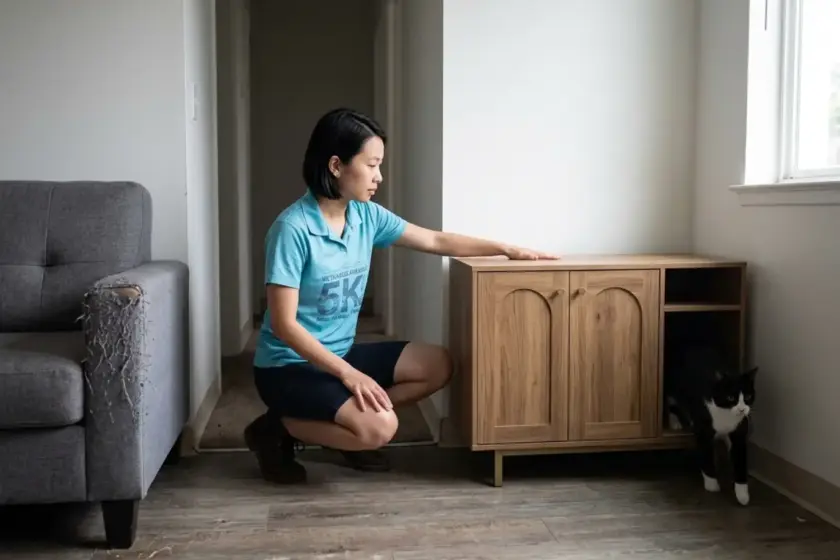
Placement recovers some of what the lid took. Put the cabinet where the cat can see the doorway of the room from inside the box, in a corner with actual air movement rather than a closet or a dead alcove behind a door.
Same furniture, same footprint, and he gets part of the vantage point back for nothing. In a small apartment this is often the only lever you have, and it is a better one than most people expect.
Turn the cabinet so the opening faces into the room rather than into a wall or a corner. It takes ten seconds, it changes nothing about how the furniture looks from the sofa, and the cat gets his sightline back for free.
The Verdict, and What to Do Tonight
Enclosures are not bad for cats. Enclosures that are too small, too still, and too easy to stop scooping are bad for cats, and nearly everything sold with a lid on it is at least the first of those.
Measure the interior floor before you decide anything else. It is the single number that separates a box that works from a box that looks like it works, and it is the one number nobody selling you a box wants to talk about.
If there is a second cat in the house, the question stops being about size and becomes about the doorway. A hood in a one-cat home is furniture. A hood in a two-cat home is a door one cat can hold.
Then check back in three weeks. Not because plastic wears out that fast, but because three weeks is long enough for a cat to have accepted or quietly rejected a change, and long enough for a new daily habit to have slipped. Look at three things: is he going all the way in, is the scoop still happening every day, and has anything started appearing outside the box.
Tonight, do the free version. Take the back panel off the cabinet and put a tape measure on the floor of the pan. If it measures up and the airflow was the whole problem, you just saved yourself the price of a second box.
Amazon’s Audible — free for 30 days
Your cat won’t let you read. Let someone read to you.
Audible is Amazon’s audiobook library — thousands of titles, read out loud, on your phone. Free for a month, plus one audiobook to keep forever.
Frequently Asked Questions
01Are covered litter boxes bad for cats?
Not by design. The research found no across-the-board preference between covered and open boxes. The problem is that almost every covered box sold is far smaller than the ones that research used, so most real covered boxes fail on size rather than on the lid itself.
02Do covered litter boxes actually trap odor?
They contain it rather than remove it, which is why the room smells better and the inside of the box smells worse. With one opening and no airflow, ammonia concentrates in the space the cat has to put his head into.
03Why won’t my cat use a hooded litter box?
Usually he cannot turn around inside it, cannot see the room from in there, or is sharing it with a cat who parks near the only doorway. Put an open box beside it for a week, keep both equally clean, and let him vote.
04Are litter box enclosures bad for cats in a multi-cat home?
This is where they cause the most trouble. One entrance that is also the only exit lets one cat control the other’s access, and the study people cite for reassurance tested cats alone or separated from their housemates.
05Is a hooded box worse for a big cat?
Usually, yes. Cats over about thirteen pounds trended toward the open box in the data, and the entry hole is a second problem on top of the floor space. A large cat has to duck in and then turn around in a space built for a smaller one.
Leave a comment