Best Pheromone Diffuser for Multi Cat Homes, Doors Closed
Best pheromone diffuser multi cat: MultiCat vs Optimum vs Classic, 60-70 m² rated for an open room, a 30-day vial + where the outlet goes ➜

Alfredo RamsesFounder · November 3, 2026 · 16 min read


On this page8 sections
- 1What a Pheromone Diffuser Changes in a Fighting Home, and What It Leaves Alone
- 2A Wound or a Sudden Change Goes to the Vet Before a Plug
- 3Which Formula Fits Which Cat: MultiCat, Optimum and the One-Cat Classic
- 4Rated Coverage Assumes an Open Room, and a Closed Door Splits the Apartment
- 5Where the Plug Goes: Where the Fight Starts, Not Where the Outlet Is
- 6The Vial Is the Test, and the Refill Is the Real Price
- 7One Vial, One Notebook, and a Second Route in the Hallway
- 8Frequently Asked Questions
When one of your cats waits at the end of the hallway until the other has gone by, he is reading a corridor that holds one cat at a time, and he is right about the corridor. A plug-in diffuser sold as the best pheromone diffuser multi cat homes can buy feels like the obvious answer, but it changes the background mood of an apartment, not who gets the hallway. The figures below come from the maker and from one small trial in homes with two to five cats, and the diffuser tested in that trial is a different product from the ones compared here. What follows covers when the vet comes first, which formula fits which cat, what rated coverage means once the doors are shut, where the outlet goes, and how a single vial tells you whether the plug was doing anything.
Three formulas from one maker cover most of the decision, and only one of them was built for cats who already live together:
| What you buy | The home it fits | Its limit |
|---|---|---|
| FELIWAY MultiCat | Appeasing formula, for tension between cats who already share the apartment | Units of this kind have been known to smoke or smell of burning after a refill swap |
| FELIWAY Optimum | Combined formula, for the home where the nervous cat is also the one being pushed | The most expensive refill of the three |
| FELIWAY Classic | Facial formula, built for one cat, here as the contrast | Built for general ease in a single cat, not for friction between two |
What a Pheromone Diffuser Changes in a Fighting Home, and What It Leaves Alone
A plug-in cannot move a bowl or open a second path, so the useful question is what it changes in a home that already fights and what it leaves exactly as it was.
Fights Start at a Place, Not in a Mood
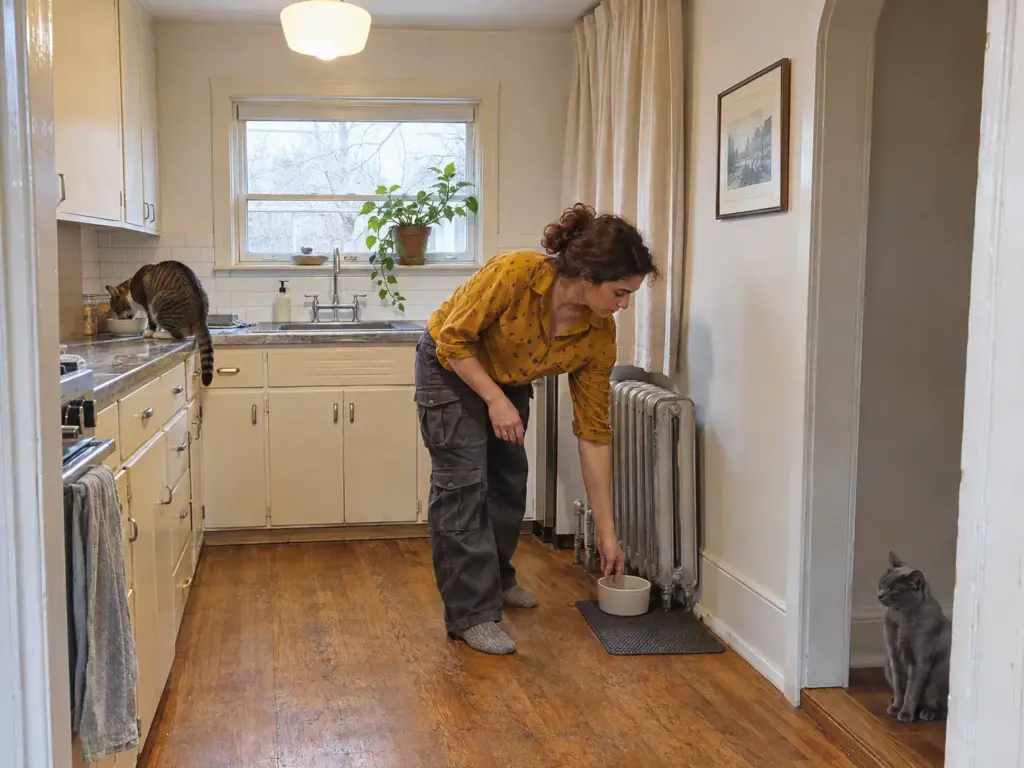
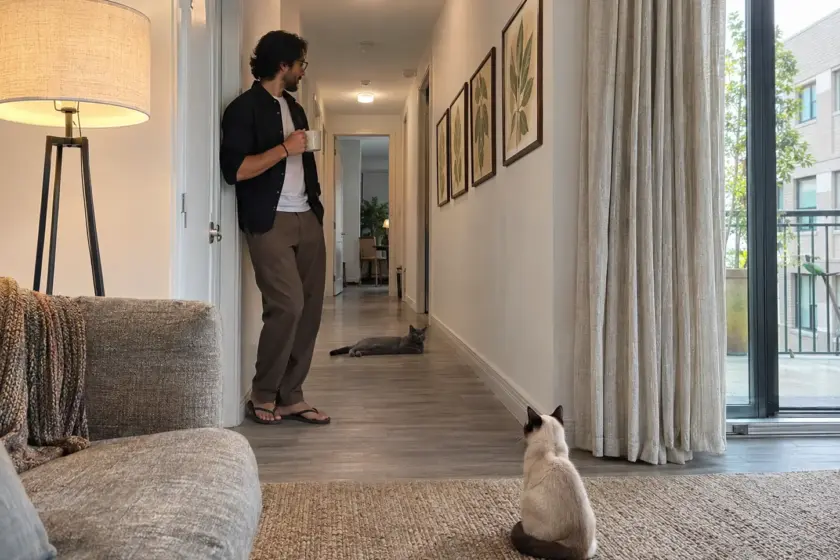
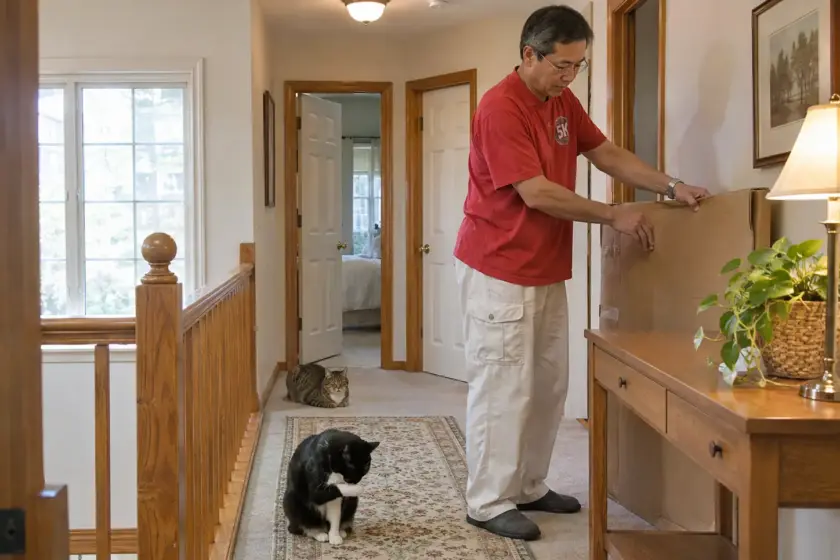
Cat fighting is never general. It happens somewhere: the kitchen doorway, the feeding station, the gap at the end of the hallway, the side of the litter box that faces the wall. Every one of those spots holds one animal at a time, and the cat who backs off is reading that constraint correctly. A diffuser does nothing about the arithmetic.
With three cats there are three pairs, and each pair can have its own corner.
What it can change is the background of the apartment, the scent a cat reads when he decides whether a room is safe to cross. That is a real lever, but it is one lever. A fight that is really about a place gets settled by giving the place a second option (a second path, a second station, a second rest spot), and the guide on how to stop cats fighting when there is no second room works through that order for a small apartment, where the second option has to be built out of what is already standing there.
What the Only Multi-Cat Trial Measured
The evidence for plug-ins in homes like yours is thin, and it says so itself. A randomized, placebo-controlled pilot trial in 45 multi-cat households enrolled homes with two to five cats, and a home only qualified after at least one fight and four further clashes in the previous two weeks.
Twenty homes got the pheromone and 25 got a placebo. Fighting scores fell in both groups. The extra drop in the pheromone group landed at P = 0.06, and at P = 0.04 on day 42; the authors call the result promising, which is a fair word for a number sitting on the edge.
Two details change how to read it. Every household sat through an education session a week before the trial started, covering what to watch in their cats, so part of the improvement in the placebo group came from owners who had learned to read their own house. And the product tested was FELIWAY Friends, with the materials supplied by the maker, Ceva. The kits compared below are other listings from the same family, so the trial tells you what to expect from the idea of a plug, not from a particular box.
The Free Changes Come Before Any Plug
The free changes go first, and they are the part most likely to settle a fight that belongs to a place. A second food station at a different eye line, so one cat cannot watch the other eat, takes the bowl out of the stand-off, and two bowls, plus one sets out how many stations a pair actually needs. A second route through the contested gap lets the cat who waits stop waiting; in a hallway that is a shelf or a chair cats can use as a bypass, because a corridor with one way through is a corridor with one winner. A rest spot in another room gives the displaced cat somewhere that is his, and a cat who has somewhere of his own tends to cross the shared rooms with less to prove.
A diffuser suits a rental because it needs no drilling and no hardware, just a wall outlet. But it does not replace the second bowl, and in a small apartment the order matters: change the places, then add the plug to work on the background while the places settle.
For a few days, jot down where each stand-off starts and at what hour: the doorway, the bowl, the end of the hallway. Those notes decide where the outlet goes, and they are what a vet will ask for if an appointment comes up.
A Wound or a Sudden Change Goes to the Vet Before a Plug
Some of what looks like a house problem is a vet question, and the order matters more than the product on the shelf.
What Is at Stake When Housemates Fight
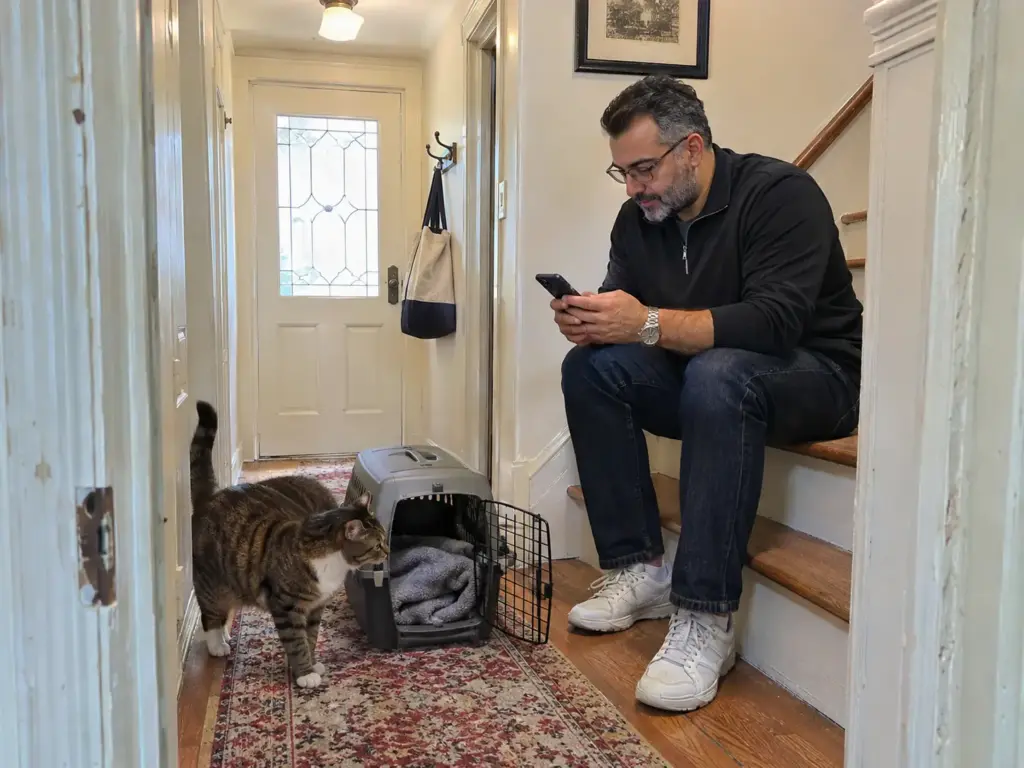
Tension between cats in one home is common, and it has a real cost. According to the American Association of Feline Practitioners’ listing of the same trial, “Aggression and social tension among housemate cats is common and puts cats at risk of injury or relinquishment.” That is the reason the order of operations matters. A plug works slowly, and a wound does not wait.
A Wound, Eating Less or Hiding All Day Goes to the Vet
Some changes are a vet’s question before they are a house question. A wound on either cat, a cat who eats less than usual, a cat who hides for most of the day, a cat who starts using the box differently or goes outside it, or any abrupt change in either cat’s routine: each of those is an appointment, the vet rule-out, and it comes before a diffuser. This guide stops there on purpose, because what those signs mean is for the vet to say.
Anything a cat swallows or is prescribed belongs to the vet as well: supplements, chews, doses, anything meant to calm him from the inside. What follows is about a plug that lives in the room.
After the Vet, the House Is Next
Once the cat has been seen, the house is the next question. If the fighting began when something in the home shifted, the guide to cats suddenly fighting more starts from a house that changed in the last six weeks. And for a fight that is happening right now, the useful tool is a barrier instead of a hand; a diffuser plays no part in that moment.
Which Formula Fits Which Cat: MultiCat, Optimum and the One-Cat Classic
Three boxes with the same logo sit on the shelf, and they are not interchangeable. The formula inside decides everything, and the name on the front hides it. (Switching formulas partway through a bad stretch is common, and it makes it hard to tell which change did what.)
The Appeasing Formula for Tension Between Housemates
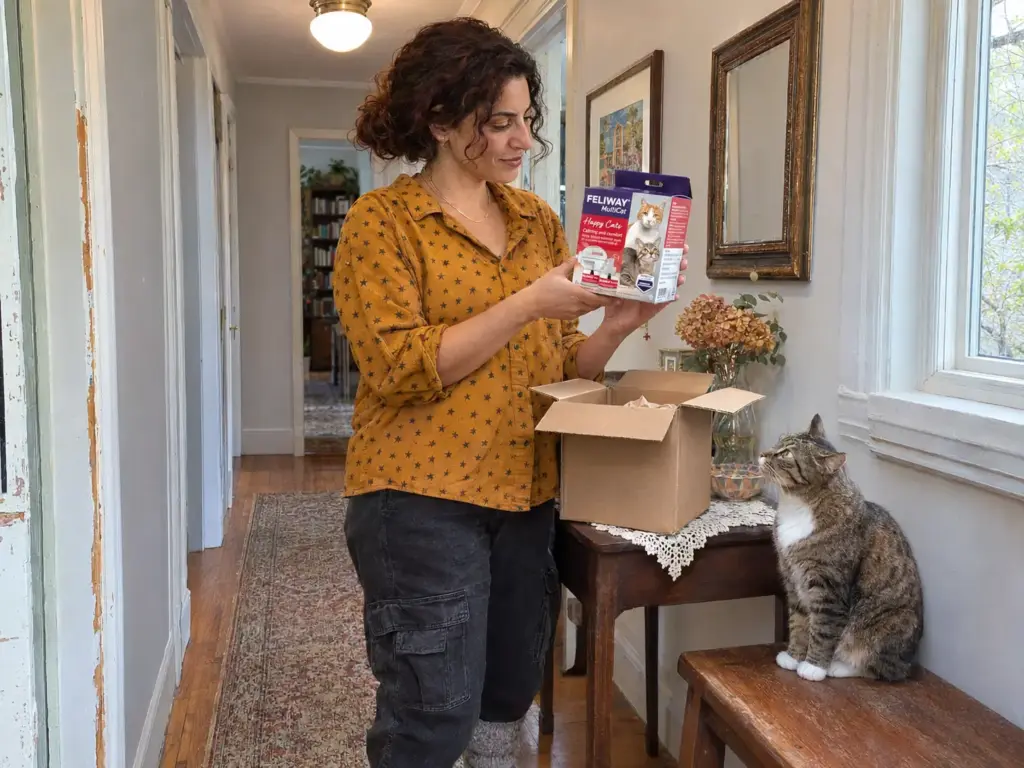
The appeasing formula (the feline appeasing pheromone) is the one built for tension between cats who already share a home, and the name most households arrive holding is FELIWAY MultiCat. It is the right first pick when the friction runs between residents. It works on the peace between cats, not on each cat’s own calm: two cats can share a sofa without a chase and one of them can still be on edge, so a quieter house does not promise a relaxed cat.
The Combined Formula When the Nervous Cat Is Also the One Being Pushed
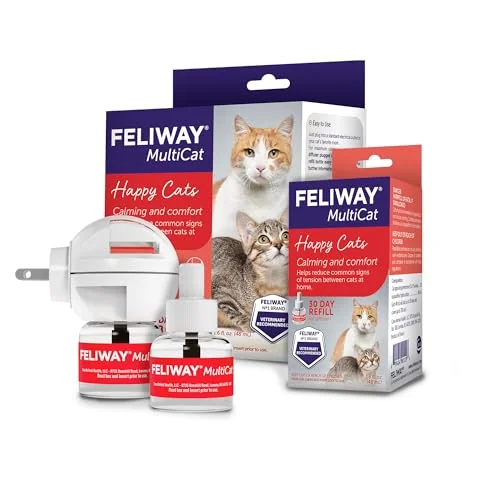
MultiCat is the name everybody reaches for, and the obvious pick stops being obvious in one specific house: the one where the cat who is tense is also the cat taking the pushes. There the combined formula, FELIWAY Optimum, covers the facial side as well as the appeasing one. It is the one to look at when a cat is on edge in general and also sits at the receiving end of the other’s moves.
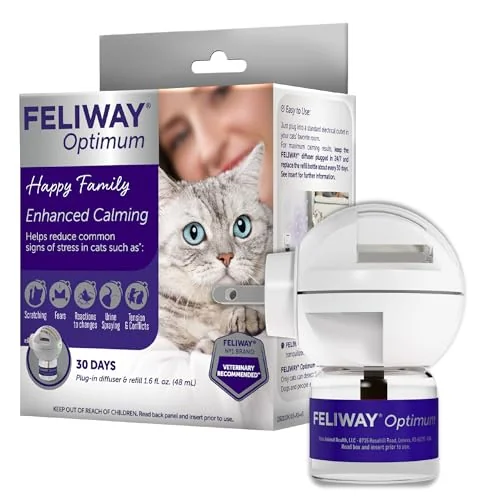
One thing no formula can be promised to do is calm the cat being pushed more than the cat doing the pushing. In one home the calmer effect showed up in the pushed cat while the pusher stayed exactly as he was; in another, a cat grew jumpier at noises from outside after moving from MultiCat to Optimum. Two single observations pointing in different directions are not a pattern, so treat a formula change as a reason to watch both cats closely for the first weeks.
Compare with the label in your hand, not the name on the box. The words to look for are cat appeasing (or the same idea in plain language); a box that says only calming or facial is built for one cat’s general ease.
The Facial Formula Is the One-Cat Foil
FELIWAY Classic (a diffuser with a 48 mL vial) is the facial formula (the feline facial pheromone), made for the general ease of a single cat, and it earns its place in this comparison as the contrast. In at least one home with two pushy cats it changed nothing, which is exactly what the formula’s design predicts: it was never meant to touch friction between two animals.
A newcomer is a different moment with a different plan, and pheromone diffusers compared for introducing cats covers that case, so it is left out here.
Rated Coverage Assumes an Open Room, and a Closed Door Splits the Apartment
The coverage figure on the box is the first number most buyers check, and it is the one that needs the most careful reading.

What 60 to 70 Square Meters Is Rated For
The listings rate these plug-ins at about 650 to 750 square feet (60 to 70 square meters) per unit. That figure is per diffuser, and the listings do not say whether it was rated in an open room or across a whole apartment. Placement advice for these plug-ins adds that doors and curtains get in the way.
So the arithmetic most buyers do, “my apartment is smaller than that, so one plug covers it”, rests on a number with no stated room behind it. It deserves a second look before the second outlet is ruled out.
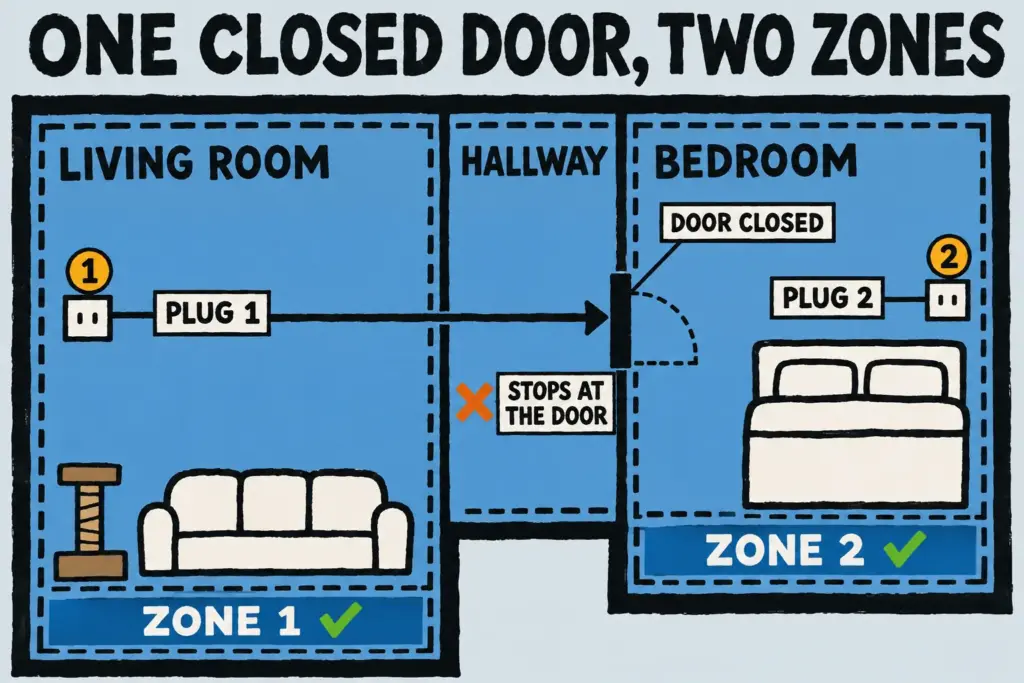
A Closed Door Cuts One Apartment Into Two Zones
Treat a closed door as a wall for scent. The air in a shut bedroom is not the air in the hallway, so what the plug in the hallway puts out does not reach the bedroom while the door is closed. This is reasoning, not a measurement: no source gives a percentage for how much a closed door cuts, and none is claimed here.
The cat it affects most is the one who already keeps away. A cat who spends the day behind a bedroom door is exactly the cat who ends up outside the diffuser’s zone, and he is doing it for a reason: the door is the one place in the apartment that is his. What suits the cat (a door that stays closed) and what suits the person (one outlet, one plug) pull apart here.
Two Zones, Two Plugs, and the Bonus Kit
Two zones need two diffusers; one unit serves one zone. The Comfort Zone Multi Cat Calming 1 Room Bonus Kit comes with one diffuser and two refills, rated at 60 square meters (a little under the Feliway units), so it covers the first zone for two months and leaves the second zone waiting on a second diffuser. One flaw to plan around: in a hot summer a refill has been known to give out in about three weeks rather than the rated 30 days.
In a rental, two wall outlets are enough, with no drilling and no power strip. And if one door never really closes, say the one between the hallway and the kitchen, that gap may be covered by a single plug.
Do the coverage math twice, once with every door open and once with the doors as they sit all day. If one door stays open in practice, one plug may cover that gap, and the second diffuser can wait until the numbers say otherwise.
Where the Plug Goes: Where the Fight Starts, Not Where the Outlet Is
Where the plug goes decides whether it can do anything at all, and the choice belongs to the fight, not to whichever socket is free.
Plug It Where the Cats Rest and Cross
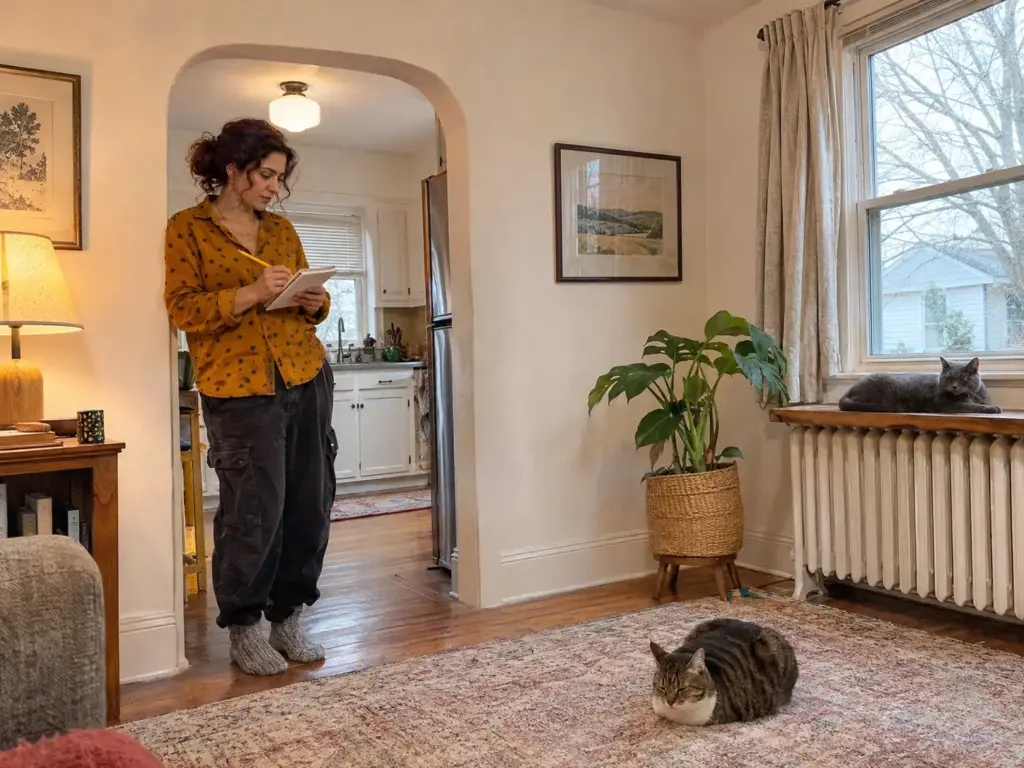
The outlet nobody is using is the outlet most buyers choose, and it is usually the wrong spot. In the trial, the diffuser went where the cats rested most, away from open windows, after each owner drew a floor plan of where their cats spent time. The maker’s guidance says the same: where the resident spends the most time. For placement, this guide adds one step to that, which is to put the plug where the stand-off starts, and to find that spot with a drawing of your own apartment.
Corners and doorways where a cat cannot see who is coming are the usual starting points, the same sightline logic behind why a sightline break at the water bowl matters. The litter area gets the same treatment, because the box nobody feels is theirs is a common stand-off site, and one more box than cats is the usual way to take the pressure off it. When the only useful outlet is somewhere else, move the bowl or the route before moving the plug.
The Outlet Needs Clear Space and No Power Strip
The maker’s listing asks for about four feet (1.2 meters) of clear space above the unit. Plug it straight into the wall, never into a power strip. No curtains, furniture or doors in front of it, and no open windows, vents or air conditioning blowing across it. A cat who knocks the unit out of a strip, or pulls it loose from a socket he can reach, has switched the diffuser off, and nothing in the apartment announces it.
Stick a small label by the outlet with the date the vial went in. The outlet is the one place everyone in the apartment looks, and an empty diffuser can sit unnoticed for weeks.
A Unit That Smells Like Burning Comes Out of the Wall
If a diffuser smokes or smells like something is burning, it comes out of the outlet. Plug-ins of this kind have been known to do it after a refill swap, in a brand-new unit and in an old one. This is a safety item, not a nuisance, and the unit does not go back into the wall to see whether it happens again.
The Vial Is the Test, and the Refill Is the Real Price
A pheromone plug gives no instant sign that it is working, so the test has to be built from a clock and a calendar.

One Vial Is About 30 Days
The maker rates a refill at about 30 days. That makes the vial the clock for a one-month trial: write down the day it goes in, and compare it with the day the stand-offs change. The usual advice is to give a diffuser about a month before judging it, and a vial is exactly that month.
When the Vial Runs Out and the Fights Come Back
In the homes where a plug works, the fights creep back as the vial runs out, and the calm can fade a few weeks past the month. That pattern is the best test the reader has: not a study, but a reading that takes no equipment. If nothing changes over a full vial, the plug is not the lever, and the places, the shared resources or the vet are where to look instead.
Put two dates in the calendar: the day the next vial is due and the first day with no stand-off. The gap between them is your answer.
Counting the Cost per Month, Not per Plug
The refill vial is the monthly cost, not the plug. The unit itself is swapped about every six months, according to plug-in lines that publish a cycle, so there is a second, smaller cost behind the vials.
Over a year the vials are what the household really pays, which is why a cheaper plug with an expensive refill is not a bargain, and why the refill price is the number to compare before choosing a formula. Optimum’s refill is the priciest of the set, and TopSum Cat Calming Pheromone Diffuser sits at the budget end for multi-cat homes. Its flaw is a thin track record: no repeated complaint turned up, but for a unit with so little behind it, that is not the same as a clean bill.
A calming spray does a different job at a different moment, and a calming spray for the trip covers the carrier and the car.
One Vial, One Notebook, and a Second Route in the Hallway
A diffuser changes the background mood of an apartment and leaves the places alone, and in the one placebo-controlled trial in multi-cat homes, the placebo group got calmer too. A wound or a sudden change goes to the vet before any plug. Pick the formula by which cat carries the pressure, read the coverage figure with the doors closed, and put the outlet where the stand-off starts.
The check for later has a clock the topic provides: one full vial, about 30 days. If the stand-offs look the same at the end of it, the plug was not the lever. If they thinned out and came back as the vial emptied, the refill is worth buying.
Today’s step needs no purchase. Jot down where and when each stand-off starts for a few days, then open a second route or move a bowl at that exact spot, and watch whether the waiting cat walks past without stopping.
Frequently Asked Questions
01What is the best cat pheromone diffuser for multiple cats?
For tension between cats who already live together, the appeasing formula (FELIWAY MultiCat) is the one built for the job. When the nervous cat is also the one being pushed, the combined formula (Optimum) is the one to look at. Neither calms each cat individually.
02Do feline pheromone diffusers really work?
They help some homes as one lever among several, and not every home. In the one placebo-controlled trial in multi-cat households the result was P = 0.06, and the placebo group improved too.
03What is the most effective pheromone for cats?
It depends on what the home needs, because no single pheromone is best for every cat. The facial formula is built for one cat’s general ease, and the appeasing formula is the one built for tension between cats who share a home.
04Is there anything better than FELIWAY for cats?
The multi-cat trial tested a single FELIWAY product, so there is no evidence that another brand does better. Comfort Zone and TopSum are alternatives with a different cost and thinner evidence behind them.
05How long does a pheromone diffuser take to work?
The clock is the vial, about 30 days. If one full vial changes nothing, the plug is not the lever. A wound or a sudden change in either cat is a vet appointment first, and this guide stops there.
Leave a comment