Why Cat Bullying Other Cat Shows in Rooms the Victim Skips
Cat bullying other cat? Find the places your quieter cat has given up and give each back [bowl, box, bed, lap] without punishing the other cat.

Alfredo RamsesFounder · November 3, 2026 · 16 min read

On this page7 sections
- 1When Cat Bullying Other Cat Is a Vet Question Before It Is a Floor Plan
- 2The Rooms the Bullied Cat Has Quietly Given Up
- 3What the Other Cat Holds in Each Place, and the One Spot to Give Back
- 4Giving the Place Back Without Punishing Anyone
- 5When the List Stays Long, Separate and Start Over
- 6Start With the Bowl, Then Walk the List Again
- 7Frequently Asked Questions
The perch by the window has been empty for a week, and the bowl in the kitchen stays full until the other cat wanders off. There was no fight to see, only a gap where one cat used to be. That gap is what cat bullying other cat looks like in most homes: one cat holds a spot, often just by lying in it, and the other stops contesting and gives the spot up, which is a sensible move for a cat with no way past.
Anything that hurts, from eating less to hiding most of the day to a bathroom habit that moved, belongs to the vet before it belongs to any furniture, and the rest is bowls, boxes, floors and territory. Below you walk the house by the list of places he has lost, see what the other cat holds in each, and give each one back without punishing anybody.
Quick Answer
Cat bullying other cat is one-way and repeated: one cat holds a spot, often just by lying in it, and the other stops contesting and gives the spot up. Eating less or hiding most of the day goes to the vet first. After that, fix each lost place and punish nobody.
When Cat Bullying Other Cat Is a Vet Question Before It Is a Floor Plan
A bowl that stays full all afternoon looks like a bowl problem, and the first instinct is to move it. Move it too soon and you lose the one thing worth reporting: a cat who skips a meal only while the other cat is in the room is not the same case as a cat who eats less all day, and from the sofa you cannot tell which one you are watching. So the order here is fixed. The vet first, the house second.
Eating Less, Losing Weight or Hiding All Day Goes to the Vet
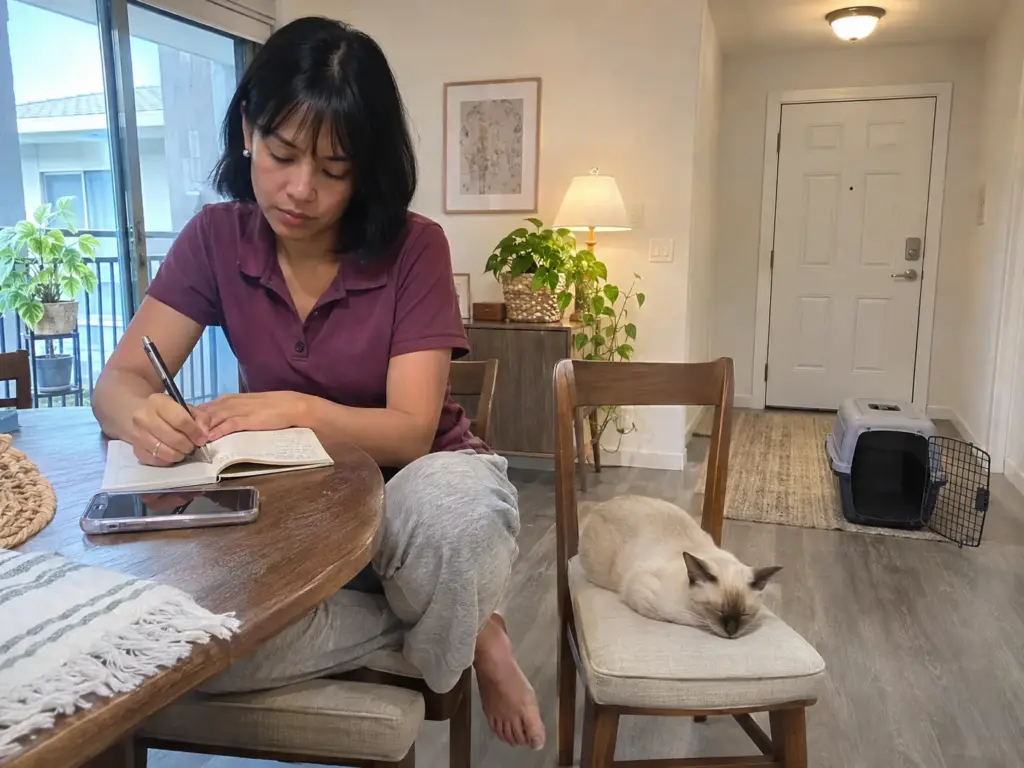
Book the appointment if the bullied cat eats less than he used to, looks thinner, spends most of the day hidden, or uses a spot outside the box for the bathroom. Any one of those is enough, and none of them needs a theory from you first. According to the ASPCA’s guide to aggression between cats, “If you notice any unusual physical or behavioral symptoms, or if your cat stops eating, please see your veterinarian right away.”
This page does not try to say what those changes mean. That belongs to the exam room, and everything below works best on a cat the vet has already seen.
Keep a plain page for each cat for 48 hours before the appointment: what he ate and about when, where he slept, which doorways he used. A page of facts gives the clinic more to work with than a general impression, and the same page becomes the start of your list of lost places.
A Wound on Either Cat Goes to the Vet
A scratch that looks deep, torn fur, a limp or a swollen patch on either cat goes to the vet, and that includes the cat who seems to be on top. Nothing on this page covers cleaning or treating a wound. It is a phone call.
If the trouble arrived suddenly, a house that changed in the last six weeks often explains the timing, and dates like those make the vet call more useful.
What Is Left for the House to Answer
The house can answer four questions: where each cat eats, where each uses the box, where each sleeps, and which way each one walks to get there. You can see all four by standing in the hallway with a notebook. What is going on inside either cat stays with the clinic.
This page also takes it as settled that the pattern goes one way. If you are still unsure it is not play, seven days of watching will tell play from a real fight, and that check comes before anything below. The full resource count for a multi-cat home, and what to do when the apartment has no spare room, sits in how to stop cats fighting when there is no second room. Here the quieter cat has already started giving places up, and that is the case this page takes on.
The Rooms the Bullied Cat Has Quietly Given Up
The easy mistake with one-way aggression is to read quiet as peace. Nobody hisses, nobody chases, and the two cats can share a room for an hour with nothing to see.
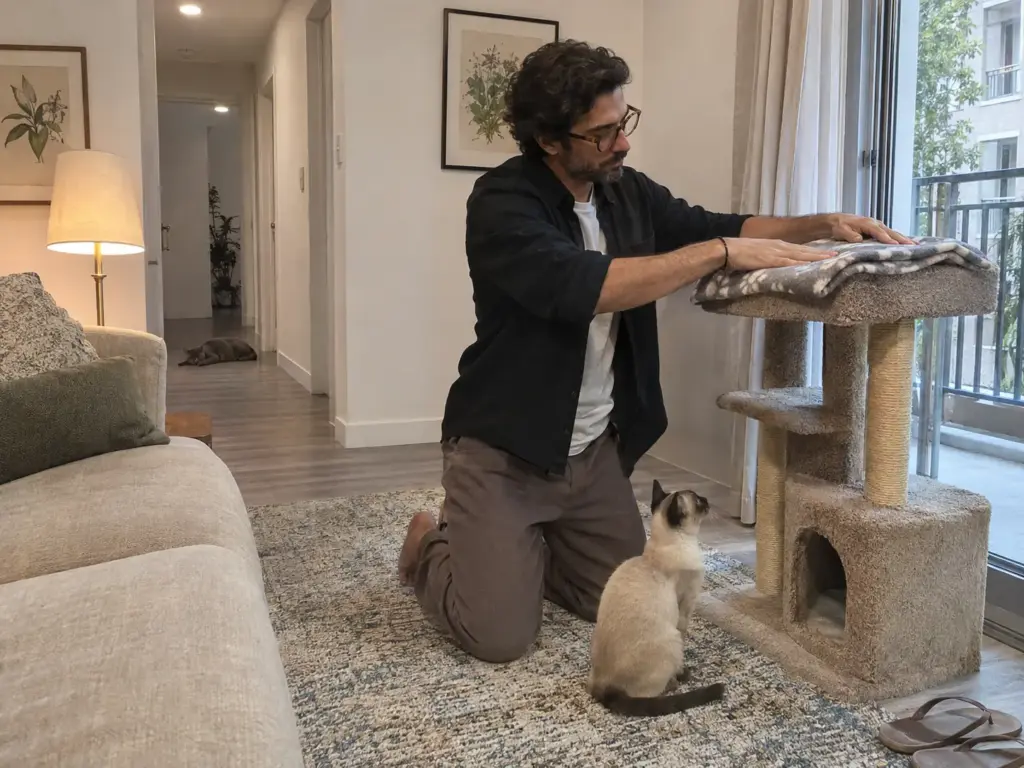
But a house where nothing happens can be a house where one cat has stopped asking for anything. The territory of the quieter cat gets divided up by the more confident one, until he keeps to a single room except at certain times of day. A withdrawn cat gets read as an easy one, and nobody has to hiss for a cat to lose a room.
Walk the Home With the Bullied Cat’s Day in Mind
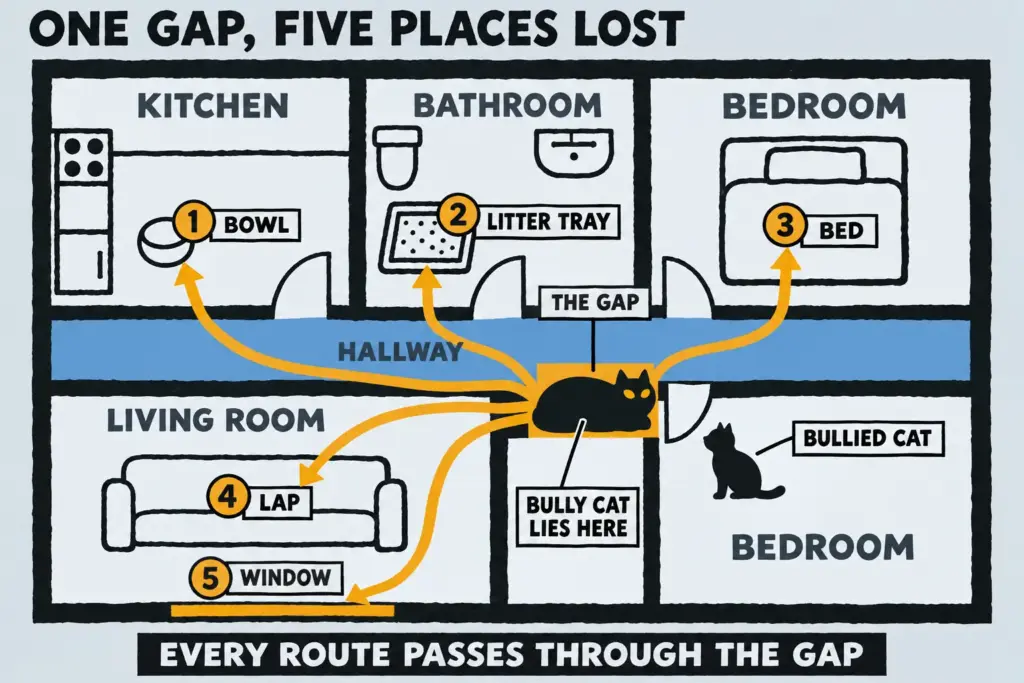
Start in the hallway and walk the day the way he would: where he eats, where he goes to the toilet, where he sleeps, where he sits with you, and how he gets to the window. Five places cover most homes, and each shows its loss in a different way.
- The bowl: it stays full until the other cat has left the room, or he eats fast with one eye on the doorway.
- The box: he reaches it only when the route is clear, or he skips the room it sits in. (A habit that has moved off the box altogether is the vet’s call, as above.)
- The bed: a cushion, shelf or cat tree he used all the time now has nobody on it, and the other cat lies close by.
- The lap: he climbs onto yours only after the other cat has gone, or stops climbing at all.
- The route to the window: the sill or shelf he used to cross the room for is now a place he looks at from far away.
Write the five on a page, most-used first. Every one he has dropped names something the other cat holds there, and in a small apartment the five tend to pass through the same doorway or the same stretch of hall. That shared stretch is what the rest of this page works on. If you are counting boxes along the way, how many litter boxes two cats need gives the number to start from.
The Cat Lying in the Doorway Is Holding the Doorway
Blocking takes no more effort than lying down in the right place. AVSAB’s guide to the multi-cat household describes it plainly: “The bully cat might simply lie in one room and stare at the victim cat who is considering entering the room.” To a person walking past, that is a cat resting in a harmless spot. To the cat on the other side of the threshold it is a closed door.
The sign to look for is the approach and the turn: he walks to the edge of the room, stops, and goes back the way he came. And the nap is in the best seat in the house for the job, since a cat lying along a hallway can see every door that opens off it. Which of your five places sit behind that doorway?
Kneel in the hallway at his eye level and stand where his bowl, his box and his bed each sit in turn. Any line of sight that crosses the doorway is the line he has been walking into, and that line is what a door, a piece of furniture or a change of spot has to break.
A Bullied Cat Often Starts Avoiding a Third Cat Too
Fear does not stay with the cat who causes it. A bullied cat often starts to avoid a third cat who has done nothing to him, and a calm newcomer can end up on the same list, because a territory that is shrinking does not check who is in the room before it shrinks. A kitten who only wants to play becomes one more thing to run from. How a third cat gets introduced without crowding the resident is laid out in the plan for when the newcomer is a kitten who only wants to play.
Indoor cats have no yard to retreat to, and with one hallway, the hallway is the whole house. A cat lying in it holds every room behind her, and the quieter cat’s list can run to all five places without a single cross word.
What the Other Cat Holds in Each Place, and the One Spot to Give Back
Calling the other cat a bully tells you nothing you can move. Naming what she holds does. That is resource guarding in plain terms: she holds the food station, or the route to the box, or the sleeping spot, or the lap, and each of those is one spot with one repair, placed where the quieter cat arrives first.
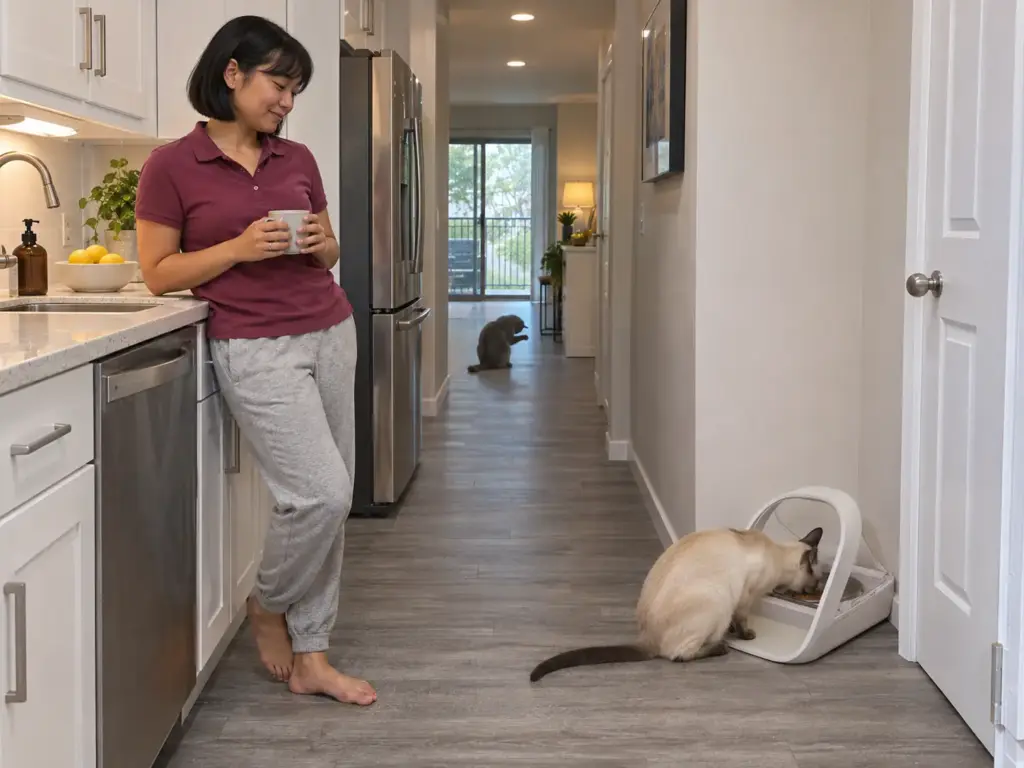
She is not planning anything. She occupies what the house leaves open for her to occupy.
The Food Station
Start with the free change. Move his food bowl farther from the doorway she lies in, or better, out of its line of sight altogether, to a spot he can reach without crossing her. The usual advice is a second bowl beside the first, and it fails here: she lies in the corridor that leads to both, so the walk is still hers. The arithmetic of two bowls, plus one only works when the walk to each bowl is different.
If the apartment has no second spot at all, a feeder that reads a microchip can stand in for distance. The SureFeed Microchip Pet Feeder MPF001 opens only for the registered chip, so a bowl in a corner she can reach stays shut to her. It holds one meal at a time with no schedule, and the four C batteries it takes are not in the box.
Whichever feeder you pick, put it where the quieter cat arrives first and leave the old bowl in its old place for the other cat, so the change reads as his gain and not as her loss. A cheaper route to the same gate is the PETLIBRO RFID Automatic Cat Feeder, which opens for a tag on the collar instead of a chip. That means the cat has to wear the tag every day, so it is the better pick only for a cat who tolerates a collar.
Meals at fixed hours are a different job. For that, the PawsPik Automatic Microchip RFID Cat Feeder has a 16-cup hopper, but it takes dry kibble only and is the most expensive of the three. If you want more microchip feeders weighed for a home with more than one cat, there is the full comparison of microchip feeders for more than one cat.
Lie down in her spot in the hallway and look at his bowl. If you can see it from there, so can she, and the bowl is not far enough away however many feet the tape measure says.
The Litter Route
A box is a place he has to walk to, and the walk is part of the box. The count everyone quotes is one box per cat plus a spare, in different places or on different levels, and International Cat Care on conflict between cats says it that way. It also notes that a cat can block a resource by doing no more than standing between the other cat and it.
The count is right and it is not enough. Three boxes in a row in one bathroom are one box with a single doorway, and she can hold the doorway. Give the spare a route that bypasses her: the far end of the house or, better, a different level if the home has one. For where a box goes in the first place, where a litter box goes, and three places never is the reference.
The box is also where trouble tends to show for the quieter cat, and a change in his habit there is a call to the clinic before it is a layout question.
The Sleeping Spot and the Lap
Height is free if the house already has it: the top of a bookshelf with a folded fleece on it, a deep windowsill, a chair pushed against a wall. None of it needs drilling, which suits a rental. Every cat needs somewhere private to rest, and for him that spot has to be out of her view from the doorway, or it is only another place to be watched.
The owner’s lap is a resource too, and sharing it is a human preference. The constraint on his side is that he cannot climb up while she is watching. Close the door on her for a few minutes at a time and let the lap be his, then give her hers later in another room. Two cats on one sofa at the same moment looks like peace to a person, and for the quieter cat it is one more place where he is watched.
In an apartment with one door that shuts, the spare spot is usually a dry bathtub with a towel in it or a corner of the bedroom behind the door. The rule holds there as everywhere: it is his first.
Giving the Place Back Without Punishing Anyone
A shout works for as long as it takes to say it. After that, either she redirects her lying to somewhere less visible or he hides at the sound of your voice, and the spots on his list are still taken.
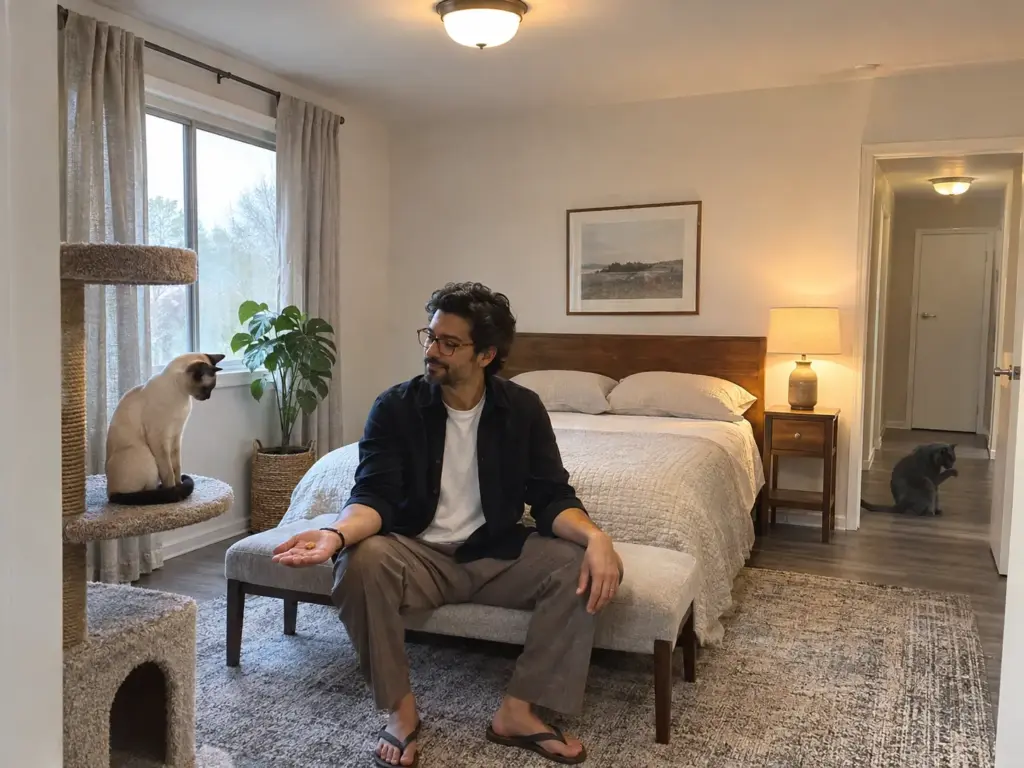
Why a Swat or a Shout Keeps the Hold Stronger
Cornell’s Feline Health Center on behavior problems is blunt about physical punishment, and swatting a cat off a spot counts: it can raise a cat’s fear and anxiety and make the trouble worse. It also teaches nothing about the spot. She is not breaking a rule, only lying where the house lets her, and a shout in the hallway makes the hallway tenser for both of them.
When a real fight does need breaking up, a barrier instead of a hand is the way, and the steps live there.
Calm Time on the Bullied Cat’s Side
The repair is only half done when the spot is free. The quieter cat also has to find out that it is free, and he will not believe it the first time. So close the door on the other cat for a short stretch and let him have the room: let him sniff the doorway, cross the floor, climb to the perch.
When he steps into a place he had given up, a treat or a quiet word from you marks it. There are no sessions to count and no minutes to time. Watch him, and end it while he is still relaxed.
The closed door stays a human job. You are giving him the house for a while and giving her an equal stretch elsewhere, so neither of them reads the door as a punishment.
Give the reward to him for stepping into the place, not to her for leaving it. A treat handed over as she walks away teaches her that leaving is how treats arrive, and the quieter cat learns nothing about the room.
Scent Help, and Where It Fits
Pheromone diffusers come after the changes in the five places, never in their place. The ASPCA says pheromone products may reduce tensions in some cats. The FELIWAY MultiCat Diffuser Kit with 1 Refill plugs into an outlet with no drilling, and it belongs in the room where the conflict happens most. It works for some cats and not for others, and a home with parrots or budgies is a poor fit for it.
Treat the result as information. If the quieter cat is not back in the five places after the diffuser has been in the room for a couple of weeks, the repair needs another go, not a second diffuser.
A cheaper diffuser does the same job. The Comfort Zone 30 Day Starter Kit plugs in the same way and carries the same limit, since in some homes it makes no visible difference. It can spill when it is refilled, so refill it over a towel, and a refill comes due about monthly. Diffusers get a longer comparison in pheromone diffusers compared for introducing cats, written for a pair meeting for the first time.
When the List Stays Long, Separate and Start Over
Separating two cats who keep each other company feels like giving up, and it is the opposite. It is the way to reset, and what follows is a gradual reintroduction, the same slow approach as when the second cat first arrived. If the list of lost places is no shorter after the changes above have had a few days, that is the signal to reset, and it does not mean these cats do not get along.
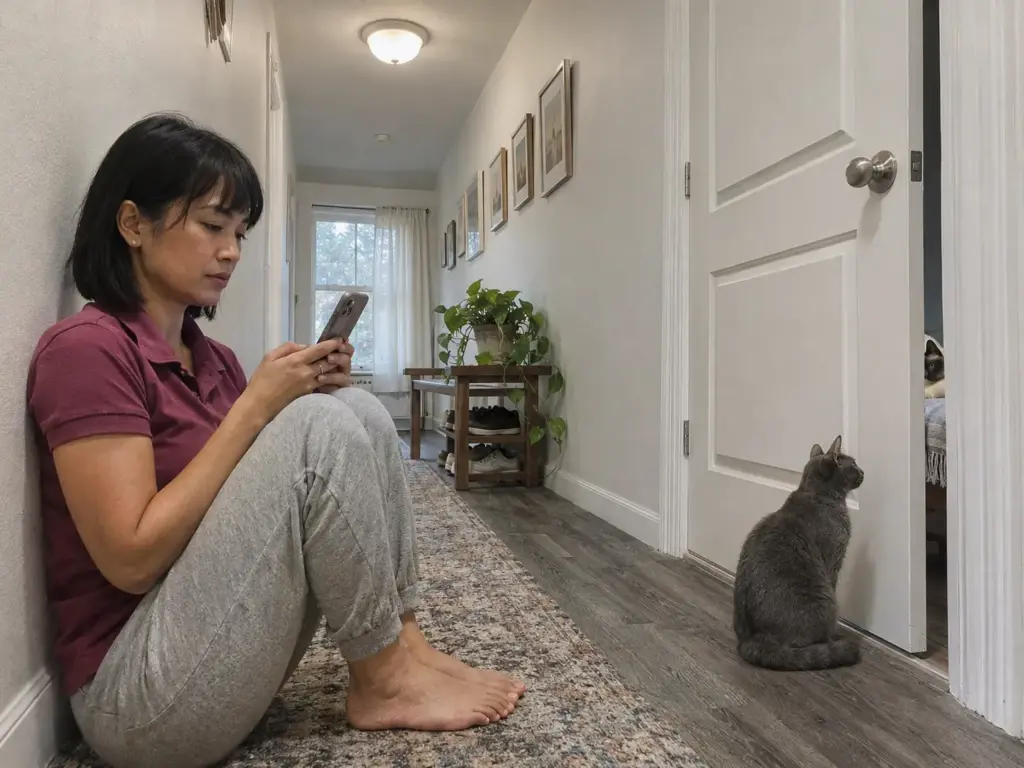
The ASPCA describes the method: separate the cats for days to weeks, then open the door one inch, and open it wider only while both stay calm. If either cat is not calm at the gap, the door goes back to shut. How a restart goes wrong between sessions is shown in signs a reintroduction is failing between sessions, and the whole method is in introducing cats in a small apartment, stage by stage.
With only one spare room, that room is his first. He is the one who has been living on one room’s timetable, and the other cat keeps the rest of the house, each with a bowl, a box and a bed of its own. If the list is still long after a careful restart, a certified animal behaviorist is the next call, and the vet comes first as always.
Start With the Bowl, Then Walk the List Again
The cat to watch is the one who has left places behind, and the places, not the fights, are what you measure him by. What hurts goes to the vet before it goes to a floor plan: eating less, losing weight, hiding most of the day, a bathroom habit that has moved, a wound on either cat. And the repair goes to the one spot, the bowl, the route, the bed or the lap, placed where he arrives first, with nobody on the other side punished for lying where the house let her lie.
Walk the list again in a few days. The bowl answers first: if it empties without him waiting for her to leave, that place is his again. The bed and the lap take about a couple of weeks, because they depend on him trusting the new spot and on you shutting the door at the same times. If a place is still empty after that, move the repair, not the cat.
Today, pick up his bowl and put it in a room she does not lie in, out of sight of her doorway. Tomorrow, watch whether he eats from it without waiting. If he still skips it, that is the clinic’s call and no reason to move the bowl again.
Frequently Asked Questions
01How do I stop my cat from bullying my other cat?
Give the quieter cat his lost places back one at a time, and do not punish the cat who is holding them. Move his bowl out of her sight, put a spare litter box where he can reach it without passing her, and give him a perch she cannot watch from the doorway.
02Why is my cat bullying my other cat?
A cat holds the spot the house lets her hold, a bowl, the route to a box or a bed, so the cause is usually resources, not character. If the change came on suddenly, look at the last six weeks of the home.
03How can I tell if a cat is bullying another cat?
Bullying goes one way and repeats, and the cat on the receiving end gives up places such as the bowl or the perch instead of answering back. If you cannot yet tell it from play, seven days of watching will sort it.
04Is it normal for cats who live together to fight?
Friction between cats who share a home is common, but a cat who stops eating or stops using the litter box needs the vet. The guide to stopping cats fighting when there is no second room covers the rest.
05Why does my bullied cat avoid my other cat too?
Fear does not stay with the cat who caused it, so the quieter cat tends to avoid a calm third cat as well. Give each cat places of its own. If he stops eating or hides most of the day, call the vet.
Leave a comment