Clumping vs Non-Clumping Litter, by How Many Cats
Clumping vs non-clumping by the numbers [one cat: 2-3 weeks vs 7-10 days] + the four-month kitten line & why bentonite is the real risk.

Alfredo RamsesFounder · August 23, 2026 · 18 min read

On this page8 sections
- 1Clumping and Non-Clumping Are Solving Two Different Problems
- 2One Cat, and the Math That Nobody Publishes
- 3Two Cats Cut Every Interval Roughly in Half
- 4A Kitten Under Four Months Changes the Answer Completely
- 5Hard Floors, Rented Floors, and What the Deposit Has to Do With Litter
- 6Texture, Dust, and the Cat Who Has Already Decided
- 7The Decision, Compressed
- 8Frequently Asked Questions
You have already read that clumping is easier and non-clumping is cheaper, and neither line told you which bag to put in the cart. That is because the real variable in the clumping vs non-clumping decision was never the litter. It is how many animals are using the litter box, and what the floor under that box is worth to you.
The numbers that answer this exist, they are specific, and nobody publishes them next to a cat count. So here is what each category physically does with urine, then the arithmetic for one cat and for two, then the households where the answer flips.
Here is the short version before any of it.
| What you’re comparing | Clumping | Non-clumping |
|---|---|---|
| What it does with liquid | Seals it into a solid you lift out | Absorbs and holds it in the bed |
| The daily job | Scoop the clumps, top the bed back up | Stir, remove solids, wait for the deadline |
| Full change, one cat | Every 2 to 3 weeks | Every 7 to 10 days |
| Full change, two cats | Every 1 to 2 weeks | Every 4 to 5 days |
| Weight to haul home | Heaviest option here (clay) | Paper and pine are the lightest |
| Kitten under four months | No bentonite clay. Plant-based clumping is fine | Paper or pine, the standard pick |
Clumping and Non-Clumping Are Solving Two Different Problems
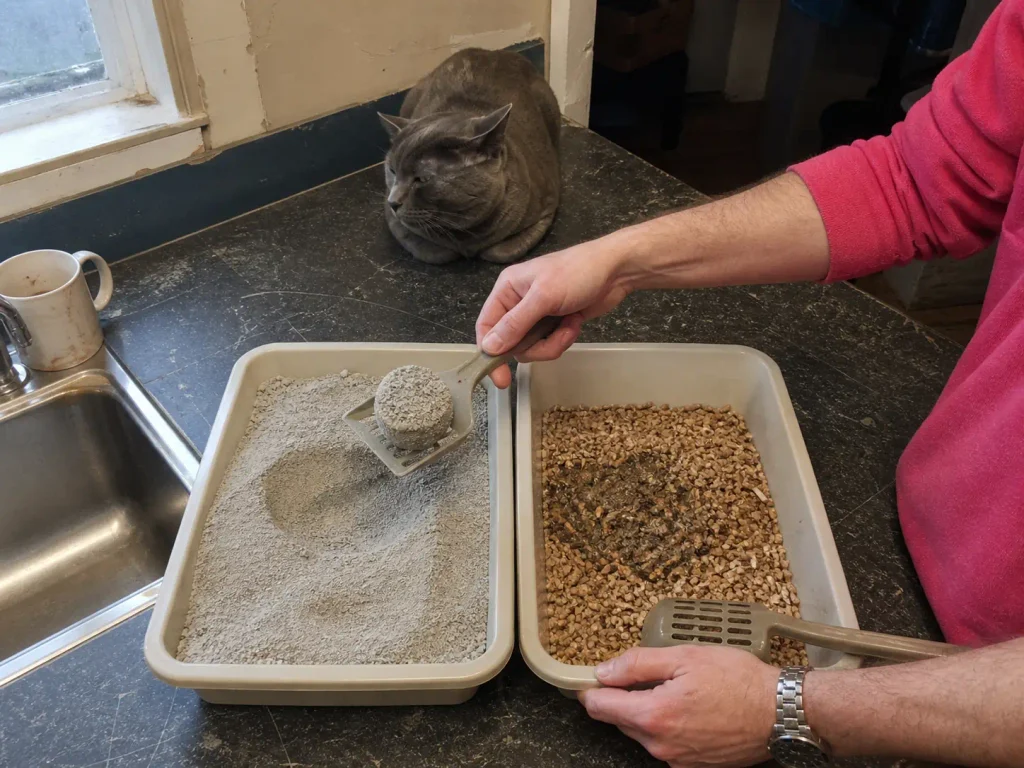
Most people think the choice is between the better litter and the cheaper one. It isn’t. One category removes the urine from your apartment every day; the other stores it in the box until you dump the whole thing. Once that sentence lands, everything else in this article is arithmetic.
What bentonite actually does when it gets wet
Sodium bentonite is a clay that expands to roughly fifteen times its dry volume the moment it touches liquid. That expansion is not a side effect of clumping litter. It is the clump: the grains around a puddle swell, lock into each other, and set into a mass solid enough to lift out in one piece. Not every clay does this, which is why “clay litter” on a bag is not the same claim as “clumping.” Everything marketed as scoopable litter is selling you that one physical trick, whether the clumping agent is clay or a plant fiber doing the same job.
The practical consequence is that clumping gives you a partial fix. You take out the part that is soiled, drop the bed back to its working depth with fresh litter, and the other ninety percent of the box carries on. The urine leaves the building in a bag today, not next week.
Why non-clumping isn’t a failed version of clumping
Non-clumping is not clumping that didn’t work. It was never trying to. It absorbs liquid and holds it distributed through the bed, which is a perfectly sound way to handle moisture right up until the bed is saturated. At that point there is nothing to scoop out, because there is no discrete thing to scoop.
This is why non-clumping has only a total fix, the dump-and-refill. You cannot spot-scoop your way back to a fresh tray. The box gets emptied, washed, and refilled, or it doesn’t get fixed.
People describe non-clumping as smelling fine for a week and then not, which sounds like the litter degrading and isn’t. It is the saturation point arriving, and it arrives on a schedule you can predict. Odor control in this category is really just the calendar.
The one difference that drives every other one
Here is the part that saves you from a lot of shopping. Clumping is not a material. It is a behavior, and materials come in both versions.
Clay clumps, and clay also comes non-clumping. Corn litter, wheat litter, tofu and grass all clump. Recycled paper litter, wood pellet litter and silica gel crystal all sit on the non-clumping side. So a bag labeled natural, or plant-based, or low-tracking tells you almost nothing about which of these two systems you are buying into.
If you want the material-by-material breakdown, the seven litter materials and who each one is for covers each one on its own terms. This article is about the fork that comes first.
And that fork is a maintenance decision, not a quality one. Non-clumping’s replacement schedule isn’t a judgment call you make by sniffing the box. It is a fixed interval, and it is short. Which brings us to the numbers.
Not sure which one is already in your box? Pour a small glass of water into one corner and come back in ten minutes. Either a solid block lifts out whole, or you find a damp patch that crumbles. That answers it faster than reading the bag, and it works on the half-empty sack with no label left on it.
One Cat, and the Math That Nobody Publishes
The kitchen-table version of this section is one sentence: with one cat on clumping litter you scoop every day and dump the box maybe twice a month, and with non-clumping you dump it every week or so with no in-between. Three of the biggest pages on this exact search say “more frequently” and stop. Here are the numbers they left out.
The clumping interval, and the daily job it depends on
Clumping, one cat, scooped daily: a full change every two to three weeks. Scoop twice a day and that stretches toward three to four. This is the interval that makes clumping feel low-effort, and it is worth being clear that you are not getting it for free. You are buying it with sixty seconds every morning.
That interval also assumes the clump comes out intact. A litter that shatters when the scoop touches it leaves half the urine behind and quietly resets your schedule, which is why hard-clumping unscented clay is the reference case for this behavior.
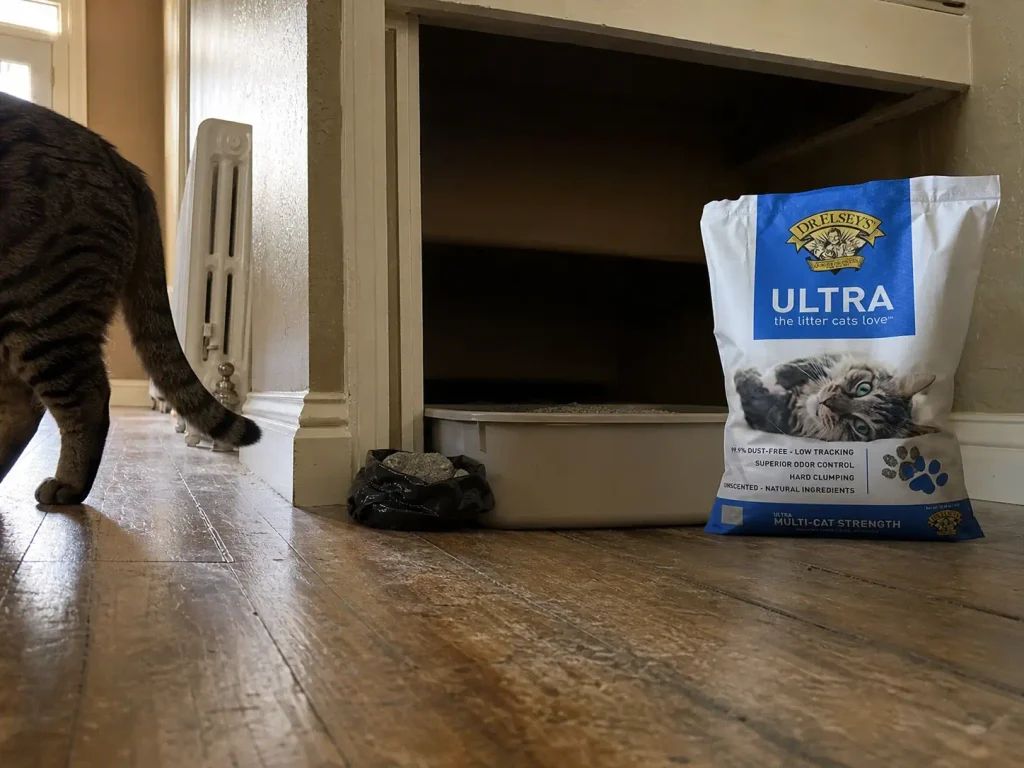
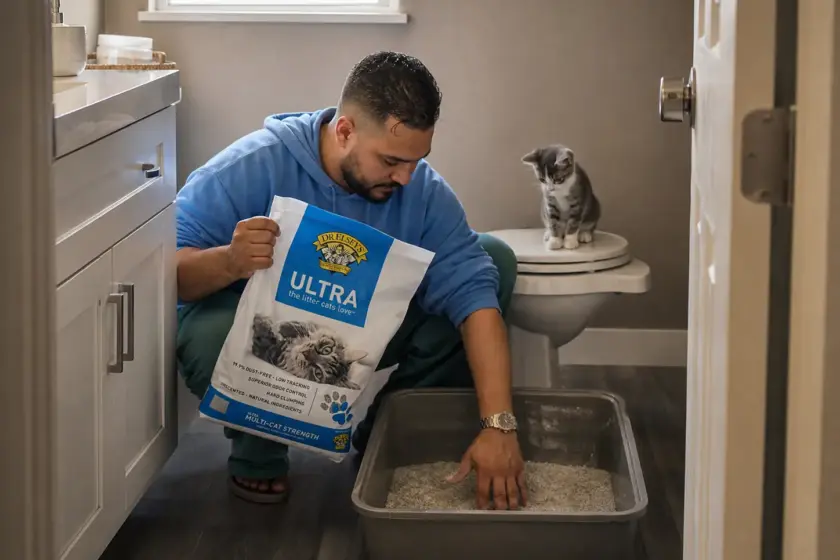
The Dr. Elsey’s Ultra Unscented Clumping Clay Cat Litter is the plain version of that: a 40 lb bag of bentonite with nothing added, which matters because added fragrance is its own rejection risk with a cat that has opinions about the box. The catch is right there in the number, though. Forty pounds is a real thing to get up a flight of stairs, and that is the trade you are making.
Skip the daily scoop for three days and the two-to-three-week figure stops being true. The box gets to the end of its life on its own schedule regardless of what the bag promised, and the smell tracks the scoop cadence more tightly than it tracks the brand. If the smell is your actual complaint rather than the shopping, what the scoop cadence does to the smell is the more useful read.
The non-clumping interval, and why there’s no partial fix
Non-clumping, one cat: a full change every seven to ten days. That number holds even with good care, because there is no mechanism for removing urine between changes. You take out the solids, you stir the bed, and then you wait for the deadline.
The daily job here is different in kind, not just in size. With clumping you are removing something and topping up; with non-clumping you are managing a countdown to the next full box change. Neither is harder in the moment. One of them just ends in a dump-and-refill four times as often.
What a full change actually costs you in a small apartment
A full change is not an abstraction. It is a bag of used litter that has to leave your apartment, and in a one-bedroom that means it sits by the door until you go out, or it goes down to the bins tonight in your pajamas. Twice a month versus four times a month is a genuinely different relationship with your own trash, and in a small place apartment odor is decided by that bag as much as by the box.
That is also where the cost argument gets murky. Non-clumping is usually cheaper per bag and you go through more of it, so the per-bag saving is not the whole story. If the friction in your week is the errand rather than the receipt, the cheaper bag can end up being the expensive one.
Two Cats Cut Every Interval Roughly in Half
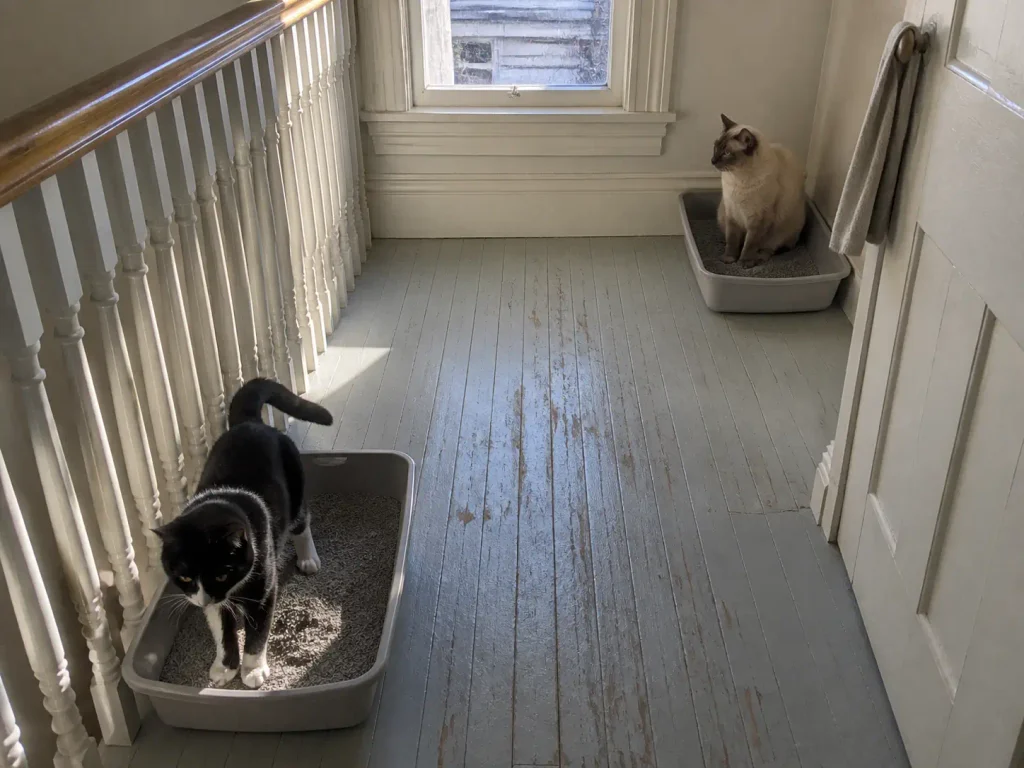
Picture reaching into the box on day four and hitting one fused block the width of the tray instead of tidy separable balls. That is the multi-cat experience of clumping litter in an under-boxed house, and it is the section most readers came for without knowing it. Two cats do not double the work. They compress the schedule until one of these two categories stops being practical.
The two-cat intervals, side by side
Clumping, multiple cats: a full change every one to two weeks. Non-clumping, multiple cats: every four to five days.
That second number is where most of these arguments end. Seven to ten days is a chore you schedule. Four days is a chore you live inside, and it comes around again before the memory of the last one has faded. For a lot of two-cat households, that single figure decides the whole question without any further debate about odor or texture or what the bag claims.
Mounding, and why it isn’t the litter’s fault
Every multi-cat household thread has the same recurring complaint, and it has its own word: mounding. In a heavily used box, fresh clumps land on top of clumps that haven’t been removed yet and fuse into one mass instead of staying separable. The scoop hits a slab. People conclude the litter is defective, buy a different brand, and get exactly the same slab three days later.
The litter is working. It is doing the one thing it does, which is to bond wet grains to the grains touching them, and in a box getting used twice as often there is simply more wet surface for a new deposit to find. That is a box-count problem wearing a litter-type costume. The cats are not being unreasonable here either, incidentally. They are using the box that exists.
Why an extra box beats a better litter
Before you buy anything, count the boxes. The 1+1 litter box rule says two cats want three, and adding one changes this arithmetic more than any brand switch will, because it halves the traffic through each tray and the clumps get room to set on their own. It costs a plastic tub and ten minutes of deciding where it goes. The box-count rule and the exception to it covers where that third box actually needs to sit, which matters more than most people expect.
Only after the box count is right does the litter question come back on the table. If you already have three boxes for two cats and the clumps are still fusing, that is a genuine litter-performance problem and worth solving with a purchase. If you have one box, the best bag of litter on the market will produce the same slab.
If your clumps are fusing into one block, count your boxes before you change brands. Two cats and one tray produce exactly that, with the best litter on the market inside it. The bag is not the variable you have been changing.
A Kitten Under Four Months Changes the Answer Completely
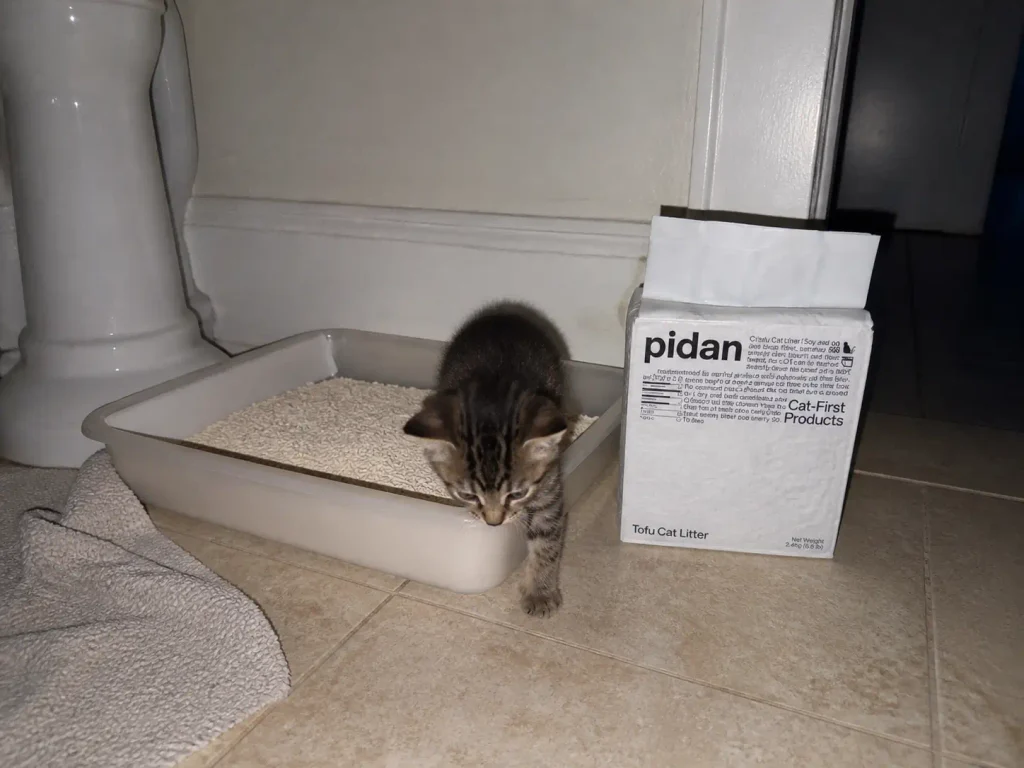
Everything above is optimization. This part isn’t. If there is a kitten under four months in the house, the category choice stops being about your morning routine and becomes a rule you follow.
The age line, and where it comes from
No clumping clay under four months. Some sources put the floor at twelve weeks, which tells you the exact edge is debated, but the existence of a real line is not. It is an age threshold, not a vague “when they’re bigger.”
The reason is the same expansion that makes the clump work in the first place. Kittens investigate the world with their mouths, a new box included, and bentonite that swells to fifteen times its volume on contact with liquid is not something you want a kitten swallowing.
Litter ingestion in a kitten is a phone call to the vet, not a thing to manage at home, and that is the entire extent of what this article will say about it. If you want the mechanism explained properly, why clumping clay specifically is a problem for kittens is the sibling that owns it. Worth saying plainly, though, because it stresses people out: a kitten mouthing at litter around a new box is described everywhere as ordinary kitten behavior.
Clumping isn’t the risk — bentonite is
Here is the correction almost nobody makes, and it costs readers a whole category they could safely be using. The problem is not clumping. The problem is bentonite. Corn, grass, wheat and tofu clump perfectly well and count as kitten-safe litter, because none of them set like cement in a gut.
So a household with a kitten does not have to give up scoopable behavior to keep that kitten safe. pidan Tofu Cat Litter is the concrete version of that sentence: a plant-based clumping litter in a 5.3 lb bag, which keeps the daily-scoop arithmetic from the last two sections intact without the bentonite. That bag size is also the honest limitation. It is small, and in a two-cat house you will be buying it often enough to notice.
If you would rather just stay non-clumping until the four-month mark and revisit it then, that is the conservative call and it is a fine one. Fresh Pellet Non-Clumping Paper Cat Litter is the standard recommendation for that window, and its 12 lb bag is genuinely easy to carry, which is not nothing when the cheap option is also the one you replace weekly. You are accepting the seven-to-ten-day full change for a few months in exchange for not having to think about it. Reasonable trade.
One thing worth naming for mixed households, because it catches people out: a kitten and an adult cat means two litter types running at once, and the kitten can reach the adult’s box. The box-count math applies per type, not per house. And if you are also weighing a box system, the same age threshold shows up in automatic boxes for reasons that have nothing to do with litter and everything to do with weight sensors.
Hard Floors, Rented Floors, and What the Deposit Has to Do With Litter
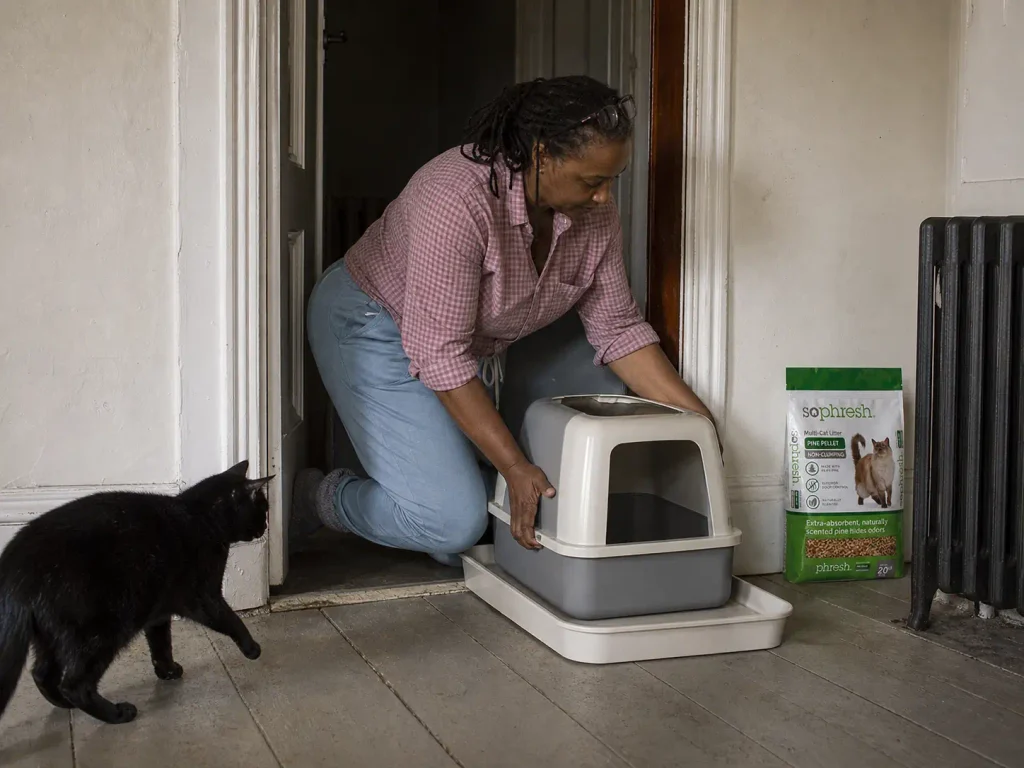
Every article on this subject treats the choice as a cleaning preference. If you rent, it isn’t. A box holding a week of urine while it sits on vinyl plank or laminate is a deposit conversation, and it is the one thing in this comparison with actual money attached to getting it wrong.
What a week of stored urine is sitting on
Non-clumping holds liquid at the bottom of the box until the full change. That is the design, and on a mat it is fine. On a hard floor it means sustained moisture in a plastic litter tray, in the same spot, for seven to ten days at a stretch. Four to five with two cats.
If the tray has a hairline crack in a corner, or the box is old and the plastic has gone chalky, that contact time is what finds it.
Clumping never builds that standing volume, because the liquid is lifted out and binned the same day. It is a small difference in mechanism and a large difference in what is sitting against your floor at 2am on day six. It is also why the smell tends to come back on a schedule rather than gradually, which is the same mechanism explored in why the smell comes back after you clean.
The tray, the mat, and the seam — the version that costs nothing
Before anyone buys a different litter for this: the box does not have to sit on the bare floor. A boot tray, a plastic under-mat, a cheap shallow storage lid, anything with a lip that catches what the box lets go. That is pocket change against a floor repair, and moving the box off a plank seam costs nothing at all.
Do that first. It is the renter-friendly move that works for both litter categories, and it means the decision goes back to being about your schedule instead of your deposit. Which is where it should be.
When non-clumping wins on weight instead
Weight cuts the other direction and it would be dishonest not to say so. Clumping clay is the heaviest thing in this whole article. Paper and pine pellets are the lightest, by a lot. If the actual friction in your life is hauling bags from a car to a third-floor walk-up, that is a real, unglamorous point for non-clumping that no comparison chart bothers to weigh.
So Phresh by Petco Pine Pellet Non-Clumping Cat Litter is the practical version: a 20 lb bag of pine litter, cheap per pound, and pellets have one structural advantage worth understanding.
Paired with a sifting box, saturated pellets break down into sawdust and fall through to the bottom tray, which hands non-clumping the partial fix it otherwise doesn’t have. The catch is that it only works with the right box, so the litter alone won’t do it. And one more correction while we’re here: crystal litter breaks the rule that non-clumping means budget-friendly litter. Silica is the splurge in the category.
Put the box where the floor is whole, not where it looks tidiest. On plank flooring, straddling a seam with a tray that holds a week of urine is the one mistake in this article that gets paid for out of the deposit.
Texture, Dust, and the Cat Who Has Already Decided
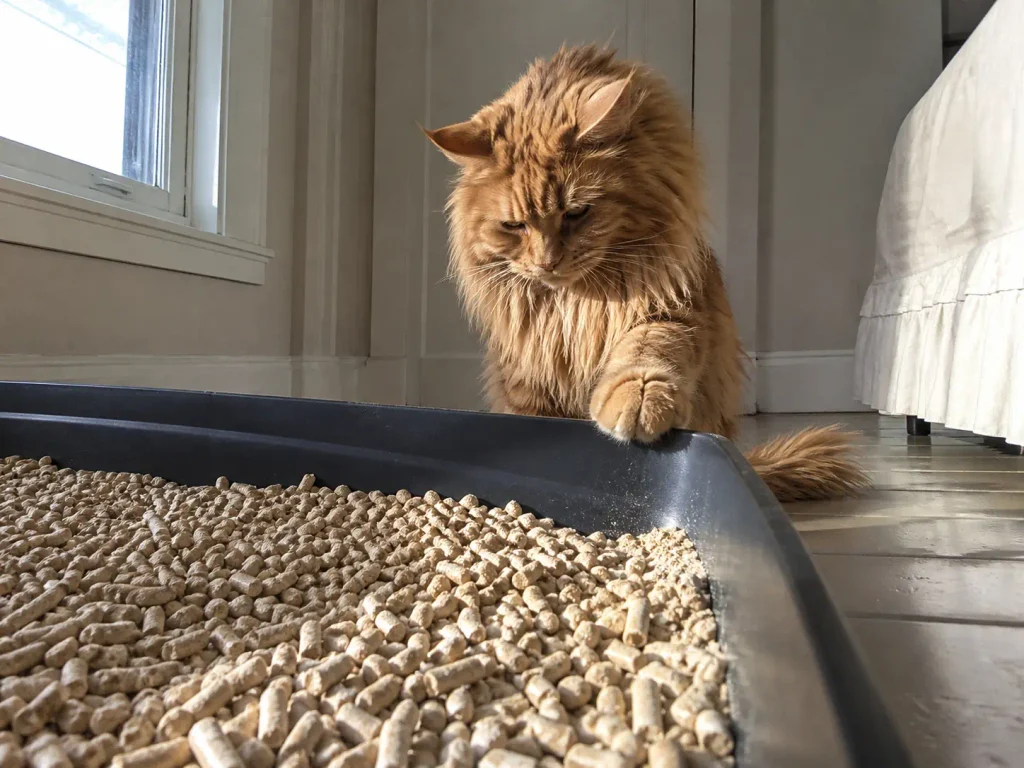
You can do all of this arithmetic, buy the correct category for your household, and have the cat refuse it. That is not the cat being difficult. He is standing barefoot on a surface several times a day and reporting back, and the report is about the surface, not about you.
What grain size and dust do to a paw
There are numbers behind this too. Dust above roughly five percent by volume acts as an irritant on paws and coat, and particles under two millimeters cause micro-abrasion between the toes while a cat digs. Then he grooms, and whatever settled in the creases of his paws goes in his mouth. That is a mechanical fact about a material, not a personality trait.
Clumping clay is generally the finer, softer surface underfoot. Pellets are large and hard, and a cat raised on one texture will often reject the other on contact, before smell has entered into it and before location matters at all.
Fine grain has a second cost, too: it is the same property that drives litter tracking across a hard floor. If dust is your specific concern and you want low-dust litter picks rather than the mechanism, the low-dust clumping picks for a multi-cat house is the sibling that ranks them.
Why the cat’s vote outranks yours here
I used to file “my cat hates the new litter” under preference, the way the big retail guides do. Enough threads describing the same abrupt, same-day rejection of a specific granule size changed my mind about that. It is too consistent and too immediate to be taste.
Look at what each party is optimizing for. You are optimizing for scooping convenience, bag weight and the walk to the trash. He is reporting on a surface he stands on with no shoes, digs in with his claws out, and then licks off his feet.
When you disagree about a litter, you are describing a preference and he is describing a constraint. A texture preference in a cat is not a whim; it is the thing that turns into litter box avoidance a month later. Preferences are negotiable. That is the whole reason his vote wins this one, and it is also why Ohio State’s guidance on litter boxes points at box conditions rather than temperament when a cat starts avoiding a box.
Reading the three-week signal
The failure mode nobody warns you about is the quiet one. A category the cat tolerates but doesn’t like rarely produces a dramatic refusal. It produces a box being used slightly less, three weeks later, while he holds it a bit longer or finds the second box more often. No confrontation, no mess, nothing to notice unless you are watching.
So watch for use, not for protest. And if the answer turns out to be that you picked the right category and the wrong texture, litter switching is a gradual litter transition done properly, not a swap done on a Tuesday. How to switch without the box getting boycotted is the sibling that owns that protocol, because doing it badly is its own separate way to lose a cat’s trust in a box.
The Decision, Compressed
Clumping removes the urine daily. Non-clumping stores it until you dump the box. Every other difference in this comparison, the cost, the smell, the weight, the labor, follows from that one sentence, and if you remember nothing else, remember that one.
Cat count is what decides it. One cat makes both categories genuinely workable, and the choice is about your temperament and your stairs. Two cats push non-clumping to a four-to-five-day full change, and that is the number where most households quietly stop arguing.
A kitten under four months rules out clumping clay, not clumping. Corn, grass, tofu and wheat keep the scoopable behavior with none of the bentonite, so nobody has to spend three months on a weekly dump-and-refill unless they want to.
Give it three weeks and check three things: whether you are still actually scooping daily, whether the box is being used as much as it was, and whether the change you made has held or quietly come undone. Three weeks is when a new human routine slips and when a cat’s tolerance stops being tolerance.
And before you buy a different bag, count your boxes and scoop every day for one week straight. If the problem was the schedule or the box count, you just saved yourself the price of forty pounds of clay and a trip up the stairs with it.
Amazon’s Audible — free for 30 days
Your cat won’t let you read. Let someone read to you.
Audible is Amazon’s audiobook library — thousands of titles, read out loud, on your phone. Free for a month, plus one audiobook to keep forever.
Frequently Asked Questions
01Do vets recommend clumping litter?
Broadly yes for adult cats: vet-recommended litter tends to be clumping, because daily removal of urine is what keeps a box usable between full changes. The exception is kittens under about four months, where clumping clay specifically is the one to avoid. Plant-based clumping litters are not part of that exception.
02Which is better, non-clumping or clumping litter?
Clumping for most adult households, and the gap widens with every extra cat. Non-clumping earns its place when bag weight is the real friction, when there is a kitten in the house, or when a sifting box makes pellets practical.
03Why would anyone use non-clumping litter?
It is lighter to carry, usually cheaper per bag, and it is the safe option for a kitten under four months. Pine and paper pellets also track far less than fine clay, which matters more on hard floors than most people expect.
04Why do shelters prefer non-clumping litter?
Shelter litter choices come from a specific combination of constraints, not a general endorsement: cost at volume, unweaned kittens who cannot be around clumping clay, and post-surgery care where fine grain is a problem. A home with two adult cats has none of those constraints.
05How often do you change non-clumping litter?
Every seven to ten days with one cat, and every four to five days with two. There is no partial version of the job, so the whole box gets emptied each time, which is the main practical difference from clumping.
Leave a comment