How to Add a New Kitten Without Crowding the Resident Cat
How to add a new kitten without crowding the resident cat: wand play, a tall gate and one-to-one time for the older cat ➜ in that order

Alfredo RamsesFounder · Updated October 31, 2026 · 16 min read

On this page7 sections
- 1A New Kitten Has No Off Switch, So the Resident Cat Needs a Gate, Not a Lesson
- 2The Kitten's Vet Visit Comes Before the First Meeting
- 3The Resident Cat Gets Your Time First, Every Day
- 4When the Resident Cat Is Elderly, Frail or Laid-Back, Weigh the Kitten Again
- 5The Kitten Runs on Its Own Clock, and Its Food Is on the Resident's Menu
- 6Resident First, the Chase on a Wand, the Doorway Measured: What to Do Tonight
- 7Frequently Asked Questions
The new kitten has been home for three days, the resident cat has hissed at the door for most of them, and the obvious next move is to ask the older cat to settle down. A hiss is a boundary being set, though, and a kitten has no off switch of its own, so it keeps coming and the resident pays for every minute of it. Bringing in a new kitten without crowding the resident means the house does the enforcing: a wand takes over the kitten’s chase, a gate and a high refuge sit between the two, the resident gets your time first, and the kitten sees a vet before any meeting. The plan bends if your resident is elderly, frail or very laid-back, or if the apartment has no second room to close a door on, and both cases get a section below.
Quick Answer
A new kitten has no off switch, so you take the job the resident’s hiss cannot do. Move the kitten’s chase to a wand, put a tall gate and a high refuge between the cats, spend your first minutes on the resident, and book the kitten’s vet visit before any meeting.
A New Kitten Has No Off Switch, So the Resident Cat Needs a Gate, Not a Lesson
By the evening of day three, the kitten may be following the resident cat around everywhere. A hiss tells a kitten nothing it has learned to read yet, so the pursuit carries on. The question here is who stops the kitten when the hiss does not, and the answer is whoever holds the door, the toy and the gate.
The Resident’s Hiss Is a Boundary, Not a Failed Introduction
Frania Shelley-Grielen of AnimalBehaviorist calls hissing “a preliminary vocal warning” and, for all the noise, more “bark than bite.” American Humane describes the first meeting the same way: “There may be some hissing or swatting, but cats often will work things out by themselves.” A hiss on day three is the resident drawing a line, and the line is reasonable.
But a hiss is the only enforcement a cat has, and it works on a cat who backs off. The kitten in these accounts does not.
Some residents want to play and roughhouse right at the carrier. If a kitten keeps coming, the resident’s choices shrink to pushing back harder or leaving the room, and neither one means the introduction failed. The pursuit is yours to handle, from your side of the door.
Which stage comes when (base camp, scent, meals, the first look) is laid out in the stage-by-stage plan for introducing cats in a small apartment, so this page stays with what a kitten changes.
Wand Play Moves the Chase Off the Resident
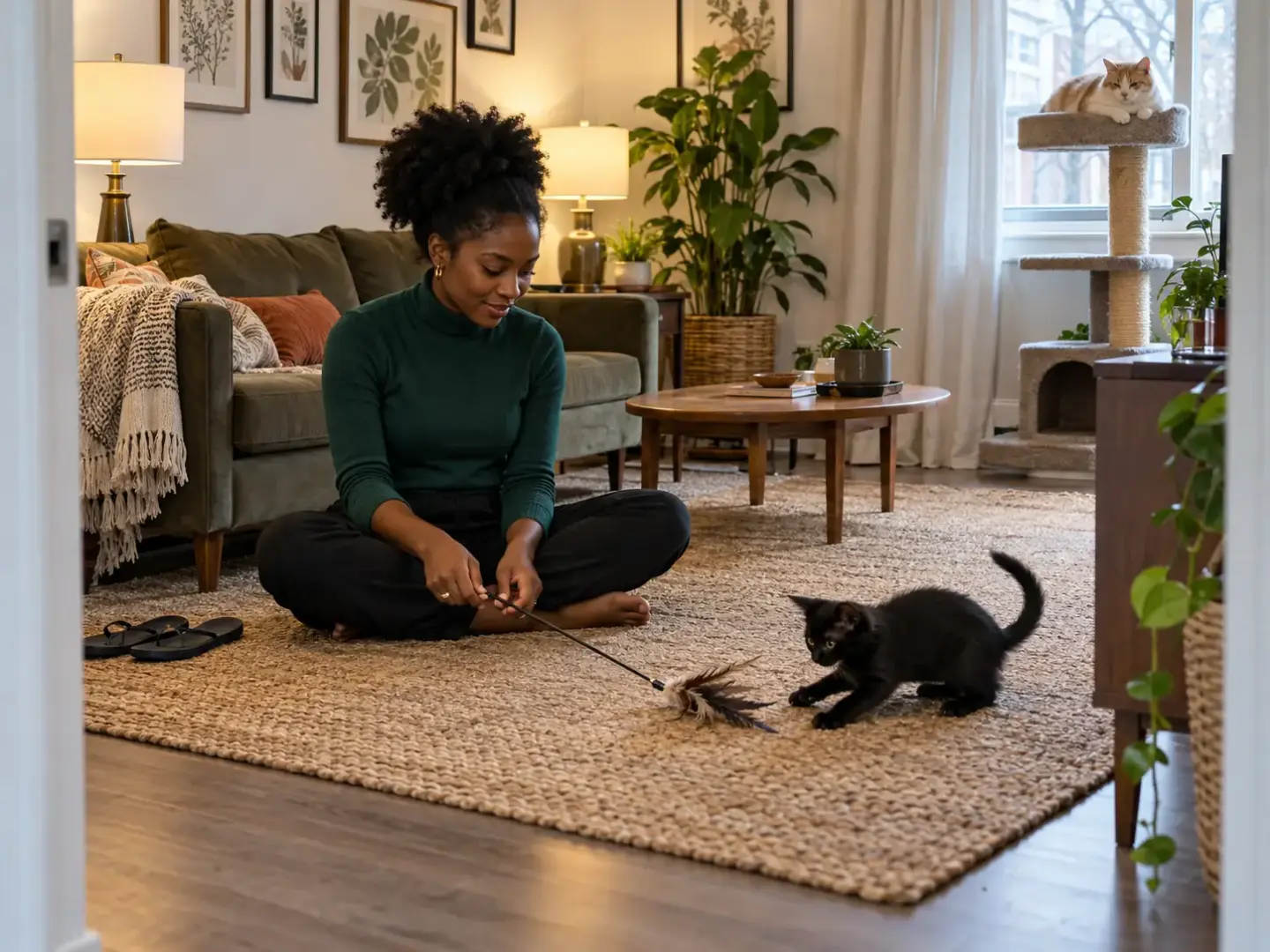
Kitten play is stalking and pouncing, a play attack on whatever moves, and the resident is the nearest thing that does. Shelley-Grielen’s advice is to engage the kitten instead by “luring fishing wand toys and objects away from or across the kitten’s line of vision.” In practice that is a feather or fishing wand, any sturdy one with a long line, worked low and away from the resident’s side of the room.
The schedule comes from the AAFP’s step-by-step introduction guide: “Cats with lots of energy can be a handful for older or more shy cats.” Its answer is two or more play sessions every day, “for at least 5 minutes each,” and toys to “channel that playful energy” so it does not land on another cat. Read that with the resident in mind. The sessions are not only for the kitten’s benefit; they are how the older cat’s day stays quiet.
Run them in the kitten’s own room before any shared time, and finish on the wand, not at the resident’s doorstep.
A Gate Measured Against the Cat, Not the Box
Start with what the apartment already has. American Humane suggests a room “that has an inch or two of space under the door,” which keeps the scent path open while the door keeps the cats apart, and a door you already own needs no purchase. The gate belongs to the later stage, when the cats see each other, or to the apartment whose kitten room has no door to shut.
The obvious barrier is a baby gate, and it fails on height. According to American Humane’s guide to introducing cats, “A baby gate is perfect, but usually not high enough for cats, so you may need to stack two on top of each other.” Stacked gates work until someone has to pass through, and then you are lifting a gate every time you cross the doorway.
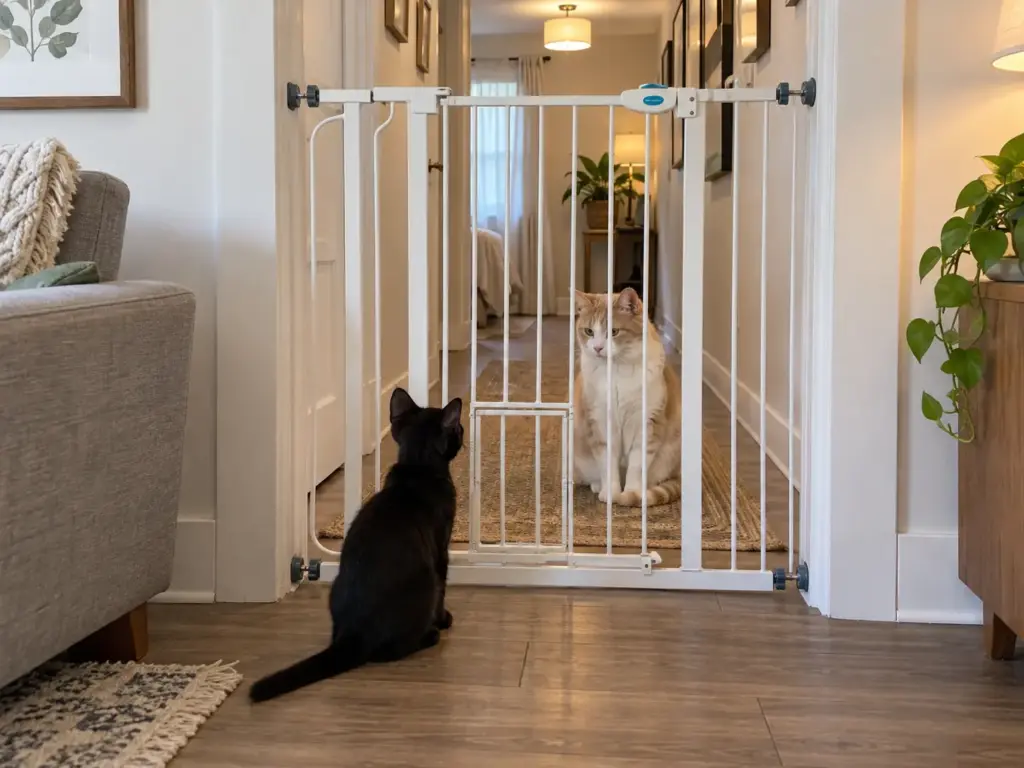
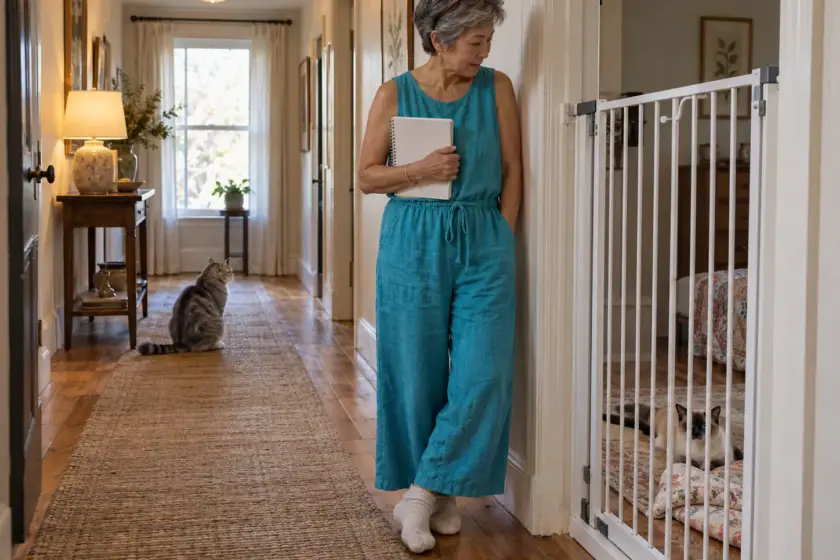
The Carlson Extra Tall Walk-Through Pet Gate with Small Pet Door stands 36 inches tall and has a pet door built in, so nobody takes the barrier down to get by. It is metal, so the cats see and smell each other through it, which puts it after scent and separate meals in the sequence rather than in place of them. The AAFP’s guide lists an “extra tall cat gate (door-sized pet gate)” among the see-through barriers for that same stage.
Check the fit before the height. The openings run 29 to 31 inches without the extension and 34 to 36.5 inches with it, so a doorway that measures between 31 and 34 inches fits neither.
Stand in the doorway with your hand held at the height of the resident’s reach, then look at where a kitten’s paw could get over the top of a gate or under the bottom of one. That takes a minute and settles the question before anything is ordered.
There is a free barrier too. One owner taped a clear plastic garbage bag to the outside of the door as a see-through barrier and said it worked wonders. If you try it, tape it flat so that nothing hangs loose within a cat’s reach.
A Refuge the Kitten Cannot Reach
A gate holds the kitten. It does nothing for a resident who wants a retreat somewhere the kitten cannot follow. In the studio-apartment account, the resident “goes on her high perch and just watches the kitten,” which is a cat using a refuge it already had. In the shotgun house, another owner had no doors on the bedroom at all, so there was no room to close and no second space to give.
The check costs a walk through your own place. Stand where the kitten can climb, then look for the route the resident has to somewhere the kitten cannot get to. If you cannot find one, that is the first thing to build, ahead of the gate. The route is what you are checking.
Each tool in this section serves a different cat. The wand is for the kitten, the perch is for the resident, and the gate is for both. This is not the setup for two adults, who need the same things. Here the kitten needs an outlet and the resident needs an exit.
The Kitten’s Vet Visit Comes Before the First Meeting
You want the kitten out of the carrier and into the apartment today, and a vet appointment looks like a delay. It is the opposite: the kitten vet visit goes ahead of every meeting, and it is booked before the kitten arrives so the introduction does not wait behind it.
Book It for the Day the Kitten Comes Home
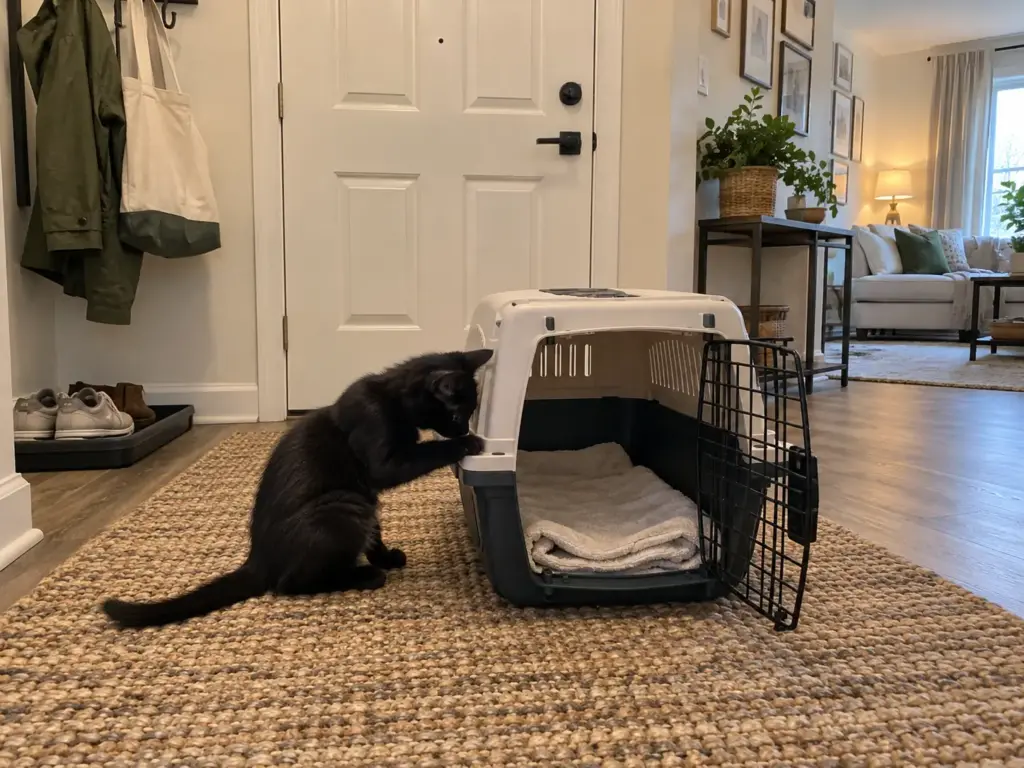
1st Pet, a veterinary practice, puts the timing plainly: “If possible, schedule your kitten’s first visit to the vet on the same day you plan to bring the animal home.” Book the slot ahead and give the clinic your date. A slot three weeks out is three weeks of base camp. Whether the introduction can begin before vaccinations is a question for the vet, and the answer comes from the clinic.
When you call, ask whether the clinic can see the kitten on the day it arrives, and book the resident’s check-up in the same call if it is overdue.
The Resident Gets a Check-Up Too
The visit list has a second name on it. The AAFP’s step-by-step introduction guide says that before any introduction “all the cats should have had a recent veterinary check-up and be in good health,” and that the new cat “should be tested by your veterinarian for common contagious diseases.” What gets tested and when is the vet’s call, and the sentence ends there.
For the resident, the check-up is also where the question of fit gets asked out loud. The same guide says “Do not consider adopting another cat if you have a resident cat who is in poor health or is a senior with medical concerns,” which is where the section on older residents below picks up.
What Ends the Attempt and Goes to the Vet
These stop signs pause the introduction and go to the vet, not to the plan: either cat not eating or drinking, avoiding the litter box, urinating outside it, any wound, or vocalizing that does not stop. When to call the vet is when one of them shows up, not after a few more days of the same routine. 1st Pet’s own list of distress signs is inappropriate urination, excessive vocalization and abnormal grooming, and its instruction is the one this blog shares: “If one or both cats begin to show extreme signs of distress, see a veterinarian.”
What those signs mean is the vet’s question, so the list stops at the list. The stage-by-stage plan carries the same stop rule; this is the kitten’s side of it.
The Resident Cat Gets Your Time First, Every Day
Some people add a kitten because the resident seems bored, or because it has started sleeping all day, and both reasons come from kindness. The arrival still cost the resident something, because the kitten now gets the lap, the talk and the play that used to be the older cat’s alone, and the resident’s day gets smaller.
Greet the Resident Before the Kitten
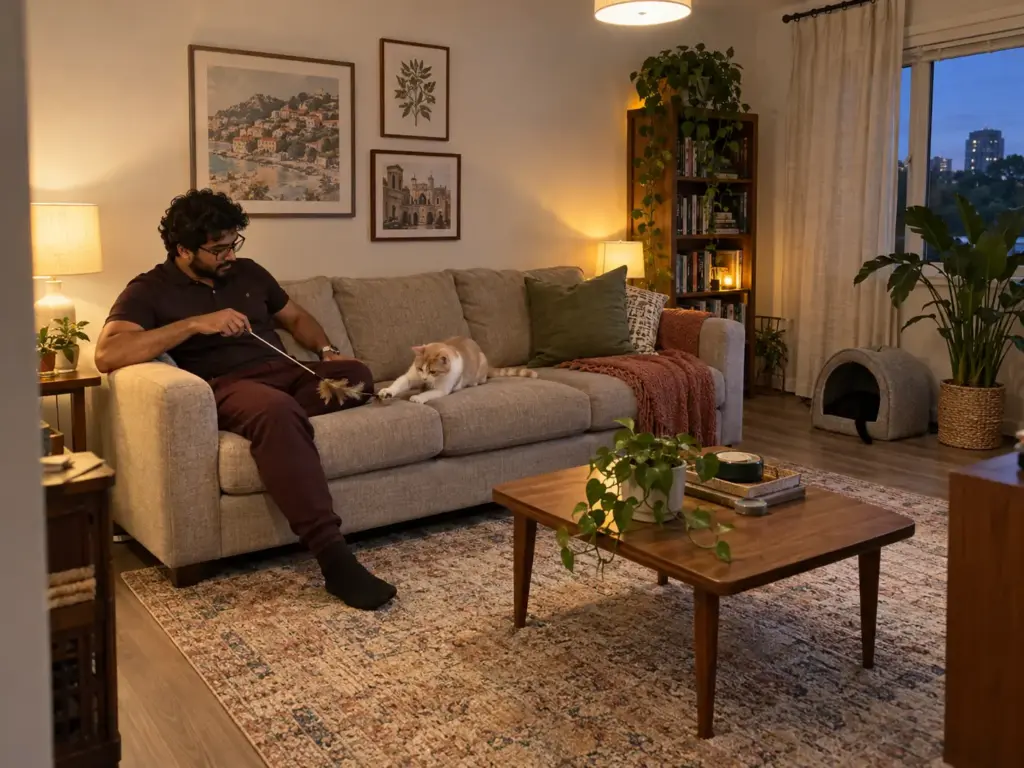
Shelley-Grielen puts attention in the same category as furniture: “Your affection, attention and engagement are just as much of a resource as raised resting places.” If it is a resource, it can run short, and it runs short at the door. Coming in with the carrier, greet the resident first, then go to the kitten’s room. Keep that order every time the door cycles, so the sound of the kitten’s room opening follows something good for the resident and does not replace it.
For the first week, keep the resident’s favorite treat in your pocket and hand it over before you open the kitten’s door. The door opening then predicts something good for the resident.
One-to-One Time the Resident Can Count On
The AAFP lists “regular, positive, and predictable caregiver-cat social interactions” among the five things every cat needs from its home. Predictable is the word to build on: a resident who knows its slot is coming can sit out a kitten’s afternoon. Put the resident’s one-to-one time before the kitten’s, at the same hour each day, with the kitten’s slot after it, in the kitten’s own room until the pair are meeting.
A person who works from home may aim for equal time with everyone, which is a fair target for someone who is in the apartment all day. But equal is where you end up. For the first weeks the order matters more than the split, because the resident is the one whose day just changed.
How long the resident’s patience lasts is set by its own pace, and how long each introduction step takes depends on what the cats show you rather than on a date you picked.
One Cat’s Routine Is Not the Other’s
With two adults you run one household routine. With a kitten and a resident you run two, and the second is not the first with a smaller cat. The resident in the boredom account played “for maybe 10-15 minutes each day and then got bored of us and would walk away.” Kittens, by Shelley-Grielen’s description, “typically have a longer appetite” for play.
Put the two side by side and the schedule writes itself: short and early for the resident, long and tiring for the kitten, each in its own slot. If the resident goes off its food or stops using its box, that belongs to the vet list in the section above, not to the schedule.
When the Resident Cat Is Elderly, Frail or Laid-Back, Weigh the Kitten Again
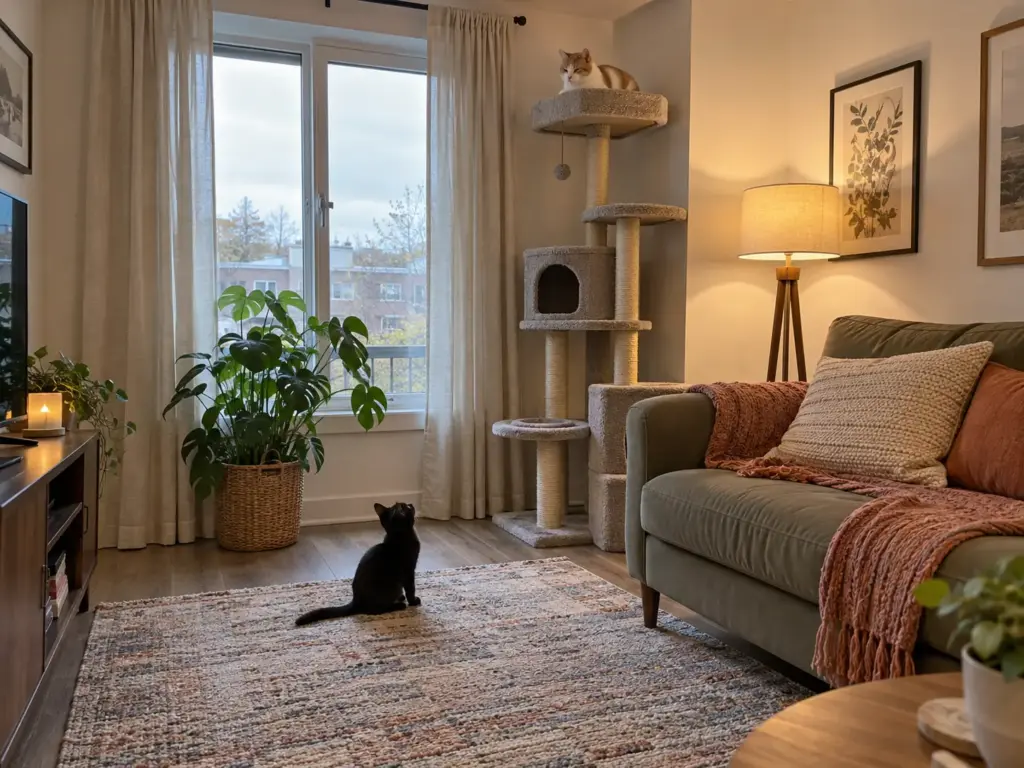
Some residents sleep most of the day, and a kitten is a poor fit for a laid-back cat like that. Everything above assumes a resident who can absorb a kitten’s energy. This section is for the one who cannot, and for the owner deciding whether the plan or the match is the problem.
What Age and Temperament Change
American Humane is blunt about the match. With a very laid-back, elderly or frail cat at home, “it is best to avoid kittens and very playful or rambunctious cats.” The AAFP comes at it from the medical side: “Do not consider adopting another cat if you have a resident cat who is in poor health or is a senior with medical concerns.” Whether your resident counts is a conversation for you and your vet before the kitten comes home, and if the kitten is already there, that conversation moves to this week.
Day one still gives you something you can see without any medical knowledge: where the resident goes when the kitten is on the other side of the gate, and whether it is back in its usual spots by evening.
Several days of growling through the door point to a mismatch. American Humane says it this way: “If the problems continue for several days, it is likely the match is not going to work out.” That sentence gives no number of days, and no number is invented here. Pace is the more useful measure.
The AAFP says “Do not move to the next step until each cat is comfortable with the current step,” and that the whole process “can take anywhere from a few days to a few months, and sometimes longer.” The resident’s comfort sets the date.
The Resident’s Route to Somewhere Else
The usual advice is a second room. In a house with a spare room, the refuge is a room. In a small apartment, or any home with one room to share, it is a route: the line of furniture a resident can take from the floor to somewhere the kitten cannot get to.
The studio resident on her high perch had one. The shotgun-house owner, with no doors to close, had none, and kept the kitten in the kitchen, a room the resident does not use.
One studio owner kept the kitten in the bathroom for 4 to 5 hours overnight. That is one arrangement in one apartment, and no one-room solution is promised here. A route a senior cat cannot climb is not a route, so run the check from the first section with the resident’s age in mind: could this cat get up there on its worst day, or does the route need a middle step?
The Kitten Runs on Its Own Clock, and Its Food Is on the Resident’s Menu
It is 11 p.m. The kitten is at full speed, the resident is trying to sleep, and the next two hours depend on how the kitten’s evening was spent. The kitten’s day, its play and its bowl, runs on a different schedule from the resident’s, and the bowl is the first place the two collide.
Tire the Kitten Before Shared Time
A play session before turning out the light leaves the kitten spent by the time the resident wants the apartment quiet.
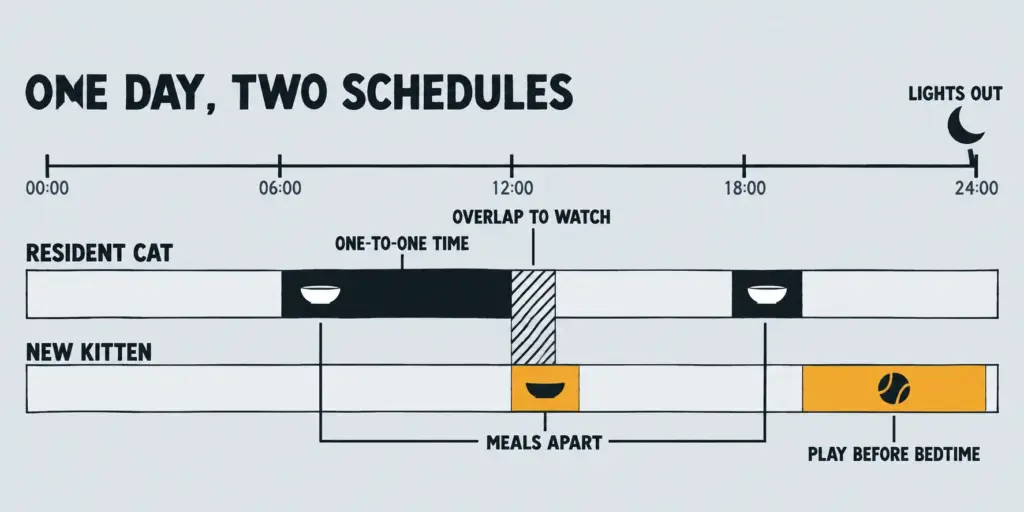
That evening session is the last of the day’s two or more, and it decides the resident’s night. Run it as the wand taking the kitten through the whole chase, and end it at the kitten’s door, not the resident’s. Then the resident’s evening starts with a kitten that has nothing left to bring to it.
The Kitten’s Bowl Is Not a Buffet
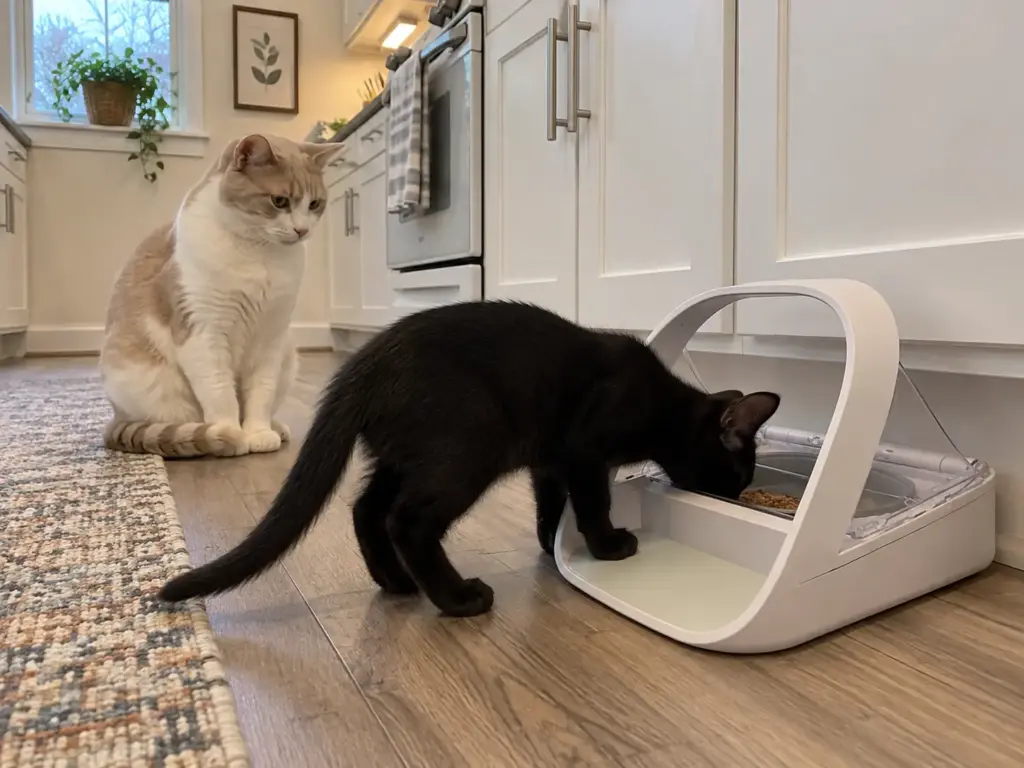
Kitten food is the first thing the resident will take. One owner’s tip was a single line: “cover kittens food as res cat will eat it when kitten isn’t looking.” The free version is separate food bowls in separate places: feed the kitten in its own room and the resident first, in its own spot, until the cats share space.
Once they do, the arrangement that does not depend on you being in the room is the Sure Petcare SureFeed Microchip Pet Feeder Connect, which opens only for the microchip or RFID tag it is paired with, so the kitten’s bowl stays shut to the resident. That requirement is the condition: the kitten has to carry a microchip or an RFID tag the feeder can read. No measurement for the unit is on hand and no repeated complaint came up, so hold the listing’s dimensions against the spot on your floor before ordering. Whether the two cats can share bowls at all gets its own answer in the piece on whether cats share food bowls.
Put the kitten’s bowl in the kitten’s room until a feeder is in place, and feed the resident first, in its own spot.
One of Each, Plus One
The AAFP names the most common source of friction between cats: “Not having sufficient, visually separated resources is the most common cause of tension between cats.” Its count is “one of each resource per cat, plus one extra,” spread through the home so no corner gets congested. For a resident and a kitten, that is three of everything: litter boxes, water bowls, food bowls, beds, scratching posts. (In a small apartment, three litter boxes is the number that makes people wince, and how many litter boxes two cats need walks through where they go.)
The kitten’s litter is its own question, answered in the piece on clumping litter and kittens.
Resident First, the Chase on a Wand, the Doorway Measured: What to Do Tonight
Three things carry the rest. The kitten has no off switch, so the house takes the job the resident’s hiss cannot do: the wand, the gate and the high route. The kitten’s vet visit and the resident’s check-up come before any meeting. And the resident’s time comes first in the day, at the same hour, for as long as the introduction runs.
Three weeks in, look at two things: whether the resident’s slot has survived a busy week, and whether the kitten’s chase still ends on the wand and not on the resident. A cat accepts or rejects a change within days, but a routine you set up for it tends to slip around the third week, so that is when it shows.
Today, spend nothing. Pencil the resident’s one-to-one slot into tomorrow ahead of the kitten’s, put the wand where your hand reaches it first, and measure the width of the doorway you would gate, then write the number on the door frame.
Frequently Asked Questions
01How long does it take a resident cat to adjust to a new kitten?
The AAFP says the process can take ‘anywhere from a few days to a few months, and sometimes longer,’ and the resident sets the pace, not the calendar. Move on only when each cat is comfortable with the current step. How long each step takes is covered separately.
02How long will a resident cat hiss at a new kitten?
There is no general number. American Humane calls some hissing or swatting at a first meeting expected, and one owner’s hissing eased by day 5, but that is a single case. Hissing through the door for several days points to a mismatch. A cat that stops eating, or any injury, goes to the vet.
03What happens if you introduce a new kitten to a resident cat too soon?
Rushing risks tension that lasts: the AAFP warns that moving ahead before each cat is comfortable ‘can result in long-term tension between the cats.’ Go one step back instead of correcting either cat. Introducing cats right away covers what skipping steps looks like.
04Can a new kitten live with an older resident cat?
Sometimes, but the match decides it. American Humane says to avoid kittens with a very laid-back, elderly or frail resident, and the AAFP says a resident with medical concerns is a reason to talk to your vet first. Ask the vet before the kitten comes home.
05Should the kitten see the vet before it meets the resident?
Yes, ideally on the day it arrives, and the AAFP wants every cat in the home to have had a recent check-up. Timing around vaccinations is a question for the vet, and the answer comes from the clinic.
Leave a comment