Cat Hair on Hardwood vs Carpet, and Which One Hides It
Don't judge cat hair on hardwood vs carpet by what you see: hardwood shows the hair you missed, carpet keeps it (+ the free fix for the strip between)

Alfredo RamsesFounder · Updated October 30, 2026 · 13 min read
On this page7 sections
- 1Hardwood vs Carpet for Cat Hair, and Which Floor Shows What You Missed
- 2A Cat Picks Where to Lie by Warmth and by How the Surface Feels
- 3What Carpet Keeps After the Vacuum Has Gone Over It
- 4Claws and Footing: What Each Floor Asks of the Cat
- 5Check the Strip Where Hardwood Meets Carpet
- 6Start Where He Lies, and Look Again in Three Weeks
- 7Frequently Asked Questions
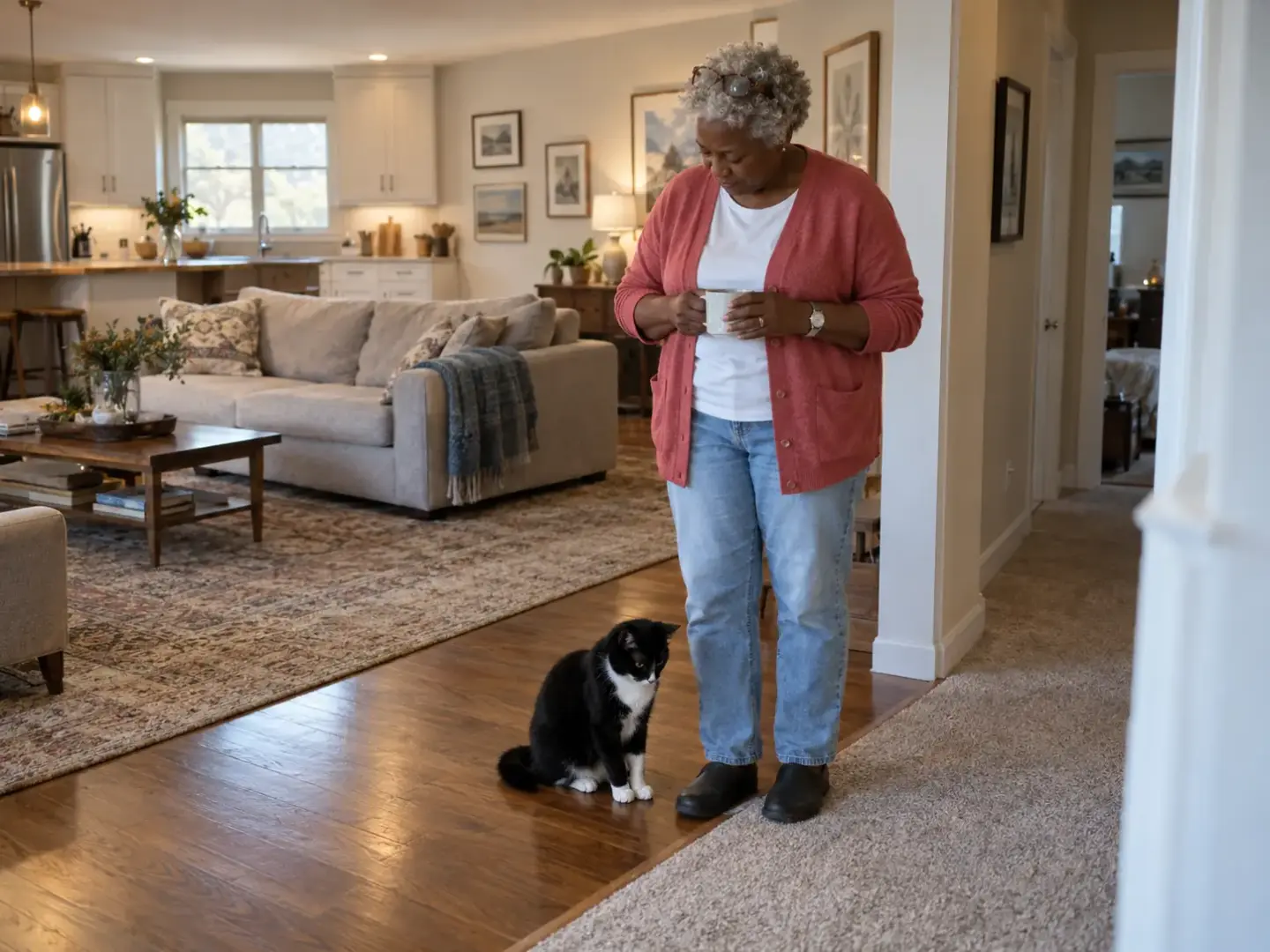
You vacuumed the living room carpet yesterday, and this morning there is a gray tuft sitting on the hallway boards while the carpet looks fine. If you are weighing cat hair on hardwood vs carpet, that tuft is not proof that hardwood is the dirtier floor; it only means hardwood is the floor that tells you. The cat decides how much hair lands, by choosing where to lie down, and the surface decides whether you get to see what he left. Below: which floor shows the hair, which one keeps it, why your cat picks the spot he does, and the strip where the two floors meet.
Same cat, same hair: what changes is whether the floor shows it or keeps it.
| What you are judging | Hardwood | Carpet |
|---|---|---|
| The hair you see | Sits on top, in plain sight | Looks tidy after a pass |
| Where it hides | Along baseboards and around furniture legs, where drafts push it | Down in the pile, under the surface you see |
| What stays after a pass | Loose hair on the surface, which a roller or a damp mop lifts | Hair, litter grit and smell, down in the fibers |
| Claws | Marks in the finish | Pulls and snags in the pile |
| What a renter can change | A large flat-weave rug on top | Very little; the carpet stays the landlord’s |
Hardwood vs Carpet for Cat Hair, and Which Floor Shows What You Missed
Which machine to buy is a separate question, and the reason vacuuming cat hair fails in three places has its own answer. Here the question is the floor underneath it. The verdict in one line: hardwood hands back the hair you missed, and carpet keeps the hair you cannot see. Neither floor is cleaner than the other, and only one of them is willing to tell you.
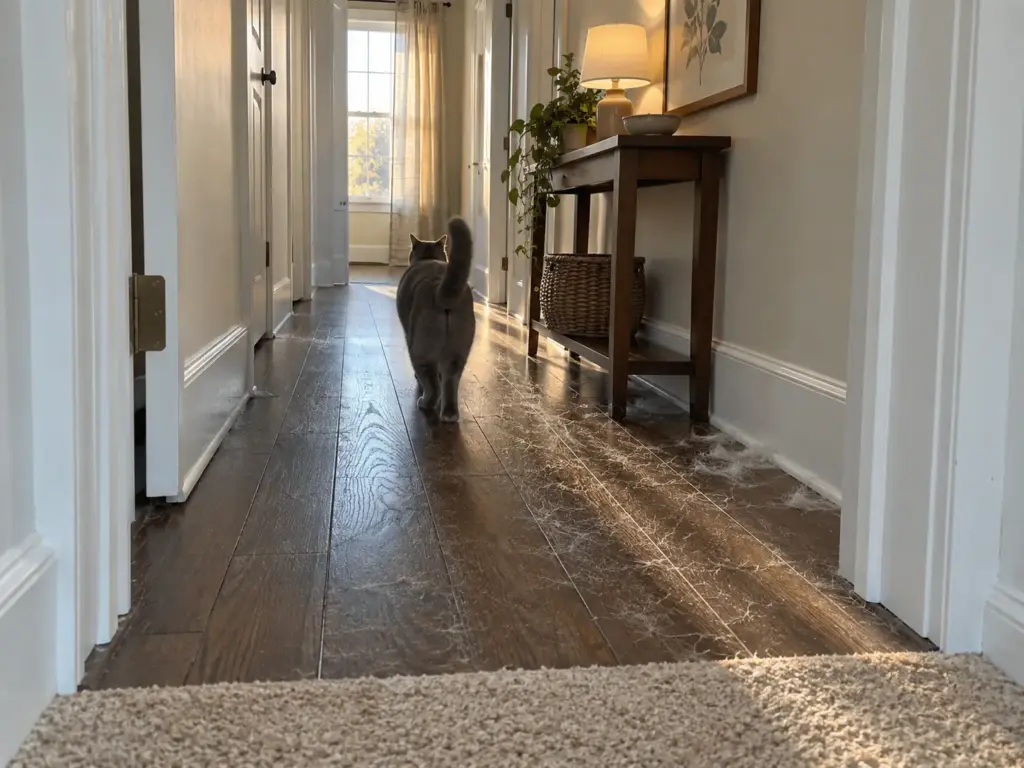
Start from where the hair sits. On hardwood it sits on top. On carpet it works down.
On hardwood the hair rides on the surface
Hair on a hard floor has nowhere to sink, so it travels. A draft down the hallway pushes it along, the cat’s own feet scuff it into drifts, and you end up with clumps against the baseboards and around table legs (the ones people call fur tumbleweeds). You see every one of them, which is annoying and also the useful part.
Sweeping lifts some of it and shoves the rest ahead of the broom. The order of tools that stops that from happening is laid out in how to clear cat hair around the house without moving it, so it is not repeated here. What matters for the floor decision is simpler: on boards, a missed pass shows by the next morning, and a roller or a damp mop picks the hair up off the surface instead of out of a weave.
Crouch at the end of the hallway when the sun comes in low through a window and look along the boards. Hair that stands proud of the finish shows up in side light, and what you can see from there is exactly what your last pass left behind.
On carpet the hair works down into the fibers
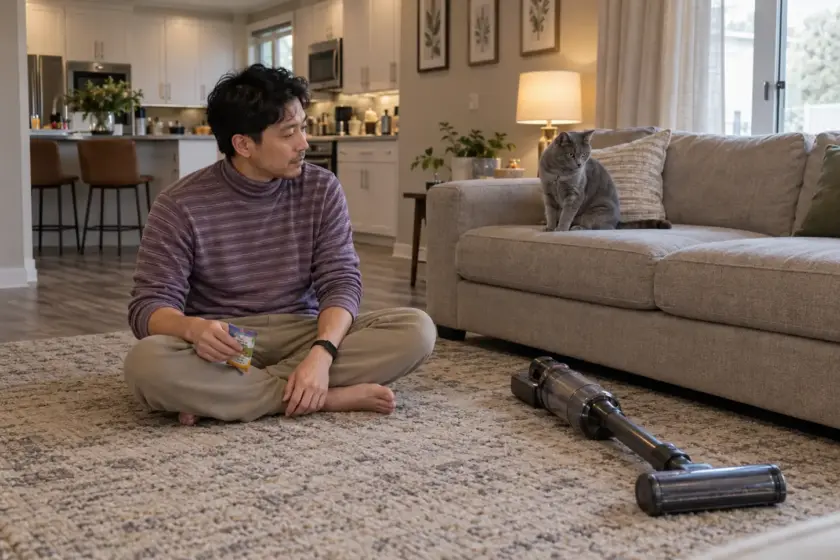
Carpet does the opposite. Cat hair in carpet settles into the pile and gets walked in, and the surface looks clean because the surface is clean. The hair is a layer under it, and hair in carpet fibers only gives itself away when you kneel down to the cat’s level or drag a damp palm across the pile and your hand comes away furred.
That palm test is worth doing once, in the room where he sleeps. It turns “the carpet looks fine” into something you can check.
None of this makes carpet the worse floor. If seeing hair bothers you, carpet is the kinder floor to look at. If you want the hair out of the house, hardwood is the one that lets you, and the usual answer (“hardwood, it’s easier to clean”) only holds for the second person.
One cat or two: how fast the floor shows it
With one cat, carpet can go a while before it gives itself away, and hardwood looks tidy for a good while too. With two cats, hair lands in more places at once, and the boards show it fast while the carpet starts filling underneath. A second cat does not double the hair on your floors, but it does shorten the time before you notice, and that is what changes how often you clean.
If the choice of floor is yours, carpet vs hardwood for cats comes down to one question: would you rather see the hair or not see it? If the floor isn’t yours to choose, the rest of this guide is about the floor you have.
A Cat Picks Where to Lie by Warmth and by How the Surface Feels
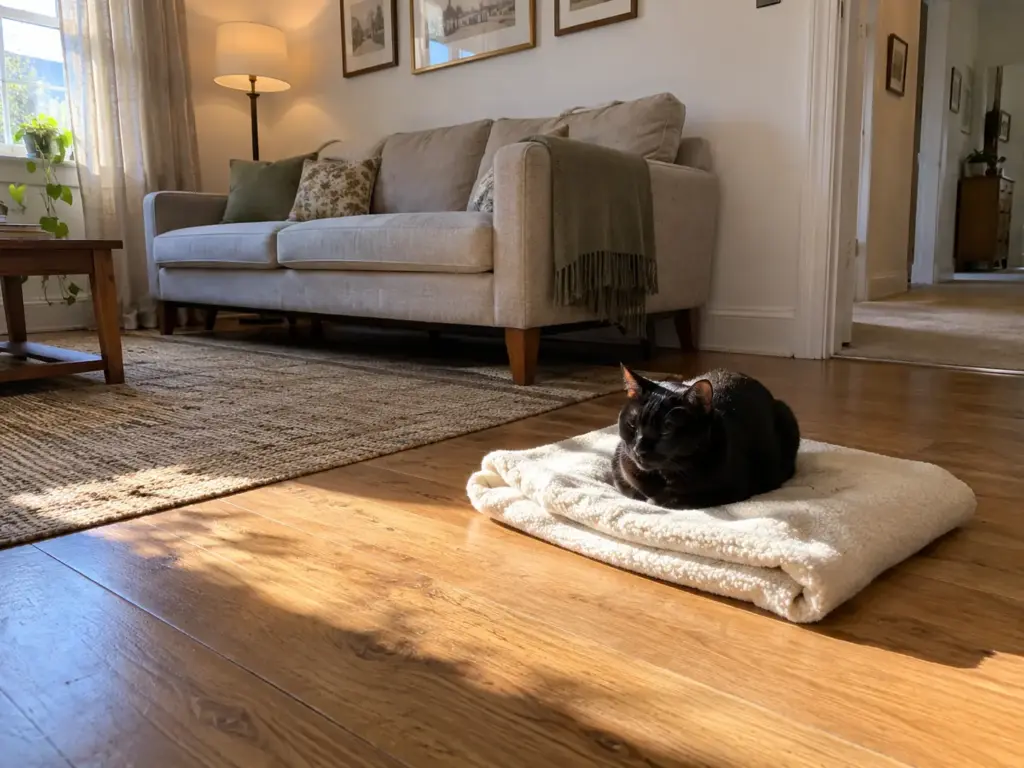
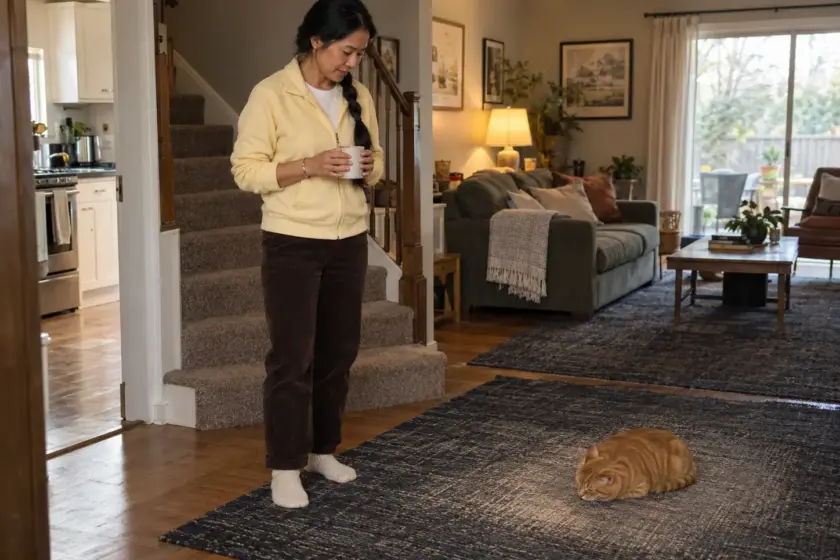
A cat that skips the rug you chose and flops on bare boards has made a decision, and it follows two things: how warm the spot is and how the surface feels under him. The rug may simply lose on both. That matters for hair, because the hair ends up wherever he does.
What the 1999 housing review found
According to a 1999 review of cat housing published in the Journal of Feline Medicine and Surgery, “Tests indicate that cats prefer polyester fleece to cotton-looped towel, woven rush-matting and corrugated cardboard for lying on.” Fleece against cardboard is not carpet against boards, so do not read it as a ruling on your living room. What it does show is that cats sort surfaces by feel, not only by temperature.
The same review cites a shelter test (Roy, 1992) in which cats chose wood over plastic, and also liked materials that hold a steady temperature, such as straw, hay, wood shavings and fabric. Shelter pens are not apartments, and again nobody compared hardwood with carpet. But the two results point the same way: warmth and feel both count.
Many cats lounge wherever they like, and some move from the tile in summer to the rugs in winter. Treat that as a pattern, not a result. It fits the review, though.
Why the sun patch beats the floor you chose
A bar of sun across the floor warms whatever is under it, so a stretch of cold hardwood in direct sun can beat a rug in shade. And in summer it reverses: the boards he ignored in January become the cool spot he picks, and where the cool spot moves in summer follows that move through the house.
The instinct is to put his bed on whichever floor is easier to clean and expect him to take the hint. It fails, because you moved the surface and left the warmth behind. Put the soft thing where the warm spot already is.
Where the hair goes after that
The hair stays where the cat stays. The sun patch, the doorway and the spot at the foot of the sofa collect most of it, and the rest of the room gets a thin scatter. Cleaning every square foot with the same effort each time spends effort where there is little to find, so give the spots where he lies the full pass and the rest a lighter one.
Start free: for a few days, just watch where he settles and make a mental map. You will probably find two or three spots, not twelve.
If his favorite spot is bare hard floor, lay a fleece or similar soft blanket right there instead of trying to move him to a new place. He gets the feel the review points to, and the hair collects on something you can shake out.
What Carpet Keeps After the Vacuum Has Gone Over It
Running the machine over carpet and calling it clean treats two jobs as one. The machine takes what it can reach, and everything the cat leaves behind keeps working its way down. Carpet is where “I vacuumed” and “it’s clean” stop meaning the same thing.
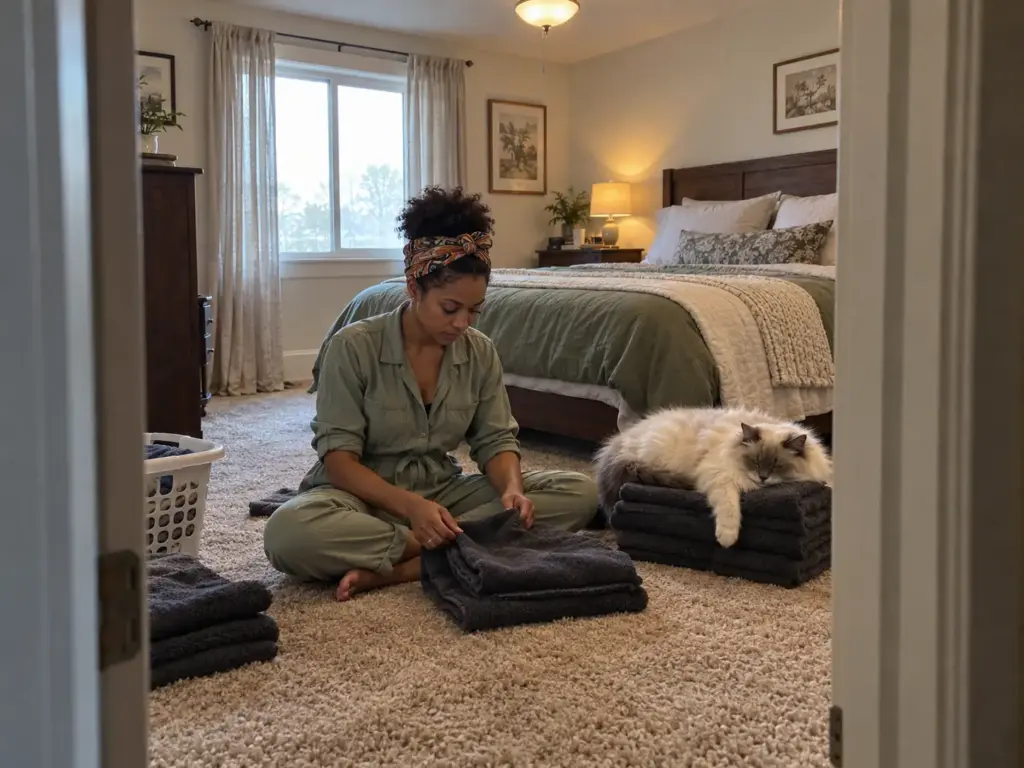
The hair, the litter and the smell in the pile
Hair is not the only thing that rides in on his paws. Litter grit comes out of the box, lands in the fibers, gets stepped on, and pushes deeper with every pair of feet. If grit is reaching the carpet, where litter tracking starts is the place to look: at the box exit, before it gets underfoot.
Smell works the same way. What drops onto a wiped board gets wiped; what drops into a pile settles into a layer you cannot reach with a cloth, so carpet near the box or a favorite napping spot holds on to it longer. A low pile gives hair and grit less room to hide than a long one, but either way they end up in the same layer.
The free fix goes first: pick up the visible grit and tufts before the first pair of feet crosses them. Once they are pressed in, you are chasing them. Before they are, you are just tidying.
A spill on carpet versus a spill on boards
Take a tipped water bowl, or any other mess on the floor. On boards, a cloth ends it in a minute. On carpet it soaks in, and you are blotting a layer you cannot see, which means more passes and a longer wait before the spot is dry.
If the mess is vomit, or accidents that keep repeating, how often it happens is a question for your vet. The floor only answers the cleanup, and that depends on what is underfoot.
Claws and Footing: What Each Floor Asks of the Cat
The usual fear runs two ways: he will wreck the boards, or he will snag on the carpet. Both can happen, and neither is the cat’s fault. A cat sharpening his claws is using what is under his feet.
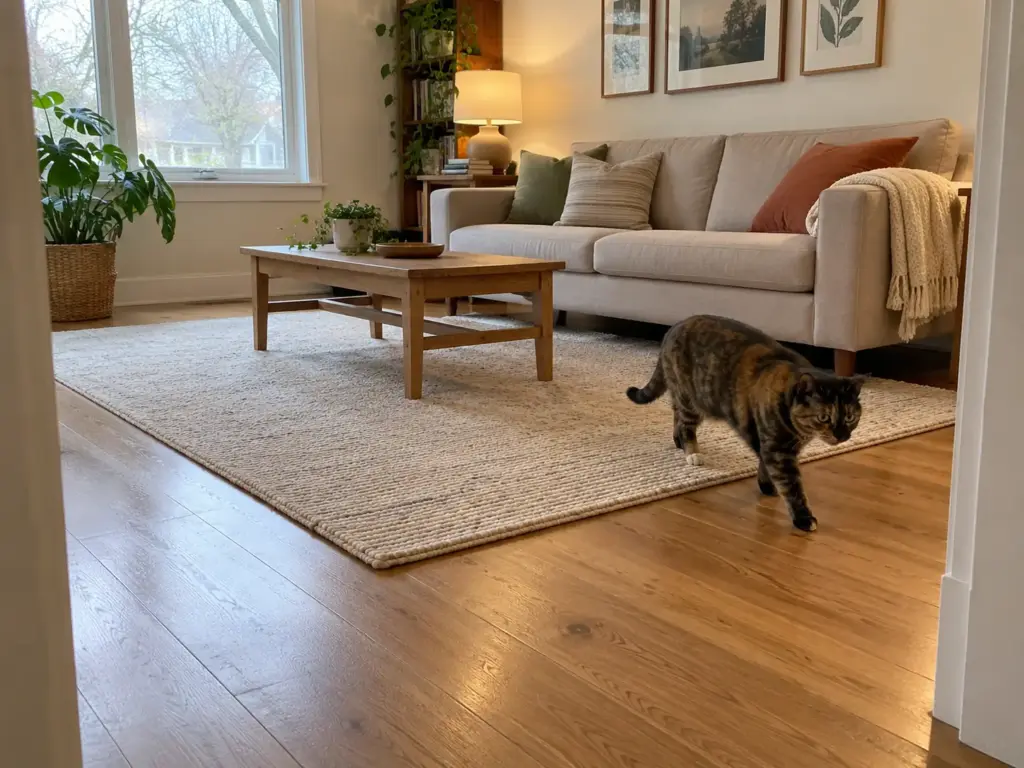
Both floors take the claws
The same 1999 review lists carpet and wood among the surfaces cats scratch, so claws are not hardwood’s problem alone. On boards the marks are in the finish; when a cat scratches carpet, they show up as pulled threads and snags in the pile. Whichever you have, the cat will use it.
That is an argument for giving him something better to scratch than the floor, but the post and its placement are a different article.
A rug on hardwood: the renter’s version of choosing a floor
A rented apartment floor belongs to someone else, which is the premise behind living with cat shedding in a rented apartment: you work on the surface, not the structure. A large area rug protects boards you cannot change, and it needs no drill and no permission. Pick a flat weave, which gives hair less to burrow into than a deep pile, and make it big enough that his usual lying spot sits fully on it.
Luxury vinyl plank, tile or low pile carpet are the in-between floors, and which one is installed is the landlord’s decision.
Put a non-slip underlay beneath a rug on boards, and place it where he lands and lies, not where the room looks balanced. A rug that skids is worse than bare floor, and a rug he never touches is only decoration.
The line where footing becomes a vet question
If your cat slips on the boards, limps, or can no longer get up onto things he used to reach, tell your vet before you change anything about the floor. A rug will not answer that question. Once he has been checked, everything above applies as written.
Check the Strip Where Hardwood Meets Carpet
You vacuum the carpet, you sweep the boards, and the hair is still lying along the line between them. That line is the floor between two rooms changing hands, and no tool you own was made for it.
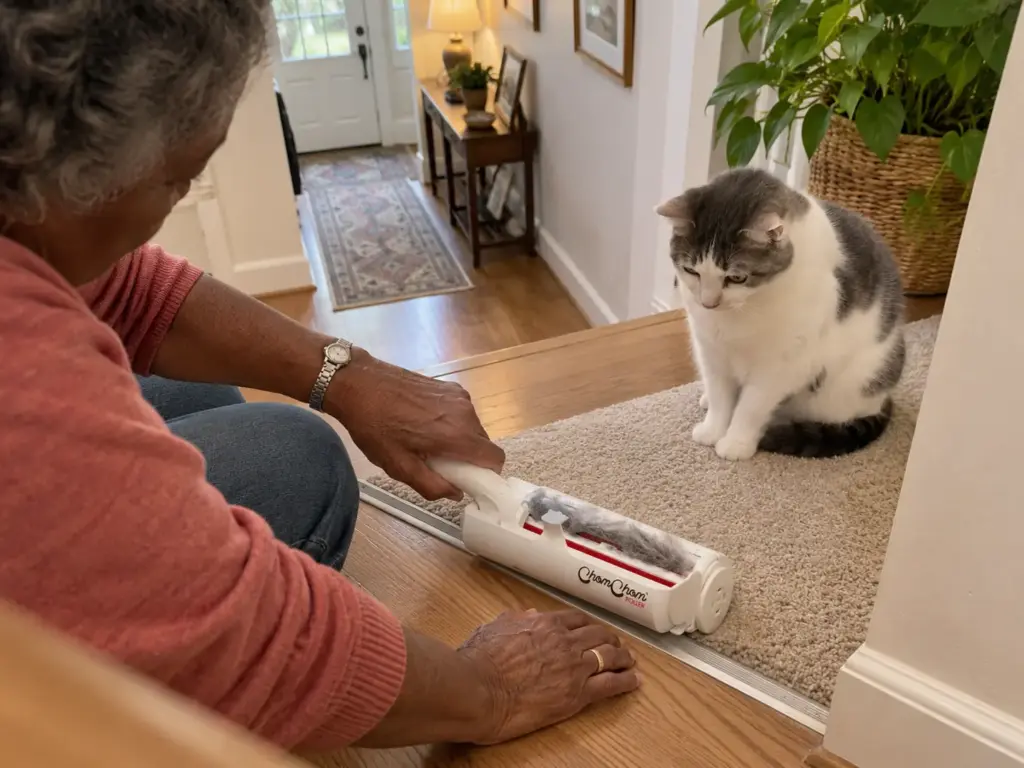
What to look for along the strip
A vacuum works one floor and a broom works the other, and the strip where they meet is the edge of both strokes, so each tool stops short of it. Hair from both sides drifts into that line and stays.
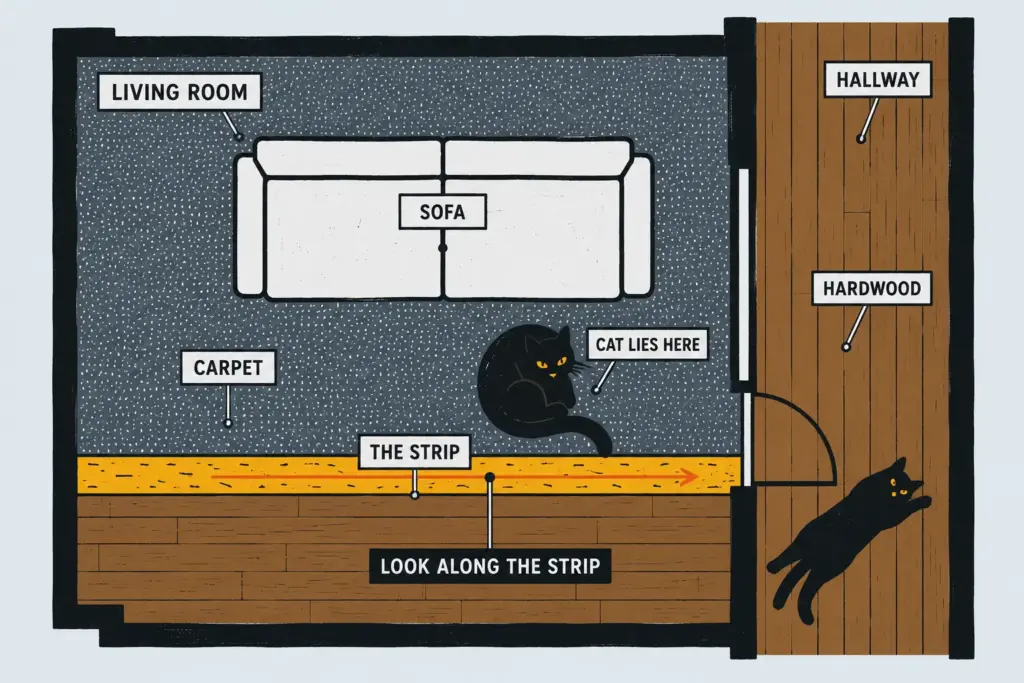
Look along it in low light, the same side light that shows what the boards missed. With two cats the strip fills sooner, and with one it fills slowly enough that you may not notice for a while. A robot vacuum has trouble at a rug edge as well, and what a robot vacuum can and cannot lift covers where that limit sits.
The free fix first
Before anything gets passed over the strip, lift the hair by hand. A slightly damp rubber glove dragged along the line gathers it into a roll you can drop in the trash (a bare damp hand works, but the glove grips better). Do it before the broom or the machine, because either one scatters whatever is sitting there.
The roller that fits the strip
Once the hair is lifted, a roller finishes what the glove leaves along the line. The ChomChom Roller Pet Hair Remover, original size at 2.5 x 7.5 x 7.5 inches, is reusable: you roll it in one direction, the hair collects in a chamber, and you empty it, with no sticky sheets to replace. It works the boards and the top edge of the carpet with the same stroke, which is why it suits a strip. It covers a line, not a room, so it will not replace a machine on the carpet itself.
Roll the strip before the vacuum comes out, not after. A machine pushes loose tufts ahead of it at the edge, and a roller is the tool that gets them back once they have moved.
If you would rather spend less on the roller, the Evercare Easy-Store Mega 50 Layer Handheld Pet Lint Roller does the same strip with sticky sheets. It costs less up front, but you tear off a layer each time it fills, and fifty layers go faster on a line that two cats keep refilling. If the strip turns out to be the small part of the job and the carpet itself needs a machine, what to look for in a cat hair vacuum is the next stop.
Start Where He Lies, and Look Again in Three Weeks
Three things carry this guide. Hardwood hands back the hair you missed and carpet keeps the hair you cannot see, so decide which of those you can live with. Clean where he lies, because the hair follows the cat and not the floor plan. And on the strip between two floors, pick up the hair by hand and roll it before any machine touches it.
Three weeks from now, look along the same strip in the same light. A blanket or rug he has claimed, and a strip that no longer shows a line of tufts, mean the routine held. If the hair has moved to a different corner, so has he, and that is where the next pass goes. The lighter weekly step that keeps it from piling up again is part of how to reduce cat shedding by fixing where the hair lands.
Today, wait for the low light, crouch at the end of the hallway, and look along the strip and the spots where he sleeps. Do the first pass there, and note how small the area turns out to be.
Frequently Asked Questions
01Is hardwood or carpet better for a home with cats?
Neither floor is better for the cat; the real choice is whether you would rather see the hair or not see it. Hardwood shows what you missed, carpet keeps it out of sight, and he will lie wherever it is warm and soft on either one.
02Do cats prefer carpet or hardwood floors?
Cats pick where to lie by warmth and by how a surface feels, not by whether it is called carpet or hardwood. A 1999 housing review found they preferred polyester fleece to cardboard for lying on. That is anecdote, but it fits.
03Which is easier to keep clean of cat hair, carpet or hardwood?
Hardwood is easier to clean, because the hair stays on the surface where a roller or a damp mop can lift it. Carpet keeps hair in the fibers, so it takes more passes and still hides what it holds. There is no solid percentage for either floor.
04Will a cat damage hardwood floors?
Yes, claws can mark a hardwood finish, but cats sharpen their claws on carpet as well, so neither floor comes through untouched. A large rug protects boards you cannot change. A cat that slips or limps on them is a question for your vet.
05What can I do about cat hair where the carpet meets the hardwood?
Look along the strip in low light, lift the hair off by hand, then run a handheld roller over it before you bring out any machine. Hair from both floors drifts into that line, and neither tool’s stroke reaches it fully.
Leave a comment