Best Cat Food Bowl for Messy Eaters — Three Mess Types
Don't buy a bowl until you read your floor. Messy eating is three failures (flinging, dragging, splashing) and one bowl cannot stop all three.

Alfredo RamsesFounder · August 31, 2026 · 19 min read
On this page7 sections
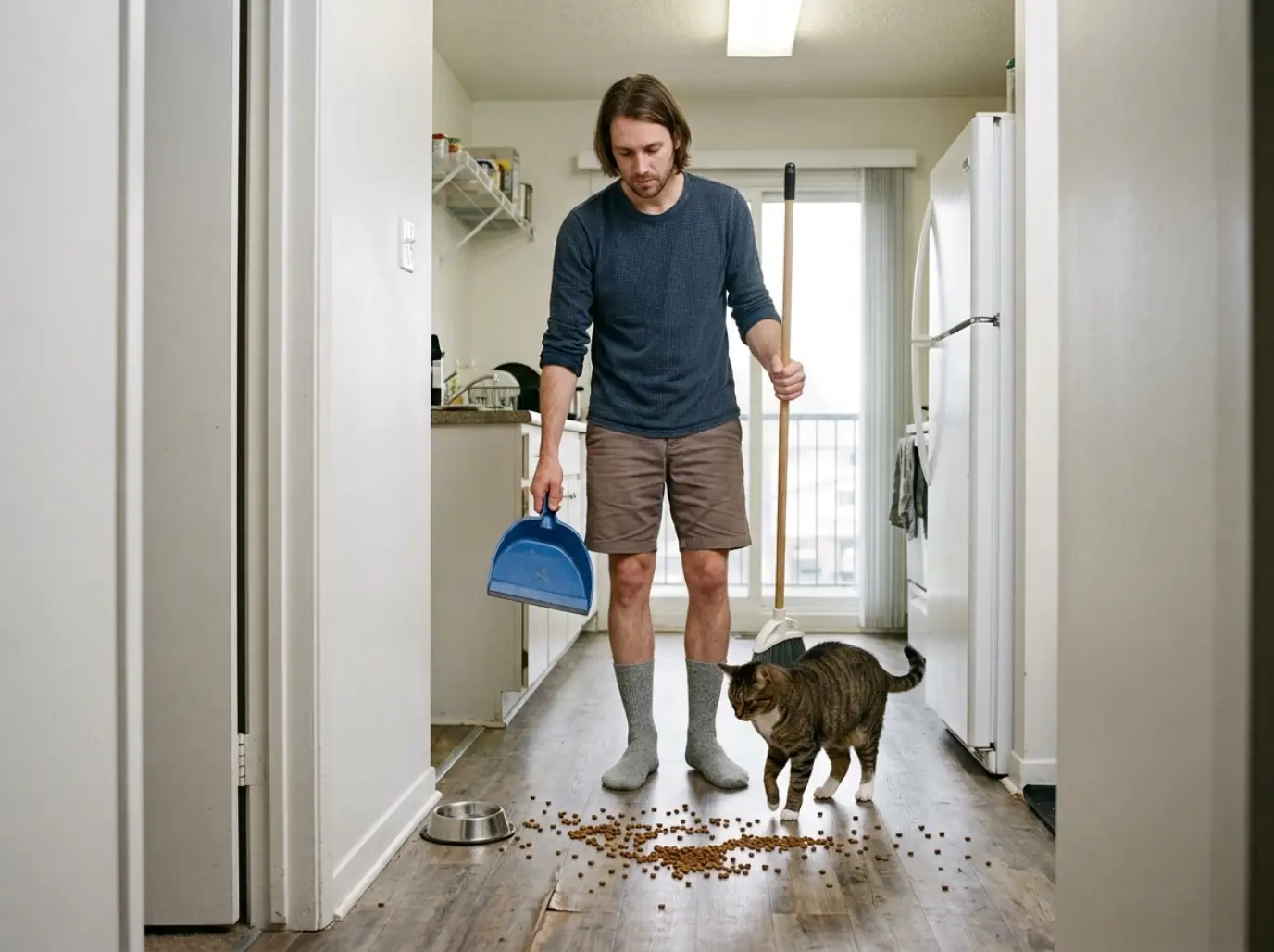
The floor tells you before the cat does. A pale arc of kibble a hand’s width out from the bowl, a dried ring of water that has been there since Tuesday, a few pieces tracked halfway to the hallway. You sweep it after breakfast and it is back by dinner. Most best cat food bowl for messy eaters lists treat sloppy eating as one checkbox and go straight to a product, which is why so many people buy a bowl that fixes a problem they never had.
It is not one problem. It is three, they break in physically different ways, and the same bowl cannot stop all of them. Work out which one is yours from the mess on your floor, then read what stops it, and only then spend anything.
Quick Answer
Read the floor, not the bowl. The pattern names your mess type and its fix.
- Food in an arc around the bowl means the bowl is too narrow or too deep. Go wider and shallower, or slide a raised-edge mat under the one you own.
- Food carried out of the bowl and dragged across the floor needs a catch surface wider than the bowl, which means a tray system rather than a lip.
- Water in a ring on the floor is paw-dipping. That one is answered by rim height, roughly three inches of rise, not by a wider dish.
Why the Floor Is a Mess and the Bowl Looks Fine
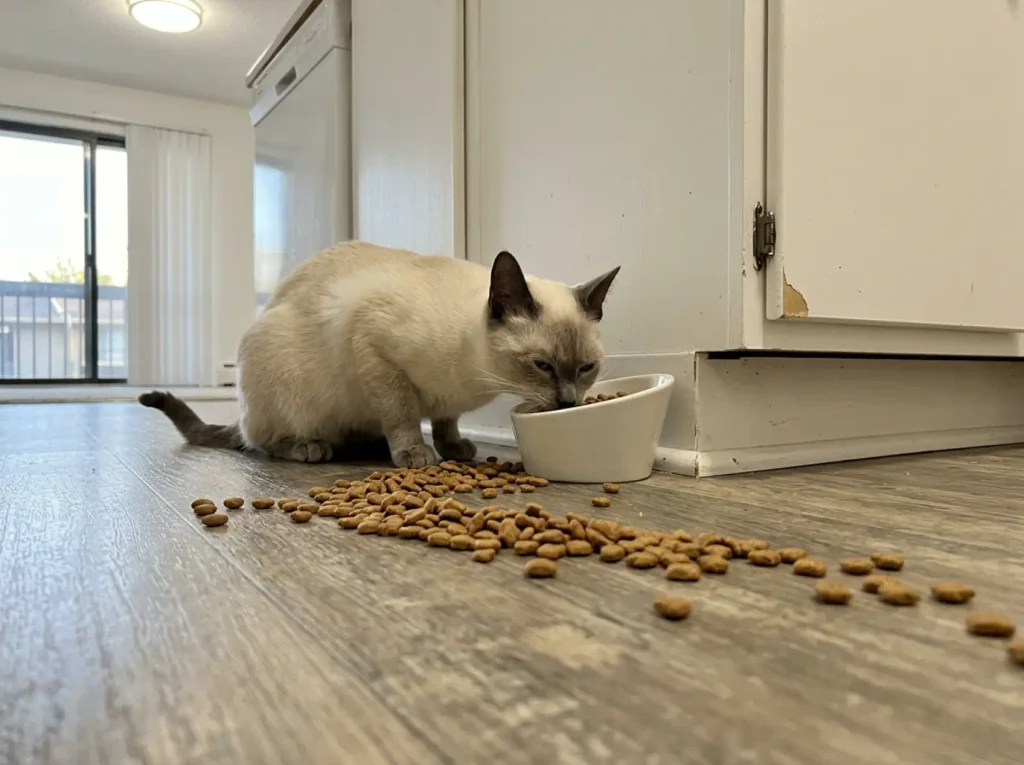
You have looked at that bowl twenty times and found nothing wrong with it, because there is nothing wrong with it while it is sitting still. A bowl only shows its fault with a cat’s face inside it and his front paws outside it. The whole failure happens in about ninety seconds, twice a day, and by the time you walk in, all that is left is the evidence on the floor.
So read the evidence instead. This is the part that costs nothing and that nobody bothers to write down: the three failure modes leave three different marks of food scatter.
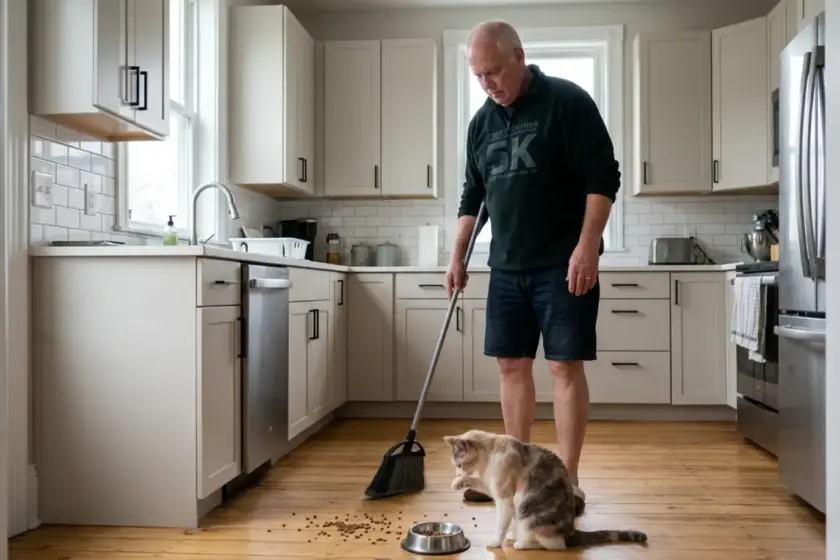
Kibble in a rough semicircle a few inches out, evenly spread, is flinging. A trail that leads away from the bowl, sometimes with a single piece at the end of it where he stopped to eat, is dragging. A dried ring on the floor near the base, with the bowl still half full, is splashing. Look at what your floor actually says before you decide anything about material or shape.
And if you want the wider picture first, the pillar guide covers what each bowl material actually does and where each one gives out.
Flinging usually starts at the rim. A narrow, deep bowl asks the cat to put his whole face inside a container narrower than the span of his whiskers, and whiskers touching a wall on both sides is unpleasant enough that he will look for another way in. The other way in is his paw.
He hooks the food up and out to somewhere he can eat it without the bowl pressing on either side of his face, and every hook throws a few pieces further than he meant. He is not being careless. He is solving a geometry problem you handed him.
Dragging is the same instinct with a longer stride. Instead of eating the food he pulled out, he carries it — dragging food clear of the dish before he starts on it.
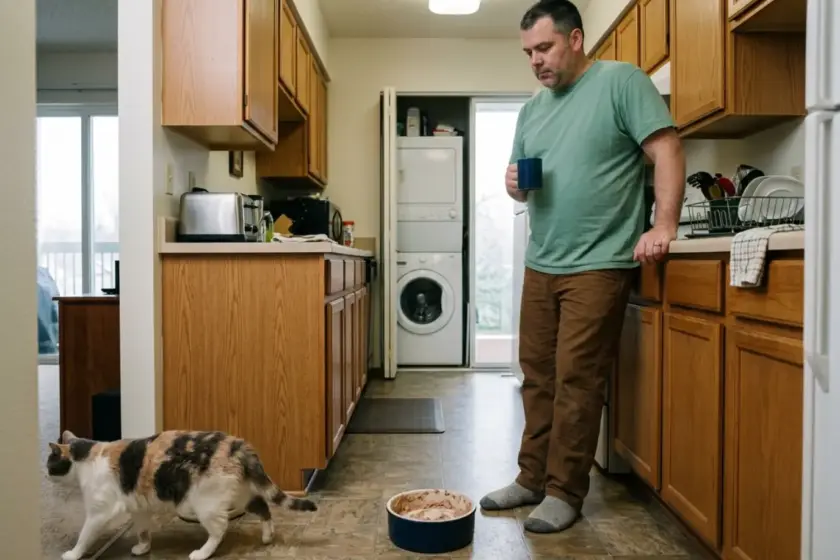
And there is a second, duller mechanism people miss entirely: a light bowl on a slick vinyl or tile floor moves under him. Each push shifts it a finger’s width, so by the halfway point the bowl has walked off the edge of whatever mat you put down. Cats also relocate bowls deliberately, which is a separate behavior with its own reasons, and if what you actually have is a bowl that travels across the floor while he eats then friction is your problem, not containment. Those two look identical when you are holding a dustpan.
The word the community uses for all of this, over and over in retail reviews and forum threads, is “pushing food out.” It is a good description of what the cat does and a bad description of what you have to fix, because it covers both flinging and dragging at once. That collapse is exactly why a single product so often disappoints: it was engineered against one of the two and sold against both.
Before you buy anything, sweep the floor clean one evening and leave it. The next morning, look at the pattern before you touch it. Arc around the bowl, trail leading away, or a ring of dried water. That is the entire diagnosis, and it costs nothing but one morning of not tidying up.
What Actually Stops Each of the Three
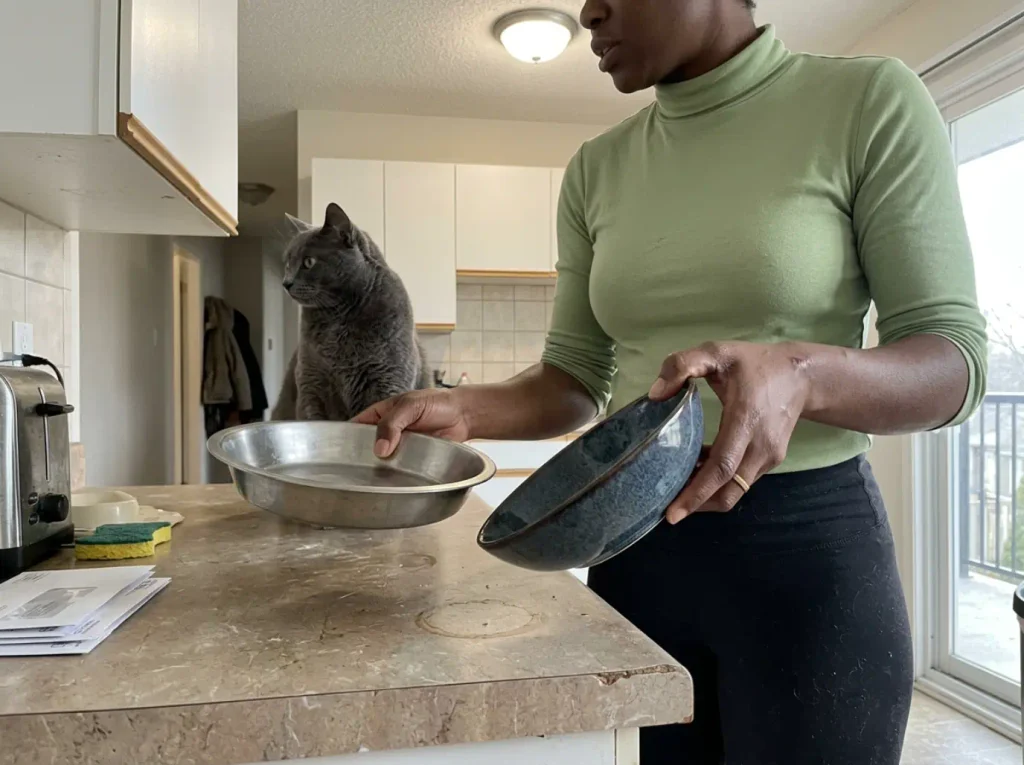
Here is where most readers are about to buy the first thing labeled spill-proof, and roughly half of them are about to buy the wrong one. The features that stop these three failures are not interchangeable, and two of them work against each other.
Against flinging, the fix is width and shallowness. Not a taller rim, not a tray. If the whisker pressure is what makes him paw the food out, a bowl wide enough that his face fits without contact removes the reason, and nothing needs catching afterward.
Somewhere around six inches of interior width and a shallow dish is the shape that does it for an average adult, and a bowl too small for the portion in the first place has the same effect, which is a sizing question more than a containment one. If you have never checked, the bowl you own may simply be the wrong size for the job before it is the wrong shape.
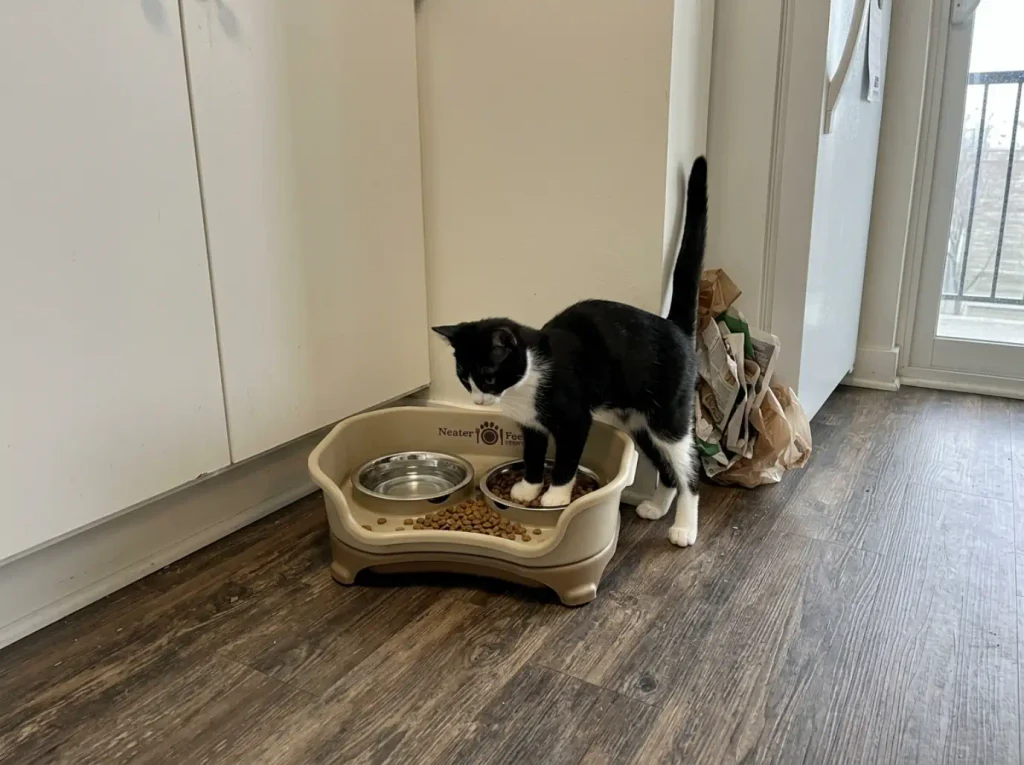
Against dragging, the rule is the one no listing prints: the catch surface has to be wider than the bowl in every direction. A lip on the front edge of a dish stops food that leaves the front edge, and a cat pulling food out does not consult the front edge. He takes it wherever his paw is pointing. What works is a catch tray — a raised perimeter that runs all the way around both dishes, at a radius further out than the bowl itself, because the food is going to exit at a random bearing every single meal. Anything less is a partial answer sold as a complete one.
Against splashing, the answer is height, and this is the number that decides the purchase. Water displaced by a paw goes up and over, so what contains it is vertical rise at the rim.
The bowls actually built for this sell the feature as a splash guard, and the ones that earn the name run around three inches tall, which is roughly twice what a standard cat dish gives you. A wider dish does nothing here — it just gives the water a longer run before it clears the edge. And the paw dipping itself is not a bad habit to correct: cats dip a paw in before drinking as an inherited depth check, a way of finding the surface before committing their face to it. You are not going to train that out, and you should not try.
| What the floor looks like | What is actually happening | What stops it | What will not |
|---|---|---|---|
| Even arc of kibble a few inches out | Whiskers hit the sides, so he hooks food out with a paw | Width and shallowness, about six inches across | A taller rim, which makes it worse |
| A trail leading away from the bowl | He carries food out to eat it somewhere open | A raised perimeter wider than the bowl, all 360° | A front lip or a small mat |
| Dried ring of water near the base | Paw-dipping displaces water up and over the rim | Rim height, roughly three inches of rise | A wider or shallower water dish |
| Bowl itself has moved across the room | Light bowl, slick floor, no friction under it | Weight or a rubber-ringed anti-skid base | Any tray the bowl is not fixed to |
Which leaves the feature that gets sold hardest and stops none of the three on its own: elevation. Raising a bowl changes his posture and the angle his neck works at, and that is a real thing worth having for some cats.
But a narrow bowl six inches off the floor is still a narrow bowl, and that holds whether it is a stainless steel bowl or a ceramic bowl, and it will get pawed out at exactly the same rate, just from higher up. Elevation is a comfort answer that got borrowed by the mess aisle. Buy it if you want it for what it does.
And “mess-proof” is marketing language, so treat it that way. No bowl is. What exists are bowls that reduce one specific failure, and a page promising to end all of it is a page that has not asked which one you have.
If your floor pattern says water and the product you are looking at leads with extra wide, you are being sold the wrong feature. Width is the answer to kibble. Against water it is rim height or nothing, and the two specs almost never come in the same dish.
The Fix to Try Before You Buy a Bowl
Almost everyone who searches this is ready to spend real money to stop mopping. Maybe half of them do not need to, and nobody on this results page is going to say so, because every page on it earns when you buy. So here is the free part first.
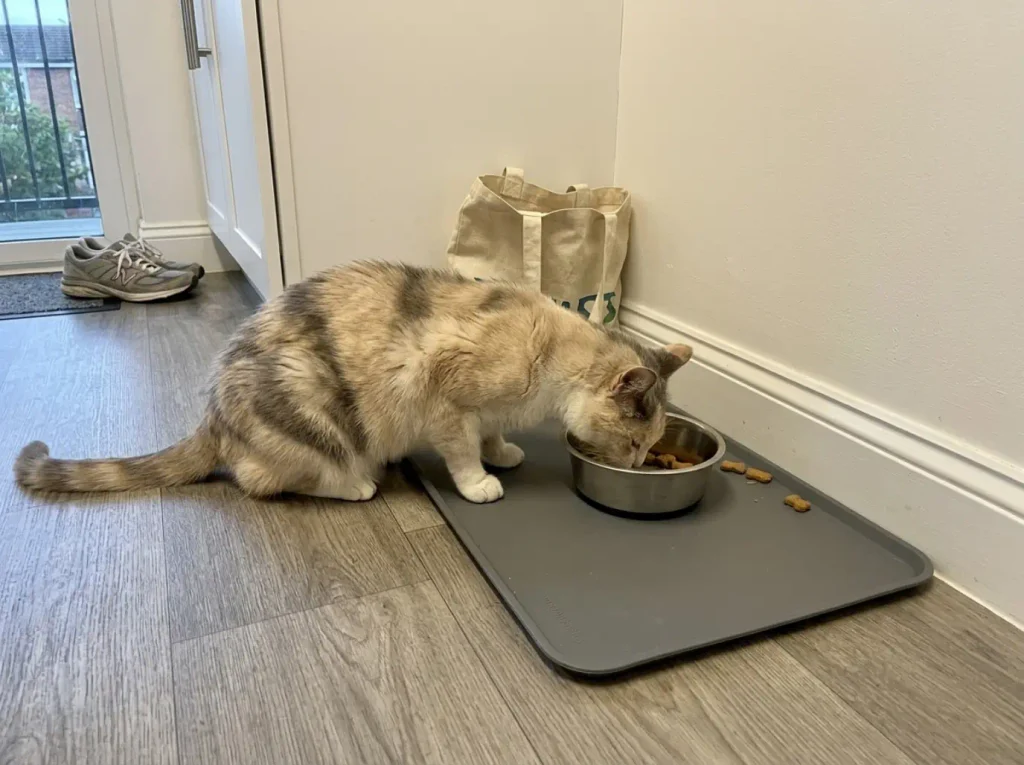
Push the bowl against a baseboard or into a corner. A bowl with a wall behind it cannot travel in that direction, and a surprising share of bowl-walking is just the thing sliding away from a cat who is leaning into it. This takes ten seconds and it either works or it rules something out by tonight. If the bowl stops moving and the arc of kibble stays exactly the same, you have confirmed you have a flinging problem, not a friction one, and you have narrowed the purchase before making it.
Then separate the food from the water. A lot of what people describe as a disaster is splashed water landing on kibble scatter, which is what turns two tidy messes into one paste welded to the vinyl.
Move the water two or three steps away, out of splash range of the food. Cats generally prefer their water away from their food anyway, so you are not fighting him to do it. The cleanup changes character immediately: dry kibble sweeps, wet kibble scrubs.
The third step costs a little, and it is still the cheapest thing in this article. A silicone mat with a raised edge is the cheapest floor protection there is: it sits under the bowl you already own and does two jobs at once, catching what clears the rim and gripping the floor so the bowl stops skating. Retailers themselves position it as the low-cost first move, and yet almost no roundup puts it ahead of the product cards, because ahead of the cards it earns nothing.
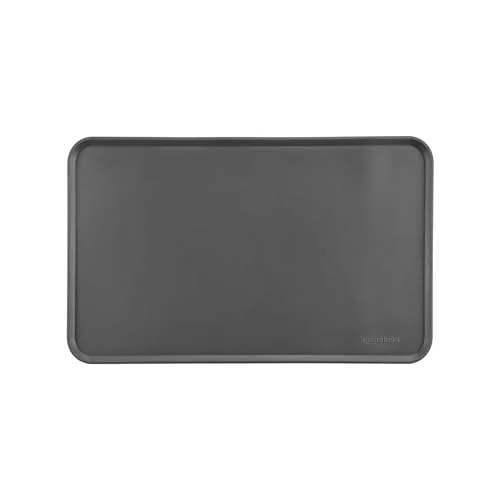
Now the honest part, and it is the reason this section exists rather than a mat recommendation dressed up as advice. The mat gets handed out as the answer to messy eating full stop, and enough threads describe the same outcome to show why that is wrong: the person buys the mat, the mat works beautifully for a week, and then they notice the food is landing past it.
That is the dragging pattern, and a mat cannot help, because the cat is not spilling food near the bowl. He is taking it somewhere. If your trail leads off the mat, the mat was never the fix and no bigger mat will be either. That is the point where a tray system stops being an indulgence and starts being the cheaper option, counting the mopping.
Best Cat Food Bowls for Messy Eaters, by Which Mess You Have
By now you should know which of the three you own, so this list is arranged that way instead of as a ranking. There is no best bowl here. There is a best bowl for a trail, a best bowl for an arc, and a best bowl for a ring of water, and buying across those lines is how people end up with a drawer of bowls and the same floor.
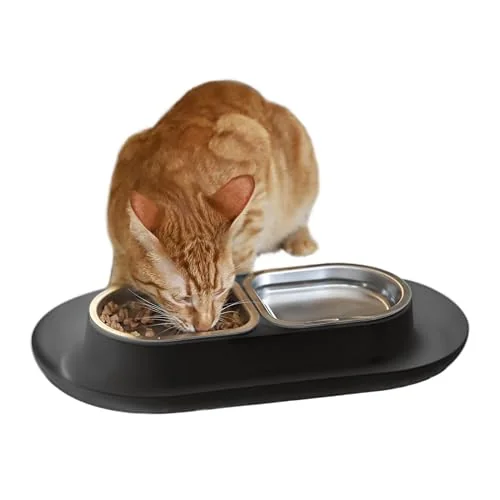
Start with dragging, because it is the failure the cheap fixes cannot reach, and the one where an actual system earns its keep. What you need is two separate catch strategies running at once, since a cat who hauls food out is usually also the one who leaves a puddle behind at the water dish.
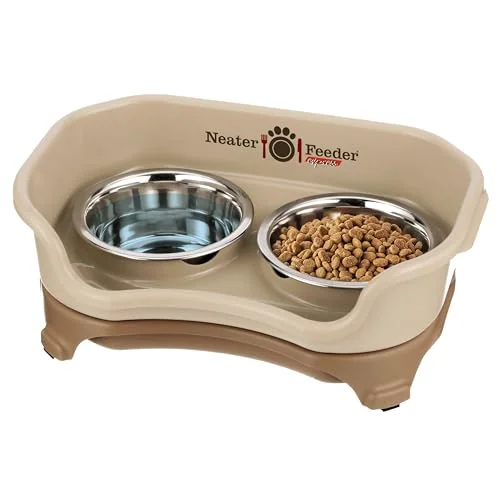
One thing to know before you commit to any tray feeder: you are buying plastic, and where that plastic touches food is the part that matters. The dishes themselves are stainless in both systems below, which is the right call, and the tray is structural rather than something he eats from. That distinction is the whole argument, and it is worth understanding why the material of the tray matters as much as its shape before you decide a plastic base bothers you.
Next, the cat whose food leaves in no particular direction. If your arc is not really an arc but a scatter on all sides, and there is water in it too, the fix is the perimeter.
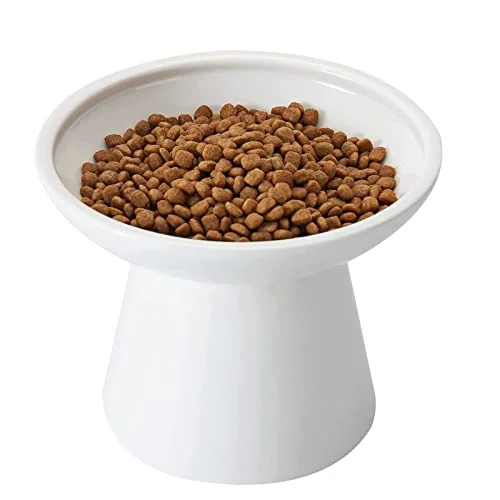
Then there is the cat whose mess is purely a whisker problem, and for him the cleverest tray in the world is still catching a consequence instead of removing a cause. Go at the trigger. A wide, shallow dish that his face fits into without contact means he has no reason to reach in with a paw, and once the paw stops, the arc stops.
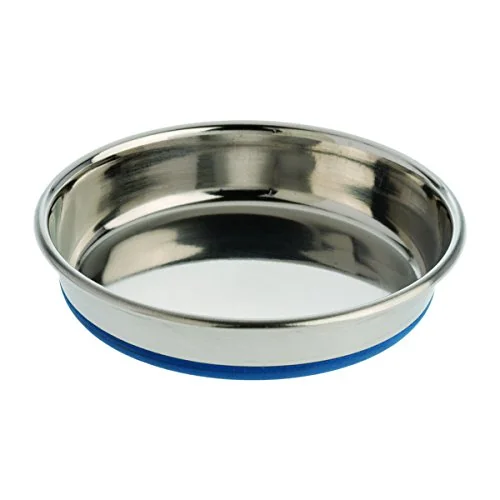
And if you read all of the above and none of it is you, because your food stays in the bowl and the bowl is simply somewhere else by the end of the meal, then you have the smallest problem on this page and you should spend accordingly. A weighted, rubber-based steel dish ends bowl-skating and nothing else, which is fine when nothing else is happening.
Read those four caveats together and the shape of the decision is clear.
The tray costs you floor space and washing-up time. The 360-degree perimeter catches beautifully and prevents nothing. The wide ceramic prevents beautifully and catches nothing. The dish with a rubber non-slip base does one job perfectly and ignores the other two. Nothing here does everything, which is why the diagnosis had to come first.
Two Cats, and the Mess That Isn’t About the Bowl
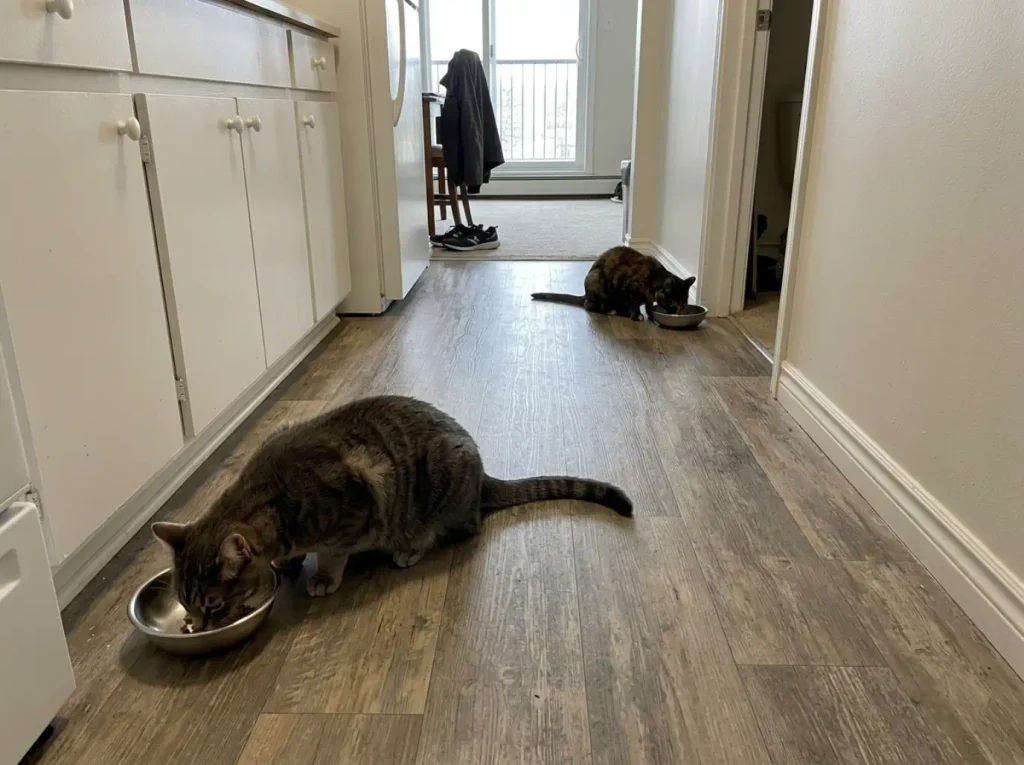
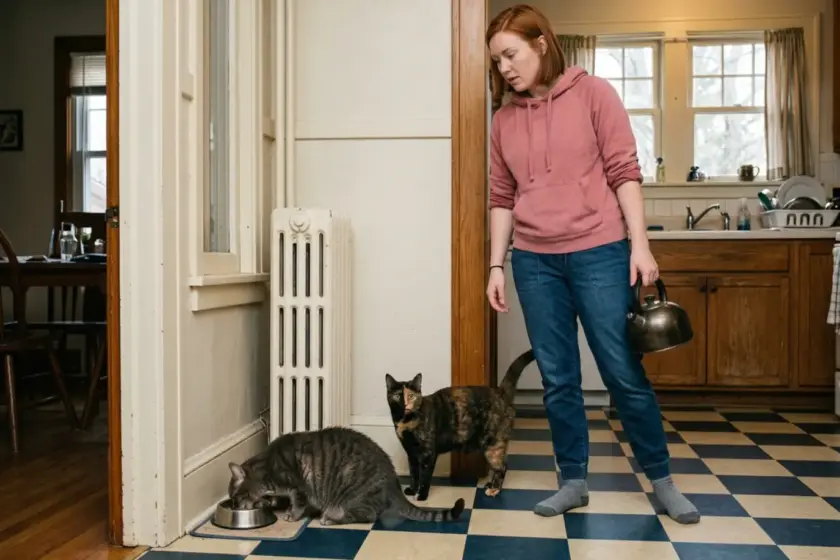
Add a second cat and roughly half of this stops being a bowl question. The cat who eats fast and sloppy is very often eating fast because somebody else is standing four feet away, and no dish ever made will fix a room.
Start with the count. One bowl per cat plus one is the same arithmetic used for litter boxes, and the spare is not a luxury once one of them is a messy eater, because it lets you separate rather than negotiate. Whether they should be sharing at all is its own argument, and the sibling piece on whether two cats should share a bowl at all works through it properly.
Then the placement, which outranks the hardware here. Two identical bowls three or four steps apart, ideally without a direct line of sight between them, will cut the pawing and scattering more than any tray you can buy, because they remove the hurry that causes it. A cat eating at his own pace does not shovel. That is the entire mechanism, and it is free.
Use matched bowls, deliberately. With two different models you cannot read the evidence any more: you find a mess on the floor and have no way to know which station produced it, or whether the difference in mess is the cat or the dish. Identical bowls make the floor legible again. That is the real reason for a matched set, not the look of it.
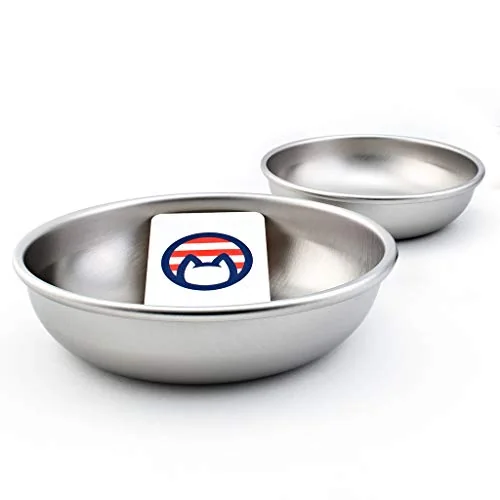
Which brings up the part worth saying plainly, because a lot of writing on this topic gets it backwards.
The messy one is not the bad one. Eating fast and hauling food out of a dish is what a cat does when he feels watched at a resource he cannot defend. That is low-grade resource guarding, and it is a territory answer, not a discipline problem. He is telling you the feeding station is too crowded. Move the stations and the eating changes, usually within a few days.
One last thing that only shows up in multi-cat apartments: the floor evidence gets mixed. You will find an arc from one and a trail from the other in the same square meter, read it as one confusing pattern, and buy something that half-solves both. Diagnose per bowl, not per household, and the picture separates immediately.
If you do not know which of the two is the messy one, move the bowls three steps apart for a week and watch which patch of floor gets dirty. It costs nothing, it answers the question before you spend, and often the separation alone fixes enough that you stop needing the answer.
What to Do Tonight
Read the floor before you read another product page. An arc, a trail or a ring of water tells you which of the three failures you have, and those three want three different things: width, a catch surface wider than the bowl, or roughly three inches of rim.
Try the free moves first. Push the bowl against a baseboard, move the water two steps away from the food, and put a raised-edge mat under what you already own before you replace anything. That sequence solves it outright for a fair number of people, and for everyone else it narrows the purchase.
Then buy against your failure, not against a list.
Width is useless against splashing. A mat is useless against dragging. A tray catches everything and prevents nothing. Match the fix to the pattern and you buy once.
Give it three weeks and look at the floor again. The question is not whether there is less mess but whether the pattern changed shape: if the arc is smaller, you hit the cause; if it is the same size and simply somewhere else, you bought containment for something that needed prevention, and the answer is back in the second section, not in another purchase.
Tonight, though: push the bowl against the baseboard and move the water two steps away. If you wake up to a clean floor, you have just saved yourself the rest of this article.
Amazon’s Audible — free for 30 days
Your cat won’t let you read. Let someone read to you.
Audible is Amazon’s audiobook library — thousands of titles, read out loud, on your phone. Free for a month, plus one audiobook to keep forever.
Frequently Asked Questions
01Why does my cat push food out of the bowl before eating it?
Because the bowl is narrow or deep enough that his whiskers press the sides before his mouth reaches the food, so he hooks it out to somewhere he can eat comfortably. A wide shallow bowl removes the reason instead of catching the result.
02Do spill-proof cat bowls actually work?
They work against the one mess they were designed for, and that mess is different in every product. A raised lip or perimeter catches food that leaves the dish; it will not stop a cat lifting food out, and it does nothing for a bowl that slides across the floor.
03What is the difference between a slow feeder and a spill-proof bowl?
A slow feeder makes a meal take longer by putting ridges and obstacles in the food; a spill-proof bowl contains what leaves the dish. Different problems, and a slow feeder can make scattering worse if your cat paws food out from between the ridges.
04Are elevated bowls better for messy eaters?
Not on their own. An elevated cat bowl changes his posture, which is a separate question from containment, and a narrow bowl raised six inches gets pawed out just the same. What helps is width and shallowness, raised or not.
Leave a comment