What Size Cat Food Bowl — Food and Water Differ
What size cat food bowl? 5.5" wide minimum, under 2" deep and 1-2 cups, plus 6-7" for a large breed + why the water bowl uses other math.

Alfredo RamsesFounder · August 31, 2026 · 17 min read
On this page8 sections
- 1The Two Bowls on Your Floor Are Solving Different Problems
- 2Measure the Cat, Not the Bowl
- 3The Size Bands, by Cat
- 4Two Cats Change the Arithmetic
- 5Where the Wrong Size Shows Up, and Where It Doesn't
- 6Sizing the Water Bowl, Which Is a Different Sum
- 7The Size Is Right When the Floor Stays Clean
- 8Frequently Asked Questions
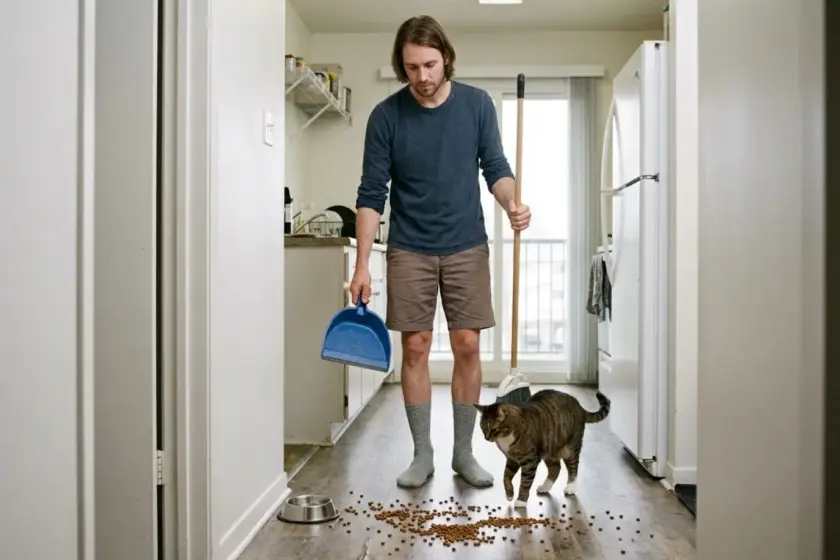
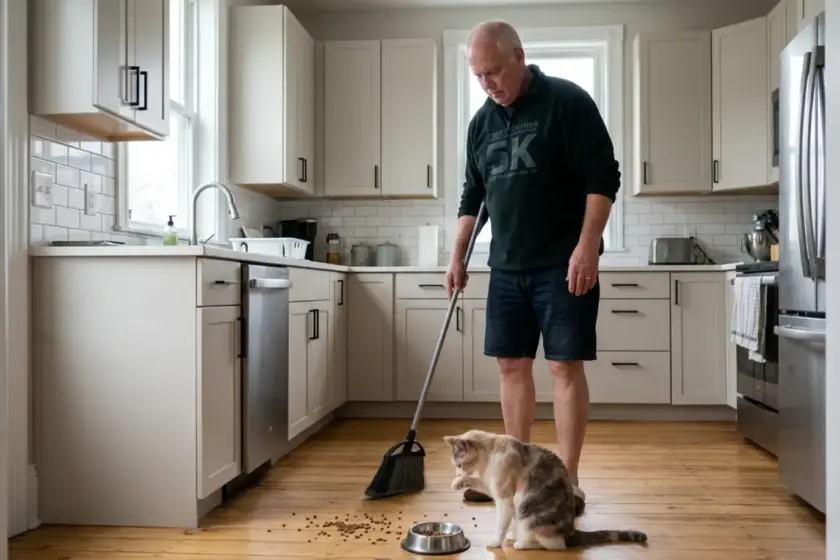
He isn’t a messy eater. He’s dragging kibble over the rim onto the tile because the rim is touching his whiskers on every single bite, and eating off the floor is the workaround he came up with. Whiskers aren’t decorative hairs; each one is wired with roughly a hundred to two hundred nerve endings, which is why a bowl wall registers at all.
So the answer to what size cat food bowl you need starts somewhere nobody in the search results starts: there isn’t one bowl size, because the food bowl and the water bowl are solving two completely different problems. Here’s the measurement that settles the food bowl, the size bands by the cat actually standing in your kitchen, what changes when there are two cats, and why the water bowl gets sized by a different sum entirely.
The size bands, before anything else:
| Your cat | Food bowl diameter | Depth | Capacity |
|---|---|---|---|
| Kitten | 5" and up | Under 1.5" | 1–2 cups |
| Adult under 12 lb | 5.5" minimum | Under 1.5–2" | 1–2 cups |
| Adult 12 lb and up, large breeds | 6–7" | Under 2" | 2–4 cups |
| Multi-cat station | One bowl each, spaced apart | Same rule per bowl | Per cat, not pooled |
The Two Bowls on Your Floor Are Solving Different Problems
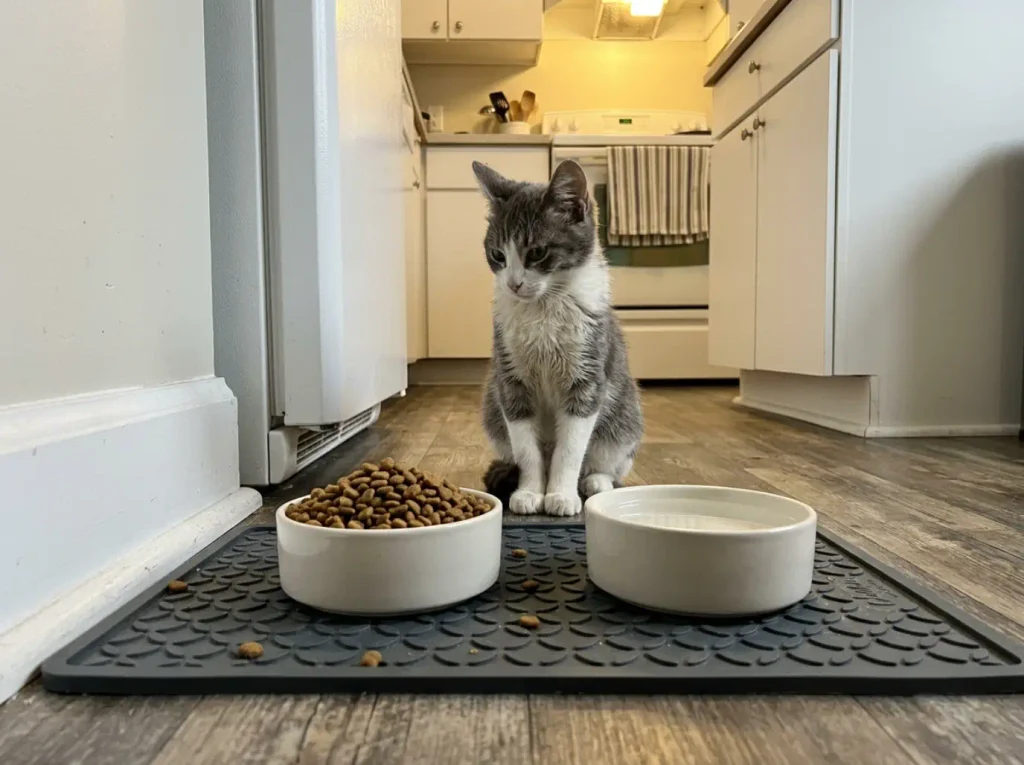
Almost everyone buys the matching set. Two bowls, one box, identical dimensions, and the pair goes down on the kitchen floor together because it arrived together. Then the cat drinks fine and eats badly, and the owner concludes something about the cat rather than something about the bowls. The set was never checked against two different rules, because nobody told them there were two.
What the Food Bowl Is Actually Fighting
Eating buries the face. That’s the whole mechanical difference. A cat lowers his head into the dish, and the width of his face at whisker level is wider than the width of his head, so the constraint isn’t the head fitting, it’s the whiskers clearing.
Every time a whisker brushes the wall, that contact registers as information, because whiskers carry roughly 100 to 200 nerve-rich mechanoreceptors apiece, according to Cornell’s Feline Health Center. Repeat that forty times a meal and you get a cat who solves it by not putting his face in there at all.
Which makes the food bowl a surface-area problem, and makes bowl depth the number that decides it alongside width. The food has to sit in a single layer wide enough for the face to get in clean, and the walls have to be low enough that nothing brushes on the way down. Cat owners have a name for the result when it goes wrong: whisker fatigue, a term some vets argue with and every person who has swept kibble off a kitchen floor recognizes immediately. You don’t have to buy the syndrome to buy the geometry.
What the Water Bowl Is Actually Fighting
Nothing about drinking buries the face. He puts his tongue in, not his cheeks, so whisker clearance is barely a factor and depth stops being the enemy. What matters instead is bowl capacity: how much it holds between the times you actually get around to changing it.
That’s a volume question with a completely different answer, and it’s why the two bowls in the matching set should probably not be twins. A deep bowl that would be a disaster for kibble is fine for water. A wide and shallow bowl that’s perfect for food runs dry by mid-afternoon and gets dust in it.
Why the Matching Set Gets Both Wrong
The matching set is optimized for a third thing entirely, which is looking like a matching set on your floor. It’s designed for the human, and that’s fine as far as it goes. It just means the odds of one enclosure size happening to satisfy both a surface-area rule and a volume rule are not good.
Usually it fails the same direction: deep enough to give a cat water bowl real capacity, which makes it too deep to be a food bowl. So the water works, the food doesn’t, and the mess looks like a cat problem. It isn’t. He’s telling you the rim is in his face, and the only vocabulary he has for that is kibble on the tile.
Whether you land on ceramic, steel or a plastic bowl is a separate decision from the size, and the bowls pillar covers all three on their own merits.
Before you measure anything or buy anything, sit on the floor at bowl height and watch one meal from the side. You’re looking for one thing: do the whiskers fold back against his cheeks as he goes in? If they fold, the bowl is too narrow, and you now know it for free in under two minutes.
Measure the Cat, Not the Bowl
Every guide in the results tells you to buy wide and shallow. Not one of them tells you wide compared to what. So you end up in the pet aisle holding two bowls, comparing them to each other instead of to your cat, which is exactly the same mistake as buying a litter box by looking at litter boxes.
The Whisker Span, and How to Take It Without a Struggle
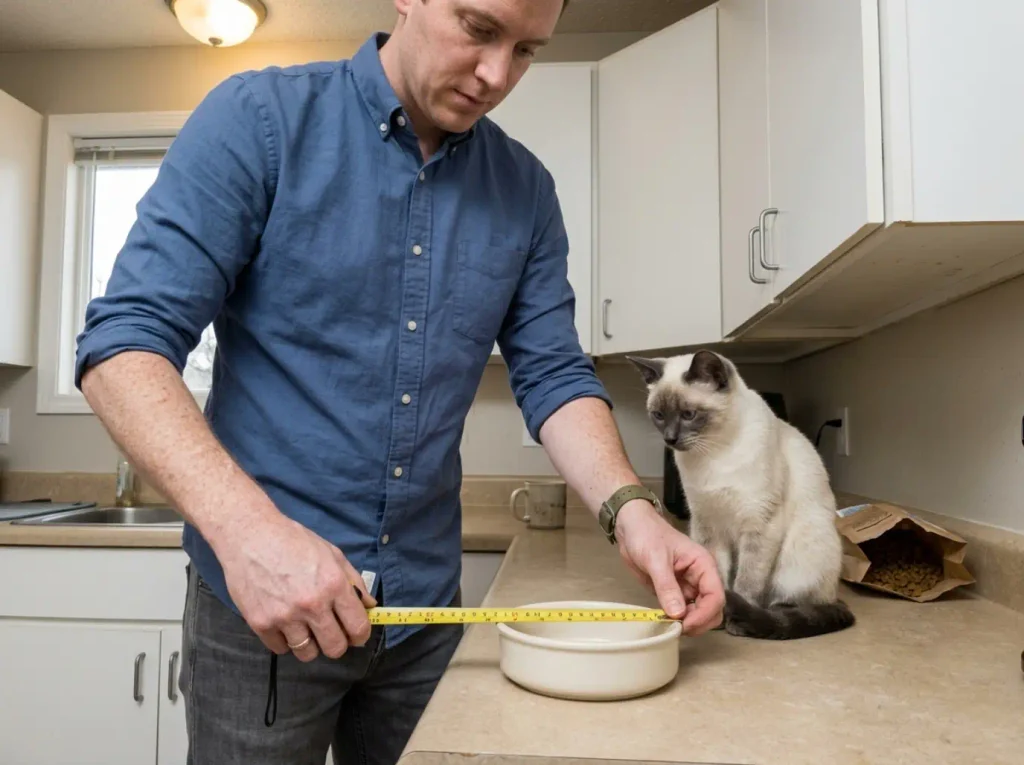
The number you want is the whisker span: tip to tip, straight across his face, at the widest point. Not the head, not the skull, not the shoulders. The whiskers stick out well past the face and they’re the part that hits the rim first.
Getting it is easier than it sounds because you don’t have to touch him. Wait until he’s settled and hold a ruler or a strip of paper across in front of his face without making contact, then read where the tips fall. Or take the measurement off a straight-on photo with something of known width in frame, a credit card leaning against the wall behind him, and do the arithmetic later. Whatever number you get, that’s the one the bowl has to beat, and long-whiskered cats push it wider than you’d guess from looking at the face.
The Clearance Rule That Comes Off That Number
Here’s the part nobody publishes. Take the whisker span and add half an inch to an inch. That total is your minimum bowl diameter, and the reason for the margin is that a cat doesn’t lower his face into the exact geometric center of a dish every time. He comes in at an angle, from whichever side he’s standing on. A bowl that’s precisely as wide as his whiskers is a bowl he clears only when he’s perfectly aligned, which is never.
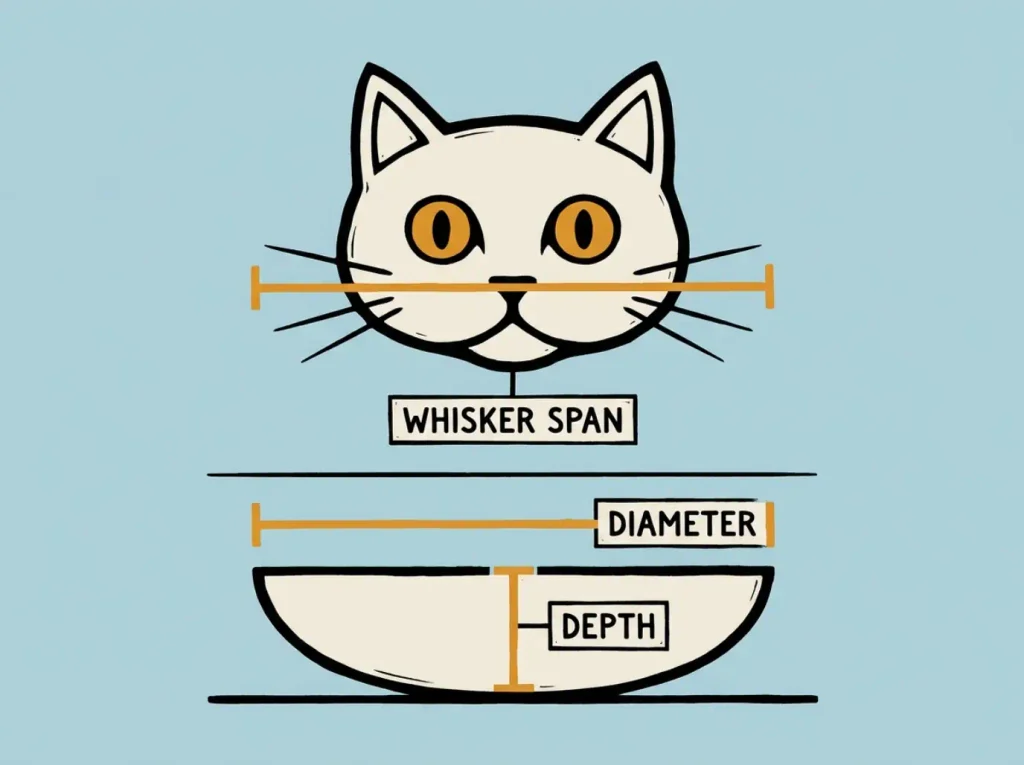
For most adult cats that arithmetic lands on 5.5 inches as the practical floor, and 6 inches or more if he’s broad-faced or long-whiskered. And before you buy anything: go get the bowl that’s already on your floor and put a ruler across it. A decent number of them pass. Free is a better result than correct-and-purchased.
Depth, the Half of the Answer Nobody Publishes
Diameter is where the advice stops, and it’s only half the answer. Depth needs to stay under 1.5 to 2 inches, and this is the one people get half-right: they buy a bowl with a generous diameter, feel good about it, and it’s a cereal bowl at two and a half inches deep. Wide rim, deep well, and the whiskers still touch on the way in because they’re touching the sides of a bowl that curves upward.
Actual products that get this right cluster tightly in a band you can hold a ruler to. CatGuru ships at 1.2 inches deep, Van Ness Ecoware at 1.25, PetRageous at 1.5. That’s not a coincidence and it’s not marketing: it’s the range where a cat’s face can get all the way to the bottom without anything brushing. If your bowl is deeper than two inches, the diameter doesn’t rescue it.
The Size Bands, by Cat
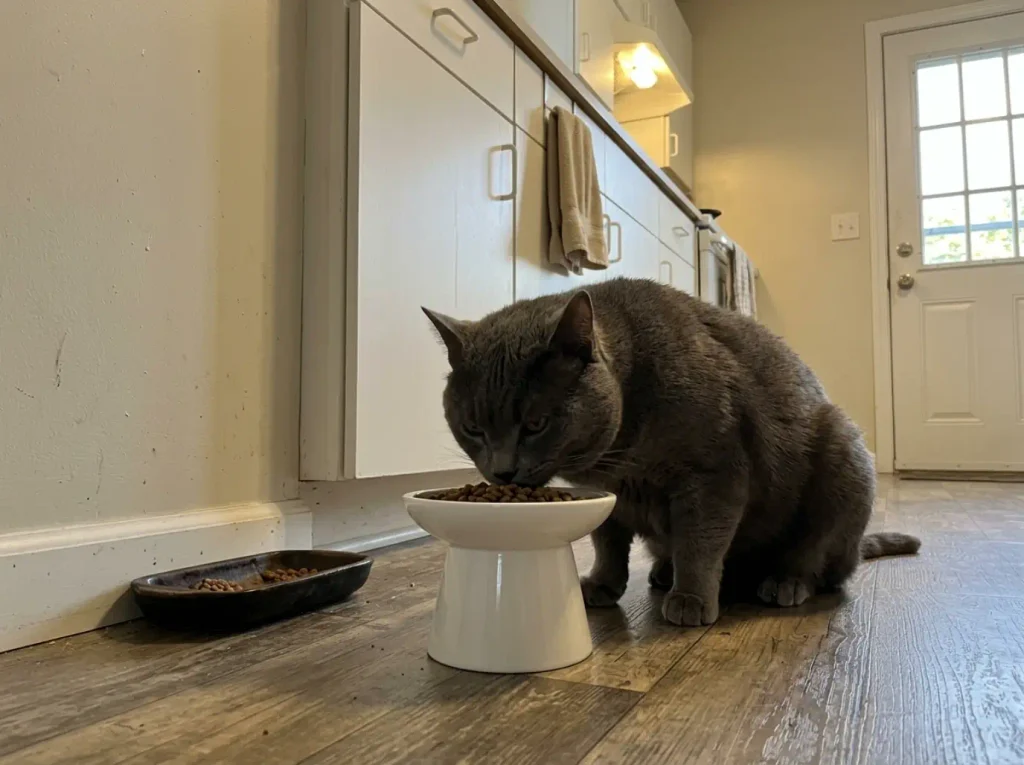
One size fits all is a 4.5-inch saucer that works fine for an eight-pound cat and fails a fifteen-pound Maine Coon the same day it comes out of the box. Breed size changes the diameter math, not just how much the thing holds, and that’s the distinction the generic guides collapse into a single vague sentence.
Cats Under Twelve Pounds
This is most cats, and the target is 5.5 inches of diameter, under 1.5 to 2 inches deep, holding one to two cups. That diameter is the minimum that clears the whiskers rather than a comfortable middle, so treat it as a floor and round up rather than down when you’re deciding between two.
If you want to see what that number looks like as an actual object, the 4 Pcs Stainless Steel Cat Bowls land at 5.5 inches with a genuinely low profile, which is what the whisker friendly label on a listing is supposed to mean once you put a number on it, and a dishwasher safe stainless steel bowl in a set of four means one is being washed while another one works. The catch with light steel is that it slides: a cat who pushes his bowl around the kitchen will push these too unless they’re on a mat or have a rubber ring underneath.
Large Breeds, Where the Saucer Stops Working
Twelve pounds and up moves you to 6 to 7 inches of diameter, same under-two-inch depth rule, two to four cups of capacity. A large breed cat isn’t just heavier, he’s wider at the face, and a Maine Coon’s whiskers extend past where a standard bowl’s wall sits. A flat-faced breed changes the sum in the other direction: a brachycephalic cat like a Persian has a shorter muzzle but the whiskers still splay, so width matters and depth matters more. The saucer that his housemate eats out of happily is a rim in his cheeks.
Weight brings a second failure mode with it: a big cat can move a bowl. He shoves it, it travels, food goes over the side. That’s the argument for ceramic here.
The CEEFU Extra Wide Elevated Ceramic 6.2″ Shallow Cat Food Bowl sits inside the 6-to-7-inch band with enough mass that shoving it doesn’t accomplish much. The elevation is a separate decision from the size and not every cat wants it, so if he’s currently eating happily off the floor, the height isn’t the thing you’re fixing. Steel and ceramic both clear the size rule; the material argument is a different one.
Kittens, and the One Moment You Size Up
A kitten bowl needs one to two cups and the same shallow rule, because kitten whiskers are proportionally just as sensitive as adult ones. Portion size is what shrinks at that age, not the diameter. Smaller face, smaller span, same physics.
What people get wrong is the timing of the upgrade. They watch and wait and second-guess, replacing bowls every few months on a hunch. There’s a cleaner trigger: size the bowl up when you switch him from kitten food to adult food, generally around twelve months and up to eighteen for large breeds. One decision, one moment, already on your calendar.
Capacity, honestly, is the least interesting number in this whole article. A food bowl doesn’t need to hold a lot; it needs to hold one meal without the kibble mounding up above the rim. Mounded food is food that gets pushed over the edge on the first bite.
Buy the kitten’s second bowl at adult diameter and just put less food in it. A wide bowl with a small portion in the middle costs a kitten nothing, and it means the one upgrade you were planning for the twelve-month food switch is already done.
Two Cats Change the Arithmetic
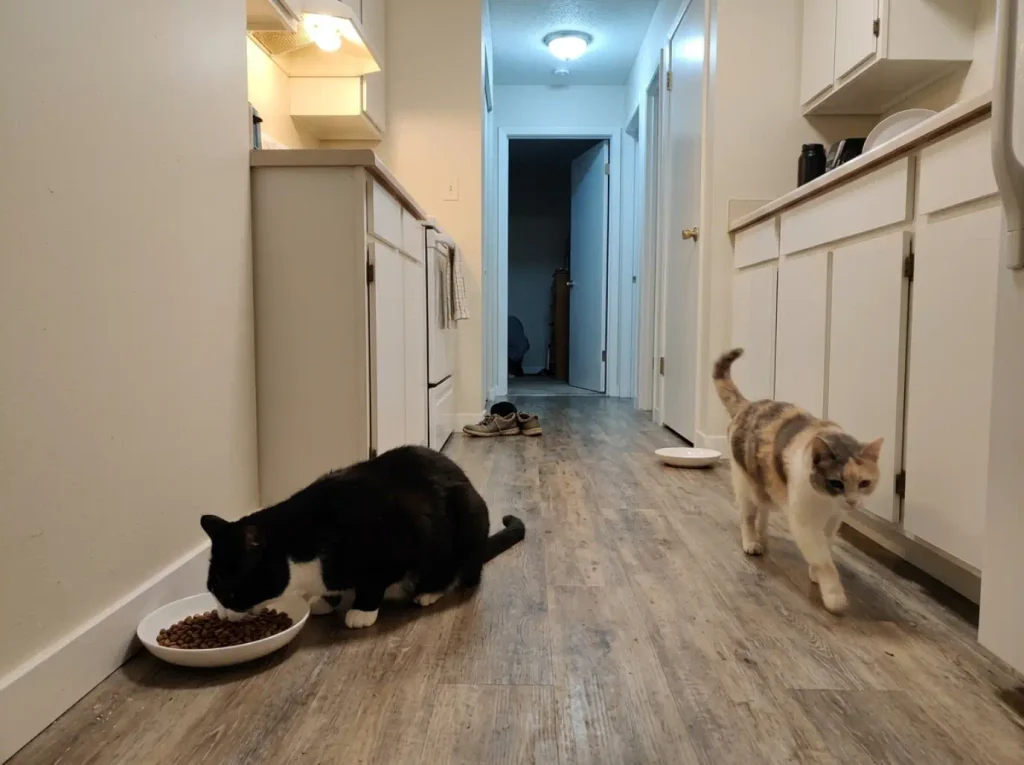
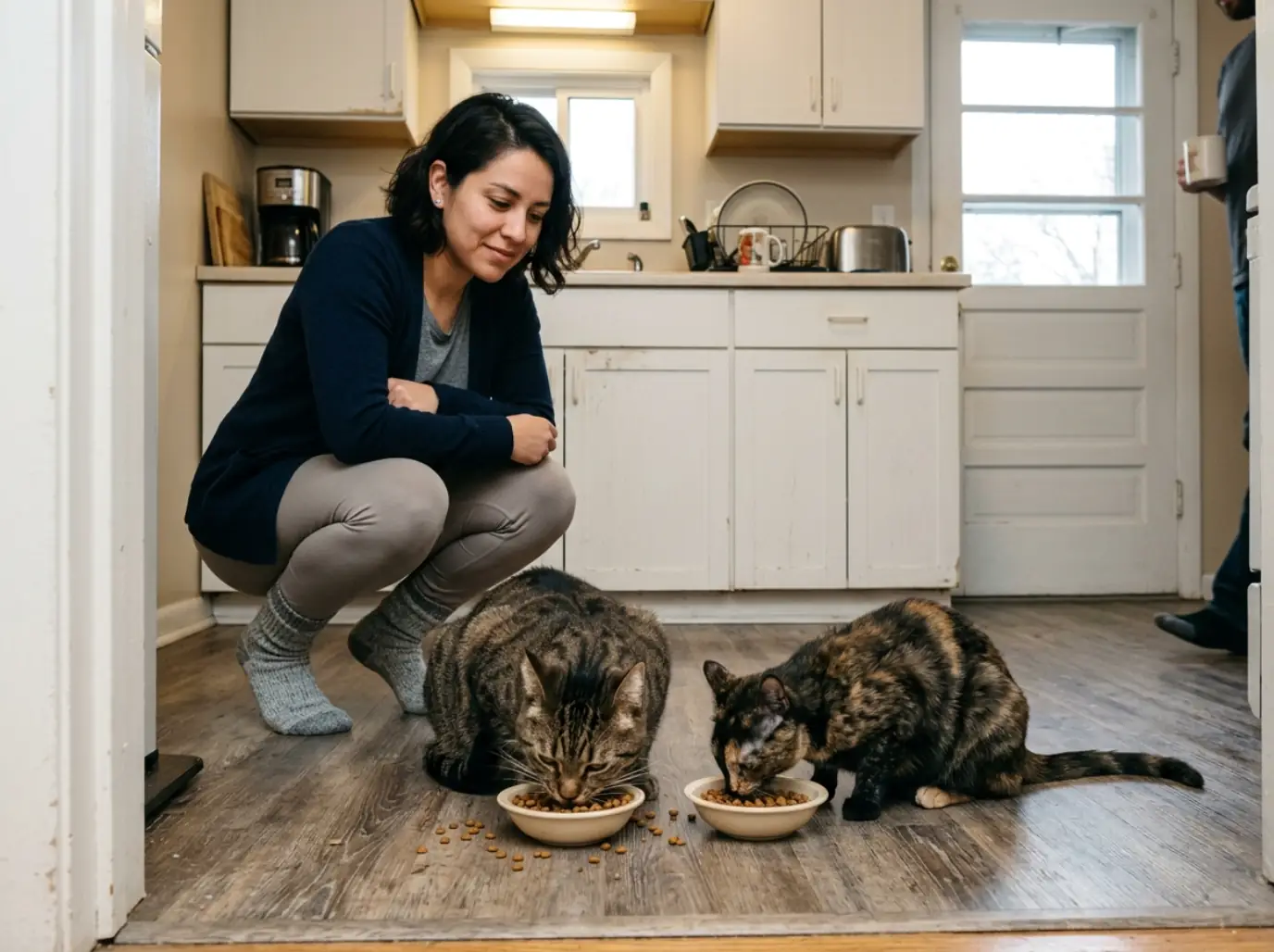
Add a second cat and the question quietly stops being what size and starts being how many, how far apart. Most two-cat homes answer it by buying one bigger bowl, which feels like the same solution scaled up. It isn’t. It’s a single point of contact where two animals now have to eat shoulder to shoulder.
One Bowl per Cat, and Why Spacing Beats Capacity
The default is one bowl per cat, each sized individually by the rule above. A shared oversized dish is a convenience decision made by the person doing the filling, not a sizing decision made for the cats. Those are allowed to be different things, as long as you know which one you’re making.
And spacing does more work than capacity ever will. Two correctly sized bowls with real distance between them, ideally not even in each other’s eyeline, beats one large surface every time, because the problem was never how much food fits. It’s that two cats eating within a whisker’s reach of each other are both eating with one eye up.
Before you buy anything, pick up the second bowl you already own and move it to the other side of the room. Free, thirty seconds, and it fixes a surprising share of these.
In a multi-cat household the temptation is to build one feeding station and be done, and it’s worth saying that a spill-proof bowl doesn’t fix a spacing problem. If you do want matched dishes for two cats or more, the Ceramic Cat Food Bowl Set arrives as four wide, shallow bowls, which covers one per cat with spares in rotation while the others get washed. None of them is an elevated bowl, and for most cats that’s fine: height is a comfort question, width is the clearance one.
Four ceramic bowls is also four things that break if you’re careless with a sink. The cheaper answer for exactly two cats is the Americat Company Stainless Steel Cat Bowls in 18/8 304-grade steel: two correctly sized bowls instead of one large one, which is the entire point of this section rendered as a purchase.
When a Single Large Station Is the Right Call
There is a version where one big surface makes sense, and it lives at the top of the range. Extra-wide communal bowls exist at around 16 inches across and up to 8 cups, and for a household of three or more cats where the routine is topping off dry food once a day, that’s a real answer rather than a lazy one.
It’s just not the default for two cats. The honest framing is that the human wants one bowl to fill and the cats want two bowls apart, and the cats are describing a constraint while the human is describing a preference. One extra refill a day is a cheap way to lose that argument gracefully.
Where the Wrong Size Shows Up, and Where It Doesn’t
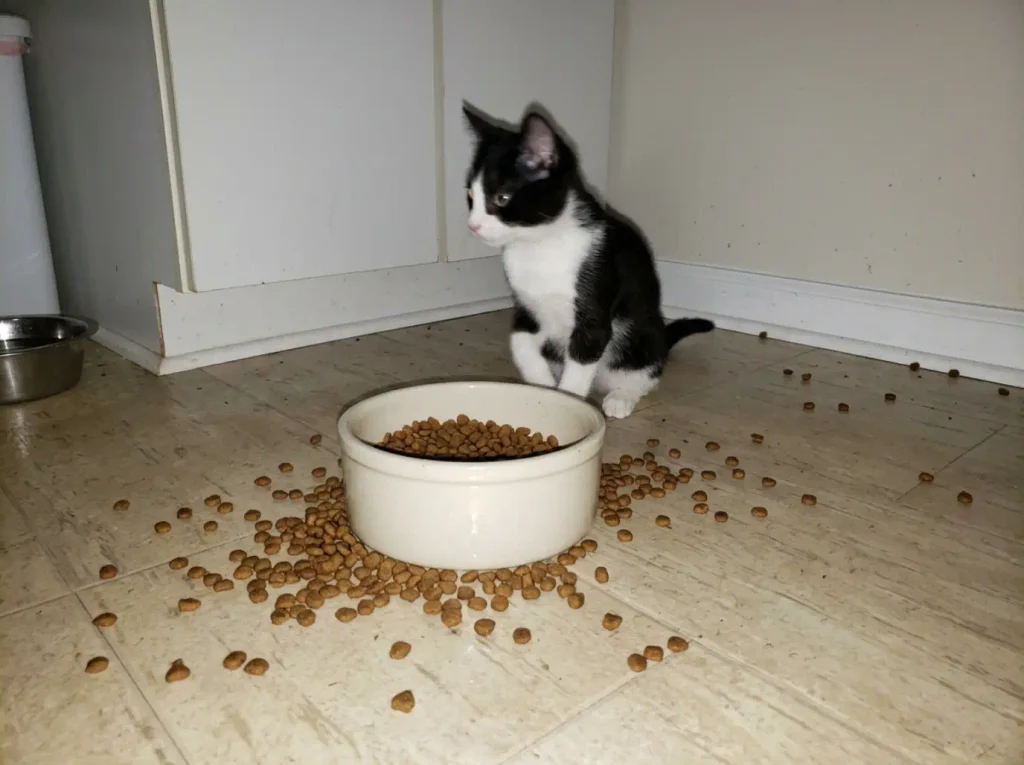
This is the section the searcher actually needs and nobody writes: how to tell the difference between “my bowl is wrong” and “something else is going on.” They look nothing alike once you know what you’re looking at.
The Tells That Are the Bowl
An undersized bowl announces itself the same way in every household. Kibble on the floor around the base. Pawing or scooping food out with a front foot before eating it. Eating from the edge of the pile rather than the middle.
Leaving a neat ring of food around the sides and walking away as though the bowl were empty. Whiskers visibly folding back as he commits his face.
The mechanism behind all five is one thing: straight-sided, deep, narrow bowls trap food in the corner where the wall meets the floor of the dish, and that corner is exactly where he can’t get to without pressing his face into the wall. So he gets it out with a paw and eats it off the tile, where nothing touches him. That’s not pickiness and it isn’t a training failure. It’s geometry, and he solved it.
The phrase that shows up over and over in bowl reviews after someone switches is some version of “my cat used to eat off the floor next to the bowl, not anymore.” Same cat, same food, different dish.
What a Bowl Cannot Explain
Sizing mistakes cause mess and frustration. They don’t cause weight loss, and this is where the line sits. Cornell’s Feline Health Center notes that a cat who refuses to eat and is losing weight needs a veterinary exam, not a new bowl. A cat whose daily water intake or eating drops off a cliff is a phone call today, and everything in this article assumes that call already happened and came back clear.
Back to geometry. A cat with a bowl problem is eating — he’s just eating badly, and around the bowl rather than in it. He’s interested in the food, he approaches it, and the mess is the evidence of him working around an obstacle.
That’s a different picture from a cat who walks up, looks, and leaves. Knowing which one you have tells you whether you’re shopping or dialing.
Sizing the Water Bowl, Which Is a Different Sum
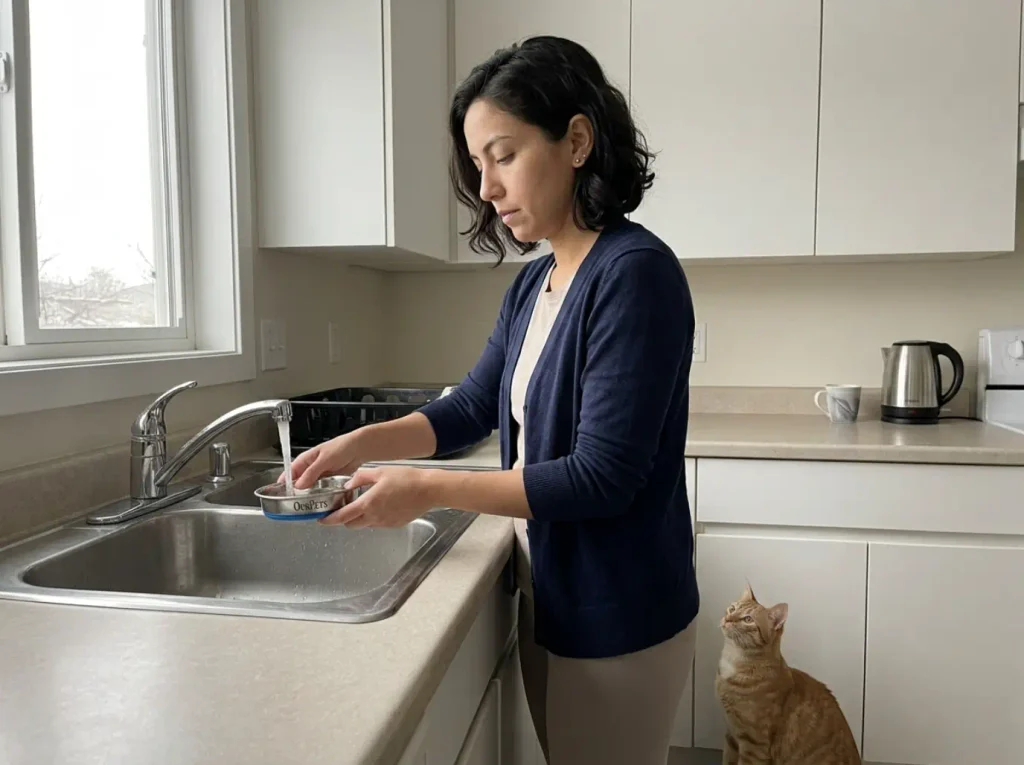
Once the food bowl clicks as a width problem, the water bowl stops being confusing. Nothing about drinking puts his face against a wall, so the whisker rule releases its grip and the only real question left is how much it holds and how often it gets emptied.
Capacity, and Why Topping Off Is the Wrong Habit
Size it so it carries a full day comfortably without you thinking about it, and then here’s the part that matters more than the number: empty and refill rather than top off. Topping off means the water at the bottom is never the water you poured, and the film that builds on the inside wall never gets interrupted. Run a finger around the inside of a bowl that’s been topped off for a week and you’ll feel it before you see it.
A wide bowl still helps a broad-faced cat, so don’t read this as permission to buy something narrow. It just means depth isn’t the villain here that it is on the food side. For small portions and kitten-scale drinking, a one-cup bowl is the reference point, and the OurPets DuraPet Stainless Steel Non-Slip Cat Bowl is the version of that with a non-skid base, which is the detail that stops a light bowl traveling across a kitchen floor.
It’s also worth splitting the two food bowls in your head: a dry food bowl only has to hold kibble in one layer, while a wet food bowl gets scraped at and washed every single day, so the easier one to clean wins. One cup is genuinely small, though. For an adult cat you’re refilling it more than once a day, which is fine if you’re home and annoying if you’re not.
Sizing to the Routine You’ll Actually Keep
Cleaning cadence is part of sizing, and this is the piece that gets left out entirely. A bowl too big to fit comfortably in your sink or your dishwasher rack gets washed less often, and washing it less often cancels out the capacity you bought. The same film builds inside a fountain, on a schedule you can set, which is one of the honest arguments for the machine over the dish.
Pick the size you’ll actually keep washing. A system holds for about three weeks and then it doesn’t, and what breaks first is never the intention, it’s the friction. And if the bowl keeps going untouched no matter what size you land on, a moving-water source is a different question with its own answer.
Wash the food bowl daily and the water bowl daily too, not weekly. A perfectly sized bowl that stays greasy is still a bowl a cat eats around, and the dried film on a food dish is the one variable people never test when they’re convinced the size is the problem.
The Size Is Right When the Floor Stays Clean
Three things to take out of this. Measure the whisker span first and add half an inch to an inch, because most of the answer is sitting in that one number and it costs you two minutes to get it. Food is sized by width and depth (5.5 inches minimum, under two inches deep, 6 to 7 inches for a large breed) while water is sized by what it holds — two rules, two bowls, and the matching set satisfies neither on purpose. And two cats means two bowls with distance between them, not one bigger bowl, because the thing you’re solving for is proximity rather than volume.
Check back in three weeks, not three months. Watch one meal. If the floor around the base is clean and he’s eating from the center of the dish rather than picking at the edge, the size is right and you’re done thinking about it.
Start with the bowl already on your floor. Ruler across the top, ruler down the inside. If it clears his span and sits under two inches deep, you just saved the money and the problem is somewhere else.
Amazon’s Audible — free for 30 days
Your cat won’t let you read. Let someone read to you.
Audible is Amazon’s audiobook library — thousands of titles, read out loud, on your phone. Free for a month, plus one audiobook to keep forever.
Frequently Asked Questions
01Do cats prefer deep or shallow bowls?
Shallow, and it is less a preference than a clearance problem: a deep rim contacts the whiskers on every bite. Keep the food bowl under about two inches deep and the question mostly answers itself.
02What is the best depth for a cat food bowl?
Under 1.5 to 2 inches. Real products that get this right cluster tightly in that band, commonly 1.2 to 1.5 inches, and a standard cereal bowl at two and a half inches or more is a mismatch even when its diameter is fine.
03What is the best shape for a cat food bowl?
Wide and shallow with sloped rather than straight sides. Straight-sided bowls trap food in the corners, which is what makes a cat paw kibble out onto the floor to reach it.
04Why don’t you put a cat’s water next to their food?
Many cats drink more when the water sits away from the food bowl, so separating them is a cheap thing to try. It also keeps stray kibble out of the water, which means you are emptying and refilling a cleaner bowl.
05What size water bowl does a cat need?
Big enough to carry a full day without topping off, which for most single-cat homes is a modest bowl emptied and refilled once daily. Capacity is the only sum here; the whisker clearance rule belongs to the food bowl.
Leave a comment