Best Cat Food Bowls for Wet Food, by Depth
Wet food bowls, by the numbers: 1.5 inches deep max, 5.5-6.5 across for whisker clearance + real weight, because shallow dishes are the ones that tip.

Alfredo RamsesFounder · August 31, 2026 · 21 min read

On this page8 sections
- 1Wet Food Does Not Behave Like Kibble in a Bowl
- 2Depth First: Under an Inch and a Half, and Why
- 3What Material Does When Food Sits Wet Against It
- 4A Shallow Bowl Needs More Weight, Not Less
- 5The Wash-Every-Meal Reality, and How Many Bowls That Means
- 6The Picks, Matched to the Four Things That Matter
- 7What to Do With This
- 8Frequently Asked Questions
The bowl is not empty. There is a ring of food pressed up the walls, a third of the meal still sitting in the bottom, and the cat has walked away from it. That is not fussiness, and it is not the flavor.
Wet food does something kibble never does, and it is why a canned food bowl is not just a smaller version of a kibble one: it sticks to whatever it touches, so the last of the meal ends up flattened against the sides where she has to push her whiskers into the wall to reach it. The shape that fixes this is not the shape most cat food bowls for wet food are made in, and the number that decides it is depth. Below you get what depth actually does, how wide is wide enough, which materials survive food sitting wet against them twice a day, why a shallow bowl needs more weight rather than less, and how many dishes a wet-food house really needs to own.
Quick Answer
A bowl earns the wet-food job on five counts, and depth is the one that decides it:
- Shallow: an inch and a half of wall height or less
- Wide: 5.5 to 6.5 inches across, so whiskers never touch
- Non-porous: stainless steel, glass, or certified food-safe glaze
- Weighted, or with a genuinely wide flat footprint
- Enough dishes to wash a whole one after every meal
Wet Food Does Not Behave Like Kibble in a Bowl
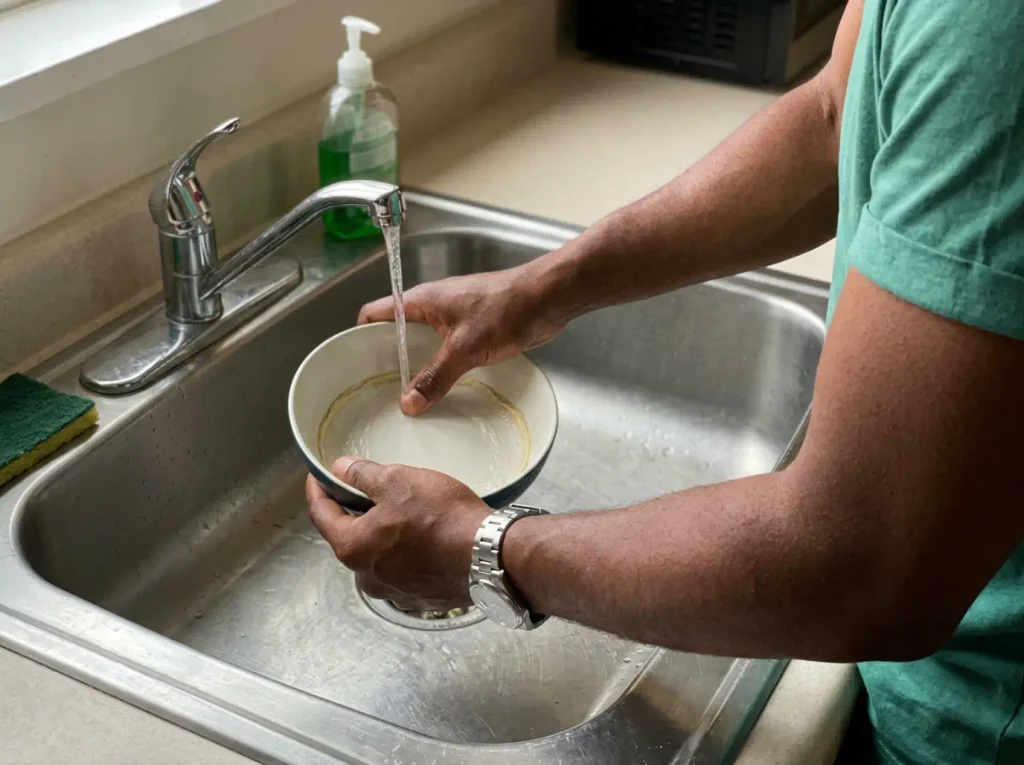
Kibble pours. It settles flat, and when the cat noses at it, it rolls back toward the middle where her mouth already is. Wet food coats. It presses outward and upward against whatever wall it meets, and then it stays there, because nothing about a pâté is going to slide back down a vertical surface on its own.
That difference has two consequences, and the first one is the last third of the meal. Once the food is on the walls instead of the floor of the dish, your cat has to put her face further in to get at it. In a deep bowl the walls arrive at her whiskers before her mouth arrives at the food, so she eats the accessible middle, backs off, comes back to fish at the edges twice, and gives up. What you find later reads like a rejected meal.
What actually happened is that the dish ran out of reachable food while it was still a third full.
The second consequence is the wash, and this is the sentence that changes what you buy. A kibble bowl gets a shake and a refill. A wet-food bowl has protein residue drying onto it, and vet-reviewed cleaning guidance puts washing after every single use as the ideal with daily as the bare minimum. Not a rinse.
A full wash, with soap, twice a day if you feed twice a day.
Before you buy anything, tip the bowl you already own toward the light right after a meal. If you can see a ring of food above the level of what is left in the bottom, that ring is what your cat is being asked to press her whiskers into to finish her dinner.
The bowl that looks clean and is not is the same story running one step later. Dried food collects in the seam where the wall meets the floor of the dish, a rinse never reaches it, and a porous surface holds onto it in a way steel or glass does not. If you want the full argument about which bowl material holds up in a house with cats, the Bowls pillar covers it across every use; this article narrows it to the wet-food case, where moisture sits in contact with the surface for hours rather than minutes.
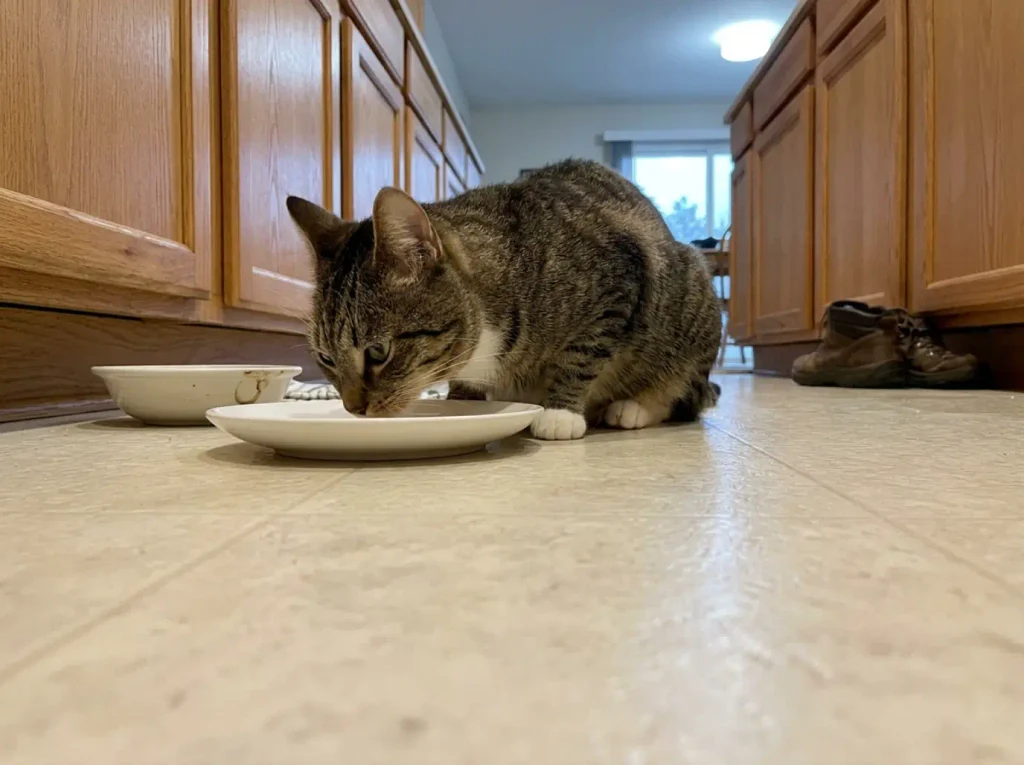
And the free fix comes before any of it. If you own a shallow saucer or a side plate, most of the answer is already in your kitchen cabinet. The rest of this is about what to own if you would rather stop washing a deep dish under the faucet with your thumb.
Depth First: Under an Inch and a Half, and Why
Every article about this says shallow and wide. Almost none of them say how shallow, which is how people end up buying something shallower than what they had and still too deep for the job.
The working figures are depth of an inch and a half or less and width of 5.5 to 6.5 inches across. Those two numbers solve two different problems, and most bowls on a shelf solve only one of them.
Depth Is What Strands the Food
A wet-food meal is a small volume spread over a large area, which is the exact opposite of what a bowl was invented for. A dish that is close to flat still holds a full portion fine, because the portion was never deep to begin with: a standard can of pâté flattened out is roughly a half inch of food across a six-inch circle. Give it two inches of wall and you have not given the food anywhere useful to go. You have given it somewhere to climb.
Watch what a cat does when the depth is wrong and the pattern is always the same. She eats the middle, backs off, returns twice to work at the edges, then leaves. In forum threads that abandoned-at-two-thirds bowl gets blamed on the food brand constantly, and people switch flavors three times before anyone suggests the dish. It is usually the dish.
Width Is What Keeps the Whiskers Clear
Depth strands the food. Width is what keeps her face out of the walls while she is getting to it. An adult cat’s whisker span runs a little wider than her head, and the working minimum of 5.5 inches across exists so that the whiskers stay in open air the entire time her mouth is down. Go under that and you are asking her to fold them against the rim for every bite, which is a thing cats will do for a while and then quietly stop doing.
The two numbers have to arrive together. A tall narrow tumbler is a failure on both counts. A wide but deep serving bowl fixes the whiskers and still buries the last of the meal against the sides. What you want is closer to a saucer than to a bowl.
Worth one line here and no more: food bowls and water bowls do not want the same dimensions, and the sizing rules for each split at exactly that point.
Whisker Fatigue Is Contested. The Geometry Is Not.
Whisker fatigue is a retail term before it is a veterinary one. There is no settled consensus behind it as a named condition, and if you want to argue about the label, that argument is genuinely open.
The geometry underneath it is not open at all. A narrow dish puts hard walls exactly where the whiskers are — the vibrissae, which are wired for touch and not decoration — cats leave food in dishes that do that, and a wider dish stops it happening. You do not have to accept the diagnosis to accept the fix, which costs you nothing either way.
Here is where I have changed my own position. I used to treat shallow-and-wide as a nice-to-have, a comfort upgrade for a cat that was already eating fine. After enough threads describing the same two-thirds-eaten bowl and the same three flavor changes that did not help, I stopped calling it comfort. For wet food it is the difference between a finished meal and a wasted one.
What Material Does When Food Sits Wet Against It
The material argument usually gets made in the abstract, in terms of scratches and vague bacteria. With wet food it is concrete: this is a surface with protein drying onto it twice a day, every day, and moisture is what starts the clock. Biofilm can establish itself in a porous surface within about a day of moisture being present, and wet food supplies that moisture at every meal in a way kibble never does.
Stainless Steel, and What a Scratch Costs You
Stainless steel is the default here for reasons that hold up. It is non-porous, it goes in the dishwasher, and at 18/8 304 grade it has been independently lab-tested free of lead, mercury, and cadmium. In comparative testing it resists bacterial colonization by a wide margin over plastic.
But that advantage lives in the surface, and it is conditional. A scuffed, scratched steel bowl has lost most of what you bought it for, because the scratches are exactly the shelter the smooth surface was denying. Check the inside floor of a steel dish once in a while, and when it stops being smooth under a fingertip, retire it.
Steel is cheap. That is part of why it wins.
Ceramic, and What “Food-Safe Glaze” Has to Mean
Ceramic works, with a condition attached to it that most boxes do not explain. “Lead-free” printed on packaging is a manufacturer’s claim, not a certification. The FDA’s lead-leaching test for ceramic soaks the piece in acid for a full day and measures what comes out against a numeric limit. That is a real, checkable standard. A phrase on a sleeve is not.
Buy ceramic that states food-grade compliance and you have solved something else by accident, which is the honest reason to like it: a heavy ceramic dish is also the answer to the stability problem in the next section. It does not slide, because it is too heavy to slide. Its catch is the flip side of the same fact. It is heavier to lift, heavier to hand-wash, and it chips, and a chipped or cracked glaze is a place bacteria live.
Glass, and the Trade-off Nobody Prints on the Box
Glass is as non-porous as steel and it has one advantage neither of the others has: you can see through it. Whether a glass dish is actually clean is not a judgment call, which matters more than it sounds when the thing you are checking for is a film in a seam.
Its catch is obvious and worth saying plainly rather than burying in a footnote. It breaks. Vet-reviewed guidance treats glass as a temporary option rather than the everyday one for exactly that reason, and a kitchen floor is not a forgiving surface. If you have a tile kitchen and a cat who shoves her dish around, this is the material that punishes that hardest.
One honest line and then this article stops: if you are already seeing bumps on her chin or a change in the skin there, that is a vet visit, not a bowl swap. Bowls are furniture. Skin is medicine. The plastic side of that conversation belongs to its own article, and the plastic and chin acne question has two answers, not one.
A Shallow Bowl Needs More Weight, Not Less
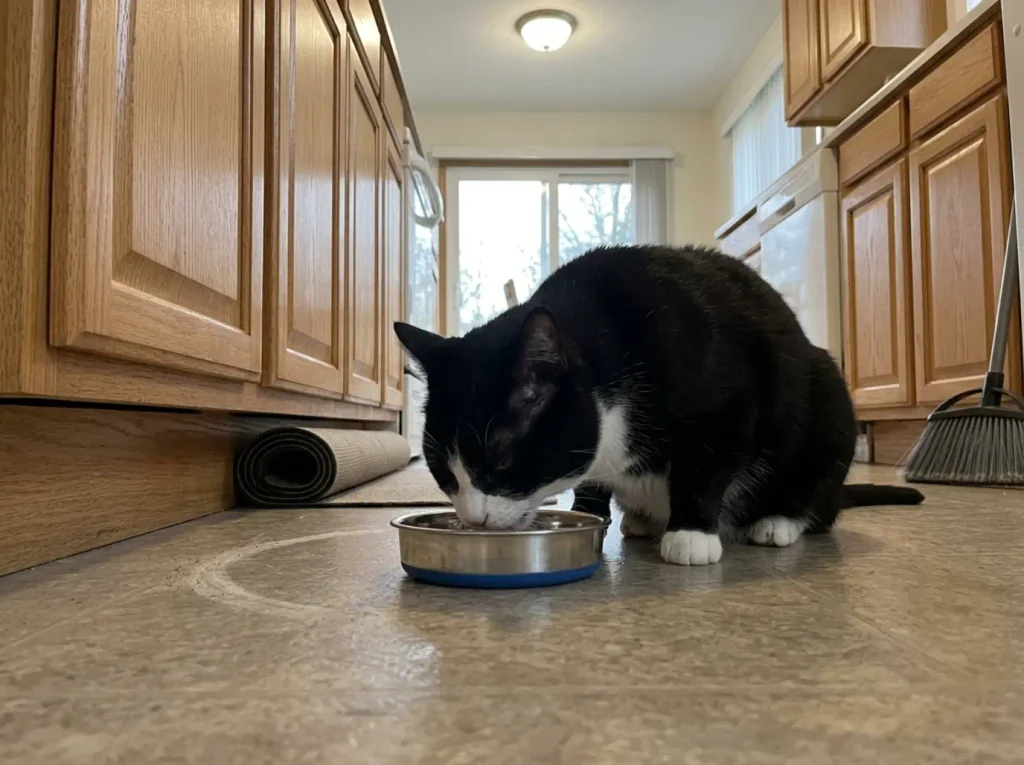
Here is the gap every roundup leaves open. They recommend shallow and wide, then list “non-slip” three bullets later as a generic checkbox, without noticing that shallow and wide is precisely why the thing needs holding down.
Why the Walls Were Doing More Than You Thought
A deep bowl has walls, and the walls were doing two jobs. They held the food in, and they gave the cat something to push against without moving the whole dish. Take them away and every nudge of her nose becomes a shove across the tile. So you fix the whisker problem and you inherit a stability problem, and you find the dish three feet from where you set it down, upside down, with dinner on the floor.
That is not the cat being destructive. She is pushing at the food the way she would push at food anywhere, and you handed her a plate with nothing to brace against.
Weight, Footprint, or Rubber, in That Order
Three things actually resist this, and they are not equal. Real weight in the dish itself is the strongest, because nothing about a heavy ceramic or a weighted stand cares how hard she pushes. A genuinely wide flat footprint is second, since a shallow dish that spreads its base out has to be lifted at an angle before it can flip. A rubber or silicone ring bonded to the underside is third and still useful.
A light plastic dish with four little rubber feet is the weakest of all of them, and it is also the most commonly sold.
Before you buy any of that, try the free version: a rubber-backed mat under the bowl you already own. If there is one in the kitchen you are done for nothing. It kills the sliding. It does not stop the flipping, which is a separate problem that needs mass.
Set the bowl down empty and push it sideways with one finger, the way a nose would. If it travels, she will travel it further, and she will do it twice a day for the next several years. That single push tells you more than any product description about non-slip feet.
There are reasons a cat pushes a dish around that go beyond simply knocking it, and if yours relocates the bowl on purpose rather than by accident, the behavior behind moving a food bowl is worth reading on its own. This section only needs the mechanical half of it.
One sizing note belongs here rather than earlier. The useful rule of thumb is a dish about one and a half times the actual portion, not the biggest one you can find. A dish much wider than the meal gives the food room to get pushed out to the far edge and abandoned there, which recreates the exact problem the width was supposed to solve.
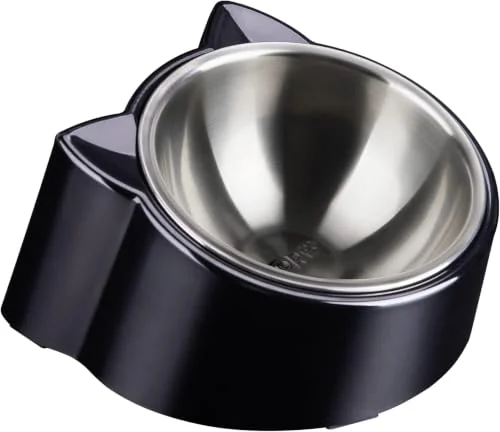
The Tilted Option, and Who It Is Actually For
For a senior cat with stiff joints, or one with diagnosed arthritis, the reach down into a floor-level dish is its own problem and it has nothing to do with whiskers. A tilted bowl changes the angle of her neck rather than the depth of the dish, and the marketed slant sits somewhere around twelve to fifteen degrees. An elevated bowl does something related but not identical: it raises the whole dish instead of angling it, which helps the reach without addressing the neck. If an older cat is eating in short bursts and standing up between them, the neck is a fair thing to suspect before the food is.
Honestly, this is one paragraph and not a section, because it is a different problem for a different cat. If yours is young and eating comfortably, a tilt buys you nothing that depth and width did not already buy.
The Wash-Every-Meal Reality, and How Many Bowls That Means
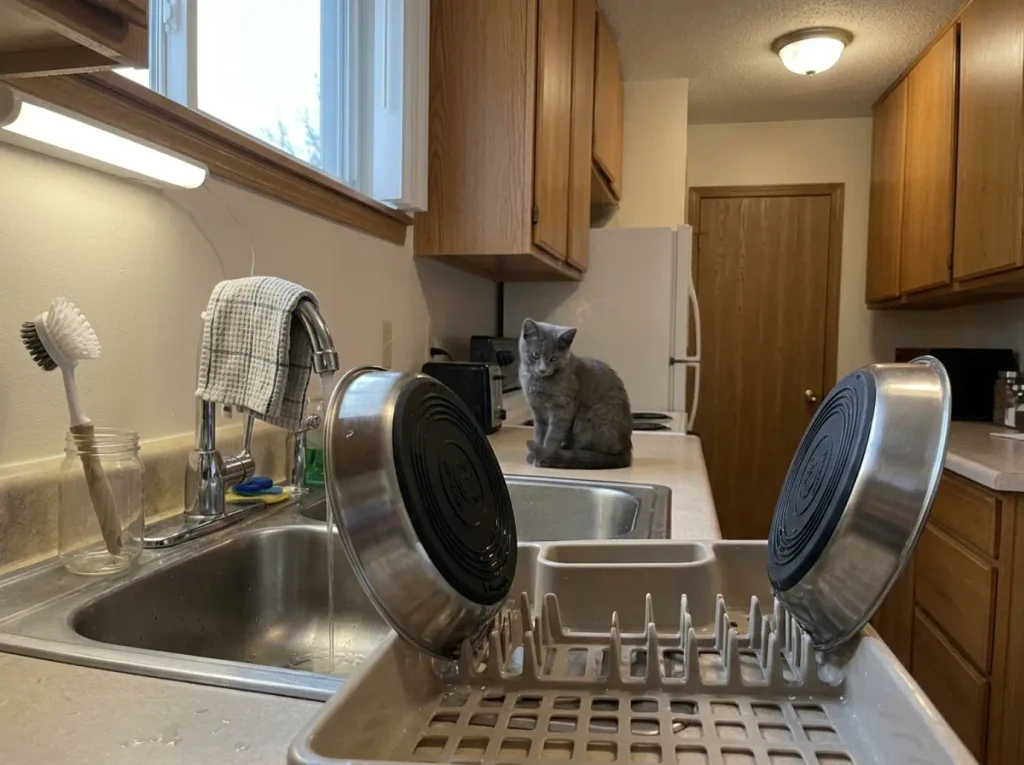
Nobody buys “a set of bowls.” They buy one nice bowl, and then they discover they are washing it under the faucet between meals with the cat sitting on the floor watching them do it.
What “Wash After Every Meal” Actually Involves
In plain terms: a full wash with soap after each wet meal, plus a weekly disinfection on top of that. The vet-reviewed version of the weekly step is a soak of around five minutes in a heavily diluted bleach solution, rinsed and air-dried overnight. That is the standard. Whether you hit it every single week is between you and your kitchen, but it is worth knowing what the target is before deciding a rinse was enough.
The reason it is stricter than kibble is not fussiness about hygiene. Wet food puts moisture on the surface at every meal, and moisture is what lets biofilm get established inside a day.
How Many Bowls a Wet-Food House Needs
Here is the consequence nobody prints on any of these product pages. One bowl per cat per meal, not one bowl reused all day. Two wet meals a day means two clean dishes a day, which quietly makes a two-pack or a four-pack a more honest purchase than one premium dish, no matter how good the premium dish is.
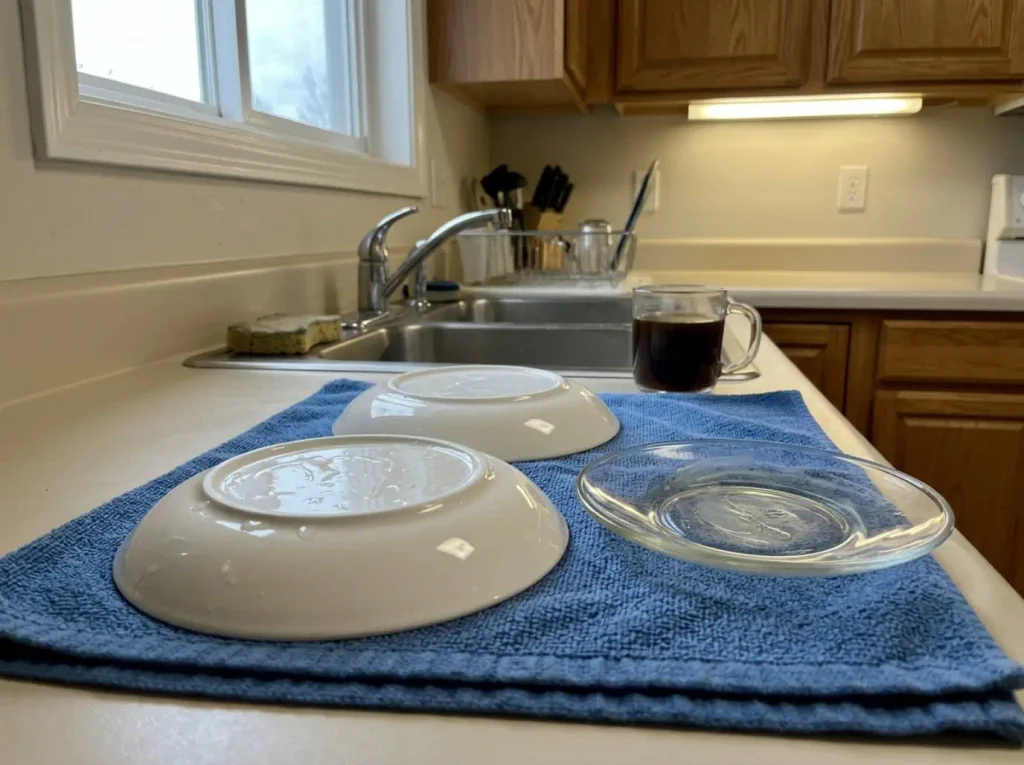
The free version first, as always: the dishes you already own. A side plate is shallow and wide by definition, it goes into the dishwasher with everything else, and there are already six of them in the cabinet. Buy a dedicated set when you want something that stays put and does not cost you a dinner plate’s worth of cabinet space. And if you have two cats, the arithmetic on how many bowls you need changes again, in the sibling’s territory rather than here.
There is a constraint the entire search results page ignores, and it is the one most renters are living in. No dishwasher means hand-washing twice a day, forever, and that changes which feature decides the purchase. It stops being material and becomes shape.
A dish with a tight, sharp seam where the wall meets the base is a dish you will clean badly every time, because a thumb and a sponge cannot get into a right angle. A dish with a rounded interior gets clean in one pass under running water.
Run a fingertip around the inside seam where the wall meets the base after you have washed a dish. If it comes away tacky, that seam is the part of the bowl that never actually gets clean, and it is the first thing to check on any dish before you buy a second one just like it.
If You Leave It Out for Hours, the Advice Inverts
One honest exception, because pretending a single shape covers every case would be the easy thing to do here. If you free-feed wet food and it sits out for hours, you want less exposed surface, not more. A wide shallow dish maximizes the area drying out and putting odor into the room, and in warm weather that same exposed surface is what draws flies to the dish. Both are exactly what you were trying to avoid.
That case runs against everything above, and it should. Wide and shallow is optimized for a meal that gets eaten in one sitting. If your cat grazes at the same portion across an afternoon, a smaller dish with a smaller opening keeps it edible longer, and you trade a little whisker clearance to get that. Pick the problem you actually have.
The Picks, Matched to the Four Things That Matter
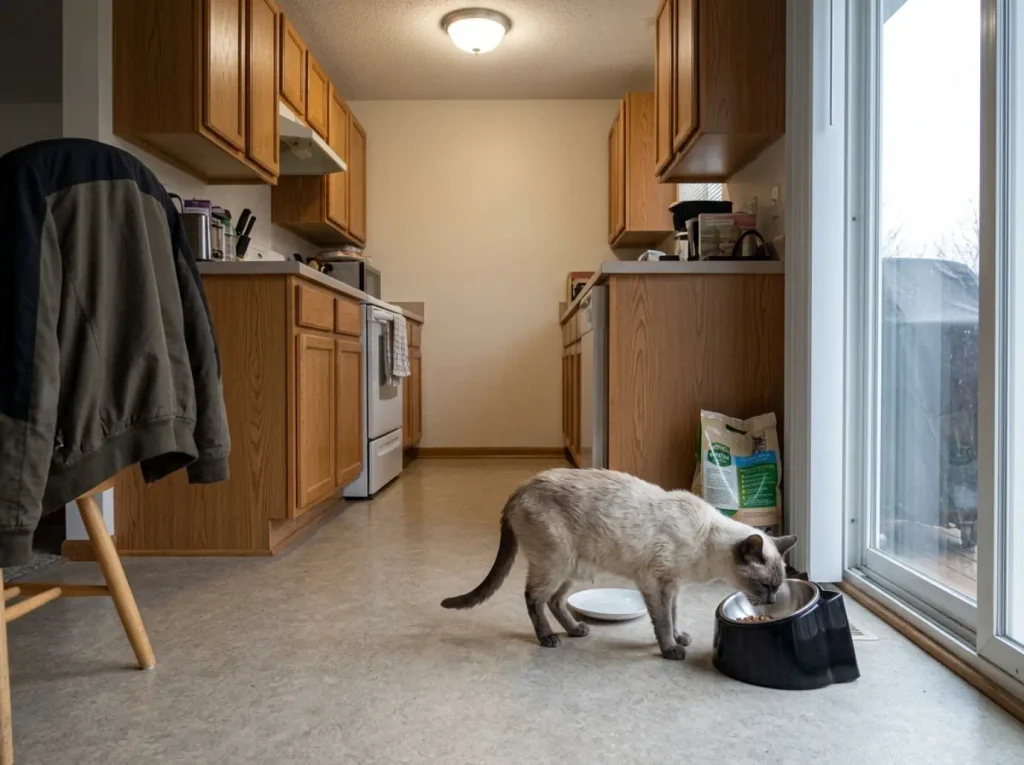
You now know what to look for, so this part exists only so you do not have to go and find it yourself. It is a mapping rather than a ranking. Each pick answers one of the four things this article established: depth, material, stability, rotation.
| Bowl | Material | Depth / width | Best for | The catch |
|---|---|---|---|---|
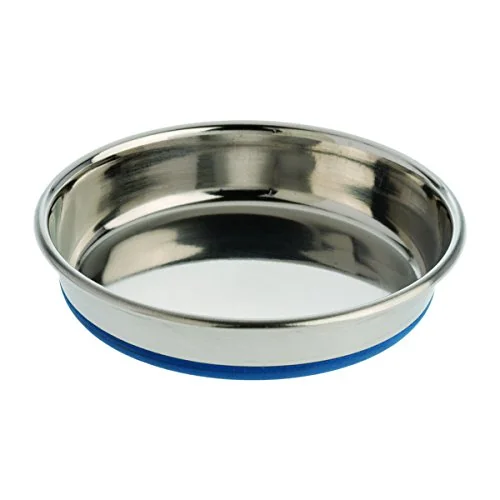
| OurPets DuraPet | Stainless steel | About 1 in deep, 1 cup | The depth problem, solved cheaply | One dish, one meal |
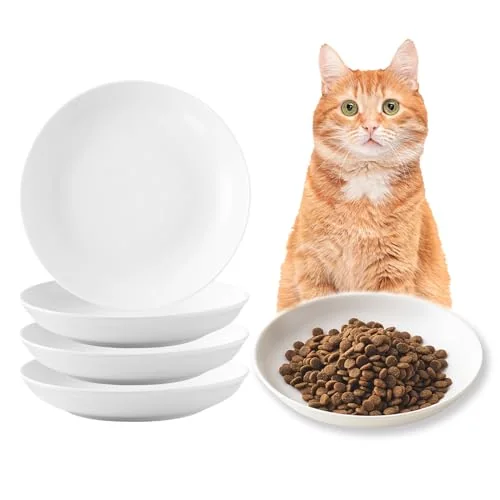
| Ceramic Bowl Set (4-pack) | Food-grade ceramic | Wide and shallow, 4 dishes | Weight and rotation in one buy | Heavy to lift, heavy to hand-wash |
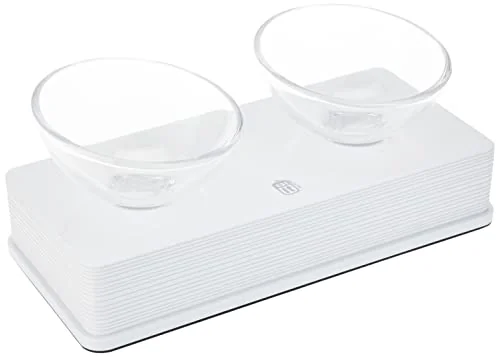
| Catit Style Glass Diner | Glass | 6.8 fl oz each, 2 dishes | Seeing that it is actually clean | It breaks, and tile is unforgiving |
| CATPRO Tilted Feeder | Steel on melamine stand | 5.5 in dish at 15° | An older or stiff cat’s neck | Takes real floor or counter space |
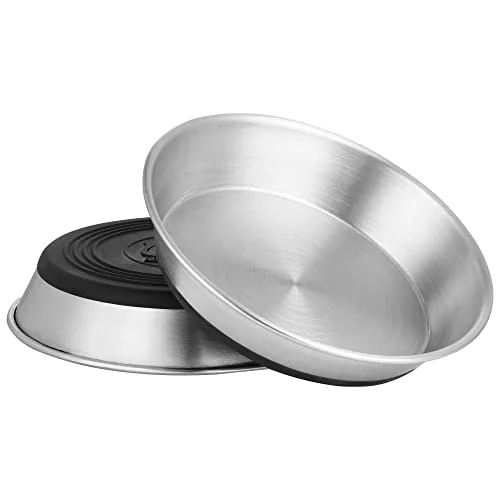
| WROSWT 2-Pack | Stainless steel | 1.22 in deep, 5.98 in wide | The twice-a-day wash cycle | The plainest looking of the five |
If the Problem Is Depth
The OurPets DuraPet and the WROSWT pair are the same answer at two different scales. Both land at roughly the wall height this article argues for, both are non-porous steel, and both cost very little. The DuraPet is the one to buy if you want a single well-made dish with a bonded rubber ring under it. The two-pack is the one to buy if you already know you feed twice a day and washing between meals is the thing you keep failing at.
If the Problem Is the Wash Cycle
Four ceramic dishes or two steel ones. The ceramic set buys you the most slack, since four dishes covers two full days of two meals before anything has to hit the sink, and the weight means no mat is required. The steel two-pack is the cheaper version of the same logic and the one that goes into a dishwasher without a second thought. The glass diner sits between them: fewer dishes, but the only material where clean is something you can confirm with your eyes instead of a fingertip.
If the Cat Is Older or Stiff
The tilted stand, and only for that reason. A fifteen-degree slant does nothing for a cat who is eating comfortably, and it takes up more room than any flat dish here. It earns its place when the reach down is the part that has gotten hard, which is a different complaint from a half-finished bowl.
And one last time: if a side plate from your own cabinet is working, nothing on this list beats it by enough to matter. Buy something when you want it to stay where you put it, not because the plate was wrong. If the real issue is food ending up around the dish rather than in it, the mess pattern matters more than the food type and that is a different article.
What to Do With This
Depth is the decision. An inch and a half of wall or less, with real width behind it, and the abandoned last third of the meal stops happening on its own.
Shallow costs you stability, so buy the weight back. Put it in the dish itself or in a genuinely wide footprint, not in four rubber dots on the underside of something light.
Wet food means a full wash after every meal, which makes two or four dishes the honest purchase instead of one good one.
Check back in three weeks. Not three months: this depends on your cat accepting a new dish and on you keeping a washing habit, and both of those either take or slip inside a month. Look at two things. Is the bowl still where you put it, and is it coming back empty? A slipping wash routine shows up in the bowl before it shows up anywhere else in the kitchen.
Try the side plate first. If the food starts coming back clean off a flat dish you already own, you have answered the question for free, and you also know exactly what to buy the day you want something that stays where you put it.
Amazon’s Audible — free for 30 days
Your cat won’t let you read. Let someone read to you.
Audible is Amazon’s audiobook library — thousands of titles, read out loud, on your phone. Free for a month, plus one audiobook to keep forever.
Frequently Asked Questions
01What type of bowl is best for wet cat food?
A shallow, wide dish in a non-porous material: stainless steel, glass, or ceramic with a genuinely food-safe glaze. Depth matters more than anything else, because wet food clings to the walls and a deep bowl strands the last of the meal where the whiskers hit the sides before the mouth reaches the food.
02What is the safest type of food bowl for cats?
Stainless steel at 18/8 304 grade is the most consistently tested option: non-porous, dishwasher-safe, and lab-certified free of lead, mercury and cadmium. Ceramic is safe when the glaze is properly food-safe, but lead-free on a box is a manufacturer’s claim rather than a certification, and the real test is a full 24-hour acid soak.
03Which food bowls are best for cats generally?
The shape rules are the same as for wet food: shallow enough that the face never has to drop below the rim, wide enough that the whiskers stay clear. A dry-food bowl can afford to be deeper, because kibble does not cling to the walls. The bowl that works for both is the shallow one.
04How often do you need to wash a wet food bowl?
After every meal. Wet food leaves protein residue that dries onto the surface, and vet-reviewed cleaning guidance treats washing after each use as the ideal with daily as the absolute minimum, plus a weekly disinfection. That cadence is the reason owning two or four dishes is more practical than owning one.
05Do cats actually get whisker fatigue from deep bowls?
The term is contested and there is no settled veterinary consensus behind it. What is not contested is the geometry: a narrow bowl puts its walls where the whiskers are, and cats routinely leave food in dishes that make them press their face into the sides. You do not have to accept the label to accept the fix.
Leave a comment