Why Cats Move Their Food Bowls Across the Floor
Two behaviors, not one [covering vs carrying]. Bowl width 5.5 inches minimum, depth under 2, and the rug-pad scrap that ends the sliding.

Alfredo RamsesFounder · August 31, 2026 · 19 min read
On this page8 sections
- 1Two Behaviors That Look the Same
- 2The Pawing Is an Instinct With Nowhere to Go
- 3The Bowl May Be Too Narrow for Her Face
- 4A Bowl That Slides Is a Bowl She Has to Chase
- 5Where the Bowl Sits, and Who Else Is in the Room
- 6When This Is a Vet Visit and Not a Bowl Problem
- 7What to Do Tonight
- 8Frequently Asked Questions
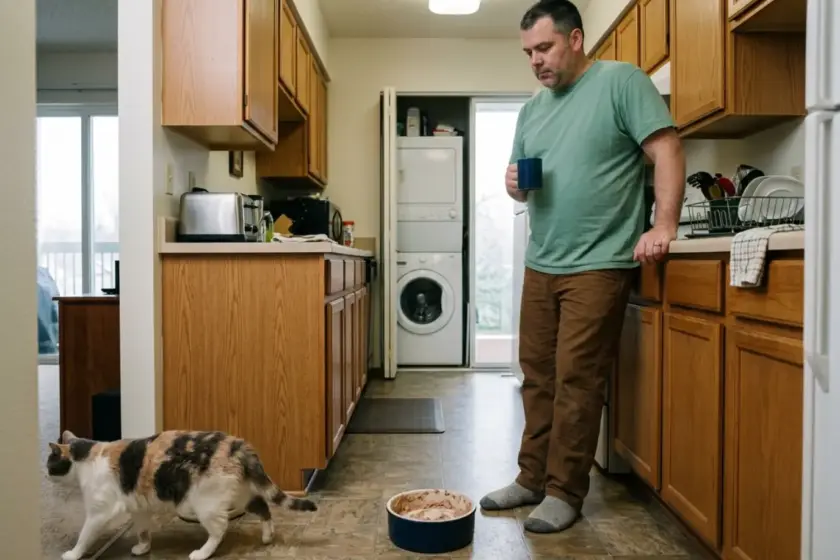
The bowl is not where you left it. You have been sweeping kibble out from under the radiator for a week, and somewhere in there you started wondering whether something is wrong with her.
Nothing is wrong with her. She is saying something about that bowl or that spot, in the only vocabulary she has, and the reason the advice you have found so far does not fit is that “she moves her bowl” describes two completely different behaviors that happen to leave the same mess on your floor. This is a house with two cats in it and someone who measures things, not a clinic, so the fix here starts with a tape measure rather than a theory.
So: first we split the two behaviors, because they look alike and mean opposite things. Then the measurement, the free fix, the multi-cat check, and the one version of this that belongs to a vet rather than to a bowl.
Quick Answer
Cats move food bowls for two reasons that get treated as one. Pawing at the floor around the bowl is scent-caching, an intact burying instinct running on a floor with nothing to bury. Dragging the bowl or carrying food away is a complaint: too narrow for her whiskers, too light for the floor, or the wrong spot. Start with a bowl at least 5.5 inches across and under 2 inches deep, on something that grips. If she is also eating less, that is a vet visit.
Two Behaviors That Look the Same
You have been describing this to people as “she moves her bowl,” and everyone answers a slightly different question. That is not because they are being unhelpful. It is because that one phrase covers two separate things with two separate causes, and thirty seconds of actually watching tells you which one you have.
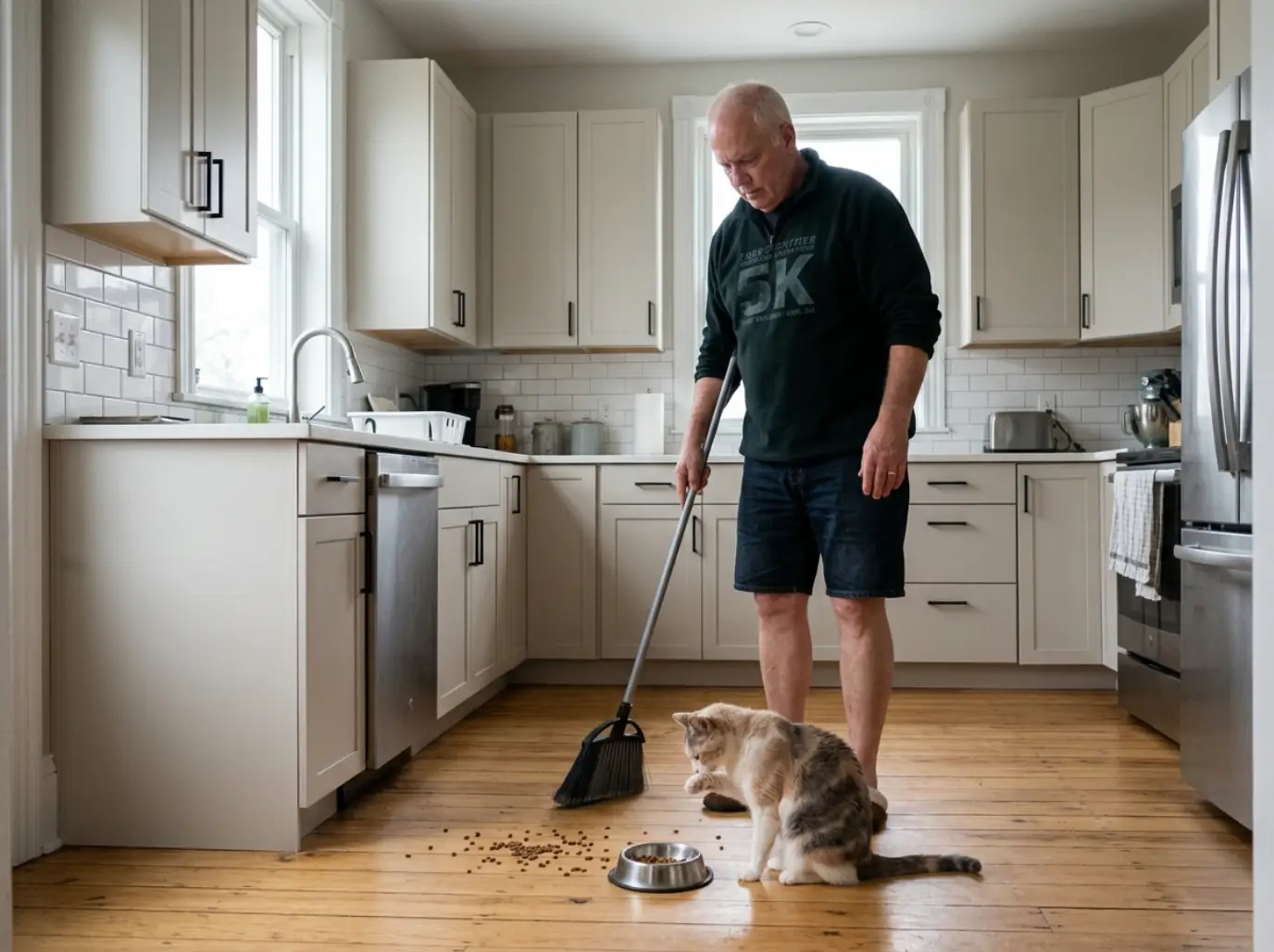
The tell is the direction of the effort. Paws moving toward the bowl is covering: she sweeps at the bare floor beside it, scrapes at the rim, sometimes works at the wall behind it, and nothing actually goes anywhere. The bowl or the food moving away from where it started is carrying: the dish travels, or a mouthful comes out and gets eaten on the tile six inches off.
Timing separates them too, and it is the easier tell if you catch only the aftermath. Covering happens after the meal, on a bowl that is mostly empty. Carrying happens during it, while there is still food to work with.
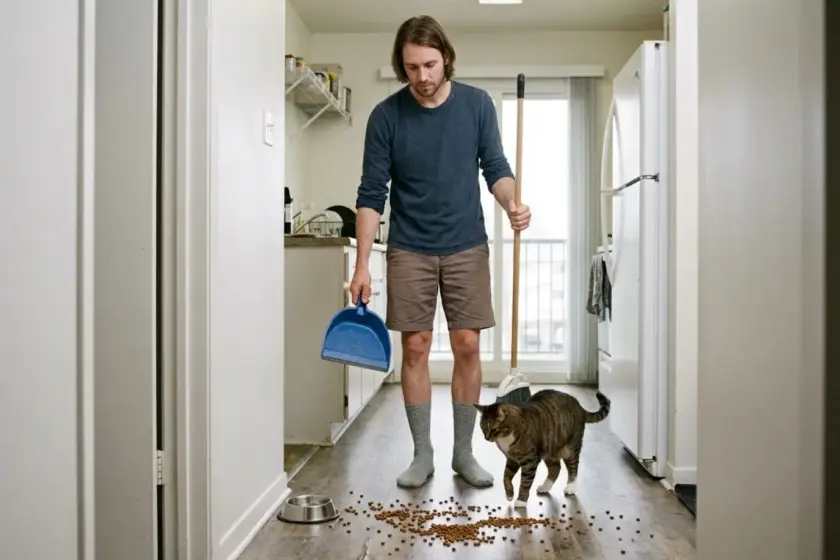
So the floor tells you which one you missed. If you find the bowl in a new spot but the boards around it are clean, that was carrying. If the bowl has not moved but there is dry food scattered in a rough arc beside it, that was covering. In a single cat home those two readings cover almost everything you will see.
Prop your phone against something and record one meal instead of trying to remember it afterward. Thirty seconds of video answers the covering-or-carrying question better than a week of noticing the mess, because the mess looks identical either way and you are always seeing it an hour late.
Plenty of cats do both, on different days, for different reasons. That is fine, and it is worth saying because the two answers do not overlap at all. Covering needs nothing changed. Carrying is the one pointing at your setup, and the rest of this article is mostly about carrying.
There is one overlap that matters, and it is the reason the last section exists. If either behavior shows up alongside her eating less, the split stops being useful and the question changes entirely. Hold that thought.
Everything below is about the bowl as a piece of behavior. If you also want the bowl as an object, what a cat bowl is made of, and where each material fails covers the material question this article deliberately leaves alone.
The Pawing Is an Instinct With Nowhere to Go
She finishes eating, then starts patting at bare hardwood beside an empty dish, hooking her paw toward the bowl over and over, moving precisely nothing. It looks faintly ridiculous, and it is the single most common reason people arrive at a search box convinced their cat has developed a problem.
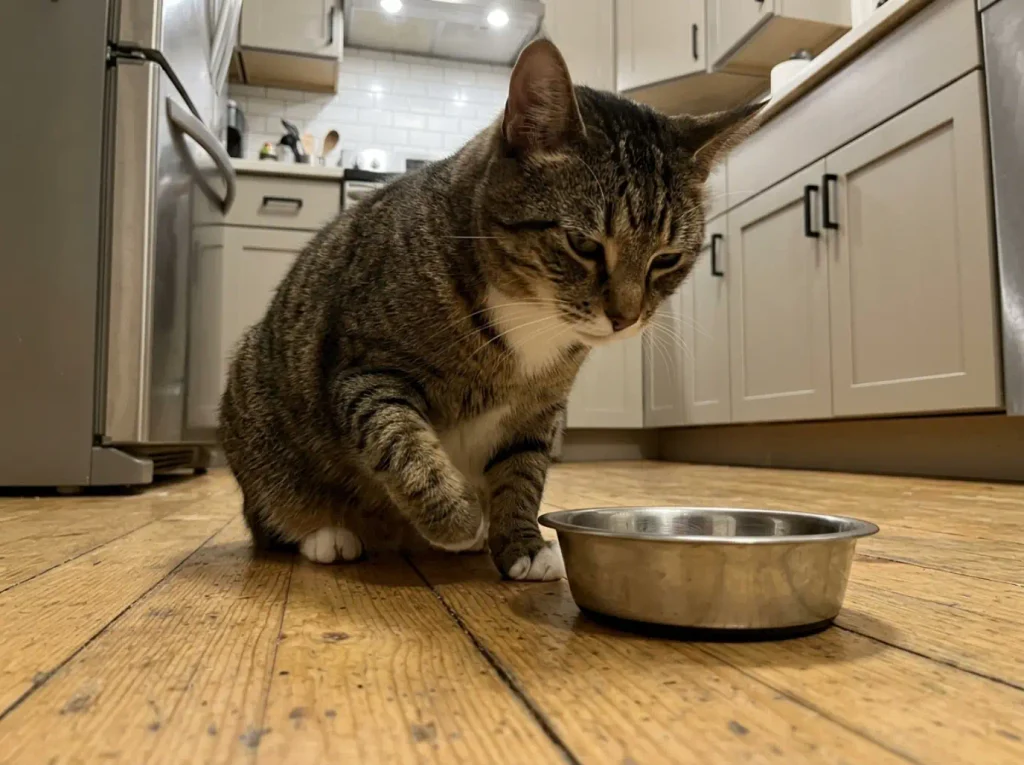
It is not a problem. It is food caching, and the whole routine is intact. A wild cat who cannot finish what she caught covers it: burying or scratching debris over leftovers hides the scent from scavengers and from anything larger that would happily take both the food and the cat.
Outdoors that works. On tile it moves nothing at all, which is why the motion looks unfinished. She is not failing at it. There is no dirt.
The predatory behavior that produced the habit is thousands of years older than your kitchen floor, and it did not come with an off switch.
The same scratching does a second job at the same time. The glands in her paws deposit scent on whatever she scrapes, so while she is trying to hide the smell of the food, she is also stamping the spot as hers. Two functions, one motion, and both of them fire on a kitchen floor exactly as they would on soil.
This is where the framing that most sites use goes quietly wrong. Read this as anxiety or as a broken cat, and you start changing things: the food, the bowl, the room, sometimes all three in a week.
And now she has a genuinely disrupted routine sitting on top of a behavior that was never disrupted in the first place. The instinct is not a symptom of stress. It is territorial behavior running normally, which is the stress-free version.
So here is the part almost nobody writes down, because it sells nothing: if pawing at the floor is all she does, you are finished. Nothing to buy. Nothing to move. The behavior costs you a small arc of scattered food and about four seconds with a broom, and the alternative is a cat with an instinct she cannot express.
If it bothers you aesthetically, a non-slip mat under the bowl catches the arc and gives you one thing to shake out instead of a floor to sweep. That is a housekeeping preference, and it is yours to have, but it is not a fix, because there was nothing to fix.
Honestly, this is the best possible outcome of reading an article like this one. Most of the time it is not.
The Bowl May Be Too Narrow for Her Face
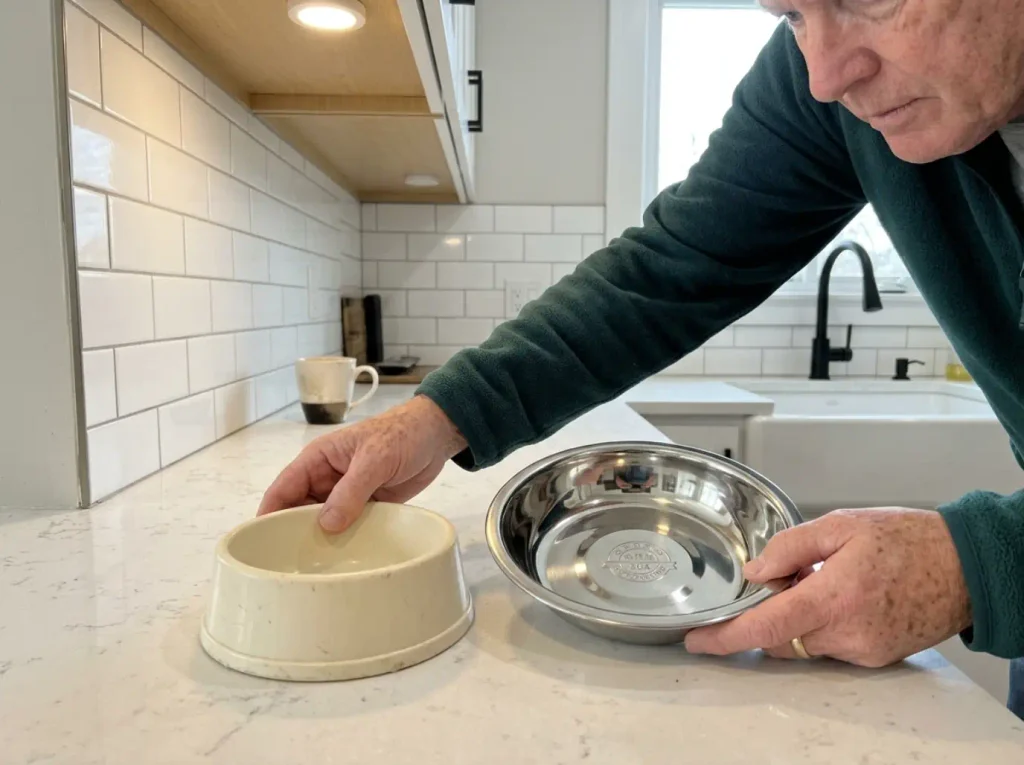
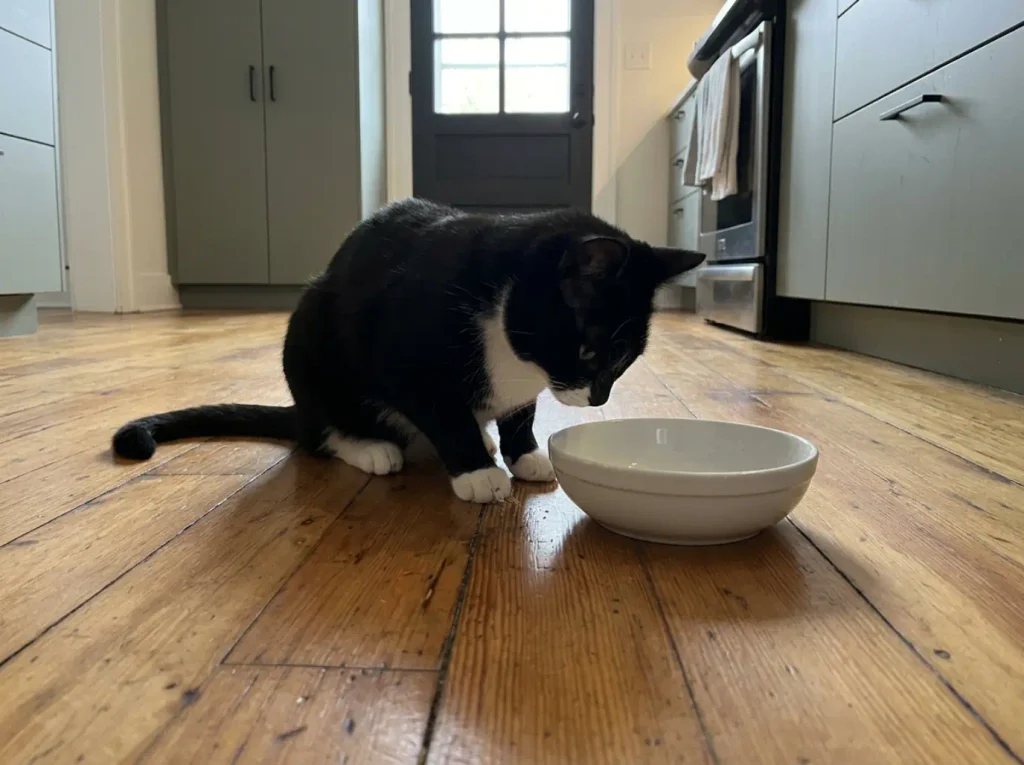
Different cat, different behavior. She eats from the middle of the dish, backs off, hooks a mouthful out onto the floor beside it, and eats that instead. Then she does it again. It reads as fussiness, or as her wanting you to know she is displeased with the service.
It is neither. That is a cat getting her face out of a dish that is touching her on both sides.
The mechanism is dull and physical. A deep, narrow bowl forces her whiskers to bend inward against the walls on every single bite. Whiskers are not decorative hairs; they are dense with nerve endings and they are how she reads the space right in front of her face. The term people use for the result is whisker fatigue, sensory overload rather than injury, and the behavior it produces is exactly this one: take the food somewhere the walls are not.
So here is the number, which is the part every competing page leaves out. An adult cat’s whisker span, measured across those stiff vibrissae on both cheeks, runs roughly 5 to 6 inches.
So a bowl of at least 5.5 inches across clears it. Six inches or more is better for a large cat or a long-whiskered one, and a big Maine Coon at full width will use every bit of that margin. Depth under about 2 inches. The free dish that shipped with a bag of food or came in a kitten starter kit is often around 4 inches across and deep enough to sink her face into, and that shape is the entire complaint.
Now the honest part, and it matters more than the number. Whisker fatigue, or whisker stress, gets stated as established fact across most of the pages that mention it, and it is not. At least one licensed vet has publicly said they have never encountered it as a clinical diagnosis in practice.
So treat it as a widely repeated behavioral theory that is cheap to test and easy to reverse, rather than as settled science. The wider bowl is still worth trying, because the swap costs nothing and the geometry argument stands on its own without the label. But it is worth knowing which of those two things is solid and which is not.
Which brings up the free fix, and it comes before the products because it always does. A saucer or a small side plate you already own is wider and shallower than almost any dedicated cat bowl sold. Put her food on one for a week. If the carrying stops, you just answered the question for the price of washing an extra plate, and you learned something no product page would have told you. This is also what people report doing in bowl threads before they buy anything, and reporting back that it worked.
If it works and you would rather not feed your cat off the good china permanently, the 4 Pcs Stainless Steel Cat Bowls are a shallow bowl at 5.5 inches, which is the floor rather than a premium feature, and four of them means you can spread stations around without a second purchase. For a big cat where 5.5 is technically clear but tight, the CEEFU Extra Wide Elevated Ceramic bowl runs 6.2 inches and adds height, though the elevation is a separate bet from the width and ceramic chips if it goes on a hard floor from counter height. And if you simply want a plain wide stainless steel bowl, with no elevation and no whisker friendly label attached to the price, the Americat two-pack does that job and nothing else.
For the full picture on shape, the full sizing rule, and why the food bowl and the water bowl want different shapes goes deeper than this section needs to.
Measure the inside of the bowl, not the outside. A ceramic dish with thick walls and a tapered profile can be 6 inches at the rim and barely 4 at the bottom, where her face actually is. The number that counts is the width at the food line.
A Bowl That Slides Is a Bowl She Has to Chase
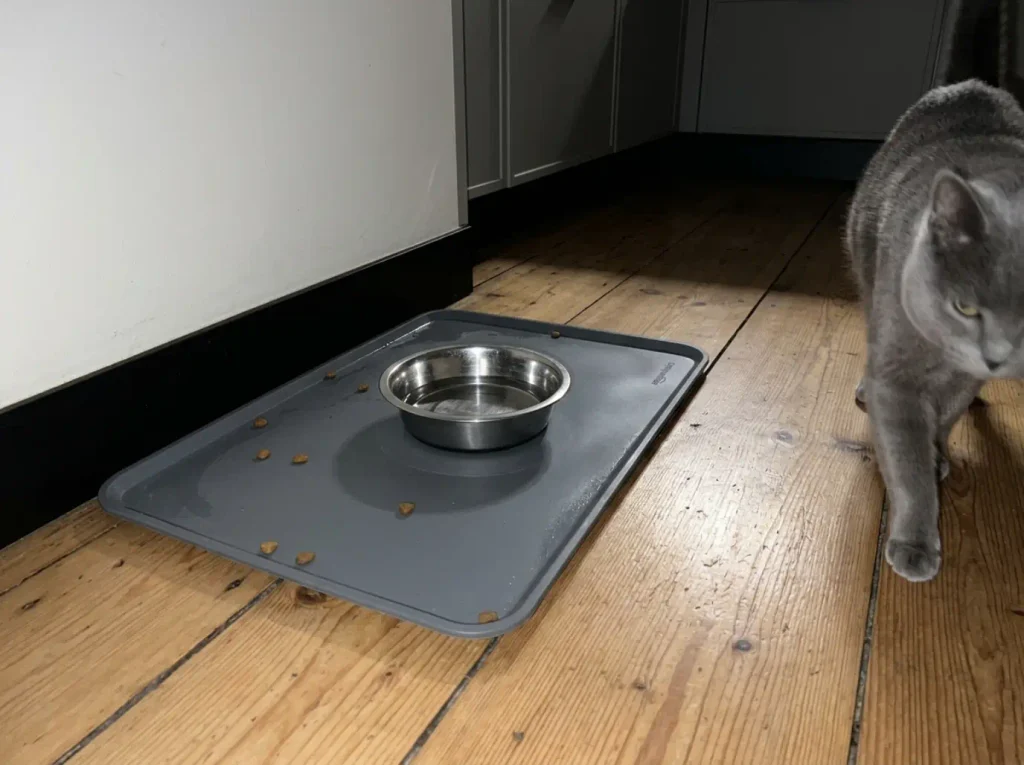
Every time she pushes her face in, the dish moves an inch. Twenty bites, twenty inches, and by the end of the meal the bowl is under the radiator and you have concluded that your cat drags her bowl across the kitchen for reasons of her own.
She does not. The bowl is not being dragged, it is being pushed, one bite at a time. A light dish on a hard floor slides away from the pressure of a cat’s face, because that is what light objects on smooth surfaces do. This is the most mechanical cause on the list and the one nobody separates out, probably because it is boring and there is no instinct to write about.
The tell is direction and timing. A pushed bowl travels one way, always away from where she stands, and it travels while she eats. A carried bowl, or a bowl moved for any behavioral reason, wanders. If you find it in the same corner every single day, gravity and physics did that, not your cat.
The free fix here beats the paid ones by a distance. A scrap of rug pad. A strip of shelf liner. The offcut from a rubber-backed doormat.
Anything with grip underneath solves the bowl stability problem outright, and most homes already own one of those three without thinking of it as cat equipment. Note that this one is not about bowl placement at all: the same dish slides on tile and stays put on a rug, in the same spot, on the same day.
People in bowl threads describe an improvised non-slip mat as a workaround rather than a solution, which is the right instinct and also slightly too modest. It is a solution. It just does not come in packaging.
Weight is the other free variable worth testing. A heavier ceramic or steel bowl on the same floor moves measurably less than a light plastic one, which is one of several reasons the case against plastic bowls has two answers rather than one. Before you buy any grip at all, try whatever the heaviest small dish in your kitchen happens to be.
Before you buy grip, test it. Put the bowl on a folded tea towel for one meal. If it stays put and she stops chasing it, the problem was the floor, and a scrap of rug pad finishes the job for nothing.
If you are replacing the bowl anyway, buying the grip built in saves you a second object on the floor: the OurPets DuraPet Non-Slip bowl has a rubber ring molded into the base and stops sliding without a mat under it, though at one cup it is a small dish and a large cat on wet food will empty it fast. And if you like your current bowl and only want it to stay where you put it, the Amazon Basics silicone feeding mat grips at 18.5 by 11.5 inches and its raised edge catches whatever she takes out, which handles the other half of this article’s behavior at the same time. The caveat is size: measure your spot first, because that footprint is larger than people picture and it will not tuck into a narrow gap between an appliance and a wall.
Where the Bowl Sits, and Who Else Is in the Room
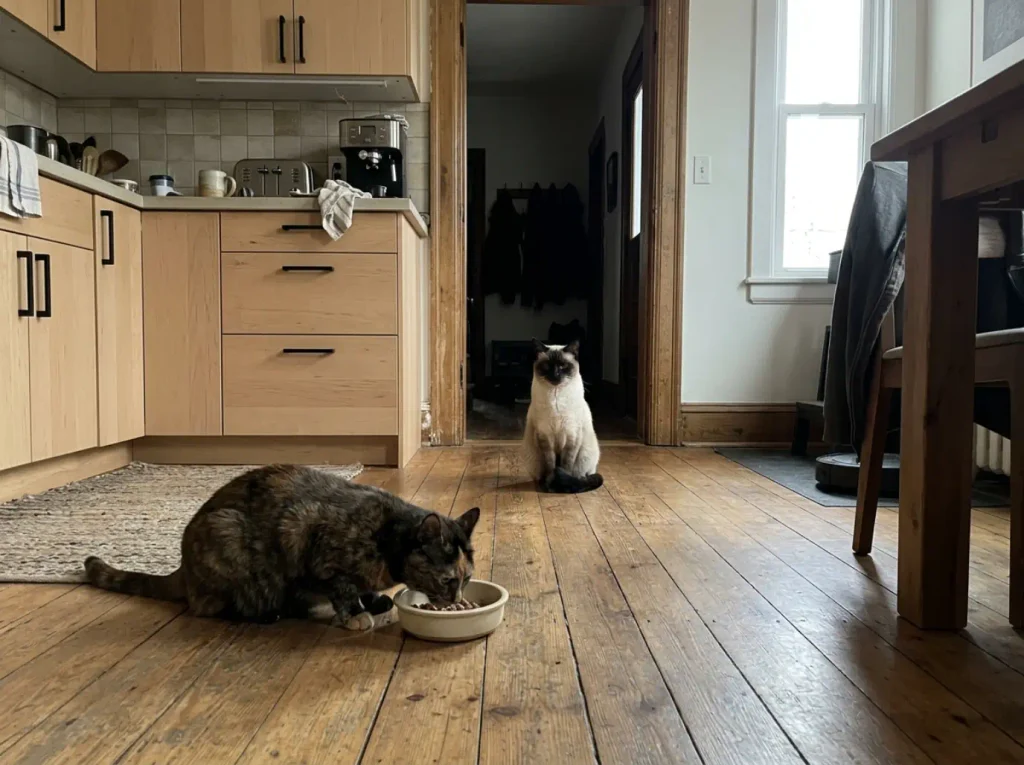
You put the bowl in the corner because it was out of the way. That is a human reason, and a good one. From where she is standing, though, a corner is a spot with two walls behind her and exactly one way out.
Cats eat with their heads down and their peripheral vision compromised, so they prefer a clear sightline while they do it. A bowl jammed against two walls can produce bolting, or produce her carrying a mouthful out to somewhere more open and eating it there. On your floor, that looks precisely like she moved her food. It is worth pulling the bowl eighteen inches off the corner for a few days before you conclude anything else, because that test is free and takes one second.
The water bowl is the next thing to check, and it fails in a way the product aisle actively encourages. Cats instinctively avoid eating right next to their water, a holdover from not contaminating a drinking source with the remains of prey. A combination double-dish, the single molded unit with two wells touching, works directly against that.
So some of what looks like her shoving the water half away is food and water separation happening without your help. A few feet is enough, and the two bowls do not need to match or to be in the same style. If moving the water further off makes her stop drinking rather than start, that is its own question, and the cat a water fountain actually works for is where it gets answered.
Then litter box proximity, where vet-reviewed guidance puts roughly 6 to 10 feet between food and box, in a separate area where that is possible. In a small kitchen that number sounds like a joke, which is the next paragraph.
In a studio or a one-bedroom, that separate area does not exist, and being told to use one is how a reader decides an article was not written for them. So maximize distance inside the room you have, which usually means opposite walls, and then stop trying to buy distance and buy a barrier instead.
A bookshelf between the two does more than four extra feet of open floor. The box in a closet with the door propped open a few inches does more still. No drilling, no lease conversation, and where the box actually fits when there is no second room works through the placement logic in more detail than this section can.
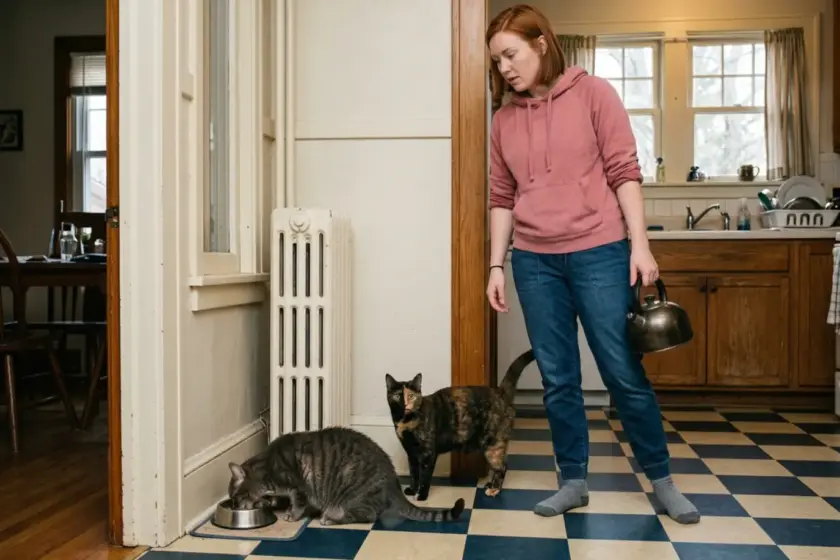
And then there is the cause people miss entirely, because it is not happening at the bowl. If you have two or more cats and only one of them is moving her food, stop watching the bowl and watch the doorway. Cat behaviorists describe food-bowl resource guarding as the most common form of guarding in multi-cat homes, and it happens routinely between cats who otherwise share a couch without incident.
The guarding cat almost never does anything dramatic. It stands somewhere. It sits in the kitchen entrance looking at nothing in particular, and the other cat takes her mouthful and eats it in the hallway.
Once you have seen it, you cannot unsee it, and it explains months of mess in about four minutes. This is why the detective moment gets described the same way over and over in multi-cat threads: nobody solved it by studying the bowl.
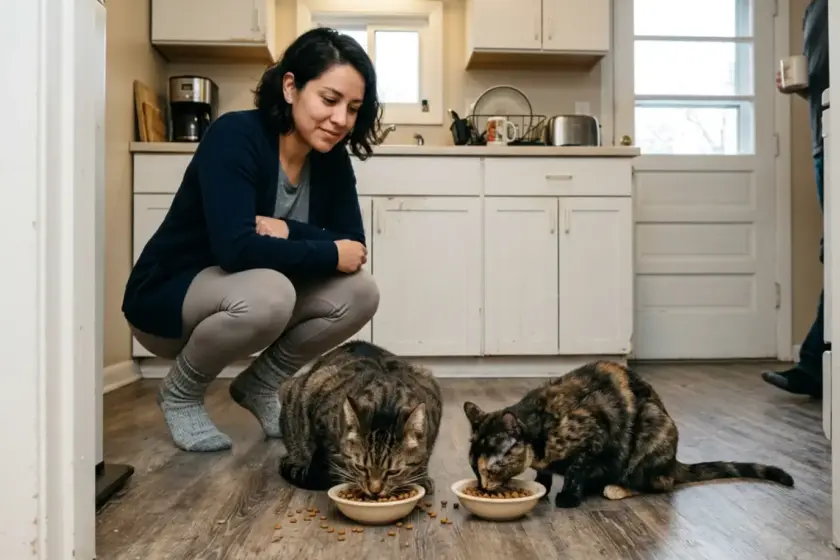
The answer is choice, not a larger bowl. Separate feeding stations in genuinely different places, two or three of them, including one up on furniture, so that one cat physically cannot cover them all at once. Vertical counts as a different place; a windowsill or the top of a low bookshelf is a real second station in a studio where floor space is already spoken for.
For one week, feed the two cats in different rooms rather than at two bowls in the same room. If the moving stops, it was never the bowl. Two bowls a foot apart is one feeding station with extra steps, and the guarding cat can still cover both from where it is sitting.
When This Is a Vet Visit and Not a Bowl Problem
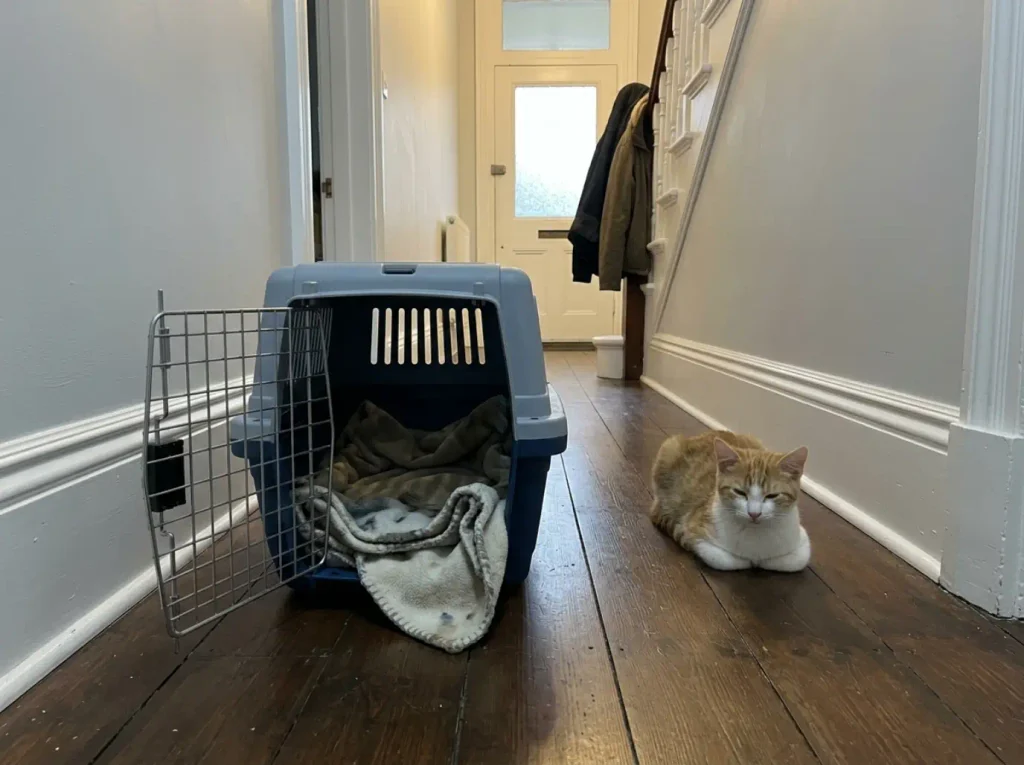
Everything above assumes she is eating normally and doing something odd around the bowl. There is one version of this where the bowl is not the story at all, and it is worth knowing which one you have before you spend three weeks rearranging your kitchen.
The line is this. Bowl-moving on its own is furniture, instinct and territory, and that is the part this site can help with. Bowl-moving plus a change in how much she eats is a different question, and this article does not answer it.
The specific things that move it out of this article’s territory: eating noticeably less or refusing food, weight coming off, vomiting, and the one people talk themselves out of, a sudden change in a long-standing habit. A cat who has eaten the same way for four years and changed this month is not making a point about the dish.
The caution is real here rather than boilerplate, and the reason is worth one sentence: reduced appetite in cats is time-sensitive in a way it is not in dogs or in people. That is the whole reason this section exists and why it sits before the conclusion instead of buried at the end.
What this article will not do is interpret those signs, name a cause, or hand you something to try at home first. That is a call to the vet, today, and not a bowl to buy.
What you can usefully bring to that appointment is observation, which is a different thing from diagnosis and is genuinely useful to the person doing the diagnosing: how long it has been happening, whether she is finishing meals, and roughly how much she is eating in a day.
The most useful thing you can do before that call is weigh the food. “She seems to be eating less” is hard to act on. “She is leaving half of what she finished three weeks ago” is not. A kitchen scale and thirty seconds a day gives the vet something real to work with.
What to Do Tonight
Watch one meal before you change anything. If she is pawing at the floor after she eats, that is scent-caching, the routine is intact, and there is nothing here to fix. If the bowl travels while she eats, you have a setup problem, and setup problems are cheap.
Measure the bowl you already own. Under 5.5 inches across, or more than about 2 inches deep, and you have your answer without spending anything. A side plate will confirm it inside a week.
If you have more than one cat, watch the doorway rather than the bowl. The cat causing this is very often the one doing nothing at all.
Then come back to it in three weeks, and look at three things: is the bowl still ending up somewhere else, is she finishing her meals, and is the food on the floor or in the dish. Change one thing at a time with three weeks between, or you will end up with a fixed cat and no idea which change did it.
Start with the cheapest version. Move the bowl out of the corner and put a scrap of rug pad under it. If that ends it, you solved this for nothing, and that is the most common outcome of the three.
Amazon’s Audible — free for 30 days
Your cat won’t let you read. Let someone read to you.
Audible is Amazon’s audiobook library — thousands of titles, read out loud, on your phone. Free for a month, plus one audiobook to keep forever.
Frequently Asked Questions
01Why does my cat keep moving her food bowl?
Two different things get described that way. If she is pawing at the floor around the bowl, that is a burying instinct with nothing to bury, and there is nothing to fix. If the bowl itself travels while she eats, she is pushing it: too narrow for her whiskers, too light for the floor, or in a spot she does not want to eat in.
02Why do cats move food out of bowls?
Usually because the bowl is touching her face. A dish under about 5.5 inches across, or deeper than roughly 2 inches, presses her whiskers on both sides with every bite, and taking a mouthful onto the floor is how she eats without that. A wider, shallower dish, and a side plate works as a test, usually ends it in a few days.
03Is it bad if my cat scratches around her food bowl?
No. That is food caching, covering leftovers to hide the smell, a survival instinct that works outdoors and does nothing on a kitchen floor. She is not distressed and the food is not spoiled. It is one of the few cat behaviors where the correct response is to change nothing at all.
04Should I use a mat under my cat bowl?
If the bowl slides, yes, and it does not need to be a cat mat. A scrap of rug pad or a strip of shelf liner underneath stops the bowl moving for nothing. A purpose-made feeding mat adds a raised edge that catches what she takes out, which is a convenience rather than a fix.
05My cat moves her bowl and is eating less than usual. What now?
That combination is a vet appointment rather than a bowl question, and it is worth making sooner than feels necessary, because a cat eating less is time-sensitive. Nothing in this article applies to that version. Bring how long it has been going on and roughly how much she is leaving.
Leave a comment