Elevated Water Bowls Tip More Than Food Bowls Do
Don't raise the water bowl just because the food bowl went up. Water sloshes, tips & costs a marginal drinker every trip. Here's when it's worth it.

Alfredo RamsesFounder · September 15, 2026 · 17 min read
On this page7 sections
The food bowl went up on a stand a few weeks ago and it worked, so the water bowl got the same treatment the same afternoon. Now there is a wet ring on the floor every morning, the laminate by the wall has gone slightly dark, and you cannot tell whether your cat is drinking less or just spilling more. Here is the thing nobody in this search result will admit: no controlled study has ever tested elevated bowls against floor bowls, so every confident sentence about posture and digestion out there is a manufacturer claim wearing a lab coat. What can be said honestly about whether a water bowl should be elevated is narrower, and a lot more useful, because water behaves nothing like kibble once it goes up in the air.
Quick Answer
Not automatically. Raising the water helps the same cats raising the food helps, and does nothing measurable for a healthy adult. Water also carries a cost food does not: it sloshes and it tips. If you raise it, match the food height, weight the base, and watch the bowl level for a week.
What Elevating the Water Bowl Actually Changes
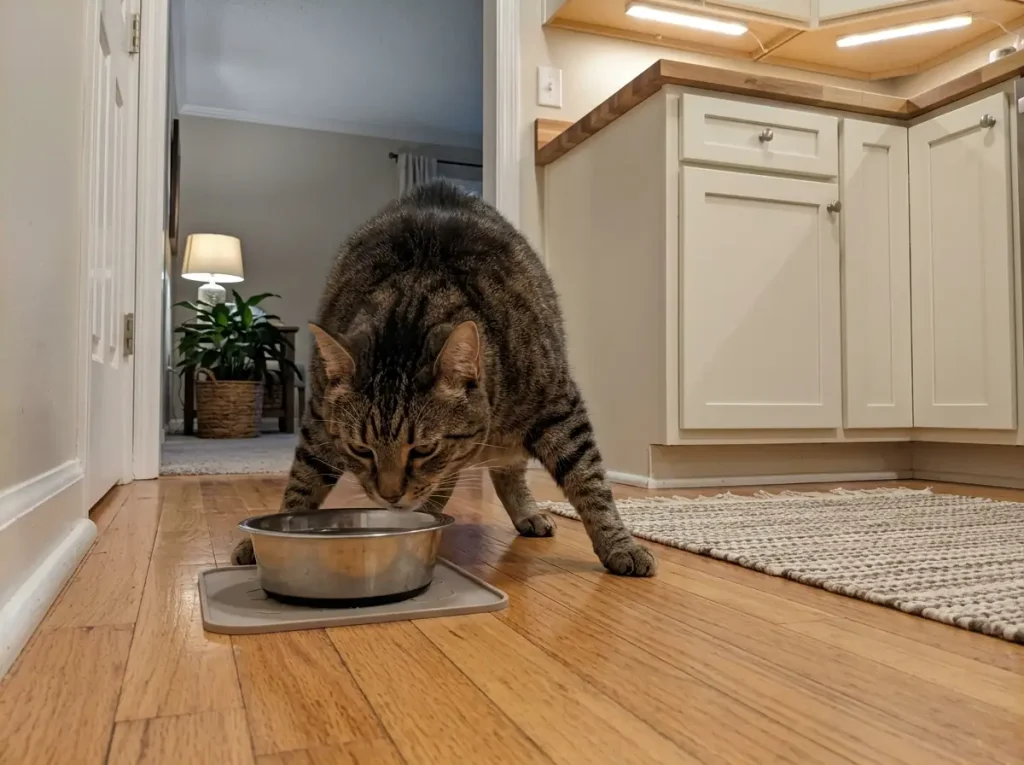
Everyone who buys a stand has been handed the same three words: posture, digestion, joints. Nobody hands over the part where the evidence behind those words is thin, and nobody mentions that “digestion” is a food word that got copied onto the water bowl one day without anyone stopping to check whether it survived the trip.
The Posture Argument, and How Much of It Is Real
The mechanical claim is simple enough and it is true as far as it goes. A raised bowl brings the water up to the cat instead of sending the cat down to the water. Less crouch, less neck flexion, less weight loaded onto the front legs while the head is down. That is real geometry and you can watch it happen in your own kitchen.
What is not real is the certainty attached to it. There is no controlled trial testing elevated bowls against floor bowls for any outcome at all, and researchers who study feline feeding behavior still cannot agree on ideal water bowl placement, let alone ideal height. The benefit claims come almost entirely from the people selling the stands.
That does not make elevation useless. It makes it a fix looking for a specific problem, rather than an upgrade every cat is owed.
Why the Digestion Reason Belongs to the Food Bowl Only
The digestion argument is about food traveling down the esophagus at a friendlier angle, which is why vets raise it with cats who bring their dinner back up ten minutes after eating. Follow that logic one step further and it falls apart at the water bowl. Water is not food. It does not sit in the esophagus, it does not come back up because of an angle, and there is no version of the regurgitation story that ends with a puddle of water.
This is where most of this topic goes wrong, and it goes wrong in the same way every time. The reasoning was built for the food side, then quietly extended with a clause. The most common sequence in cat forums is not “I researched elevated water bowls.” It is “I bought a feeding station, it came with two bowls, so both went up.”
The water half of the decision was never separately reasoned. It arrived attached to the food.
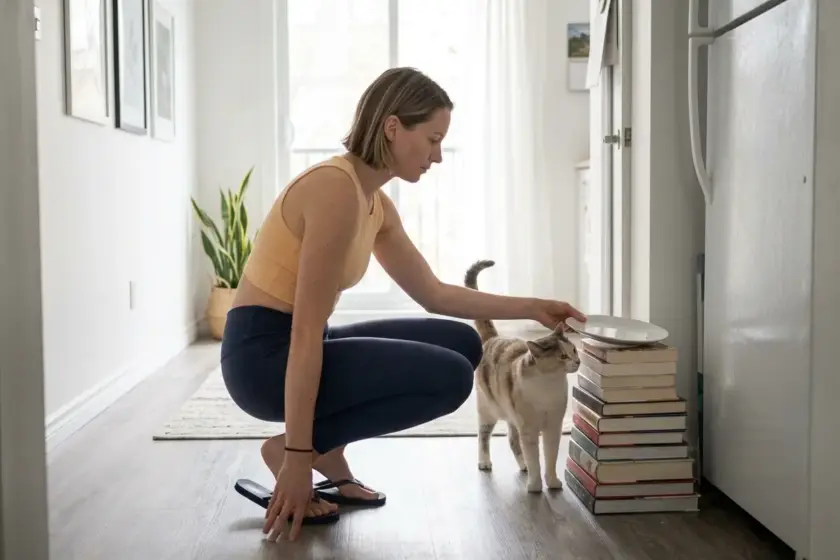
Before buying anything, put the water bowl on a stack of two hardback books for a week. If the cat drinks the same and the floor stays dry, you have your answer for free and you keep the money.
Who Vets Actually Suggest This For
Vets do recommend elevation, and they recommend it for a reason rather than as a default. The two cases that come up are a senior cat with joint pain who braces on the way down to a floor bowl, and a cat with a history of vomiting after eating, bringing dinner back up within a minute or two of finishing it.
Both of those are food-side reasons. Both are worth acting on. Neither describes a healthy four-year-old who has been drinking off the kitchen tile since he moved in.
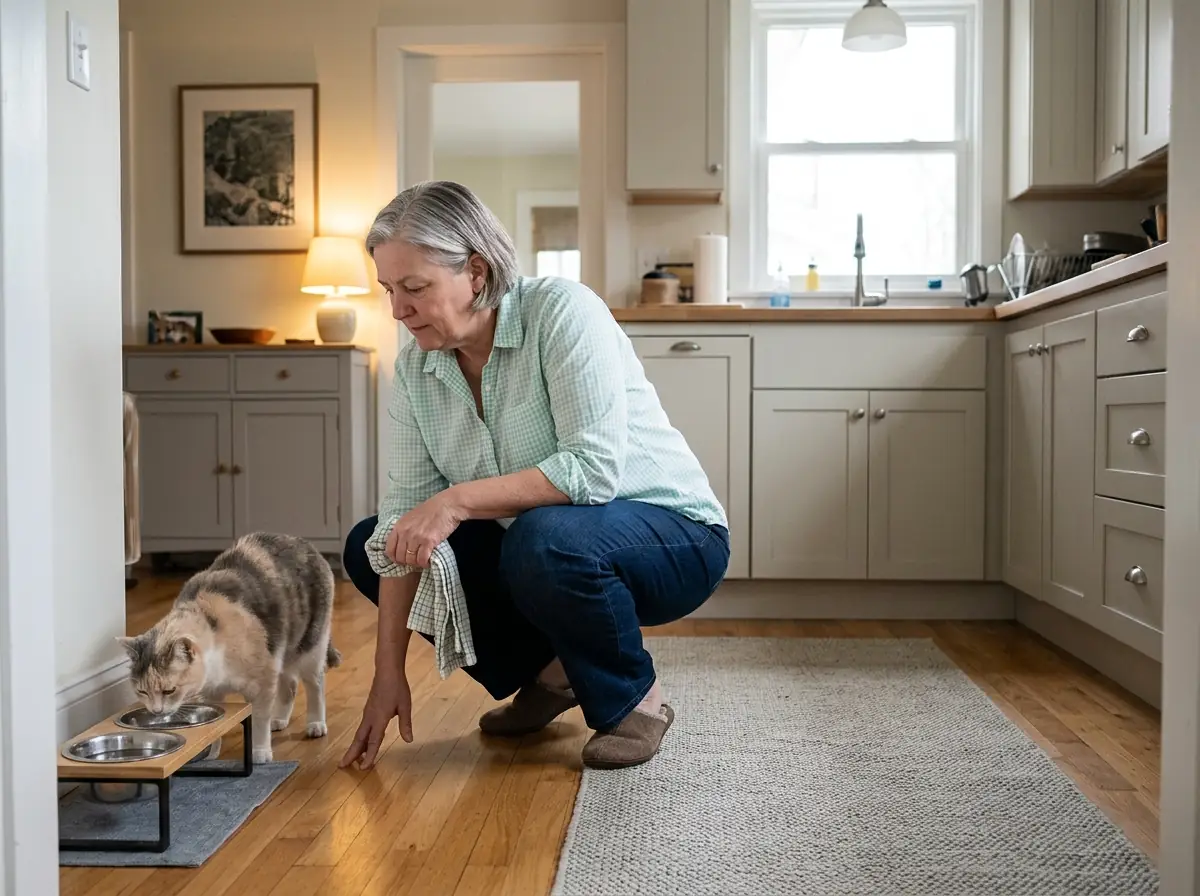
So the honest starting question is not whether raised bowls are good. It is whether your cat is one of those cats. If you already raised the food because of a real, watchable reason, you are in the group where elevated bowls help some cats and not others (the full picture on which is which) and the water is worth a proper look. If the stand came in a set and you raised the food because the box did, the water is a coin flip you are about to pay for in floor damage.
Water Behaves Differently From Food, and the Bowl Is Why
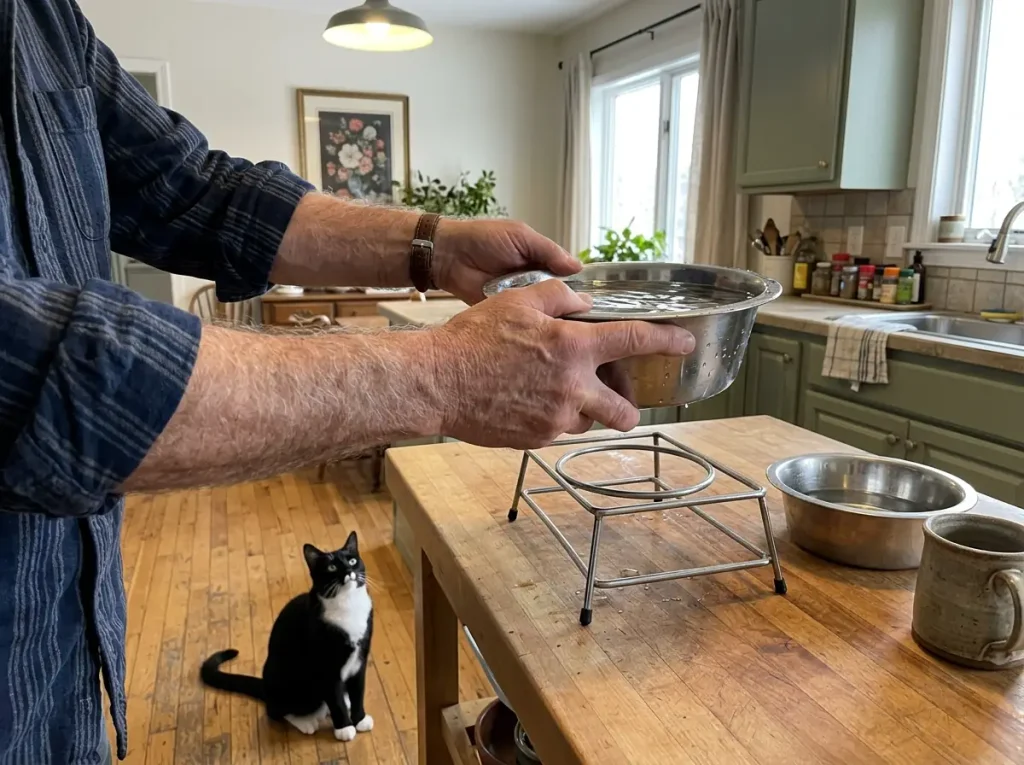
A food bowl empties. A water bowl is full all day, every day, and it is full of something that moves. That one difference drives everything else here, and it is the reason the water bowl deserves its own decision instead of inheriting the food bowl’s.
Twelve Trips a Day, Not Two Meals
Food is a scheduled event. It happens twice, it takes four minutes, and the bowl sits empty for the other twenty-three hours. Water is not an event at all. It is eight, ten, twelve short trips scattered across the day and the night, most of them lasting a few seconds.
That changes the math on friction. Whatever you add to the trip gets paid every single time, not twice. A stand that is slightly awkward to approach, a rim at the wrong angle, a station that now sits in the walkway where somebody’s feet go past: each of those is a small tax, collected a dozen times a day, on an animal whose water intake was already lower than it ideally would be. And a cat who is a marginal drinker has the least margin to lose.
Cats are bad at hydration to begin with. They evolved to get most of their water out of prey, and a house cat on dry food is running closer to the line than its owner usually realizes. Adding a step to that trip is the wrong direction to be pushing.
Full of Water Is Not the Same Weight as Full of Kibble
Now put the physics on a stand. A bowl of kibble is light and its contents stay where you put them. A full bowl of water on a raised platform is top-heavy in a way a bowl of kibble never is: the mass is high, the mass is liquid, and it shifts the moment the cat leans a shoulder into the rim to drink.
Kibble does not slosh. Water does, and it does it in the same direction the cat just pushed.
The people who buy a lightweight elevated stand expecting less mess and get more mess describe the discovery in almost identical words. It looked sturdy until it was full. That phrase is worth sitting with, because it names the failure exactly: these stands are stable empty, on the shelf, in the photo, in your hands when you unbox them. They are tested by the buyer at the only moment they are guaranteed to pass.
Even vet-reviewed coverage of raised bowls concedes the point directly, which is rare in this category: a poorly designed elevated bowl causes more spills, not fewer.
What Whiskers Do at the Water Bowl
Whiskers touch the water on every one of those dozen visits. A deep, narrow bowl lifted onto a stand puts the sides against the face at a new angle, and unlike at dinner there is no strong motivation pulling the cat through the discomfort.
Whisker fatigue as a formal diagnosis is genuinely contested, and it should not be sold as settled. A 2020 controlled trial found no measurable difference in eating behavior between wide and narrow dishes. But in that same trial, given a free choice, 24 of 38 cats went to the wide shallow dish anyway.
That is the number worth carrying around, and it is exactly why the bowl study nobody quotes matters more than the slogan printed on the packaging. Whatever whisker stress turns out to be, cats vote with their face even when the stopwatch says it does not matter. If you are raising the water, widen and flatten it at the same time. The two changes belong together.
Where Elevated Water Bowls Go Wrong in a Small Apartment
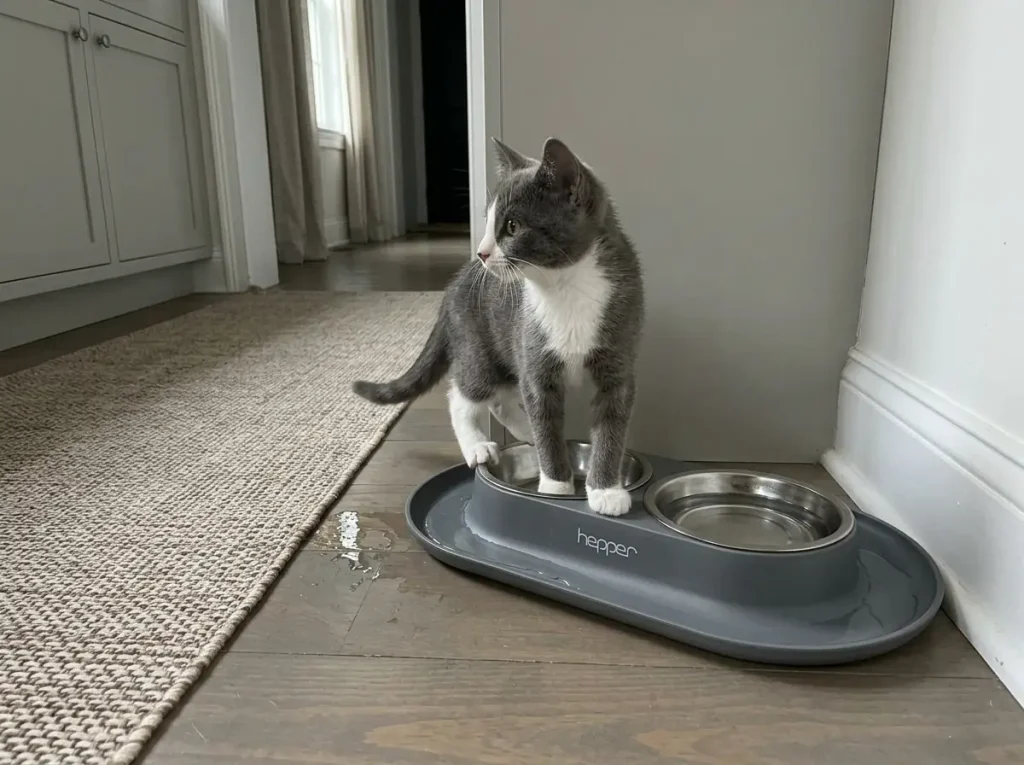
In a house with tile, a spilled water bowl is a wet patch and a paper towel. In a rented apartment with laminate, the same spill happening every morning for a month is a swollen seam along the joint, and swollen seams do not go back down. That is the version of this problem nobody writes about, and it is the one that costs actual money.
The Three Things That Have to Line Up for a Spill
The failure has three parts, and any one of them alone is harmless. A light stand. A high center of mass because the bowl is full. A cat who leans on the rim to drink instead of standing square to it.
Put a light stand under a full bowl and nothing happens until the cat leans. Give a leaner a heavy low bowl on the floor and nothing happens either.
Stack all three and the whole station goes over sideways, usually at four in the morning, usually in the same spot, and usually onto the one section of floor you do not own. The fix is to remove any one of the three, which is good news, because two of them are free to remove.
Fill the bowl and push the rim sideways with one finger, the way a cat leans on it. If the station rocks at all with a full bowl, it will go over eventually. Test it full, never empty.
The Free Fixes, in the Order Worth Trying Them
Start under the stand, not with a new stand. A square of rubberized shelf liner or a plain silicone mat underneath gives the thing a non-slip base it never had from the factory, and it turns a slide into a stop. That alone settles a surprising number of these.
Second, swap the bowl rather than the furniture. A wide, heavy-bottomed dish in the stand you already own needs far more paw force to tip than the narrow light one that came with it, and it fixes the whisker problem in the same move. Material does a lot of the work here: a stainless steel or ceramic dish carries real weight of its own, while the light plastic bowl most stands ship with is the one that goes over.
Third, look at where the station lives. Move it out of the traffic lane, off the path between the hallway and the kitchen, so nobody clips it with a foot on the way past. None of this requires drilling, adhesive or anything a landlord would notice, which is the whole point of a renter-friendly fix: water problems never need a permanent solution to stop being problems.
If the stand and the bowl are both right and the floor is still wet, the remaining answer is a station that catches what escapes. The Hepper NomNom Spill-Proof Elevated Cat Bowls run a wide perimeter tray around two shallow stainless dishes, so the water that comes over the rim lands inside the station instead of on the laminate. It is a containment answer rather than a stability one, and that is the honest limitation: a determined leaner can still shift the whole thing, so it belongs on the shelf liner too, not instead of it.
When the Cat Is Spilling It on Purpose
Not every puddle is a stability problem, and this is where hardware stops helping. Kittens play in water as a matter of routine, and some breeds stay water-tolerant well into adulthood. Maine Coons are the usual named example, and anyone living with a large one will recognize the paw going in before the face does.
That is not tipping by accident. That is dumping the bowl, and the two look identical on the floor at seven in the morning while being completely different problems. The tell is the pattern: an unstable stand goes over and stays over, once, with the bowl displaced. A cat who is playing leaves the station upright and the water outside it, on the same side, day after day.
No stand design fixes the second one. A heavier bowl in a lower, wider format at least makes the game less rewarding, and a cat who has a proper thing to paw at usually stops auditioning the water bowl for the role.
How High the Water Bowl Actually Goes
Every article says elevated. Almost none says how high, and not one of them says whether water goes to the same height as food. If you are standing in the kitchen with a stand still in its box, a philosophy is no use to you. You need one measurement.
Measure to the Elbow, Not to the Shoulder
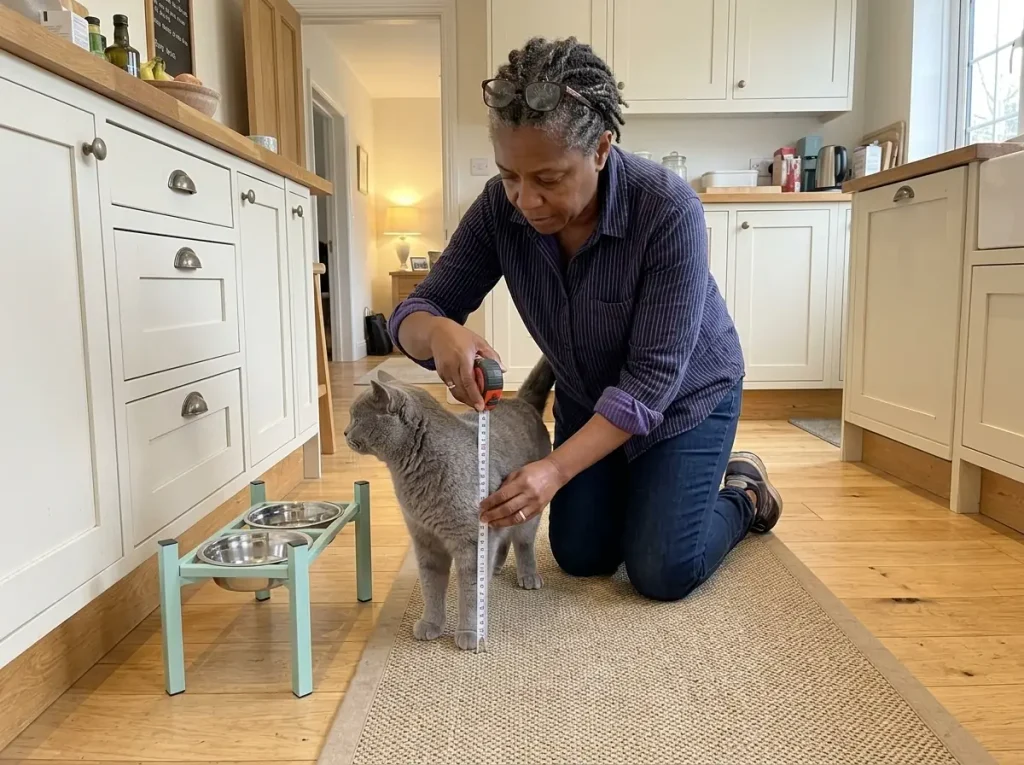
The rule is not a number printed on a box, because the number on the box describes the stand and not your cat. The rim of the bowl should sit level with the cat’s lower chest height, roughly at the elbow, so that the head drops slightly to drink while the shoulders stay where they are. That is the whole target. Higher than that and the cat is reaching up, which puts the neck strain somewhere new instead of removing it.
Measure while the cat is standing, not sitting. Floor to the point of the elbow on the front leg. That is the number, and it is smaller than almost everyone guesses before they check.
The Inches, for a Medium Cat and a Large One
In practice the elbow rule lands around four to six inches for a medium cat, and six to eight or more for a large one. A big Maine Coon at full stretch is a different animal from a compact shorthair, and one household with both cannot be served by a single fixed height, which is the quiet reason so many stands end up back in the box.
Measure the cat, not the stand. A stand advertised by its maximum height tells you nothing about where the rim actually ends up, because the bowl sits down inside it and eats an inch or two of that number before the cat ever arrives.
If you want the measurement to stay adjustable after the books come out from under the bowl, the Drawinsage Adjustable Metal Raised Cat Bowl Stand takes ordinary shallow dishes and moves through the four-to-six range, so one purchase covers a growing cat or two cats of different builds. The catch is that adjustable joints are one more thing that can work loose, so it needs the same full-bowl finger test every couple of months. For the general case across food and water both, the full height breakdown in inches goes further than this section needs to.
Same Height as the Food, Different Bowl
Here is the answer to the question that started all this. Water goes to the same height as food for the same cat. Elbow is elbow, and there is no separate water geometry.
The dish is what changes. Shallower and wider on the water side, because the whisker contact happens a dozen times a day here instead of twice, and because a shallow dish has its mass lower in the stand. Same height, different bowl. That is the entire adjustment, and it takes ten seconds to make.
Two Cats Change the Answer
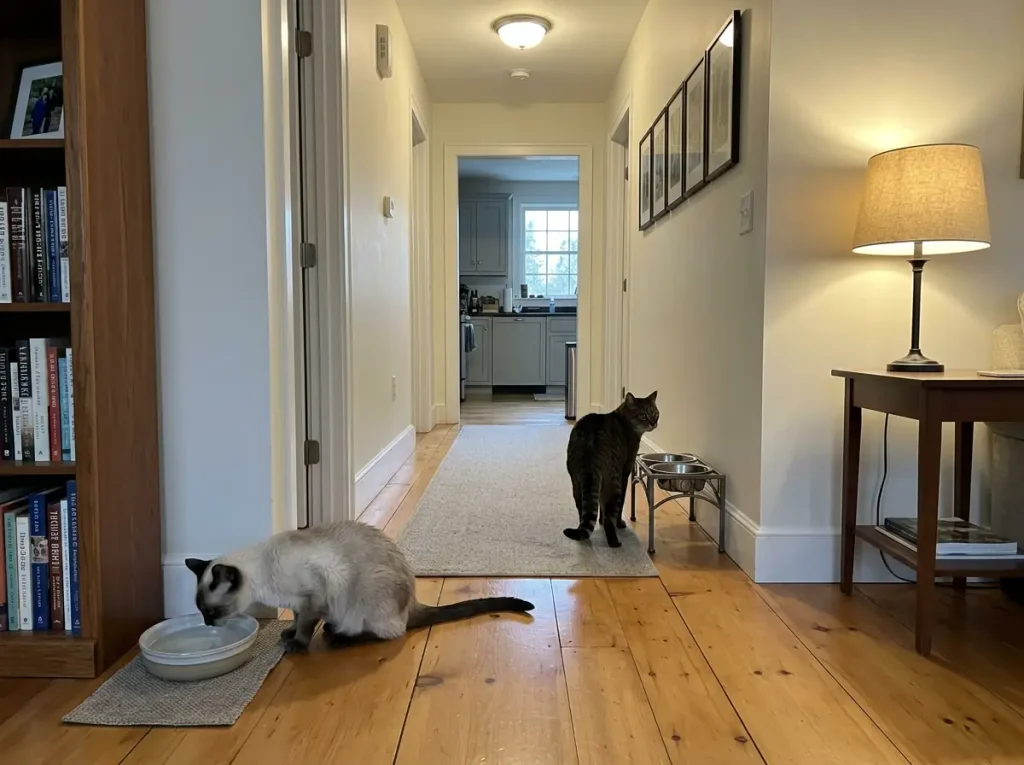
One elevated water station in a two-cat apartment is not a station. It is a checkpoint. And the cat who loses the checkpoint is usually the one who was already drinking least, which is exactly the cat you cannot afford to lose ground with.
One Station Becomes One Chokepoint
A floor bowl in an open room is approachable from three sides and easy to leave. Elevating it turns a vague, shared resource into a single defined spot with one approach and one exit, and cats are solitary drinkers who dislike being closed in. In a home with any existing tension between two cats, that concentrates it into one location instead of spreading it out.
The expert recommendation for multi-cat households runs directly against the single-station instinct: separated, multiple feeding and drinking areas rather than one central point.
And the trap has a second half. Corner placement looks like the obvious stability fix, since a corner braces two sides of the stand. Cats dislike corners, because a corner blocks the sightline to the room and leaves nowhere to go if another cat walks in. The stability answer and the placement preference pull in opposite directions, and the cat is right about which one matters more.
Two Cats, Two Heights
Two cats are rarely the same size, and one stand height suits exactly one of them. The other is now either crouching over a bowl that is too low or reaching up to one that is too high, all day, every day, at the resource you most want him to visit casually.
The pattern that keeps surfacing in multi-cat threads is the quiet one going off water while everyone watches the confident one drink happily from the new station. There are two honest answers. Either give each cat his own height, which is two cheap low stands rather than one nice tall one, or use an adjustable riser and split the difference toward the smaller cat, because reaching up is the worse of the two failures. Multiple low-friction water points beat one good elevated one, every time, and it is not close.
Watching the Water Level Instead of the Cat
You will not catch a drop in drinking by watching your cat. Nobody does. The visits are short, they are scattered, and half of them happen while you are asleep or out of the room.
Watch the bowl instead. Refill at the same moment each morning and notice whether you are topping it up as often as you were before the stand went in. A week of that is a far better signal than any amount of observing, and it costs nothing but attention.
If the level is dropping slower than it used to, the station is the suspect and it should come back down. This is also the point where the fountain question tends to arrive, and it is worth knowing whether a fountain actually moves the needle on how much a cat drinks before you spend anything on one.
Refill at the same moment each morning and mark nothing. Just notice whether you are topping it up as often as you were before the stand went in. A week of that beats watching the cat.
One boundary before the furniture talk resumes. A cat who suddenly starts drinking a great deal more, or clearly less, is a vet visit and not a bowl-height question. That is true whether you are worried about dehydration or about the opposite.
Say it to a vet first and adjust the station afterward. Everything above assumes a cat whose drinking has not changed on its own.
The Short Version
Raise the water only if you raised the food for a reason you could name out loud: an older cat who braces on the way down, or one with a history of bringing dinner back up. Matching the stand because it came in the set is not a reason, and it is the single most common way this ends badly.
If you do raise it, raise it to elbow height with a wide shallow dish and a weighted base, and put something grippy under the stand before the first full bowl goes in. And in a multi-cat apartment, two easy water points beat one good elevated one every time.
Check back in three weeks, because that is how long it takes for a cat to accept or reject a change and for a new human routine to start slipping. Two things to look at: is the bowl going down at the same rate it did before, and is the floor around the stand dry every morning. Two books under the bowl for a week costs nothing and answers the question ahead of time. If the cat drinks the same and the floor stays dry, you just found out you never needed the stand.
Amazon’s Audible — free for 30 days
Your cat won’t let you read. Let someone read to you.
Audible is Amazon’s audiobook library — thousands of titles, read out loud, on your phone. Free for a month, plus one audiobook to keep forever.
Frequently Asked Questions
01Should a cat water bowl be elevated?
Only if the same reasons that justify an elevated food bowl apply to your cat: joint pain, a bracing posture at the floor, or regurgitation after eating. For a healthy adult there is no evidence it helps, and it adds a tipping risk the floor bowl never had.
02How high should a cat water bowl be?
The rim should sit level with the cat’s lower chest, around elbow height with the cat standing. That is roughly four to six inches for a medium cat and six to eight for a large one. Measure the cat rather than trusting the height printed on the stand.
03Do elevated bowls help cats with arthritis?
Vets often suggest them for older cats who struggle to crouch, because the bowl comes up instead of the cat going down. If your cat has started moving differently or seems sore, that is a vet visit first. Bowl height is what you adjust afterward, not instead.
04Why does my cat spill water from an elevated bowl?
Usually the stand is light and the full bowl sits high, so leaning on the rim tips the whole thing over. Sometimes it is not spilling at all: kittens and some breeds deliberately paw at water, which needs a heavier, wider bowl rather than a better stand.
05Should the water bowl be next to the food bowl?
Many cats prefer them apart, and separated water points are the safer setup in a multi-cat home. If you are elevating anyway, that is the moment to move the water somewhere else rather than bolting both bowls to one board.
Leave a comment