Is Whisker Fatigue Real? One Study Says Maybe
Is whisker fatigue real? One trial, 38 cats: no difference in food eaten (but 63% picked the wide dish). What that split actually means.

Alfredo RamsesFounder · September 7, 2026 · 16 min read

On this page7 sections
On June 5, 2017, a national newspaper told cat owners that their cat’s fussiness at dinner might be something called whisker fatigue, described as a fairly new diagnosis. Every single person quoted in that piece sold bowls. That is not a scandal, and it does not make the idea wrong, but it is where the term entered the language, and most of what has been written about it since has been repeating a product story back at itself. So here is what the anatomy actually supports, what the one controlled study measured, and what to do with a question the science has not closed.
Quick Answer
Partly. The anatomy is real: whiskers are among the most densely innervated structures a cat has. The syndrome is not proven. One controlled trial exists, it found no difference in how much or how fast cats ate, and most cats preferred the wide dish anyway. A flat plate tests it for free.
Where the Term Came From, and Who Was Selling
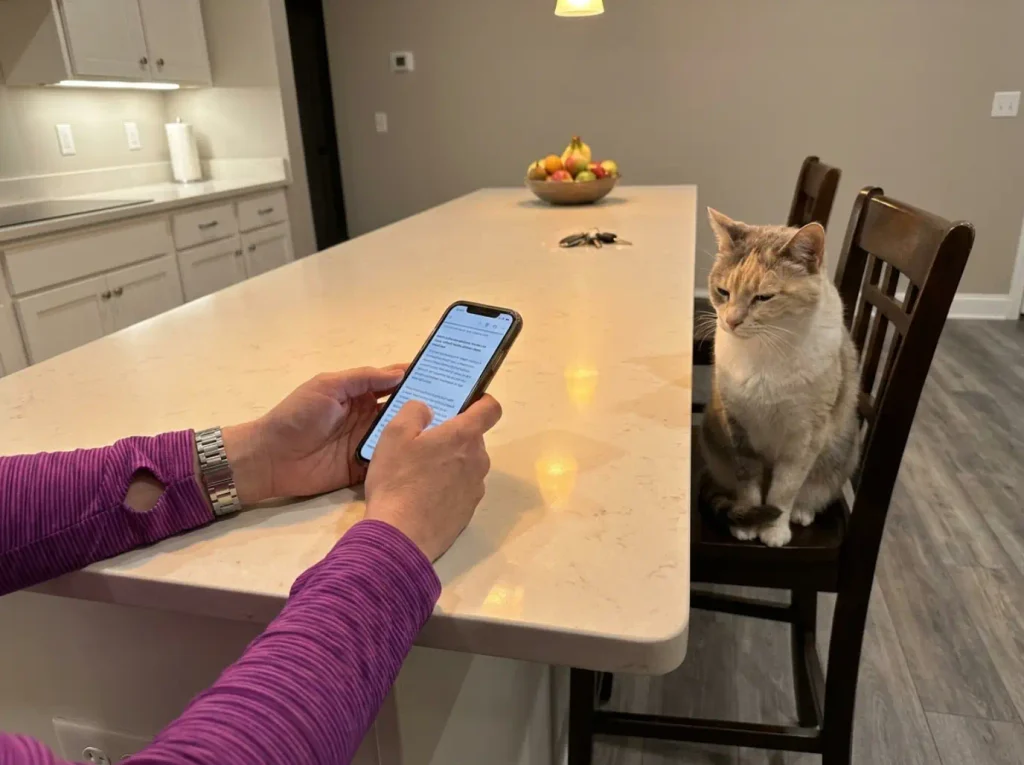
Before you decide whether to believe in whisker fatigue, it helps to know who said it first. The answer is not a laboratory. It is a lifestyle piece in the New York Times, and the sources in it were bowl manufacturers. No veterinarian was interviewed for the article that introduced the phrase to a general audience.
That should not be enough to dismiss the idea, and it isn’t. Plenty of real problems get named by the people who sell the fix, because those are the people paying attention to the problem. But it does change how much weight the phrase has earned on its own, and it explains why the term arrived fully formed, with a name, a symptom list and a product category already attached. Most conditions do not show up in that order.
Then there is the part that is harder to argue with. In 2017, someone went and searched the three journals where a feline condition would live if it existed: the Journal of the American Veterinary Medical Association, the American Journal of Veterinary Research, and the Journal of Feline Medicine and Surgery. The search returned zero results for whisker fatigue. Not a handful of cautious mentions. Not a debate. Nothing. The term had no footprint in veterinary science at all while it was busy becoming common knowledge on the internet.
The head of the AVMA at the time, Thomas Meyer, DVM, went on the record shortly after with a sentence worth reading slowly: a cat’s whiskers are very sensitive, and there is currently no evidence showing that whiskers rubbing against food bowls causes cats stress or discomfort. Read that again, because the veterinary trade press went back and checked and this is the sentence they found. He did not say it is false. He said nobody has shown it. There is no veterinary consensus behind the term, and there never was one to lose.
Those are different claims, and the distance between them is the whole subject of this article. It is also why the blunt version going around forums — that the whole thing is a marketing ploy — overshoots. An unproven claim and a fabricated one are not the same failure.
If you want the broader picture instead of the evidence question, the pillar on whisker fatigue covers the signs, the bowls and the multi-cat side. This page stays on one thing: whether any of it has been demonstrated.
When a health claim about your cat traces back to a single news story, check whether anybody quoted in it stood to make money from you believing it. That is not proof either way. It just tells you how much the claim has earned so far, and how much of the work is still ahead of it.
What Whiskers Actually Do, Which Is the Part Nobody Disputes
Here is where I have to be fair to the theory, because the anatomy is genuinely on its side.
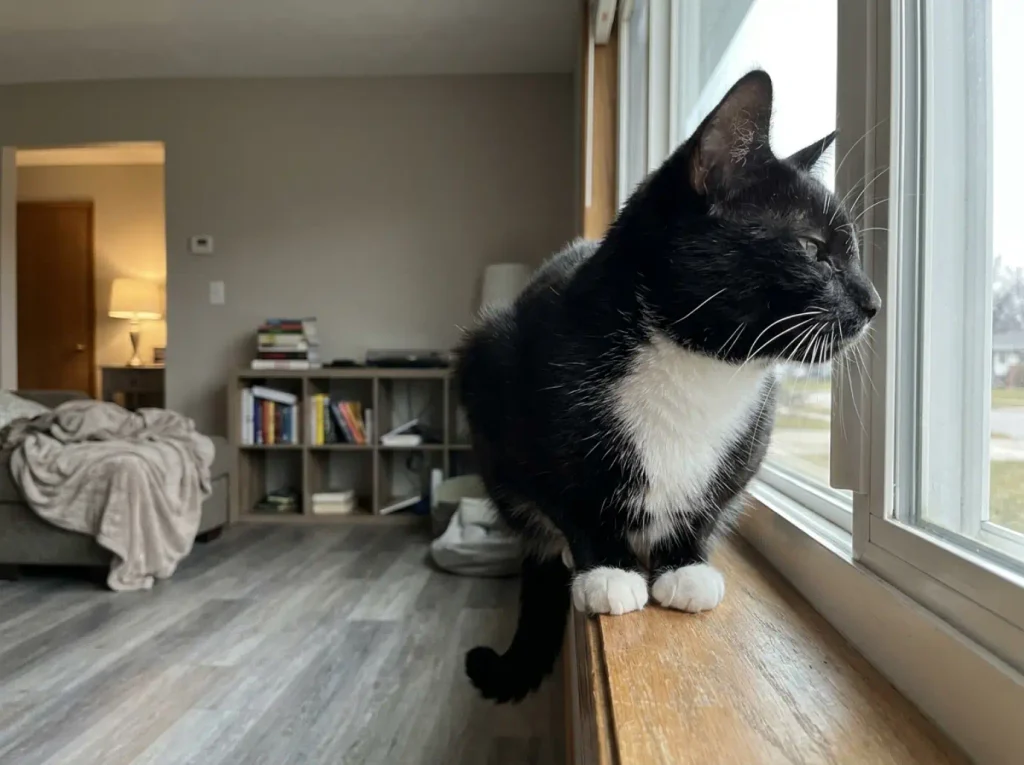
Most people picture a whisker as a stiff hair. It isn’t. A whisker grows out of a follicle-sinus complex, a structure wrapped in blood-filled sinuses and threaded with sensory nerve endings running back to the trigeminal ganglia. Whiskers are among the most densely innervated structures in any mammal, which puts them closer to your fingertips than to the fur on the cat’s back. On cat anatomy, this part is settled and nobody argues it. Cut one and the cat feels nothing, because the shaft itself is dead tissue.
Bend one and the cat knows about it immediately, in detail, because the base is wired like a sensor. That is the honest case for the theory: cat whiskers are sensitive enough that constant contact at a feeding station is not nothing, and sensory overload is at least a coherent thing to propose.
They also feed proprioception. Cells at the whisker base register the whisker’s own deflection and its position under gravity, which is part of how a cat judges a gap it cannot see into, finds the edge of a countertop in the dark, and knows where its own head is relative to everything around it. This is working equipment, in constant use.
So a whisker pressing against the wall of a deep, narrow bowl is not nothing. Something is being registered, every mouthful, for as long as the meal takes. That is the honest half of the theory and it deserves saying plainly, because half the articles on this subject wave it away as if whiskers were decorative.
But there is a gap the theory still has to cross, and it is wider than it looks. “The cat feels this” and “the cat is distressed by this” are two separate claims. Only the first one has evidence behind it. Your own shirt collar touches your neck all day and it registers, in exactly the same sense, and you would not call it collar fatigue. Elizabeth Colleran, DVM, DABVP in feline practice and a board member of the American Association of Feline Practitioners, put the position about as precisely as it can be put: whiskers are sense organs with a high degree of specialized nerve endings, sensitive enough that one could make the case for overstimulation, but there is no data supporting it as a thing.
Plausible and proven are different words. Most of the internet has been using them interchangeably for eight years.
The One Study, and What It Actually Measured
There is a study. You will see it referenced everywhere, usually in a clause, usually without a protocol attached. It is Slovak and Foster, “Evaluation of whisker stress in cats,” Journal of Feline Medicine and Surgery, 2020, run at Washington State University, and it is the only controlled trial that exists on this question. One. Total.
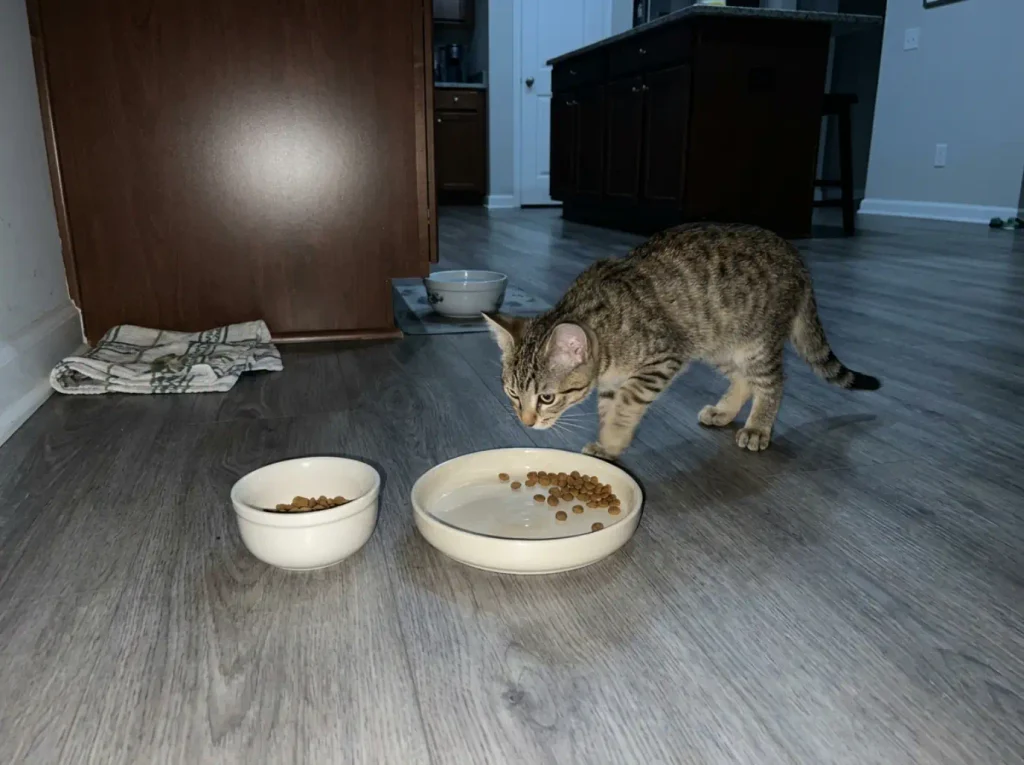
The design matters more than the result, so take the design first. Forty cats enrolled and 38 finished: 15 spayed females and 23 neutered males, split across two materials, with 19 eating from ceramic and 19 from stainless steel. Each cat was fasted for 12 hours, then given a premeasured meal from its own normal bowl while being filmed. A week later, the same premeasured meal from a whisker-friendly dish of the same material, filmed the same way. The next day, both dishes went down side by side with the same food in each, and the owner recorded which one the cat chose.
The measured variables were the sort you can count without arguing about them: time spent feeding, amount of food eaten, and amount of food dropped on the floor. That is to the study’s credit. Nobody was asked to rate how relaxed their cat looked.
📏 And notice what that design does. It asks two different questions, not one. Question one is whether bowl shape changes eating behavior. Question two is which bowl the cat picks when both are available. These are not the same question, they do not have the same answer, and this is precisely where most retellings of this study fall apart. People quote the answer to question two as though it settled question one.
One more thing about scope, since it gets skipped everywhere: the trial used dry food only. Wet food sits lower in the dish and clings to the walls, so if anything it should press harder on the whisker theory, and it has never been tested. Any whisker-fatigue claim aimed specifically at wet feeding has less behind it than the dry-food claim does, which is already not much. The depth question for wet food is worth reading on its own terms, but do not expect a study at the end of it.
If you want the plain-language version of the trial before the next section, the study summary from the EveryCat Health Foundation is the least mangled one available.
What It Found, and What It Did Not

Two results. Only one of them supports the sales pitch, and it is not the one you have been shown.
This is the only peer-reviewed study on the question, so what it says carries weight in both directions.
Result one: no statistically significant difference. Not in time spent feeding, not in the amount eaten, not in the amount dropped on the floor. The cats ate the same from the deep narrow bowl as they did from the wide shallow bowl. The headline claim, the one on every product listing, the one that says a wide bowl fixes eating problems, is not what this study showed. It is closer to the opposite of what this study showed.
Result two: given the choice, 63% of the cats picked the whisker-friendly dish. 24% went back to the regular bowl and the rest had no opinion. That is a real preference, in a real trial, and dismissing it would be as dishonest as leading with it. The cats liked the wide dish. They just did not eat any differently from it.
Both results are true at once, and holding both is the entire skill here. Preference is not harm. A majority of cats preferring a shape tells you something worth knowing about what your cat would choose. It tells you nothing about whether the old bowl was doing damage.
Now the part nobody walks you through, which is why this study is thin evidence in both directions. The authors listed the limitations themselves, and they are not small. Nobody could be blinded, because the owner and the cat can both see which bowl is which the moment it hits the floor. The sample was small and drawn from one city. And each cat was observed over a single meal per condition. Picky eating, as owners actually describe it, is a pattern that shows up over weeks. This study looked at one sitting each and then asked a question about a pattern.
Then there is the confound, and it is the reason I would not build anything load-bearing on that 63%. Every cat’s normal bowl in this study was both smaller and deeper than the dish it was compared against. Width, depth and novelty were never separated from each other. So a cat choosing the wide dish might have been choosing a wider dish, or a shallower one, or a brand-new one it had never seen, or simply a clearer view of its own food while eating. None of those four explanations is about whiskers. The study cannot tell them apart, and neither can anyone quoting it.
The conventional move at this point is to declare a winner. I would rather say the accurate thing: one small unblinded trial is a data point, not a verdict, and this one happens to point away from the marketing while giving the marketing a preference result to wave around.
🚑 One line, because it is the only line in this article that is not about a bowl. If a cat has genuinely stopped eating, or is losing weight, that is a question for a veterinarian and it does not wait behind a bowl experiment. Appetite change gets looked at medically first. Bowl shape is a conversation for afterward.
The behavior most often blamed on whisker fatigue is a cat pulling food out of the bowl to eat it off the floor, and there are at least four ordinary explanations for that before you reach the whiskers.
Preference and performance are two separate results, and any article that gives you only one of them is selling you something. A cat picking the wide dish tells you what the cat likes. It does not tell you the old bowl was doing any harm.
What to Actually Do About It, Real or Not
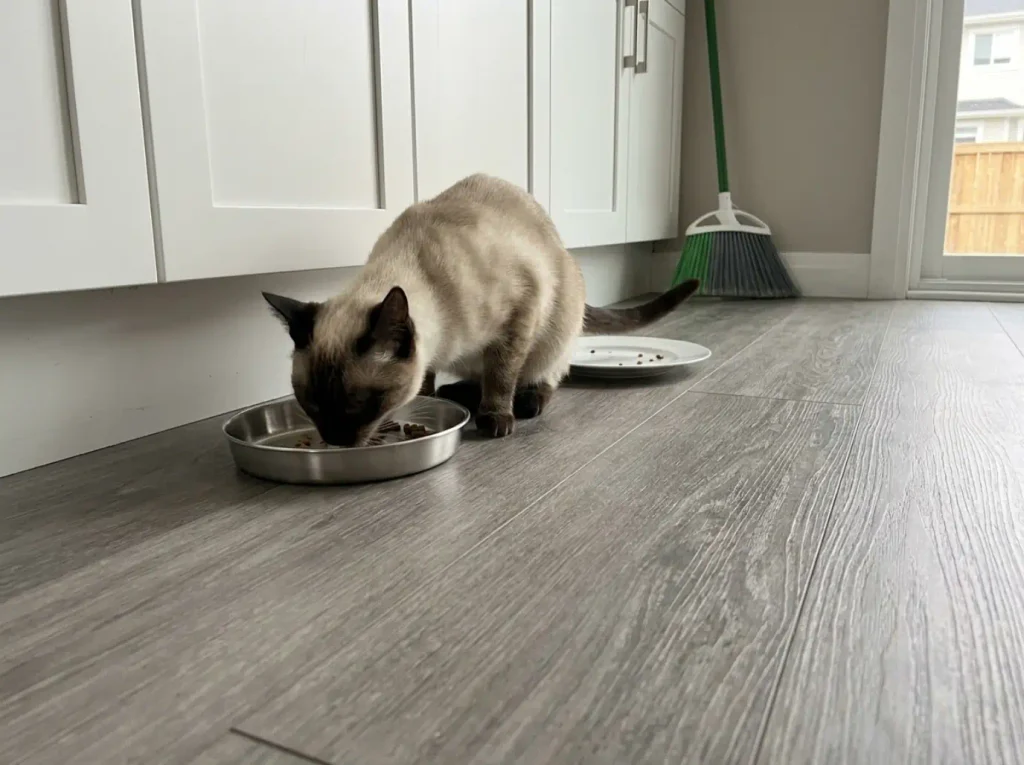
The verdict is unsatisfying, so here is the useful part: you do not need this settled to act on it. The test is free.
💰 Start with a flat plate you already own. A dinner plate, a shallow saucer, the small side plate at the back of the cabinet. It is wide, it is shallow, and whiskers physically cannot touch the sides of it. That is the exact variable a whisker-friendly bowl is sold on, tested for nothing, in your kitchen, tonight. Give it a week, because a cat treats anything new as suspicious for the first two days and you will learn nothing from day one.
Watch two things and only two things. Whether the cat finishes the meal in one go instead of walking off and coming back. And whether food stops ending up on the floor around the bowl. If neither changes after a week, you have your answer for your cat, and it cost you nothing but a plate in the dishwasher. That is a better result than most of what the internet will sell you.
If the plate does work, buying a proper dish is still a reasonable thing to do, and this is where I would push back on the pure-skeptic position. A dinner plate slides across tile the moment a cat puts weight on the rim, it has no lip to keep dry food from skating off the edge, and it takes up counter-sized space in a corner that probably has none. What you would be paying for is the same shape with a base that stays put. Not a cure. A plate that behaves.
The plain version is the Ceramic Cat Food Bowl Set, wide and shallow in food-grade ceramic and sold in fours, which is the honest answer for a house with more than one feeding station or anybody tired of washing the same dish twice a day. The catch with ceramic is that it chips, and a chipped rim is a place bacteria live, so a dropped bowl is a replaced bowl rather than a rescued one.
If ceramic is not your thing, the 4 Pcs Stainless Steel Cat Bowls run 5.5 inches across, which is the minimum diameter the sizing rule for cat food bowls lands on, and steel does not chip or scratch the way plastic does. It also skids on a hard floor and shows every single water spot, so if you are the kind of person that bothers, buy the ceramic.
One variant is worth naming separately, and not for whiskers at all. The CEEFU Extra Wide Elevated Ceramic dish is 6.2 inches across on a raised base, and the raised base is about neck and shoulder comfort for a big cat or an older one eating off the floor. That is a different problem from whisker contact and I would rather label it honestly than fold it into the same claim. It is also one more surface to clean under, and it is the wrong choice for a cat that likes to crouch low over its food, which plenty do.
Whether to change the dish at all is partly a material question rather than a shape one, and the case against plastic bowls has better evidence behind it than the whisker theory does.
One last confound, and it is the one I would check before any of the above. In a two-cat home, a cat that paces at the bowl, eats in short bursts, or pulls food out to eat somewhere else may be reading the other cat rather than the dish. It is waiting for a clear exit, or eating fast because it expects company, or refusing to put its head down in a spot where it cannot see the room. Bowl shape does not touch any of that. If two cats are sharing a bowl in your kitchen, fix that first and then run the plate test, or you will not know which change did the work.
The same logic gets applied to the water bowl, incidentally, and it holds up about as well there. Whether fountains actually work runs into the same shape of evidence: a preference that shows up clearly, and a measurable benefit that keeps not showing up.
Run the plate for a week before you buy anything. If the cat eats the same way off a dinner plate as it did from the bowl, the bowl was never the problem, and you found that out for free instead of finding it out for the price of a bowl.
Conclusion
Whisker fatigue is a plausible theory that nobody has demonstrated. The anatomy behind it is solid, genuinely so, and the syndrome built on top of that anatomy is one small study and eight years of repetition.
That study found two things, and they point in opposite directions. No difference in how cats ate. A clear majority preferring the wide dish anyway. Only the second result survives scrutiny, and a preference is not a harm.
And you do not need the question answered to act on it. Your cat is not waiting for a peer-reviewed consensus. It has an opinion about the dish already, and the cheapest way to find out what that opinion is costs one plate and one week.
🗓️ Check back in three weeks. That is long enough for a new dish to stop being new and start being furniture, which is when you find out what the cat actually thinks. If food is still landing on the floor after three weeks on a flat plate, the bowl was never the variable. And if the cat is eating less than it used to, that stopped being a bowl question a while back.
Try the plate you already own. If nothing changes, you have your answer, and it cost you a week.
Amazon’s Audible — free for 30 days
Your cat won’t let you read. Let someone read to you.
Audible is Amazon’s audiobook library — thousands of titles, read out loud, on your phone. Free for a month, plus one audiobook to keep forever.
Frequently Asked Questions
01Do cats really get whisker fatigue?
Nobody has demonstrated that they do. Whiskers are sensitive enough that the theory is not absurd, but the only controlled study found no difference in how cats ate from a whisker-friendly dish, and the AVMA has said plainly there is no evidence bowl contact causes stress.
02Can you fix whisker fatigue?
You can remove whisker contact for nothing by feeding from a flat plate, which is all a whisker-friendly bowl does. Whether that fixes anything depends on whether there was a problem to start with, and a cat that has genuinely stopped eating needs a vet, not a different dish.
03Can cats feel pain if you cut their whiskers?
The whisker shaft has no nerves in it, so cutting one is not like cutting skin. But the follicle it grows from is densely innervated, and a cat without whiskers loses real information about gaps and nearby objects. There is no reason to trim them.
04What is whisker fatigue in humans?
It is not a human condition. People do not have vibrissae, the specialized sensory whiskers with their own blood-filled follicle-sinus complex, so the term does not transfer. It turns up in searches because the phrase sounds like it ought to mean something general.
05Is a whisker-friendly bowl worth buying?
Possibly, but not as a cure. In the one existing study most cats preferred the wider dish even though they did not eat differently from it. If a flat plate works and you are tired of it sliding across the floor, a shallow dish with a proper base is worth buying for that reason alone.
Leave a comment