Three Cats, Four Water Bowls, and Here’s Why
Don't buy one bigger bowl for three cats. You need four water stations (cats +1), spread out so no single cat can quietly guard them all.

Alfredo RamsesFounder · September 28, 2026 · 15 min read

On this page7 sections
- 1Four Bowls for Three Cats, and Why the Fourth One Exists
- 2What a Bowl-Guarding Cat Looks Like When Nobody Is Fighting
- 3Where the Four Go in an Apartment That Only Has So Many Corners
- 4What Goes in the Four Spots, When the Free Version Is Not Enough
- 5Whether One of the Four Should Be a Fountain
- 6The One Thing to Watch This Week
- 7Frequently Asked Questions
The bowl is full. It was full this morning, it is full now, and three cats live here, so everybody must be fine. That full bowl is the problem.
A shared water bowl tells you exactly one thing, which is that water is in it. It tells you nothing about which of the three cats has been near it today. The number below comes from the feline environmental guidelines plus what three-cat households report once they start watching, and the short version is that the count is not three. Here is the actual number, why the extra one exists, where the four go in an apartment that has a normal number of corners, and the change that costs nothing.
Quick Answer
Three cats need four water stations: one more than the number of cats, in four separate places a cat can reach without walking past another cat. Four bowls in a row is still one station. The spare is not for extra thirst. It is so no single cat can stand between the other two and every source of water at once.
Four Bowls for Three Cats, and Why the Fourth One Exists
Most people arrive at this question already holding a number. One bowl per cat sounds reasonable, it is easy to remember, and it fails quietly, because it assumes three cats and three bowls means three cats drinking. Those are different sentences.
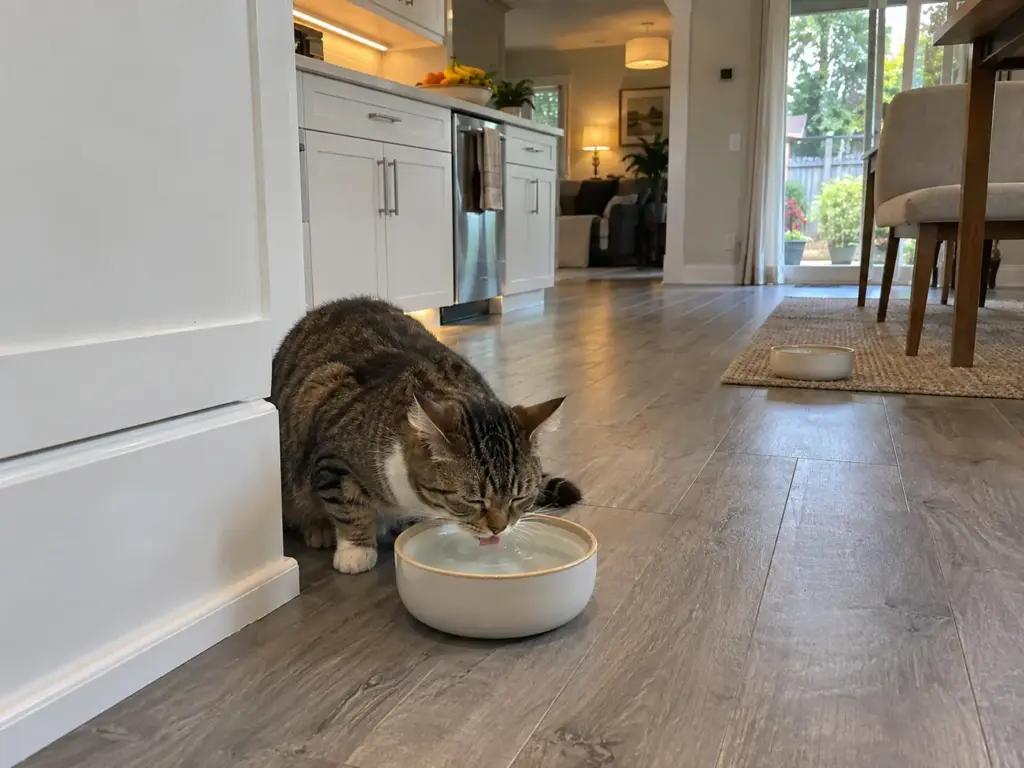
The fourth station is not generosity, and it has no bearing on volume. Three cats do not drink four bowls’ worth of water, and nobody is suggesting they should.
What the fourth one buys is redundancy against a single cat. One cat can sit in front of one bowl. One cat can, with a bit of walking, make a nuisance of itself at two.
With four bowls on four different sightlines, a cat would have to be in four places at once to control the water, and cats have not solved that. As one forum poster put it while explaining why more bowls beat one big bowl, she can’t defend them all. That is the whole mechanism in five words, and it is resource guarding described without the term.
The formal guidance does not hand you a number for three cats, which is part of why nobody writes this article. According to the AAFP and ISFM’s own environmental needs guidelines, “A cat should have a choice for each resource; for example, a minimum of two resting areas, two feeding areas and two toileting areas.” Two is the floor for any multi-cat household, one cat or ten.
The same document then says every cat should have its own separate feeding station, and that instruction is the one that scales. Three cats, three stations as the working floor, and the fourth for the miss.
The conventional wisdom is that this is just the litter box rule wearing a different hat. It lands on a similar number, so the comparison is fair, but the reasoning behind it is not the same at all.
A litter box gets used up. It fills, it gets soiled, and the spare exists so that no cat ever arrives at a box that has already been spent. A bowl does not get used up. Water sits there being water.
The spare bowl exists because of sightlines, not capacity, which is why the count for water is driven by the floor plan and the count for litter is driven by the calendar. Neither version of the n+1 rule is about generosity. If you want the other half of that arithmetic, the litter box count works on a different logic and is worth reading on its own terms rather than borrowing from.
And this is where the guarding hides. Owners describe it in forums without ever using the word conflict: one cat sticks her head in front of another’s and drinks until the other one walks away, or simply sits in front of the dish at the moment she knows somebody wants it.
No hissing, no swatting, no fur on the floor. Nothing that a person walking through the kitchen would flag as a problem, because nothing looks like a problem. The bowl still looks full. If you want the volume side of this, how much water a cat actually needs in a day is the pillar that does the ounces; this article does the geography.
Count locations, not bowls. Two bowls sitting on the same kitchen mat is one station, and one station is one thing a cat can sit in front of.
What a Bowl-Guarding Cat Looks Like When Nobody Is Fighting
You are probably reading that last paragraph and thinking it does not apply, because your three get along. They sleep in a pile. Nobody has ever thrown a punch. Fair enough, and it changes nothing: bonded cats guard resources too, and the thing that controls water access in a house of three is almost never a fight.
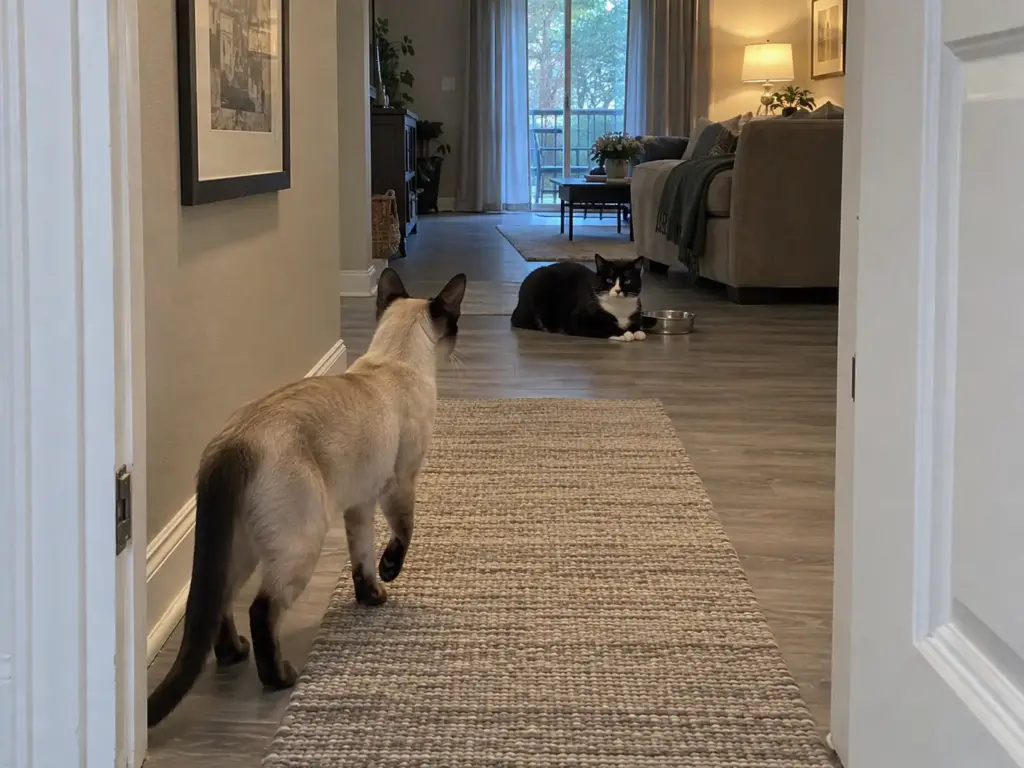
Cats are solitary drinkers by design. The guidelines frame avoidance and evasion as the normal feline response to pressure, which means a cat that meets resistance at the bowl does not argue about it. It leaves. Then it comes back later, or it does not.
So the signs are boring, which is precisely why they go unreported for months. There are four worth watching for, and they cost nothing to check.
One cat only drinks when the other two are asleep. One cat walks toward the kitchen, stops in the doorway, looks at the bowl, and turns around. One cat is consistently the first one there, every time, as though the bowl is an appointment. And the level in the bowl drops slower than three animals ought to manage between them.
The blocker is usually not who you would guess. It is not always the biggest cat, and it is frequently not the pushiest one in any other context, because this is not a personality trait being expressed across the whole apartment. It is one cat who has decided that one fixed point belongs to her.
Owners describe exactly this and then talk themselves out of it, because nobody is getting hurt, and somebody in the thread always corrects them: she is being a bully in her quiet insistent way. Which is the useful phrase, honestly, because quiet and insistent is what you are looking for.
The same threads note that the guarded object drifts. Today the water, next month the sunny chair. Territory in a small home is held by controlling things, not corners, and it was never really about the water.
🚑 One thing this is not, and the distinction matters more than anything else on this page: if one of the three has suddenly started drinking noticeably more, or noticeably less, that is not a placement problem and this article does not try to solve it.
A sudden change in how much a cat drinks is a vet visit, and everything here assumes the vet has already cleared all three. Spreading bowls around an apartment fixes access. It does not fix thirst, and it cannot treat dehydration. For the slower, non-sudden version of the question, a cat who stops drinking from a bowl that looks fine covers what else changes a cat’s mind about a bowl.
Where the Four Go in an Apartment That Only Has So Many Corners
“Put them in different places” is useless advice in a one-bedroom, and every guide that says it is picturing a two-story home with a basement and a spare room. You have a kitchen, a living room, a hallway, a bedroom, and a bathroom that already has the litter box in it.
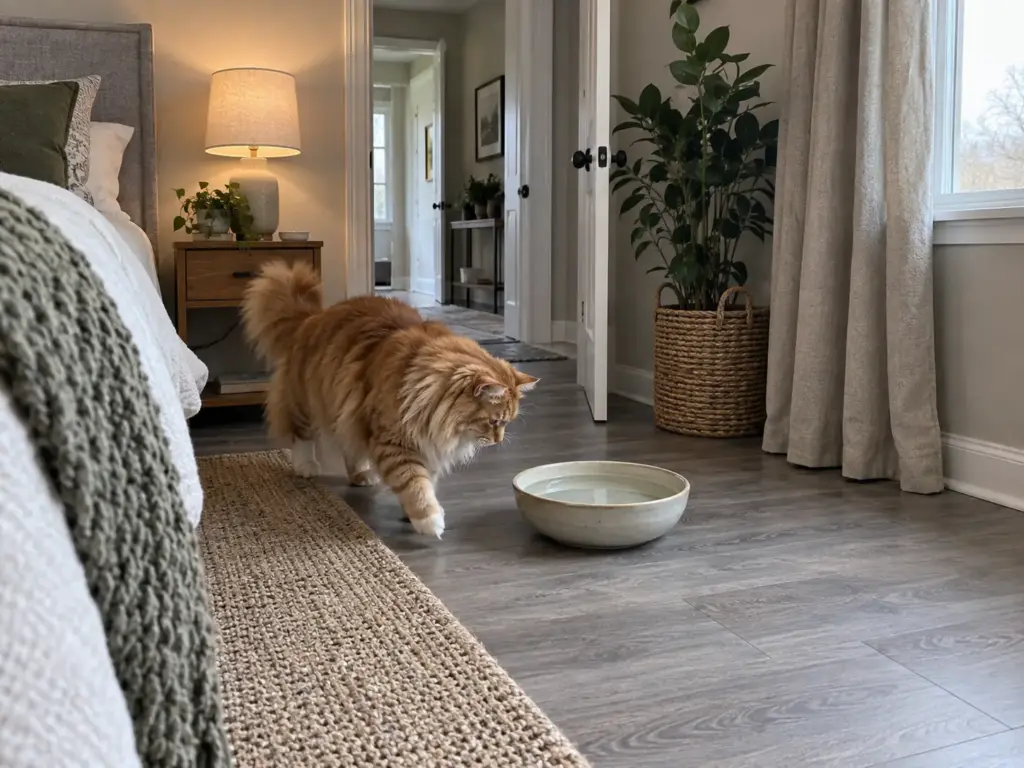
That is the real estate, and bowl placement on one level is a different puzzle. Here is how to spend it.
The rule that generates the map is this: a cat should be able to reach a bowl without crossing another cat’s spot, and without walking into a dead end. No bowl at the back of a closet. No bowl in a nook where the only way out is back past whoever is standing there.
A cat will not commit to a position it cannot leave from, and a bowl in a dead end is a bowl that gets used once and then quietly retired from the rotation.
Worked out for four stations in a single-level apartment: the first goes in the main living area but off the traffic lane, not in the doorway everyone funnels through. The second goes at the far end of the home, usually a bedroom or another low-traffic spot that shares no sightline with the first.
The third goes on a different line entirely, which in practice means a hallway nook, a side table, or the far end of a counter, because vertical spread substitutes for square footage when you have run out of rooms. The fourth goes wherever the three of them already choose to hang out, and you do not have to guess at that one. Watch them for a week.
Two rules override all of it. Water goes away from food, and water goes away from the litter box. The guidelines separate those resources deliberately.
The second one is non-negotiable in a small apartment, where the honest temptation is to put everything in one tidy pet corner so it is all in one place when you clean. That corner is convenient for you and contaminated for them. While you are deciding heights and surfaces, whether the water bowl should be raised at all is its own decision and it goes differently for water than for food.
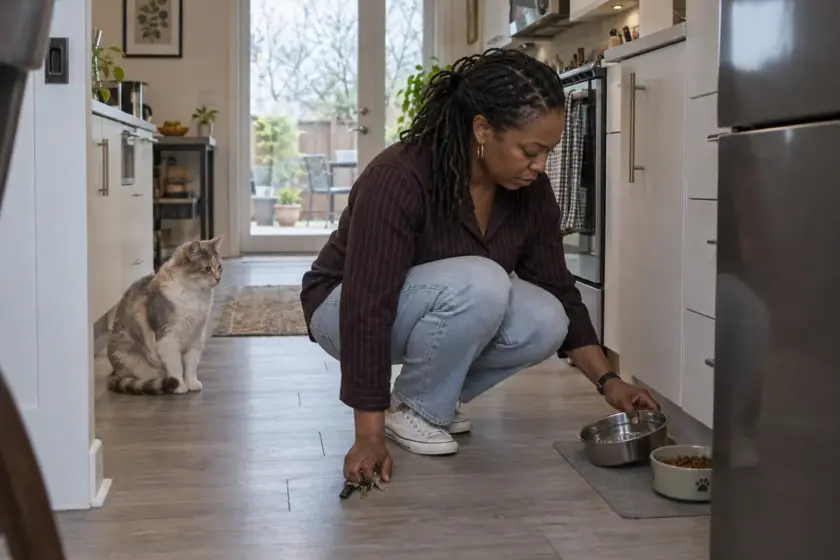
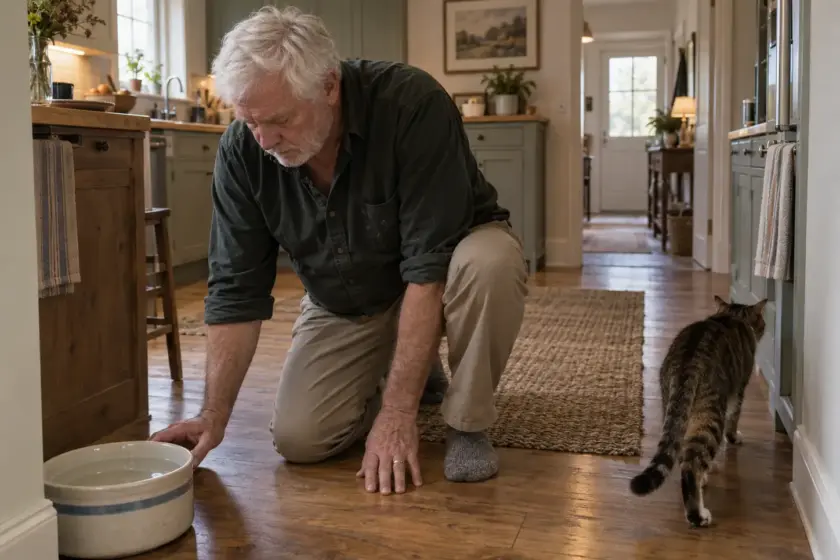
Free first, and this is the part worth doing before anything else. Three of your four stations are almost certainly bowls the household already owns, sitting in the wrong place. Nobody needs to buy four bowls to find out whether four locations fix the guarding.
In the forum thread that documents this best, the owner did not buy anything at all. She added and spread the bowls she had, and reported afterward that the guarding cat even stopped defending the communal living room water. The change was the map, not the hardware.
Spend a week noting where the three of them nap. The fourth station goes there. They have already done the survey for you.
What Goes in the Four Spots, When the Free Version Is Not Enough
Once the map works, the bowls themselves matter for exactly one reason: a bowl a cat dislikes is a station that does not count. Put a bad bowl in your perfectly spread fourth location and you have three stations and an ornament. Two things do that work, and neither of them is price.
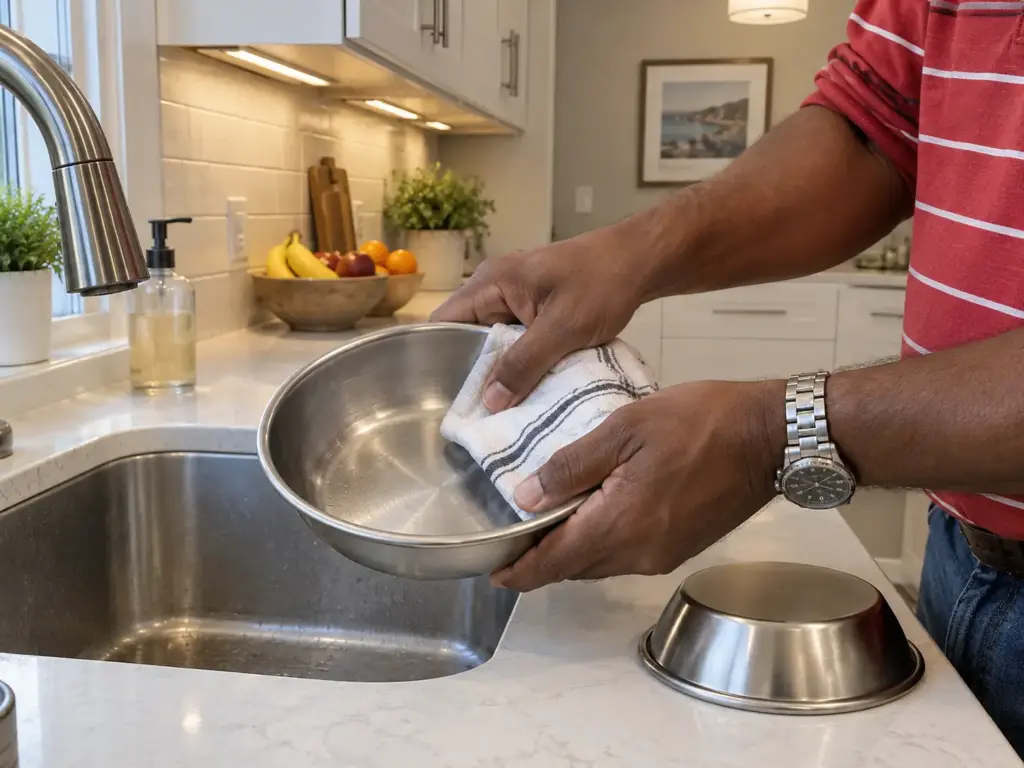
Width comes first. A narrow, deep bowl forces a cat to tilt its head sideways on every sip to keep its whiskers clear of the rim, which is the everyday version of whisker fatigue, and a cat that finds a bowl uncomfortable does not file a complaint.
It walks to one of the other three, which collapses your four stations back down to three and puts you halfway back where you started. Roughly five and a half inches across, with enough whisker clearance that nothing brushes the sides, is the target. If you want the version of this measured against an actual cat’s face, bowls measured against a cat’s face goes into the geometry properly.
Material is one line. A ceramic bowl, a glass bowl or a stainless steel bowl all hold up and all get properly clean, which matters more than usual here because you now have four of them. A plastic bowl is the one to retire: it scratches, and the scratches hold on to smells.
Which brings up the trade nobody mentions when they tell you to add stations. Four stations is four bowls to refresh, not one. Standing water grows a film on the same clock whether there is one bowl or four of them, so fresh water daily now means four stops instead of one, every day, forever.
That is not an argument against four. It is the thing to know before you commit, because the household that sets up four stations and then refreshes two of them has built a system with two stale bowls in it, and a dirty bowl is a station a cat writes off. Budget for the odd spill too: four bowls on the floor is four things a cat can knock.
If your current bowls are the problem rather than the placement, two straightforward options. The Americat Company Stainless Steel Cat Bowls come as a pair of 304-grade steel dishes, no plastic to scratch and hold onto smells, and one pack covers two of your four spots. The catch is that steel is light, so a determined cat can push one around a tile floor.
For covering the whole apartment in a single purchase, a wide, shallow Ceramic Cat Food Bowl Set comes four to a box, which maps onto three cats plus the spare station without any arithmetic. Ceramic chips if you drop it, and a chipped bowl is a bowl to replace rather than keep using.
The common misstep, from the same threads, is buying one bigger bowl instead of more bowls. It feels like the same fix and it is not remotely the same fix. A bigger bowl is still one location, and one location is still guardable by one cat who got there first.
A bowl wide enough that the whiskers clear the rim is the entire requirement. If a cat drinks with its head cocked to one side, the bowl is too narrow and that station is on borrowed time.
Whether One of the Four Should Be a Fountain
Every hydration question attracts this one eventually, so let us put it in its place. A fountain is a station. It is not a system, and it does not replace the map. Drop a fountain in the exact corner where the guarded bowl used to sit and you have given the guarding a new object to sit in front of, one that hums.
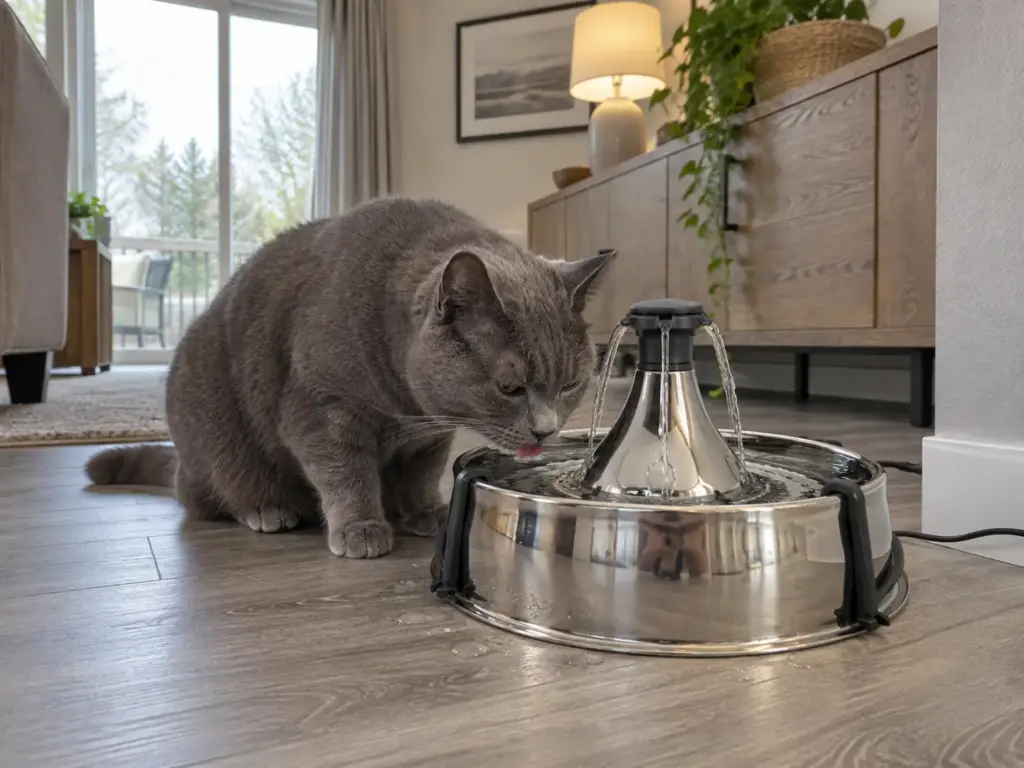
Where a cat water fountain earns its spot is narrower and more specific than the marketing suggests. If one of your three has been visibly uninterested in the still bowls and keeps turning up at a dripping faucet or the glass on your nightstand, that is a preference for running water, and it is worth catering to with one of the four stations.
One. Not all four, because the other two cats may not care at all, and you would be buying three appliances to solve one cat’s opinion. This matters most in a house on dry food, where the bowls do all the work; the wet food moisture in a canned diet already covers a good share of the day’s intake.
For households in that spot, the PetSafe Drinkwell Stainless 360 Multi-Pet Fountain is built with drinking positions all the way around it rather than a single spout, which suits three cats better than a unit they have to queue at. It is still one station. It still counts as one.
The count adds a cost here that the bowls do not. A fountain has a filter and a pump, both on a maintenance schedule, so making one of your four stations a fountain adds a recurring chore that the other three do not have. Skip it for long enough and the fountain becomes the station nobody uses, which puts you back at three. Whether a fountain suits your cat at all is a separate question worth answering before you buy one for a house that already has a working map.
And there is a renter constraint that decides this more often than preference does: a fountain needs an outlet, and outlets are where the apartment says they are, not where the map wants a bowl. Plan the three still-water stations first, on the logic of sightlines and quiet corners, and then see whether any outlet happens to sit near a spot that works. If none does, you have four bowls and a perfectly good setup.
The One Thing to Watch This Week
Four stations for three cats, in four separate places. Count locations, not dishes, because two bowls on the same mat has always been one.
Move what you already own before you buy anything. Three of the four are usually bowls that just need to be in a different room, and that costs an afternoon and nothing else.
Watch who arrives at the water first. Do it for a week. The cat who is always there first, every single time, is the reason the fourth bowl exists, and you will not see it until you look for it.
Check back in three weeks. By then you want to see wear on all four stations, nobody hesitating in a doorway, and water levels dropping at a rate that makes sense for three animals. If one station has never been touched, it is in a bad spot rather than a spare one. Move it, do not remove it.
The free version of this takes about ten minutes: carry three of your existing bowls to three different rooms this afternoon and leave them there. If the doorway hesitation stops, you just answered the question without buying anything.
Amazon’s Audible — free for 30 days
Your cat won’t let you read. Let someone read to you.
Audible is Amazon’s audiobook library — thousands of titles, read out loud, on your phone. Free for a month, plus one audiobook to keep forever.
Frequently Asked Questions
01What is the 3-3-3 rule for cats?
It describes a newly adopted cat settling in: roughly three days hiding, three weeks learning the routine, three months feeling at home. It has no connection to how many bowls or boxes a household needs, which is where the two get mixed up.
02Is 3 Litter Boxes for 3 Cats Enough?
The usual guidance is one box per cat plus one, so four rather than three. It lands near the water number for a completely different reason: a box gets used up and needs a spare, while a bowl only ever gets blocked.
03How Many Water Bowls Should You Have Per Cat?
Plan on one station per cat plus one spare, in separate locations. For three cats that is four; for two it is three. The spare is what stops a single cat from controlling every water source at once.
04Do Three Cats Need Three Separate Water Bowls if They Get Along?
Cats that get along still drink alone, because that is how they are built rather than a sign of friction. Separate stations cost nothing to try, and they remove a problem that is very hard to spot while it is happening.
05Should I Put All the Water Bowls in the Same Room?
No. Bowls in one room are one station with extra dishes in it. Spreading them across the home is what lets a cat always reach water without passing another cat on the way.
Leave a comment