Why Cats Drink Away From Food, and How Far Is Far
Don't measure the gap in feet (the 3-5 ft rule comes from no study). If your cat can see the food bowl from the water, it hasn't moved.

Alfredo RamsesFounder · September 28, 2026 · 20 min read
On this page8 sections
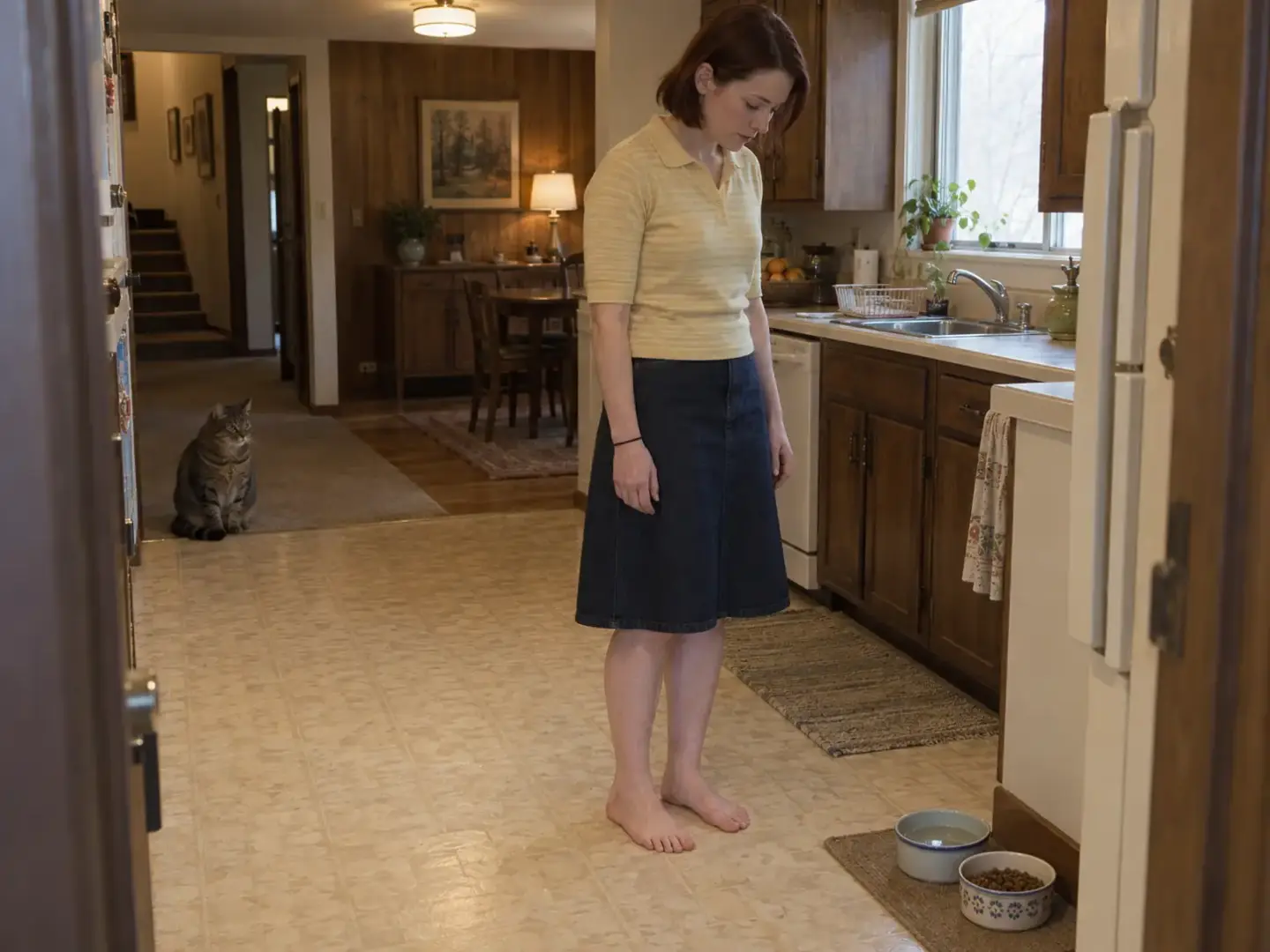
You have been hearing him drink from the bathroom sink for months. You notice it the way you notice a dripping faucet, filed under things this apartment does, until one morning you look at the kitchen and see the water bowl sitting full and untouched right beside the food dish where you put it on day one.
He is not being difficult about water. He is reading the location, and his read is correct, which is the part almost nobody says out loud. The theory behind that read is a consistent observation from people who study cat behavior, not a controlled study, and this article is going to be honest about that before it tells you to move anything. What follows is what the cat is actually solving, how much distance is enough in a home that does not have distance to spare, and the fix that costs nothing.
Quick Answer
Cats drink away from food because instinct reads water sitting beside prey as water at risk of spoiling, and because food particles falling into the nearby bowl confirm it in practice. The three-to-five-foot figure everyone repeats comes from no study. What decides it is breaking the sightline: another room, or the same room behind furniture.
What the Cat Is Actually Solving
Standing water next to a food source is, to a cat’s instincts, a water source with a problem. The version of this animal that hunted for a living caught something, ate part of it, and left the rest where it fell, and anything decomposing near a puddle made that puddle a worse bet than the one two fields over. So the default setting is separation.
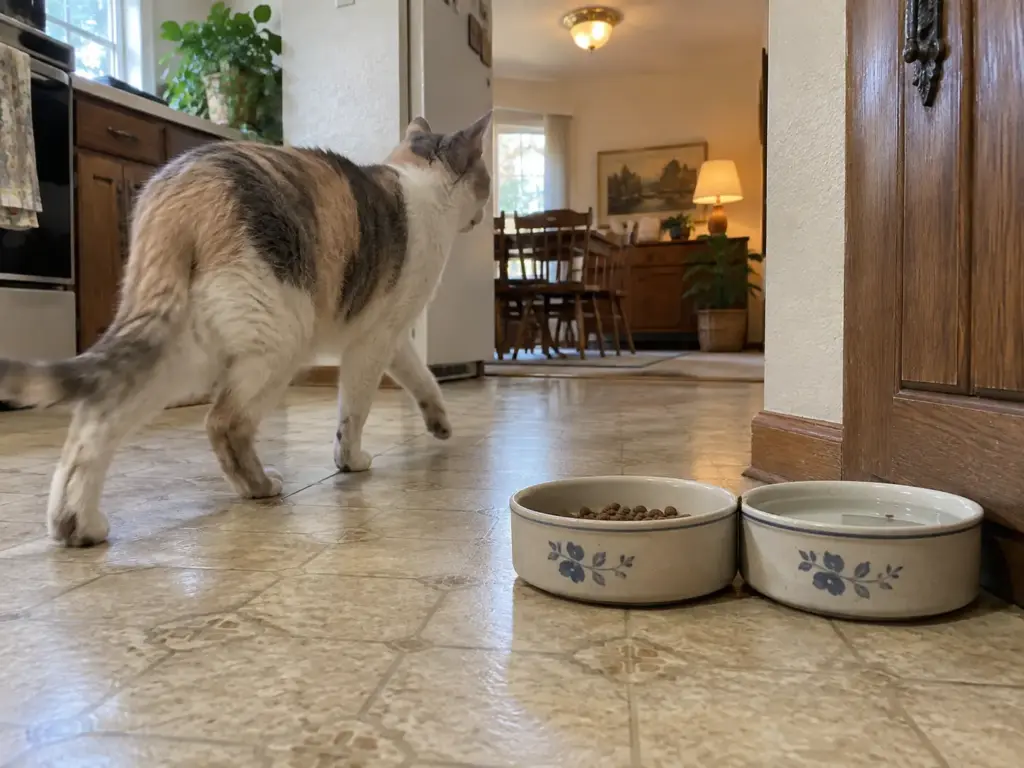
Your cat is applying that setting to a ceramic dish of kibble that arrived in a cardboard box, and the setting does not know the difference. This is the wild instinct half of the story, and it comes bundled with a second inheritance from the same desert ancestor: a low thirst drive. A cat built to get most of its water from what it caught never evolved to notice a bowl the way a dog does, which is why the bowl has to be in a spot he approves of rather than a spot he tolerates.
That is the leading explanation. It is not a proven mechanism, and you deserve to hear the difference. Nobody has run the controlled study on where a cat prefers its water bowl relative to its food bowl. Purina, which sells the food, is the only major source in this whole conversation willing to write that down plainly, saying there aren’t any good studies on ideal cat water bowl placement and that it falls to owners to work out what their own cats prefer.
Four out of five articles on this subject state prey contamination as settled science. It is not settled science. It is a behavioral pattern that shows up consistently enough that acting on it is the sensible bet, which is a different and more useful thing.
And there is a second mechanism underneath it that needs no instinct at all to explain. Cats are messy eaters, kibble scatters, wet food flings, and food particles land in a bowl sitting eight inches away. Within a day that water has a film on it. You would not drink it either.
This one you can verify tonight without believing a word about ancestral hunting behavior: look into the water bowl next to the food and tell me what is floating in it.
So when the cat goes looking elsewhere, he is not developing a quirk. The faucet drinker, the one who waits on the edge of the tub, the one who sticks his head into your glass of water, the one who quietly uses the dog bowl in the other room: that is all the same instinct pointed at whatever water in the apartment reads as neither stagnant water nor contaminated. Sink drinking and toilet drinking belong to the same list, and so does the cat who only drinks after you run the tap.
He found a better source than the one you bought him. Given his criteria, he is not wrong.
The setup that catches the most people is the double feeder: the molded combo unit with a food side and a water side sharing one base, usually designed for dogs, usually bought because it is tidy and takes up one footprint instead of two. That last part is the whole appeal, and it is an appeal to you, not to him.
The pattern people report is depressingly consistent. The combo unit goes down, the water side stays full, and the cat starts drinking out of the toilet. The fix in those stories is never a better double feeder. It is no double feeder.
None of this means a full bowl proves a cat is fine. Cornell’s Feline Health Center puts a number on it: roughly 4 ounces of water per 5 pounds of lean body weight per day, which puts an average 10-pound cat at about a cup a day between the bowl and the moisture in his food. If you want the full arithmetic on how much water a cat actually needs in a day, the pillar has it.
The short version is that a bowl still at the same level after two days is not a cat who isn’t thirsty. It is a cat drinking somewhere you have not found yet.
One honest caveat before you start measuring: a cat on wet food is getting most of that cup from his dinner, since the moisture content runs as high as 80%, and he will barely touch the bowl no matter where you put it. On dry food the bowl is the whole supply, and that is when placement stops being a detail.
The Number Nobody Can Back Up
You have probably already tried moving it. Most people have. You slid the water bowl to the other end of the same mat, or the far side of the same counter, and the cat did not register that anything had happened, and you concluded the whole theory was nonsense.
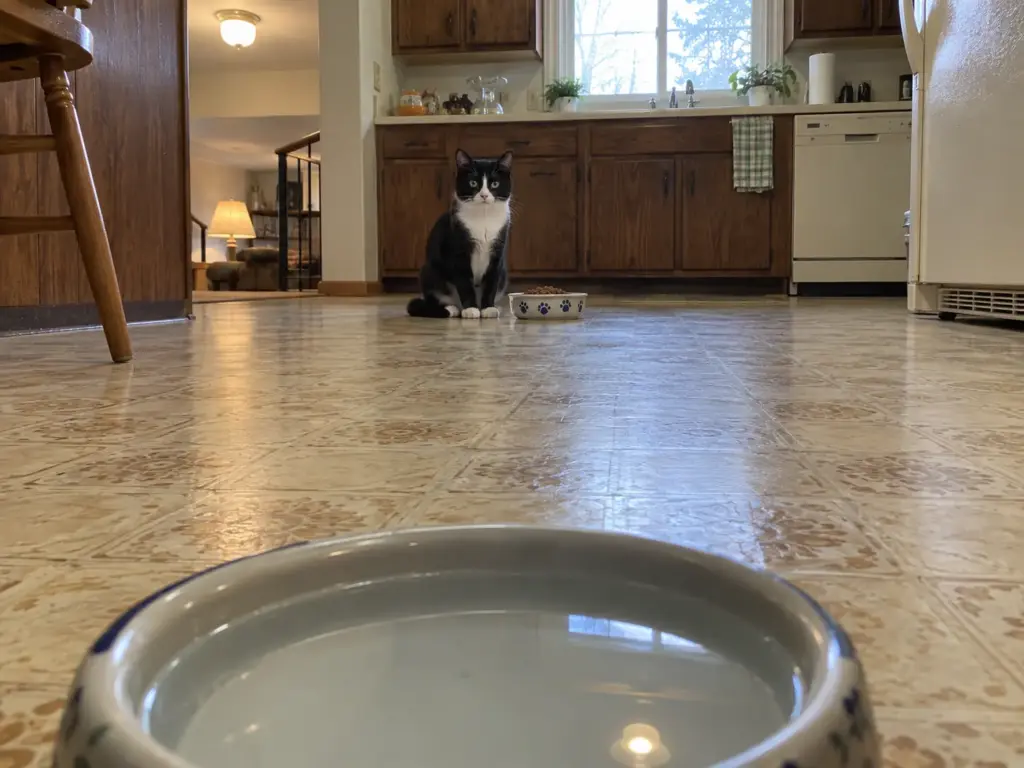
Reasonable conclusion, wrong target. The theory was fine. The move was not a move.
The number that circulates is three to five feet, and it gets repeated across dozens of articles as though it came from somewhere. It did not. No source explains why five feet and not four, or seven, or a room. It is a figure that got written down once and has been copied ever since, and calling that out matters more than replacing it with a different invented number, because the invented numbers are exactly what makes people shuffle a bowl eighteen inches and give up.
Here is what does hold up. A move that breaks neither the smell nor the line of sight does not count as a move to the cat. The two bowls are still one station in his head, and one station is what he was avoiding. So stop measuring in feet and run a different test: can the cat see the food bowl from the water bowl? If yes, and they share a corner, the bowl has not moved yet no matter what a tape measure says.
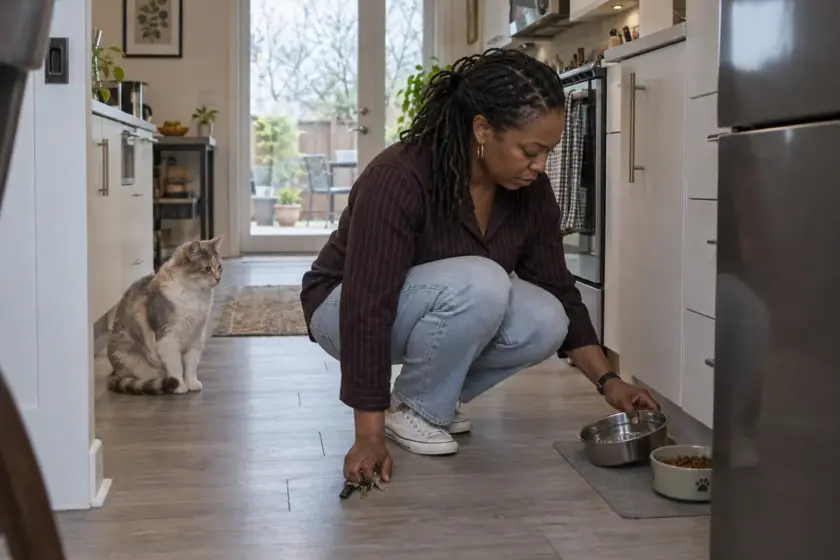
Run the two-second test. Crouch down until your eyes are at the height of the water bowl and look toward the kitchen. If you can see the food dish from there, so can he, and the bowl needs to go further than you just put it.
Distance is not the only thing the spot has to get right, though, and this is where a lot of well-meaning relocations fail. A cat will not settle in to drink with his back to the room. Purina’s guidance on this is the useful half of its advice: bowls tucked into corners force the cat to turn away from open space, and cats avoid them. Which means a bowl you carried two rooms away and wedged behind the pantry door can fail for its own reason, having successfully solved the one you were aiming at.
What you are really after is a boundary, not a distance. A doorframe does more than three feet of open floor. So does the end of a hallway, the corner of a kitchen island, the back of a sofa.
Sightline first, then corner placement, then feet — in that order, and feet are the one that matters least. The real distance between bowls is whatever the cat has to walk around, not what a tape measure reads: a water station eight feet away in a straight open area from the food does less work than one four feet away around the edge of a bookshelf.
Where the Water Goes When There Is No Second Room
“Put it in another room” is advice written by someone who has another room. In a studio the kitchen and the only free patch of floor are maybe twelve feet apart with nothing in between, and in a one-bedroom the bedroom door is shut at night, which is exactly when a cat does a lot of his drinking. The standard advice falls apart here, and the fact that every competitor in this niche stops before reaching this paragraph is a choice they made, not a limit of the subject.
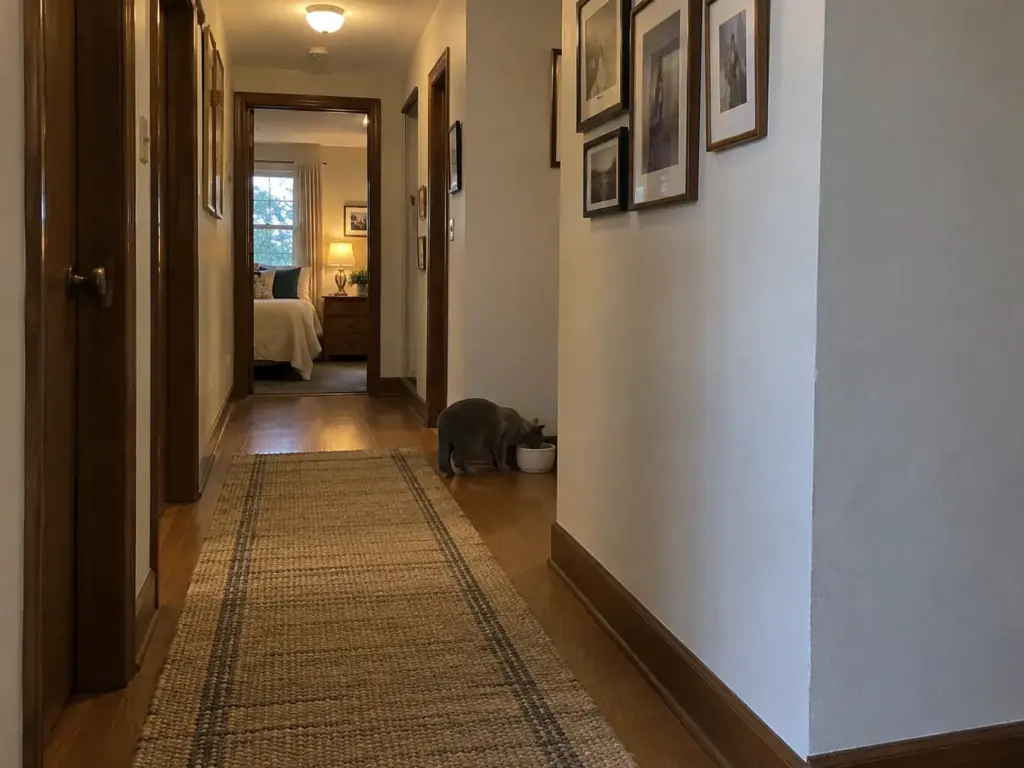
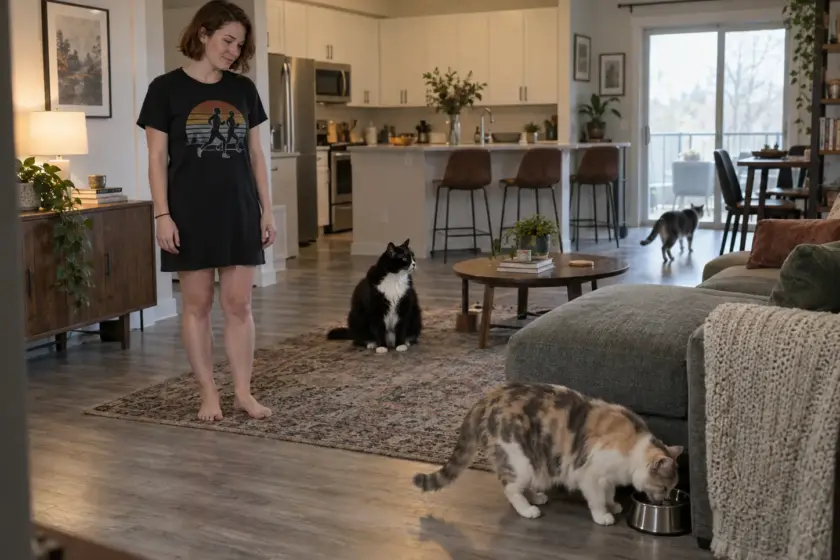
In a small apartment, “away” translates to a visual break, and visual breaks are free. Behind the arm of the couch. On the far side of a bookshelf so the shelf blocks the line back to the kitchen. In the dead angle beside the counter where the counter’s own bulk does the hiding.
None of those is five feet. All of them work better than five feet of clear floor, because the thing you are defeating is the cat’s read of one shared station, and a solid object between two bowls ends that read. In a studio apartment that solid object is the whole strategy, since it is the only thing you have more of than floor.
The hallway split is the most reliable version in a one-bedroom apartment: food in the kitchen, water at the far end of the hall. It works because a hallway is a room boundary wearing a disguise. You get the doorframe, the change in light, the change in floor, and the cat gets a station that feels like its own territory rather than an annex of the feeding station.
Some spots look like solutions and are not:
- A closed corner: no sightline out, no second way to leave. Solves the distance and creates the corner problem instead.
- Behind a door that swings: fine until someone opens it fast, once, at which point the station is finished as far as the cat is concerned.
- Beside the fridge or the dishwasher: appliances start themselves. A compressor kicking in while he is mid-drink teaches the exact lesson you do not want taught.
- On a windowsill or a narrow shelf: you get the height and the sightline and lose the stability, and a bowl he can tip is a bowl he stops using.
That appliance one is worth a second of attention if a fountain is anywhere in your future, since a pump has the same problem built in. The small-apartment question of whether a fountain’s noise and cord are worth it at all gets its own treatment in whether a fountain belongs in a small apartment, and it is worth reading before you buy rather than after.
And then the boundary that is not negotiable in any apartment, however tight: keep the water away from the litter area. Most articles file this as a separate tip in a separate section, as if litter-adjacency and food-adjacency were two different pieces of advice. They are the same rule.
A cat will not drink beside anything that smells like a hazard, and the nose does not care whether the hazard is decomposing prey or a litter box. One rule, two smells. What you want for the water is a quiet low-traffic spot that is still open enough to see out of. If your studio fix puts the water two feet from the box because that was the only open floor left, you have traded one avoidance for another and the bowl will stay full.
The Free Fix, Before You Buy Anything
Almost everyone arrives at this problem convinced they need to buy a fountain. Most people need to move a bowl they already own and then wait three days. That is the entire intervention, it costs nothing, and it works often enough that doing anything else first is out of order.
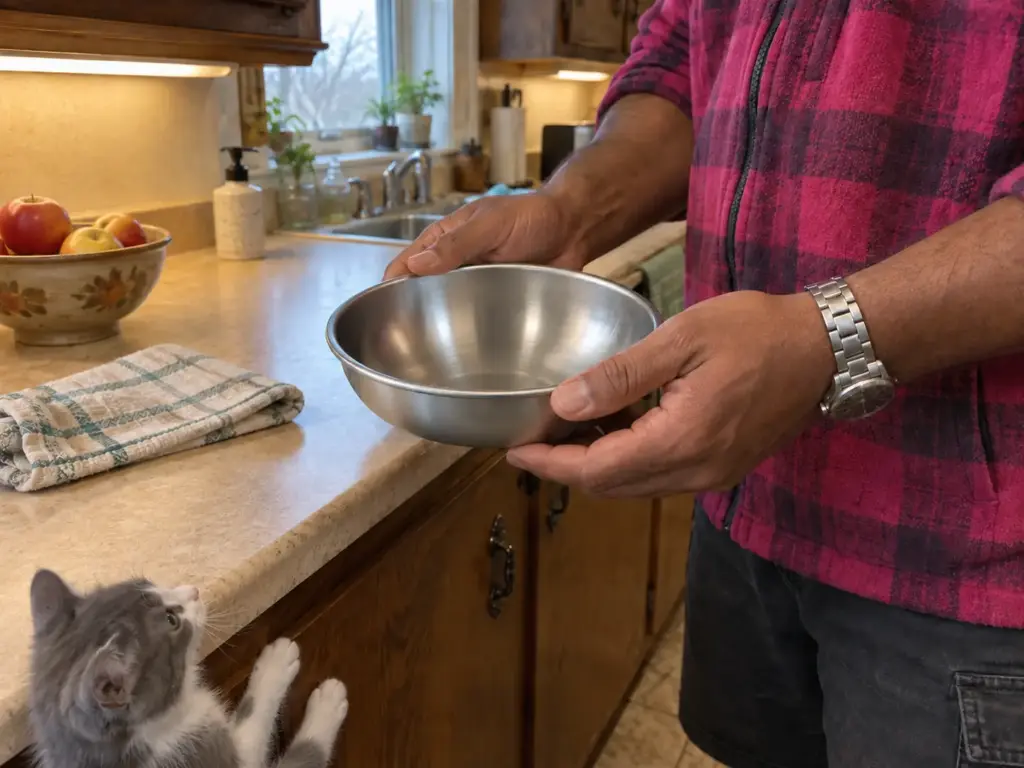
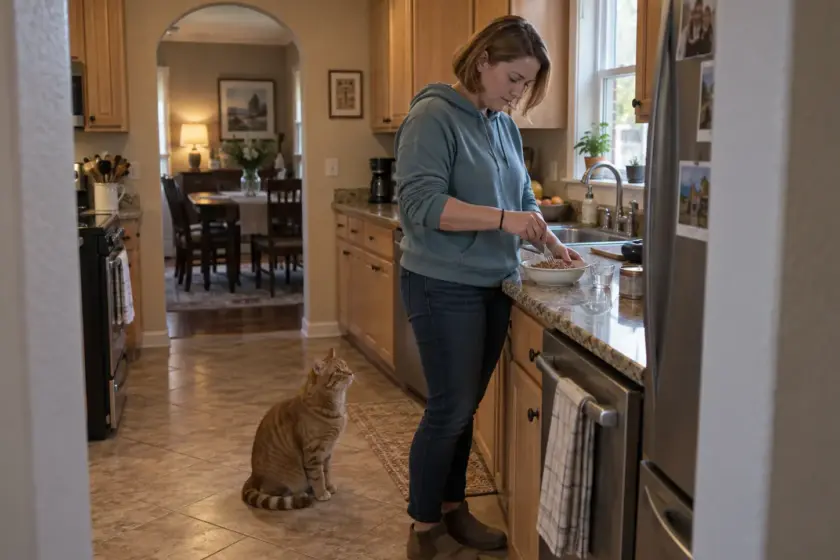
So: open the cabinet, take out a second bowl, put it on the other side of the boundary you just identified, and fill it. Leave the original bowl exactly where it is for now.
You are not enforcing a decision, you are running an election with two candidates, and the cat votes with his tongue. Give it three days and look at both levels. He will tell you.
He does not care whether the bowls match, by the way. That is a kitchen concern and you are the only one in the apartment who has it.
There is one point where the bowl itself stops being irrelevant, and it is material. Porous surfaces hold odor, and a bowl that smells faintly of food recreates, at the new location, the exact problem the distance just solved. A scratched plastic bowl is the usual offender: the scratches trap residue, the residue outlasts washing, and the cat reads food where there should only be water. That is cross-contamination without a single crumb visible.
Non-porous surfaces do not do this, which is why the stainless steel bowl and the ceramic bowl are the two that keep getting recommended by people who have worked through this once already. The Americat Company Stainless Steel Cat Bowls come as a pair in food-grade 18/8 304 steel, which suits this job specifically because you need two stations anyway and neither one will carry a smell between refills. The caveat is that light steel bowls skate across a hard floor when a cat pushes into them, so they want a mat or a slightly recessed spot rather than open tile.
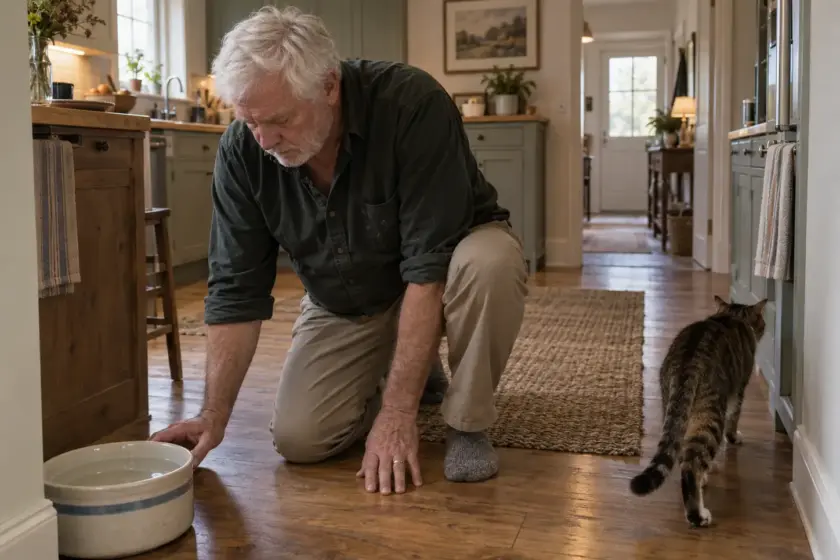
Do not remove the old bowl on day one. Run both for three days and let the cat show you which station he has accepted. Pulling the familiar one immediately turns a test into an eviction, and a cat who loses a station before he has gained one just drinks less.
Shape is the other thing worth getting right, and it is a completely separate failure from distance. A narrow, deep bowl drags the whiskers along the rim on every single visit, which is the whisker stress that adds up into what gets called whisker fatigue, and some cats will take that for months while some start avoiding the bowl within a week. Wide and shallow removes it.
That is a different cluster with its own evidence, and if the whiskers brushing the rim on every visit sounds like what is happening at your bowl, start there instead, because no amount of relocation fixes a bowl that is the wrong shape. Worth knowing too that the food bowl and the water bowl don’t want the same size — they are solving different problems and the matching set sold as a pair is usually optimized for neither.
If you have more than one cat, buying in fours is the cheaper way through, since the working math is one station per cat plus a spare and that is three bowls minimum for two cats. A Ceramic Cat Food Bowl Set gets you four in a wide, shallow profile, which covers the whisker problem and the station count in one purchase. Ceramic’s cost is that it chips, and a chipped glaze is porous again, so a bowl that has taken a knock off the counter goes in the trash rather than back into rotation.
When a Fountain Answers Two Problems at Once
If your cat has spent the last six months sitting in the bathroom sink waiting for you, he is not asking for distance. He is asking for movement. Those are two different requests, and the reason a fountain gets recommended so relentlessly in this conversation is that a fountain placed correctly answers both of them with one object.
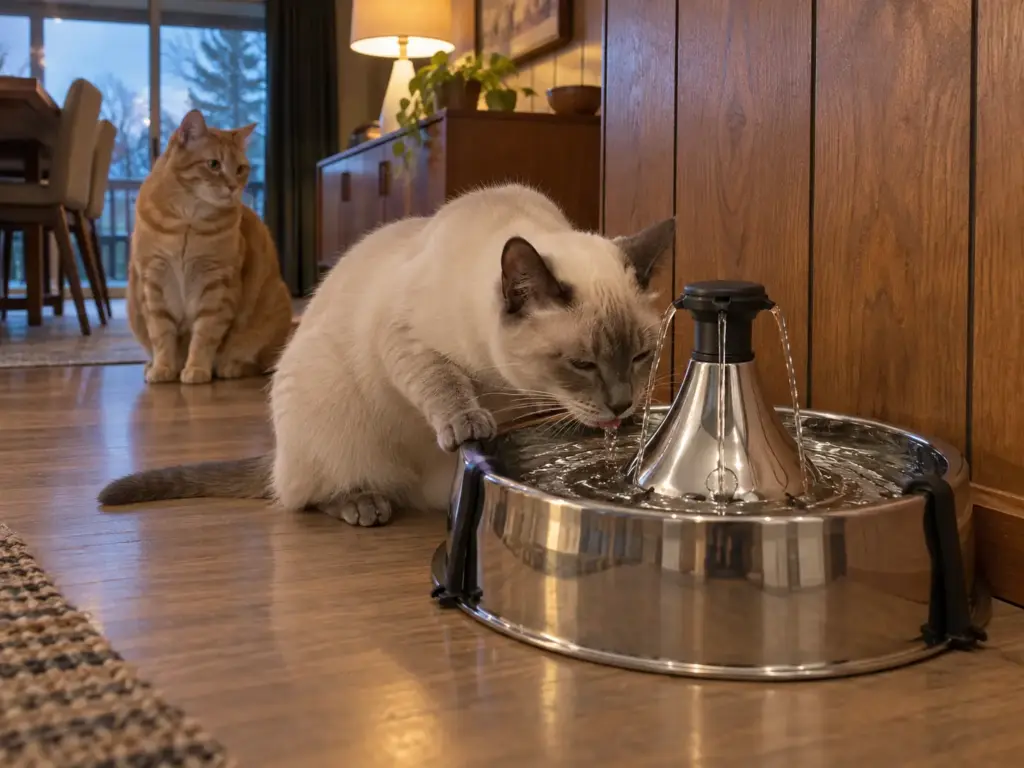
Running water reads as safe to a cat in a way standing water does not, which is the same family of instinct that pushes the bowl away from the food in the first place. Moving water is water that came from somewhere and is going somewhere. Still water in a dish has been sitting there long enough to be anyone’s guess. A faucet drinking cat has simply found the best water in the apartment and scheduled his day around your bathroom habits.
Which leads to the trap: a cat water fountain does not exempt you from the placement rule. A fountain parked next to the food dish is an expensive bowl with the original problem intact, plus a pump. The fountain solves movement. You still have to solve distance, and you solve it the same way as before, with a boundary.
Capacity is the decision most people get backwards, because bigger sounds safer. The PetSafe Drinkwell Stainless 360 holds 128 ounces and drinks from all sides at once, which is the right shape for a multi-cat home where two cats might arrive together and the wrong shape for anything smaller than a two-bedroom, where it becomes furniture. Conventional advice says buy the biggest reservoir you can so you refill less. In a studio that logic gives you a large appliance sitting in the middle of the only clear floor you had, and the reservoir size was never the constraint anyway.
For a single cat, the Pioneer Pet Raindrop holds 60 ounces in a footprint small enough to tuck into the dead angle by a bookshelf, which is exactly where you wanted the water anyway. Its trade-off is the smaller reservoir: leave for a weekend with two cats drinking from it and you are coming home to a dry pump.
Height is its own small decision, and it interacts with this one. A fountain sits taller than a floor bowl by default, which helps an older cat who would rather not crouch and hurts nothing for a young one, but an elevated bowl tips more readily than one sitting on the floor, and raising the water bowl brings its own trade-off in stability. An unstable station in a new location is two changes at once.
The written caveat on every fountain, straight out of the one-star reviews: a pump means a cord, a low constant hum, and filter maintenance that is real maintenance. The filter has a schedule, that schedule is shorter than you expect, and a fountain past its change date grows a film and starts to smell. At that point the cat abandons it and you are back where you started, except now you own a machine.
None of this treats anything, incidentally. A fountain is furniture that moves water.
Run the fountain for two days before you take the old bowl away. The pump noise is part of what the cat has to accept, and discovering it for the first time while thirsty is not how you want him to meet it.
Two Cats Change the Answer
You fixed the distance. You did it properly, boundary and all. And then the shy one stopped drinking.
You did not do it wrong. You built a bottleneck, and the other cat found it before you did.
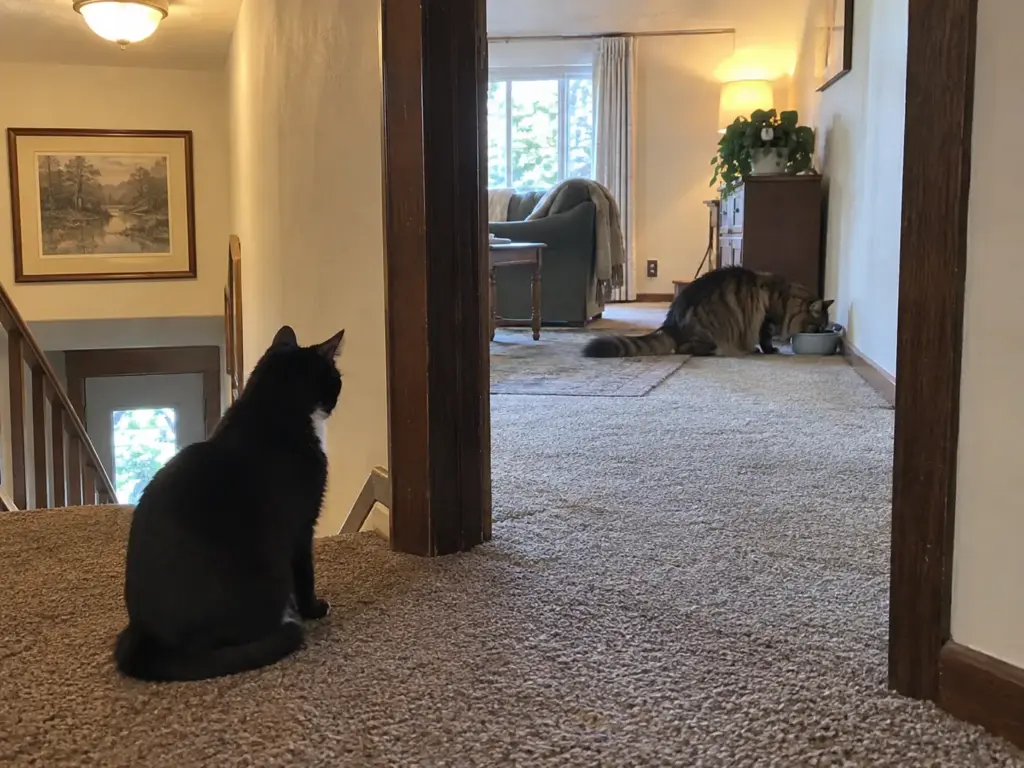
Start with the piece of arithmetic that catches everyone: to a cat inclined to control a resource, two water sources side by side count as one thing. Splitting them from the food but leaving them touching each other distributes nothing. One cat sitting between them holds both. Separation from food and separation from each other are two different jobs, and doing the first does not buy you the second.
The new risk the relocation creates is the shape of the new spot.
Move the water “away” and it frequently ends up somewhere with exactly one entrance — the end of a hallway, a bathroom, the gap behind a door — and a cat lying across that entrance closes the station without a sound. Cornell names this precisely, listing among the things to get right “assuring that there are no conflicts among cats and/or other pets that may result in a particular cat being ‘banned’ from the water bowl”.
Banned is the right word. Nobody fought. Access simply ended.
This is why it goes unnoticed for weeks. There is no hissing, no chase, no scattered fur, nothing that looks like resource guarding in the way people picture it. There is one cat drinking less and a full bowl that argues everything is fine.
The bowl is not evidence. A cat who is quietly losing a territorial blocking contest leaves the water exactly as full as a cat who has plenty. If you are watching one cat drink less and the station looks perfectly good, the general diagnosis of a cat that has stopped drinking from a bowl that looks fine covers the causes that are not about placement at all.
The test is quick and it is architectural, not behavioral. Stand at each water station and count the ways out. Two routes means a cat can drink and leave without negotiating with anyone. One route means the station belongs to whoever gets there first, permanently, and no amount of watching them get along in the living room changes that.
This is not a personality assessment. It is a floor plan assessment. The AAFP/ISFM Environmental Needs Guidelines describe access to multiple separated resources as one of the core pillars of a healthy feline environment, which is the professional way of saying that a multi-cat household with one good water station has one water station regardless of how good it is.
What this article deliberately does not settle is the count. How many stations two cats need, or three, is arithmetic with its own answer and its own article, and how many water stations three cats actually need is where that math lives. Placement and count interact, and getting the placement right in one spot while running short on stations just moves the bottleneck somewhere new.
Move One Bowl and Give It Three Days
Your cat does not have a quirk about water. He is separating it from something his instincts read as a risk, and the film of kibble dust on the surface of the bowl proves him right every afternoon, whatever you make of the ancestral hunting part.
The distance that matters is not measured in feet. It is measured in sightlines and boundaries — another room if you have one, the back of a bookshelf if you do not, and a doorframe beats five feet of open floor every time. If the cat can see the food from the water, the bowl has not moved.
With more than one cat, the new spot needs two ways in or you have swapped a loud problem for a quiet one. Count the exits before you commit to the location.
Check back in three weeks. Not three months, because this depends on a cat accepting a new station and on you keeping a routine, and both of those either take or fall apart inside a month. At three weeks you are asking three questions: is the new bowl going down, is the old one still untouched, and is he still going to the sink?
The move to make today costs nothing. Take a bowl you already own, put it on the far side of the nearest real boundary, fill it, and leave the old one alone for three days. If it works, you just saved yourself a fountain.
One line before you go, and it stays a line: a cat who stops drinking altogether, rather than switching to a different station, is not a placement problem. That is a vet visit.
Amazon’s Audible — free for 30 days
Your cat won’t let you read. Let someone read to you.
Audible is Amazon’s audiobook library — thousands of titles, read out loud, on your phone. Free for a month, plus one audiobook to keep forever.
Frequently Asked Questions
01How far should my cat’s water be from their food?
Far enough that the cat cannot see the food bowl from the water bowl, which in most homes means a different room or the far side of a piece of furniture. The three-to-five-foot figure you will see repeated is not backed by any study, and a bowl moved a hand’s width within the same corner will not register as moved at all.
02Do cats need water if they only eat wet food?
Yes, though they will drink far less from the bowl, because wet food is up to 80% water and is already doing most of the work. A wet-fed cat barely touching the bowl is expected rather than a placement failure, so judge it on the daily total, not on the bowl alone.
03Why does my cat drink from the faucet instead of the bowl?
Running water reads as fresher and less risky than standing water, so the faucet is the same instinct that moves a cat away from the food bowl, just aimed at a different target. It also tells you the bowl is losing the comparison, which is worth acting on either way.
04Is a double feeder bad for cats?
For most cats, yes, because a combo unit locks the food and water together at exactly the distance the cat is trying to avoid, and food particles end up in the water besides. They are usually designed for dogs, who do not share the instinct and do not object to the arrangement.
05My cat stopped drinking after I moved the bowl. What now?
Put the old bowl back and run both stations for a few days, because a cat who loses a familiar station without having accepted a new one simply drinks less. And if a cat stops drinking altogether rather than switching stations, that is a vet visit and not a placement problem.
Leave a comment