How to Elevate a Cat Food Bowl Without Buying One
Don't buy a riser (or a drill). Elevate a cat food bowl tonight with books + shelf liner, sized to your cat's elbow, not a generic 4 inches.

Alfredo RamsesFounder · September 15, 2026 · 23 min read

On this page8 sections
- 1The Height That Matters Is Your Cat's, Not a Number
- 2What Raising the Bowl Actually Changes, and What It Does Not
- 3Build the Riser Out of What Is Already in the Kitchen
- 4Make It Stop Sliding and Stop Tipping
- 5The Water Bowl Is a Different Problem
- 6Two Cats, a Rental, and the Week After
- 7Conclusion
- 8Frequently Asked Questions
The bowl scrapes across the tile at six in the morning, an inch at a time, until it fetches up against the baseboard and he finishes his breakfast standing in the corner. Or the quieter version: he walks up to a full plate, stands over it, and backs off.
Search for how to elevate a cat food bowl and the internet hands you a project. Every DIY elevated feeder plan online starts the same way. Purina’s own guide opens its materials list with a cutting board, a three-foot wood dowel, four wood screws, a drill, and a jig saw, which is a Saturday and a trip to a hardware store dressed up as a DIY fix. The height that matters here is your cat’s, not a number off somebody’s list, everything you need to hit it is already in the kitchen, and the part nobody covers is what keeps it from sliding off across the floor a week later.
Quick Answer
Four steps, no-tools, nothing bought:
- Measure floor to elbow with your cat standing square.
- Stack something firm and wider than the bowl to that height.
- Put rubber liner under the stack and under the bowl.
- Push the rim sideways. If it moves, rebuild it heavier or wider.
The Height That Matters Is Your Cat’s, Not a Number
You have probably read three numbers in three articles by now and noticed they disagree. Four inches, five to twelve centimeters, ankle height, chest height. They disagree because a Maine Coon and a British Shorthair are not the same animal standing up, and almost nobody writing those numbers says so out loud. Before you build anything it is worth being sure elevation is even your problem, because whether an elevated cat bowl is worth it for your cat at all depends on the cat rather than on the kitchen.
The published figures are starting points that somebody averaged. Purina’s own step-by-step elevated feeder guide targets an eating surface about four inches off the floor, which is a reasonable middle for a medium cat and is wrong by two inches in either direction for a lot of cats who are not medium. The advantage you have over a manufacturer is that the specific animal is standing in your kitchen right now.
Where to Measure, With the Cat Standing
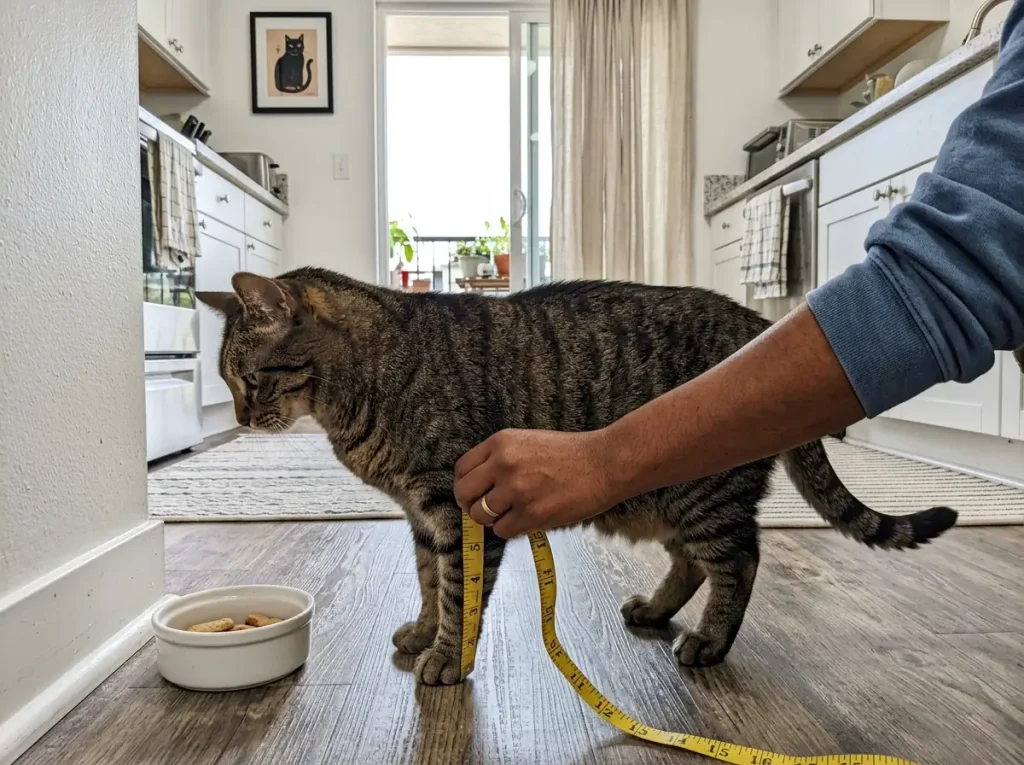
Floor to elbow. The elbow is the joint where the front leg folds into the chest, and the reason it beats “chest level” is that you can put a finger on it and two people will land on the same spot. That measurement is the height you want the rim of the bowl sitting at, straight across, not an offset from it.
The catch is the word standing. He needs to be square on all four feet, weight even, and ideally slightly bored with the whole exercise. A cat reaching up toward something in your other hand is dimensionally a different cat, and you will build a riser two inches too tall for the one who actually eats there.
Skip the tape measure entirely. Stand a paperback on its end next to him while he eats at floor level, mark where his elbow falls with your thumb, and carry the book to the stack. You are matching a height, not filing a number, and a book you can hold against the riser is faster and more honest than a measurement taken from a cat who was busy objecting to being measured.
Why the Published Numbers Disagree With Each Other
Roughly two to four inches suits a small cat, four to six a medium one, six to eight or a little more a large one. Those tiers are a sanity check on the number you took off your own animal, and that is the only job they should be doing.
If your measurement lands two inches outside the tier for his size, measure again. If it lands one inch outside, trust the cat. The full breakdown of the inch-by-inch numbers by cat size is worth having open while you stack, but as a cross-check and not as the instruction.
There is one measurement people forget until the food is already in the dish. Your number is the height of the eating surface, not the height of the platform. A deep dish sitting on a four-inch stack puts the food at two inches, and you have built the right riser under the wrong bowl.
The Quick Check That Says You Got It Right
Watch one meal from a few feet back and low down. The forearms should sit at roughly a right angle and the head should come down level rather than tipping. No stretching upward, no folding downward, no stepping back after the first mouthful.
If he eats through the whole portion standing square, stop adjusting things. That is the entire test, and it takes one meal.
What Raising the Bowl Actually Changes, and What It Does Not
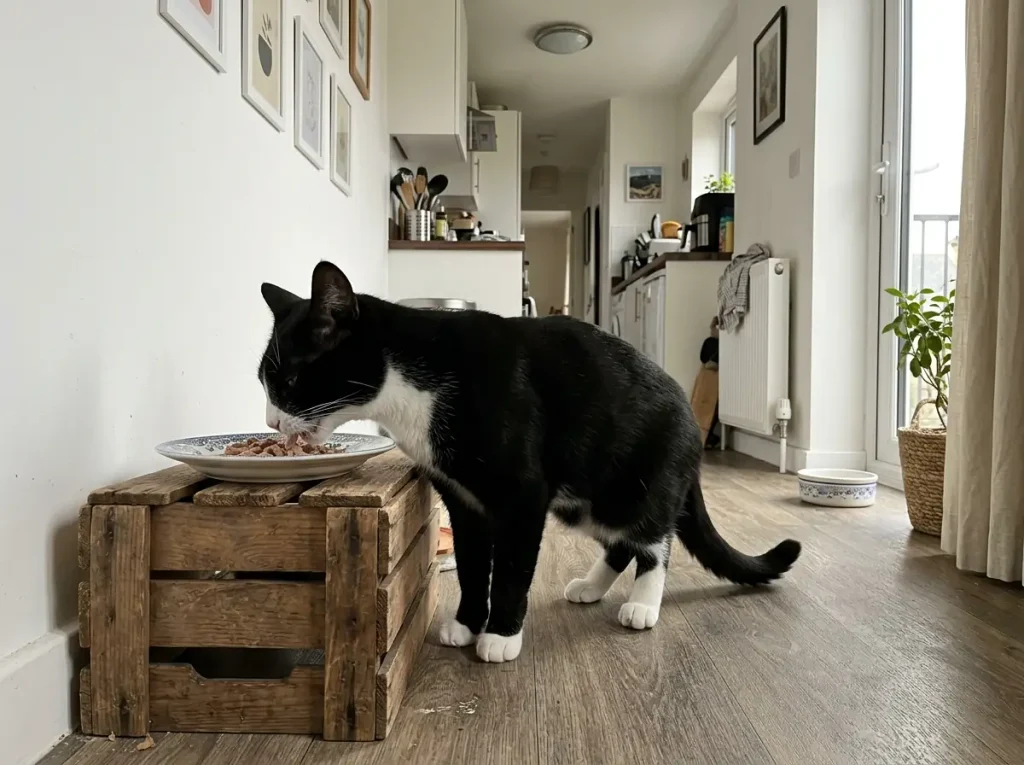
Half the people who raise a bowl are trying to solve something height does not touch, and it is kinder to lose them here than to have them stack books and stay annoyed on Thursday. What elevation buys is straightforward mechanics: neck posture improves because the neck and spine stay in a straighter line, the esophagus runs downhill instead of bending around a corner, and joint strain drops because an older or stiff cat is not bracing his weight on his front legs to get his mouth to the floor. That is a comfort change, and for the cat it is a real one.
What a Straighter Neck Actually Buys the Cat
The reader comment that keeps turning up under articles like this one is always the same shape. Someone with a fourteen-year-old senior cat raises the food and the water because, in their words, she has some arthritis, and like her owner it gets harder to bend and get up. That is who is searching this at ten at night, and it is a better description of the benefit than any diagram of a spine.
For a cat with stiff joints, floor feeding is a small squat held for the length of a meal, several times a day. Take three or four inches out of that and the meal stops being a position he has to hold. Younger cats mostly do not care, which is worth saying plainly rather than pretending every cat needs this.
Why This Is Not a Fix for Whisker Fatigue
Whisker fatigue is a different problem wearing similar clothes, and the two get merged constantly in the same search sessions. It comes from a deep or narrow bowl pressing against the whiskers on the way to the bottom, and it has nothing to do with how far off the floor the bowl sits. Raise a narrow bowl six inches and you have every bit of that problem, just higher up and better lit.
The tell is where he eats from. A cat under whisker stress eats from the edges, paws food out onto the floor in the classic food flicking pattern, and leaves a ring of kibble around a dish that still has food in the middle. A cat with a bowl height problem eats from the center and backs off.
If you are seeing the first pattern, the whisker question, which is about bowl width and not height is the one to answer, and the riser can wait. And if both are true, fix the dish first. A wide shallow bowl on the floor beats a narrow deep one on a pedestal.
While we are naming things: the community word for the other half of this is scooty bowl, meaning a bowl light enough that the cat shoves it around the kitchen while he eats. Half of that is the bowl and half of it is the floor, which is what the whole of section four is about.
The Line Where This Stops Being About Furniture
One boundary, said once. Regular regurgitation, or weight loss, needs a vet before it needs a taller bowl. Everything in this article is furniture.
There is also a quieter conflict worth naming, because nobody else names it. The reason a lot of these platforms get built is that the human is tired of bending down to fill a dish on the floor, and a bowl at human-convenient height is usually too high for the cat. The human is describing a preference. The cat is describing a constraint, and the constraint is the one that has to win.
Build the Riser Out of What Is Already in the Kitchen
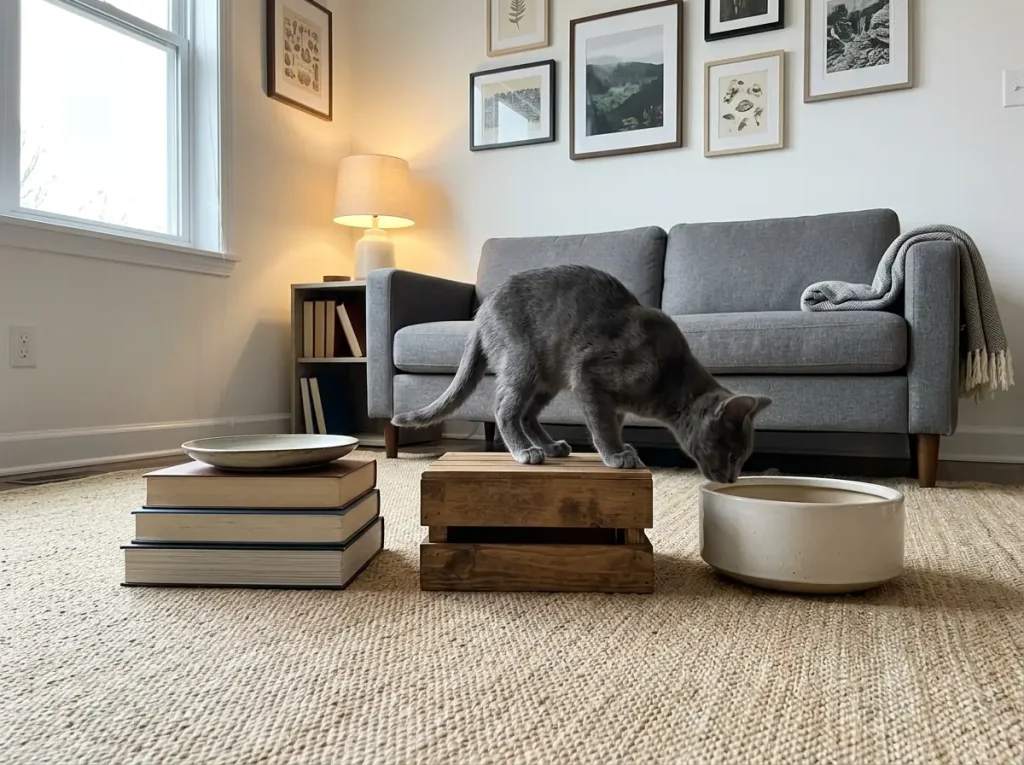
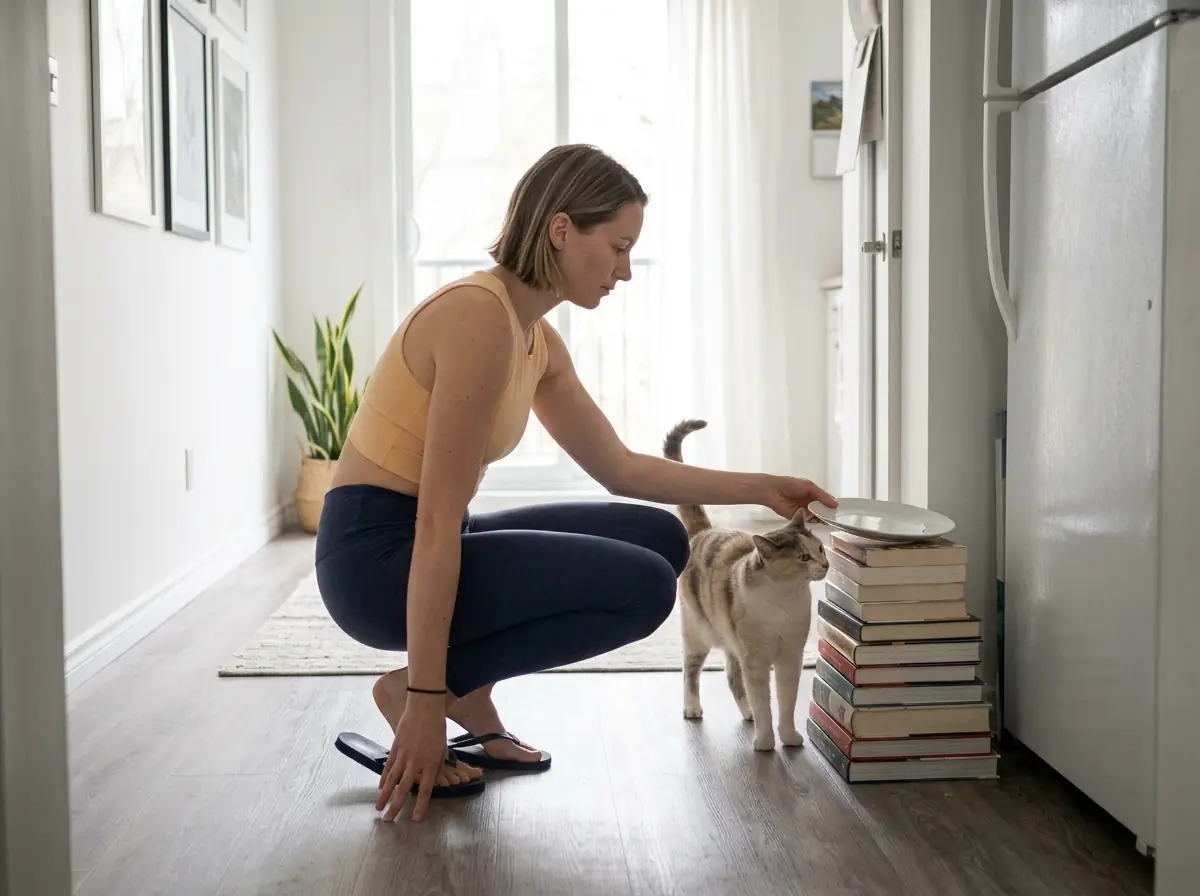
Here is the part you came for, and it should take less time to do than it took to read. You have a number. You need something in the apartment that is that tall, wider than the bowl, and heavy enough that a determined cat leaning into his dinner cannot walk it across the room. That is the entire specification.
One rule sits above all three options and it is the one that decides whether this works. Width beats height every time. The base has to be wider than the bowl in every direction, because the moment the bowl overhangs the platform, a cat pressing on the rim is operating a lever and the physics are on his side.
The eating surface itself should be a ceramic bowl or a stainless steel bowl on top of whatever the riser is. A plastic bowl scratches, holds a film in the scratches, and some cats stop liking it long before their humans notice; the differences between ceramic, steel or plastic and what actually fails matter more once the dish is up in the air, because you have just made it easier to knock over.
The Stacked-Book Riser
Hardcovers, all the same size, stacked to your number. This is the version that works best for the same reason a roundup of nine different raised-bowl builds recommends stacking or removing boards on its wood plan: the height is adjustable in the smallest useful increment, which for books is about half an inch. Take one out, put one back. No saw involved.
Use the boring ones. A stack of matched hardcovers about the size of a large dictionary gives you a wide, flat, dense platform, and dense is doing real work here because weight is half of what keeps it still. Cookbooks are the usual candidates, and there is a reason nobody regrets it.
The failure is stacking different sizes. A smaller book anywhere in the pile creates a step, the top surface rocks slightly, and a cat will not put his full weight over something that moves under his paws. He will eat from the edge instead, at an angle, which is the exact posture you built the thing to fix.
Build the stack on the counter, not on the floor. On the counter you are looking straight at the edges and any book sticking out or sitting proud is obvious in a second. Assembled at floor level while crouching, a half-inch overhang is invisible from above, and it is the half inch that turns into a wobble.
The Box or Crate Version
A shoebox-style container or a small crate, turned upside down or left the right way up with something heavy inside it. The heavy part is not optional. An empty box is a light box, and a light box is the same problem as a light bowl with more surface area for a cat to push against.
Fill it with what you would otherwise be storing anyway. A couple of cans, a bag of rice, spare batteries. Anything that turns a cardboard shell into ten or twelve pounds sitting still on the floor. Then choose your box the way you would choose the base of a lamp, wide and low rather than tall and neat.
Cardboard is the honest weak point of this version, and the maintenance section covers why. If you have a sturdy box in plastic or a wooden drawer of the right height, use that instead and skip the whole question.
The Planter Version, and Where It Goes Wrong
A wide ceramic or ovenproof planter turned upside down, with the bowl’s rim resting on the lip, is the most photographed version of this hack and the one most likely to end badly. Catster’s own plant-pot plan says it plainly in its own instructions: the bowl may break if tipped over. Naming the risk is not the same as solving it, and no source that publishes this build solves it.
It goes wrong two ways. A planter narrows toward the base when it is upside down, so the footprint is smaller than the top, which is the opposite of the width rule. And ceramic on tile has almost no friction, so the whole assembly slides as a unit until it hits something and stops abruptly.
I used to put the planter first in this list, because it looks like furniture and a stack of books looks like a stack of books. Then you read the failure the plans themselves admit to, and the ranking flips. Looks lost.
Use it only if the pot is genuinely wider at the bottom than the bowl is across, and only with liner underneath. Otherwise the box wins on every count that matters, and it is free too.
Make It Stop Sliding and Stop Tipping
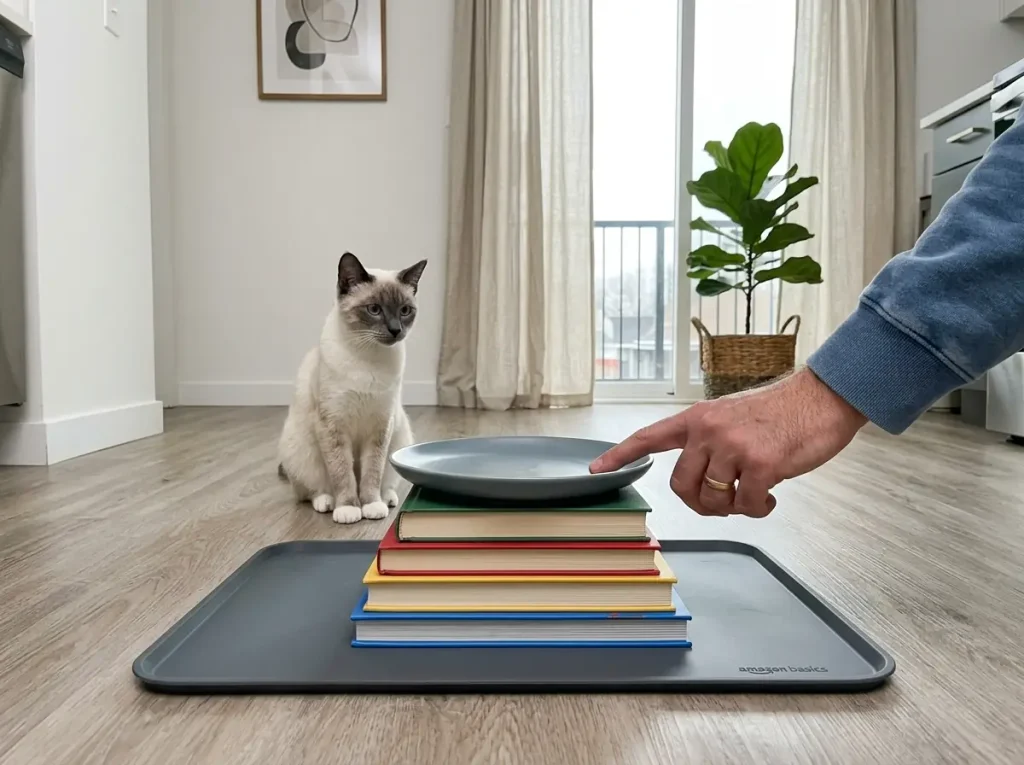
The build takes two minutes. The reason improvised risers get abandoned is the week after, when the thing starts walking across the floor at breakfast and somebody decides the whole idea was a failure. It was not the idea. It was that nobody wrote down the three ways this breaks, because none of the people writing about DIY feeders are actually improvising.
- It slides. Hard floor plus a light base plus a cat pushing forward into his food equals a platform that migrates a few inches per meal. Tile and hardwood are the worst offenders; a rug is not a solution, because the rug moves too.
- It tips. The cat rests his weight on the near rim of the bowl, the bowl overhangs the base, and the whole stack rotates over that edge. This is the one that ends with ceramic on the floor.
- The base is chewable. A cardboard box at nose height, in the room where food happens, is a cat toy with a nine-month life expectancy. Corners get worked at, then a corner collapses, then the platform is not level anymore.
The Two Places the Non-Slip Layer Goes
Rubber shelf-and-drawer liner, the mesh kind sold on a roll, is the fix. It costs pocket change, and there is a decent chance there is a partial roll in a kitchen drawer right now. It goes in two places, and skipping either one leaves half the problem in place.
The first piece goes under the whole riser, between the base and the floor. That is the layer that stops the platform migrating. The second goes on top of the riser, between the platform and the bowl, and that is the layer that stops the bowl skating around on the platform you just built. People do the first and forget the second, then conclude the riser did not work when what actually happened is that the bowl moved and the riser stayed put.
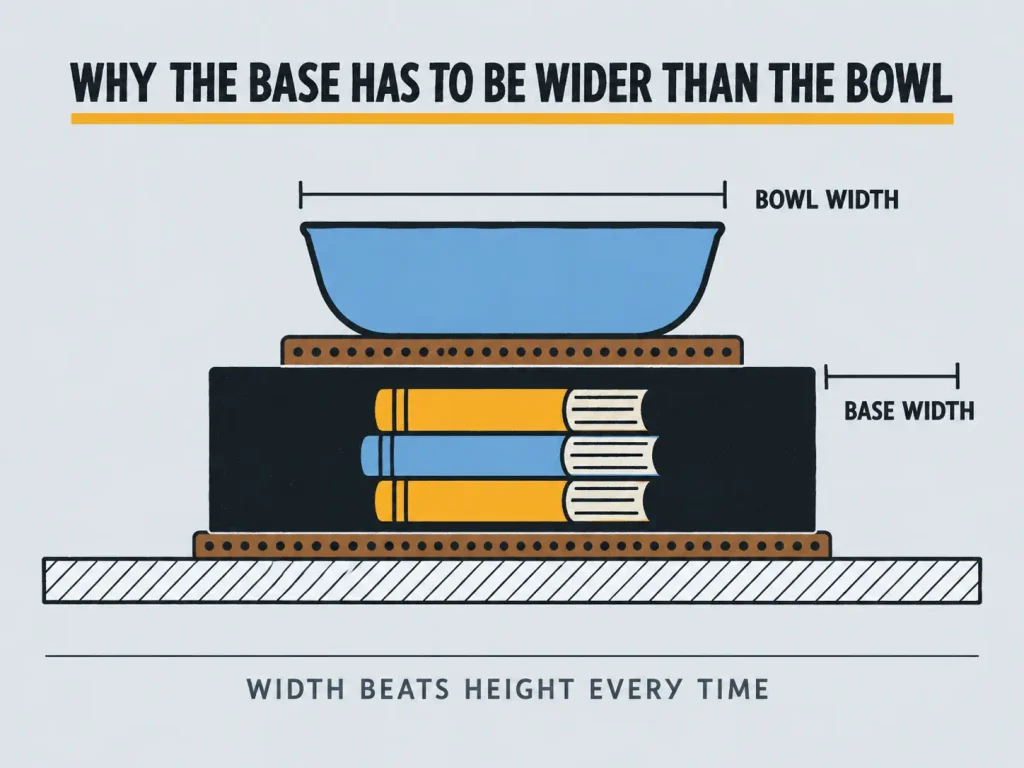
If there is no liner in the house and you would rather buy the one thing than make a trip for a roll of mesh, the Amazon Basics Waterproof Non-Slip Silicone Pet Feeding Mat with Raised Edges does the same job in one piece and adds a raised lip that catches the kibble that gets pawed over the side, which on a raised cat bowl travels further than it used to. It sits under the riser rather than on top of it. The caveat is that silicone is a single sheet and does not grip quite like open mesh does on a very smooth floor, so on polished tile the mesh under the base and the mat as the floor layer is the belt-and-braces version.
The Two-Finger Test
Before the first meal, not after it. Put two fingers on the far rim of the bowl and push sideways and down, the way a cat leans in when he is genuinely interested in what is in there. Not a tap. Real pressure.
If anything shifts, rocks, or creeps, the base is too narrow or too light, and you fix it by going wider or heavier rather than by hoping. It is ten seconds and it is the difference between a setup that lasts a year and one that gets dismantled on Wednesday.
Run the test with the bowl full, not empty. A full dish sits lower in its own weight and behaves differently under a sideways push, and full is the state it will be in every single time a cat is leaning on it. An empty bowl passes tests that a full one fails.
Why the Bowl’s Own Rubber Ring Stops Working
Most stainless bowls ship with a rubber ring molded in and sold as a non-slip base, and for a while it is one. Then it wears thin, or it lifts at one edge, or it comes away entirely in the dishwasher, and rubber ring failure is one of the more common complaints people report about bowls they otherwise liked. What you are left with is a smooth steel rim on a smooth platform.
This is worth understanding before you raise anything, because a ring that fails at floor level is an annoyance and a ring that fails four inches up is a bowl on the floor. The mesh liner does not wear out the same way, does not depend on adhesive, and costs nothing to replace when it eventually goes gray. If the bowl keeps traveling even with liner in both places, why the bowl travels across the floor in the first place usually comes down to the bowl being too light or too narrow rather than the surface underneath it.
The Water Bowl Is a Different Problem
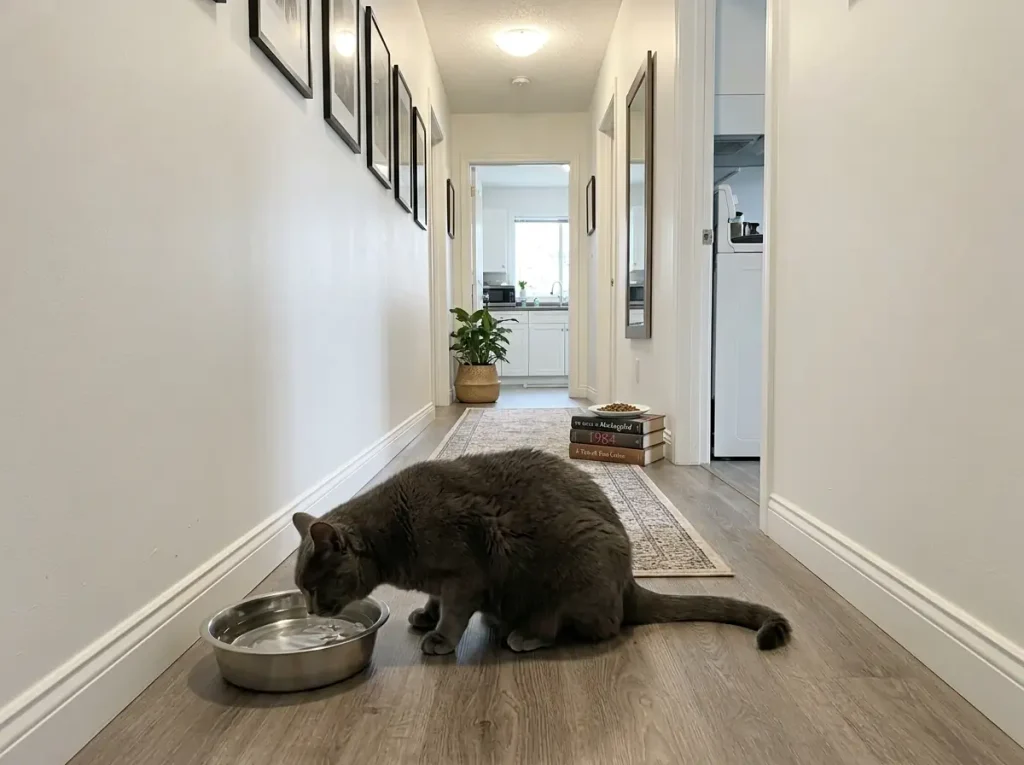
Almost everybody builds one platform and puts both bowls on it, because that is what a bought cat feeding station looks like. Then the water gets pushed around, the floor is wet twice a week, and the cat goes back to drinking out of a glass in the bathroom. Keeping the water bowl separate from food bowl is the fix, because the two vessels are not the same object and do not want the same treatment, which starts with the fact that food and water bowls want different shapes before either of them goes anywhere near a riser.
Why the Two Bowls Do Not Want the Same Platform
Start with physics. A water bowl full of water is heavier than a food dish and it behaves differently when it is nudged, because the contents keep moving after the bowl has stopped. That sloshing is a small force applied repeatedly in whatever direction the cat happens to be pushing, which is exactly the load a stack of books is worst at resisting. A shared platform sized for a shallow food plate is usually too small in footprint for both anyway, so one of them ends up at the edge, and that is the lever problem again with a liquid payload on top of it.
The two vessels are also different heights before you raise either one. A food plate is shallow, often under an inch deep, so the platform is doing nearly all of the lifting. A water bowl is a deep vessel by design, frequently three or four inches tall on its own, which means it arrives at the party already elevated.
Put both on the same four-inch stack and the food surface lands at four inches and the water surface lands at seven, and you have accidentally built two different heights for the same cat while thinking you built one. This is the measurement nobody publishes, and it is the reason a shared platform feels wrong in a way people struggle to name.
Then there is the drop. Water spilled from four inches up does not land in a puddle where the bowl was; it carries, and it goes across the floor and under the cabinet you cannot reach. It also lands on the riser on its way down, which matters a great deal if your riser is a stack of hardcovers or a cardboard box, because both of those absorb it. Wet books swell along the top edge and never sit flat again, and that is a platform that has quietly stopped being level under a bowl you are no longer watching.
And the reason that outranks all of it: cats routinely prefer their water somewhere away from their food, and a lot of them drink noticeably more when the two are separated. That separation is the single easiest thing to improve about a feeding setup, and building one tidy platform for both takes an arrangement that was working and undoes it, in the name of the kitchen looking neater.
The human wants one clean object in the corner. The cat wants distance between the water and the smell of the food. Only one of those two is describing something he cannot negotiate.
What to Do If You Raise the Water Too
Plenty of cats are perfectly happy with the water left on the floor even when the food is up, and if the reason you are here is a stiff older cat, raising the water is the part that helps least and spills most. Try food only first and leave the water where it is for a couple of weeks. That is not a compromise or a half-measure; for a lot of households it is the finished answer, and it is one fewer thing on the floor to knock over.
If the water does go up, it goes up on its own base, in its own place, ideally against a different wall. Three rules, and they are all corrections of what goes wrong with the food riser rather than repeats of it.
Make the base wider than you made the food one, because the consequence of a tip is a wet floor rather than a handful of kibble. Measure to the water surface rather than to the platform, which for a deep bowl usually means a shorter stack than the food got, sometimes only an inch or two of lift. And put something waterproof between the bowl and the riser, which is where the silicone mat earns its place over mesh liner, since mesh passes water straight through to whatever is underneath it.
Height matters less here in general, and it is worth knowing why rather than just being told. Drinking is a shorter and more vertical motion than eating, held for seconds rather than minutes, so the neck angle you were correcting at the food bowl barely comes into it. Stability is doing almost all of the work. A water bowl that is an inch too low and completely solid beats one at a perfect height that shifts when he leans in, every time.
Two Cats, a Rental, and the Week After
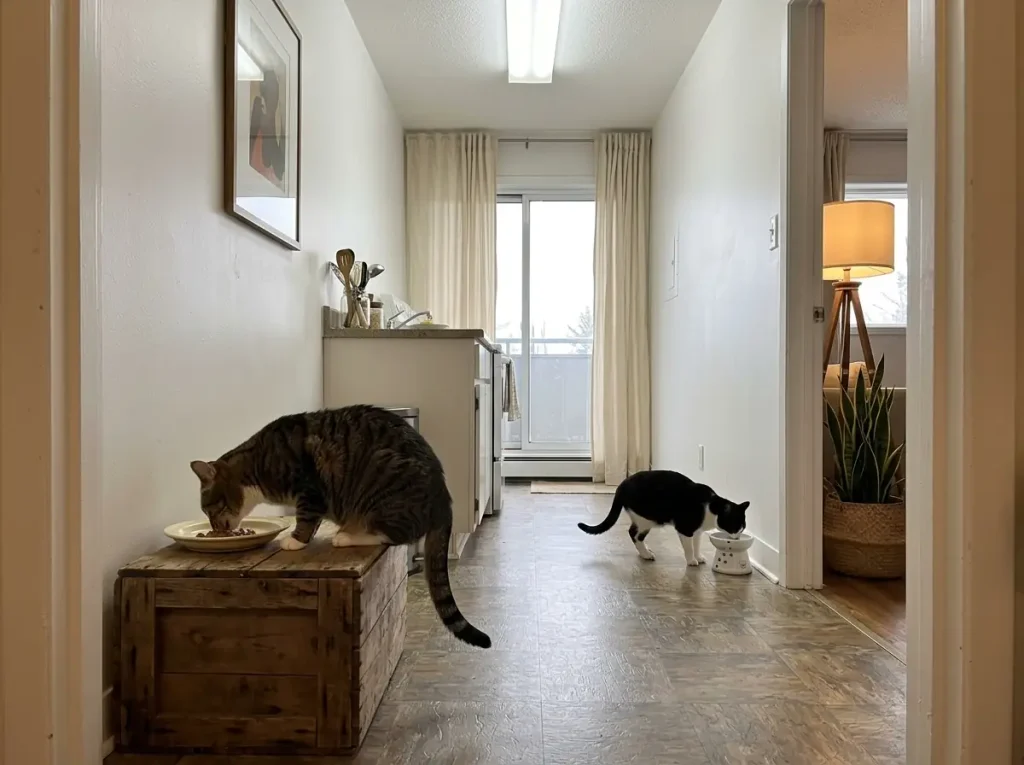
The build works on Saturday. Whether it is still standing in three weeks depends on how many cats live in the apartment and on what you are allowed to do to it.
Two Cats Need Two Stations, Not One Taller One
Here is the trap, and in a multi-cat household it catches people who were solving a completely different problem. Two cats who fed at opposite ends of the kitchen floor had separation.
Build one nice wide platform and put both bowls on it, and they now feed shoulder to shoulder, which is a change nobody intended to make. Raising the food does not create separation. It can quietly take it away.
Two risers, two rooms if the apartment has them, or at least two corners with a line of sight between them. It costs another set of stacked books, which is to say nothing, and it keeps the arrangement they already worked out for themselves.
There is a side effect worth knowing about before it surprises you. A six-inch platform against a counter run is a step, and a cat who could not get up there before may be able to now. Not a reason to skip the riser, just a reason to look at what is next to it and to move it a foot out from the base cabinets.
The Renter Version, and Why Nothing Gets Fixed to Anything
Every DIY feeder plan published by a major site ends with screws, glue, or brackets, which makes it useless to a fair share of the people searching for it. This version touches nothing. No wall contact, no adhesive, no hardware, no hole in any surface that somebody is holding a deposit against.
What holds it in place instead is weight and friction, which is the same principle behind every renter-friendly piece of cat furniture that works: it stands on its own feet. And on moving day it is a stack of books and a strip of liner, so it packs in about nine seconds and goes back up in the new kitchen the same night, at the same height, because the number came off the cat and the cat is coming with you. If you like this approach, the same no-purchase approach applied to bowl shape is the companion piece for the other half of the feeding setup.
The maintenance is small and it is not zero. Books warp if water reaches them, so keep the water on its own base and away. Cardboard softens where it gets damp and gives up somewhere around the point you have stopped thinking about it. And the liner collects crumbs underneath, which is a two-minute job when you wash the bowls, not a separate chore.
Cut the floor liner an inch larger than the base on all sides and leave it there permanently. It becomes the outline: after you sweep, or after somebody moves the whole thing to mop, the riser goes back exactly where it was instead of two inches over. Cats notice the two inches, and the setup drifts across a kitchen surprisingly fast without a mark to return to.
If You Would Rather Just Buy One
Some households are not going to keep a stack of books stable, and that is a fair assessment to make about your own kitchen rather than a failure of nerve. Before spending anything, the cats it helps and the ones it does nothing for is the question to settle, because a bought riser under a cat who did not need one is an ornament.
The Necoichi Ceramic Elevated Cat Food Bowl is the one-step version of everything above: ceramic, a shallow well that keeps the whiskers clear of the sides, and the lift built into the object so there is no stack to maintain. The regular size holds about a cup, which is generous for most cats and means the food sits in a wide layer rather than a deep column. Its limitation is the same as every fixed-height bowl, which is that the height is decided for you, so measure your cat before ordering rather than after.
For a wider mouth, the CEEFU Extra Wide Elevated Ceramic Shallow Cat Food Bowl runs 6.2 inches across the well, which is the measurement that matters for a flat-faced cat or for a household where whisker clearance is the real complaint and the height is secondary. Wider also means it takes up more floor, so in a small kitchen with two of them side by side, measure the space before the cat does it for you.
Conclusion
Measure the cat, not the internet. Floor to elbow with him standing square, and every other decision in this article follows from that one number.
The riser is whatever in the apartment is wide enough and heavy enough, and the non-slip layer in both places is what makes it survive the week rather than the weekend. Two cats get two stations, and the water stays its own problem on its own base.
Check back in three weeks. Not because anything will have worn out, but because that is when a setup either has held its position or has quietly drifted across the kitchen: is the riser still where you put it, is the bowl still level, and is he eating standing square instead of stepping back off the plate.
Stack the books tonight and watch one meal. If he eats through without backing off, it is solved, and it cost nothing.
Amazon’s Audible — free for 30 days
Your cat won’t let you read. Let someone read to you.
Audible is Amazon’s audiobook library — thousands of titles, read out loud, on your phone. Free for a month, plus one audiobook to keep forever.
Frequently Asked Questions
01Should you elevate a cat’s food bowl?
For a cat that is older, stiff, or backs off a floor-level plate, usually yes, because it keeps the neck in a straighter line while he swallows. For a healthy young cat eating happily off the floor, there is nothing here to fix.
02How do you elevate a cat food bowl without buying anything?
Stack matched hardcover books or a weighted box to your cat’s elbow height, then put rubber shelf liner underneath it and another piece between the riser and the bowl. The base has to be wider than the bowl in every direction, or it becomes a lever.
03What is the ideal height for a cat food bowl?
The floor-to-elbow measurement with your cat standing square, which lands roughly between two and eight inches depending on his size. Measure the animal rather than copying a number, and remember the target is the eating surface, not the platform.
04Do cats eat better with elevated bowls?
Some do, and the ones that do tend to be older, larger, or stiff in the joints. It is a comfort change rather than a diet fix, and it does nothing for a bowl that is too narrow for the whiskers.
05Will a raised bowl stop my cat pushing it around the floor?
Only if the riser is heavy and wide enough. A light stand slides exactly like the bowl did, and the factory rubber ring on a stainless bowl wears off with use, so the shelf liner underneath is what actually holds the whole thing still.
Leave a comment