What Height Should a Cat Bowl Be, in Inches
Cat bowl height in inches [2-4 kitten + 4-6 average adult + 6-8 large breed], measured floor to rim, plus the elbow test that checks it.

Alfredo RamsesFounder · September 14, 2026 · 15 min read

On this page7 sections
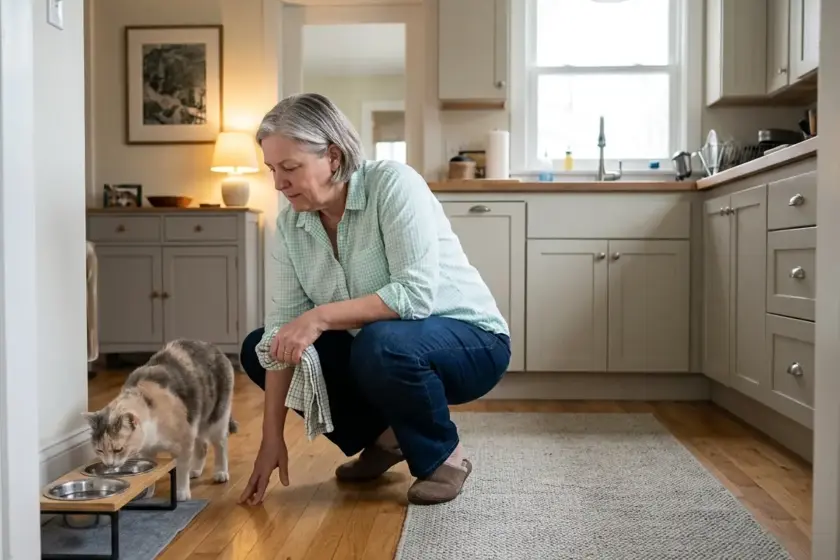
He hunches over the dish like he is reading something small on the floor, or he tips his chin up and takes the food off the top of the pile with his neck extended. Either way, he is not being fussy about dinner. He is solving a geometry problem somebody else handed him, and he is solving it the only way an animal can, which is with his posture.
Every guide on the first page of Google answers this question with “chest level.” Chest level is a landmark, not a number, and you cannot buy a landmark. You also cannot check one, because nobody can point at a cat’s chest twice in a row and land in the same place. So here is the number, in inches from the floor, broken out by the size of the cat, plus the one-minute way to measure your own animal and the free way to test the height before you spend anything on it.
Read every figure below as inches of lift measured from the floor to the rim of the bowl, not the height of the stand it sits on.
| Size of Cat | Lift, Floor to Rim | How You Know It Is Right |
|---|---|---|
| Kitten or small adult | 2 to 4 inches | Head level, no crouch, and re-measured as the kitten grows |
| Average adult, roughly 9 to 11 lb | 4 to 6 inches | Forearms near a right angle, elbows not splayed out sideways |
| Large or long-bodied cat | 6 to 8 inches or more | Neck stays in line with the spine instead of folding down |
The Number, by the Size of Your Cat
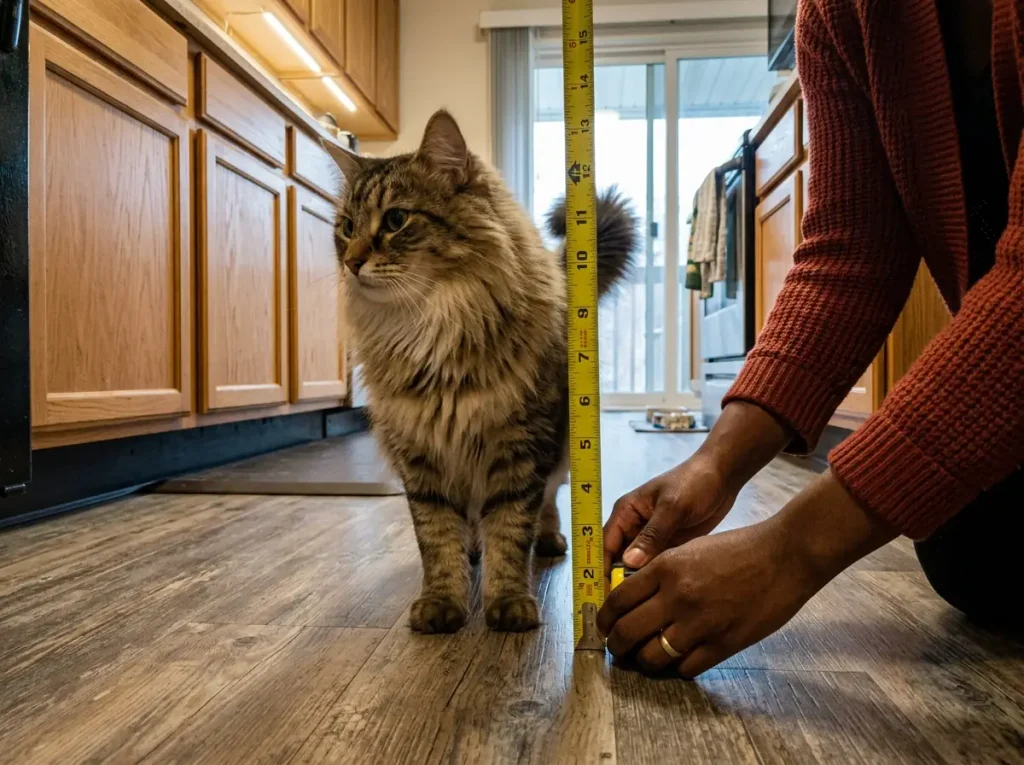
Take the table above as the working answer and then read the rest of this section, because the ranges only behave if you measure the same thing the table measured. Lift means floor to the rim of the bowl. It does not mean the height of the stand, and it does not mean the height of the box the stand came in. This is where most people misread a product listing: a stand advertised at six inches with a deep dish sitting inside it can put the food surface back down at three, which is roughly where it started when it was on the tile.
A kitten or a genuinely small adult lands around two to four inches of lift. An average adult, call it nine to eleven pounds, sits at four to six. A large or long-bodied cat wants six to eight, and sometimes more than that. Those three rows are not three flavors of the same animal, which is the part the search results keep flattening.
Why the Big Cats Get Their Own Row
A large breed is not an average cat scaled up by ten percent. A Maine Coon’s shoulder can stand 10 to 16 inches off the ground, and once the shoulder is that far up, the distance the head has to travel down to a floor dish is a genuinely different trip than the one a compact eight-pound cat makes. Long-bodied cats are the ones whose owners most often report that the raised bowl they bought did nothing, and the reason is usually that they bought a raised bowl sized for the middle row of that table.
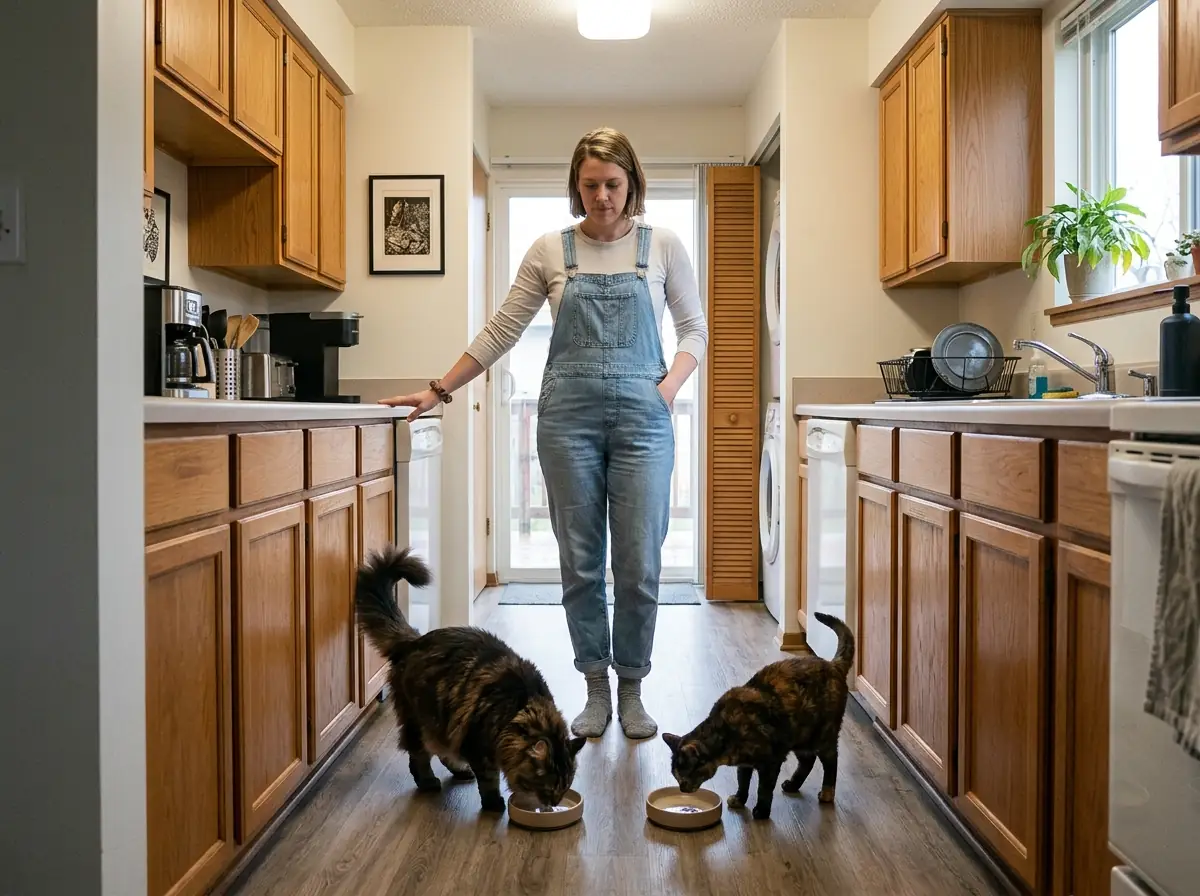
Both residents of the apartment this site is named after make the same point from opposite ends. A very large Maine Coon at full stretch needs more clearance than most brands build in. A British Shorthair at eleven pounds is heavy on short legs, which puts her nowhere near his number even though she is not a small cat. Same kitchen, two answers.
Where This Table Actually Came From
Worth saying plainly, because nobody else in this search result will: this table is assembled, not quoted. The size-tiered inch ranges come from the consensus across pet-bowl retailers and their guides, and the shoulder-height figure that justifies a separate large-breed row comes from breed reference material. Both numbers were already sitting in public. Neither had been printed in the same table as the other, which is the entire reason you had to read four articles about chest level before you found an inch.
So treat it the way you would treat any starting point that came from somewhere reasonable rather than from a lab: it gets you inside the right range in about ten seconds, and then you check it against the animal in front of you. The next two sections are that check.
Measure to the food, not to the furniture. Before you measure the cat at all, put a tape on the bowl you already own and find the distance from the floor to the rim. Half the time that gap is bigger than people assume, and the fix turns out to be a two-inch riser rather than a whole new feeding station.
Before you go any further with a tape measure, there is one question that comes first, and this is the right place in the article for it rather than a footnote at the bottom. Whether elevation is the right idea for your particular cat is a separate question from how high, and the pillar piece on whether raising the bowl helps your cat at all answers it across a wider frame than this one does.
When the Height Is Not the Problem
A fair share of people searching this searched it because something changed. The cat used to eat normally and now hunches. Food gets left in the dish. Food comes back up shortly after a meal.
Vomiting after eating is the one that sends people to this search in particular, and it is not a tape measure question. It deserves a straight answer before anyone spends an evening on the floor with a ruler.
A change in how a cat eats, arriving over days or weeks in an animal who was fine before, is a reason to call a vet. Not a reason to raise a bowl. Conditions like megaesophagus, where regurgitation is the primary symptom, are managed by a veterinarian, and bowl height is not a treatment for any of them. That is the whole of what this article has to say on the subject, and it stops there on purpose.
Stiffness in a senior cat changes what a comfortable height is, and it changes it a lot. Osteoarthritis, or degenerative joint disease, is the joint disorder cats are diagnosed with most often, and the Cornell Feline Health Center describes it as slowed-down, reclusive behavior rather than a limp — which is exactly why the kitchen doorway is the wrong place to spot it. The furniture change comes after the visit rather than instead of it. If you have been half-planning to buy a stand and see whether it helps before booking anything, that is the order this article would ask you to reverse.
What the height genuinely fixes is the ordinary case, and the ordinary case is more common than the worrying one: a cat with no complaint at all who has simply been eating at the wrong angle for years because nobody ever measured. No symptom, no change, no story. Just a floor-level dish set at a height chosen by a factory for a cat who does not live here.
Everything below this line assumes that cat, and assumes a vet has already been involved if anything about the eating itself has changed. The companion article on which cats elevation actually helps draws the same boundary in more detail.
How to Measure Your Cat in About a Minute
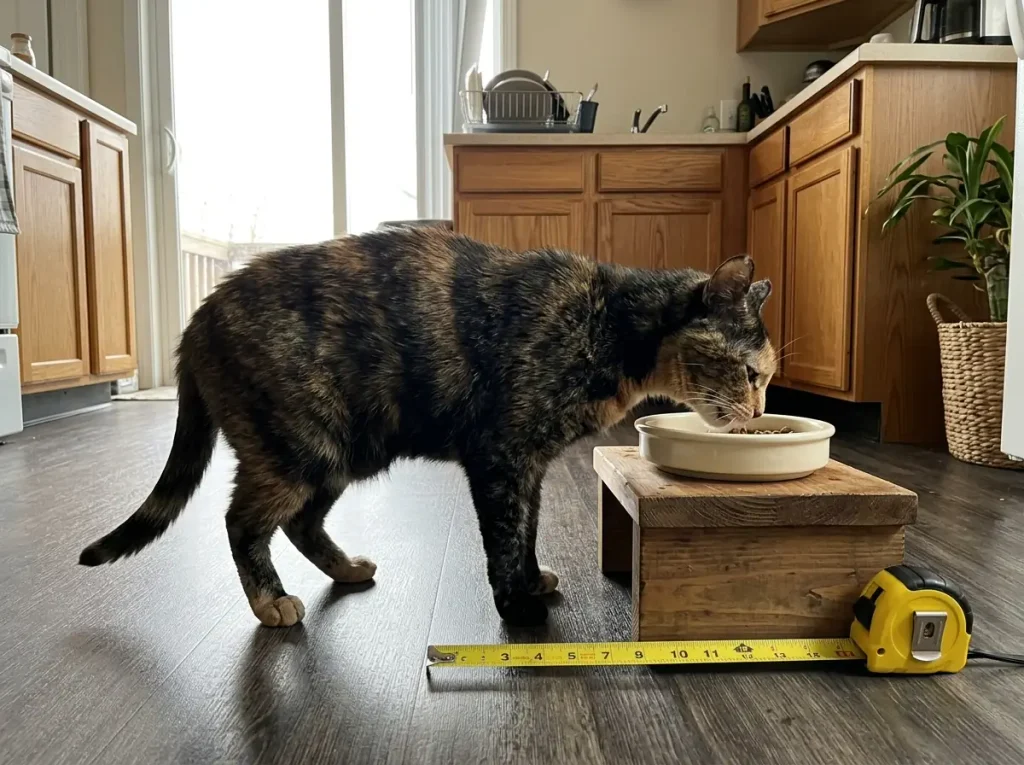
Chest level, or chest height, fails as an instruction because two people looking at the same cat will point at two different places and both feel confident. The elbow does not have that problem. You can put a finger on it, and more usefully, you can watch it while the cat eats and see whether you got it right.
Stand the cat naturally on all fours, which is the hard part, and measure from the floor to the elbow, meaning the joint where the front leg meets the body. That figure is your target rim height. Not an offset from it, not a percentage of it. That number, straight across.
- Get the cat standing square on a hard floor, all four feet down and weight even.
- Find the elbow: the joint where the front leg folds into the chest.
- Measure floor to elbow with a tape or a ruler. Write it down.
- That figure is the height you want the rim of the bowl to sit at.
- Check the food surface, not the stand: a deep dish eats two inches of your number.
The alternative method is the one the rest of the search results use, and it is worth naming rather than pretending there is only one convention. Measure floor to the bottom of the chest and subtract two to three inches. The two approaches land close to each other on most cats, and honestly, if yours disagree by more than an inch you measured a cat who was reaching for something.
That is the trap, incidentally. Measure him standing normally, bored, ideally slightly annoyed with you. A cat stretching toward a treat held above his head is a different animal dimensionally, and the whole measurement moves.
What Right Looks Like Once It Is In Place
Numbers on paper are one thing. The check is watching a meal. Forearms at roughly a right angle, head sitting level rather than tipped, no reaching up and no folding down. If you can see all three of those at once, stop adjusting things.
The two ways it goes wrong get described in cat forums as separate complaints, always in the same words: stretching to eat and hunching to eat. They get discussed as if one is a bowl problem and the other is a cat problem. They are the same problem mirrored.
Too high means stretching; too low means bending. Either way the animal absorbs it as neck strain, compensating in whichever direction is available to him. Naming them as one thing is most of the diagnosis.
And while you are down there with the tape, the height is only one of the two measurements that matter, because the width and depth of the bowl itself decides whether his whiskers touch the sides on the way to the bottom. A perfectly measured stand under a deep narrow dish solves one problem and leaves the other exactly where it was.
Test the Height Before You Buy Anything
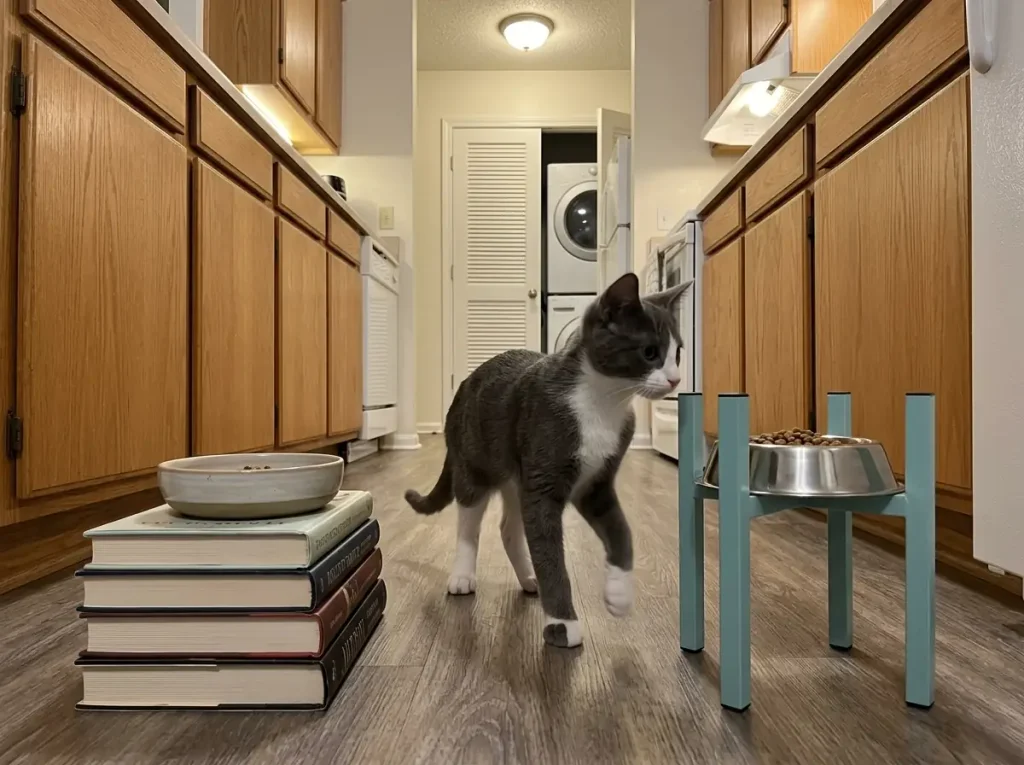
A fixed-height bowl is a bet on a number you measured once, on a cat who was not cooperating, with a tape measure you had to find in a drawer. There is no reason to place that bet blind when a stack of books settles it in two days.
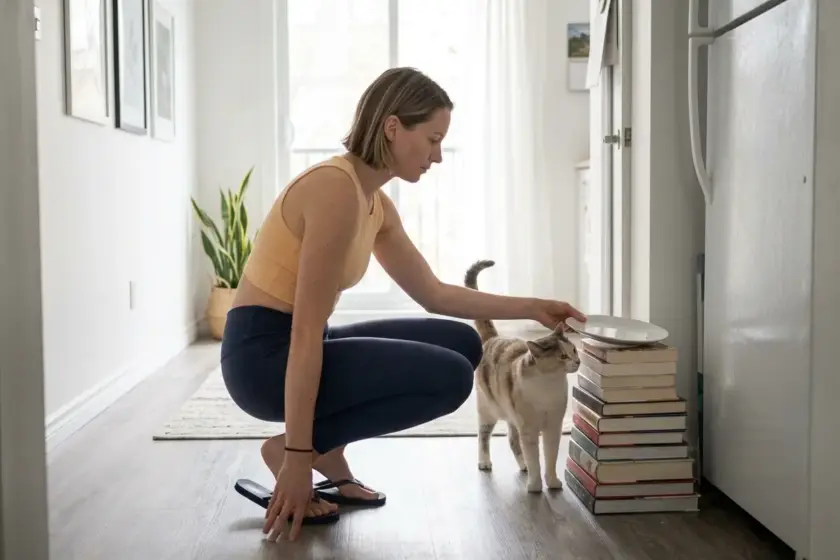
Put the bowl the cat already uses on a stack of books, or a low step stool, at the height you measured. Leave it. Feed him there for a couple of days and watch the front legs during meals rather than watching the bowl. If he backs off, or stretches, or eats from the edge with his body angled away, the stack is wrong and you change it in ten seconds by pulling out a paperback.
That ten seconds is the entire argument for testing first, because the same correction on a bought stand costs a return shipment.
Give it two full days, not one meal. A cat who skips a single meal at a new height has not rejected anything; he has noticed that the furniture moved, which is his job. A cat still refusing on day three has told you something real.
A growing kitten adds a second reason to hold off. The number that fits in March is wrong by autumn, and a fixed height bought for a four-month-old is a fixed height you will replace. If you are feeding a kitten, the books are not a compromise. They are the correct answer for now.
This is the same logic that runs through the rest of the feeding room here, incidentally. Whether whisker fatigue can be fixed without buying a bowl gets answered with a three-day test on a flat plate you already own, for the same reason the height gets answered with books. Free tests are how you find out whether the thing you were about to buy solves the problem you actually have.
Once the number is settled and it needs to become permanent, the Drawinsage Adjustable Metal Raised Cat Bowl Stand is the manufactured version of the book stack: an adjustable metal riser with preset heights that holds the bowls already in your house rather than shipping its own. Bowls are not included, which sounds like a shortcoming and is the actual point of it, since it means the height can change later without buying a new dish. The caveat is that a riser only works if your existing bowls sit in it stably, so check the base of the dish you plan to use before ordering rather than after.
Photograph the test. Take a phone photo at floor level, from a few feet back, on day one and again on day three at the corrected height. The difference in the neck angle is obvious in two still images and almost invisible while you are standing over him watching it happen live.
Two Cats Rarely Need the Same Number
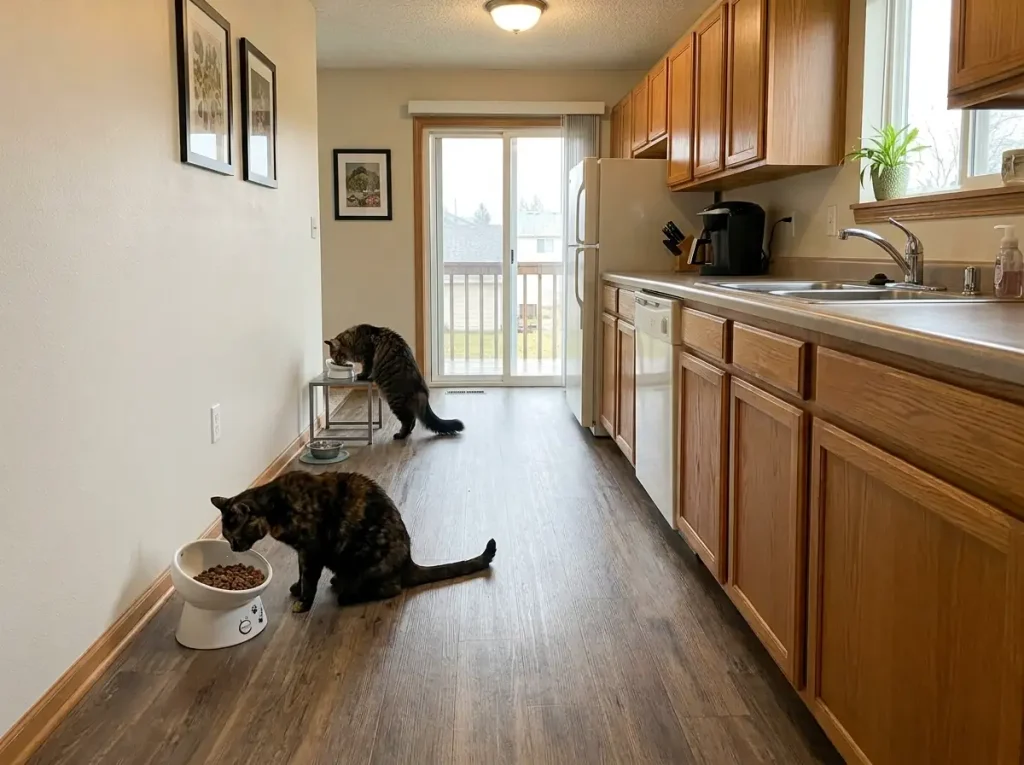
Here is the failure that repeats in multi-cat households, and it repeats because it does not look like a failure. Somebody raises one feeding station, sized for the biggest cat or for the one whose eating changed enough to be noticed, and stops. The bowl is raised. That reads as done.
Meanwhile the other cat has been eating at a height chosen for an animal that is not her, sometimes for months, and nobody notices because she never complained about anything in her life.
A kitten and a full-grown cat in the same kitchen are two different numbers, and not by a little. A compact eight-pound adult and a long-bodied fifteen-pound one are also two different numbers. One station cannot serve both, and averaging them produces a height that is wrong for everybody in a tidy, symmetrical way.
I used to treat this as a nice-to-have, the kind of refinement you get to after the real problem is solved. After enough threads where the second cat’s eating quietly changed and the household spent weeks blaming the food, I stopped. If there are two cats and one raised bowl, that is the first thing to fix, ahead of anything you might buy.
Separate stations also settle a problem that has nothing to do with inches. Cats who eat at different speeds do better apart, and whether two cats can share one bowl at all is a question worth answering before you buy hardware for either of them. If you are already rearranging the feeding area to fix a height, that is the cheapest possible moment to also fix the sharing.
Measure the quiet cat first. In a house with two, the one who gets measured is always the one who made a fuss, and the other one’s number gets guessed from his. Do it in the other order and you will usually find the gap between them is larger than you expected, which tells you immediately whether one station can serve both.
Making Per-Cat Heights Affordable
The reason this gets skipped is arithmetic. A whole new elevated bowl set per cat is a real purchase, and two of them is twice that. A bowl-agnostic riser is what makes the per-cat version sane: one riser each, sitting under the dishes the house already owns, at two different heights.
For the cat whose number is settled and is not going to change, a fixed elevated bowl is the tidier long-term answer, and the Necoichi Ceramic Elevated Cat Food Bowl is the one this site keeps coming back to across the whole feeding room. It is ceramic, the rim is extra wide so the whiskers clear the sides, and it is tilted 15 degrees. Worth being precise about that tilt, because it gets conflated with height constantly and they are two separate knobs.
Tilt angles the food toward the mouth. Height sets how far down the cat has to bend to reach it. Fixing one does not fix the other, and a tilted bowl at the wrong height is still at the wrong height.
Its limitation is the obvious one for a fixed piece: the height is decided at purchase, so it belongs to a grown cat whose number has stopped moving, not to a kitten. In stainless steel, the Hepper NomNom elevated set covers the same ground and cleans up a bit easier, though stock on it runs thin often enough that it is the alternative here rather than the recommendation.
Conclusion
Measure at the elbow, not the chest. It is the one landmark on a cat you can point at twice and get the same answer, and it is the one you can keep checking while he eats.
Test the number on a stack of books for two days before you commit to a height you cannot change afterward. The correction costs a paperback instead of a return label.
Count the cats before you count the inches. Two cats are usually two numbers, and the quiet one is the one who has been eating at the wrong height.
Look again in three weeks. Not three months: this is a posture change the cat either accepts or does not, and the answer shows up within days. What you are checking is whether the head is still level during meals and whether the food is still being finished. A kitten gets re-measured sooner than that, because a kitten in three weeks is a different cat.
Put the bowl on three books tonight. If he eats level, you just found the number for free.
Amazon’s Audible — free for 30 days
Your cat won’t let you read. Let someone read to you.
Audible is Amazon’s audiobook library — thousands of titles, read out loud, on your phone. Free for a month, plus one audiobook to keep forever.
Frequently Asked Questions
01How elevated should my cat bowl be?
Between about 2 and 8 inches from the floor to the rim, depending on the size of the cat: roughly 2 to 4 inches for a kitten or small adult, 4 to 6 for an average adult, and 6 to 8 or more for a large or long-bodied cat. Measure floor to elbow on your own cat and you land inside that range with a number that fits.
02Do cats prefer deep or shallow bowls?
Shallow and wide, in most cases. A deep bowl presses on the whiskers as the cat reaches the bottom, which is a separate complaint from height. Depth and height are two different measurements, and fixing one does not fix the other.
03Should the water bowl be elevated too?
It can be, at the same height, but water is less sensitive to the angle than food is because cats drink with the head lower. If you are only raising one dish, raise the food bowl first and leave the water where it is.
04Why don’t you put a cat’s water next to their food?
Many cats drink less when the water sits beside the food, and moving the water to another part of the room costs nothing. It has nothing to do with height. It is a placement question, and the two get confused constantly.
05What is the 3-3-3 rule for cats?
It describes how a newly adopted cat settles in: roughly three days to decompress, three weeks to learn the routine, three months to feel at home. It is about adjustment, not feeding height, and it turns up in these searches because both are things people look up in the first weeks with a new cat.
Leave a comment