Litter Box Ammonia Starts 30 Minutes After the Pee
Don't deep-clean the box again. Litter box ammonia runs on a 30-minute clock per pee (not per scoop) + the free fix almost everyone skips.

Alfredo RamsesFounder · August 22, 2026 · 15 min read

On this page8 sections
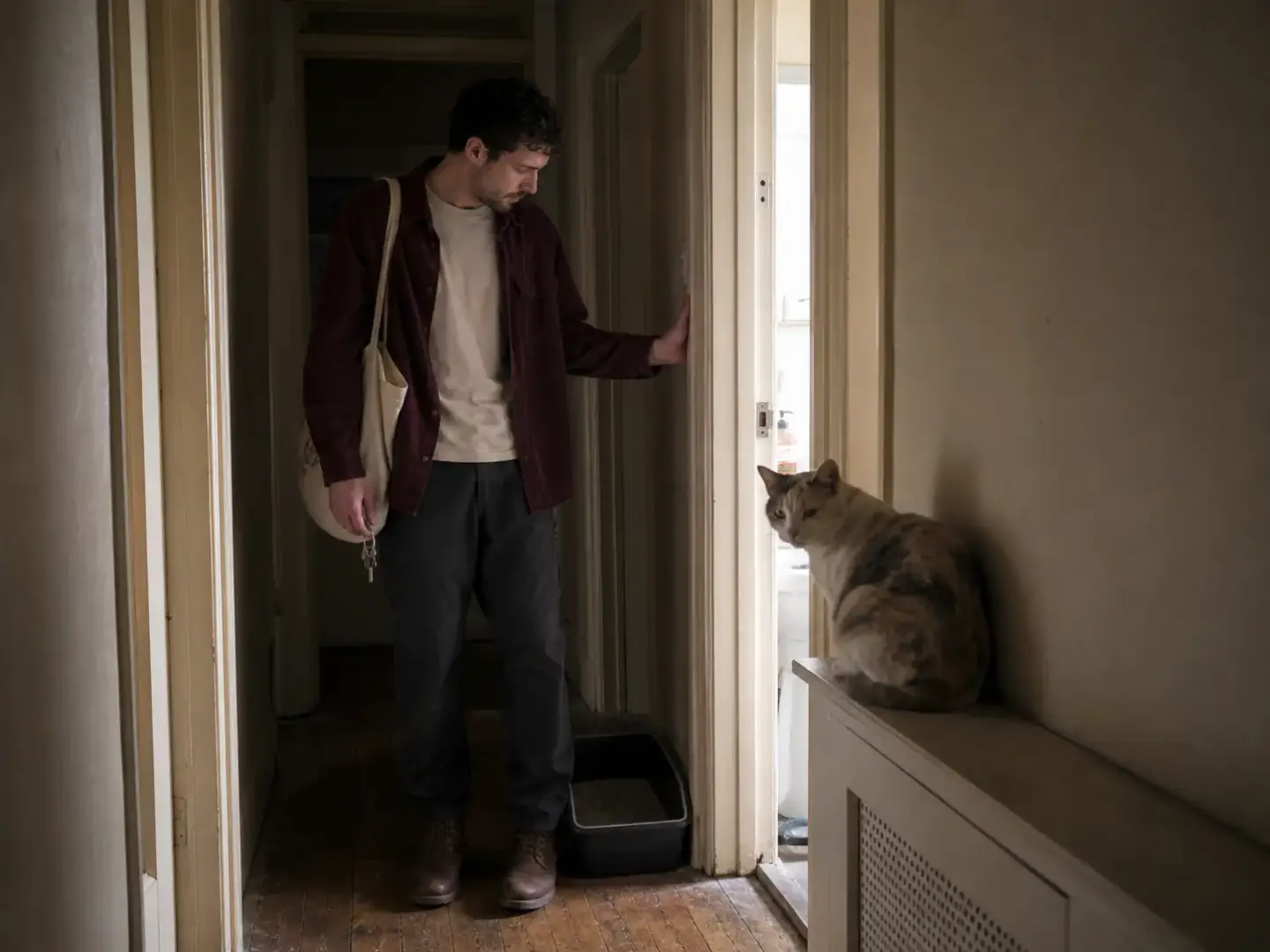
You scooped at eight in the morning. You come home at six and the hallway smells like a public restroom, and when you go look, the box is clean. Nothing is wrong with your cleaning.
Ammonia isn’t in the urine at all: bacteria manufacture it by breaking down urea, and they start about half an hour after the deposit lands. That clock restarts with every pee, not with every scoop, which is why a spotless box can ambush you by dinner. Here’s what the smell actually is, when it stops being a box problem, and what changes the clock for free.
Quick Answer
If your litter box smells like ammonia, it is almost always one of these four, in this order of likelihood:
- The box has gone hours without a scoop. Most common, fastest to fix.
- You have fewer boxes than cats plus one, so the ammonia concentrates instead of spreading.
- The plastic is scratched and holds bacteria no cleaning reaches.
- The lid is trapping the air right where your cat puts his face.
If there is also a change in how your cat is behaving, that is not the box. That is a vet visit.
Ammonia Isn’t in the Pee. It’s What Bacteria Make of It
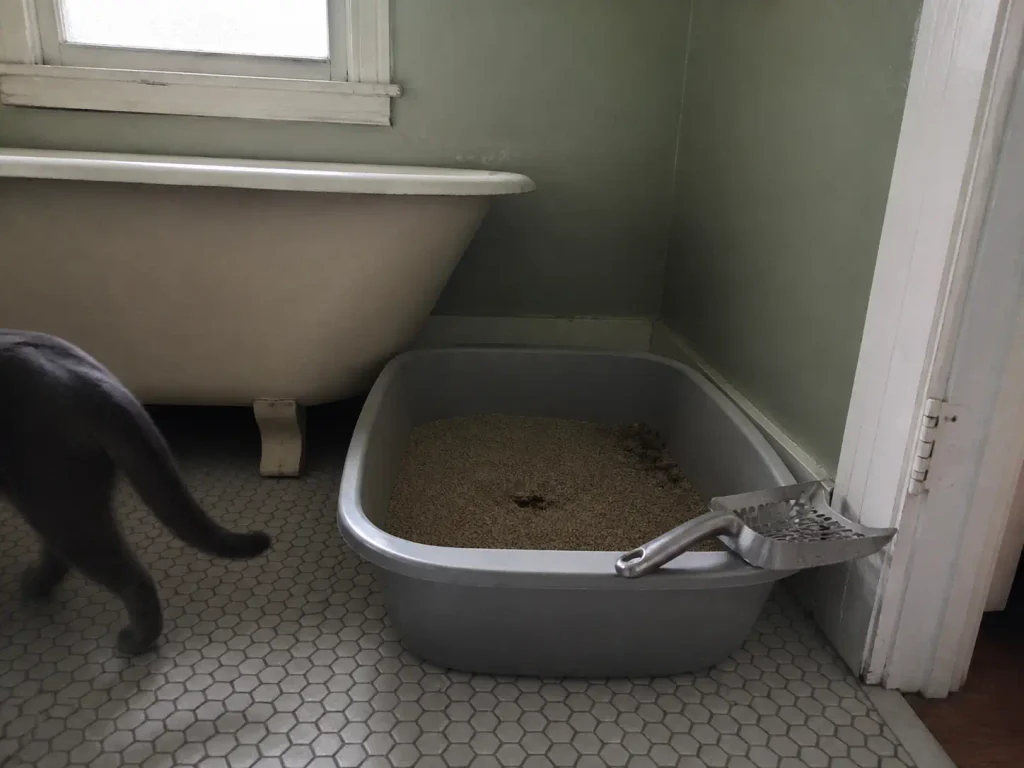
Fresh cat urine is mostly urea, and urea is close to odorless. What you smell in the hallway is not pee.
It’s pee that has been sitting long enough for bacteria to get to it, using an enzyme called urease to snap the urea apart and release ammonia as the byproduct. Nobody smells the deposit. Everybody smells the aftermath.
The timing is the part almost no one publishes: bacterial action gets going roughly 20 to 30 minutes after urination, and the smell keeps building over the hours after that as more bacteria colonize the waste. So the clock is not a cleaning schedule. It’s a per-deposit timer, and every cat that uses the box starts a fresh one. That reframe is the difference between treating this as a hygiene failure and treating it as a timing problem, and it’s the same mechanism behind why litter box odor keeps coming back after you clean.
There’s a second reason cat ammonia hits harder than the volume suggests. Domestic cats descend from desert animals and their kidneys are built to conserve water, so what comes out is concentrated waste in very little liquid. Same 30-minute clock, sharper result. A dog of the same weight would not do this to your apartment.
Which brings up the sentence everyone says and nobody examines: “but I scooped this morning.” True, and irrelevant.
That scoop only beat the clock on deposits that happened before it. Anything your cat left at nine has had nine hours by the time you walk in, and you had no way to know it was there.
Urease-producing bacteria also recolonize a scooped box, even a washed one, within hours. A morning scrub-down doesn’t buy a clean day. It buys a few hours before the same clock starts over.
The clock doesn’t reset when you scoop. It resets with every pee. That’s why two quick passes a day beat one heroic weekly deep clean, and why the best time for the second pass is the moment you get home, not right before bed. The deposits from your workday are the ones that have had all afternoon to turn.
When the Smell Isn’t the Box
Some of this is routine failing, and it looks like routine failing. The smell comes back the same evening you scooped. It concentrates in one specific spot instead of hanging everywhere.
It shows up on exactly the day you skipped a pass, and it gets noticeably better within a day of scooping twice. Those patterns describe a schedule losing to the clock, and the rest of this article is about winning that.
Then there’s the other version, and it gets one plain sentence: if the ammonia comes with a change in your cat’s behavior, such as straining in the box, blood, frequent trips back and forth, drinking more, losing weight, or eating differently, or if the smell will not respond to a routine that is genuinely clean, that is a vet visit this week. Cornell’s Feline Health Center treats a change in elimination habits as a health question before it’s a furniture question, and so does this site. That’s the whole handoff.
You’ll notice what isn’t here: the chart. Most articles on this exact search will hand you a table pairing smell descriptions with diseases, sweet means this, fishy means that, stronger means the other.
That’s a diagnosis with a nicer layout, and no one should be making one from across the room by nose, including us. Saying so out loud is information, not a dodge. What lives on this side of the line is the furniture, the litter, the smell, the noise and the territory. Anything that hurts goes to somebody with a license.
The Two Changes That Actually Move the Clock
You came here ready to buy something. The honest answer is that the two changes with the most leverage cost nothing, and that any product bought before you make them is just buying time on a problem that’s still running underneath.
Twice a Day Is the Line, Not Once
Going from one scoop to two is described across sources as the point where ammonia stops appearing, and it’s free. It works for a mechanical reason rather than a hygiene one: two passes cut the maximum age of any deposit roughly in half, and the smell tracks age, not tidiness. Morning and the moment you get home is the pairing that fits most people’s actual day.
Litter depth belongs in the same conversation, because it decides whether that scoop removes anything. Two to four inches is the working range.
Shallower and urine reaches the plastic floor before it can clump, so you’re scooping the top and leaving the source. Much deeper and cats dig to the bottom anyway and the clump breaks apart on the way out. Three inches is where most clumps lift out in one piece.
Take the Lid Off
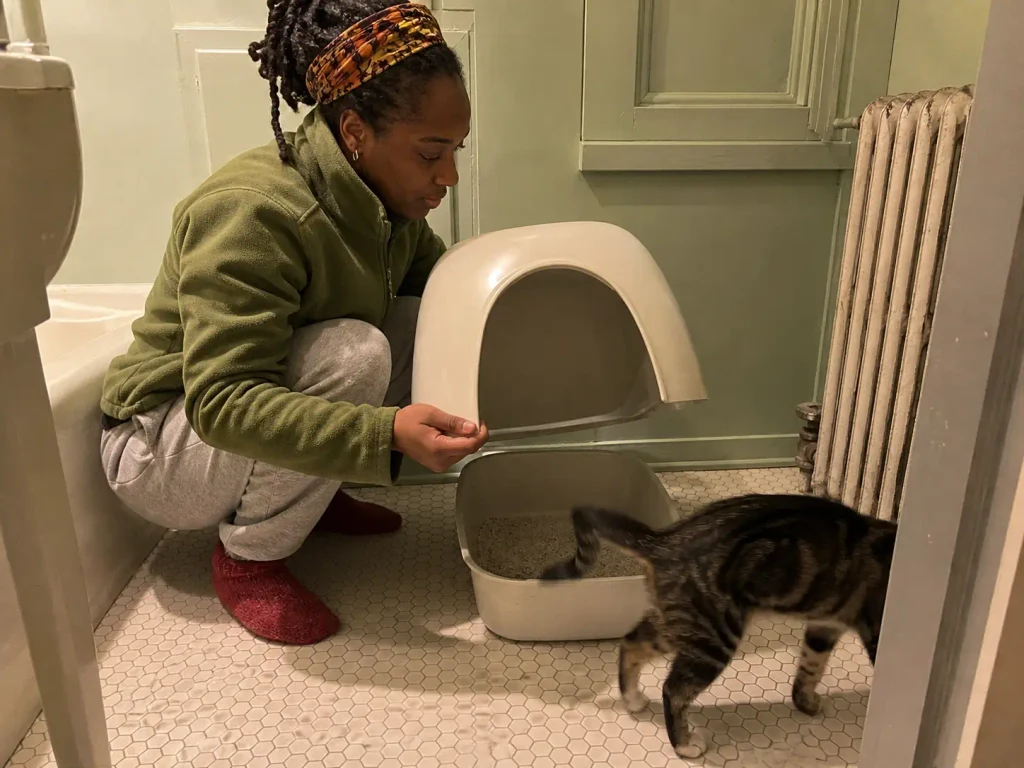
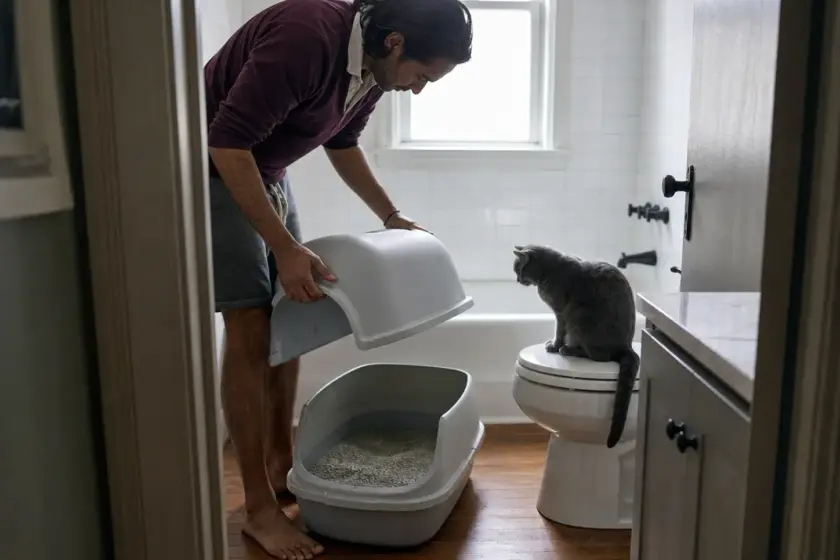
Here’s the counterintuitive one. A covered box, sold as a hooded litter box, does reduce what reaches your nose in the room, which is exactly why they read as the renter-friendly choice in small apartments. It does that by holding the air inside the box, which is where your cat puts his entire head, several times a day.
Cornell frames the trade-off plainly: tidier for the human, worse for the cat. Ammonia is a respiratory irritant, and a lid removes the one thing a room has going for it, which is ventilation.
If you bought a lid to solve a smell problem, you didn’t solve it. You relocated it onto the only resident who can’t open a window. And in a studio there is no window to open anyway, which is why an air purifier gets bought so often here and disappoints so reliably: it filters the room while the box keeps producing.
And he isn’t wrong to object. His face sits at litter level and his lungs are small, so whatever you catch walking past, he’s breathing a stronger version of every time he uses the box. You’re getting a passing whiff. He’s getting the concentrated one.
Before you spend anything on odor control, pull the lid off the box for one week. If the ammonia drops, the lid was the problem and you just saved yourself the purchase. If it doesn’t drop, you’ve eliminated a variable for free and you now know the fix is elsewhere. Either way the week pays for itself.
Wash the Box, Not Just the Litter
Weekly, with plain mild dish soap and water. No branded cleaner needed. This is the step almost everyone skips before blaming their litter, and it’s why the “I switched brands and it didn’t help” story is so common.
A better litter buys time against the clock. Non-clumping litter loses that time straight away, because urine pools at the bottom instead of lifting out, and silica crystal litter buys more of it by absorbing rather than clumping, at the cost of never showing you what you removed. It doesn’t replace the routine, and swapping brands to fix what’s really a scoop cadence problem is the most expensive way to learn that.
Never bleach, and never a cleaner containing ammonia. Both smell like urine to a cat, which can pull elimination back to the exact spot you were cleaning. For the full sequence of fixes ranked by what they cost, the sibling article has the full cost-ordered list of what clears litter box smell.
What Neutralizes Ammonia and What Only Covers It
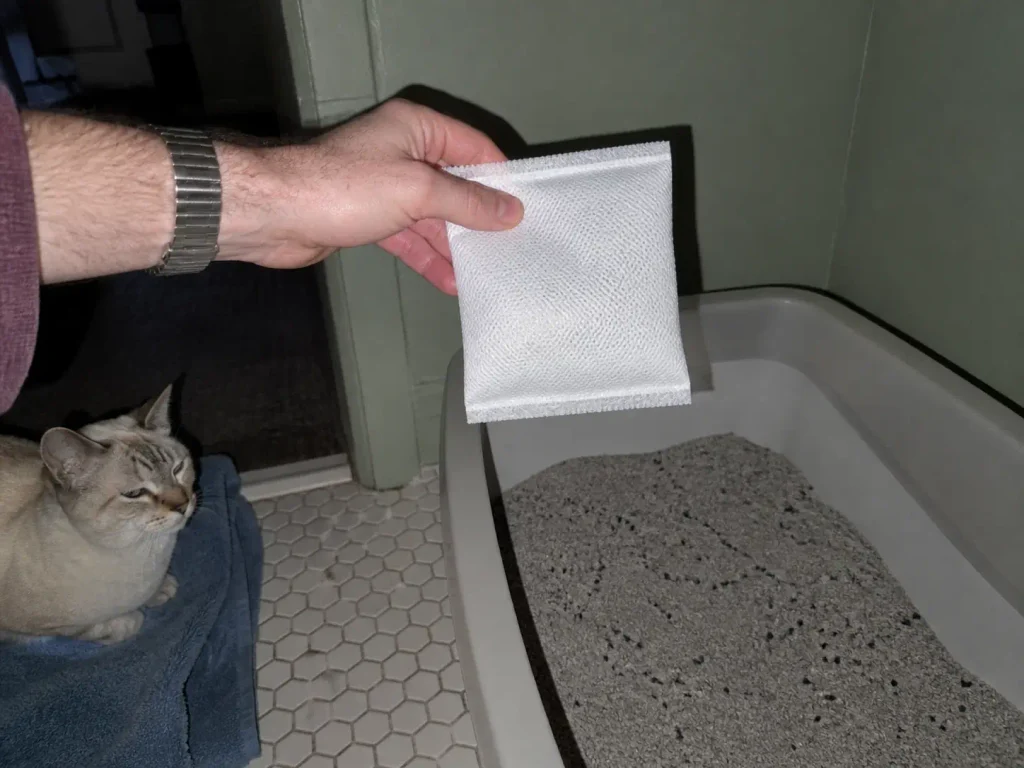
The pet aisle is full of things that smell like lavender on top of ammonia. The difference between capturing a molecule and layering a second one over it is the only one that matters, and almost nobody explains which they sold you.
Adsorption Versus Fragrance
Activated carbon adsorbs: the ammonia molecule gets held on the carbon’s surface rather than covered up. Fragrance adds a smell instead, so you end up with two, and so does the cat, who did not ask for either.
The PurifyLogix Activated Charcoal Litter Box Pouches come six to a pack in coconut-shell carbon, and the pouch is the low-effort version: one sits near the box and gets swapped on a schedule. The catch is you’re paying for the portioning. If you’d rather not, Kitty’s Odor Stopper is the same idea as a 4 lb bulk bag, cheaper per use and messier to handle. Litter box placement matters as much as which you buy: what to put near the litter box for smell, and what to keep away from it.
What the Litter Itself Can Do
Clumping litter isn’t odor control in the perfume sense. It’s prevention: it locks urine into a solid mass you lift out whole before the bacteria finish their shift. World’s Best Cat Litter Original Series comes in a 14 lb bag and clumps hard enough that the clump survives the trip to the trash, which is the only spec that matters here. Honest limitation: corn-based litter is lighter than clay and tracks further, so if your box sits ten feet from the bed, expect to sweep.
The free version forum threads reach for first is a layer of baking soda under the fresh litter. Less effective than carbon, doesn’t last as long, costs about nothing. Worth trying before anything with a brand on it.
What Never Goes Near the Box
Bleach and ammonia-based cleaners, and it’s worth repeating because they’re the two bottles under most sinks. They read as urine to a cat and can re-attract elimination to the spot you were cleaning.
What does help is an enzymatic cleaner on the residue soap can’t reach, on the plastic and the floor around the box. Rocco & Roxie Litter Box Odor Eliminator is a 12 oz jar of corncob granules you sprinkle in between scoops to stretch the interval without dumping fragrance into the room.
Read that as written: it stretches the interval, it doesn’t replace the scoop. Use it as permission to go back to once a day and you bought a jar to undo the fix that was working. None of these treat anything, by the way. They’re environment and prevention, full stop.
Ten-second test in the store aisle: turn the package over and find the active ingredient. If the answer is a fragrance, the product is working on your nose. If it’s activated carbon or a clumping agent, it’s working on the ammonia. Anything that leads with a scent name on the front is telling you which one it is before you even flip it.
Two Cats Don’t Make Twice the Ammonia
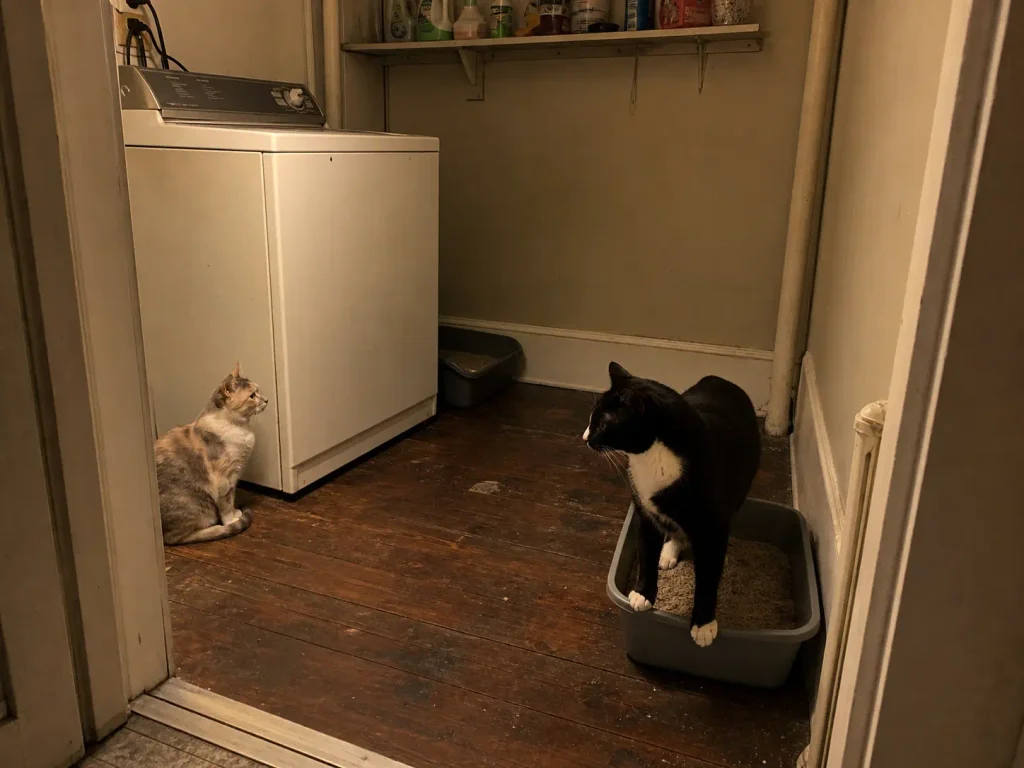
This is where most advice quietly stops working, because it was written for one cat and never says so. Add a second cat, and in a multi-cat household the math doesn’t double. It concentrates, because the same footprint of litter is now absorbing twice the deposits and two independent clocks are running across it at once.
The n+1 Rule, and What It’s Actually For
Cornell recommends one litter box per cat, plus one for behavioral reasons, mostly to do with cats not wanting to queue or ambush each other. Against ammonia it works for a completely different reason nobody spells out: it spreads the same volume of waste over more surface, so no single box accumulates enough to cross the threshold where you notice it. Two cats, three boxes. The number isn’t negotiable in the way people hope it is.
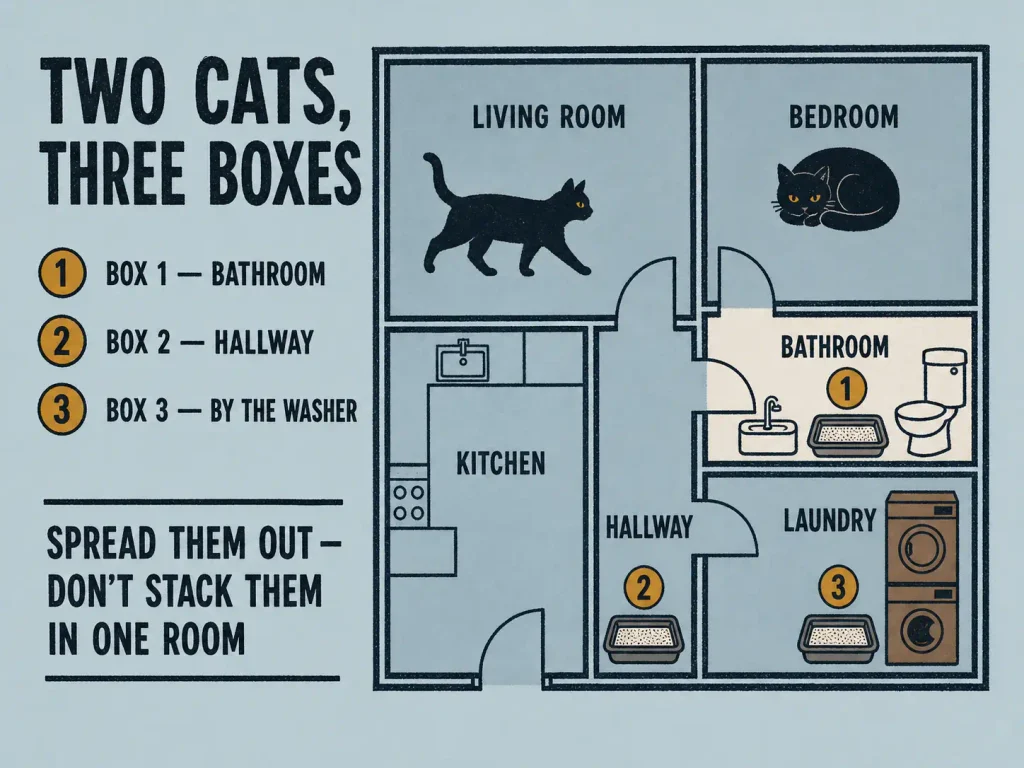
The objection is always space, and it’s fair in a one-bedroom. But the boxes don’t need to be together, and shouldn’t be. Three boxes in one corner is one box with extra steps as far as the ammonia math goes, since the waste still sits in a single square foot of apartment. Spread them and the smell has nowhere to pool.
Why the Number Rises Faster Than the Count
Here’s the concrete version. A freshly scooped single-cat box tests under 10 ppm of ammonia at the surface. Left 48 hours, the area around it can reach 50 to 100 ppm, and an uncleaned multi-cat box can match or beat the 50 ppm OSHA sets as an eight-hour workplace exposure limit for people. Human noses pick ammonia up around 5 ppm, which is why you smell it long before it’s near that number.
Read that as exposure information, not a diagnosis of anything. Two skipped days in a multi-cat home puts your cat’s face, at litter level, in air a factory would need paperwork for, while you get the diluted version from standing height. It’s a much better argument for the third box than “the internet said so.”
The failure that shows up over and over in cat forums is arithmetic, not neglect: someone adopts a second cat, keeps the same two boxes and the same once-a-day scoop, notices the apartment smells worse within a month, and switches litter brands looking for the culprit. The litter was never the variable that changed.
When the Box Itself Is the Problem
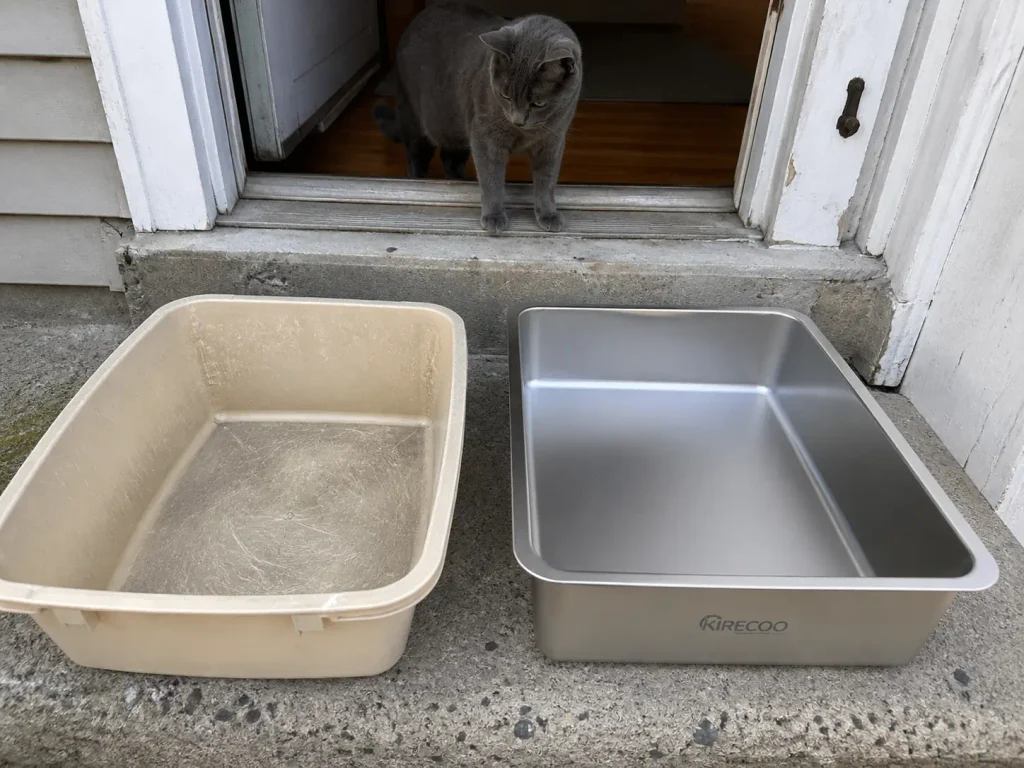
There’s a point where no schedule saves you, because what’s generating the smell is no longer what’s in the box. It’s the box. This is the least popular section of any odor article, because it ends with throwing away something that still looks fine.
Scratches Are Where the Bacteria Live
Every claw pass leaves micro-scratches in plastic, and bacteria colonize the scratches themselves, not just the litter on top. Washing the surface doesn’t reach into them. That’s why a box scooped perfectly for a week can still smell like ammonia by the third: the plastic has been absorbing odor the whole time and scooping was never touching it.
The Replacement Window
A plastic litter box gets replaced every 12 to 18 months,
sooner if the scuffing shows up early. Separately, do a full change every two to four weeks with a single cat, even with diligent daily scooping.
While you’re at it, check the box size: a box should run about 1.5 times your cat’s length from nose to tail base. Most boxes sold as “large” don’t clear that for a big cat, and a cat standing with his front paws in and his back end over the rim isn’t making a statement. He’s solving a geometry problem you handed him.
What Steel Changes, and What It Doesn’t
The free fix comes first, as it should: replace the plastic box sooner. If you’re on an 18-month cycle and the smell arrives at month ten, go to a ten-month cycle. Plastic costs a fraction of steel and solves the identical problem.
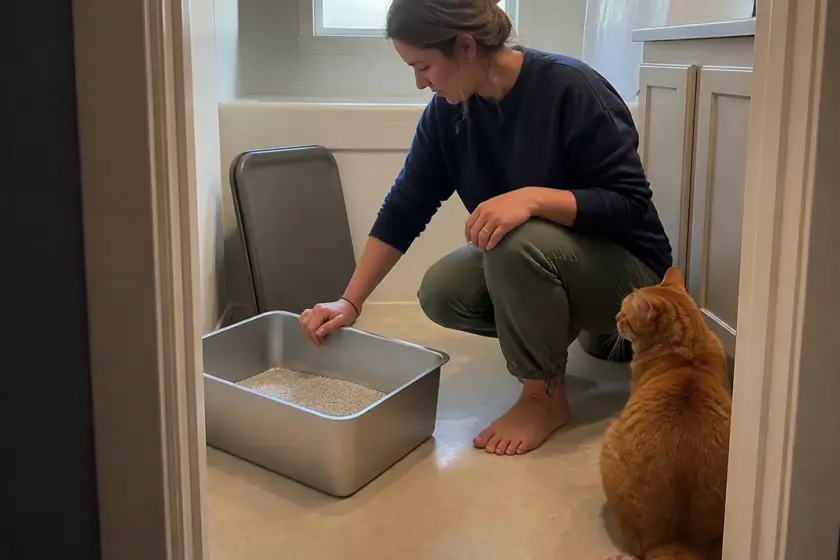
If you’re on your third plastic box and tired of the cycle, steel ends it, because a stainless steel litter box in grade-304-class steel doesn’t take the micro-scratches that harbor bacteria in the first place. The sibling article digs into whether metal litter boxes actually smell less. The Kirecoo Large High Sided Stainless Steel Cat Litter Box runs 23.6 by 15.7 by 11.8 inches, clearing the 1.5x rule for most adult cats.
The caveat nobody selling steel wants printed: it doesn’t reduce ammonia on its own. A steel box scooped once a day smells like a plastic box scooped once a day. You’re buying a box that doesn’t get worse, not one that cleans itself.
Run a fingernail across the inside floor of an empty box. If it catches anywhere, that’s a scratch, and that’s where the bacteria live that your cleaning routine never reaches. That drag is the replacement signal. Not a date on a calendar, not how the box looks from three feet away.
What to Do Tonight
Ammonia is a clock, not a stain. It restarts with every pee rather than with every cleaning, which is why two quick scoops a day beat any weekly deep clean, and why “I cleaned it this morning” was never the defense you thought it was.
Before buying anything: take the lid off for a week, and add a box if you have more than one cat. Both are free and both outperform every product in the aisle. If the routine is genuinely clean and the smell is still there, look at the box before the litter, because scuffed plastic doesn’t get better. And if the ammonia arrives alongside a change in how your cat is behaving, that isn’t the box at all.
Three weeks from now, check whether you’re still scooping twice a day. That’s where a new routine quietly slips back to once, and it’s why the ammonia returns on a random Tuesday when nothing else about your setup has changed.
Start tonight by pulling the lid off. If the hallway smells different tomorrow, you just solved this for nothing.
Amazon’s Audible — free for 30 days
Your cat won’t let you read. Let someone read to you.
Audible is Amazon’s audiobook library — thousands of titles, read out loud, on your phone. Free for a month, plus one audiobook to keep forever.
Frequently Asked Questions
01Why does my litter box smell like ammonia even after I scoop it?
Because the ammonia clock runs per deposit, not per scoop. Any urination after your last pass has had time to break down, and bacteria recolonize even a washed box within hours. If it smells the same evening you scooped that morning, the fix is a second daily pass, not a deeper clean.
02Is the ammonia smell from a litter box harmful to breathe?
You can smell ammonia at around 5 ppm, well below the 50 ppm OSHA sets as a workplace limit, so a noticeable smell in a scooped box is unpleasant rather than a hazard for you. Your cat is the one worth thinking about: his face sits at litter level and he breathes a stronger version every use.
03Does a covered litter box help with ammonia?
It helps you, not the cat. A lid cuts what reaches the room and concentrates the same air inside the box, where your cat puts his head. Cornell’s Feline Health Center makes that trade-off explicit. Taking the lid off for a week costs nothing and tells you whether it was the problem.
04Can I use bleach to clean a litter box that smells of ammonia?
No. Bleach and ammonia-based cleaners smell like urine to a cat and can pull elimination back to that spot, which is the opposite of what you want. Mild dish soap and water weekly does the job, and it handles what soaks into the plastic and the floor around it.
Leave a comment