Do Metal Litter Boxes Smell Less? Only Grade 304
Don't buy a steel litter box until you check the grade (304 vs 201) — the cheap one pits in a year and smells like the plastic you replaced.

Alfredo RamsesFounder · August 22, 2026 · 23 min read

On this page8 sections
Your plastic box does not smell because it is dirty. It smells because it is scratched, and your cat has been telling you that for months by digging harder than he used to. The odor is not sitting on the surface where your sponge goes. It is living a fraction of a millimeter underneath the porous plastic, in grooves your scoop carved one pass at a time, and no amount of scrubbing reaches down there.
That is the real question behind do metal litter boxes smell less: not whether steel is nicer, but whether swapping the material actually removes the thing producing the smell. It does. With two conditions that almost nobody selling a steel box will put in writing.
Quick Answer
Yes. Stainless steel is non-porous, so urine and bacteria have nowhere to settle and cleaning actually finishes the job. But the promise only holds on grade 304 steel, and only if the box is big enough for your cat to bury waste. A cheap 201 box pits within a year or two and lands you back where you started.
Why Plastic Starts Smelling and Steel Doesn’t
Every guide tells you to fix your scooping routine. You already scoop daily. The box still smells by evening, and the advice keeps arriving as though you had not thought of it. So skip the routine for a moment and look at the material, because litter box odor control fails here at a scale you cannot see.
Plastic is soft.
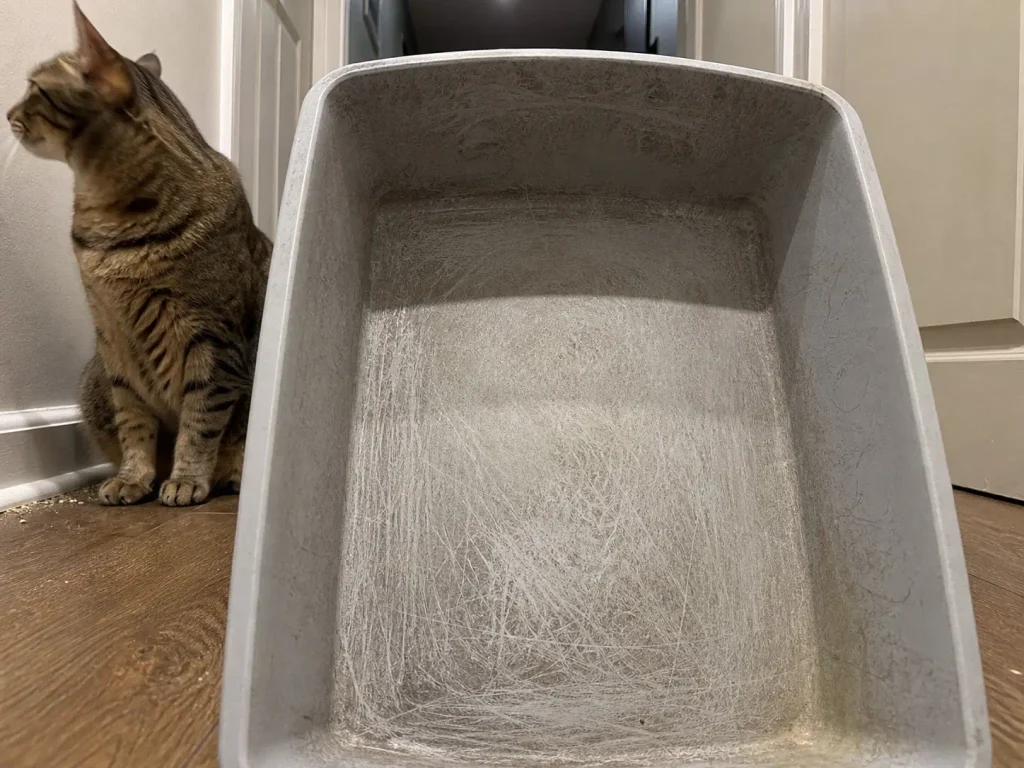
A metal scoop dragged across the bottom, twice a day, for two years, leaves thousands of scratches too fine to notice by eye. Your cat adds more every time he digs. Each groove is a place urine can wick into and bacteria can settle below the level a cloth can reach. So the box gets cleaner on top and stays colonized underneath, and the smell you are chasing is coming from inside the plastic itself.
Stainless steel does not do this. It is non-porous, which is a material property rather than a marketing line: there is no internal structure for liquid to enter. Whatever lands on the surface stays on the surface, and when you wipe the surface, it leaves. That is the entire mechanism, and it is worth understanding before you spend anything, because it also tells you the exact conditions under which steel stops working.
What “Non-Porous” Actually Means for a Box You Scoop Daily
The practical difference shows up after the wash, not during it. Surface-bacteria comparisons put a cleaned plastic surface at roughly 45% bacterial retention, against about 2% for stainless steel. Same soap, same effort, same person, wildly different result, because on plastic most of the population was never exposed to the soap in the first place. That gap is what odor retention actually measures: not how dirty the box looks, but how much bacterial buildup survives a wash.
That number reframes what “clean” means. A plastic box that looks clean is a box where you removed the visible layer and left most of the odor-producing colony intact under it. A steel box that looks clean is clean. And the gap widens over time: your plastic box gets more porous every month it exists, while steel starts and ends at the same place.
The Ghost Smell: Why a Clean Plastic Box Still Smells at Head Height
Litter threads have a name for this. The ghost smell is the faint, unmistakable note that hangs around a box you finished scrubbing sixty seconds ago. It is strongest when you walk into the room after being out, and it disappears from your awareness within about ten minutes of being home, which is why you second-guess yourself about whether it is really there.
It is really there.
It is coming out of the plastic, and it gets worse in a small apartment because the same amount of odor is diluted into less air. The best test costs nothing: leave the apartment for two hours and pay attention to the first breath you take when you come back in. Your nose adapts to a constant smell in minutes and resets in about that long away from it. If it hits you at the door, the box material is a live suspect.
Run a fingernail across the bottom of the plastic box you already own, in the corner where the clumps sit. If it catches and feels rough instead of glassy, the odor is not the litter and it is not your scooping. That is a free diagnosis, it takes four seconds, and it decides whether the rest of this article applies to you.
Where the Ammonia Is Really Coming From
Cat urine does not arrive smelling of ammonia. Urea breaks down into it, bacteria drive that reaction, and the sharp note you get at the box is a timer rather than a measure of how dirty the box is. That is also why the smell tends to feel like it comes back all at once on a random Tuesday instead of climbing slowly: the reaction has a lag, and it clears the threshold of your nose in a step, not a slope. If you want the chemistry in full, our node on what that sharp ammonia note is telling you owns that ground.
The pattern that keeps repeating in litter discussions is the one that makes everything worse: the box smells, so people clean harder and reach for a stronger product. Scrubbing harder scratches faster.
And reaching for the wrong bottle backfires twice over, because Cornell’s feline health center warns against ammonia and vinegar cleaners on litter boxes for a reason your cat understands better than you do: both of them read as urine to him. You are not disinfecting the box. You are signing someone else’s name on it.
Grade 304 vs Grade 201, and Why the Listing Rarely Says
Here is the part that separates the people who switch to steel and stay happy from the people who switch to steel and quietly go back. You paid three times what a plastic box costs specifically to stop having this conversation, and fourteen months later there are rust freckles in the corner and the smell is creeping back. You did not buy badly. You bought a grade you did not know existed, because the listing never named it.
“Stainless steel” is not a specification. It is a family. Two members of that family show up in cat litter boxes, they look identical in a product photo, and only one of them survives contact with cat urine.
What the Two Grades Are Made Of, in Plain Terms
Grade 304 runs about 18% chromium and 8 to 10.5% nickel. Grade 201 swaps most of that nickel for manganese, which is cheaper. That single substitution is the whole story. Nickel is what stabilizes the passive oxide layer, the invisible film that makes stainless steel stainless in the first place, and manganese does not hold that film together as well under attack.
Cat urine and the ammonia it becomes are exactly that kind of attack, applied daily, forever. Under that load a 201 stainless steel box can begin corroding and pitting within one to two years. A 304 stainless steel box in the same corner of the same apartment does not.
Why Grade Decides the Odor Answer, Not Just the Durability One
Every article that mentions grade at all files it under durability, as though the only cost of buying 201 is that it looks worse. That misses the point completely, and it is the single most useful thing in this entire piece.
Pitting is a new porous surface. A pit is a microscopic crater in metal that used to be smooth, and it does precisely what a scratch in plastic does: gives urine and bacteria a place to sit below the reach of your cleaning. So a 201 steel box does not just rust. It converts itself back into the exact problem you paid to escape, on a slower timeline, wearing a nicer finish. You bought two good years and a slow return to the beginning.
The word you want on the listing is rust resistant, and the grade that earns it is 304.
Watch for the early sign before the freckles arrive: a dull gray discoloration in the wet corner where the metal no longer takes the light the same way. This is also why “does stainless steel rust” is the wrong question and “which grade is this” is the right one. Rust is the visible symptom. The porosity underneath it is what turns into an ammonia smell three months later.
How to Read a Listing That Doesn’t Want to Tell You
The rule is short. If the listing does not say 304, assume 201. Manufacturers who paid for the good grade say so, in the title, in the bullets, in the spec image, sometimes stamped on the box itself, because it is the thing that justifies their price against the cheaper listing sitting right next to them in the search results. Silence is not an oversight. Silence is the answer.
What a listing that does its job looks like: the Kirecoo Large High Sided Stainless Steel Cat Litter Box names 304-type steel in its specs and gives you the interior at 23.6 x 15.7 x 11.8 inches, which clears the sizing minimum in the next section for most adult cats. The high sides are the trade-off worth knowing about: they contain a determined digger, and they are also a taller step for an older cat or a short-legged one, so measure the entry against the cat you have rather than the cat in the photo.
Before you buy, search the listing page for the string “304” in the description and in the spec photos. If all you find is “stainless steel,” message the seller and ask which grade. How long they take to answer is itself an answer, and it costs you nothing but a day.
Size Beats Material, and Here Are the Inches
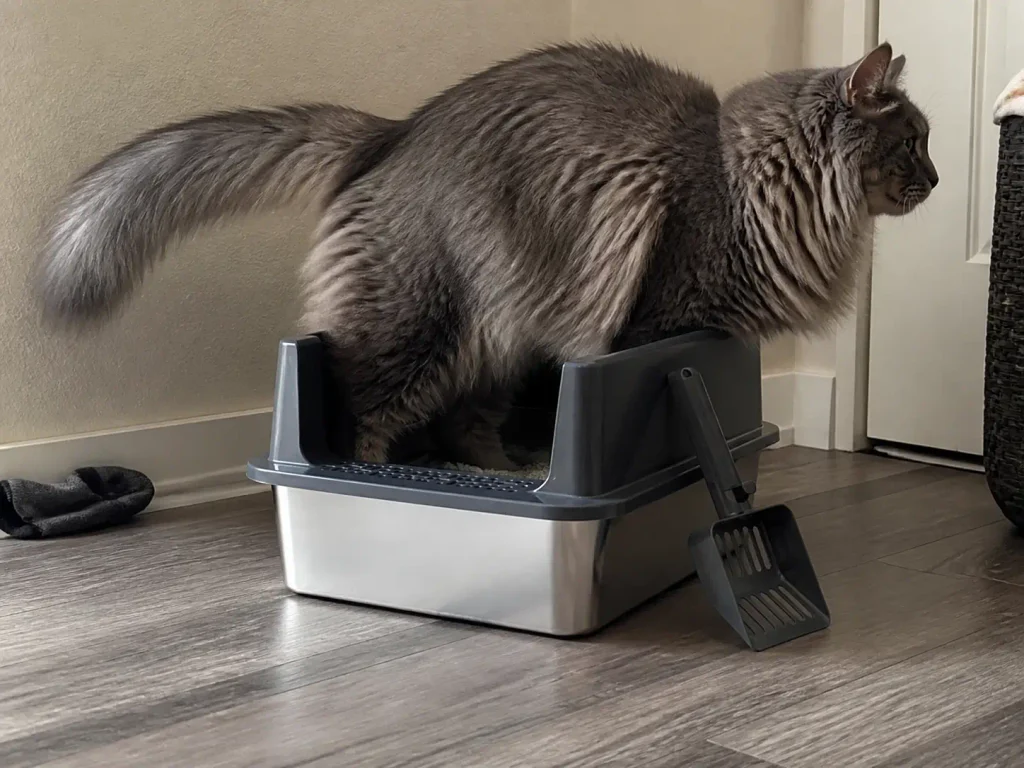
The second condition, and the one that catches people who did everything else right. You changed the material. You bought 304. It still smells, and the new box is beautiful, and it is also smaller than the one it replaced, because the good-looking steel boxes photograph better at a compact size and you were shopping with your eyes.
A non-porous surface only helps with odor that reaches the surface.
If your cat cannot bury what he leaves, most of it never touches the bottom of the box at all. It sits on top of the litter, exposed to the room, aerating. Steel did not fail. Steel was never in the conversation.
The 1.5x Rule, Measured on the Cat You Actually Have
Litter box size is the second condition, and it has a number. The working figure is 1.5 times your cat’s length, nose to the base of the tail, not counting the tail itself. Stretch him out, measure him, multiply. For a lot of adult cats that lands somewhere around 22 to 24 inches of box interior space, and it rules out a startling share of what gets sold as “large.”
A very large Maine Coon breaks the number entirely: at full body length he can need more interior than most manufacturers make at any price. For the full method, including width and the depth question, the full sizing breakdown, measured against the cat you actually have does the measuring properly.
Do that before you spend anything. If the box you already own comes up short, you have just learned that your smell problem was never about plastic, and a bigger plastic box will fix more of it than a small steel one will.
Why a Small Steel Box Still Smells
Three things happen in an undersized box, and they compound. The cat cannot turn around without touching a wall, so he digs a shallower hole. A shallow hole does not cover the deposit. And urine hits a wall instead of soaking down through litter, runs to the bottom, and sits there in a thin film with a lot of surface area exposed to the air.
That last one is the part people miss.
Odor release scales with exposed surface, not with volume. A small amount of urine spread thin against a cold steel wall smells more than a larger amount buried under three inches of litter. Your cat is not doing this to annoy you. He is doing arithmetic in a space you gave him, and he is getting the right answer.
When the Apartment Wins the Argument and What to Do Instead
Sometimes the correct box does not fit. You have one bathroom, the correct box is 24 inches long, and 24 inches is the whole gap between the toilet and the wall. This is a real constraint and pretending otherwise helps nobody.
Change the location before you change the size. A slightly smaller box in a spot with airflow and two exit routes beats a bigger one wedged into a dead corner. Cats avoid places with one way out, and a box a cat uses reluctantly is a box that gets half-buried deposits. If your washer alcove has a slatted door, that is often the best odor location in a small apartment and nobody thinks to look there.
If footprint genuinely rules, the smallest verified option in this class is the Stainless Steel Cat Litter Box with Lid for small cats, at roughly 17.3 x 13.4 x 7.87 inches.
It is a high sided litter box in a small footprint, which is a genuine combination and a genuinely narrow use case. Read the name literally. That interior is under the 1.5x number for most adult cats, which means it belongs to kittens, genuinely small adults, and the single cat household with nowhere else to put a box. Put a big cat in it and you have bought a steel box that smells, which is the most expensive way to learn this article’s second condition.
| Box | Outer Dimensions | Which Cat It Fits | The Catch |
|---|---|---|---|
| Kirecoo Large High Sided | 23.6 x 15.7 x 11.8 in | Most adult cats, single-cat home | High walls are a tall step for a senior cat |
| Small High-Sided Pan with Lid | 17.3 x 13.4 x 7.87 in | Kittens and genuinely small adults | Under the 1.5x rule for most adults |
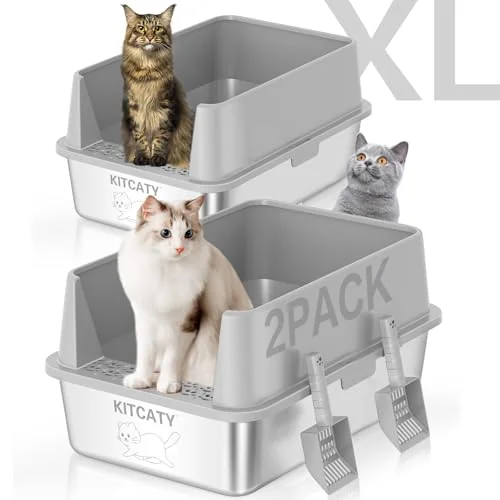
| 2-Pack XL with Lid | 23.8 x 16 x 12 in each | Two cats, covers the 1+1 rule in one order | Two boxes need two viable locations, not one wall |
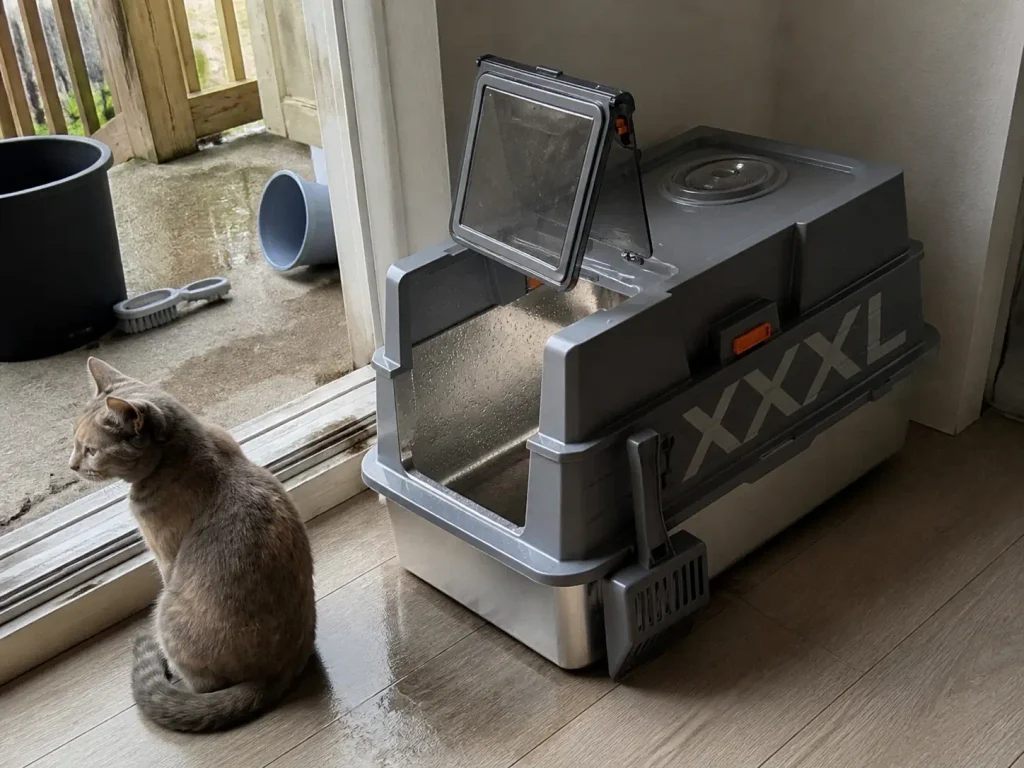
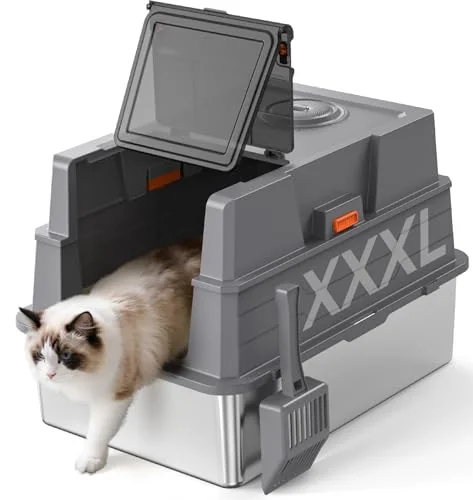
| XXXL with Lid | 28 x 20.5 x 16.5 in | Maine Coon class, or a shared box in a bigger home | Footprint of a nightstand; stock runs thin |
Two Cats Change the Answer
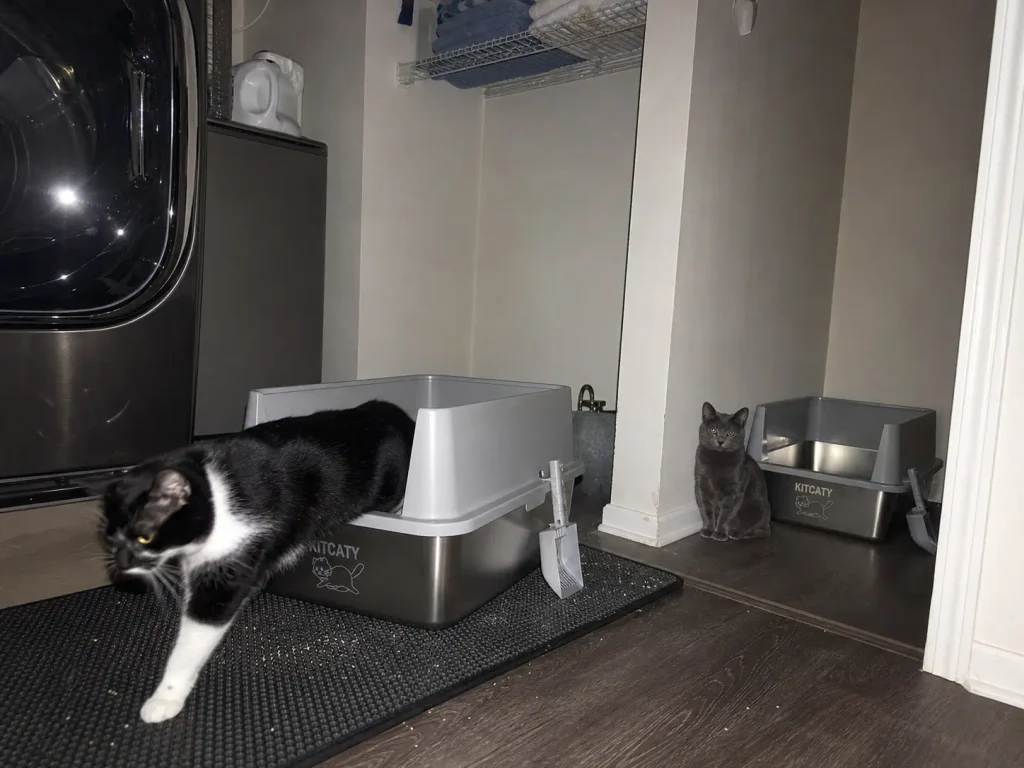
The steel box had a spectacular first week. Then the second cat arrived, or the second cat was always there and you only bought one box, and within a fortnight the smell was back. Steel did not stop working. The load doubled and the box did not.
Every article in this search result writes for one cat and one box without ever saying so. That assumption is doing a lot of quiet work, and it falls apart the moment you run the numbers.
The 1+1 Rule, and Why a Bigger Box Doesn’t Replace It
One box per cat, plus one. Two cats means three boxes. This is not a hygiene rule and it is not about volume, which is why buying one enormous box instead of two normal ones does not satisfy it.
In a multi-cat household it is about not meeting each other. A cat wants a route in and a route out that does not involve negotiating with a housemate, and a single shared box, however large, is a single point of contact he has to time correctly. The rule and its one real exception live in the one-per-cat-plus-one rule and the exception to it.
The most common expensive mistake in this whole topic is right here: spending the multi-cat budget on one premium steel box because it was the biggest one on the page. Two mid-sized boxes in two different rooms outperform it on every axis that matters, and the pair is the more budget-friendly route as well as the better one.
What Doubles When the Second Cat Arrives
There is a capacity figure worth carrying around: a 37-liter box is reckoned to stay ahead of the smell for roughly 30 days with one cat and about 15 with two. Not because the second cat is messier, but because the clock is just arithmetic. Everything else about your setup can stay the same and you have still halved the interval between full washes.
Steel handles that better than plastic, and slightly counterintuitively it earns its keep more in a two-cat home, not less. More load means more frequent full cleans, more aggressive cleaners, more scoop contact with the bottom of the box. That is the wear cycle that turns a plastic box porous in a year, and it is the cycle steel simply does not participate in.
Where the Second Box Actually Goes in a Small Apartment
Two boxes against the same wall is one box with extra steps. The whole point of the rule is separation, so the second box wants a different room, or failing that a different sightline: around a corner, on the other side of a door, anywhere a cat standing in one cannot be watched from the other.
In a one-bedroom there are usually three viable spots and two of them are wrong for reasons your cat will demonstrate later. Bathroom and the alcove where the washer lives are the reliable pair. Under a desk in the bedroom is the third, and it works better than people expect if the desk has an open back. What does not work is a closet with the door cracked four inches, which is the setup that looks tidiest and gives him exactly one exit.
What Steel Is Worse At, and Nobody Says
Every article on this topic ends with “steel wins” and stops. So here is the part they leave out, because a recommendation with no downsides in it is not a recommendation, it is an advertisement with paragraphs.
I used to treat the switch to steel as the obvious first move for anyone with a smell problem. After watching how consistently the same three complaints turn up in troubleshooting threads and brand support pages, I moved it down the list: measure the cat and fix the cadence first, then switch materials. The switch is the most expensive change in this room and it is rarely the first one that pays.
The 4 A.M. Clanging, and the Rubber Mat That Fixes It
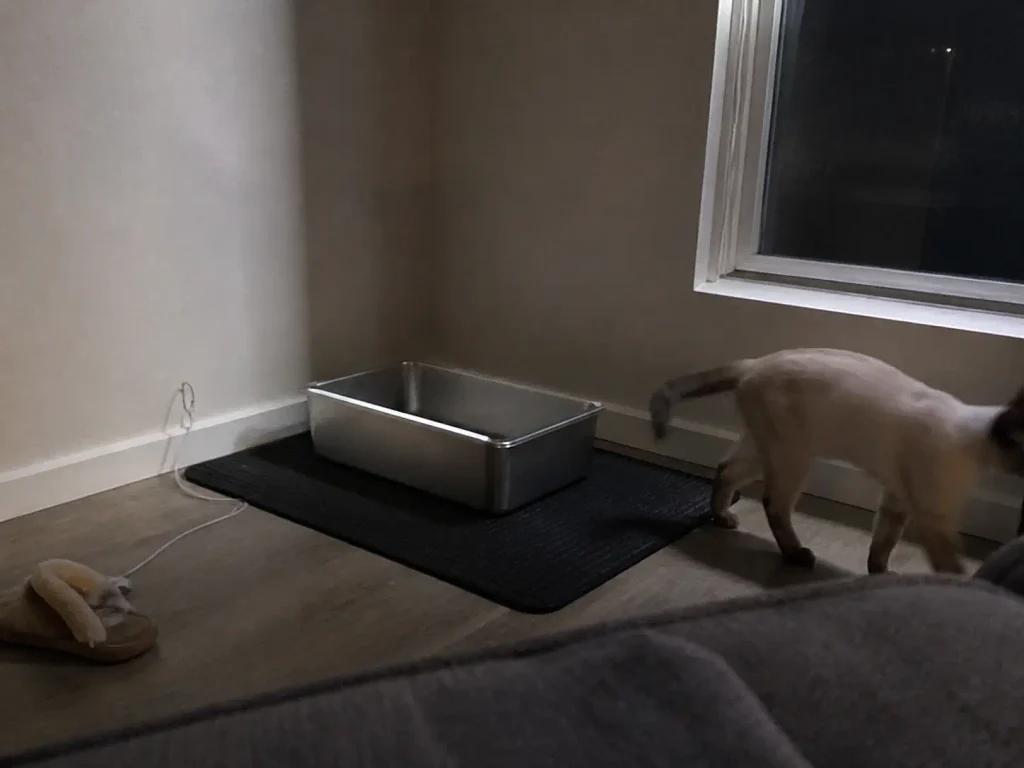
Steel is a drum, and litter box noise is the complaint that follows the switch. A cat mid-dig hitting a thin metal wall with a claw makes a sound that carries through an apartment wall, and cats do their most enthusiastic excavation in the small hours. A routine that used to be inaudible from the bedroom becomes a percussion solo at four in the morning, and it is the single most reported surprise from people who switch.
It is also the easiest thing on this list to fix. A rubber mat under the box kills the resonance through the floor, and two to three inches of litter stops claws from reaching bare metal in the first place. Total cost: less than the scoop. And it is worth setting this up on day one rather than on night three, because by night three you have already formed an opinion about your new box.
A rubber mat under the box and three fingers of litter inside it. That is the entire noise fix, you probably own the mat already, and while you are at it swap the metal scoop for a plastic one. Metal on metal is what puts the first fine scratches into the surface you just paid extra to keep smooth.
The Two-Day Cold-Metal Standoff
He will sniff the new box, decline, and use the old one. This is the default first reaction, not a sign the switch failed, and it catches people off guard because nobody selling steel mentions it. The reported adjustment window is two to three days when you transfer used litter into the new box so it already smells like his, and a towel folded underneath takes the chill off a cold floor in winter.
Leave the old box in place for those few days rather than removing it to force the issue. A cat with one option and a reservation about it will find a third option you like less, and the carpet is always nearby. He is not being stubborn. A litter box is a place where he is briefly defenseless, and he wants to be sure about the ground under his feet before he commits.
The adjustment period runs two or three days for most cats, and cat acceptance is the variable nobody prices in, and it is the one that decides whether the box you bought gets used. A lidded model adds a second unfamiliar thing on the same day, so if you are switching material and adding a lid at once, expect a longer standoff and start with the lid off. In a small apartment litter area that matters more, because the box and the sofa share air. Lids also trade tracking control for concentrated odor at nose height, which is his nose rather than yours, and what a lid does to odor concentration is a genuinely two-sided decision rather than an upgrade.
The Number You’ll See Quoted, and Why We Don’t Repeat It
A 95.6% odor reduction figure circulates across steel litter box marketing, usually attached to a pine pellet and stainless combination. Trace it and there is no named test method, no sample size, no independent lab, and no way to know what it was measured against. It is a headline wearing a lab coat.
Which does not mean steel does not work. It means the reason to buy steel is the mechanism, not the percentage: a surface with no pores cannot hold what it cannot absorb, and you can verify that yourself with a fingernail and two minutes. Any number offered without a method is a claim about the seller, not the product. Two other things worth saying out loud: litter still sticks to steel, because urine moisture will bond a clump to any surface it dries against, so the daily scoop does not go away; and this is the priciest single change in the whole odor category, so if your cadence is loose or your box is undersized, fix those first and you may never need it.
Keeping It That Way Past Week Three
The new box smells like nothing for two weeks. Somewhere in the third week the daily scoop becomes an almost-daily scoop, and the smell comes back, and you conclude that steel was oversold. Steel was not oversold. Week three is when new routines slip, and the material was never going to cover for that.
The Daily Scoop and the Monthly Wash
The baseline is unglamorous and it works: remove waste at least once a day, and give the box a deep clean every one to four weeks. That comes straight out of the AAFP and ISFM environmental needs guidelines, and the interval is a range because it depends on how many cats are using the box, which is the arithmetic from two sections ago. The upside of getting the grade right is that the replacement cycle more or less disappears: a 304 box is the last one you buy for that corner, where plastic is a purchase you repeat every few years.
And here is the nuance almost nobody passes along.
Scrubbing the box to sterile every single day removes your cat’s own scent markers along with everything else, and a box that smells of absolutely nothing can read as unclaimed territory to him. The target is not zero smell to a cat. It is zero smell to you, which is a different and much easier target. Daily scoop, periodic wash, and resist the urge to escalate. If you want the whole cadence written out, the full routine that keeps it gone covers it, and the pillar on why litter box odor comes back after you clean explains the timing behind all of it.
Cleaners That Are Now Allowed, and Two That Never Were
Steel opens up options plastic never tolerated. You can use hot water and a real scrub without crazing the surface, and enzymatic pet-safe cleaners work well on it because there is nothing for residue to sink into. That is a genuine upgrade in what you are allowed to do.
An enzymatic cleaner is the safe default when you want more than soap.
Two things stay banned regardless of material: ammonia and vinegar. Both smell like urine to a cat, and a cat who thinks another animal has claimed the box has a reason to go elsewhere. What you also do not need is a shelf of litter box deodorizers. If the maintenance is right, they are covering a problem you no longer have; if the maintenance is wrong, they are perfume over the top of it. That money belongs in a bigger box.
The Short Version
Steel smells less, and the reason is physical rather than promotional: there are no pores for urine and bacteria to hide in, so cleaning actually finishes. But that promise is written on grade 304 only. A 201 box pits within a year or two and turns itself back into scratched plastic wearing a better finish.
A small steel box smells. Material does not buy back size, and size is measured against your cat at 1.5 times his nose-to-tail length, not against the word “large” in a listing. And with two cats the whole calculation halves: two mid-sized boxes in two rooms beat one enormous one, in any material, every time.
Check back in three weeks, not three months. Three weeks is how long a new routine takes to loosen and about how long a cat needs to make a final decision. Three questions when you get there: is he still walking into the box without hesitating, is the scoop still genuinely daily, and is there any spot on the steel that has stopped looking like the rest of it.
Before you spend anything, go measure the box you already own against the cat you already have. If the number comes back short, you just found your smell problem, and you saved yourself the price of a material you did not need.
Amazon’s Audible — free for 30 days
Your cat won’t let you read. Let someone read to you.
Audible is Amazon’s audiobook library — thousands of titles, read out loud, on your phone. Free for a month, plus one audiobook to keep forever.
Frequently Asked Questions
01What are the downsides of stainless steel litter boxes?
Three, and they are all manageable. Steel amplifies digging noise, so a rubber mat underneath earns its place; the surface is cold and unfamiliar at first, which buys you a two or three day standoff with some cats; and it costs more up front than any plastic box. None of those is a reason to skip it, but nobody selling steel mentions them.
02Is a metal or plastic litter box better?
Metal, for odor specifically, because steel has no pores for urine and bacteria to settle into. Plastic develops microscopic scratches from scooping and digging, and those hold smell that cleaning cannot reach. The caveat is grade: a cheap 201 steel box can pit within a year or two and end up back where you started.
03Why is a metal litter box better?
Because cleaning it actually finishes the job. Surface bacteria comparisons after cleaning put plastic around 45% retention against roughly 2% for stainless steel. It also survives cleaners that would craze plastic, though ammonia and vinegar stay off the list either way, since both read as urine to a cat.
04Do stainless steel litter boxes rust?
Grade 304 resists it; grade 201 often does not. The cheaper 201 swaps most of the nickel for manganese, and that is the ingredient holding off cat urine and ammonia. Rust pitting matters here for the same reason scratched plastic does: it creates a porous surface that traps odor.
Leave a comment