Which Litter Box Smells the Least, by Design
Don't buy a covered box for odor. A lid contains the smell (it doesn't remove it) and concentrates ammonia at nose height. Here's what works.

Alfredo RamsesFounder · August 23, 2026 · 26 min read

On this page10 sections
- 1What Actually Makes a Litter Box Smell
- 2Covered Boxes Contain the Smell, They Don't Remove It
- 3Size Beats Lid, and the Study Everyone Quotes Proves It
- 4Top-Entry Boxes and What They Trade Away
- 5Plastic Against Steel Over a Year
- 6Self-Cleaning Boxes Move the Problem, They Don't Delete It
- 7One Cat or Several Changes the Answer
- 8The Rental Answer, When You Can't Change the Room
- 9The Box That Wins, and What to Do This Week
- 10Frequently Asked Questions
You switched to the low-dust unscented stuff. You scoop every morning before coffee. The corner still smells by six, and you have started opening a window in February. The variable nobody tells you to change is the box itself, and here is the part that makes the search so frustrating: almost every “best for odor” page on the first results page is ranking litter brands, not box designs, and those two questions have genuinely different answers. What follows is the design axis on its own — what makes one litter box hold odor and another release it, which shape wins with one cat and which one quietly fails with two, and what you do if you rent and cannot rebuild the bathroom.
Quick Answer
Ranked by where the odor actually ends up, not by whether it reaches you in the doorway:
- A large open pan with high sides smells least in the room you live in, because nothing holds the ammonia smell long enough to concentrate.
- A covered box smells less to you and more to the cat. The lid contains odor, it does not remove it.
- Stainless steel beats plastic over time, because plastic absorbs odor and re-releases it after cleaning.
- Whatever the design, scoop cadence decides the outcome, and a lid is most often a reason to scoop less.
What Actually Makes a Litter Box Smell
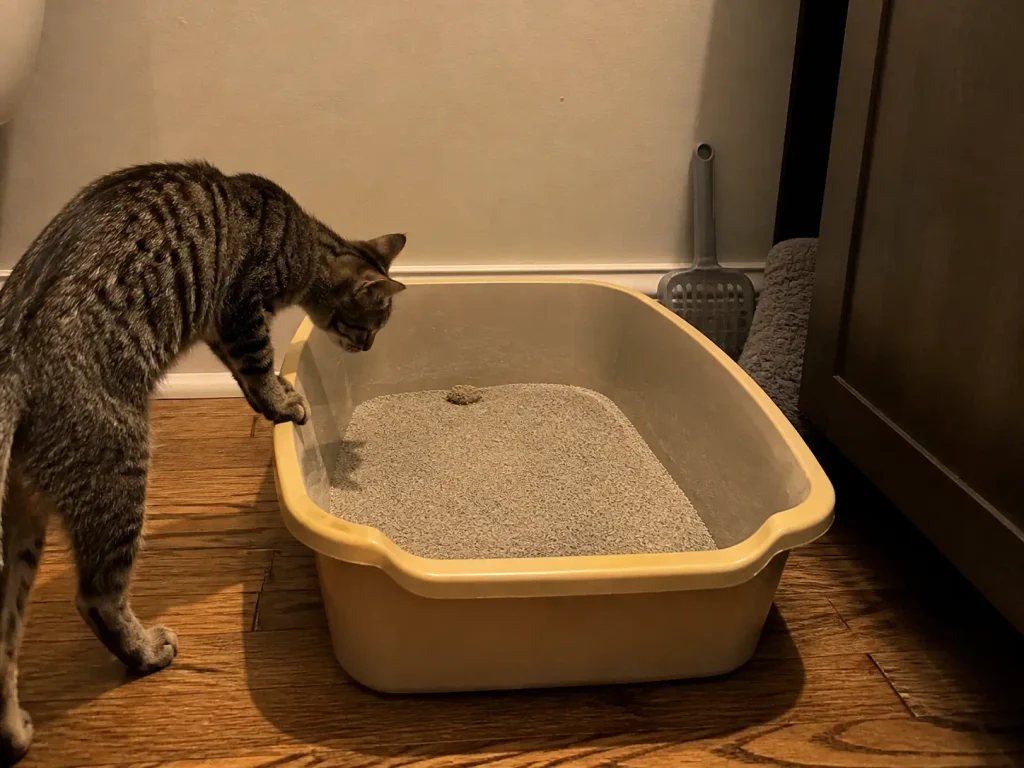
Nothing about a box smells until a cat uses it. The smell you are fighting is ammonia, produced as urine breaks down, and the box has no say in whether that happens. What the box controls is narrower than the marketing suggests: where the ammonia goes, how quickly it leaves, and whether the surface underneath it has been quietly collecting the same smell for a year.
That reframe matters because most people shop for a box the way they shop for a blender, looking for the best feature list. This is an airflow and surface problem with three variables, and once you can name them you can look at any box on any shelf and predict how it will behave.
Ammonia Is the Smell, and It Starts Fast
The timeline surprises people. This is not a slow overnight build. In practice ammonia starts building about thirty minutes after the pee, which means the difference between a room that smells and a room that does not is often a matter of hours, not days. It also means the smell does not creep up on you gradually. It arrives.
That is why the single biggest lever has nothing to do with what you buy. The AAFP and ISFM’s environmental needs guidelines set the floor at removing waste a minimum of once daily, with a full wash of the box every one to four weeks. Every box design in this article is competing for second place behind that number. If you have been treating the box as the fix while scooping every other day, no purchase is going to hold.
Porous Plastic Keeps the Smell After the Box Is Clean
Plastic is porous, and a litter box gets scratched constantly — every scoop drags grit across the floor of the pan. Those micro-scratches hold urine. You can wash the surface, and you will, and the surface will be clean. What soaked in is still there, releasing slowly, which is why a box that has been rinsed and dried can still read faintly when you put your face near it.
This is the mechanism behind one of the most common complaints in litter threads: someone scrubs harder, uses a stronger cleaner, does everything right, and the smell survives. It is not a cleaning failure. Nobody scrubs their way out of saturation.
A plastic box that still smells after a full wash is not dirty, it is saturated. Rinse it, dry it completely, and smell it up close in a room with the door shut. If it still reads, no cleaner is going to change that. Age it out rather than scrubbing harder.
Air Exchange Decides Whether It Pools or Leaves
The third variable is the one nobody prints on a box: how much air moves across the litter surface. Ammonia that can disperse dilutes to nothing. Ammonia in a small enclosed volume does not go anywhere, it just gets denser until something opens.
Volume works the same way, and it is the variable people underestimate most. A large box holds more clean clumping litter around each clump, and that unused litter is a buffer. A small box has less buffer, so it crosses the threshold from “fine” to “the whole room” faster on exactly the same schedule. That is the thread running through the rest of this article, and it is why the litter box size question keeps beating the lid question. For why the smell comes back even when your routine has not changed, the pillar on litter box odor covers the five variables that degrade quietly in the background.
Covered Boxes Contain the Smell, They Don’t Remove It
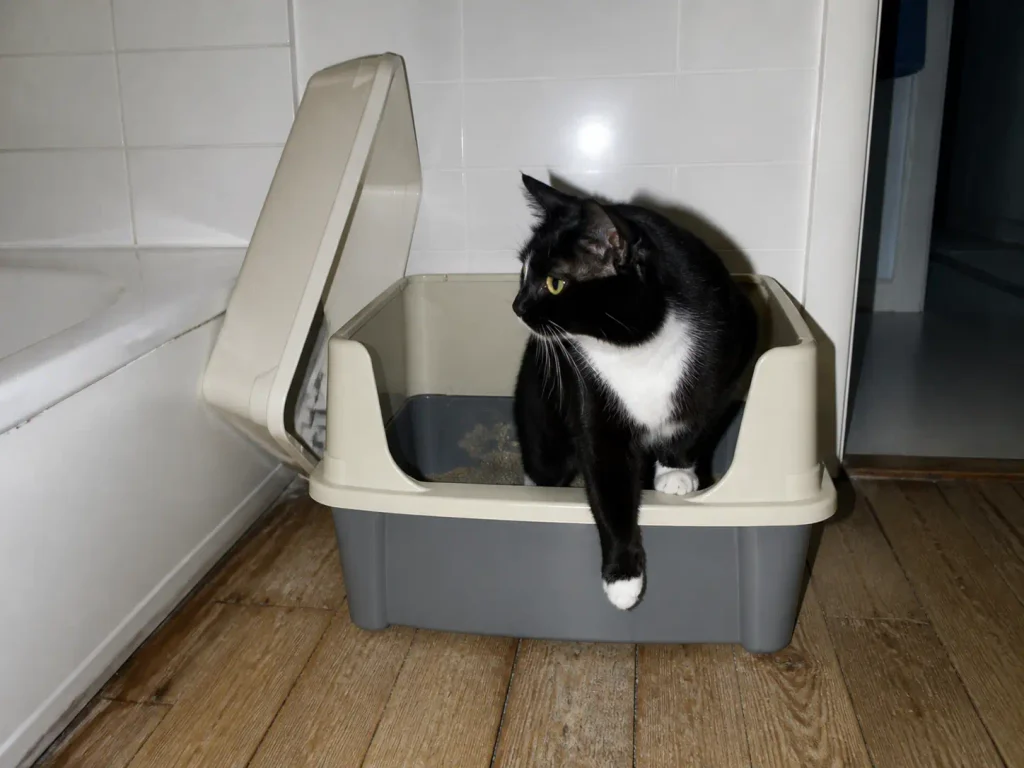
Anyone who has lifted the hood off a covered box on day two already knows the argument. That wall of warm air is the whole point of this section, and it is the thing the marketing copy is careful never to describe.
Here is the mechanism the entire first page of results gestures at and never states: a lid does not eliminate odor, it relocates it. Containment and removal are being treated as the same thing across this niche, and they are opposites. The lid works exactly as advertised for the room, because it cuts the open surface area exposed to the air you are standing in. The same lid means the ammonia has nowhere to go. It concentrates inside a sealed chamber that the cat then has to put its head into.
Less Smell for You, More Smell for the Cat
Two boxes can produce the identical amount of ammonia and give you two completely opposite experiences depending on where you are standing. That is not a paradox, it is geometry. The odor has to be somewhere, and a hood decides that “somewhere” is a space roughly the size of a shoebox with a cat’s face in it.
The company selling covered and automatic boxes admits the trade in its own copy: reduced airflow inside a covered unit keeps litter damp longer. Damp litter is slower to lock up urine and slower to dry between uses, which means the concentration inside the chamber is not just contained, it is sustained.
And this is exactly the point where this blog’s whole position applies. You have a preference about what the corner of your room smells like. Your cat has a constraint about what it is breathing while it is vulnerable and half-crouched with its back to the door. Preferences negotiate. Constraints do not.
Why a Lid Quietly Becomes a Reason to Scoop Less
This is the part that does the real damage, and it is entirely accidental. You cannot see into a covered box and you cannot smell it from outside, so the two signals that normally tell you to go get the scoop are both gone. Nothing about your intentions changed. The reminders did.
Research cited in behavior reviews of the topic found covered boxes in real homes being cleaned as infrequently as once every five days, against the daily minimum every professional guideline names. Five days of concentration in a sealed volume is the condition vets and behaviorists describe with the phrase that has stuck in cat communities: a port-o-potty. It is not an unfair description of the air in there.
Which is why the fix that owners keep arriving at independently, over and over in forum threads, is to take the lid off and keep the base. They did not read a study. They lifted the hood, got hit in the face, and drew the correct conclusion from the outside in.
The One Case a Cover Genuinely Helps
It is tempting to treat “covered box” as an automatic no. Read enough owner threads, though, and the actual complaint often turns out to be litter sprayed up a wall by an enthusiastic digger rather than odor at all. If your problem is a cat that kicks litter three feet, or a dog that raids the box, a hood solves something real that an open pan cannot. The honest version is that you are trading air quality for containment, and you should know that is the trade you are making rather than believing the lid is doing odor control.
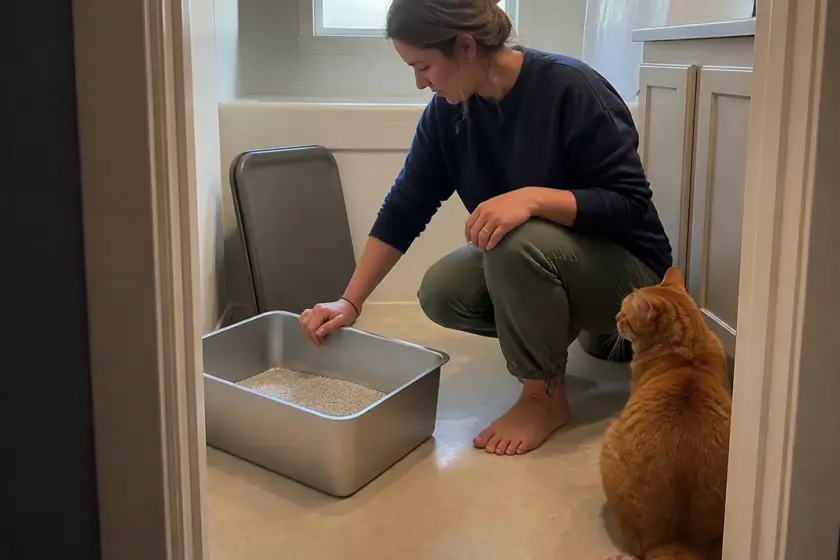
Before you spend anything, take the lid off the box you already own and scoop it daily for three days. It costs nothing and it answers the question outright. What you are usually left with afterward is a base that turns out to be too small, which is where a proper open pan comes in. The Amazon Basics Large Cat Litter Box with High Sides, Open Top is the cheapest way to test the design honestly: 19 x 15 x 11.75 inches with sides high enough to hold litter in, and nothing overhead to trap air.
Its limitation is the same as every open pan — a determined digger will still get some litter on the floor, and you will be sweeping. That is the actual cost of the trade, and it is worth naming before the fact. If the preference question itself is what is bothering you, the deeper answer on what cats actually prefer when you give them both is a separate conversation from odor.
Size Beats Lid, and the Study Everyone Quotes Proves It
Somewhere in your reading you have probably hit the line “science says cats don’t mind covered boxes.” That sentence is true. It is also close to useless, and the reason why is a tape measure.
What the Study Actually Measured
The study being quoted is Grigg et al. 2013, published in the Journal of Feline Medicine and Surgery, and it is a good piece of work. Across 28 cats over two weeks it found no significant group-level preference between covered and uncovered boxes. That is the headline, and it gets repeated as settled.
Two things get left out. First, 8 of those 28 cats did show a strong individual preference, split evenly at four each way. So roughly a third of the room cared a great deal, and a population average that cancels them out tells you nothing about whether your cat is one of them. Second, and this is the number that matters most, a certified cat behavior consultant’s breakdown of the 2013 study surfaces the box dimensions the summaries skip.
Half the Floor Area, Sold as Large
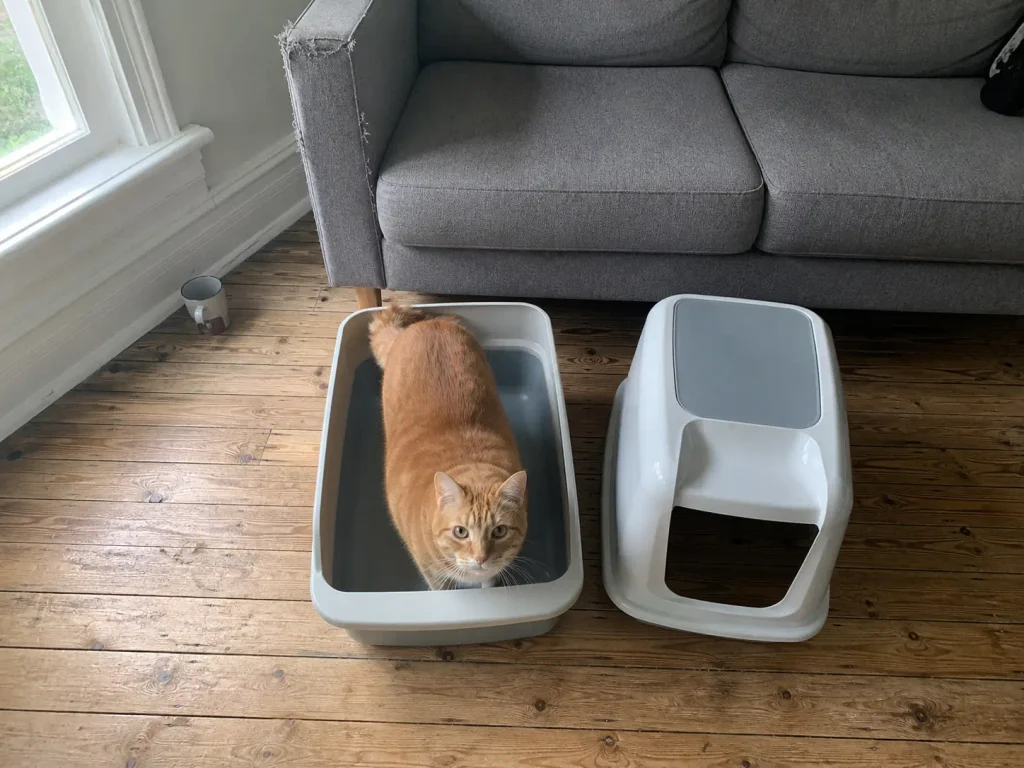
The study boxes measured roughly 32.5 x 19.75 x 19 inches. They were built from storage bins, because nothing on the market was big enough.
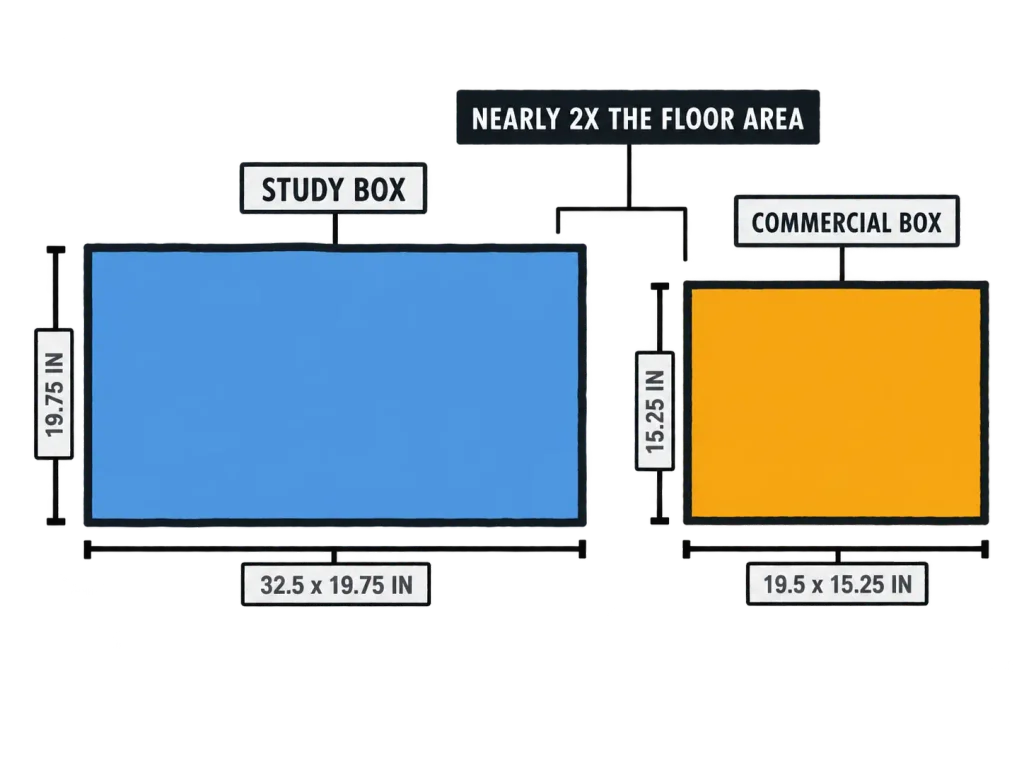
A typical commercial “large” covered box today measures about 19.5 x 15.25 x 17 inches. Run the floor area: the study box gives about 642 square inches, the commercial one about 297. That is under half. So the single most-cited evidence that cats are fine with lids was collected using a box roughly twice the size of the thing you can actually buy with a lid on it, scooped daily by protocol, by researchers. Nobody has tested cats against a small commercial covered box scooped the way real boxes get scooped in real apartments.
That is not a knock on the study. It answered the question it asked, carefully. It is a knock on how it gets quoted, and it is the reason the measurement that decides whether a box is actually large does more work than the lid question ever will. If your box is under about 20 x 15 inches of floor, arguing about the roof is arguing about the wrong thing.
There is a second reason those study dimensions matter, and it is about air rather than legroom. Doubling the floor area of a covered box roughly doubles the volume of air inside it, so the same amount of urine produces a noticeably lower concentration in the study box than in the commercial one. A hood over 642 square inches and a hood over 297 square inches are not the same product with different price tags. They are two different environments, and only one of them has ever been tested with cats in a controlled way. When you read “cats don’t mind covered boxes,” the accurate version is “cats did not mind a covered box roughly twice the size of the one you are about to buy, scooped every single day.”
Why a Big Cat Changes the Answer
The same dataset showed a trend worth knowing: cats over roughly 13 pounds leaned toward the uncovered box. Size of cat and size of box are the same problem seen from two directions. A large Maine Coon at full stretch needs more floor than most brands make, and putting a roof over an already-tight footprint takes away the one thing he was short of.
You can watch this without any equipment. If your cat stands in the box with his front paws in and his back end hanging over the rim, that is not defiance and it is not laziness. That is a cat solving a geometry problem you handed him, and the waste ends up over the edge because there was nowhere else for it to go. Odor follows waste. A box he does not fit in is an odor problem before it is anything else.
Measure the box you own, floor area first, inside edge to inside edge. If it is under about 20 x 15 inches, the lid is not your main problem. The box is, and no design change fixes a footprint.
Top-Entry Boxes and What They Trade Away
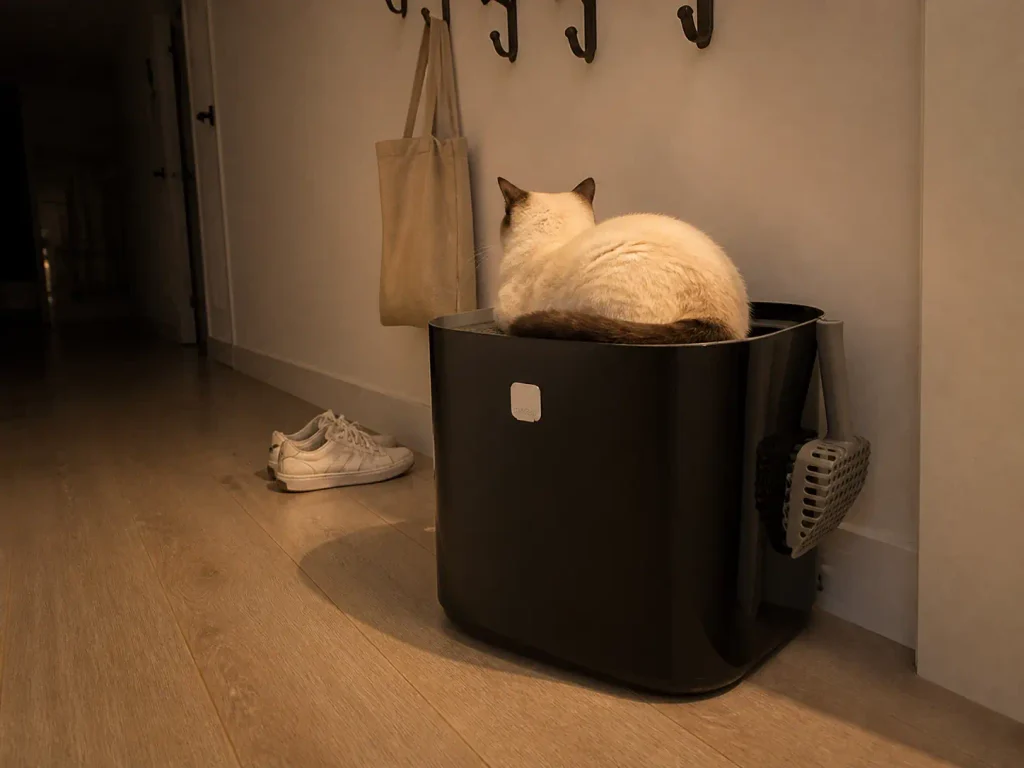
Top-entry boxes look like the clever compromise. Enclosed enough to hold the smell in, open at the top so it can still breathe. That is partly true, which makes it worth taking seriously rather than dismissing.
Why Top Entry Ventilates Better Than a Front Hood
The physics are on its side. Warm air rises, and a top-entry lid puts the opening exactly where the warm, moist air off the litter is already heading. A front-door hood does the opposite: the opening sits low, the warm air collects against the roof, and there is no path out. Same amount of enclosure, completely different behavior.
But the honest positioning is that top-entry boxes earn their keep on tracking, not on odor. That is where the design genuinely wins, and top-entry boxes earn their keep on tracking is a different article for a reason. If you want a named example, the Modkat Top-Entry Cat Litter Box is 16 x 16 x 15 inches with a swivel top lid rather than a fully closed hood, which is the version of top-entry that dodges the worst of the containment problem. The caveat travels with it and is not small: 16 x 16 inches is 256 square inches of floor, well under the threshold from the last section, so this is a design for a medium cat with a tracking problem, not a large cat with an odor problem.
The Cats That Struggle to Get In
A Certified Applied Animal Behaviorist flags top-entry as a design to be careful with, and the objection is not about smell at all. It is entry. The cat has to jump up, balance on the rim, and drop down into a hole, then reverse the whole thing on the way out.
The cats that struggle with that are predictable: older ones, heavy ones, and short-legged breeds. An eleven-pound British Shorthair build is compact and low to the ground, and for that cat the entry is a climb rather than a step.
And the failure mode here is worse than the one you were solving. A box that is hard to enter gets used less, and a box that gets used less means waste somewhere else in the apartment and a cat holding it longer than it should. Sudden litter box avoidance, where a cat stops using a box it used fine last week, is a vet visit before it is a furniture problem. Everything in this article assumes that call has already been made.
Plastic Against Steel Over a Year
Two identical boxes, cleaned on the identical schedule, will not smell the same after a year. That is the entire material argument, and it has nothing to do with steel looking nicer.
Why Scrubbing Stops Working on Plastic
We covered the mechanism earlier: porous surface, micro-scratches from scooping, urine soaking into a layer your sponge cannot reach. The part worth adding here is the timeline. A plastic box has a service life for odor purposes measured in months to a couple of years, and it expires regardless of how conscientious you are. The people who replace a plastic box every year and describe it as wasteful are usually the ones with the least smell in the room.
The cheapest honest test costs nothing. Rinse the box, dry it, and put your nose close in a room with the door closed. If it reads, it is saturated, and you have your answer.
What Steel Actually Fixes, and What It Doesn’t
Stainless steel is non-porous. There is no structure for urine to soak into, so there is nothing to re-release later, and a steel box that is clean actually is clean. Year two smells the same as week one, which is a claim no plastic box can make.
It is not free of drawbacks, and it would be dishonest to skip them. Steel is louder — litter and claws against metal make a noise a nervous cat notices, and in a studio at 3am so will you. It is colder to the touch in an unheated room. It costs more up front, and the shallow ones warp cheap if the gauge is thin. Whether the grade of the steel matters, and it does, is covered properly in whether metal boxes really smell less, and which grade of steel matters.
Sizing Steel for a Big Cat and for a Small One
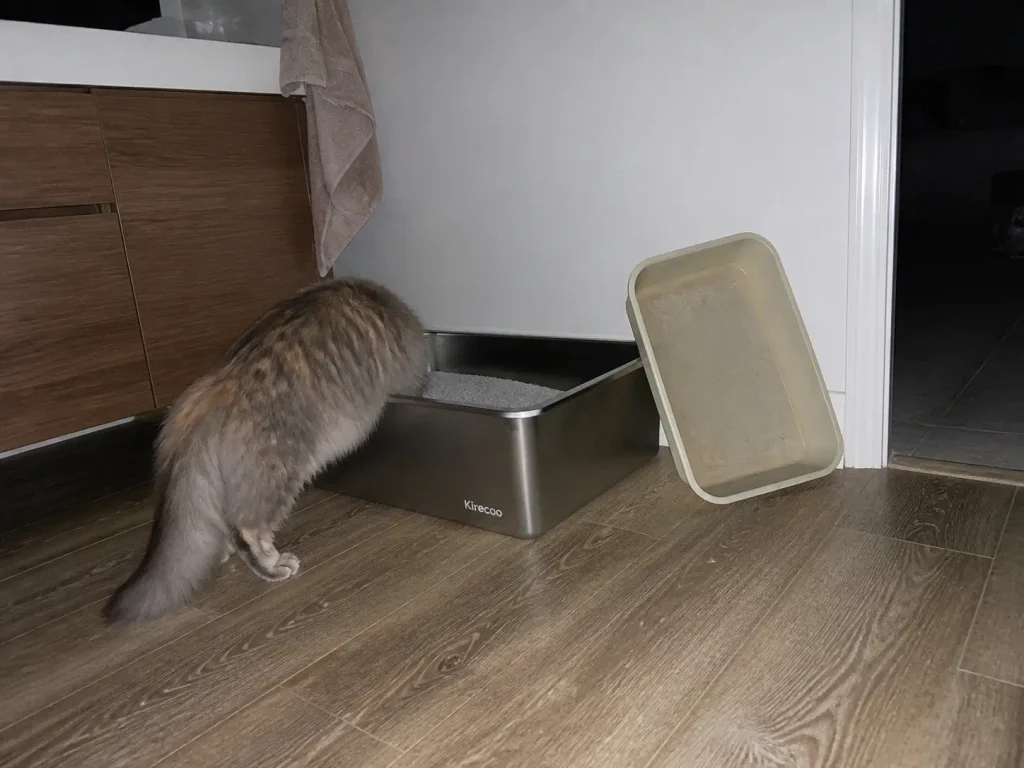
Material only helps if the footprint is right, so this is where the two threads meet. For an average or large adult, the Kirecoo Large High Sided Stainless Steel Cat Litter Box runs 23.6 x 15.7 x 11.8 inches, which is 371 square inches of floor and clears the “actually large” threshold this article set two sections ago, in a material that will not saturate. The high sides are doing real work against a digger. Its drawback is footprint: 23.6 inches is a lot of bathroom floor, and in a small apartment you need to measure the spot before you order it.
For a genuinely small cat, or a corner that cannot take the larger pan, the Stainless Steel Cat Litter Box with Lid, High-Sided Metal Litter Pan for Small Cats is about 17.3 x 13.4 x 7.87 inches. Say the caveat plainly: that is 232 square inches, under the floor-area threshold for an average adult cat. It is a constraint choice, not a default, and it is the right call only when the constraint is real.
Self-Cleaning Boxes Move the Problem, They Don’t Delete It
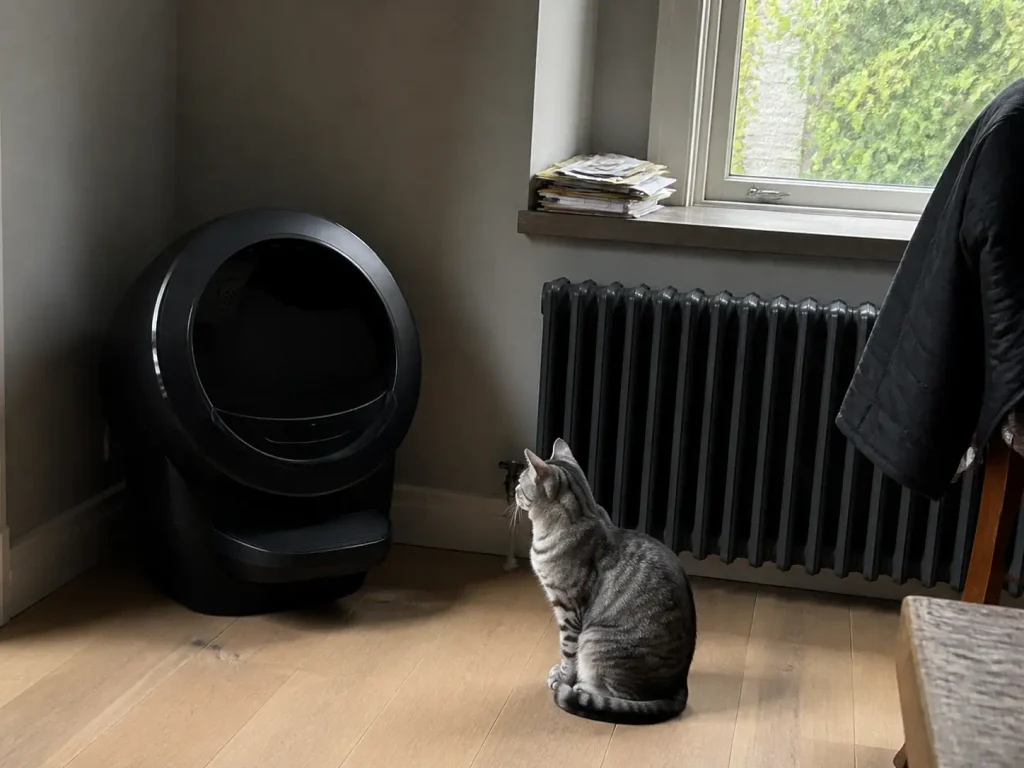
An automatic box removes waste within minutes of use. On paper that is the best possible scoop cadence, better than any human is going to hold on a Tuesday in November. Then nobody opens the unit for six weeks, and the picture changes. If you are weighing one of these seriously, how self-cleaning boxes work and who actually needs one is the fuller treatment; this section covers only the odor side.
Best-Case Scoop Cadence, Worst-Case Maintenance
The odor logic really is sound. Separating waste from the litter bed within minutes cuts off ammonia production near its source, and no manual routine competes with that. Give the design its due.
The catch is that the waste has not left the room. It is in a sealed drawer three feet from where it started, which is the covered-box problem again at a smaller scale. Every unit needs a full strip-down every few weeks, and these are enclosed units, so the litter box ventilation caveat from earlier applies to the cat standing inside one too.
Where the Smell Actually Lives in an Automatic Box
When owners say their automatic box smells, they are almost always describing a unit that has never been fully taken apart. The odor is not in the litter. It is in the rake teeth, the seams of the waste drawer, the sensor housing, and the interior wall of the globe where damp litter dust has been packing into a film for a month. Those surfaces do not get touched by a cycle, and most people never open them.
So the honest framing is that an automatic box does not remove the maintenance, it changes its shape. Instead of one minute a day with a scoop, you owe it twenty focused minutes every few weeks with the thing in pieces. If that trade suits how your brain works, it is a good trade. If “set it and forget it” is what sold you, this is the design most likely to disappoint you. For readers who have already decided the trade is worth it, the Whisker Litter-Robot 4 Supply Bundle is the reference unit in the category, with the caveat attached rather than buried: it is a premium purchase, it has a larger footprint than a standard pan, and it only outperforms a plain open box if you keep the strip-down on the calendar.
One Cat or Several Changes the Answer
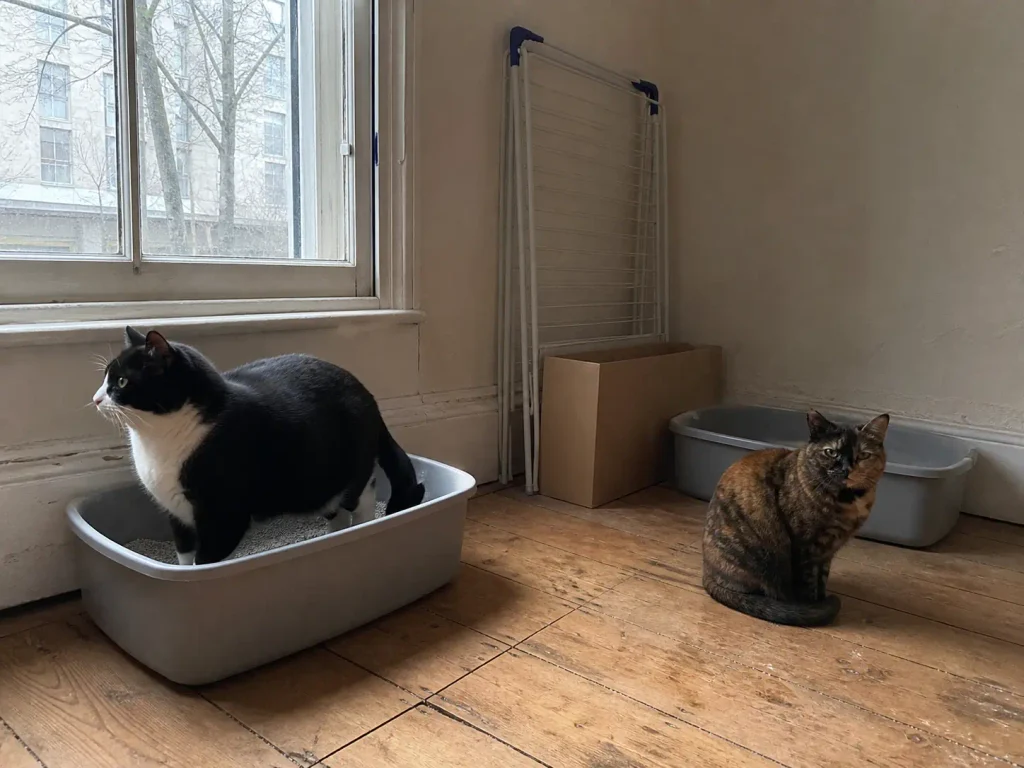
Nearly every roundup on this topic writes as if there is one cat in the apartment. With two, the arithmetic changes enough that the recommendation flips.
Why Odor Scales Faster Than Box Volume
Two cats produce roughly twice the waste. The box does not get bigger. That is the whole problem in one line, and it means a covered box shared by two cats reaches in a day the concentration a single cat would take three days to build. Every margin the design was relying on is gone.
The buffer of clean litter is the thing being consumed fastest, which is why volume and material matter more in a multi-cat home than in a single-cat one, not less. A saturated plastic box in a two-cat apartment is running the same failure twice as fast, and it hits the end of its usable life in months rather than years.
Litter depth is where this shows up first, and it is the cheapest thing to get wrong. Two to four inches is the working range, and in a shared box the bottom of that range stops working almost immediately. At two inches the clumps reach the floor of the pan and break apart when you lift them, which leaves saturated fragments behind that you will not see and will definitely smell. Three inches is where a clump tends to come out whole. With two cats you are burning through that depth twice as fast, so the box that was fine on Sunday is under-filled by Wednesday without anyone noticing a change.
The other thing that scales badly is your own nose. One cat gives you a slow, legible signal: the room starts to read, you scoop, it clears. Two cats push the box past the threshold between one check and the next, so the smell does not build gradually, it turns up.
That is why multi-cat households so often describe the odor as arriving on a specific day rather than creeping in, and why a design that was holding fine for months appears to fail overnight. Nothing failed. The margin just got smaller than the gap between your scoops.
There is also a second reason enclosure gets worse with more cats, and it is not about smell at all. A hooded box has one exit. A cat mid-elimination is vulnerable and knows it, and being in a chamber where it cannot see another cat approaching is a documented stress factor in the behavior literature. In a home where two cats have any friction between them, a hood turns the box into a place with no escape route. Some cats will simply stop using it, and where they go instead is usually soft and near a door.
One More Box Beats One Better Box
The pattern reported constantly in multi-cat threads is the same story with the same ending: two cats, one covered box, ammonia in the hallway, and one cat quietly using the rug. The instinct is to buy a better box. The move that actually works is a second one, in a different room.
That is free if you already have a spare pan and cheap if you do not, and it does more for the smell than any design upgrade in this article. The count rule and its exceptions are covered in how many boxes two cats actually need. For odor purposes the logic is simply that two boxes halve the load on each one, and half the load is half the ammonia in each.
The placement of that second box is doing most of the work, though, and this is where people undo the benefit without realizing. Two boxes side by side in the same corner is one box with a divider as far as your cat is concerned, and as far as the air in that corner is concerned it is worse than one box, not better. The second box goes in a different room. Different room, different air, and a cat that is avoiding the first one for reasons of its own now has an option that does not involve walking past the other cat to reach it.
Give that a week before you buy a single thing. If the hallway clears, the box design was never the problem and you have saved yourself a purchase and learned something more useful than any review could have told you.
Before buying anything for a two-cat smell problem, add a second box in a different room for a week. Not the same room, a different one. If the hallway clears, the box was never the issue and you just saved yourself a purchase.
The Rental Answer, When You Can’t Change the Room
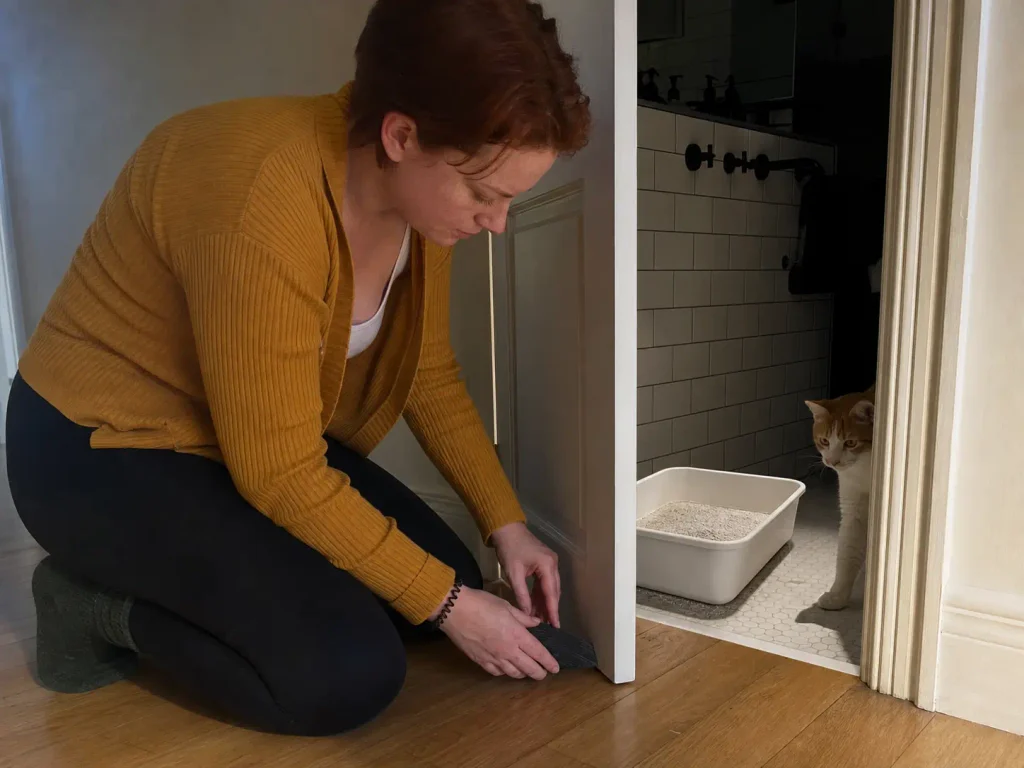
Most odor advice quietly assumes a spare bathroom, a window that opens, and permission to drill. If you are renting a one-bedroom, you likely have none of the three, and that is the actual reason a lot of people end up searching for a box that smells the least instead of just moving the box somewhere else.
Airflow Before Hardware
In a small apartment the box almost always ends up in the room with the worst air exchange, because that is the room where it is out of sight. A windowless bathroom, a closet, the gap beside the washer. That placement is doing more damage than the litter box design itself, and it is the first thing to change because it is free.
Passive airflow is the lever, and it is unglamorous. Leave the door ajar instead of shut. Pull the box out of the tight corner so air can move on more than two sides. Do not shut it inside a cabinet. If there is a window anywhere in that room, two fingers of gap does more than any product you could buy for the same problem, and it costs nothing.
And this is where an open pan stops being a compromise and starts being the renter-friendly answer: in a room that is already short on air exchange, adding a sealed chamber is the last thing you want. Where exactly the box goes when options are limited is worked out in where the box goes in a small apartment.
There is one honest test for whether any of this is working, and it is free. You stop smelling your own apartment within about twenty minutes of being in it. Go out for two hours and walk back in through the front door. That first breath is what your guests get, and it is the only assessment that has not been ruined by your own nose adjusting.
Why Hiding the Box Usually Makes It Worse
The standard small-apartment move is to buy a piece of litter box furniture, a cabinet with a cat-sized hole cut in the side. It looks like a solution. It is the covered-box problem rebuilt at room scale, with even less air exchange than a hood, because now there is a wooden box around the plastic box.
The timing gives it away every time. People describe buying the enclosure to hide the smell, and the smell getting noticeably worse in the weeks after, and only connecting the two in hindsight. Nothing else changed. The airflow did. If you are considering one, read what an enclosure does to the air the cat is breathing before you order it.
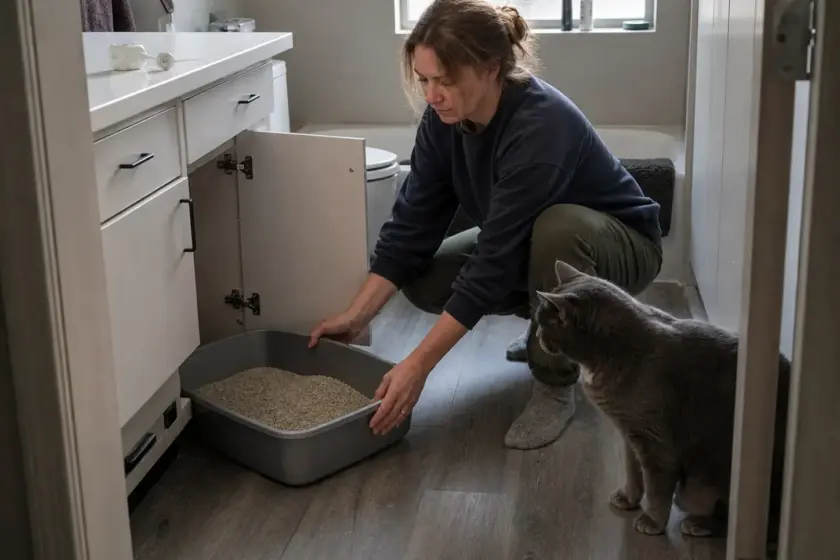
There are ways to make furniture work, and they all involve deliberately breaking the seal you paid for. Take the back panel off entirely and stand the unit a few inches off the wall. Leave the door open, or take it off its hinges. Cut a second opening on the opposite side so air has somewhere to go and your cat has a second exit, which solves the resource-guarding problem in the same move. What you end up with is a piece of furniture that hides the box visually while behaving like an open shelf, which is exactly the goal, and it is worth saying plainly that this is the opposite of how these units are sold and assembled.
And if you rent, the honest bottom line is that the design lever is smaller than the placement lever. A large open pan in a room with a door left ajar will beat an expensive sealed unit in a windowless bathroom every time, and it costs a fraction as much. Get the placement and the cadence right first. Then, if the smell is still there, spend money on the box.
The Box That Wins, and What to Do This Week
The box that smells least in the room you actually live in is a large open pan with high sides. Nothing traps the ammonia, so nothing concentrates it, and you can see the problem from across the room which means you fix it that day.
A lid buys you less smell in the doorway and more smell at your cat’s nose, and it quietly buys you a longer gap between scoops. That gap is what you are smelling three weeks later. And material decides year two: plastic saturates and re-releases no matter how you clean it, while steel does not have the structure to hold anything.
Take the lid off the box you already own, or swap the pan, and give it three weeks. Then check two things: whether the room clears within a day of a scoop, and whether your cat is using the box as readily as before. Three weeks is enough for a cat to accept or reject a change and just long enough to find out whether your new routine survived contact with a normal week.
Start there. The first move costs nothing, and if the room clears you answered the question without buying a thing.
Amazon’s Audible — free for 30 days
Your cat won’t let you read. Let someone read to you.
Audible is Amazon’s audiobook library — thousands of titles, read out loud, on your phone. Free for a month, plus one audiobook to keep forever.
Frequently Asked Questions
01Is there any litter box that doesn’t smell?
No box is odorless, because the smell comes from urine breaking down into ammonia rather than from the box itself. What a box changes is how fast that ammonia leaves and whether it concentrates. An open pan with high sides releases it; a hood holds it. Design buys a better starting point, not an exemption from scooping.
02Do covered litter boxes smell less?
Less to you, more to the cat. The lid keeps odor out of the room by keeping it inside the chamber your cat has to put its head into, and reduced airflow keeps the litter damp longer. It also makes it easy to go another day without scooping, which is usually why covered boxes end up smelling worse overall.
03Do vets recommend covered litter boxes?
Veterinary and behavior guidance is generally neutral on lids and specific about everything else: box size, number of boxes, and daily scooping. The AAFP and ISFM environmental guidelines set a minimum of one scoop a day and a full wash every one to four weeks, and that cadence matters more than whether the box has a roof.
04Do cats prefer open or covered litter boxes?
As a group, cats in the most-cited study showed no clear preference, but about a third of them individually did, split evenly both ways. That study also used boxes nearly twice the floor area of a typical commercial covered box. Larger cats trended toward open. In practice, the bigger the cat, the more a hood costs them.
05How do I stop my house from smelling like cat litter?
Start with cadence and airflow before hardware: scoop at least once a day, take the lid off if the box has one, and move the box out of the least-ventilated corner. If the smell survives all three, the box is likely saturated plastic and has reached the end of its useful life.
Leave a comment