Where a Litter Box Enclosure Goes and Still Looks Right
Litter box enclosure placement by the numbers: 24x20x18 inside, 8x10 entry, 4 inches of clearance per side (+40 inches if you have two cats).

Alfredo RamsesFounder · August 25, 2026 · 19 min read

On this page8 sections
- 1What a Spot Has to Give the Cat Before It Has to Look Good
- 2The Clearance Numbers Nobody Publishes
- 3Where Those Spots Actually Are in an Apartment
- 4Why the Spot That Worked Open Stops Working Enclosed
- 5The Two Checklists, and Why Running Them Together Is the Mistake
- 6One Cat, Three Cats, and the Cabinet That Becomes a Choke Point
- 7What to Do With All of This
- 8Frequently Asked Questions
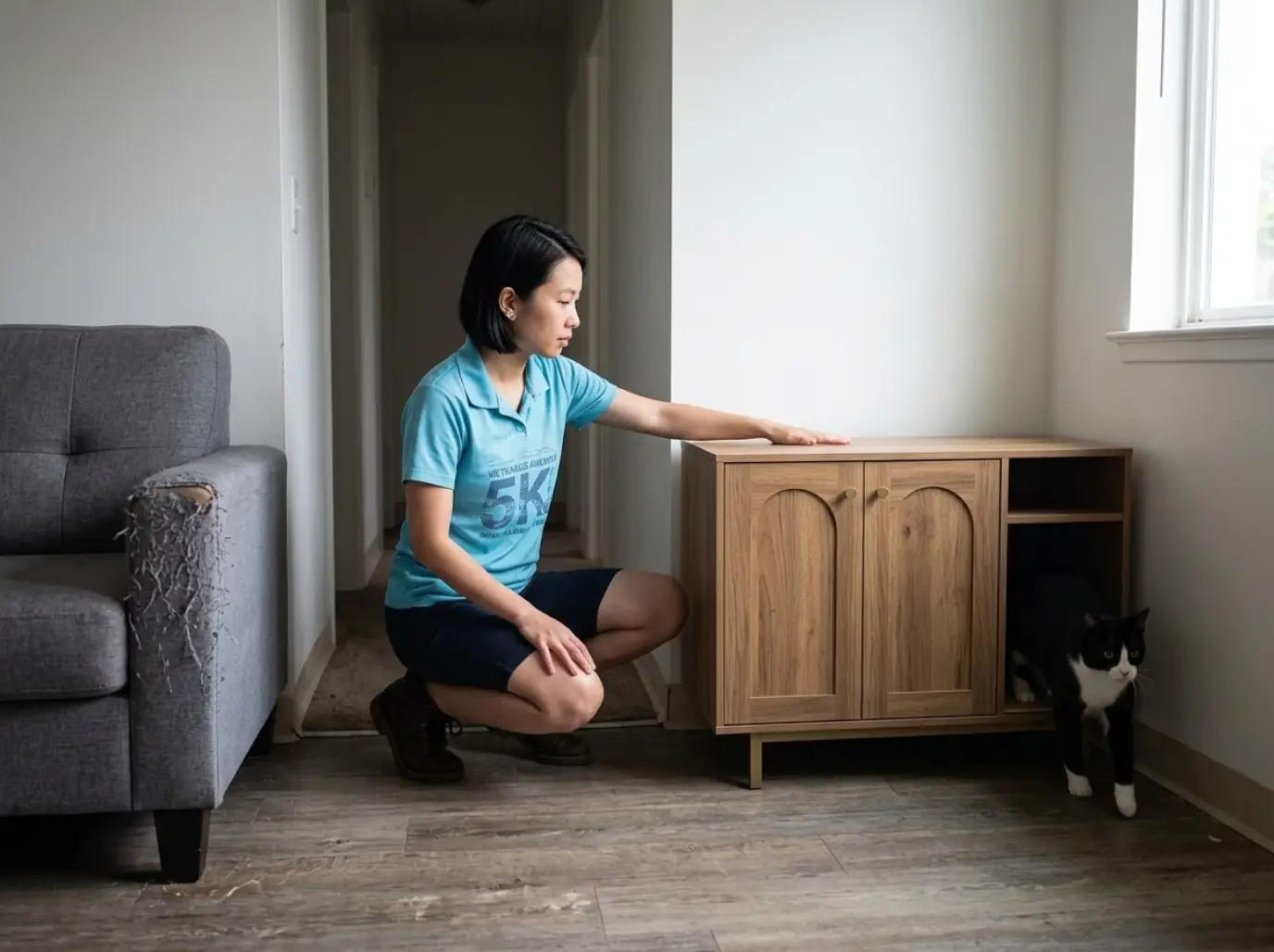
The corner worked for eighteen months. Then a cabinet went around the box, and within three weeks the room smelled and the cat started pausing at the opening before going in. Nothing about the room changed.
The box changed, and the spot that suited an open pan does not automatically suit a closed one. He isn’t being fussy about his new furniture; he’s telling you the air stopped moving, and he’s right. Figuring out where to put a litter box enclosure means measuring the space in front of it, not just the wall behind it, and the numbers below come from the interior dimensions that litter cabinet makers publish for their own units and from the tip-over threshold the CPSC applies to any freestanding furniture over 30 inches tall.
Here’s the order this article runs in: what a spot has to give the cat, where those spots actually exist in an apartment, what changed the moment four walls went up, and why one cat and three cats are two entirely different placement problems.
Quick Answer
A litter box enclosure belongs in a spot that clears all six of these. Miss one and the cabinet becomes the problem.
- Two openings on the unit, not one, so air crosses through
- Clear floor ahead of the entry, at least a cat-length deep
- Hard floor underneath, never carpet
- Off the main path, but never at a dead end
- Away from the food, the water and the bed
- A door nobody closes, on any day of the year
What a Spot Has to Give the Cat Before It Has to Look Good
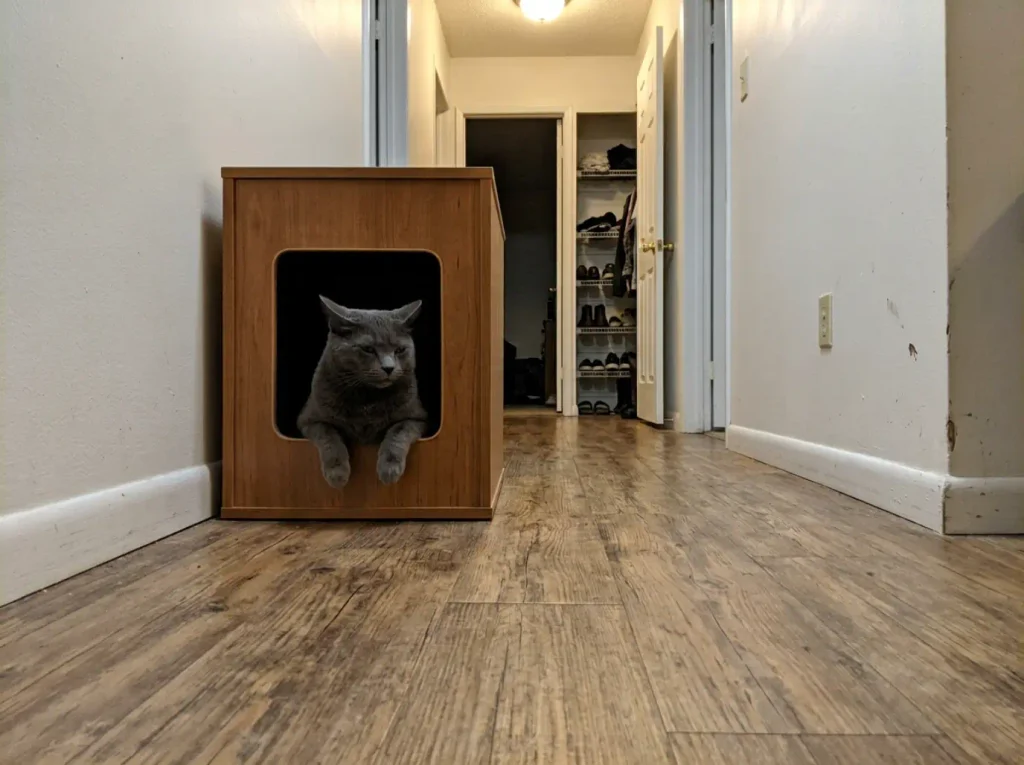
Almost everyone starts with the wrong question. “Where will nobody see it?” is a fine second question and a terrible first one, because the room that hides a cabinet best is usually the room that ventilates it worst. Litter box placement with furniture around it is a different question from placement without.
Putting four walls around a covered litter box turns an odor trapping problem into a ventilation problem, and the pillar on what an enclosure actually changes about the box inside it covers the full trade. What matters here is that the change is real, and it happens the moment the walls go up.
- Air, and it comes first. Two openings, not one. One lets air in and the other lets it out; with a single hole there’s no current, just a gap.
- 24/7 access, every day of the year. No spring-loaded closet door, no bathroom someone shuts on the way out, no guest room that closes when there are guests.
- Non-carpeted flooring underneath. Carpet under a closed cabinet is the worst pairing available: what escapes the doorway sits in the fiber, and what leaks past a seam goes unseen until it smells.
- A low-traffic corner, never a dead end. A cat wants an exit line. One way out is the definition of a spot he’ll avoid.
Ventilation is the one people underestimate, because an open pan never asked for it. Room air did the work. A closed unit with a single doorway holds warm, damp air against wood, and the odor doesn’t dissipate anymore; it waits. You’ll notice it as a pulse rather than a background, which is the tell that the problem is the cabinet’s air path and not your scooping.
The dead-end rule deserves more than a bullet. A cabinet shoved into the back of a narrow closet has one route in and the same route out, and a cat evaluating that geometry is doing exactly what you’d do in a stairwell with one door. And if the spot you’re eyeing calls for a tall narrow piece, check the CPSC’s tip-over guidance for furniture over 30 inches tall before you commit. A litter box cabinet in that height class is a tip-over candidate under the same rule as a bookcase, and in a rental where you can’t anchor to a stud, that quietly rules out a whole category of placement.
Here’s the failure story that repeats in litter threads more than any other: the tidiest, most out-of-the-way corner in the apartment gets picked on moving day, and it turns out to be the one with the least air movement, for exactly the reason it was tidy. Nothing else needed to be there either. Camouflage gets optimized first, and the bill arrives three weeks later.
The Clearance Numbers Nobody Publishes
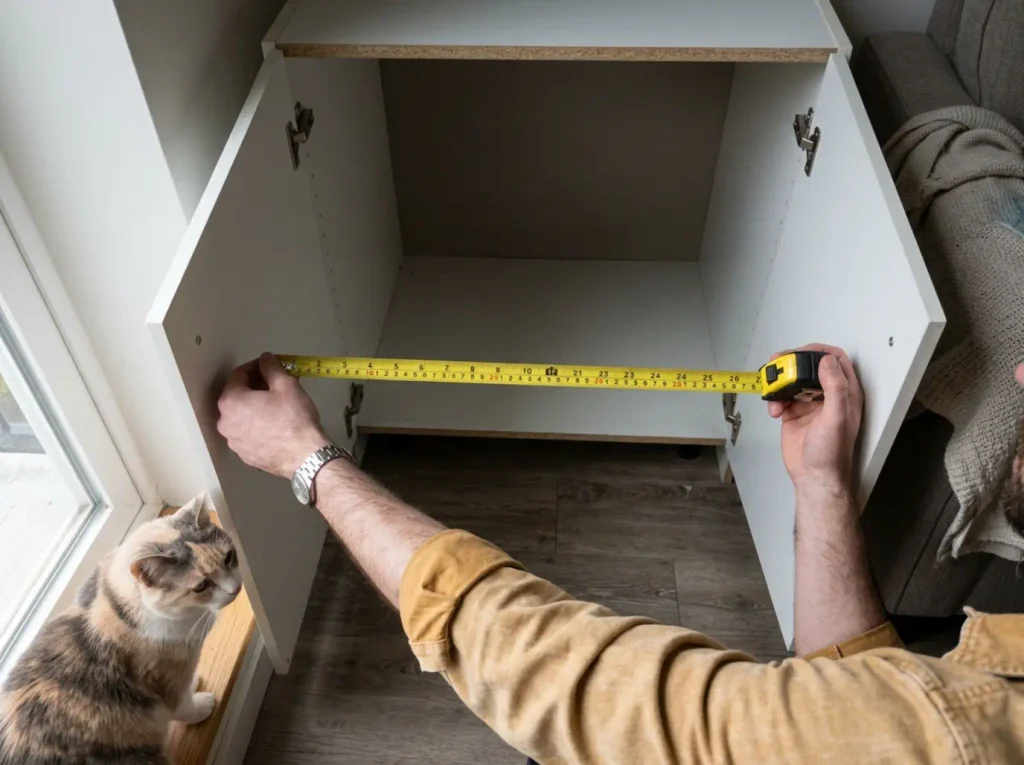
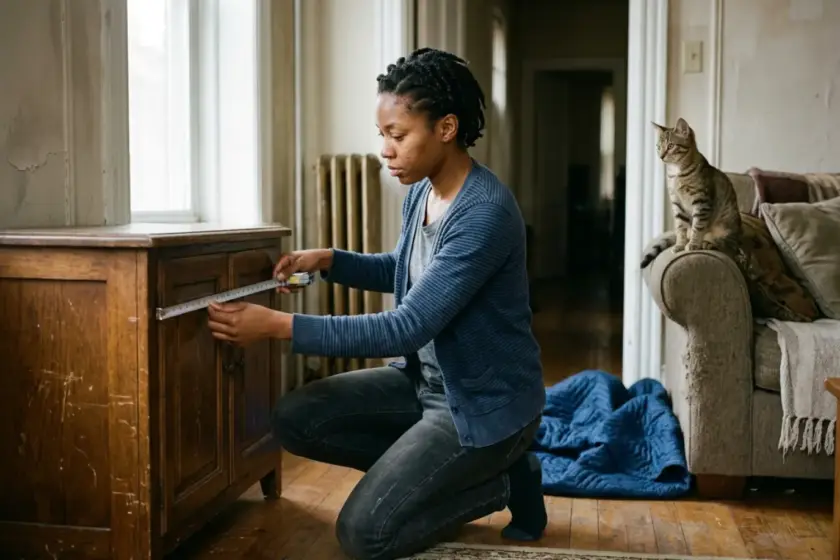
You held a tape measure to the wall and the cabinet fits. Good. That’s the measurement that matters least. What you haven’t measured is the floor in front of the opening and the volume inside, and a unit that fits the wall can still be unusable.
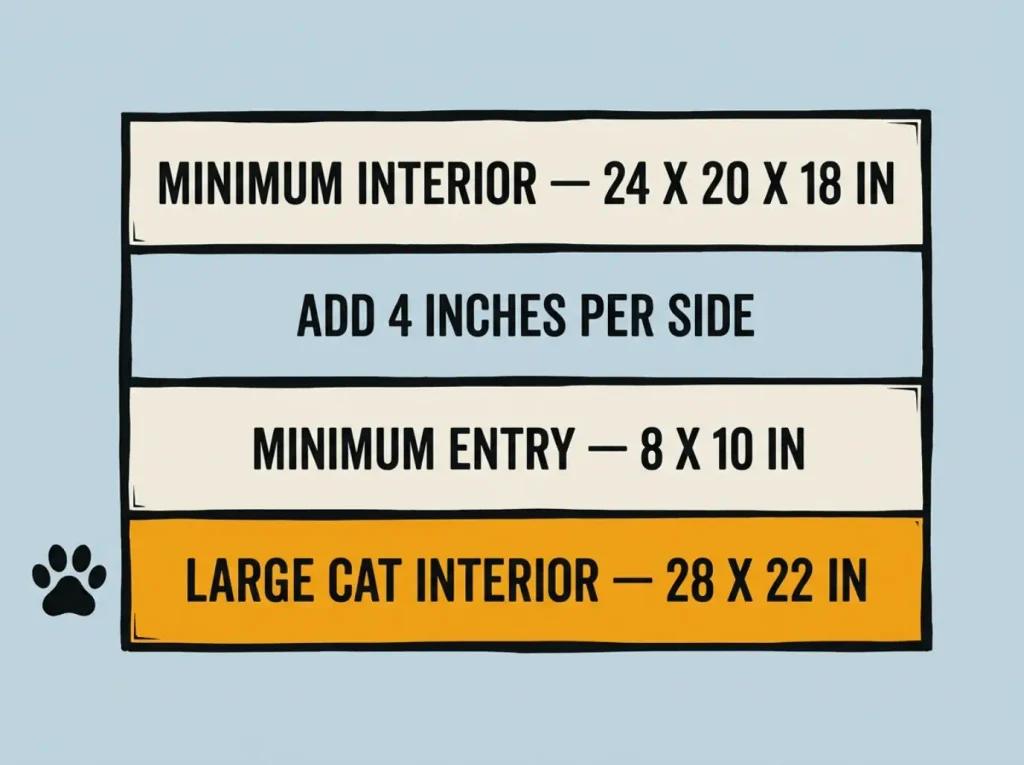
Start inside. The minimum workable interior for one adult cat is 24 inches wide by 20 deep by 18 tall. Under that, he’s crouching to fit rather than crouching to do what he came for, and those are different postures with different outcomes.
The sizing method is simple enough to do in your kitchen: measure the actual pan you plan to put in there, then add 4 inches on every side. That’s the 4-inch clearance rule litter cabinet makers use when sizing an enclosure, and it exists because “fits the box” and “fits the box plus a cat who needs to turn around” are two different numbers. If you’re not sure what pan you should be starting from, the box measurements that decide what has to fit inside are the input to this whole calculation.
The entry opening has its own floor: 8 inches wide by 10 inches tall, minimum. That’s sized for an average house cat, and average is doing heavy lifting in that sentence. A large Maine Coon at full stride has to drop his head to clear a 10-inch doorway, and ducking to enter a dark box with one exit is precisely the thing a cat weighs before deciding a spot isn’t worth it. Same for a senior with stiff joints, for whom every inch of headroom is a negotiation.
For cats over 15 pounds, the interior goes to at least 28 inches wide by 22 deep, with an entry tall enough that he walks in level. Not a luxury. A large cat in a standard cabinet is a fit problem, not a tight squeeze, and the two get confused constantly.
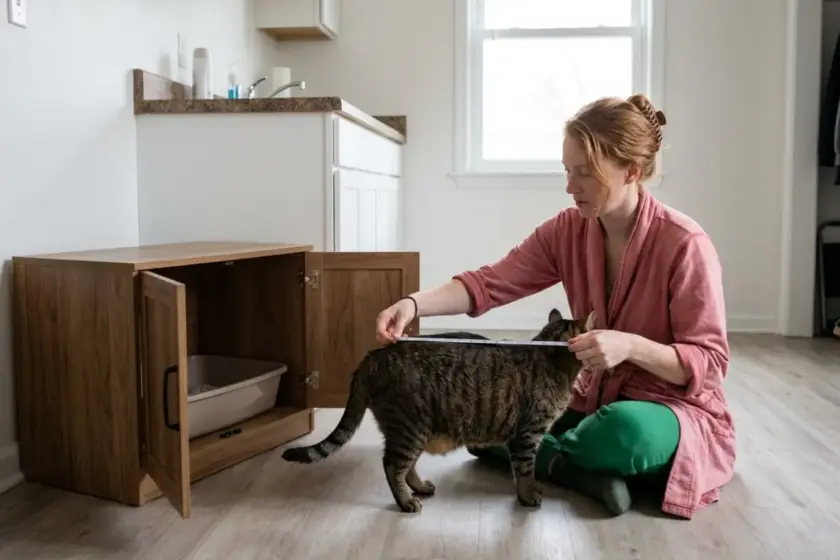
Now the measurement nobody publishes: the floor in front. Nobody gives a figure for it, and the reason there isn’t a clean one is that it scales with your cat, not with the cabinet. The working version is a cat-length of clear floor ahead of the opening, measured on your own cat from nose to tail base.
That clearance has to hold his turning radius: he walks in facing forward, turns around inside, and walks out facing forward. It’s the same nose-to-tail logic the AAHA Feline Life Stage Guidelines use to size the pan itself. Cats back out of nothing willingly. That clearance is what actually decides whether a corner works, and it’s why a cabinet can pass the wall test and fail the room.
And if the box going inside is a self-cleaning litter box, throw the whole calculation out and start again. An automatic unit inside furniture wants an interior around 30 inches tall by 25 wide by 40 long, plus a power cord cutout in the back panel, which isn’t a bigger cabinet so much as a different category of furniture. A top-entry box changes the entry math too: the opening moves to the lid, so the headroom above the unit becomes the measurement that decides it. That’s it.
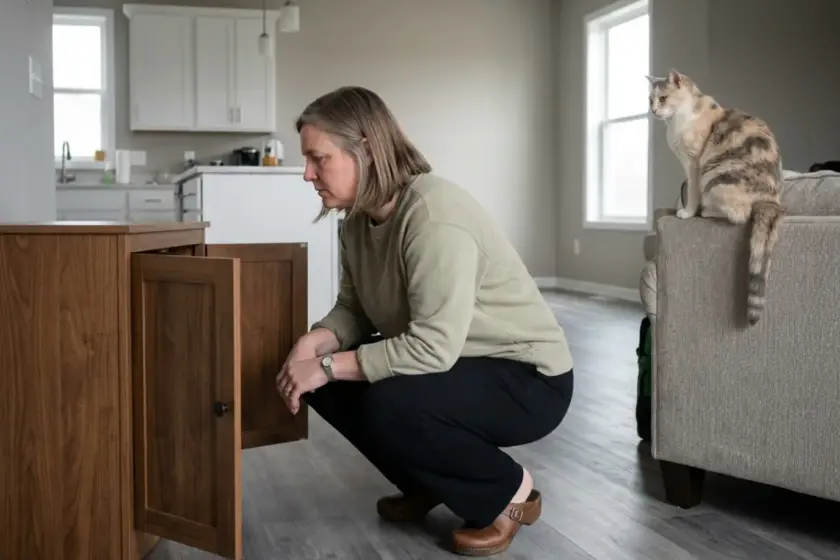
Measure the front clearance with the cabinet door swung fully open, not closed. The open door eats the space you’re standing in, and the space in front is the one that decides the spot. A corner that measures fine shut can lose six inches the moment you go to scoop.
Where Those Spots Actually Are in an Apartment
Everything above reads like advice for a house with a spare room. In a small apartment with one bedroom and one bathroom you have four candidates, maybe five, and each of them costs you something. Here’s what each one gives and what it takes.
The bathroom, under or beside the bathroom vanity, is usually the strongest option available. Hard floor, an extractor fan already installed, and a door that stays ajar most of the day without anyone thinking about it. The cost is that it’s your only bathroom, and the door closes when there’s company. Solve that with hardware, not good intentions: a hinge stop that holds a permanent three-inch gap does the job for pocket change.
The laundry room or the washer nook gives you the same hard floor plus real air movement whenever the machine runs. The problem is noise. A washer hitting spin cycle three feet from a cat sitting inside a wooden box is a spot he’ll stop using without announcing it, and you’ll spend a week blaming the litter.
The living room, converted into furniture, is where most small-apartment setups land, and it’s the placement most dependent on looking deliberate rather than hidden. A console table or a TV console conversion is the usual route, and it is the point where a box becomes litter box furniture rather than a box in a corner. A bookshelf conversion does the same job if you already own the shelf. If you’re buying rather than converting, the Hzuaneri Cat Litter Box Enclosure sits in the compact-to-mid-size class that fits a room without a spare corner, with storage above and a litter catching mat at the doorway for what comes out on his feet. Inside a cabinet, a low-dust litter that also tracks less earns its keep twice over, and unscented litter is the safer default in a space with restricted air. Run it through the interior numbers from the section above before you buy, though: compact classes buy their footprint from somewhere, and with a large cat that somewhere is often the entry height.
The closet cat door route works when the closet door can stay cracked or when you cut a permanent pass-through. It stops working the day someone closes it, which in a shared apartment is a matter of when, not if.
And where not to put it, in order of how often it goes wrong: on carpet, behind a door that swings toward the unit, at the dead end of a narrow closet, and next to the food and water bowls. The bowls are the most common and the easiest thing on this entire list to fix, because you move the bowls, not the cabinet. Cats don’t eat next to where they go, and a bowl two feet from a litter cabinet is a conflict you set up for free and can dismantle for free. What belongs near the box and what makes the smell worse goes through the rest of the neighbors.
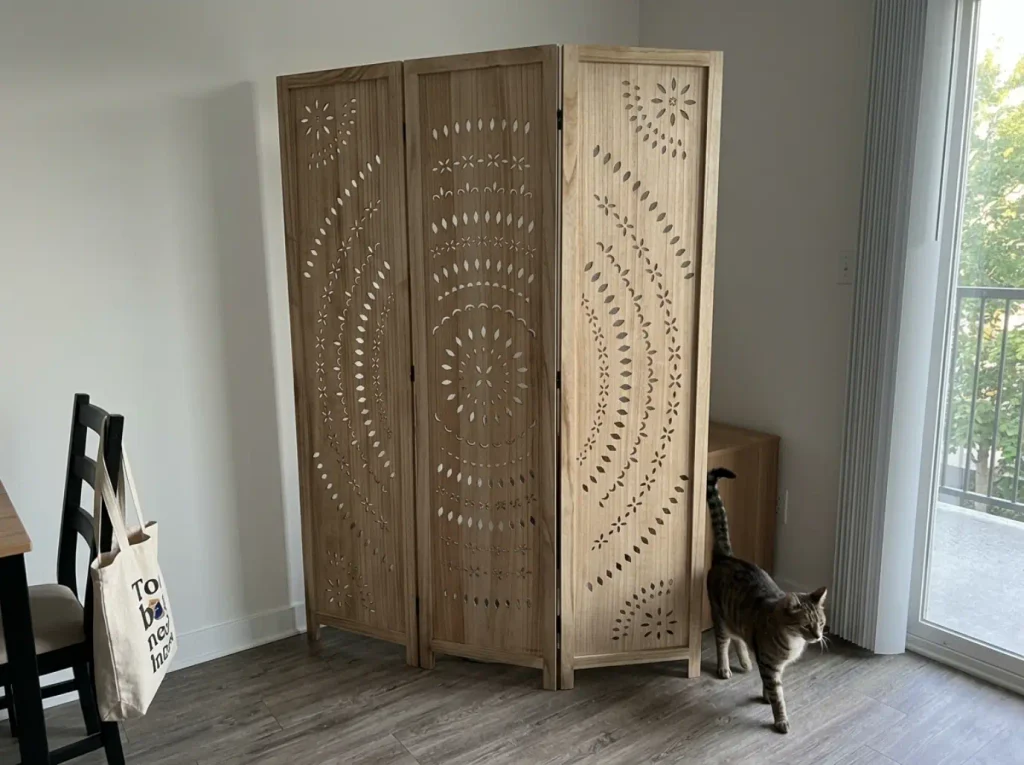
For renters, the workaround that comes up most in apartment threads isn’t furniture at all. It’s a folding privacy screen in a corner of the living room: no assembly, no-drill, nothing the lease cares about, and it moves to the next apartment in the back of a car.
A 5.6-foot folding room divider with three panels gives you the visual concealment a cabinet gives without any of the airflow debt, since a screen has no lid and no back. The limitation is honest: it hides the box from the sofa, not from the person walking past it, so it works in a studio apartment or any room with a single sightline to protect, and not much else. That is as renter-friendly as concealment gets.
If the bathroom is your only viable spot and the door keeps getting shut, a rubber hinge stop leaves three inches of permanent gap and costs a fraction of a cat flap. It also survives a move, which a hole in a rental door does not.
Why the Spot That Worked Open Stops Working Enclosed
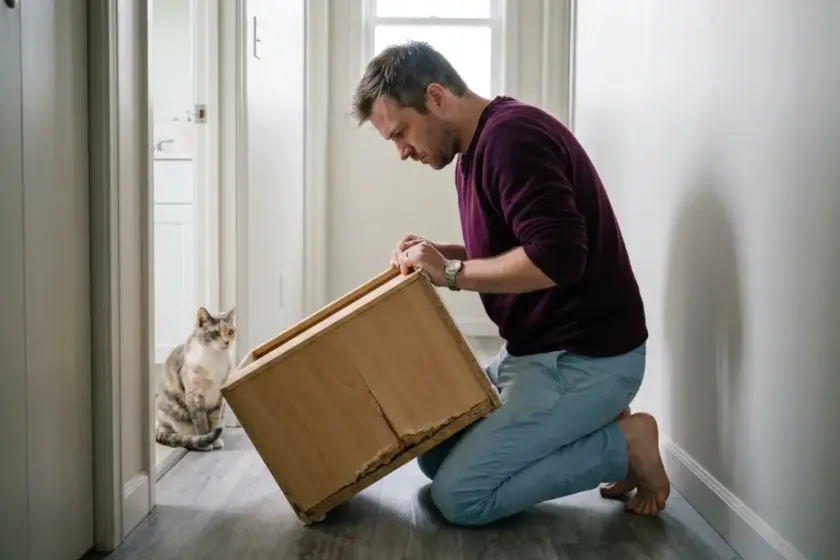
The box sat in that corner for a year and a half without a complaint. You put a cabinet around it, and three weeks later the apartment smells. The instinct is to blame the cabinet’s build quality. Usually the cabinet is fine and the corner stopped being the same corner.
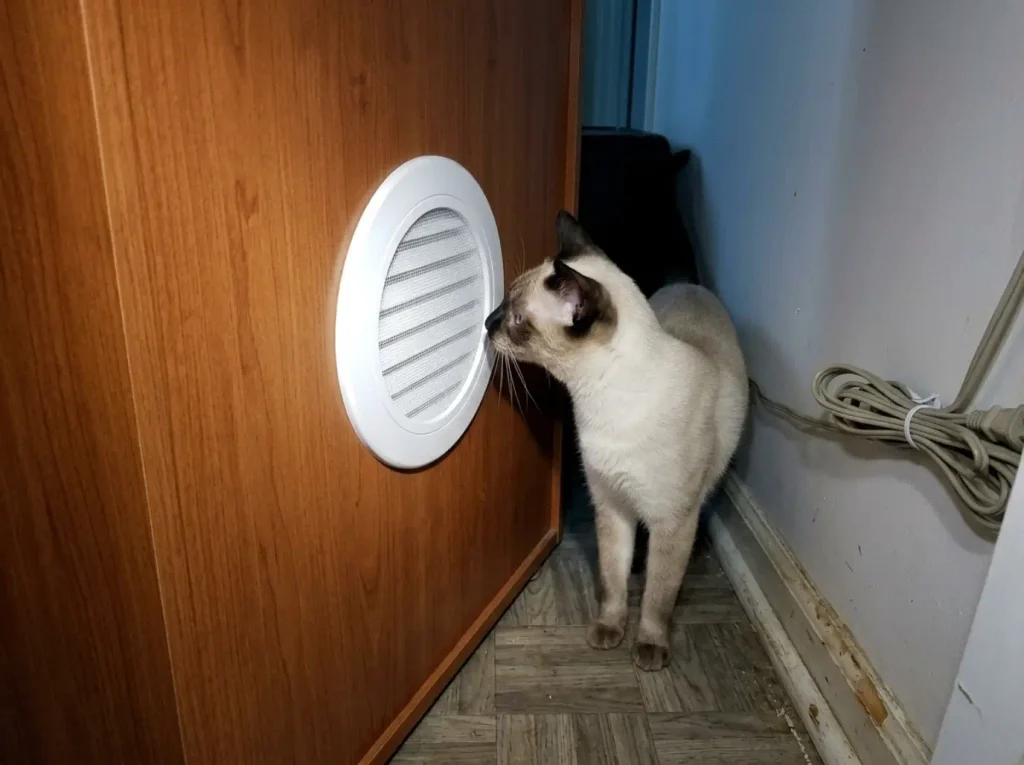
The current you had was the room’s. An open pan ventilates on borrowed air, the ordinary movement that happens in any room with a door and a window and people walking through it. Put four panels and a lid around it and that air stops arriving. The room is unchanged. The inside of the cabinet is a separate climate now, and it’s one you built. Before you buy anything to fix it, check the back panel: a great many converted and ready-to-assemble units ship with a solid back held on by six screws, and taking it off is a screwdriver and four minutes. That alone restores a cross-draft in a lot of setups. If the piece has no removable back and no second opening, a Repa Market 4-inch round vent cover drops into a hole you cut in the furniture rather than in the apartment, giving you the second opening the unit didn’t come with. It’s a grille, not a fan, so it only works if there’s a path for air to reach it; a vent on the same face as the doorway moves nothing.
The odor changes shape, not amount. It used to dissipate steadily and now it accumulates and releases in one go, when you open the door or when he goes in and displaces it. Same smell, redistributed, which is why it registers as worse even when nothing about the litter or the scooping schedule moved.
Sightlines change too, and this is the part people skip. A cat on an open pan sees the whole room and knows who’s coming. Inside a box with one opening he sees a rectangle of floor, and that changes how long he stays and whether he bothers covering. It’s not preference. It’s the same calculation you’d run.
Moisture stays. What used to evaporate now condenses against the panel nearest the pan, and unless that panel is moisture-resistant it drinks it, and that’s the beginning of a second problem — the material one, which is where the moisture ends up once the box is enclosed and a subject of its own.
The signals that this is already happening are small and easy to read as personality: he goes in, comes straight back out, and returns later. Or he starts going right beside the unit instead of inside it. Neither of those is defiance; both are him reporting on the air.
And a cat who stops using a box he used without trouble for months is telling you something a vet should hear before any of this furniture advice applies. That’s a phone call, not a placement question. Back to the cabinet.
The three-week test: if the smell now returns between scoops when it never used to, the variable that changed is the cabinet’s air, not how often you clean. Scooping twice as hard is the fix people try first and it almost never holds.
The Two Checklists, and Why Running Them Together Is the Mistake
You’re running one mental list right now, and on that list “nobody should see it” and “he should actually use it” are competing for the same corner. The first one is easy to win, which is the trouble, because you pay for the win with the second. Split them, and run them in a fixed order.
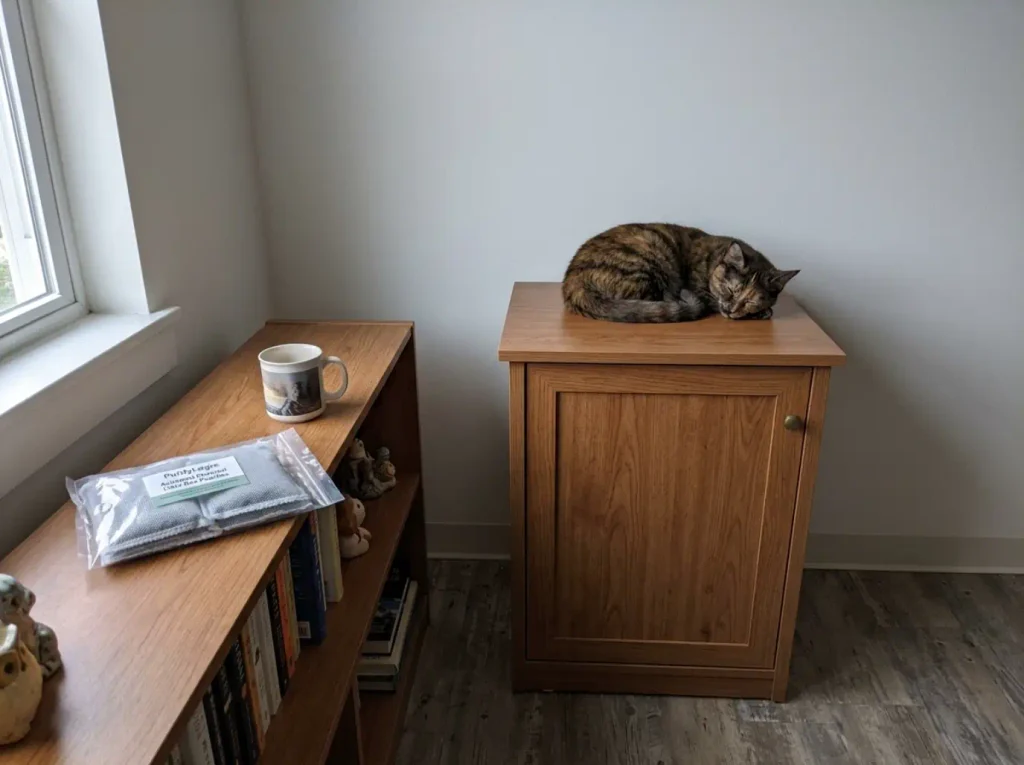
The cat’s list runs first, and it has veto power. Air in and air out. The interior and entry numbers from earlier. Hard floor. A clear exit line. Distance from the food, the water and the bed. Access on every day of the year, including the days there are guests. A spot that fails any one of these doesn’t advance to the second list, and no amount of clever decorating compensates. Passive help sits at the end of this list, not in place of it: something like PurifyLogix activated charcoal pouches work like a passive charcoal filter and take the edge off between scoops, inside a cabinet that already ventilates properly. Any deodorizer is doing the same job on the same terms. Inside one that doesn’t, carbon is a six-pack of nothing. It absorbs what reaches it, and in a sealed box, very little does.
The apartment’s list runs second, and only across the spots that survived. Is it visible from where people sit? Does it line up with the other furniture, or is it wedged in? Does the height relate to what’s beside it? Can you open it fully without moving a chair to scoop? These are real questions and they deserve real answers, just not before the first list is settled.
Which brings up the distinction the title is built on. A hidden enclosure is one you can tell is trying not to be noticed: shoved into a corner, detached from every other piece in the room, a different finish from everything around it. That is the whole difference between a hidden litter box and a placed one.
A deliberate one sits in plain view, at a height that agrees with its neighbors, and doesn’t apologize. The second reads better to guests, and it works better for the cat, because a spot that’s part of the room is a spot with air and traffic and light.
The aesthetics and the function stop fighting once you run them in the right order.
The conflict is worth naming out loud, because it’s the same one in every apartment: you want the most tucked-away corner in the place, and he wants a room with more than one way out. When those don’t overlap, the cat wins. You’re describing a preference and he’s describing a constraint, and only one of those is negotiable.
For what it’s worth, the compliment people report when this lands isn’t “I didn’t notice it.” It’s some version of “that looks like it was planned.” That’s the exam.
The visitor test: sit where a guest sits and look around the room. If the first thing your eye lands on is a piece of furniture trying not to be noticed, it’s hidden. If it takes you a moment to locate it because it belongs there, it’s placed.
One Cat, Three Cats, and the Cabinet That Becomes a Choke Point
With one cat this is picking a corner and getting on with your day. With two or three, picking a corner is the mistake itself, because a cabinet is one place no matter how wide it is, and a place with one door is a place that can be watched.
One cabinet is one location, even with two pans inside it. To a cat who guards, two boxes twelve inches apart are the same box. The one-per-cat-plus-one rule counts locations, not trays, and it’s the detail that gets lost the moment litter furniture enters the conversation, because furniture invites you to think in units. How many boxes two cats actually need, and where they go works through the count itself.
Before spending anything, do the free version: take the second open pan you already own and put it in another room. That resolves more multi-cat cases than any purchase does, and the cost is the ten minutes it takes to carry it.
The standard advice used to run the other way: buy one wide unit, on the reasoning that two pans inside one cabinet at least gets you two pans. Enough choke-point stories in multi-cat household threads have worn that down. Two separate places beats one wide place, and it isn’t close.
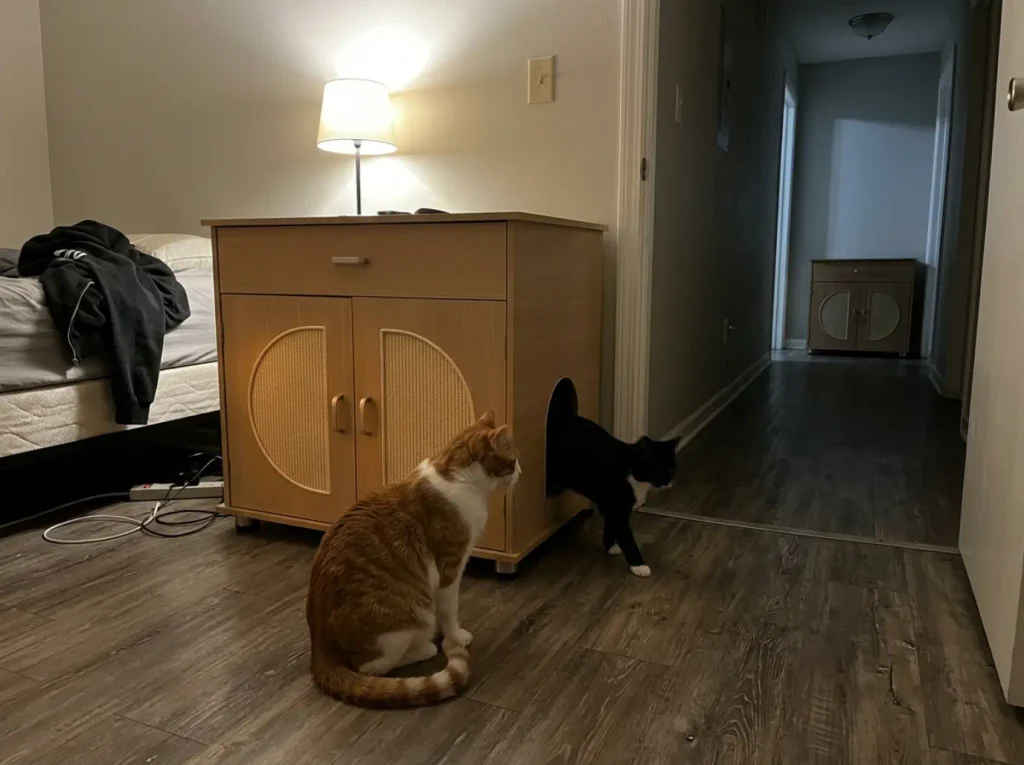
If you do want one unit to hold two genuinely separated pans, the interior has to clear 40 inches wide. Below that you’ve bought two boxes and one bottleneck. A unit like the Tangkula Litter Box Enclosure lands right at that threshold at roughly 40 inches across, with a pull-out drawer for scoop and litter and adjustable feet that matter more than they sound like they do on the uneven floors old apartments have. The caveat is the one the number can’t fix, though, which is the next paragraph.
Even above 40 inches, it’s still one doorway. The dominant cat sits in front of it and doesn’t have to do anything else, and that is where territorial conflict starts in a home that looked settled. That’s the whole mechanism, and it’s why two smaller cabinets in two different rooms beat one large cabinet in the good corner by a wide margin in a multi-cat apartment. Guarding needs a single point to be worth guarding.
Each unit needs its own numbers. You don’t split one allocation of clearance across two cabinets. Each one wants its own cat-length of floor in front, its own hard surface, its own exit line, its own distance from the bowls. Two cabinets crammed into one nook is one location wearing a costume.
The signal that guarding is already happening is quiet: one cat waits while the other is inside, or goes in fast and leaves faster, or you start finding things just outside the cabinet but nowhere far from it. The answer to all three is a second location, not a bigger cabinet.
What to Do With All of This
Run the cat’s list first and the apartment’s list second. The decor questions are legitimate, but they only get to choose among the spots that already cleared air, access, floor, exit and distance.
Measure the floor in front with the door swung wide open, and size the interior by measuring your actual pan and adding four inches per side. A cabinet that fits against the wall can still fail the room, and the front clearance is the number that catches it.
With more than one cat, count locations instead of trays. Two small cabinets in two rooms beat one wide cabinet in the best corner, every time, because one door is one thing to guard.
Come back to it in three weeks. That’s long enough for the cat to have made up his mind and for your scooping routine to have found its real rhythm. Three things to check: whether the smell now returns between scoops when it didn’t before, whether he goes in and comes straight back out without staying, and whether one cat is waiting a turn.
Start with the free version tonight. Move the food and water bowls to the far side of the room and take the back panel off the cabinet. Ten minutes, no money. If the smell breaks with that alone, you just saved yourself a new cabinet and learned that the problem was never the furniture.
Amazon’s Audible — free for 30 days
Your cat won’t let you read. Let someone read to you.
Audible is Amazon’s audiobook library — thousands of titles, read out loud, on your phone. Free for a month, plus one audiobook to keep forever.
Frequently Asked Questions
01Where should you not put a litter box enclosure?
On carpet, behind a door that swings toward it, at the dead end of a narrow closet, and beside the food and water bowls. The carpet and the bowls are the two you fix for free: move the bowls, not the cabinet.
02What is the golden rule for litter boxes, and does an enclosure change it?
One box per cat plus one, and an enclosure does change how you apply it, because the rule counts locations rather than pans. Two boxes inside one cabinet are one location to a cat who guards the door.
03Do cats prefer enclosed or open litter boxes?
Given a free choice, most cats take the open one, mainly for the sightlines and the air. An enclosure closes most of that gap when the interior clears 24 by 20 by 18 inches and has two openings instead of one.
04Can a litter box enclosure go in the bathroom of a one-bathroom apartment?
Yes, and it is usually the best spot on offer: hard floor, an extractor fan, and a door that sits ajar most of the time. Solve the door first with a hinge stop that holds a permanent three-inch gap.
05How much space does a litter box enclosure need in front of it?
Roughly a cat-length, measured nose to tail base, so he can walk in facing forward, turn around inside, and walk out facing forward. Measure it with the cabinet door swung fully open, never closed. That is the measurement that decides the spot.
Leave a comment