Best Litter Box for Less Tracking, by Wall Height
Wall height, by the cat: 8 inches for a normal digger, 10 for a large one, 12+ for a hard kicker (and why an 18-inch shield contains less).

Alfredo RamsesFounder · August 23, 2026 · 26 min read

On this page8 sections
- 1Why a Box Called Large Still Throws Litter Across the Room
- 2Diggers and Walkers Need Different Boxes
- 3Open and High-Sided, and What to Measure Before Buying
- 4Top-Entry Contains the Most, and Costs the Most
- 5Two Cats Change Which Box Is Right
- 6Senior Cats, and the Entry Lip Everyone Measures Wrong
- 7The Short Version
- 8Frequently Asked Questions
The box says large on the side. It was not the cheap one. And there is still litter in the hallway, two rooms away from where the box actually sits. He is not being messy about it, and he is not doing it to spite you: he is burying, which is the entire reason the box exists, and a four-inch rim was never built to contain a cat throwing litter backward at speed.
Almost every article on this problem tells you to get a box with high sides and then never says how high, so this one measures the wall in inches instead, and separates the box that wins on paper from the box that survives a home with two cats. Below: four box designs, one number that decides between them, and what each design quietly takes away from you or from the cat.
Quick Answer
The best litter box for less tracking is the one whose wall is tall enough for how your cat digs, and low enough at the entry for how your cat walks.
- A wall of 8 inches contains a normal digger; 10 inches for a large or vigorous cat; 12 or more for a cat that kicks hard or sprays standing.
- Measure the wall, not the box. Many high-sided boxes are a 6-inch pan with a clip-on shield, and the seam leaks.
- Top-entry contains the most litter and costs the most: no sightline, harder entry, and a mess you stop seeing.
- With more than one cat, choose open and high-sided over top-entry, even though top-entry scores better on tracking alone.
Why a Box Called Large Still Throws Litter Across the Room
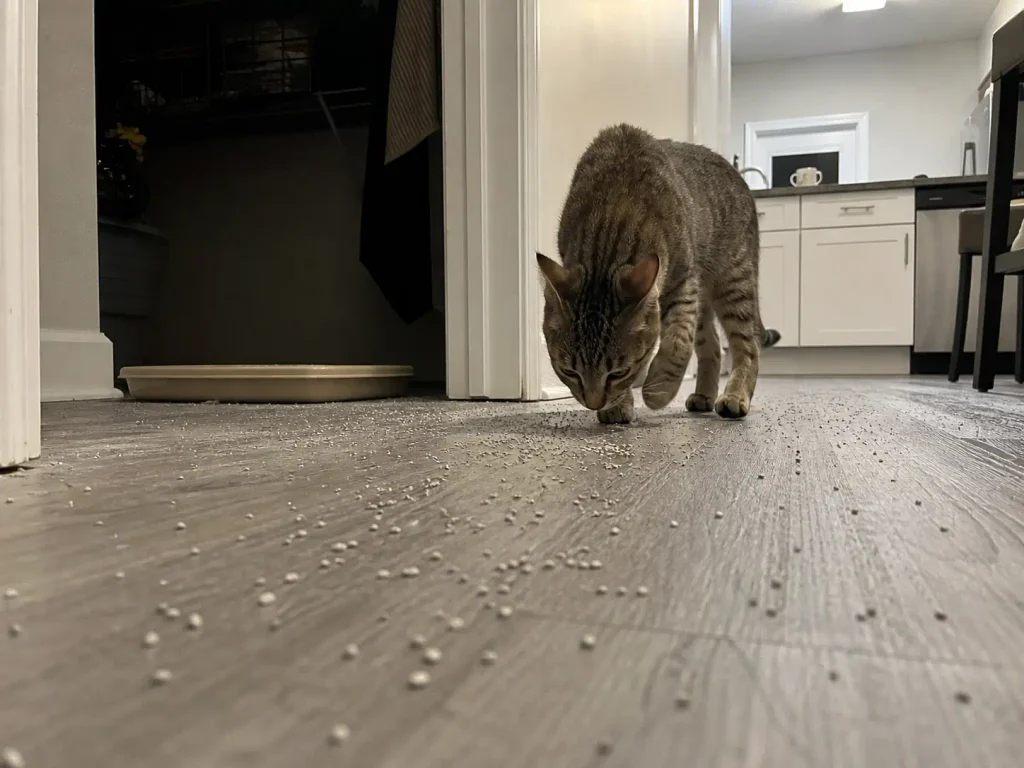
You already bought the upgrade. The listing said large, high-sided, no-mess, and it arrived in a box that felt satisfyingly heavy. Three days later there is litter under the radiator in the next room and the whole thing feels personal.
It is not personal, and the box is not defective. It is doing the job it was designed for, which is holding litter in place while a cat stands in it. Stopping a dig is a completely different job, and most pans were never asked to do it.
The standard rim on a store pan runs 3 to 5 inches. A cat mid-bury is not gently pushing litter around; he is scooping it backward with both front paws in fast repeated strokes, and the granules leave his paws on an upward arc. Five inches of plastic does not intercept an arc.
The word doing the damage is large. On a listing, large describes floor area, almost never wall height. A box can be 24 inches long, roomy enough that your cat can turn around without folding himself in half, and still have a five-inch wall all the way around. Those two numbers get printed in the same line of the same spec block and only one of them has anything to do with your hallway.
It helps to know that litter leaves a box by three separate routes, because the box only closes one of them. Some of it goes over the wall during the dig, thrown up and back.
Some of it walks out on the paws, pressed into the pads and dropped along whatever path he takes afterward, which is why a mat only works on the first two steps and why the litter three rooms away is usually not mat-shaped litter. And some rides out in the fur, which matters mostly with a long-haired cat and has nothing to do with what you buy. This article fixes the first route. Only the first. The other two belong to the granule you choose and the mat you put down, and no box wall on earth will do their work for them.
That is worth being blunt about before anyone spends money. The box is lever two of three. Granule size and shape does more heavy lifting than the box does, the mat catches what gets past both, and buying a taller box while running a fine, lightweight, clay dust that sticks to everything is fixing the smallest of the three problems first. If you have not sorted out which lever is yours yet, start with the three fixes for tracking, ranked by how much they actually do, then come back here to spend the money properly.
There is one more failure worth naming now, because it is the most common way people waste a purchase on this exact problem. The recurring story in litter threads is a buy-and-return cycle: the reader upgrades to a taller box, opens it, and finds a shallow pan with a tall plastic shield clipped onto the top edge. The wall height on the listing was the two numbers added together.
Litter then escapes through the seam where the shield meets the pan rather than over the top, so the floor barely improves and the box now costs more and is harder to wash. Height was never the whole answer. Where the wall starts is.
Diggers and Walkers Need Different Boxes
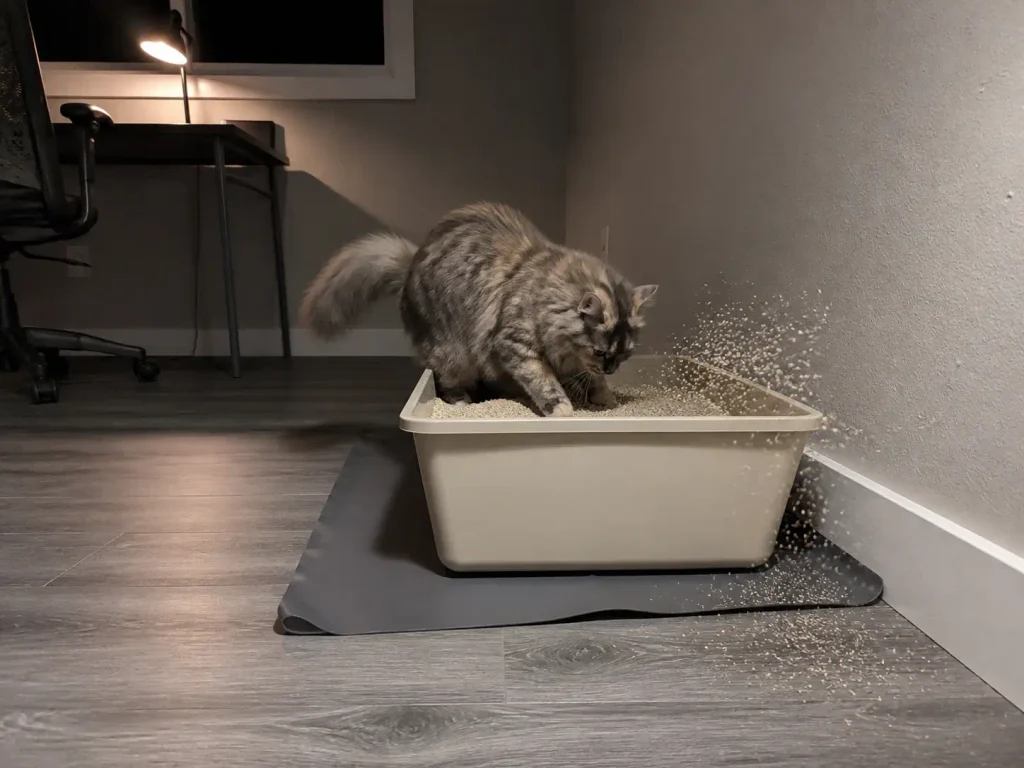
Two cats, two apartments, the same box off the same listing, and completely different floors. One home sweeps a light ring around the box every few days. The other finds litter in the kitchen. The box is identical, so the box is not what is different.
What is different is what each cat does in the ten seconds before he leaves.
Start with why he digs at all, because it changes the tone of everything that follows. Burying is not tidiness and it is not manners. It is threat management.
A cat covering waste is editing the scent record of a room he lives in, and how thoroughly he does it says something about how secure he feels in that spot. A cat who digs like he is being paid by the pound is not misbehaving. He is telling you the substrate feels wrong under his paws, or the location does not feel safe enough to leave the job half done. He is right about that, and the flying litter is a side effect of him solving it.
Here is the split that decides your purchase, and no competitor states it as a decision point. The digger throws litter up and back, over the wall. He is a mid-dig problem. The walker carries it out on his paws, one granule per pad, and drops it wherever he goes next. He is an exit problem.
Wall height solves the digger completely and does absolutely nothing for the walker. Buy for the wrong one and you have spent money on a box that changed nothing, which is how people end up convinced that nothing works.
Telling them apart takes one day and costs nothing. Look at where the litter actually lands. A tight ring within a foot of the box, thickest right at the entry and thinning fast, is paw carriage. That is a walker, and your fix is the granule and the mat.
Litter landing two or three feet out, or sitting on top of the mat instead of down in its grooves, or turning up in a direction the cat never walks, went over the wall in an arc. That is a digger, and this article is for him. Plenty of cats are both, which is fine: the pattern will just tell you which one is louder.
Put a sheet of dark paper under and around the box for one day. Light litter on a dark background shows you the scatter pattern you have been walking past for months, and it tells you which of the two problems you actually have before you spend anything. It costs nothing and it takes one day.
Once you know he is a digger, the wall height becomes a number instead of an adjective. This is the measurement rule the rest of the article is built on: 8 inches of continuous wall contains a normal digger.
10 inches covers a large cat or a vigorous one, where the extra reach and the extra force both push the arc further. 12 to 16 inches is for the cat who kicks hard enough to clear a standard wall from a standing start, or who urinates standing up and needs the height for aim rather than for scatter. Those are floors, not maximums. Nobody has ever complained that a wall was two inches too tall for a cat who could still get in.
Before you buy any of it, though, do the free thing first, because it fixes a real percentage of these cases outright. Deepen the litter to 2 or 3 inches, and move the box off the doorway threshold if that is where it lives.
A cat digging in an inch and a half hits bare plastic, and a cat who hits bare plastic digs harder and longer looking for something to move, which throws more litter over a wall of any height. That is a depth problem wearing a box costume, and it is the cheapest fix on this page.
Moving the box off a threshold matters because litter that lands in a doorway gets walked through by every person in the apartment, so a small scatter turns into a distributed one. Fix depth and location, wait a week, and see what is left. What is left is what a box can fix.
Open and High-Sided, and What to Measure Before Buying
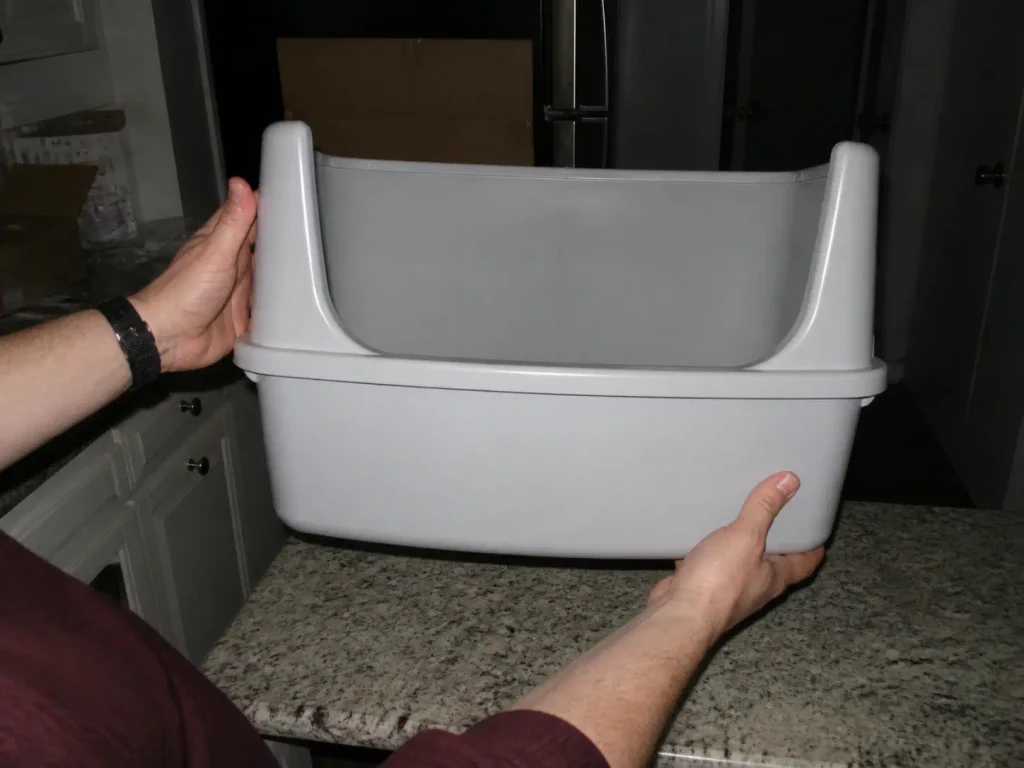
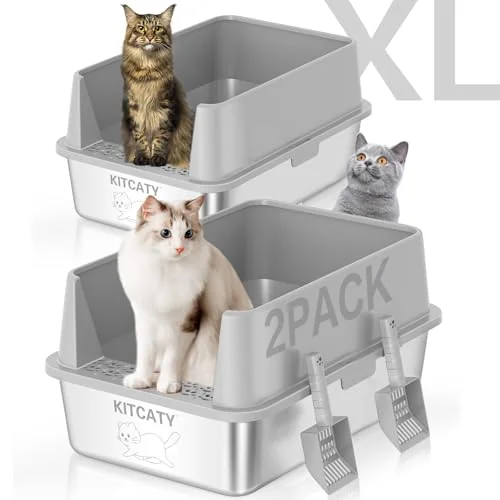
This is the boring answer and, for most people reading this, the correct one. Open on top, tall on the sides, nothing clever going on. It contains the dig, it keeps the cat’s sightline intact, it does not trap odor at his nose, and it is the cheapest category to get right.
The part worth your attention is not the brand on the front. It is where the wall physically starts.
The category in one line: one continuous wall between 11 and 12 inches covers almost every digger you will ever meet, including the big ones, with margin to spare. That range exists because it is comfortably above the 10-inch floor for a large or vigorous cat without climbing into the specialist territory where entry starts becoming a real obstacle.
Now the trap, which is the single most useful thing in this section. Roughly half of what gets sold as high-sided is a shallow pan with a scatter shield clipped onto it. The pan is 6 inches. The shield adds another 8 or so.
The listing advertises the sum.
The problem is that the sum is not a wall, it is two pieces of plastic meeting at a horizontal seam right where litter is traveling fastest. The tallest shield on the market runs 18 inches, and reviewers of that unit report the same thing repeatedly: it feels flimsy and does not always sit flush.
An 18-inch shield with a gap at the seam contains less than an 11-inch molded wall with no seam at all. Fit decides containment, not height. A one-piece wall has nothing to leak through, nothing to pop off during a wash, and nothing to misalign when the cat leans on it. It is also, usually, cheaper.
I used to treat the tall detachable shields as the obvious upgrade, on the logic that more inches must mean more containment and being able to remove the shield gave you flexibility. Enough seam-leak complaints in the same threads, always described the same way, and I stopped: the removable part is the failure point, and the flexibility is worth less than a wall that stays where it was molded.
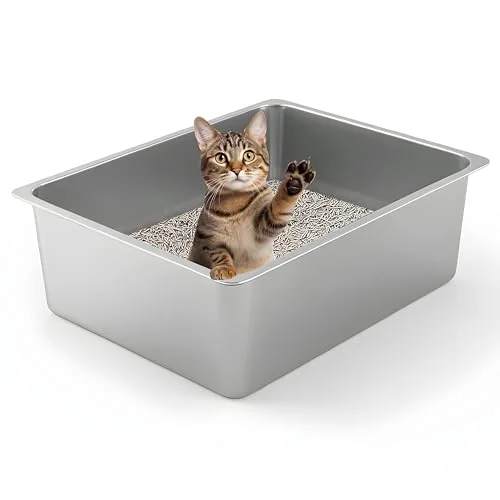
The material is a second decision hiding inside the first, and it has a consequence beyond tracking: stainless steel earns its price on odor, but only in grade 304, which is the detail that separates a metal box that stays neutral from one that develops a smell of its own. If you are buying metal for containment, you may as well buy the grade that also pays you back on the other problem.
If that is more box than the room or the budget can carry, the same structural logic exists at the bottom of the category, and it is the version most people should probably buy first.
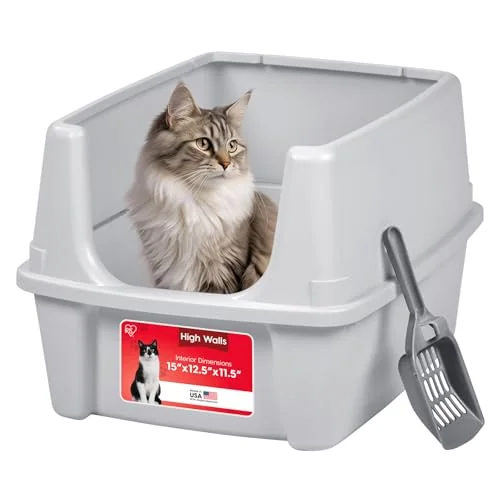
Wall height is only half of what you should be measuring, though, and the other half is about the cat rather than the floor. The AAHA/AAFP feline life stage guidelines recommend a box at least 1.5 times your cat’s nose-to-tail length, which is the veterinary version of measure the cat, not the packaging. A box marketed as large that comes in under that number is functionally small no matter what the sticker says, and a cat in a functionally small box does something specific: he digs at the edge, or he stands with his front paws in and his back end over the rim, and both of those put litter outside the box regardless of how tall the sides are.
So do the measurement before you shop. Stretch him out, measure from his nose to the base of his tail, multiply by 1.5, and then look for the interior length on the listing rather than the exterior. Those differ by an inch or two on molded boxes and by more on anything with a rim.
For a large breed the arithmetic gets uncomfortable fast: a big adult can run 20 inches nose to tail base, which puts the target at 30 inches of interior length, and the market thins out badly past 24. That is a genuine gap in the category, not a failure of your shopping.
And then the constraint nobody in this category mentions at all: footprint. A 24-inch box needs about three feet of clear wall to sit against, because the box needs room and the cat needs somewhere to stand while entering. In a one-bedroom where there is exactly one viable spot for a litter box, that is the number that decides the purchase, not the wall height. Measure the spot before you measure the cat.
If the spot is 28 inches wide between a radiator and a door swing, the 23.6-inch box is your ceiling, and the honest move is to buy the tallest wall that fits that width rather than the biggest box that fits your cat. A box that does not fit the room gets moved somewhere worse within a month, and a box in a worse room is a box that gets used less.
Two things about that spot change the math, and both hit renters hardest. The first is what is under it. On hard flooring, whatever clears the wall stays visible and travels, because a grain that lands on vinyl plank slides with the next foot that passes and ends up in the next room.
On carpet it drops into the pile and stays roughly where it landed, which looks tidier and is worse, since it is still there and now you need a vacuum instead of thirty seconds with a broom. Hard floors make the problem louder and easier to solve at the same time.
The second is what you are allowed to change. Renter-friendly here means the fix cannot involve moving a wall, cutting a doorway, or building the box into cabinetry, which rules out most of what gets recommended in a room where the box has a room of its own. What is left is the box itself, the litter in it, and the spot you put it in, which is precisely why wall height carries so much of the load in a rental: it is the one lever that fits in a bag from the front door.
Top-Entry Contains the Most, and Costs the Most
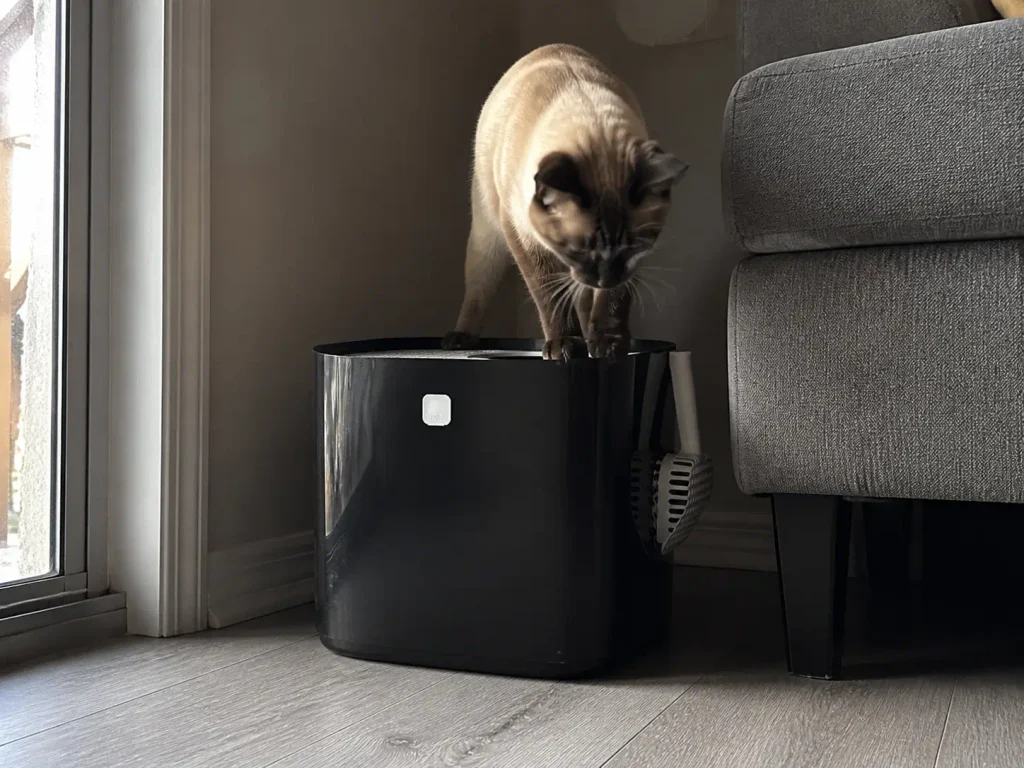
If the only thing you cared about were the floor, this would be the answer and the article could end here. The reason it is not the recommendation is everything else.
Mechanically, top-entry is the only design that works both routes at once. The cat drops in through a hole in the lid and climbs out the same way, so the walls are effectively total: nothing thrown during a dig can clear them, because there is a roof.
Then the exit surface, usually a grated or perforated lid, takes a pass at the paws on the way out, knocking loose granules back down into the box instead of onto your floor. Wall route and paw route, one purchase. Nothing else in this article does that.
Then the bill arrives. A cat has to jump up and drop in, every single time, for the life of the box. For a healthy adult cat in his prime that is a non-issue and he will not think about it twice.
For a senior, for a kitten who cannot yet make the height, for a heavy cat on short legs, or for any cat with a mobility limit, it is a toll charged on every visit. And cats do not file complaints about tolls.
They stop paying, quietly, by going somewhere the toll is zero, which is usually a bath mat or the corner of a rug. He is not protesting the box. He found a cheaper option and took it, which is what anyone would do.
This is where the dual-entry designs earn their premium and the cheap top-only boxes do not. A box that offers a front entry through the same liner gives the cat a choice, and the choice is the difference between a box the cat uses and a box the cat used twice in the first week. That fallback is the single feature separating top-entry boxes worth buying from top-entry boxes that end up on the balcony.
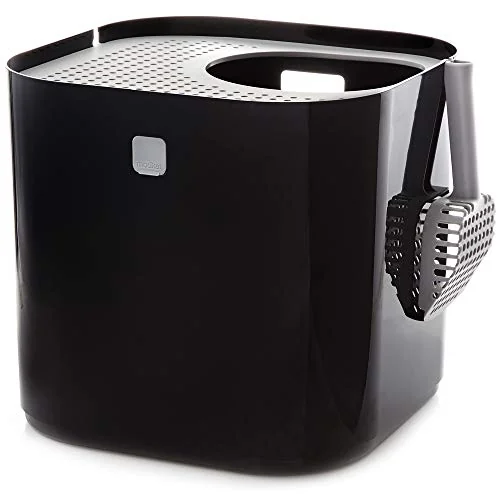
There is a second cost, and it is the one people underestimate because it does not feel like a cost at all at first. When the mess goes out of sight, scooping slips. Not deliberately. You just stop getting the reminder.
An open box tells you it needs attention every time you walk past it, and that glance is doing more work in your routine than you have ever given it credit for. Remove the glance and the interval quietly stretches from every morning to most mornings to whenever it occurs to you. Communities have a name for the result, and it is a good one: out-of-sight-out-of-mind. The best design for your floor is the worst design for your attention.
What happens next gets misread almost every time. The cat starts hesitating at the box, then stops using it, and the owner concludes the cat hates the new box. Usually the cat has no opinion about the box at all.
What he has an opinion about is the inside of it after two missed days, because a lid concentrates ammonia in a small volume of still air, at exactly the height where his nose is, in the one place he cannot back away from. Threads call that a stink chamber, which is unkind but accurate. It is the same mechanism that sinks the covered box, and it runs whether or not anyone is around to notice.
Which brings up the two designs this article has been circling without naming. The covered litter box is the hooded pan most people picture first: a standard base with a snap-on dome and a front doorway, sometimes with a flap. On tracking it lands in the middle.
The dome catches what a digger throws upward, so it beats an open low-rimmed pan comfortably, but the doorway is at floor level and the cat walks straight out through it, which means it does nothing at all about the paw route. You are buying half the containment of a top-entry box and paying the full price in sightlines and trapped air.
If you want the hood for the smell, the sibling article on which designs actually smell least is the better guide; for tracking specifically, a tall open wall does more for less.
The litter box enclosure is the other one, sold as litter box furniture: a cabinet with a cat-sized opening cut in the side, the box hidden inside, a lid or a door on top for you. Its selling point is not containment at all, it is that guests cannot see the box. The tracking math is roughly the covered box again, with one addition worth knowing: the cabinet floor around the pan collects everything the cat kicks over the rim, and unless the whole box slides out easily you will be reaching into a dark cabinet with a dustpan every week. The real cost is the footprint.
An enclosure sized for a large box occupies about as much floor as a small side table, which in a hallway or a half-bath means the box now dictates where the furniture goes. Worth it if hiding the box is what makes the arrangement acceptable at home. Not worth it if the goal on the listing was less litter on the floor.
If you buy top-entry, move scooping to a fixed time instead of doing it when it looks bad. The design deletes the visual reminder, so the reminder has to come from somewhere else: attach it to something you already do daily without thinking, like the coffee or the last thing before bed.
Two Cats Change Which Box Is Right
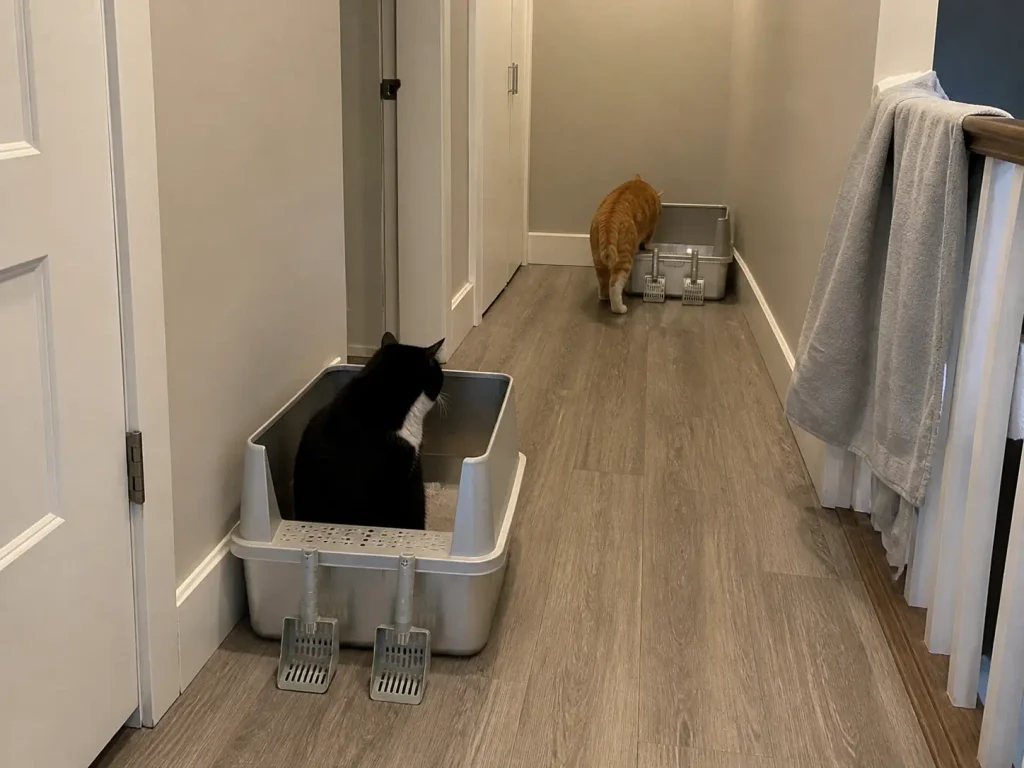
Everything above quietly assumed one cat. With two, the best box on paper can be exactly the box one of them stops using, and you will not find out for weeks.
Start with the sightline, because in a two-cat home it stops being a comfort preference and becomes a floor plan problem. A top-entry or covered box cuts the occupant’s view of the room to nothing. Elimination is the moment a cat is least able to react to anything, and a lidded box with one hole is a room with one door.
If a housemate takes up position near that door, the cat inside has no second exit and no early warning. Competitors mention this. They mention it once, in a cons list, and then recommend the box anyway three paragraphs later as if the sentence had not happened.
So here is the rule this article will state plainly, because someone should: with more than one cat, choose open and high-sided over top-entry, even though top-entry contains more litter. More granules on a floor you can sweep in forty seconds beats a cat who stops using the box. That trade is not close, and it does not get closer with a nicer box.
Then the count. Two cats means three boxes, which is the n+1 rule, and the part that gets skipped is where they go. Three boxes lined up along one wall is, as far as territory is concerned, one box in three sections.
The whole point of the extra box is that a cat who finds one occupied or one guarded has a genuinely separate option, and separate means a different room, or at minimum a different wall with a different approach. Three boxes in a row solves a hygiene problem you probably did not have and leaves the geometry problem exactly where it was.
What the failure looks like is worth describing carefully, because it does not look like a failure. There is no fight. Nothing gets knocked over. One cat simply starts waiting, hovering a few feet away instead of going in.
Then he starts going right next to the box rather than in it, which reads as an insult and is actually a compromise: he is using the right location with the wrong container because the container has become a trap. Then he finds somewhere else entirely, and by that point you are three weeks in and treating it as a litter problem. It was a geometry problem the whole time. That same sequence has a second symptom you will notice before you notice the first, which is that odor that comes back after cleaning usually has a second box behind it rather than a cleaning failure.
One boundary before moving on, and only one. A cat who suddenly stops using a box he was perfectly fine with is a vet visit before it is a furniture question. Everything on this page assumes that call has already been made. Back to the furniture.
Senior Cats, and the Entry Lip Everyone Measures Wrong
You have just read a long argument for tall walls. If your cat is twelve and stiff on cold mornings, that argument, followed literally, is how you end up with a cat urinating on a bath mat and a very confusing week trying to work out why.
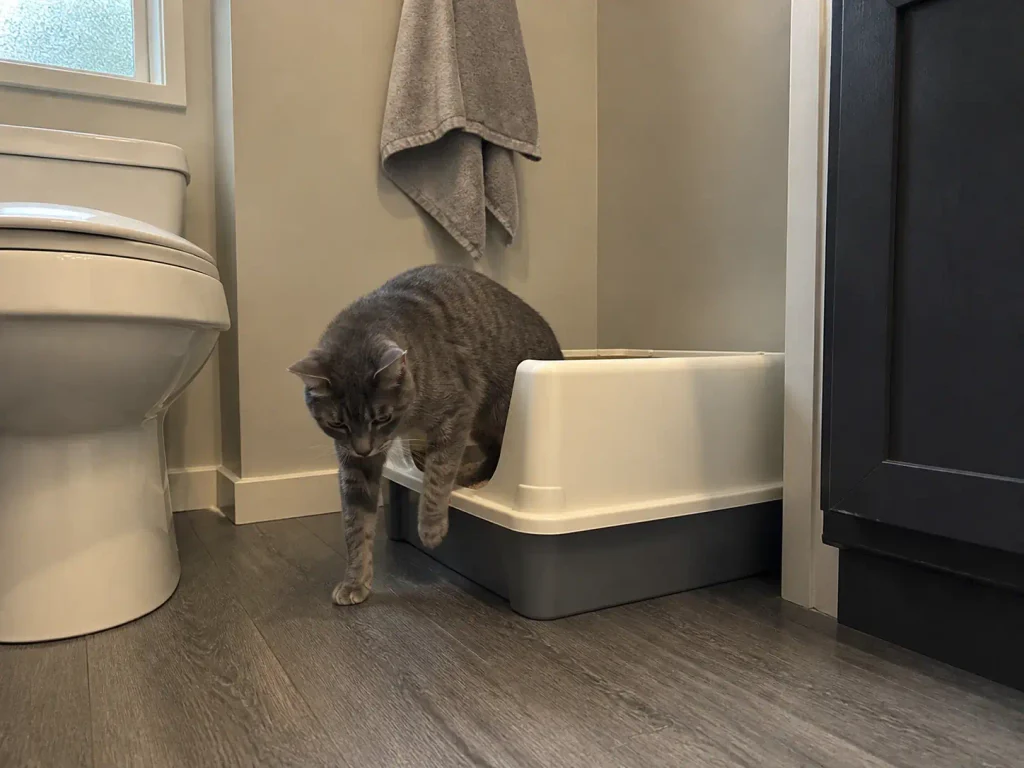
The tension is real but it is not the one people think. The number that matters for a senior cat is not the wall height at all. It is the entry height, and it wants to be under 5 inches at the lowest point he steps over, closer to 2 for a cat with a real mobility limit. Wall height is about litter.
Entry height is about whether he uses the box.
And those two numbers do not have to be the same number, which is the distinction almost every competitor collapses. A high-sided box with a stepped-down cut-out gives you an 11-inch wall on three sides and a 4-inch doorway on the fourth. The dig is contained by the three tall sides, because a cat digs facing into the box, not out of it. The entry is a step, not a climb.
Tall walls and easy entry were never opposites. A bad entry is what fails the cat, not a tall wall, and the boxes that fail seniors are the ones with a uniform rim all the way around and no thought given to where he gets in.
Measure the entry, not the wall. Stand a ruler at the lowest point the cat actually steps over and read that number. It is the one that decides whether a senior keeps using the box, and it is almost never the number printed on the listing.
If you already own the box and want to know where you stand, watch his back legs going in. That is the tell, and it is more reliable than any number. A cat who steps over the lip in one unbroken movement is fine.
A cat who lifts high, or pauses on the rim, or props a front paw on the edge to haul himself up, is being charged for the trip. He will keep paying for a while, because cats are stubborn about routine. Then one cold morning he will not, and the bath mat by the shower will cost you nothing to reach.
Inside the open-top category there is a lower-entry option that keeps you from having to go back to a 4-inch pan and lose the containment entirely. The Amazon Basics Large Cat Litter Box with High Sides, Open Top for Easy Access is built around exactly that split, high sides with an access-first entry, which makes it the sensible landing spot for a household where the cat cannot handle a continuous 11.8-inch wall but the floor still needs help. It gives up containment against the very hardest diggers compared to the fully walled boxes above, and that is the correct trade to make for a cat who is otherwise going to stop using the box.
Before buying anything for a stiff cat, though, try the free version, because it is often the whole fix. A shallow ramp or even a folded towel pushed up against the entry side turns a step into a slope. Moving the box out of a room that requires stairs removes the toll before the box does.
If the apartment only offers one workable location and none of this is possible, the sibling guide on what to do when there is only one place the box can go works the problem from the floor plan instead of the product. Costs nothing. Works often.
One last thing, and it is the part that decides whether any of this holds. Three weeks from now, three things will have drifted without you noticing: the litter will be deeper or shallower than you left it, the box will have migrated an inch or two toward the wall from being nudged during cleaning, and scooping will have slipped by a day. Each one brings tracking back with the exact same box still sitting there, which is how people conclude that the box failed. Check those three before you blame the purchase, and pair it with a mat that actually traps something so the granules that do get past the wall have somewhere to land other than your hallway.
The Short Version
Measure the wall before you measure the brand. Eight inches for a normal digger, ten for a big or vigorous one, twelve and up for a cat who kicks hard, and check that it is one continuous wall rather than a shallow pan with a shield clipped onto it. A seam at the wrong height beats any number on the listing.
Buy for the household, not the spec sheet. With two cats, open and high-sided beats top-entry even though top-entry contains more, because a box that gets avoided contains nothing at all. And check the entry separately from the wall: under five inches at the lowest step keeps a senior cat using a box that still stops a dig.
Give it three weeks and then look at three things, not the box: how deep the litter is, where the box has drifted to, and whether scooping has slipped a day. Those are what bring the tracking back, and all three are free to fix.
Start before you spend, though. Deepen the litter to three inches and move the box off the threshold. If the floor gets noticeably better in a week, you just learned you had a depth problem and saved yourself the price of a box.
Amazon’s Audible — free for 30 days
Your cat won’t let you read. Let someone read to you.
Audible is Amazon’s audiobook library — thousands of titles, read out loud, on your phone. Free for a month, plus one audiobook to keep forever.
Frequently Asked Questions
01How tall should a litter box be to stop litter from getting everywhere?
Eight inches of wall contains a normal digger, ten inches suits a large or vigorous cat, and twelve or more is for a cat who kicks hard or sprays standing up. Measure the continuous wall, not the height printed on the listing.
02Do top-entry litter boxes really reduce tracking?
Yes, more than any other design, because they work on the wall route and the paw route at once. The cost is a cat who has to jump in every time and a mess you stop seeing, which is how scooping slips and how the box eventually gets refused.
03Are high-sided litter boxes bad for senior cats?
Not if the entry is right. Look for a stepped-down cut-out under five inches at its lowest point, which gives you a tall wall on three sides and a doorway a stiff cat can still step over. Wall height and entry height are two separate numbers.
04Is a scatter shield as good as a tall one-piece wall?
Usually not. A shield clips onto a shallow pan, and if it does not sit flush the litter leaves through the seam no matter how tall the shield is. A molded wall has no seam, so fit is what decides containment rather than inches.
05Will a taller box fix tracking on its own?
It fixes one of the three routes: litter thrown over the wall while digging. It does nothing about litter carried out on the paws or dropped from the fur, which is what the granule you choose and the mat you put down are for.
Leave a comment