How to Trim Cat Nails at Home, a Few Millimeters at a Time
How to trim cat nails at home with a 2 mm margin from the quick, small cuts on dark claws, two claws a sitting + cornstarch for a nick.

Alfredo RamsesFounder · October 6, 2026 · 20 min read

On this page9 sections
- 1How to Trim Cat Nails at Home Starts With the Room, Not the Clipper
- 2Why the First Trim Fails, and When It Is a Vet Visit
- 3The Clipper: a Sharp Blade Is the Whole Job
- 4Reading the Claw: White Tip, Pink, and the Dark Claws
- 5If You Hit the Quick, the Fix Is in the Kitchen
- 6The Ladder Is Measured in Nails, Not Minutes
- 7One Cat or Several Changes Who Goes First
- 8Two Claws, a Closed Door, and a Cat Who Gets to Leave
- 9Frequently Asked Questions
You get one claw done, she twists, and by the second paw she has poured herself out of your arms and under the bed, leaving you with a clipper in one hand and a towel in the other. The easy reading is that she won’t let you, but anyone learning how to trim cat nails at home should look at what she actually pulled away from: the grip, not the clipper, since nothing in that hold told her when it would end, and on that point she is right. Owners on r/cats describe the same split over and over, a house where two cats sit through a trim and the third “flails like crazy” as soon as his feet are held, with the same clipper in the same hands. Below: the room and the light, the signs that hand the job to a vet, the clipper, where to cut and where never to, what to do about a nick, a ladder counted in claws, and what changes with more than one cat.
Quick Answer
A trim that goes well is short, loose and done behind a closed door:
- Close a bright room and wait until she is sleepy after a meal.
- Sit her on your lap facing away, then press the toe pad.
- Clip only the clear tip, about 2 millimeters short of the pink.
- Take a dark claw in small cuts toward the hook, checking each one.
- Stop after one or two claws, or sooner if she pulls away.
- Keep cornstarch open nearby; a pinch on the tip handles a small nick.
How to Trim Cat Nails at Home Starts With the Room, Not the Clipper
The clipper comes out of the drawer and the cat leaves the room. She is reacting to a place before she reacts to a tool: the sofa where she gets scooped up, the counter where she was pinned last time, the doorway she gets cut off at. So choose the room first, because the clipper only gets one fair chance per session. How often to trim is covered in the weekly routine and when a trim is due; this article is about the session itself.
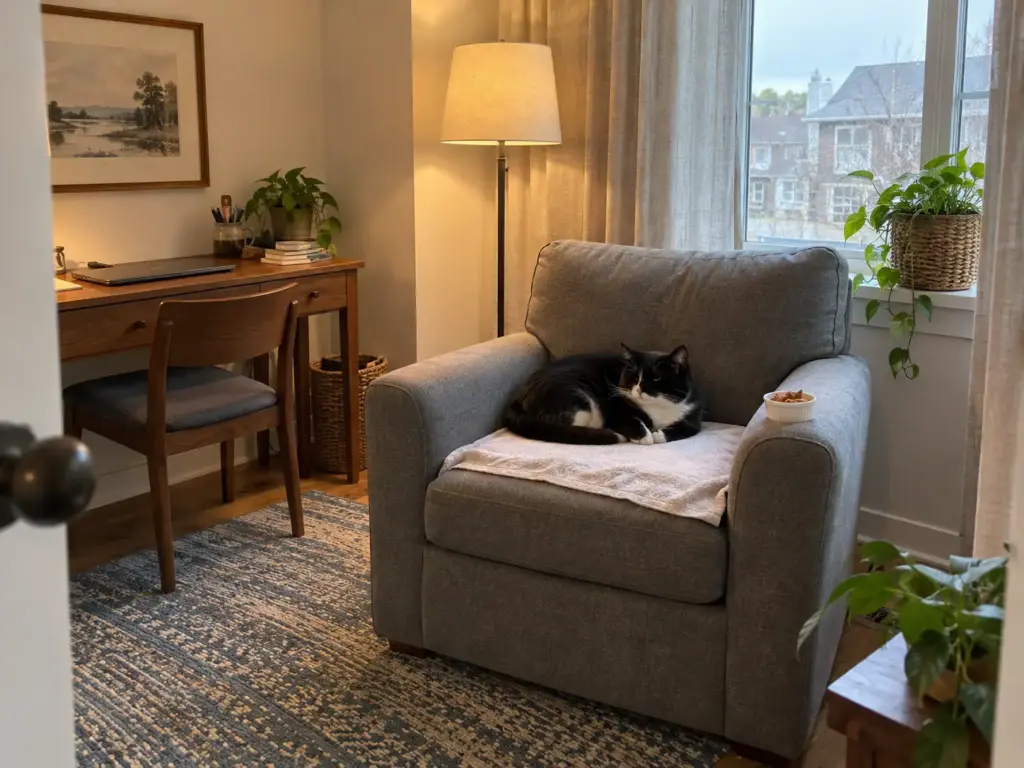
A room with a door, and a closed door at that
The Wisconsin Humane Society sets the scene with a chair in a quiet room, a cat who is relaxed or even groggy after a meal, no birds or outdoor action to watch through a window, and no other pets around. In a one-bedroom apartment that translates to a room you can close: the bathroom, the bedroom, a walk-in closet if you are lucky enough to have one. A closed door does two jobs at once. A cat who wriggles free lands on the bath mat instead of under the sofa, and the other animals in the house cannot drift in halfway through.
Check what that room already means to her before you claim it. In plenty of small apartments the only door that shuts belongs to a bathroom that already holds a litter box, and a cat who gets held down a foot from her toilet may start thinking twice about the toilet. If the box lives there, trim at the far end of the room, or use the bedroom instead. (Trading long claws for a box she avoids is a bad swap.)
Take her into the trimming room a day early with no clipper anywhere on you. Lay the towel down, sit in the chair, hand over a treat and let her sniff around and leave when she likes. Her first visit to that room should end with nothing happening to her at all.
A surface that doesn’t slide, in light you can see through
VCA suggests an elevated surface such as a counter or a table, and International Cat Care adds two details: good light before you start, and the cat on your lap facing away from you. You are looking for a pink line inside a claw that is only a few millimeters thick. Under a single overhead bulb in a windowless bathroom, that line disappears. Sit with window light or a bright lamp in front of you, so the light lands on the paw and not in your eyes.
The surface is for her. A rental bathroom counter or a laminate table is slick, and a cat who feels her back feet start to slide will brace against you, which reads to you as resistance. A folded bath towel or a rubber-backed mat under her gives her something to grip, and on your lap a towel over your jeans works better than bare fabric she cannot dig into.
Grip for her, light for you.
Not the spot where she already gets held
If you have ever tried to brush a cat who would rather not be brushed, you already know where she gets picked up for the jobs she dislikes. Often it is the sofa arm where she gets held, and that is the worst place to start trimming, because she has learned exactly what happens there. Pick a spot with no history instead: a chair in the room she naps in, a towel on the bathroom floor, anywhere she has been fed or petted and never restrained. The place should predict a treat, not a grab.
Why the First Trim Fails, and When It Is a Vet Visit
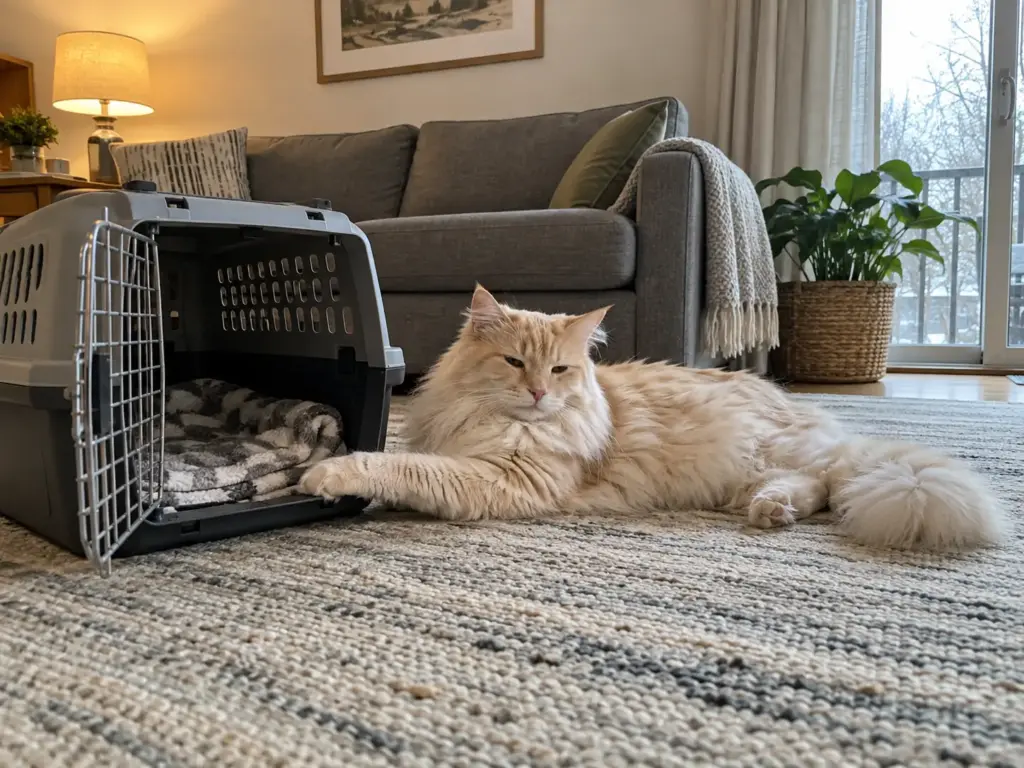
The grip is usually what she objects to
According to VCA Animal Hospitals’ nail-trim guide, “Many cats resent restraint more than the nail trim, so you may be surprised at how smoothly things can go with minimal restraint.” Less restraint is the first thing to try, and the failed first attempt runs in a predictable order. She tenses on the second claw, you tighten your hold because you want to finish, she feels the tighter hold and pulls harder, and now the two of you are arguing about the grip while the clipper sits there unused.
The moment she starts to twist, the session is over, even if only one claw is done. Next time, come back with less hold, not more. One claw taken from a calm cat is worth more than four taken from a cat who will remember the struggle.
Owners in r/cats have a name for the cat who flows out of any grasp: a “liquid cat.” The answer those threads reach for first is the “burrito,” a towel wrapped around her with one paw left out, and for some cats it works well. For the cat who panics the moment she is wrapped, it backfires; in one thread a four-year-old cat came apart inside a blanket, and every attempt after that started worse than the one before. With that cat, the better call is the lightest hold you can manage: forearms resting over her shoulders and hips rather than pressing down, and your free hand supporting the paw instead of squeezing it.
Another commenter got further with a hold the cat already knew, the legs-and-lap position used for giving pills. A familiar hold, even one she doesn’t love, beats a new one. And one owner made a point worth keeping: the cat who seems “better at the vet” is usually being held by two people there, not squirming any less.
What a harder hold does to the next trim
Each trim teaches her what the next one will be like. The Wisconsin Humane Society’s list of things not to do reads like a description of the failed first attempt: no raised voice, no punishment, no trimming when she is agitated or when you are in a hurry, and never every claw at once. Rushing is how the quick gets cut, and a cut quick on top of a hard hold is the trim she will remember for months.
The tool fails alongside the grip. Humane World for Animals notes that the blunt pressure of a dull blade can hurt and can leave the nail split, so a blunt blade that crushes rather than cuts turns a calm toe into a yanked paw. The back feet are the other trap, since most cats fuss more about their hind claws, the rear ones, and Humane World starts with the front ones for that reason. The hardest paw first, on a tired clipper, with a tight grip: that is how first trims end in the hallway.
When the kitchen stops being the answer
Some of what you notice during a trim is not yours to sort out at home. Each of these goes to your vet, and this article leaves it there:
- A claw that has curved around into the pad.
- A nick that keeps dripping after light pressure and powder.
- A claw that is torn or split.
- Swelling or limping after a trim.
- A claw that looks thick, ridged or off-color.
- A cat who cannot be held at all, even for a few seconds. VCA says to contact your vet if she resists restraint, and WSU suggests learning the technique from one.
Everything below is the ordinary trim, on a cat with ordinary claws.
The Clipper: a Sharp Blade Is the Whole Job
Scissor or guillotine comes down to your hand
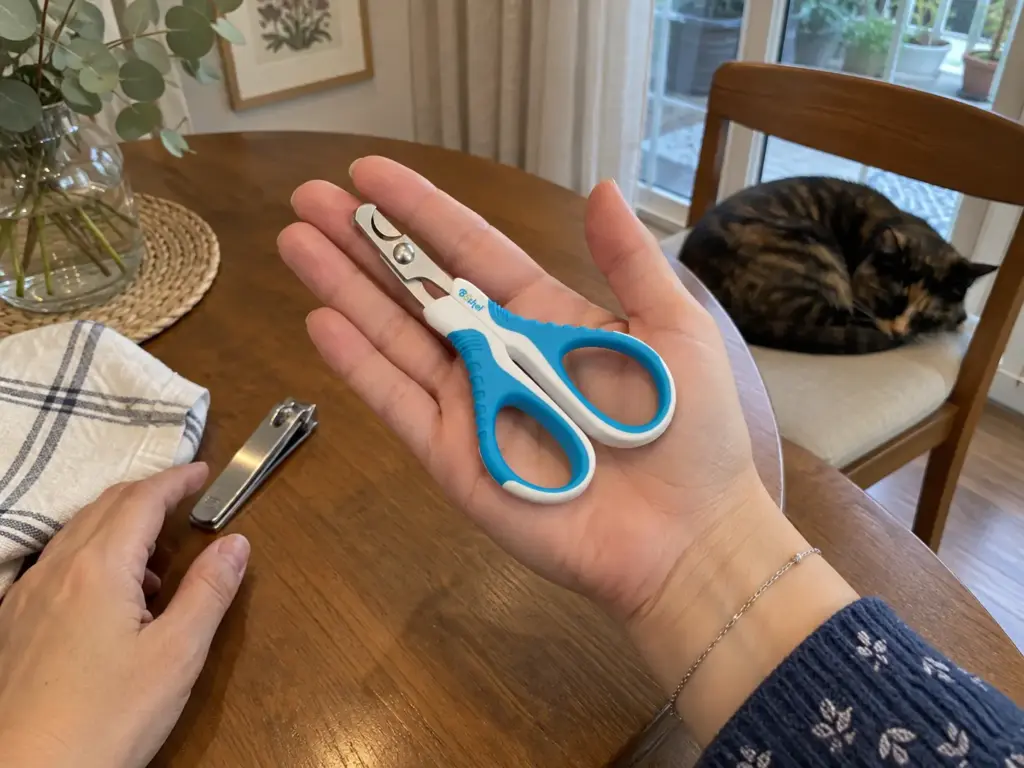
Washington State University’s veterinary teaching hospital calls the guillotine clipper the easiest type to use on cats, while VCA says either style works and that many owners prefer a small scissor-style clipper made for cats. VCA also allows a human nail clipper, as long as it is kept for the cat and not shared. Three acceptable tools, then, and no winner. Pick whichever sits steadiest in the hand you will clip with, because a clipper that wobbles as it closes is the one that drifts toward the pink.
There is one practical difference. A guillotine slides the claw through a ring, so you see less of where the blade meets it, while a scissor clipper lets you watch the cutting line as you close it. WSU prefers the scissor type for the dewclaw, which settles the choice for a lot of people.
Rehearse the sound before the first real trim. The Wisconsin Humane Society puts a piece of uncooked spaghetti in the clipper and snips it next to the cat while holding her paw, then gives a treat. A clipper that snaps shut by surprise becomes the next thing she refuses, so let her hear it break pasta a few times first.
What a dull blade does, and the free clipper you may already own
A blade that has gone dull doesn’t slice the claw. It squeezes it until it gives, and that squeeze is what she feels, along with the split, ragged end that catches in the throw blanket a week later. Replace the clipper when it stops cutting in one clean close, not when it finally breaks.
Start with what is already in your bathroom cabinet. A sharp human nail clipper, set aside for the cat and nobody else, handles small claws, and VCA lists it as a usable option. If you would rather have a tool made for cats, the BOSHEL Cat Nail Clipper is a scissor-style clipper with small angled blades, and the angle is there so you can see the cutting line on a claw that size. Owner reviews split on it, though: some find it awkward to open wide enough and say the angle hides the cut rather than showing it, and some report that it split or tore a nail instead of cutting clean, so try it on the tip of a front claw before you trust it near a dewclaw.
The grooming guide already covers the other clipper worth knowing, the Necoichi Purrcision, so there is no need to repeat that comparison here.
Reading the Claw: White Tip, Pink, and the Dark Claws
Press the pad and the claw comes out
A cat’s retractable claws stay tucked in, so the first move is getting the claw to show itself. To extend the claw, press the paw pad gently, as VCA describes, or squeeze the toe lightly between thumb and forefinger just behind the claw, the way WSU and Humane World do it. The claw slides forward and stays out for as long as the pressure holds. Light pressure is enough; if you find yourself pressing hard, she is tense, and the trim should wait for another day.
Two millimeters clear of the pink, cut top to bottom
A pale claw has two zones: a clear or white tip, and a pink core further back. That pink part is the quick, where the nerves and vessels run. The number the rest of this job hangs on is 2 mm from the quick, which is the 2-millimeter margin WSU gives: “It’s best to not cut within 2 millimeters of the quick.” Two millimeters is less than most people picture and more than enough.
Turn the clipper so the cut goes top to bottom, not side to side; VCA’s point is that a sideways cut splinters the claw, and a splintered claw snags on everything. Keep the blade you can see on your side, as WSU puts it, so you always know where the cut lands. Take the tip, then a second sliver if it still looks long. Actually, scratch that second sliver: if the first cut took the sharp hook off, stop there, because the goal is a blunt claw rather than a short one.
A dark claw gets small cuts, aimed at the hook
The 2-millimeter rule assumes you can see the pink. On a black or dark-brown claw you can’t, so there is nothing to measure that margin from, and guessing at it is how people take one big cut and hit the quick. On a dark claw, trade the number for a method. VCA and WSU both describe several small cuts that start near the tip and aim at the spot where the claw curves down into its hook.
The rule on this site is a few millimeters per cut at most, and a look at the cut end before the next one. That is slower than a single snip, and that is the point: each small cut gives you a fresh look at the claw, and you stop as soon as the hook is gone. On a cat with a mix of pale and dark claws, do the pale ones first so you can see roughly how long her quicks run, then use that as a rough guide on the dark ones (rough is the word, because claws on the same paw differ).
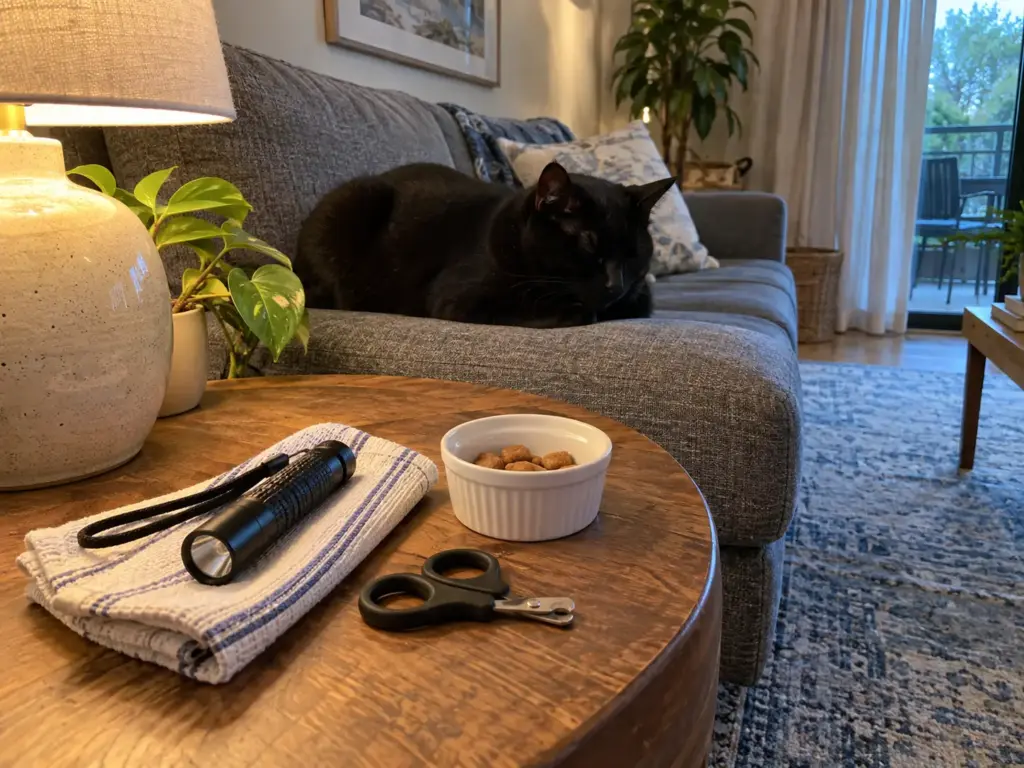
Keep a small flashlight on the towel. Held behind or below a dark claw, it can show where the quick ends, a trick PetMD suggests. Shine it, take one small cut, look at the cut end, shine it again. Four short steps per sliver feels fussy until it saves you a nick.
The dewclaw, and toe fur that hides it
A cat has 18 claws: five on each front paw and four on each back paw. The fifth on each front paw is the dewclaw, set higher on the inner side, and it never touches the floor. Walking doesn’t wear it down, so WSU says it needs regular trimming, and it is the claw people forget because it sits out of the way. Check it on its own, every session that reaches a front paw.
A common point with long-haired cats is that the fur between the toes covers both the claw and the line you are cutting toward. Breeds with heavy toe tufts, the Maine Coon among them, are the clearest case. Part the fur with your thumb until you can see claw and blade together, because on a long coat the cut has to be seen, not felt. A short, dense coat shows the claw as soon as you press the pad, which makes that same cat a much quicker job.
If You Hit the Quick, the Fix Is in the Kitchen
Take a sliver too many and a small bead of red appears at the tip. On a white towel it looks worse than it is.
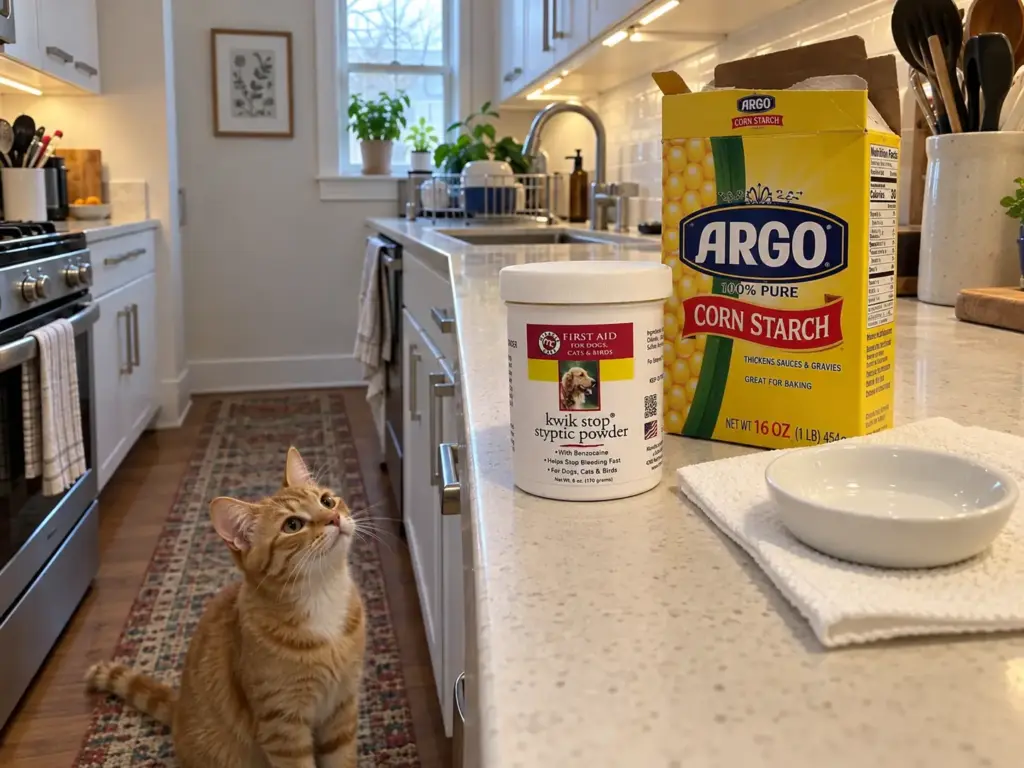
The first answer is already in your kitchen: a pinch of cornstarch or flour, which VCA suggests, or a dry bar of soap pressed against the tip, which Humane World suggests. Press lightly on the claw tip only, never the entire paw, since squeezing the paw tells her the trim just got worse. With no powder at all, WSU’s note on how long a nick takes to stop puts it at about five minutes.
Open whatever you plan to use before the first claw; the Wisconsin Humane Society’s advice is to keep it nearby while you trim. A tub you have to unscrew one-handed while holding a cat is a tub that stays shut.
If you would rather keep a styptic powder in the drawer, which VCA, WSU and Humane World all name, Kwik Stop Styptic Powder is sold for exactly this, a nick at the tip of a dog, cat or bird nail.
Two things to know first. The default listing is the 6 oz tub, which is a lot of powder for the odd nick, and PetMD points out that the formula contains benzocaine. For a single drop, cornstarch does the same job. If it doesn’t slow, or the claw is torn or split, take her to the vet; that has gone past anything in a kitchen cabinet.
The Ladder Is Measured in Nails, Not Minutes
Make friends with the paws before the clipper
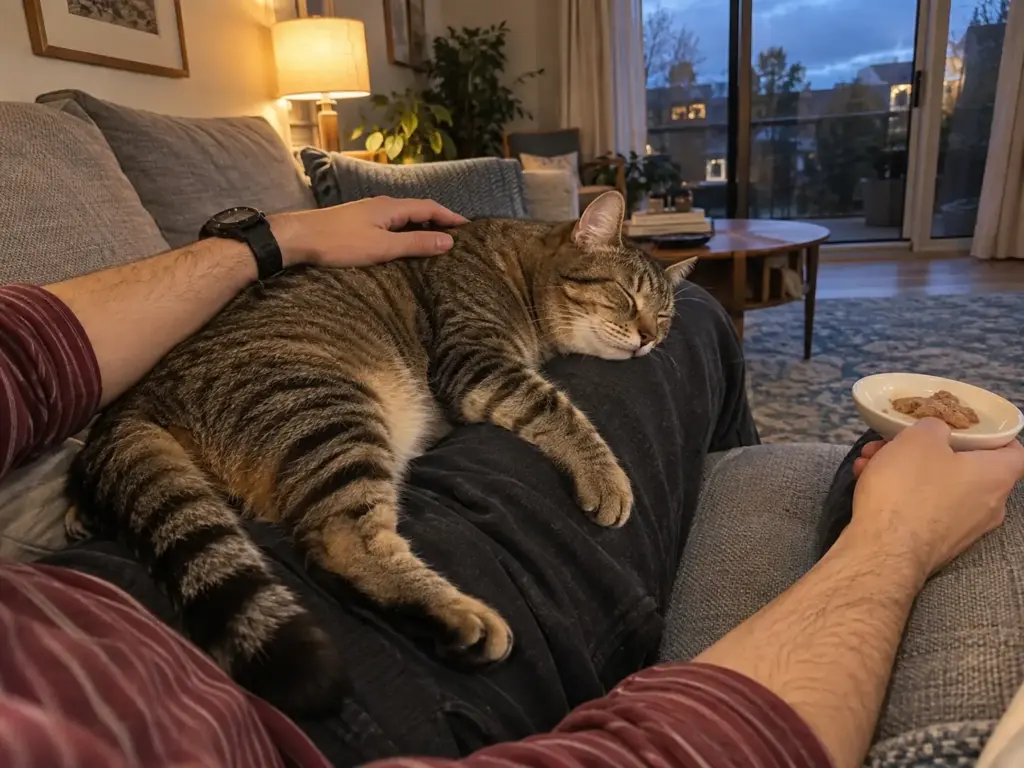
The Wisconsin Humane Society starts without a clipper at all. Take one paw between your fingers and massage it for no longer than a count of three. If she pulls away, follow the paw with gentle contact instead of squeezing.
When she settles, press the pad so the claw extends, let go and give a treat at once. One new toe every other day, until you have worked through ten toes. This is desensitization, and it builds a positive association with being handled.
VCA lays out the next rungs as a ladder: handle the feet, then one nail at a time with a treat, then two, then three, then a whole paw, and a full trim only after weeks. A treat follows every paw. Add the spaghetti rehearsal for the sound somewhere in the first rungs, and the clipper arrives already familiar. Spread across multiple sessions, the whole set gets done without one bad afternoon.
Two claws in a sitting, and the cat ends the session
Wisconsin Humane Society’s nail-trimming guide caps a sitting at two claws until she is comfortable, and suggests one paw at a time for the first couple of sessions. Humane World adds that few cats stay patient for more than a few minutes, and to start with the front claws. That turns a trim into a count. Two today, two the day after tomorrow, and a full front paw once two claws go by without a twitch.
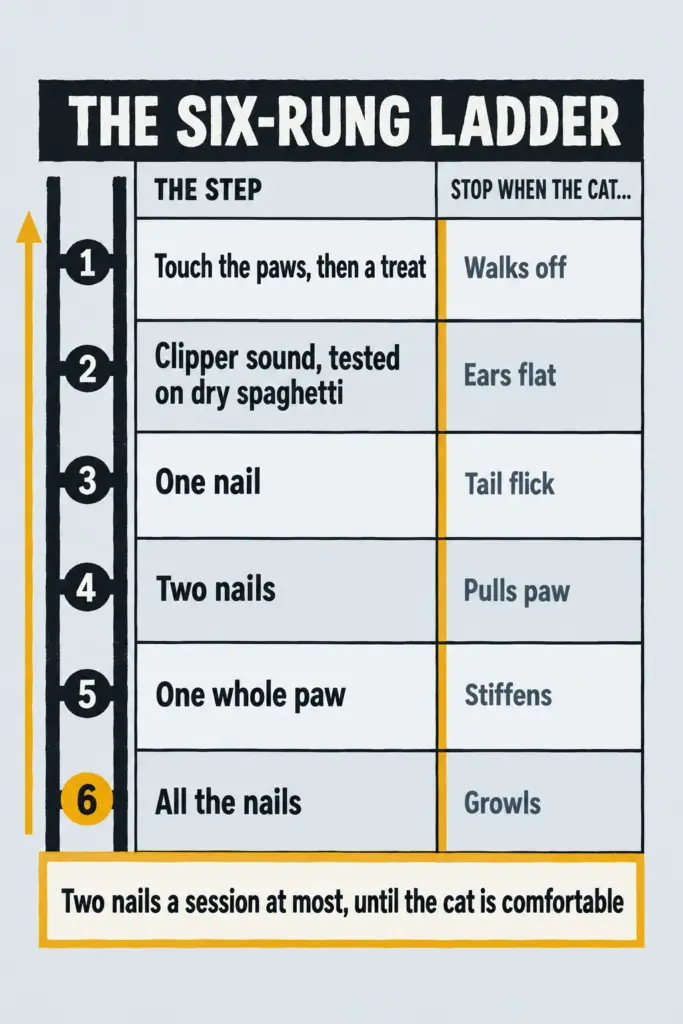
Most people come to the first trim aiming for every claw in one go, and for a cat who has never done this, that is the wrong number. A cat who already sits through trims can handle a full paw or two in one sitting. Everyone else starts at two.
The session ends when she says so: a paw pulled back, a tail starting to flick, a head turning toward your hand, a shift of weight toward the edge of your lap. Stop at the first of those, or better, one claw before it.
Owners in r/cats have found cheap ways to stretch that window. One smears a lickable tube treat on the back of the hand or along the thigh and gets a few nails done per afternoon over three afternoons. Another holds the tube between her knees, so the cat is busy licking while both hands are free. Three afternoons for a few nails each is slower than most people expect, and VCA’s ladder runs to weeks, so do not plan on a full set in one evening.
Schedule the trim for right after her meal, when she is heavy-eyed and settled, and quit one claw before she asks you to. Ending on your terms while she is still relaxed is what gets her back into the room next time.
How often is the grooming guide’s question
The sources disagree on the interval. VCA suggests every two to four weeks, Humane World every two to three, the Wisconsin Humane Society every ten days to two weeks, and International Cat Care says routine trimming isn’t advisable for most cats, because they keep their own claws in shape by scratching, and trimming is more a job for an older cat or a less active one. This article doesn’t settle it. The grooming guide reads it from signs instead of a calendar, and that is where the timing question belongs.
One Cat or Several Changes Who Goes First
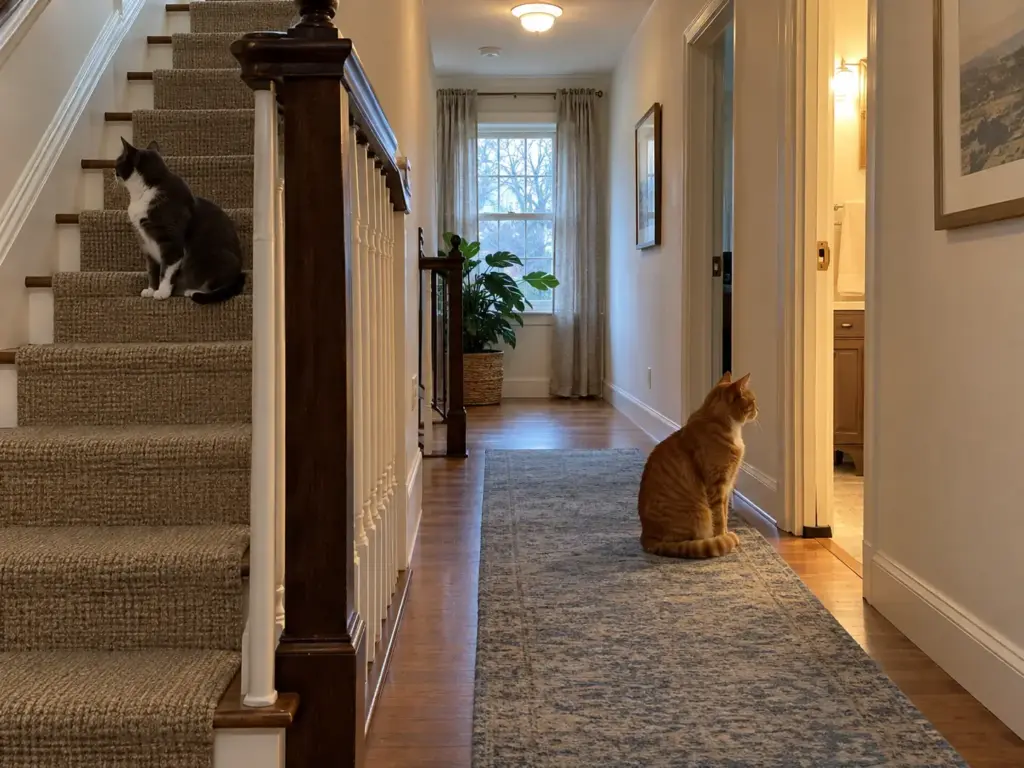
One cat: pick the hour she is sleepy
With one cat, you control the timing completely. The groggy stretch after a meal is the one the Wisconsin Humane Society points to, and the more of the setup you keep the same, the better: same room, same chair, same towel, a treat she only gets for trims. Repetition is what turns the room into a signal she can read.
Coat changes the job, too. On a long-haired cat, part the toe fur before each claw; that extra step is part of living with a coat that hides what you are cutting, and it goes more smoothly on a cat who is already used to being brushed.
Two or more: who is in the room, and who waits outside
“Make sure no other pets are around” is the Wisconsin Humane Society’s line, and in a multi-cat home that means one cat in the room at a time, with the door shut. The r/cats owner with three cats, two who allow trims and one who doesn’t, shows why: tolerance belongs to each cat, not to the household. The calm one doesn’t fix the other by example.
The order this site would use is household reasoning rather than anything published: least resistance first. The cat who allows it goes in first, which lets you set up the room, the towel and the treats while things are easy. The cat who refuses gets her own session later and works only on the ladder, two claws at a time or fewer, with no shortcuts because the first cat went well.
Give that second session its own day if you can. Right after an easy trim you are relaxed and a little overconfident, and that is when people reach for a firmer hold on the cat who needs a lighter one. Splitting the cats across days also means each one gets you at your most patient.
With three cats, a rotation works: the easy two share an evening, one after the other with the door closed between them, and the holdout gets a separate evening of paw handling and maybe a single claw. If the holdout is also the one whose claws grow fastest, she still stays on the ladder. Her claws can wait a few extra days; a trim that goes badly sets the ladder back further than that.
Keep the treats inside the closed room. A second cat watching from the doorway learns nothing about the clipper by seeing someone else get rewarded, and a treat handed out in front of her can turn the hallway tense. The feeding article on two cats in one small apartment shows how much weight doors and shared spots already carry, so give the trim its own door.
Two Claws, a Closed Door, and a Cat Who Gets to Leave
- Set up the room before you pick up the clipper: a door that closes, a towel that doesn’t slide and light in front of you.
- Clip only the clear tip, about 2 millimeters short of the pink, top to bottom; take dark claws in small cuts, and handle a nick with cornstarch and nothing more.
- Stop at two claws until she is comfortable, and let her end the session. A cat who cannot be held at all, or a claw that looks wrong, goes to the vet.
Three weeks after your first session, notice whether she walks into the trimming room on her own or has to be carried there, and whether a sitting has grown by a claw.
Tonight, before anything else, shut the bathroom door, lay a towel on the floor and hold each front paw for a count of three with a treat after, with the clipper still in the drawer. Watch whether she stays for the second paw.
Frequently Asked Questions
01What is the easiest way to trim my cat’s nails?
Close a bright room, sit her on your lap facing away, press the toe pad and clip only the clear tip, stopping after one or two claws. The clipper matters less than the hold: keep it loose, and let her leave when she wants to.
02Are you supposed to trim a cat’s claws?
Often, though sources differ: VCA and Humane World suggest every few weeks, while International Cat Care says routine trimming isn’t advisable for most cats. The grooming guide covers the signs that a trim is due.
03How long can cats go without a nail trim?
There is no single number, because it depends on how much she wears her claws down by scratching, and published schedules disagree. Watch for snags in fabric, a tap on hardwood or a claw that has started to curve. A claw grown into the pad needs your vet.
04How do I trim my indoor cat’s claws safely?
Cut only the clear tip, about two millimeters short of the pink quick, top to bottom, with a clipper that still cuts cleanly. Take dark claws in small cuts, and keep cornstarch open beside you before the first claw.
05What if my cat won’t let me touch her paws?
Start with the paws and leave the clipper in the drawer: hold one paw for a count of three, give a treat, and add a new toe every other day. If she cannot be held at all, ask your vet to show you a hold that works for her.

Leave a comment