Best Cat Grooming Kit Without the Pieces Left in the Case
The best cat grooming kit fits one shallow drawer: a 7.5 in comb, an 8 in rubber brush & one clipper, against a 5.9 x 6.1 x 9.8 in canister.

Alfredo RamsesFounder · October 6, 2026 · 26 min read

On this page9 sections
- 1A Cat Grooming Kit Is Five Jobs, and a Box Counts Pieces Instead
- 2Where Grooming Ends and the Groomer or Vet Begins
- 3The Comb, the Brush and the Slicker: Three Slots, One Drawer
- 4Coat, Hand and Cat Count Decide How Many Slots You Fill
- 5The Cat That Objects, and the Claws: a Glove and One Clipper
- 6Where the Kit Lives in an Apartment, and What Stays Out of It
- 7Box or Build: What a Boxed Kit Holds and What It Pads
- 8Start With the Comb, Then Let the Cat Decide What Joins It
- 9Frequently Asked Questions
You have a 5-piece kit open in one tab, and on the sofa a cat who has allowed the brush three times this month, each time for less than a minute. The box promises everything you need, and two or three of its pieces will end up at the back of a drawer. The cat won’t have turned them down on a whim: nobody checked what coat he has or how long he will sit still before he walks off.
The best cat grooming kit is the short list of jobs his coat actually has, one tool per job and nothing for the jobs he doesn’t, and the reply a new long-haired cat owner got in r/CatAdvice says it in one line: “The best brush is the one they’ll let you use.” Below: the five jobs, where a groomer or the vet takes over, the three everyday slots, how coat and cat count change the drawer, the glove and the clipper, where it all lives in an apartment, and the box against building it yourself.
Quick Answer
A grooming kit that gets used holds four pieces, each with one job:
- A steel comb, which finds the tangle and checks the coat before anything else touches it.
- A brush for the top layer: rubber for a short coat, a slicker for a medium or long one.
- A tool for the layer underneath, only if the cat actually has an undercoat.
- One nail clipper, used a few claws at a time.
- Leave out what a five-piece box adds to reach its count: scissors, clippers, a bladed dematter, a spare brush.
A Cat Grooming Kit Is Five Jobs, and a Box Counts Pieces Instead
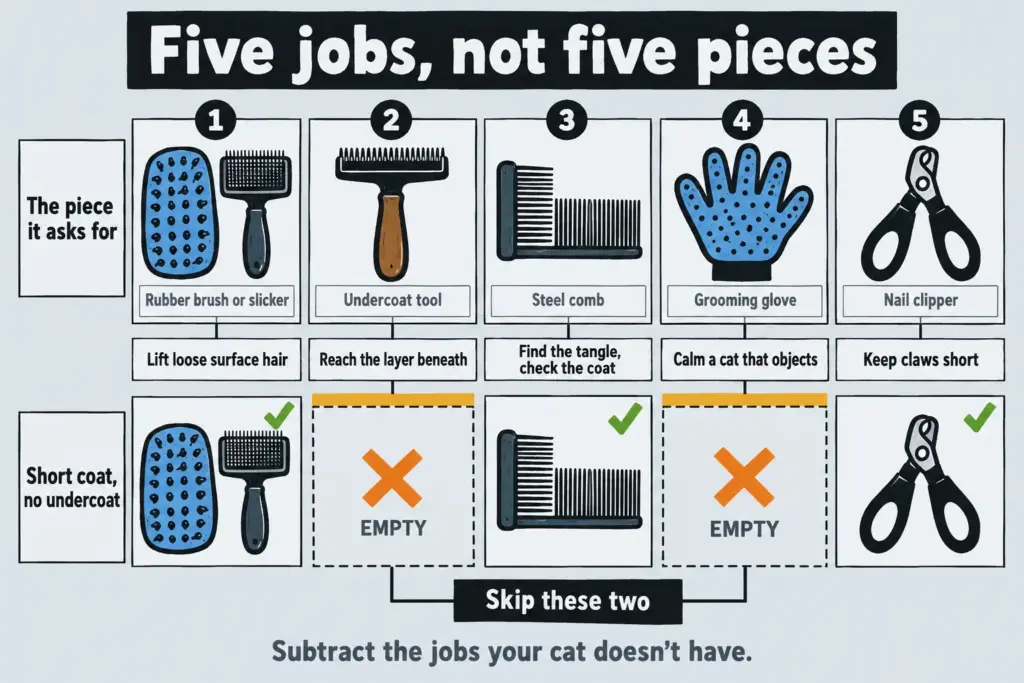
A boxed grooming set is sold by its piece count, and the count tells you nothing about your cat. Read a kit as a list of jobs instead and something useful happens: you can subtract. A job this cat’s coat doesn’t have needs no tool, and a tool with no job is the one that stays in the case.
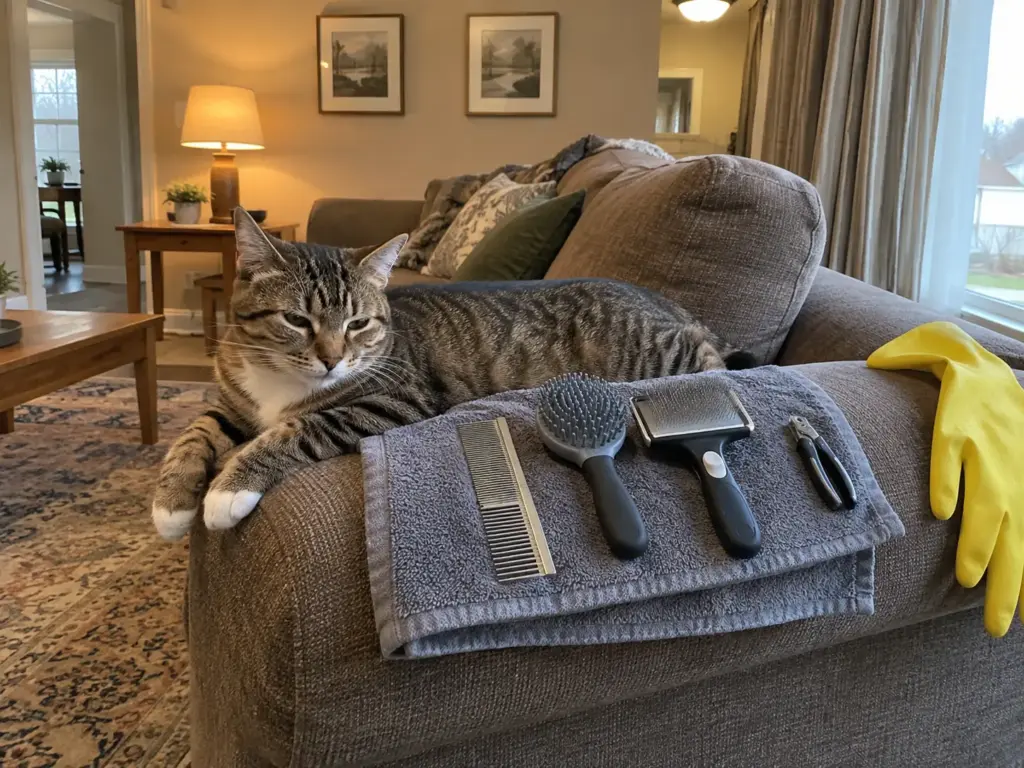
The five jobs, and which cats need all five
Every piece in a grooming drawer is there to do one of five things, roughly in the order they matter:
- Lift the loose hair sitting on the surface of the coat.
- Reach the layer under the top coat, if there is one.
- Find a tangle before it becomes a mat, and check the coat while you are there.
- Settle a cat that objects to a handheld brush.
- Keep the claws short.
A long, dense coat on a large cat can use all five. A short coat with no undercoat on a cat who likes being handled has two real jobs, the surface and the claws, plus a quick comb pass to check that nothing is building up in the spots he guards. That cat’s drawer has three pieces in it, and two of them get used most weeks.
Boxed sets are built around five, a number that fits very few cats. International Cat Care’s guide to grooming at home names three tools for a short-haired cat: a fine-toothed flea comb, a bristle brush and a rubber grooming pad or mitten, used at least once a week.
For a long-haired cat it names two: a wide-toothed comb and a rubber mitten or pad, daily but “only for as long as your cat is comfortable.” Three for the short coat, two for the long one. Even the harder coat gets fewer pieces than the box.
The kit is half of the work. The other half is how often, where and in what order, which belongs to the whole weekly routine this kit serves.
Free first: wet fingertips and a damp rubber dish glove
Before you buy anything for the surface job, try your own hands. One commenter in r/CatAdvice whose cat won’t tolerate handheld brushes strokes her with wet fingertips after a shower, and says “it brushes out a ridiculous amount of hair.” International Cat Care ends its own grooming sequence with a damp glove passed over the coat.
A plain rubber dish glove from under the sink, rinsed and wrung out, does the same thing with more grip. On a short coat that is the surface job done with no purchase. It won’t reach under a dense coat and it won’t find a tangle, so it doesn’t replace the comb. But it tells you, within a week, whether a cat who flinches at a brush will accept being stroked with something that feels like a hand.
Run the damp dish glove over the cat for a week before you buy a rubber brush or a grooming mitt. If the glove fills with hair and he leans into it, you have learned what the paid version would teach you. If he walks away from the glove too, a mitt with nubs won’t change his mind.
The cat sets the ceiling on how many tools come out
International Cat Care lists the signs that a cat has had enough: the skin rippling along his back, the tail swishing or thumping, a sharp turn of the head toward your hand, freezing, ears rotating back, lip licking, a sudden burst of grooming himself. Its instruction when you see them is to stop and “see if they’ll tolerate it another day.” A cat whose limit is one tool and forty seconds has a one-tool drawer, however many pieces came in the box.
He is also right about where the limit sits. In r/cats, one owner whose cat dislikes brushing found the mats forming in the armpits and around the back end, and worked out why: “they’re the spots I brushed the least.” Those are also the spots where International Cat Care says the skin is thin and knots form, so the cat had a reason to guard them.
The tool in the drawer was never the problem. Where the cat allowed it to go was, and a gentler first tool in those spots is what moves the line.
The same thread on long-haired adoption carried the advice that sums up this section: “More than the tool, it’s making the experience nice for them so they’ll let you keep doing it.” A drawer built around what the cat accepts gets opened again next week.
Where Grooming Ends and the Groomer or Vet Begins
This section sits before any tool on purpose. A grooming kit keeps a healthy coat in order. It doesn’t treat skin, it doesn’t take out a mat that has reached the skin, and it doesn’t answer what a bald patch means.
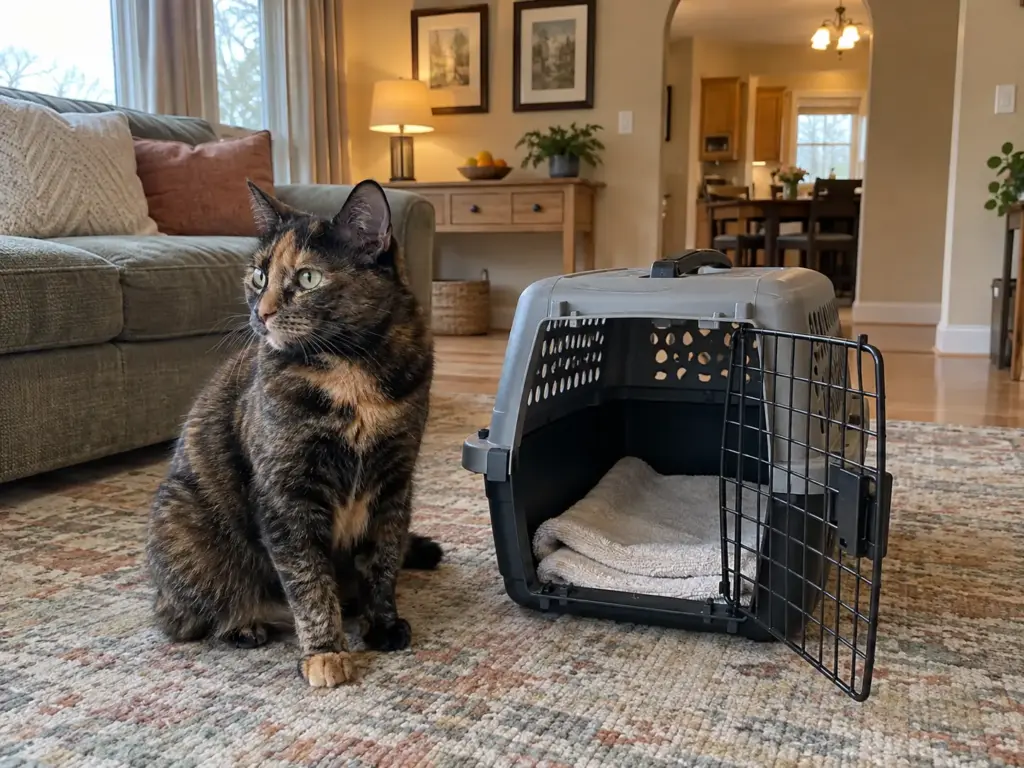
What the kit is for, and what it never touches
Can you groom your cat yourself? Yes: with dry tools, in short sessions, with the cat setting the limit. The kit covers loose hair, small tangles you can feel before they tighten, and claws. Everything else goes to someone else.
The Catit long-hair kit includes a dematting tool with a blade, and a buyer review on its Amazon page warns that “using the bladed item on a cat with short hair would cause injury.” One review from 2017, not a test. Still, an edge packed next to the brushes invites exactly the job this section hands to a professional. A cat on flea treatment, or one whose skin already worries you, is a question for the vet before any tool goes near him.
The stop signs: skin, mats and a cat that stopped tolerating the brush
Each of these ends the session and moves the question to a groomer or the vet. None of them is explained here, because none of them is a tool question.
Skin that looks red, scabbed or bald under the coat. A significant loss of hair, which the ASPCA’s cat grooming tips say a veterinarian should investigate; if what worries you is the amount of hair on the floor, read why a bald or thinning patch is not a tool question before you change brushes.
A mat that doesn’t loosen when you work it gently with your fingers. A cat who fights grooming hard enough that he or you could get hurt, which the ASPCA sends to “a professional groomer or a veterinarian.” And a cat who used to let you brush him and now won’t.
Hairballs get one sentence and no more. Brushing is housekeeping, and a cat who is lethargic, stops eating for more than a day or two, or retches again and again without bringing anything up needs to be seen without waiting, according to the Cornell Feline Health Center on when hairballs need a vet.
When a cat who used to sit for the comb starts refusing it, put the comb away instead of ordering a softer tool. International Cat Care’s advice is to stop and try another day; a change that sudden is worth mentioning to the vet before it becomes a shopping problem.
Why scissors and clippers stay out of the drawer
The pull toward scissors comes the first time you find a mat and think you can snip it out in ten seconds. International Cat Care is blunt about it, in the same grooming guide: “Don’t be tempted to use scissors – it’s extremely difficult to see where your cat’s skin ends and the hair starts when it gets really matted.” Severe mats, it adds, are shaved off by the vet team, often under sedation, which is the vet’s call to make.
So this drawer holds no scissors and no electric clippers. A comb that finds tangles early keeps you from needing either.
The Comb, the Brush and the Slicker: Three Slots, One Drawer
These are the pieces that come out every week, in the order they are used. Each one has a size you can check against your own hand and a flaw you should know before you buy it.
The comb comes first: it finds the tangle and checks the coat
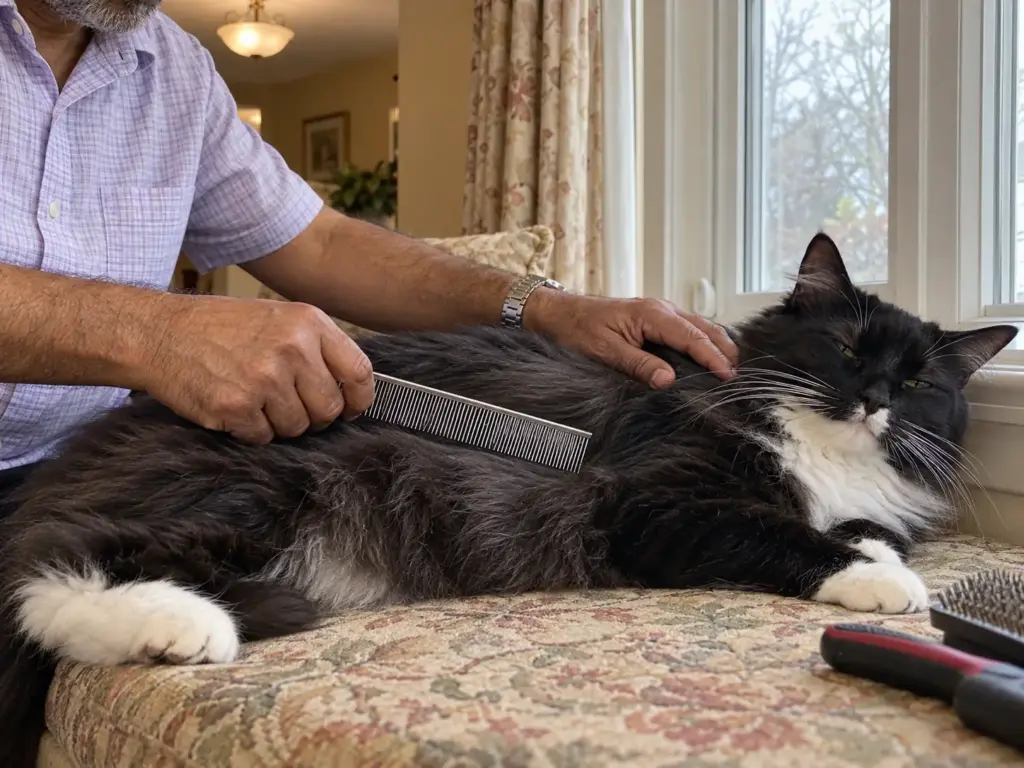
Most people reach for the brush first. The comb should go first, because a brush glides over a tangle and a comb stops on it. Pass a steel comb through the armpits and behind the back legs before anything else, and it tells you where knots are forming and where the brush hasn’t been reaching. Those are the spots that owner in r/cats found matted, the ones brushed least and rubbed most.
International Cat Care calls for a wide-toothed comb on a long coat and a fine-toothed comb on a short one. You don’t need two combs for that. The PETTOM Steel Grooming Comb is 7.5 inches long with coarse teeth at one end and fine teeth at the other, so one comb covers both coats and both passes. For how many times a week each coat gets brushed, the answer depends on the coat and has its own page.
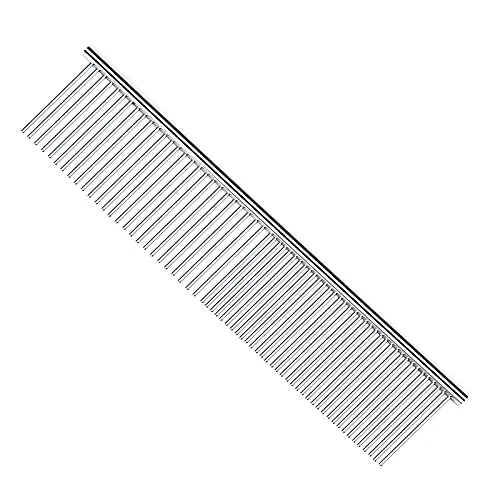
No tooth-spacing figure is printed here, because none is published for cat combs. The working check is simpler: the comb should pass through the armpit coat without catching on clean hair, and when it does catch, that is the knot it was sent to find.
The surface slot: a soft rubber brush for a short coat
On a short coat the surface job is the one that pulls the most hair, and the damp dish glove from the first section already does it at no cost. When you want a tool with more reach than a glove, rubber is the step International Cat Care names, and it keeps any wire away from thin skin.
The Cat Brush with Soft Rubber Pins is a washable silicone brush that measures 8 x 4.5 x 2.5 inches, about the length of a hand with the fingers closed, which is wide enough for the back and flanks of an average cat. Its weak point is that it loosens hair without collecting it, so some of what it lifts lands on the bed and the sofa. And soft does not mean unlimited: a commenter in r/grooming warned that a cat can be over-brushed with rubber too, so the short-session rule still holds.
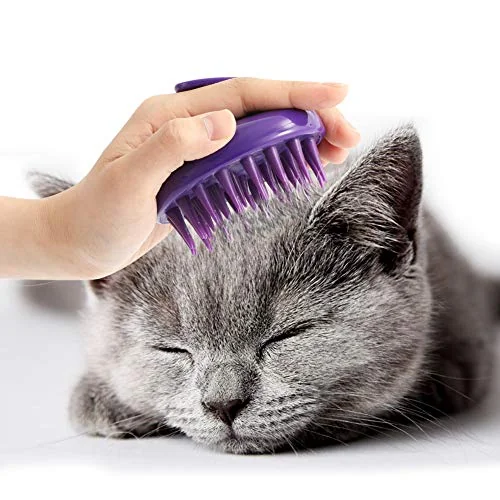
Material matters more than shape here. In r/CatAdvice, one owner described a rubber brush so staticky that every session felt like the two of them shocking each other, and the cat left after a few seconds. The cat had a fair complaint. If a rubber tool crackles in a dry apartment, try the damp glove before deciding the cat dislikes being groomed.
The slicker: for a medium or long coat, and where it stops
A slicker is the brush most cat owners already have. On a medium or long coat it smooths the topcoat and catches small surface tangles, which is useful after the comb has opened the coat. Before it, it skims.
The owner adopting a long-haired cat in r/CatAdvice was told exactly that: “A slicker brush isn’t going to do that. You need something more like a wide tooth comb style.” On a long coat the comb leads and the slicker finishes.
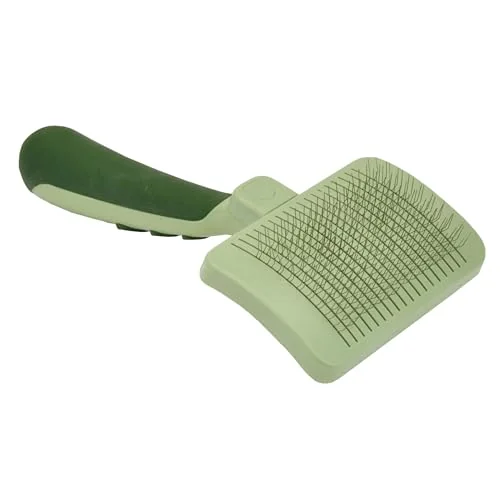
The Coastal Pet Safari Cat Self Cleaning Slicker Brush measures 2 x 5 x 8.75 inches and is a self-cleaning brush: a button pushes the collected hair off the pins. Its pins are stiff, and a buyer advises keeping them on the fur rather than pressing them into the skin.
A cheaper slicker, and the button that sticks
The Hertzko Self Cleaning Slicker Brush does the same job for less. A three-star reviewer notes its tines run longer than on pricier slickers and says to use it gently on a short-haired animal, and the release button “seems a bit clunky,” which other buyers echo when they say it is hard to press.
Lay the three everyday pieces side by side and they are hand-sized: the comb at 7.5 inches, the rubber brush at 8, the Coastal slicker at 8.75. Measure your drawer against these before you measure it against a box.
Start every session with the comb in the armpits and behind the back legs, while the cat is still relaxed. Those are the spots that get brushed least and rub most, and a knot found there in week one is a two-stroke job instead of a groomer appointment.
Coat, Hand and Cat Count Decide How Many Slots You Fill
The drawer is sized by the coat type, not by the household. Two cats who look alike from across the room can need different pieces once you part their fur with your fingers.
A short, compact coat and a long, dense one need different drawers
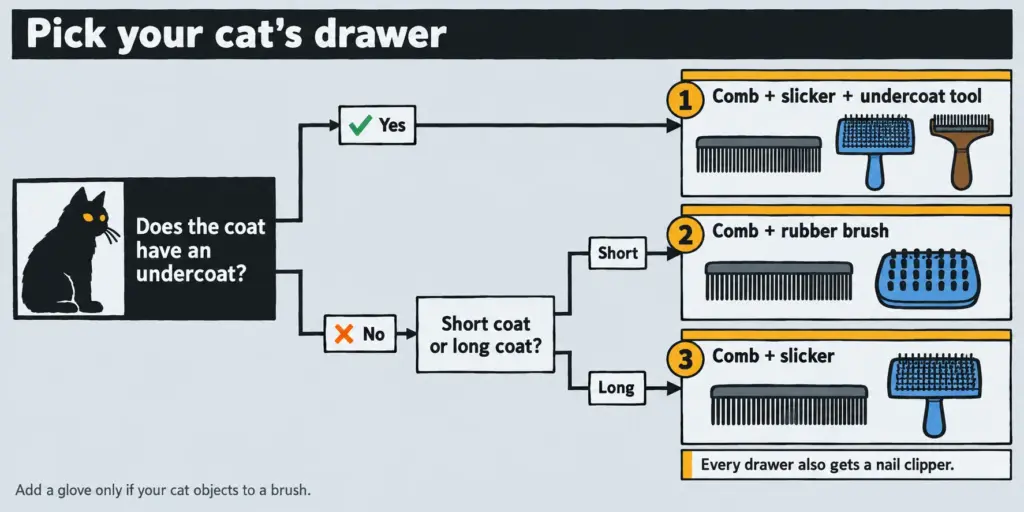
A compact cat with a short, dense coat needs the fine end of the comb, a rubber or bristle brush and a glove, with an undercoat tool only if a real undercoat shows when you part the fur at the shoulder. A large cat with a long, dense coat needs the wide end of the comb first, a slicker for the top layer and, if there is a thick layer underneath, one tool for it. International Cat Care still lists only two pieces for the long coat, so the third is earned by the undercoat and not assumed.
The structure behind those two cases (single coat, double coat, how long the guard hairs run) is laid out in how the coat of a compact short-haired cat differs from a long one. For the drawer, one test is enough: part the fur and look. Soft, cottony hair close to the skin means a layer underneath. Hair that looks the same from tip to root means there isn’t one.
The layer under it: only if the cat has one
The clearest case comes from a single apartment. In r/CatAdvice, an owner wrote that her deshedding tool “gets almost nothing off” the long-haired, wispy sister, “but works so so great on her brothers.” Same apartment, same tool, two coats, two results. Her coat simply has no layer for the tool to reach.
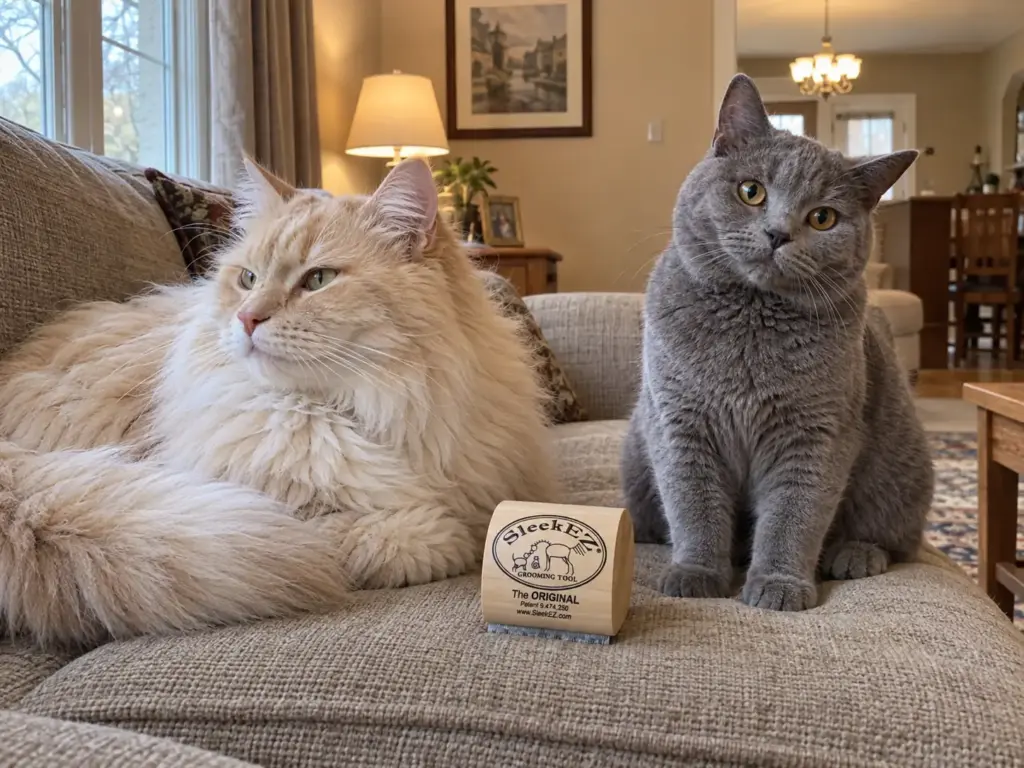
When the undercoat is there, the SleekEZ Cat Brush for Shedding has a 5.5 x 3 x 1.5 inch head, small enough to sit in a palm and follow the frame of an average cat. It is also easy to overdo: one owner in r/grooming found patches with no hair after less than ten minutes, and the reply that helped was “a few passes over each section.” A coat that looks thin afterward goes to the vet before the tool goes back on it.
The obvious pick for this slot is the FURminator, and on a big cat with a thick undercoat it is a reasonable one. The FURminator Undercoat deShedding Tool for Medium/Large Short Hair Cats is sized by weight, for cats over 10 lb, and its listing gives no head width.
On a wispy single coat it is the sister’s story again, and one commenter holds that it “cuts hair,” which is an opinion rather than a test. For a cat with no undercoat, the right number of tools in this slot is zero. Which tool reaches which layer, and how often a blade should come out, is covered in which tool reaches the layer under the top coat.
If a deshedding tool pulls almost nothing from one cat and a pile from another, don’t press harder on the first. Part that cat’s fur at the shoulder: no soft layer near the skin means the tool has no job there, and the comb and a rubber brush are the whole drawer for that coat.
Two cats, two coats, one apartment
With one cat, the drawer is one set. In a multi-cat apartment the drawer doesn’t double, it splits: each coat gets the pieces it needs, and the pieces the coats share (usually the comb and the clipper) can stay shared. A long-coat comb and a short-coat rubber brush in the same drawer look different enough that nobody mixes them up. Two identical slickers do get mixed up, so mark one.
If one of the cats is on flea treatment, ask the vet before the same comb goes from one coat to the other. That is the only rule this article gives about sharing.
Your hand is the last measurement. A head as wide as your palm suits an average cat and covers too much of a small one in a stroke, and a clipper with a small grip is harder to hold steady in a large hand (the Necoichi below carries exactly that complaint). Check the tool against the cat’s flank and against your own hand. The box size tells you neither.
The Cat That Objects, and the Claws: a Glove and One Clipper
The last two slots are the simplest. One is for the cat who won’t accept a handheld brush, and the other is the piece that gets used most often in the whole drawer.
A glove for the cat that refuses a handheld brush
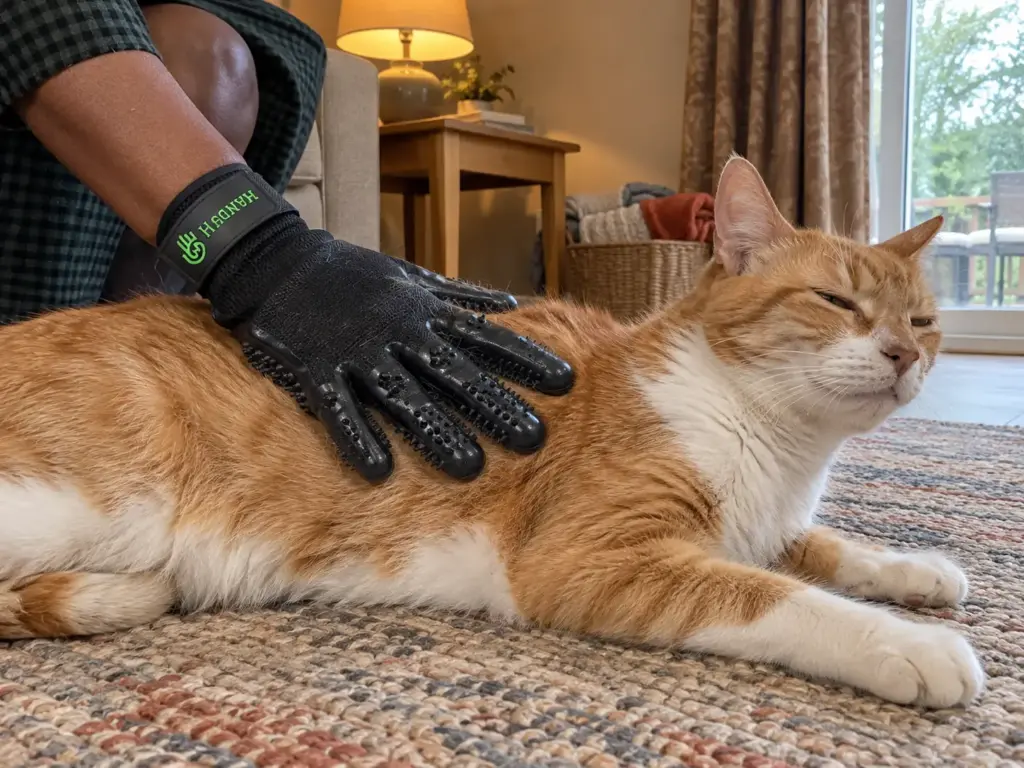
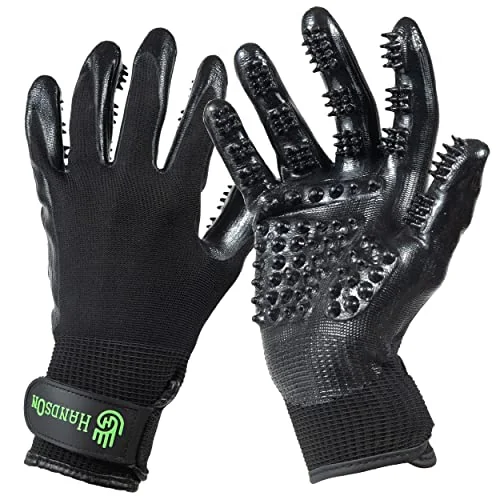
A grooming glove works because it feels like being petted. In r/CatAdvice, one owner wrote that her cat “doesn’t like hand held brushes but loves the gloves and they seem more effective anyway,” and added the caveat herself: “Probably wouldn’t be so great if the cat was long haired though.” Another, with an adopted senior cat, found she hid as soon as the glove came out, so even the gentle tool is a negotiation.
The damp dish glove comes first, as it did for the surface job. If the cat accepts it and you want something with nubs, a glove earns its slot. If he objects to every tool, the reasons are the subject of what a cat that won’t let you brush it is objecting to, and a new tool rarely answers them.
One clipper type, and the two that lead the pack
The claw slot takes one clipper. Two styles in the drawer only means you will use the one you can find. A small scissor-style clipper with angled blades suits most cats and most hands, and how to actually use it, a few millimeters at a time, belongs to how to trim cat nails at home, a few millimeters at a time.
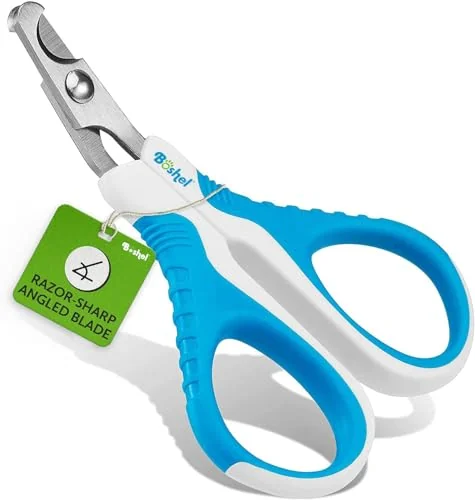
One step up is the Necoichi Purrcision Stainless Steel Cat Nail Clipper, rated 4.8 stars, with thin blades that one buyer says “make it easier to see the quick.” Its grip runs small, and a reviewer warns that “if someone has big hands might be a little harder.” If you already own a clipper made for human nails and it cuts cleanly, try it first on a calm day before buying either.
Why the claw slot is a good one to buy and a bad one to improvise
Kitchen scissors are the improvised tool people reach for, and they are the wrong one for the same reason scissors stay away from mats: you can’t see clearly where to stop. A clipper made for claws puts the blade where you can watch it and keeps the cut short.
If the cat fights hard enough that one of you could get hurt, the ASPCA’s answer is the same as for grooming, a professional groomer or the vet, and that is the second section of this article applied to claws. A groomer appointment for nails is a normal, small thing to book.
One clipper and one glove are two slots and two pieces. Anything past them, from a mat at the skin to a cat who fights the clipper, belongs to a groomer or the vet, so leave room in the drawer for nothing else.
Where the Kit Lives in an Apartment, and What Stays Out of It
In a small apartment a grooming kit competes with spatulas and phone chargers for drawer space, and a kit that lives in the back of a closet doesn’t get used. Size and placement decide whether the comb comes out on an ordinary evening.
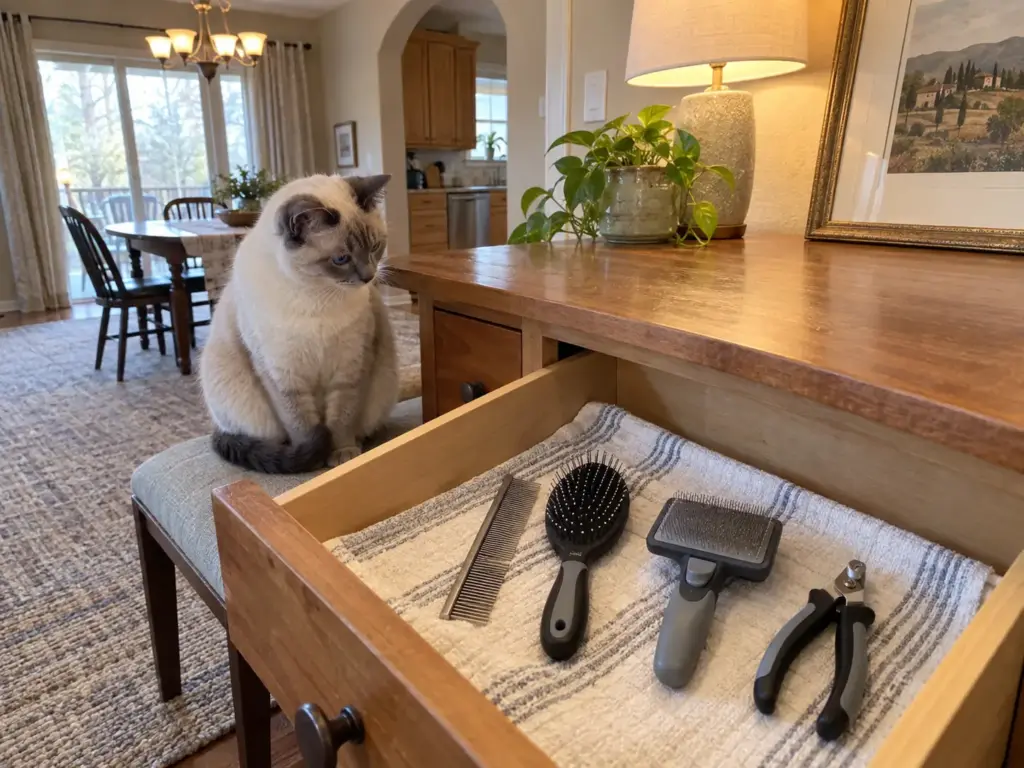
One drawer, one caddy: measure it against the four tools
The longest piece of the minimum kit is the slicker at 8.75 inches, so any drawer deeper than about nine inches takes all four tools lying flat, next to the comb at 7.5, the rubber brush at 8 and the clipper in its 6.46 x 3.58 inch package. The Catit five-piece kit comes in a canister of 5.9 x 6.1 x 9.8 inches, a small footprint that stands almost ten inches tall and holds pieces this drawer has already left out.
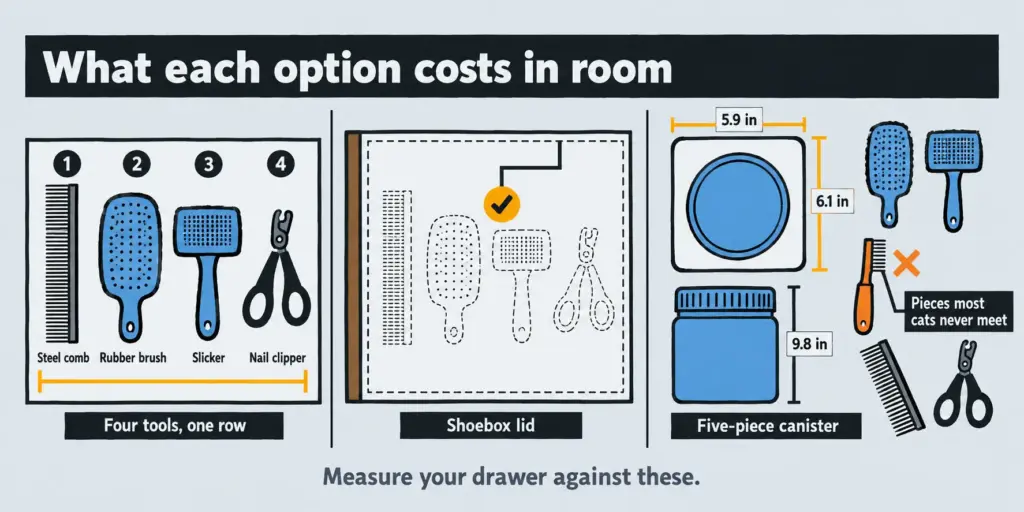
No organizer needs buying for this. A drawer near the place you groom, or a small caddy that lives on a shelf, works as long as you can reach it without getting up from the spot where the cat is sitting. Measure the drawer you already have against these numbers before you add anything to it.
Two cats with two coats change the layout more than the size. Put the shared pieces (the comb and the clipper) in the middle and each coat’s brush at either end, so the long-coat slicker never ends up on the short-coated cat because it was the one on top. In a studio, where the drawer and the grooming spot may be the same few feet of kitchen, a caddy with a handle beats a drawer: it goes to wherever the cat has settled, and back again when he leaves.
Where the session happens, and where the hair lands
The cat picks the spot, and the spot he already likes beats any spot you choose for him. A window seat, the arm of the sofa or a low counter he jumps onto by himself all work, with a towel underneath that can be lifted with the hair on it. Grooming on bare upholstery means the hair you just took off settles into the fabric and keeps coming back out. If he only relaxes on the bed, groom on the bed, on a towel; a cat carried to a “grooming area” he didn’t choose spends the session planning his exit, and the session ends early.
When the session ends, fold the towel inward, carry it outside or to the trash and shake it there, then wash it with the rest of the pet laundry. The rubber brush in particular loosens more than it holds, which is one more reason the towel matters. For the bigger question of where shed hair goes in a rental, see the washable layer under the grooming spot.
What stays out of a dry-tools kit
Scissors stay out, for the reason International Cat Care gives. Electric clippers stay out too. Shampoo, ear cleaner and toothpaste are not in a dry-tools kit, and choosing them is a separate conversation with the vet, not a drawer decision.
Then there is the stuff you bought that the cat never accepted. A tool that hasn’t come out in three weeks of regular grooming is telling you its slot doesn’t exist for this cat. Give it to a friend with a different coat in the house, or donate it, and the drawer stays the size of the jobs.
Keep the comb on the shelf or the counter where the cat likes to sit, not in the drawer with everything else. The tool you can see is the one you pick up for a thirty-second pass while he is already relaxed.
Box or Build: What a Boxed Kit Holds and What It Pads
The boxed set has a real case in two situations. For everyone else, building the drawer piece by piece wins, and the comparison below shows where.
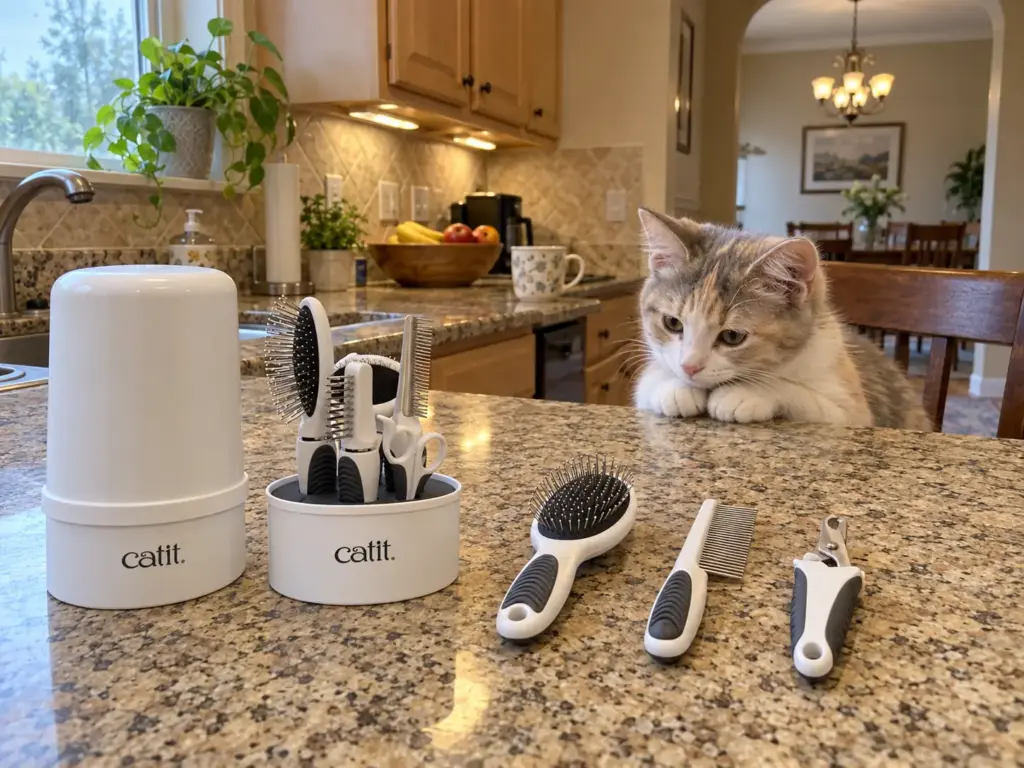
What five pieces in a canister actually hold
The Catit Senses 2.0 Long Hair kit, the one boxed set in this comparison, holds a pin brush, a metal slicker, a dematting tool with a blade, a comb with rolling pins and a curved nail clipper. Set against the two drawers this article has built, it looks like this:
| Option | What it holds | What the cat actually meets | Where it falls short |
|---|---|---|---|
| Catit Senses 2.0 Long Hair kit | Five pieces in one canister | The comb, the slicker and the clipper | A bladed dematter, a slicker that doesn’t self-clean, made for long coats only |
| Short-coat drawer | Steel comb, rubber brush, one clipper | All three, most weeks | Add a glove only if the cat refuses the brush |
| Long, dense coat drawer | Steel comb, slicker, one clipper | All three; an undercoat tool only if there is an undercoat | More pieces to buy one at a time |
On a long-haired cat, three of the box’s five pieces do the work this article assigns them. The other two are the ones the next section is about.
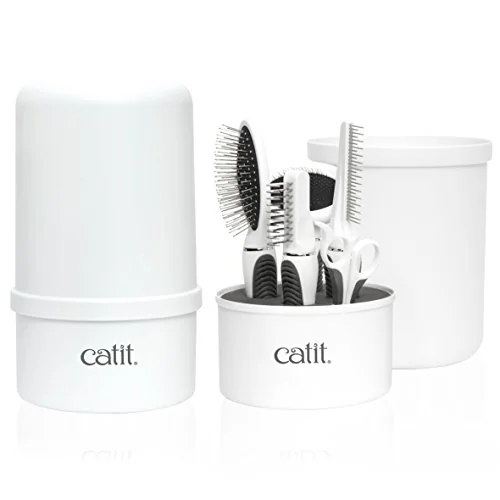
What a boxed set pads, piece by piece
Start with the blade. The dematting tool is the piece the review from 2017 flagged for short coats, and it is also the piece that tempts you toward a mat this article sends to a groomer. A kit for long hair can carry it with some logic; it still isn’t a tool to reach for on the first tangle you find.
Then the slicker. A four-star reviewer of the Catit kit replaced its slicker with her own self-cleaning one, because “having to waste time cleaning out the brush is annoying.” That is the quiet cost of a bundle, carrying case and all: one piece is the weaker version of something you would have chosen on its own, and you pay for both.
Other five-piece sets on sale fill their count differently, with a massage brush, scissors or electric clippers. Notice which pieces those are. They are the ones the stop signs leave out of the drawer.
A long-hair kit also does nothing for a short coat. If the cat on your sofa has a short, dense coat, the box is the wrong shape from the start, and the three-piece short-coat drawer covers everything it would.
When the box is the right call
Two situations make the box sensible. Someone adopting a long-haired cat who wants everything in one place on the first day, before learning what this cat tolerates, gets a reasonable starting set. And a box makes an easier gift than three separate tools. Even then, the advice from that adoption thread holds: “you may not have everything on hand from the start,” and the first weeks will show which pieces stay.
For everyone else, build the drawer: the comb first, the surface brush that suits the coat, one clipper, and the undercoat tool only once you have parted the fur and found something to reach. The tools are half the work, and the other half is the full grooming routine, ten minutes a session at most.
Before the box goes in the cart, lay out the grooming tools you already own and count the ones you would actually open. If they cover the comb, a brush and a clipper, the box adds two pieces to a drawer that is already complete.
Start With the Comb, Then Let the Cat Decide What Joins It
- The minimum drawer is the jobs this coat has: a comb first, a brush for the top layer, an undercoat tool only if there is an undercoat, one clipper, and a glove if the cat objects to brushes.
- What counts is what the cat accepts. A box of five does nothing for a cat who sits for one tool, and a one-tool drawer used every week beats a full one used once.
- Scissors, clippers, bath products and anything touching skin trouble, a mat at the skin or a bald patch stay out of the kit and go to a groomer or the vet.
Three weeks from now, open the drawer and count the tools that have actually come out, run the comb through the armpits to see whether it catches less than it did, and notice whether the cat still settles for a session or has started leaving sooner. Tonight, before ordering anything, wring out a rubber dish glove, lay a towel on the cat’s favorite spot, and run the glove and the comb you already own over him until he decides he is finished. What ends up on the towel, and how long he stays, tells you which slot to fill first.
Frequently Asked Questions
01What is the best kit for grooming a cat at home?
The best kit is the smallest one that covers your cat’s coat: a steel comb, a top-layer brush, an undercoat tool only if there is one, and a nail clipper. Add a glove if the cat refuses brushes. A five-piece box usually adds pieces most cats never meet.
02What is the best tool to groom a cat?
A steel comb is the best first tool, because it finds tangles and checks the coat before any brush goes over it. International Cat Care suggests a wide-toothed comb for long coats and a fine-toothed one for short coats. After the comb, the best tool is the one your cat lets you use.
03Can I groom my cat myself?
Yes, with dry tools, short sessions and the cat setting the limit, most cats can be groomed at home. A mat that won’t loosen with your fingers, red, scabbed or bald skin, or a cat who fights grooming is a groomer or vet question, not a reason to buy another tool.
04Are cat grooming tools worth buying, or is a rubber glove enough?
For a short coat, a damp rubber dish glove or wet fingertips can handle the surface job for free, and some owners never need more. Buy a tool when the free one stops reaching: a comb for tangles, a slicker for a longer coat, a clipper for claws.
05Do I need a different grooming kit for a short-haired cat and a long-haired one?
Usually you need a different drawer rather than a different brand, because the two coats ask for different combs and brushes. A short coat takes a fine-toothed comb and a rubber brush; a long coat takes a wide-toothed comb and a slicker. A long-hair boxed kit adds a bladed tool a short coat doesn’t need.


Leave a comment